




Abstract
Abstract
This study reports experimental results and modeling analysis of reductive removal of perrhenate (a surrogate for radioactive pertechnetate) from water using a class of starch-stabilized zero valent iron (ZVI) nanoparticles. Thermodynamic analysis of the reduction pathway indicated that reduction of Re(VII), and possibly Tc(VII), is highly favorable with a ΔG of=−316.66 kJ/mol for Re(VII) and −448.66 kJ/mol for Tc(VII). The final reduced product was ReO2, which is much less mobile and less bioavailable than ReO4−. Starch-stabilized ZVI nanoparticles were able to rapidly and completely reduce and remove perrhenate at ambient temperatures. The reaction rate constant increased from 0.351 h−1 at 15°C to 0.428 h−1 at 45°C and a fairly low activation energy level of 5.13 kJ/mol was determined. A surface blocking effect on the ZVI nanoparticles was evident due to surface precipitation of the resulting ReO2. As a result, the pseudo first order rate constant decreased from 0.356 to 0.230 h−1 when the initial Re(VII) concentration was increased from 5 to 20 mg/L; complete Re(VII) reduction and precipitation were achievable in all cases. Accordingly, a more general and sounder pseudo nth order model was proposed to interpret reaction kinetics. Starch-stabilized ZVI nanoparticles were nearly four times more effective in reducing Re(VII) than commercial iron powder. Results revealed great potential of starch-stabilized ZVI nanoparticles for possible reductive immobilization of pertechnetate in soil and groundwater.
Introduction
I
Radioactive technetium (Tc-99) is one of the nuclear wastes with a long half-life (T1/2=2.1×105 years). Typically, Tc-99 exists in aqueous solutions as pertechnetate (TcO4−), which is highly soluble and is prone to transport in soil and groundwater. In contrast, studies have revealed that in the anaerobic environments, Tc can be present in the tetravalent state (i.e., TcO2·nH2O solid), which is known to be much less mobile and less bioavailable (James Farrell et al., 1999).
Due to the high mobility of TcO4−, conventional methods, such as adsorption, can hardly be effective in immobilizing TcO4− in groundwater. However, researchers have observed that reduction of Tc(VII) to Tc(IV) can effectively reduce mobility of Tc (Cantrell et al., 1995; Lloyd et al., 2000; Darab et al., 2007; Hu et al., 2008).
In recent years, zero valent iron (ZVI) nanoparticles have been heavily studied for remediation of contaminated soil and groundwater. As a class of strong and environmentally benign reducing agent, ZVI nanoparticles have been found effective for reductive dechlorination of chlorinated solvents (Wang and Zhang, 1997; Ponder et al., 2000; He and Zhao, 2005; 2007; Phenrat et al., 2010), reductive immobilization of hexavalent chromium (Xu and Zhao, 2007), reduction of nitrate (Xiong et al., 2009), and reduction of perchlorate (Xiong et al., 2007).
The goal of this study was to investigate the kinetics of reductive immobilization of technetium in soil and groundwater using a class of starch-stabilized ZVI nanoparticles. For experimental convenience, perrhenate was used as a surrogate of pertechnetate. The specific objectives were to (1) study the valence state variation of rhenium (Re) and the extent of the Re(VII) reduction by ZVI nanoparticles; (2) test the effectiveness of starch-stabilized ZVI nanoparticles for reductive immobilization of perrhenate; and (3) explore a modified approach to determine reaction kinetics.
Experimental Protocol
Because of commercial constraints with the use of radioactive technetium, perrhenate has been commonly used as a surrogate for pertechnetate (Kim and Boulègue, 2003; Stephan et al., 2004). As technetium and rhenium both belong to the VIIB subgroup, the electron configurations follow the same rule of nd5(n+1) s2 and their chemical properties are very similar. It is known that both pertechnetate and perrhenate can be reduced to metal oxide (MO2), which is sparingly soluble in water and chemically stable.
Experiment reagents and instruments
Reagents included sodium borohydride (NaBH4), ferrous sulfate heptahydrate (FeSO4·7H2O), a water soluble starch, high purity nitrogen, potassium perrhenate (KReO4), ammonium sulfate [(NH4)2SO4], citric acid (C6H8O7·H2O), sodium dihydrogen phosphate (NaH2PO4·2H2O), benzene (C6H6), tartaric acid (C4H6O6), ethyl violet, and iron powder (150 μm), All chemicals were of analytical grade except for potassium perrhenate (KReO4), which was of spectroscopic grade. All solutions were prepared with deionized water.
Instruments used were X'Pert PRO XRD, CPA225D electronic balance, HITACHI CF16RXII high speed centrifuge, PHB-1 precise pH meter, and SP-756 ultraviolet-visible spectrophotometer.
Preparation of ZVI nanoparticles
Starch-stabilized ZVI nanoparticles were prepared following the aqueous reduction method by reducing Fe(II) to Fe(0) using BH4− in the presence of a water-soluble starch as a stabilizer. Detailed preparation procedures were reported elsewhere (He and Zhao, 2005; He et al., 2007; Ye, 2009). In brief, deionized (DI) water and a starch solution were first purged with purified N2 for 15 min to remove dissolved oxygen. Then, a stock solution of FeSO4 was added to the starch solution to yield a solution with a desired concentration of Fe (0.35–0.4 g/L) and soluble starch (0.7 wt%). Then, a NaBH4 stock solution was added to the flask dropwise through a burette within 2 min and at twice the stoichiometric amount. The stabilized ZVI nanoparticle suspension was then sealed and stored for 10 min before each use.
Kinetic tests
Stabilized ZVI nanoparticles were then tested in batch experiments for reduction of Re(VII) in water. The tests were carried out with a set of 250-mL conical flasks. The reaction was initiated by injecting a ReO4− stock solution into suspensions of freshly prepared ZVI nanoparticles. The reactors were then tightly sealed and the mixtures were shaken on a rotator operated at 60 rpm. At predetermined times, duplicate conical flasks were sacrificially sampled. The sample suspensions were transferred to centrifuging tubes and centrifuged with a high-speed centrifuge for 3 min to remove the nanoparticles. The supernatants were then analyzed for total Re(VII) remaining in the solution phase. The Re(VII) reduction rate was calculated based on mass balance calculations. The initial and final pH was measured. Control tests were conducted in parallel without ZVI nanoparticles, but under otherwise identical conditions. All the experimental points were duplicated to assure data quality.
Chemical analysis
Total rhenium was analyzed following the extraction spectrophotometric method (Yujing Wang et al., 2004). A seven-point standard curve was established in the concentration range of 0–12 mg/L as Re. In this range, the relationship between absorbance and concentration strictly followed Beer's law.
Results and Discussion
Thermodynamic analysis of Tc(VII) reduction mechanisms by starch-stabilized ZVI nanoparticles
Particle size of the starch-stabilized ZVI nanoparticles was measured to be about 80 nm (Wang et al., 2010). Assuming a nonporous structure of the particles, the specific surface area was calculated to be about 9.5 m2/g. Because of the increase of surface active atoms, coordination number, and the high surface energy, the reactivity of the nanoparticles per unit mass is expected to be much higher than commonly available iron powders.
According to the Higginson and Marshall Rule (Higginson and Marshall, 1957), when a transition metal ion is involved in a series of reactions, the change of oxidation number is typically 1 or 2. As the valence shell electron configuration for the VIIB subgroup transition metals follow the general rule of nd5(n+1)s2, it can be inferred that the technetium reduction by ZVI takes the following pathways:
Based on Equations (1)–(4):
Thus, the overall reaction is
The final reduced form of Tc(VII) is TcO2(s). The overall reaction consumes proton (at a Tc-to-H+ molar ratio of 1:1), hence, the reaction will result in a rise in pH in the system, which favors immobilization of the radionuclide.
Based on the standard redox potential for Tc(VII)/Tc(IV) and Fe (III)/Fe(0), the overall reduction potential was obtained to be:
Then, the corresponding Gibbs free energy change is:
Accordingly, the reaction equilibrium constant is K=8.85×1079, indicating that the reduction of TcO4 is thermodynamically highly favorable.
Similarly, perrhenate can be reduced by ZVI according to the following stoichiometry:
The standard redox potential for the above reaction is:
The corresponding Gibbs free energy change is then ΔG=−316.66 kJ/mol, which gives the equilibrium constant K=8.85×1056. Evidently, the reaction is also thermodynamically highly favorable.
Reaction kinetics of perrhenate reduction by ZVI nanoparticles: model interpretation and effect of initial concentration
Figure 1 shows the XRD's result of nanometer iron particles using starch. Figure 2 shows the reduction kinetic data of perrhenate at initial concentrations of 5, 10, 15, and 20 mg/L as Re. In all cases, the dosage of ZVI nanoparticles was kept at 0.08 g/L. Whereas the final equilibrium concentrations tend to converge to zero in all cases, the reaction rate at higher initial Re concentrations was significantly slower. This observation indicates that, although the electron supply was sufficient for degrading all Re(VII), the reaction rate varies with the concentration of Re(VII) in the system, which is quite unusual and has not been well studied in the field. Conventionally, the degradation kinetics is often described using the pseudo first order rate law (e.g., He and Zhao, 2005). Figure 3 plots the kinetic data of Fig. 2 in accordance with the linearized pseudo first order kinetic model, that is, ln(C0/C) versus time (t).

X-ray diffraction results of nanometer iron particles using starch.
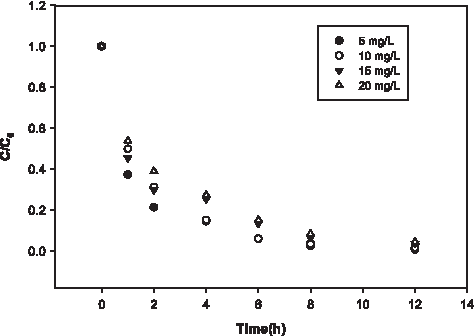
Kinetics of reductive removal of perrhenate by use of starch-stabilized zero valent iron (ZVI) nanoparticles and at various initial perrhenate concentrations. Experimental conditions: temperature=20°C, pH=7.0, ZVI=0.08 g/L.
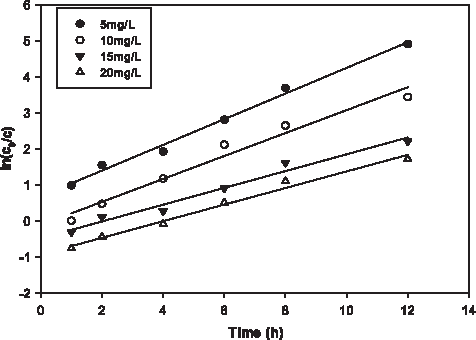
Reduction of Re(VII) by ZVI nanoparticles as a function of time: kinetic data plotted as ln(C0/C) vs. t at four initial concentrations.
The same kinetic data were also test plotted (not shown) as 1/(C0 − C) and 1/(C0 − C)2 versus time, respectively, corresponding to the second and third order rate laws, respectively. It was observed that the first order rate law as shown in Fig. 3 best simulates the reduction kinetics. At the experimental initial concentrations of 5, 10, 15, and 20 mg/L, the correlation coefficient R was 0.992, 0.970, 0.975, and 0.986, respectively. Accordingly, the data fitting resulted in the following reaction rate constant k values: 0.356, 0.318, 0.233, and 0.230 h−1, respectively, for the four initial Re concentrations. Evidently, as the initial Re concentration goes up, the rate constant decreases markedly.
Activation energy for reduction of Re(VII) by ZVI nanoparticles
Figure 4 shows the kinetic data [plotted as ln(C0/C) vs. t, initial Re concentration of 10 mg/L] obtained at various temperatures: 15°C, 25°C, 35°C, and 45°C.
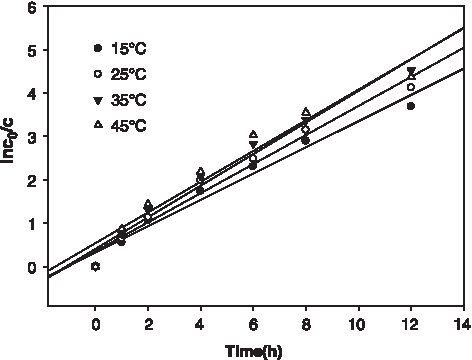
Concentration change of perrhenate during reduction kinetic tests by ZVI nanoparticles at various temperatures. Initial concentration=10 mg/L as Re, pH=7.0, ZVI=0.08 g/L.
With the increase of the reaction temperature, the reaction rate constant k increased from 0.351 h−1 (15°C) to 0.428 h−1(45°C). This observation indicates that increasing the reaction temperature could enhance the reduction rate of perrhenate, and the classical collision theory can be applied to describe the temperature effect in the reaction rate between iron nanoparticles and perrhenate although the temperature effect is not as effective as in homogeneous reactions. Elevated temperatures result in more energetic collisions that can overcome the activation energy barrier.
The kinetic data can be further interpreted using the Arrhenius equation:
where A is the pre-exponential factor, Ea is the activation energy, R is the universal gas constant, and T is temperature.
Figure 5 shows the Arrhenius plot [ln(k) vs. 1/T] of the experimentally determined rate constants at various temperatures and the model simulation. Figure 5 shows that ln(k) strongly correlates with 1/T, with a correlation coefficient R of 0.988. The slope of the straight line gives an activation energy (Ea) of 5.13 kJ/mol, and the intercept yields a pre-exponential factor (A) value of 9.29 s−1. The quite low activation energy indicates that reduction of perrhenate by ZVI nanoparticles is also kinetically quite straightforward. The temperature effect on the reaction rate was relatively modest, and temperature had little influence on the final amount of ReO4− reduced. For example, at temperatures 15°C , 25°C , 35°C , and 45°C, the removal rate in 12 h of rhenium was 97.7%, 98.0%, 98.9%, and 98.9%, respectively.

Arrhenius plot of perrhenate reduction rate constant as a function of temperature.
Effect of ReO2 on ZVI reactivity and a pseudo nth order kinetic model
The observed strong variance of the rate constant at various initial Re concentrations is quite unusual, and suggests that the commonly used pseudo first rate law may not be accurate in describing the reaction kinetics in the heterogeneous system, where the nanoparticles serve as the electron donors and when the resulting products may interfere with the activity of the nanoparticles.
Based on the thermodynamic analysis [Eq. (7)], the final reduction products of perrhenate by ZVI nanoparticles include ReO2 solid and iron oxide. It has been well recognized that as ZVI corrodes, an iron oxide shell will form, which can slow down the electron transfer, and thus, the reduction rate. In addition, the resulting ReO2 solids are expected to precipitate on the particle surface, which can block the surface reactive sites and further complicate the reaction kinetics.
Considering the blocking effect of ReO2 and in search for a sounder kinetic model, a pseudo nth order rate law as given in Equation (9) was tested to interpret the Re reduction kinetics:
where n is the reaction order. The values of k and n can be obtained through nonlinear fitting or Equation (9) to the experimental kinetic data of Fig. 1 using MATLAB. Table 1 summarizes the best fitted results.
Table 2 reveals that with increasing initial concentration of perrhenate, the reaction order increased from 0.90 to 1.22, and the reaction rate constant k decreased from 0.52 to 0.23 h−1. In the reaction system, the agitation speed was fast, and thus, mass transfer should not be rate controlling. Considering that the redox reaction between the ZVI nanoparticles and perrhenate proceeds at the surface of ZVI nanoparticles, and the product of the reaction is ReO2 solid, the reduced reaction rate at higher initial concentrations of perrhenate can then be attributed to a blocking effect of the resulting ReO2 that is precipitated on the surface of the nanoparticles. At a higher perrhenate concentration [i.e., a greater ratio of Re(VII) to surface reactive sites], the overall reaction rate is controlled by the available reactive sites of the nanoparticles. In the initial stage of the reaction, more reactive sites are available. However, as the reaction proceeds, more ReO2 is patched on the surface of the nanoparticles, resulting in blockage of the reactive sites. The higher the perrhenate concentration, the more ReO2 is produced, and thus, the more sites are blocked. As a result, a higher reaction order and a smaller rate constant were evident at elevated perrhenate concentrations. Conversely, at lower perrhenate concentrations, more surface sites of the nanoparticles are available and the surface blockage by ReO2 is less profound. As a result, more effective collisions between perrhenate and the nanoparticles are expected, which is characterized by the modestly lower reaction order, but markedly greater reaction rate constant at Re=5 mg/L (Table 1).
Comparison between stabilized ZVI nanoparticles and a common iron powder
Figure 6 compares the kinetic data of ReO4− reduction using the starch-stabilized ZVI nanoparticles and a commercial iron powder with a mean diameter of 150 μm under otherwise identical conditions.
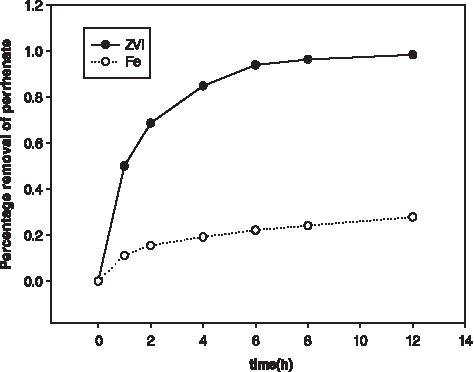
Plot as C/C0 for both cases. Initial concentration of perrhenate=10 mg/L as Re, pH=7.0, ZVI=0.08 g/L.
After 12 h of reaction, perrhenate removal was 98.4% for starch-stabilized ZVI nanoparticles compared with 27.9% for the iron powder. Note that the specific surface area of the starch-stabilized ZVI nanoparticles was 9.5 m2/g compared with 5.06 m2/g. Therefore, a more than three times greater removal rate by the stabilized nanoparticles can be primarily attributed to the nearly two times greater specific surface area. In addition, the thicker iron oxide shells on the more aged iron powder are expected to diminish the reactivity of the core iron.
Conclusions
This study tested the effectiveness of a class of starch-stabilized ZVI nanoparticles for reductive removal of perrhenate (a surrogate for radioactive pertechnetate) from water. Based on both experimental kinetic data and thermodynamic and kinetic modeling analyses, the following conclusions can be drawn from this work.
1. Thermodynamic analysis indicated that reduction of Re(VII), and possibly Tc(VII), is highly favorable with ΔG=−316.66 kJ/mol for Re(VII) and −448.66 kJ/mol for Tc(VII). The final reduced product will be ReO2 or TcO2, which is expected to be much less mobile and less bioavailable than ReO4− or TcO4−.
2. Starch-stabilized ZVI nanoparticles are able to rapidly and completely reduce and remove perrhenate at ambient temperatures in 12h. The reaction rate constant increased from 0.351 h−1 at 15°C to 0.428 h−1 at 45°C. A fairly low activation energy level of 5.13 kJ/mol was determined for the reduction reaction.
3. A surface blocking effect on the ZVI nanoparticles was evident due to surface precipitation of the resulting ReO2. As a result, the pseudo first order rate constant decreased from 0.356 to 0.230 h−1 when the initial Re(VII) concentration was increased from 5 to 20 mg/L although complete Re(VII) was achievable in all cases. Based on a more general pseudo nth order model analysis, the blocking effect can also alter the reaction order.
4. Compared with commercial iron powder, the starch-stabilized ZVI nanoparticles were nearly four times more effective in reducing Re(VII).
Using perrhenate as a surrogate, the results revealed great potential of starch-stabilized ZVI nanoparticles for possible reductive immobilization of pertechnetate in soil and groundwater. The results warrant further detailed work to test the effectiveness of the nanoparticles for in situ immobilization of Tc(VII).
Footnotes
Acknowledgments
The authors gratefully acknowledge the partial financial supports from the following sources: the National Natural Science Foundation of China (No. 41072265 and No. 41230638), International Cooperation Program of Shanxi Province (2010081021), Shanxi Scholarship Council of China (No. 2013- key 2), The Science and Technology Key Program of Shanxi Province (No. 20131101028), The Doctoral Program of Higher Education of Shanxi Province (No. 20101415110003), Students Innovative and Pioneering Program of Shanxi province (No. 120164075), and the Auburn University IGP program.
Author Disclosure Statement
No competing financial interests exist.