




Abstract
Abstract
Polyaluminum chloride (PACl) is a commonly used coagulant for water treatment. One mode of action of PACl
Introduction
Overview
PACl structure and precipitation
PACl is an inorganic polymer coagulant that has gained wide acceptance for use in water treatment as a result of its efficacy over a broader pH range and at lower temperatures than the commonly used alternative, aluminum sulfate (alum) (Benschoten and Edzwald, 1990). The dominant stable species in dissolved PACl,
Many mechanisms have been proposed for the coagulation of suspensions, including: (1) Destabilization of colloidal particles by the nucleation of positively charged Al precipitates on negatively charged colloidal surfaces, or precipitation charge neutralization (PCN) (Dentel, 1988). PCN is based on the observation that, under the circum-neutral pH of most natural waters, the precipitates of aluminum salts and polymers are positively charged. These species are thought to destabilize negatively charged colloids by attaching and neutralizing their surface charge, thereby decreasing electrostatic repulsion between colloids and inducing aggregation (Ye et al., 2007). (2) As a consequence of the relatively large size and stability of Al precipitates and their positive charge, electrostatic patch coagulation (EPC) has also been proposed as a potential coagulation mechanism (Ye et al., 2007). EPC is characterized as a localized PCN mechanism; patches of positive charge are created by aggregates of Al-precipitate adsorbing to a small fraction of the surface of the colloid. Next, attractive electrostatic forces attach the positively charged Al precipitate patches to the “naked” surface of other colloids on collision. It is hypothesized that large flocs can be formed in this manner (Ye et al., 2007; Lin et al., 2008a; Lin et al., 2008b). (3) At high coagulant doses, colloidal particles can be removed when they become enmeshed in the voluminous self-aggregated Al-precipitate, a process called “sweep flocculation” (Bache and Gregory, 2007). The term “sweep flocculation” is best considered a description of the colloid and coagulant suspension and does not provide a mechanistic understanding of why Al-precipitate should interact with itself or colloids in the observed manner. Consequently, EPC and PCN are explored in greater detail next.
Derjaguin–Landau–Verwey–Overbeek theory and model
Interaction between charged particles in a suspension is cited as the driving mechanism in PCN and EPC and has been modeled by the Derjaguin–Landau–Verwey–Overbeek (DLVO) theory. In this model, Van der Waals interactions are responsible for the attractive energy between particles; VA· VA is inversely proportional to separation distance between particles and is, therefore, effective at small separation distances [Eq. (1)] (van Oss et al., 1990).
where AH is the Hamaker constant, a is the radius of the particle, and h is the distance between the particles. The DLVO theory assumes the particles are spherical and have the same diameter.
Repulsive energy in the DLVO model, VR, originates when the similarly charged electrical double layers of particles overlap and are proportional to the surface charge squared [Eq. (2)]
where ε is the dielectric constant of water at 25°C, ζ is the zeta potential of the particle (see Measuring Charge next for greater detail), and κ is the inverse of the Debye–Huckel length and is given by Equation (3).
where e is the elementary charge of an electron, NA is Avogadro's number, I is the ionic strength of the solution, κB is Boltzmann's constant, and T is the temperature. The double layers are assumed to be much thinner than the radius of the colloidal particles (
Attractive and repulsive energies between particles can be summed to find the total energy, VT [Eq. (4)]. When VT is positive (VR dominates), the area under the curve of VT as a function of separation distance represents the activation energy, the energy that should be provided to allow two particles to get close enough so that the attractive Van der Waals force dominates.
According to PCN and EPC, the goal of coagulation is the electrostatic destabilization of the colloidal suspension. Application of the DLVO theory to a colloidal suspension suggests that the electrostatic destabilization occurs when the activation energy is reduced so that colloids can approach one another. Electrostatic destabilization can be achieved by changing the surface charge of the colloids, which is incorporated into the DLVO theory by zeta potential, ζ, or through reducing the distance over which repulsive energy acts by increasing the ionic strength, I, of the solution. The addition of positively charged Al-precipitate aggregates that adsorb/attach to the surface of the colloid would reduce the surface charge and the resulting energy barrier. Electrostatic attraction would hold the Al precipitates to the colloidal surface, and the Van der Waals forces accounted for in DLVO theory would be responsible for the inter-particle bond that holds the charge-neutralized colloidal particles together (Lin et al., 1990).
In order to elucidate the coagulation mechanism of PACl under normal dosing conditions, it is informative to approximate the size of the Al precipitates interacting with the suspended colloids that create turbidity in the source water. Since they will readily self-aggregate, a wide range of sizes have been reported in the literature for Al13-oxyhydroxide precipitates from PACl. A detailed geometric analysis has not been previously published and is provided in this study. This study, through modeling and experimentation, provides an estimate of the time scale of aggregation of Al precipitates and an evaluation of the impact of Al precipitate size on attachment efficiency as well as the ensuing formation of flocs that can be removed by sedimentation. This information also permits an inference of the mechanism of coagulation by the Al precipitates produced by PACl and indicates the conditions that are responsible for optimal turbidity removal by PACl at a given dose.
Al-oxyhydroxide aggregation model
To interpret the impact of Al precipitate aggregation on flocculation, a physically based model was generated to capture the kinetics of self-aggregation in a circum-neutral pH suspension in the absence of other colloids. The primary PACl molecule
Aggregation often begins with a suspension of particles that collide and form clusters due to Brownian motion (Lin et al., 1990; Asnaghi et al., 1992). These clusters continue colliding due to both Brownian motion and velocity gradients, resulting in a suspension of polydisperse clusters. Through static and dynamic light scattering (DLS) experiments, researchers have found that the aggregation kinetics of many different colloids follow the same pattern (Lin et al., 1990). As a result, colloidal aggregation kinetics has been conceptually divided into two distinct stages—diffusion-limited (DLCA) and reaction-limited colloid aggregation (RLCA). In DLCA, the aggregation rate is limited only by the rate of collisions between the particles; this assumes an attachment efficiency near unity. To predict an attachment efficiency near unity for DLCA, the repulsive barrier between two approaching particles should be reduced to much less than κBT, an approximation of the Brownian energy. If the energy barrier is reduced to near zero, the full extent of DLCA can be achieved. In RLCA, collisions are driven by velocity gradients, and multiple collisions are required before two particles can stick together (attachment efficiency less than one), resulting in a slower aggregation rate. In all stages of colloid aggregation, the clusters of original colloids (primary particles) take on a three-dimensional fractal structure, with a 3D fractal dimension Df≈1.8 for DLCA and Df≈2.1 for RLCA (Lin et al., 1990; Asnaghi et al., 1992). A fractal dimension of 3 represents a collision where volume is conserved. Lower fractal dimensions indicate higher incorporation of water in the aggregate. A homogenous aggregate with a fractal dimension of three would have a constant density, independent of aggregate size.
We present here an innovative application of established relationships to approximate the time course of aggregation of Al13 precipitates. To account for the fractal nature of aggregates (Asnaghi et al., 1992; Lin et al., 2008a; Nan et al., 2009; Weber-Shirk and Lion, 2010), a fractal growth equation was used to determine the size of the aggregate particle after each consecutive collision [Eq. (5)]. Inherent in this equation is the assumption that all collisions occur between identical particles, such that collisions double the number of the primary particles within the resulting aggregate (Weber-Shirk and Lion, 2010).
where n is the number of sequential collisions, α is the fraction of collisions that result in attachment, Df is the 3-D fractal dimension, dn is the aggregate diameter after n collisions, and dinitial is the initial aggregate diameter. The initial floc volume fraction, ϕinitial, is calculated by Equation (6).
where CPACl is the concentration of PACl in the PACl aggregation tube used in this research, and ρinitial is the observed density of PACl, 1.138 gm/mL (see Coagulation Geometries). The floc volume fraction for a given collision, ϕn, is then calculated as Equation (7):
The effective particle density number, Nn, is determined by dividing the floc volume fraction by the volume of a single aggregate [Eq. (8)].
Given Nn, the model of Meibodi et al. (2010) that assumes Brownian motion and uses the Smoluchowski approach for the collision of particles in a dilute suspension is used to calculate the average time, tn,diffusive, for a given collision, n [Eq. (9)].
where v is the dynamic viscosity of water at 25°C. Due to the initial 180 nm aggregate size and concentration used in experiments, shear-induced collisions also occur in the reactor and contribute significantly to the final aggregate size. Shear-induced collisions are considered RLCA in nature and have an attachment efficiency less than unity. The time for a shear-induced collision can be modeled by Equation (10), as derived by Weber–Shirk and Lion (2010).
where ω is the energy dissipation rate. In the transitional range between DLCA and RLCA, diffusion and shear transport processes act in concert to cause collisions. Equation (11) calculates the collision time when both transport mechanisms are operative.
Since ϕn and Nn change as collisions occur, the time for each sequential collision is calculated independently. The calculated time for each sequential collision is subtracted iteratively in the model from the total experimental reaction time provided. Total experimental reaction time is equal to the hydraulic residence time in a microbore tube, which was controlled in experiments by setting the length and flow rate through a tube with a constant diameter. When the total reaction time was depleted, the number of collisions was used in the fractal growth equation [Eq. (5)] to give the final aggregate size. The number of sequential collisions was not limited to integer values to obtain the best estimate of the average aggregate size.
Coagulation geometries
A careful geometric analysis for the attachment of coagulant particles to colloid surfaces using basic physical principles has not been previously published and can enlighten our understanding of the role of the coagulant on subsequent colloid aggregation. The effectiveness of PACl as a coagulant for negatively charged kaolin clay particles is generally attributed to charge neutralization based on its high positive charge density (Benschoten and Edzwald, 1990; Ye et al., 2007; Wu et al., 2007; Lin et al., 2008b; Wu et al., 2009; Lin et al., 2009). However, if the diameter of Al13-oxyhydroxide aggregates exceeds the Debye length, there is no reason to expect charge neutralization to be a prerequisite of aggregation. This is consistent with observations by Wu et al. (2007) and Chu et al. (2008) of flocculation of particles possessing a negative zeta potential.
The geometric analysis presented here accounts for the observation that industrial-grade PACl is not a solution of primary 1.2 nm Al13 molecules, but rather a suspension of preformed Al-oxyhydroxide aggregates. The size of these aggregates can vary greatly based on the chemical preparation techniques at the factory, including aging times and handling (Benschoten and Edzwald, 1990; Hu et al., 2005; Yan et al., 2008). The industrial-grade powdered PACl used in this study (source: Zhengzhou City Jintai Water Treatment Raw Material Co., Ltd) was found to produce a suspension with an initial mean particle size of 180 nm (as measured with a Malvern Zetasizer Nano-ZS) when mixed with distilled water at a concentration of 5 mM, Al. The fractal dimension for the preformed aggregates was estimated from the bulk density of the PACl granules as described next.
Assuming a porosity, ɛ, of 0.40 for random packing of spherical particles, Equation (12) was used to find the density of the preformed aggregates, ρinitial (German, 1989).
where Mobs is the observed mass of a dry sample of the preformed aggregates, and Vobs is the observed volume of the sample of preformed aggregates. The observed density, ρinitial, was 1.138 gm/mL. Equation (13) was then used to calculate the number of primary particles in a single preformed aggregate, Ninitial.
where Vinitial is the volume of a spherical preformed aggregate with a 180 nm diameter, ρo is the density of PACl primary particles, 1.907 g/mL, and V0 is the volume of a single primary particle with a 1.2 nm diameter. The number of binary collisions that must have occurred to create the preformed aggregate was found by Equation (14) to be 20.9.
Finally, the fractal dimension, Df, for the factory-based aggregation is determined by Equation (15).
The resulting fractal dimension determined for the conditions observed in this study is 2.9, signifying that the PACl density was nearly independent of aggregate size in the preliminary aggregation stage during production of the PACl granules at the manufacturer. With this information, it is possible to model the fractional coverage or depth of coagulant on the surface of each clay platelet for a given set of PACl concentrations and geometric considerations. Equations (16)–(19) outline the calculations in the geometric model for Al13-oxyhydroxide aggregate coverage of clay.
where NClay is the number of clay platelets per unit volume (
where Df,initial is the fractal dimension of the preformed aggregate, 2.9; d0 is the diameter of the primary PACl molecule, 1.2 nm; dinitial is the diameter of the preformed aggregate, 180 nm; Df,final is the fractal dimension of the final aggregate; and dfinal is the final diameter of the aggregate determined using Equation (5). Df,final was assumed to be equal to Df,initial, 2.9, throughout the mixing chamber due to the high velocity gradients. The shear forces created by high velocity gradients cause aggregates to be more compact, incorporating little to no additional space.
The number of Al precipitates per unit volume in the flocculator, NPACl, is calculated by Equation (18).
where PAClDose is the concentration of PACl in the flocculator, NA is Avogadro's number, and MWPACl is the molecular weight of PACl, which is here 1039 g/mol. The total number of Al precipitates on the surface of a single clay particle, NPAClperClay is found by Equation (19).
where NPACl is the number of a spherical Al13-oxyhydroxide aggregate of diameter dfinal. The total number of the Al precipitates per clay is then used to determine the fractional coverage of the clay platelets assuming a square-packing arrangement of precipitates [Eq. (20)].
where SAClay is the surface area of a single clay platelet.
As an initial approximation, kaolin clay platelets were assumed to have the volume of a sphere with a diameter of 2 μm (Ye et al., 2007; Lin et al., 2008a). The platelets were assumed to be cylinders with a 10:1 diameter to height ratio, resulting in a diameter of 3.8 μm, a height of 0.38 μm, and an initial surface area of 27 μm2. The geometries used in the Results section correspond to a turbidity of 15 NTU (30 mg/L clay, relationship determined through laboratory observations) and a PACl concentration of 14.4 μM Al, at a pH of 7.5. The number of clay particles present assumes the density of kaolin clay, ρClay, is 2.65 g/mL.
The model output for the experimental conditions is shown next (see Results and Discussion). Since Al13-oxyhydroxide precipitates are assumed to be spherical, as opposed to chain like in structure, larger aggregates have a lower surface area to volume ratio, and it is expected that a larger mass of coagulant will be required to provide a real coverage of the clay platelets. If surface coverage by coagulant is related to attachment efficiency, as Al13-oxyhydroxide precipitates increase in size they will cover less of the clay platelets, and the attachment efficiency in flocculation will decrease. As a consequence, the overall particle removal efficiency in flocculation and sedimentation will decrease even though the coagulant dose is held constant.
Materials and Methods
The model for diffusion-limited Al precipitate growth was validated experimentally using a Malvern Zetasizer Nano-ZS. A 5 mM Al suspension of Al13-oxyhydroxide precipitates produced by PACl was filtered through a 0.2 μm syringe filter to isolate a narrow size distribution so as to reduce variability in the observed sizes during aggregation. After filtration, initial aggregates were 55 nm in diameter. As expected, this is less than the average aggregate size in the unfiltered suspension, 180 nm. The suspension pH was adjusted to 7.5 by the addition of dilute Na2CO3 at 25°C, and a series of size measurements was taken (final PACl concentration 2.5 mM Al). The reported sizes are the z-average determined by the Zetasizer; the z-average is the intensity-weighted mean hydrodynamic size of the ensemble collection of particles measured by DLS (Malvern Instruments Ltd, 2010). A distribution of sizes was not provided by the Zetasizer; however, a polydispersivity index (PDI) was calculated and is a measure of spread. The mean PDI was 0.4697±0.0957, indicating that the suspension was moderately heterogeneous as would be expected for aggregating particles. The sample cell was not mixed during the measurement phase, and, thus, the only transport mechanism for collisions was Brownian motion. Observations of aggregate size immediately after pH neutralization were not obtained, because initial collisions occurred at a time scale faster than the start-up detection time required for the Zetasizer (10 s).
Flocculation experiments were conducted using an apparatus comprising SRW and coagulant metering systems, a coiled tube hydraulic flocculator, and a flocculation residual turbidity analyzer (FReTA; see Fig. 1). Tse et al. (2011) provide a complete description of the experimental apparatus and methods; only the method for coagulant addition was changed for the experimental data presented here.

Schematic of the experimental assembly.
Briefly, the SRW metering system consisted of a concentrated stock suspension of kaolinite clay (R.T. Vanderbilt Co., Inc.) mixed with tap water to produce a feedback-regulated constant turbidity raw water source (Weber-Shirk, 2008). Reported Cornell University tap water characteristics are as follows: total hardness≈150 mg/L as CaCo3, total alkalinity≈136 mg/L as CaCO3, pH≈8.2, and dissolved organic carbon≈1.8 mg/L (Bolton Point Water System, 2012). Dissolved organic matter was not added to the raw water and could be introduced in future studies to expand the applicability of the results. The concentrated clay stock and the SRW feedstock were stirred to ensure homogeneous suspensions. For all of the experiments performed in this study, the SRW was maintained at a constant turbidity of 15±1 NTU, which corresponded to a clay concentration of ∼30 mg/L, and a constant temperature, 25°C. All influent chemicals were metered with computer controlled Cole Parmer MasterFlex L/S digital peristaltic pumps. Industry-grade (31% as Al2O3) PACl powder was used as the coagulant for all experiments (Zhengzhou City Jintai Water Treatment Raw Material Co., Ltd). Powdered PACl was used to reflect the available coagulant in many developing countries, particularly Honduras, where the authors implement their research on gravity-powered municipal drinking water treatment plants. The PACl was diluted with distilled water to give a stock concentration of 5 mM Al. The stock solution pH was sufficiently low (pH∼3.5) so that Al precipitation did not occur in the stock container. A Na2CO3 stock was used to neutralize the acidic PACl stock and initiate precipitation. The Na2CO3 stock was prepared with distilled water at a concentration of 3.43 mM; this concentration was chosen because with 1:1 mixing it adjusted the PACl stock to pH 7.5. Dilution water was prepared with distilled water and was adjusted to pH 7.5 with 75 μM Na2CO3. The dilution water and Na2CO3 stock were combined first and then combined with the PACl stock in a 0.8128 mm inner-diameter micro-bore tubing (Cole Parmer). The flow rate of the dilution stock was varied between experiments to alter the residence time and PACl concentration in the PACl aggregation tube (center of Fig. 1).
where QPACl is the flow rate of coagulant stock; QPlant is the total flow rate through the flocculator, 5 mL/s; PAClDose is the concentration of PACl in the flocculator, 14.4 μM Al; and PAClStock is the concentration of PACl entering the microbore tubing, 5 mM. The mixing time provided for PACl self-aggregation was determined by Equation (22):
where ATube is the cross-sectional area of the micro-bore tubing, 0.519 mm2; LTube is the length of the micro-bore tubing, 5 cm or 60 cm; QPACl is 14.4 μL/s, found by using Equation (21); Q Na 2 CO 3 is the flow rate of base stock, 14.4 μL/s; and QDilution is the flow rate of pH-adjusted distilled water stock, which was varied to produce a range of mixing times and concentrations. The micro-bore tubing length was either 5 cm or 60 cm to achieve the full range of mixing times without creating excessive head loss through the tube.
The SRW and coagulant were passed through a rapid mix unit comprising a 120 cm segment of 4.3 mm (0.17′′) ID tubing coiled around a cylinder with an outer diameter of 5 cm to ensure thorough mixing of the SRW and the PACl. Reynolds number in the rapid mix tube was ∼1450. Results from a dye study showed that adequate mixing was achieved at this flow rate due to the secondary currents induced by the coiling. The coagulated SRW entered an 84 m coiled tube flocculator. The average velocity gradient in the flocculator, G, was maintained at 50/s, calculated by Equations 2–9 of Tse et al. (2011), and the overall plant flow rate was maintained at 5 mL/s, resulting in a hydraulic residence time, θ, of 1200 s in the flocculator. As Owen et al. (2008) note, flocculation is frequently studied in batch reactors with offline size measurements for aggregation processes, resulting in poor control over the energy dissipation rate reaction time, and questionable size measurements. A tube flocculator was used, because it can be idealized as a high Peclet number reactor in a similar manner to a baffled hydraulic flocculator and also because the average velocity gradient in laminar tube flow is well defined (Weber-Shirk and Lion, 2010). After two hydraulic residence times in the flocculator, 2400 s, the peristaltic pumps were ramped to a stop. The FReTA-actuated ball valve closed, and the turbidity in the quiescent settling column was measured over a period of 30 min. The FReTA was used to nondestructively measure both the sedimentation velocity and the residual turbidity of the effluent from the flocculator. The settling velocity of the particles was calculated by dividing the 13.64 cm distance between the bottom of the ball valve and the center of the zone illuminated by the turbidimeter infrared light emitting diode by the time elapsed during settling. The residual turbidity is defined as the average effluent turbidity in the 50 s interval around the capture velocity of 0.12 mm/s, which is a conservatively designed lamellar settler capture velocity (Willis, 1978).
Based on control experiments performed with the tube flocculator at Gθ=60,000, a coagulant dose of 14.4 μM Al was determined to provide ∼50% turbidity removal with an initial turbidity of 15 NTU (Fig. 2). Residual turbidity comprises flocs that settle more slowly than the capture velocity, 0.12 mm/s. The 14.4 μM Al dose was chosen for subsequent experiments, because the sensitivity of residual turbidity at this coagulant dose enhanced the ability to observe changes in the effectiveness of PACl at different Al13-oxyhydroxide aggregate sizes.
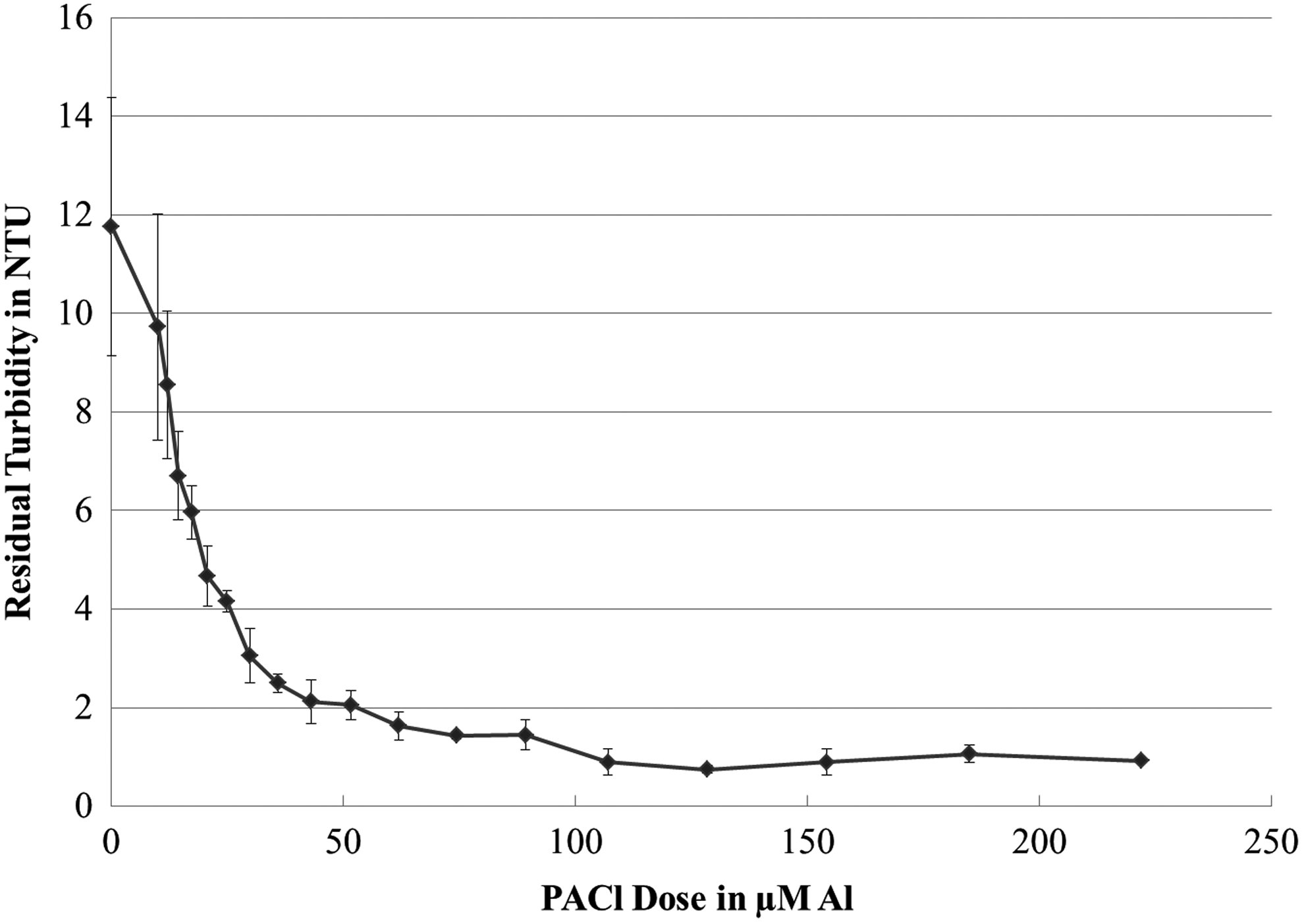
Control experiment used to choose the coagulant dose. Error bars represent a 95% confidence interval, n=4.
Results and Discussion
Figure 3 depicts the interaction energy of a suspension of kaolin clay at the solution conditions used for experiments in this research. DLVO theory suggests that kaolin clay particles in Cornell tap water would be able to aggregate at a spacing between particles of ∼1 nm, because the van der Waals energy exceeds the electrostatic repulsive energy at that separation distance, but that repulsive energy dominates between 1 and 10 nm. A coagulant aggregate of size >10 nm would extend beyond the region where repulsion occurs and could, therefore, allow colloids to form a floc despite the electrostatic repulsion.
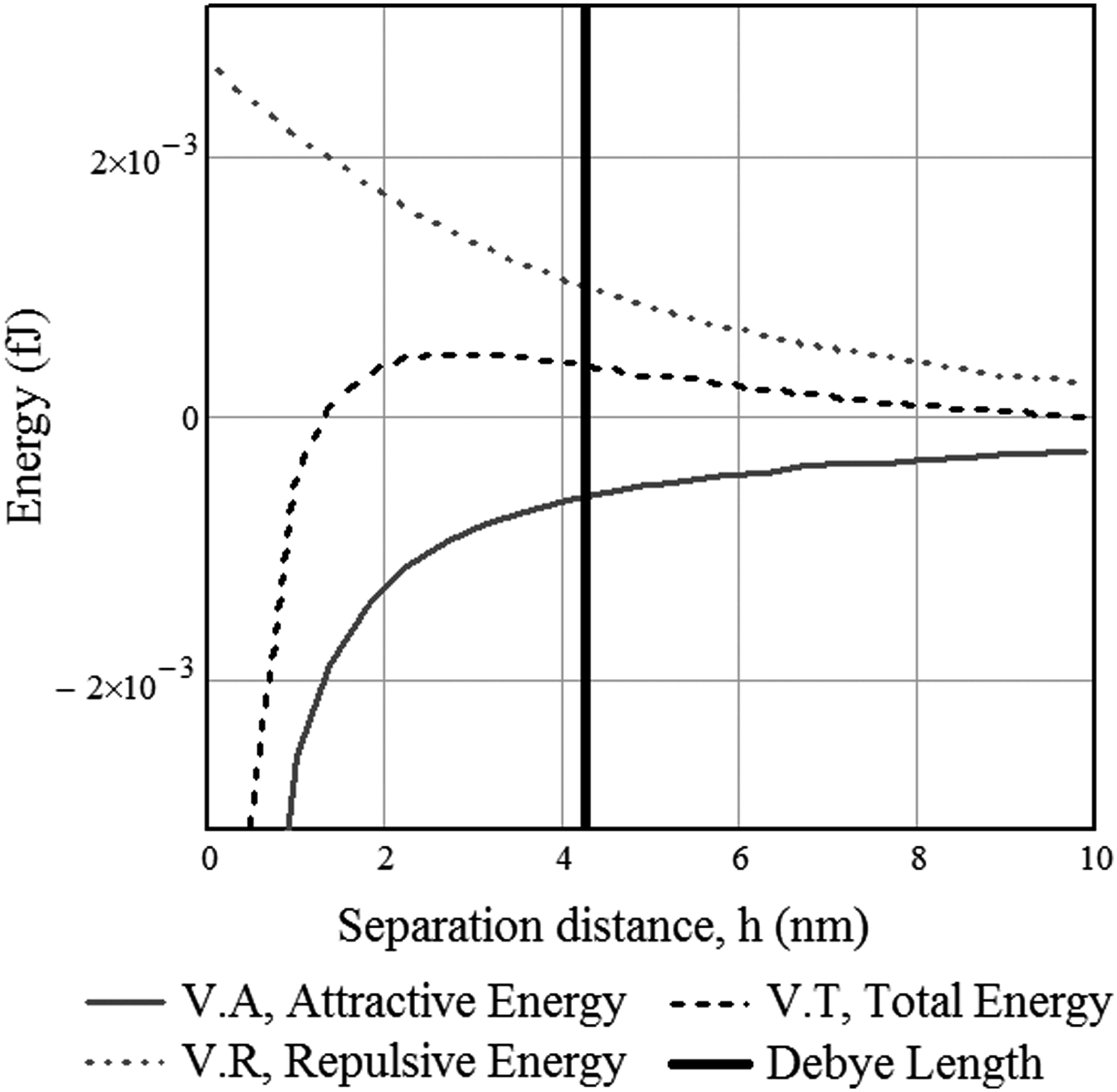
Interaction energy for 30 mg/L kaolin clay in Cornell tap water, κ=0.237/nm, a=1 μm, ζ=−25mV, 0 μM Al.
Preformed Al13-precipitates (180 nm in diameter) are many times larger than the Debye length (calculated to be 4.2 nm for the experimental conditions), and, thus, electrostatic repulsion and the need for charge neutralization were not likely to have been a significant factor in flocculation with powdered PACl.
Results for the diffusive self-aggregation of colloids observed with the ZetaSizer are shown in Fig. 4 in comparison with model predictions. Despite the difficulties inherent in observing particle collisions over very short time and length scales, the results suggest that the model based on DLCA is consistent with the observed precipitate self-aggregation for PACl (Fig. 4). The fact that Al13-oxyhydroxide self-aggregation is observed demonstrates that, if the precipitates were charged, the resulting repulsive force did not prevent attachment.
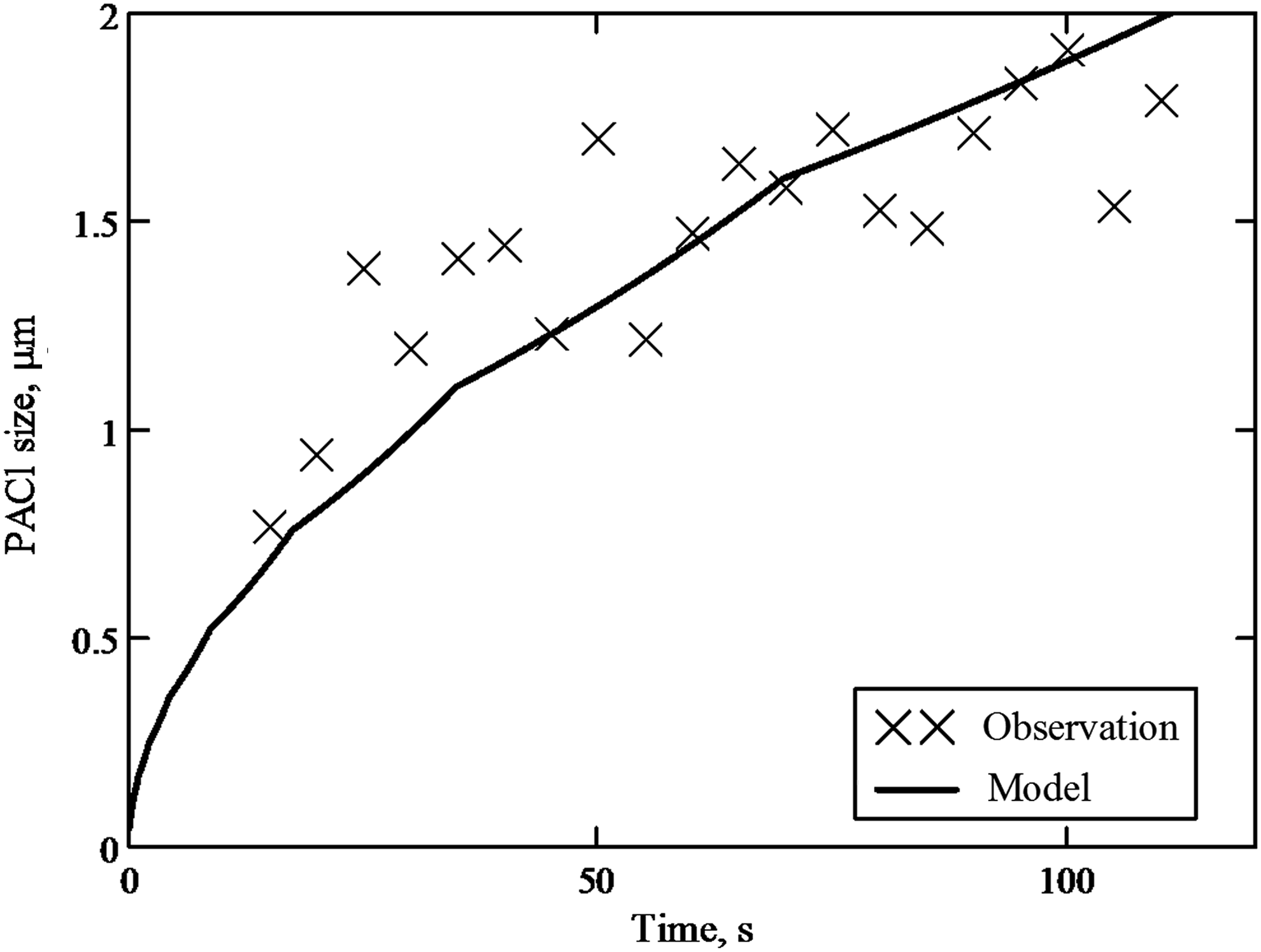
Diffusion-limited Al13-oxyhydroxide self-aggregation as a function of time at a neutral pH. Polyaluminum chloride (PACl) concentration was 2.5 mM Al. Measurements exhibit variability because of the poly-disperse nature of the suspension and the fast response time set by the user. The model assumes a fractal dimension of 1.85 for diffusion-limited colloid aggregation in the quiescent sample and an initial particle size of 55 nm. R2=0.69, n=20.
The range of coagulant doses used in the control experiment can be converted to surface coverage, assuming an aggregate size of 180 nm. Increased clay surface coverage corresponds to an improvement in turbidity removal (Fig. 5) and presumably to an increase in attachment efficiency during flocculation. Approximately 50% of the reduction in residual turbidity was obtained by the first 10% of clay surface coverage. There was minimal improvement in performance above a fractional coverage of ∼40%. These results are consistent with the expectation that the effectiveness of an adhesive is related to the fractional surface coverage and that the significant improvement in attachment efficiency, as indirectly measured by residual turbidity, occurs before the colloids are completely covered.

Residual turbidity as a function of fractional clay surface coverage by the preformed 180 nm Al-oxyhydroxide aggregates.
Fractional coverage of the clay by the Al13-oxyhydroxide precipitates can also vary even at a constant coagulant dose if the size of the coagulant aggregates changes. Surface coverage was calculated using the measured size of the Al precipitates as an input to the geometric model. Figure 6 illustrates the results of the geometric analysis and the effect of aggregate size on clay surface coverage.
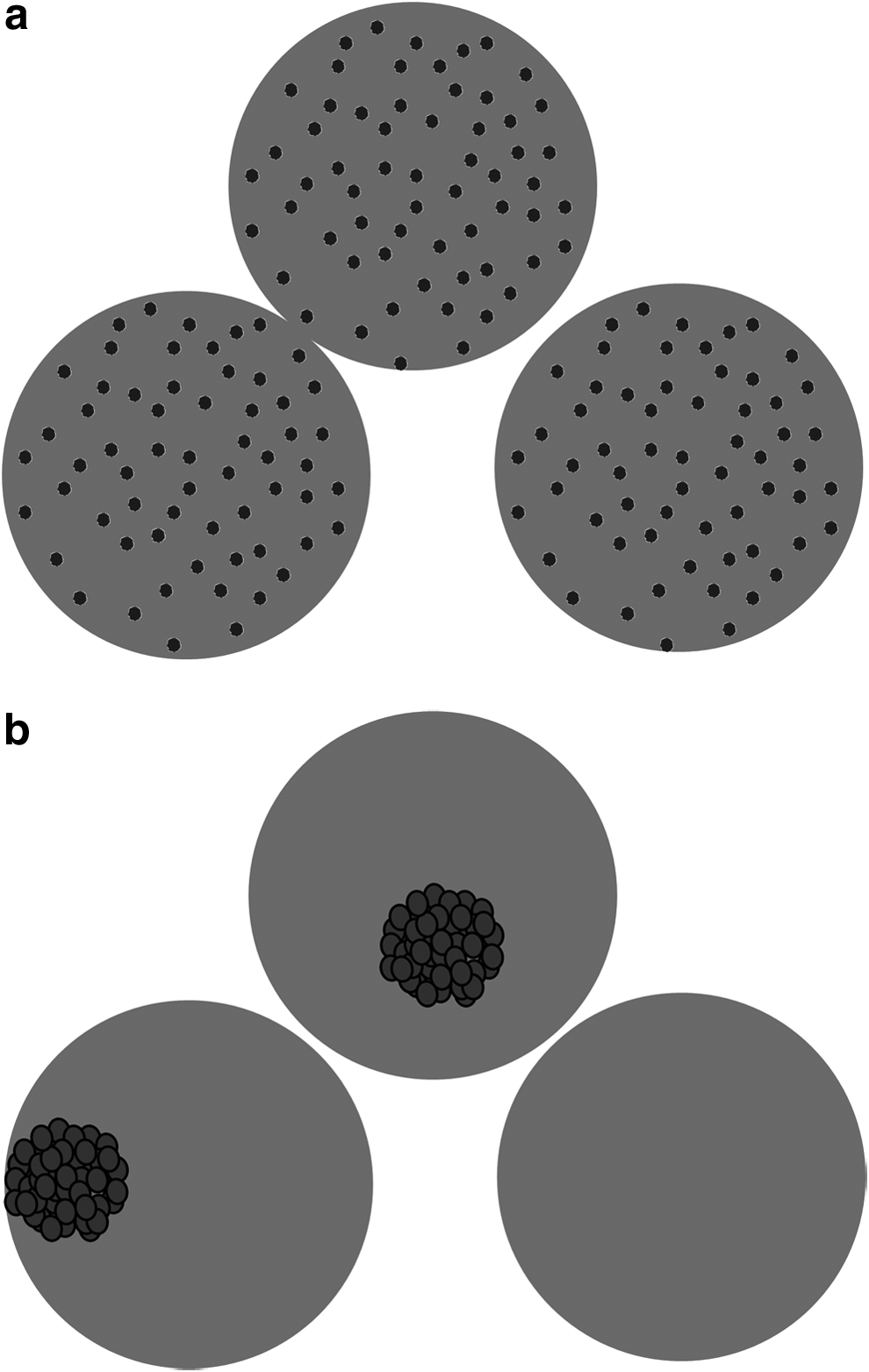
Visual geometries, approximately to scale for the experimental conditions in this study, 15 nephelometric turbidity units (NTU; 30 mg/L) and 14.4 μM Al.
If initial Al13-oxyhydroxide aggregate diameters are close to 180 nm with a fractal dimension of 2.9 due to aggregation and dehydration that occurred during the manufacturing process (as was the case for the PACl used in this research), the precipitated Al13-oxyhydroxide would cover 14% of the clay surface on average (Fig. 6a). This calculation assumes that all PACl molecules above the solubility limit precipitate and attach to a clay platelet. At pH 7.5, the solubility limit of PACl is 82 nM Al (Benschoten and Edzwald, 1990). If the Al13-oxyhydroxide is allowed to self-aggregate at circum-neutral pH for 6.2 s under the conditions in this study, 1 μm Al-oxyhydroxide aggregates are formed (see Al-oxyhydroxide aggregation model), covering only 2.6% of the colloid surface. Larger aggregates have even lower fractional coverage (Fig. 6b).
Since longer mixing times in the microbore tubing and higher PACl concentrations allow more PACl self-aggregation, the experimental results can also be expressed as a function of model-calculated fractional coverage as shown in Fig. 7a. The surface coverage of kaolin clay colloids by a given diameter of model-calculated Al13-oxyhydroxide aggregates was calculated from Equation 20. All calculations of size and fractional coverage incorporate a degree of uncertainty, because the attachment efficiency, α, is unknown during self-aggregation in the PACl mixing tube. The attachment efficiency term is expected to be <1 to account for curvilinear particle trajectories that were not considered in the collision model. The Al precipitates have a high fractal dimension and a low porosity, and, thus, flow of water through the aggregate is small and trajectory deflection as particles approach could be significant. An assumed attachment efficiency >0.1 resulted in fewer than 1 Al13-oxyhydroxide aggregates per clay particle and unrealistically large Al13-oxyhydroxide aggregates.
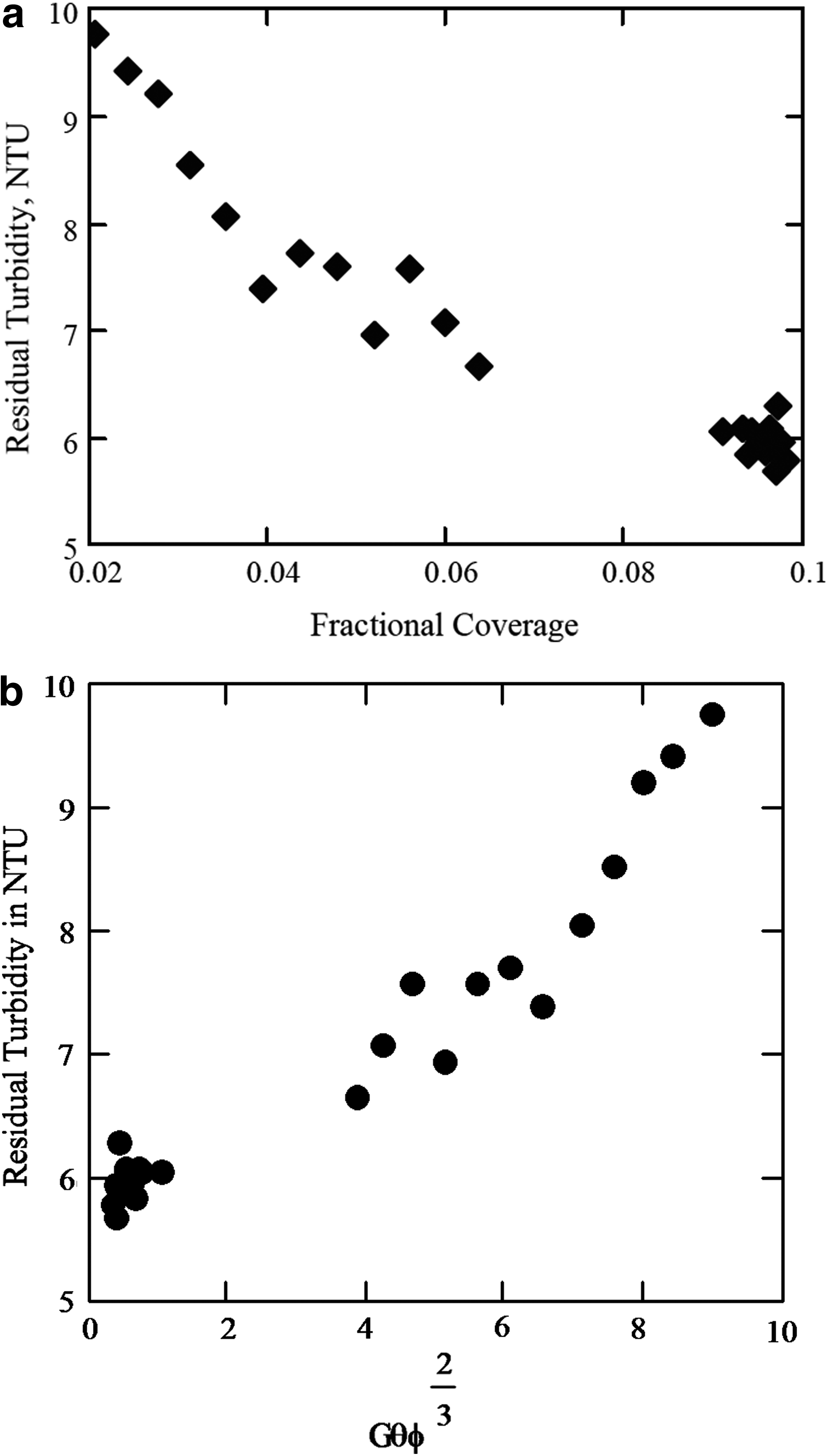
While the charge of clay colloids with attached coagulant precipitates would be expected to be constant at constant dose and pH, the removal of turbidity clearly varied with precipitate size and the ensuing surface coverage of colloids (Fig. 7a). Thus, surface coverage of colloids by Al13-oxyhydroxide aggregates is playing a significant role in colloid removal. The combined geometric and aggregation models are consistent with the role of clay platelet coverage as the dominant parameter influencing subsequent flocculation performance.
Since mixing time in the microbore tubing was varied by the addition of dilution water, concentration of PACl in the PACl aggregation tube varied in each test. The parameter
The data collected from FReTA in each of these experiments can be used to calculate the distribution of sedimentation velocities for the flocs formed under the given conditions. Figure 8 shows turbidity as a function of sedimentation velocity for a sample of the aggregate sizes in the study, assuming α=0.1 to estimate the Al13-oxyhydroxide aggregate sizes given in the legend. The sedimentation velocity is strongly correlated to the final floc size and determines the probability that a floc is removed. The slope of the curve represents the fraction of the flocs with the corresponding sedimentation velocity. Residual turbidity comprises flocs that settle more slowly than the capture velocity of a conservatively designed lamellar settler in a sedimentation tank, 0.12 mm/s in these experiments. Figure 8 shows that the fraction of particles with settling velocities lower than 0.12 mm/s increased at larger Al13-oxyhydroxide aggregate sizes.
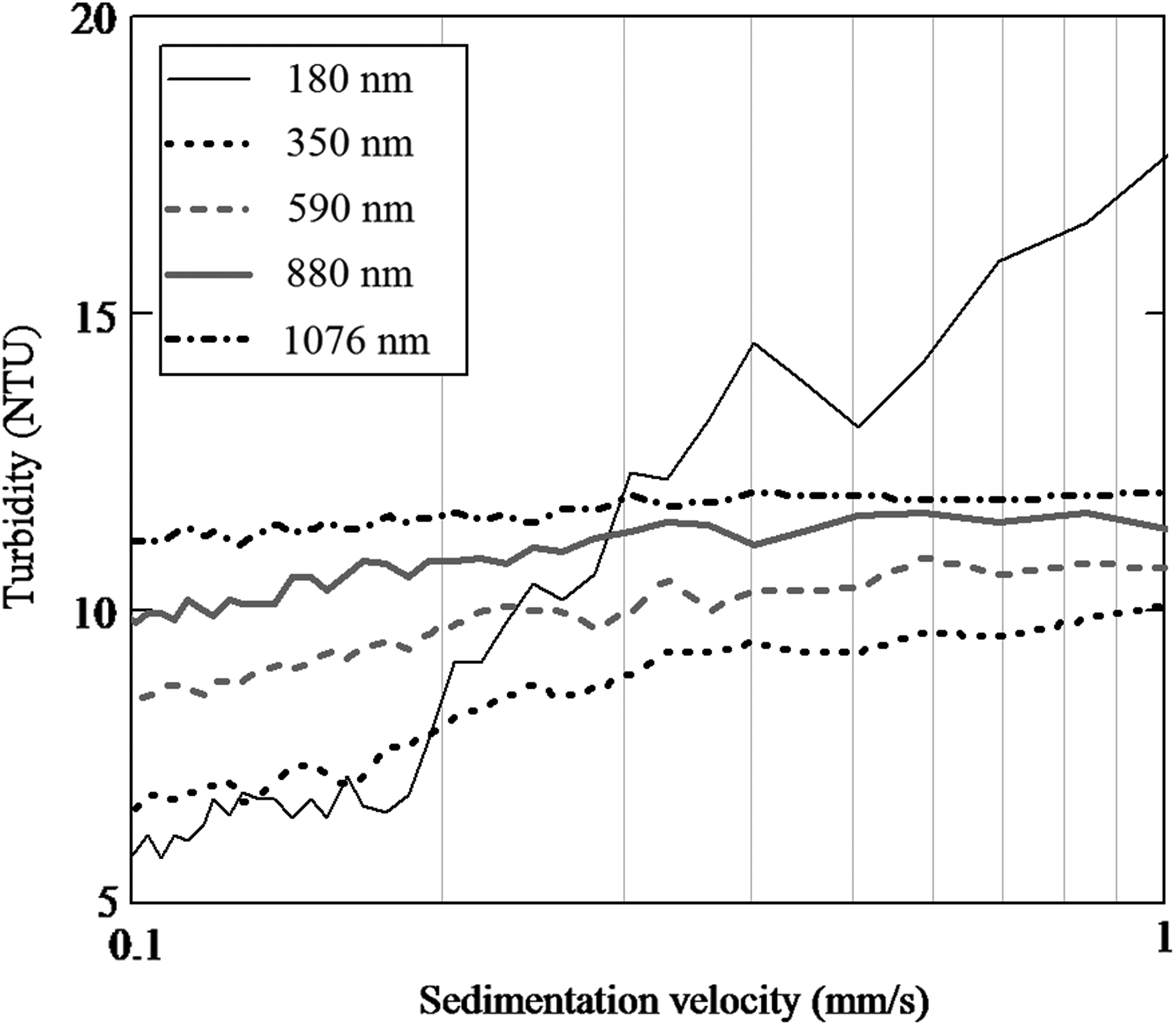
Sedimentation velocity from Al13-oxyhydroxide precipitates of various sizes. Data were collected at 1 s intervals for 30 min of settling. Each plot consists of 50 data points, each of which has an average of 36 s of data.
Starting with 180 nm initial aggregates, formation of a 1076 nm Al13-oxyhydroxide aggregate required ∼6.2 s at the experimental conditions in the microbore mixing chamber, assuming a self-aggregation attachment efficiency of 0.1. As shown in Fig. 7, providing PACl time for precipitation and aggregation will decrease the performance of the subsequent flocculation process by decreasing the attachment efficiency in the flocculation phase and increasing residual turbidity. Therefore, rapid mixing of coagulant with colloid suspensions after coagulant addition on a time scale of seconds is needed to ensure that Al13-oxyhydroxide does not self-aggregate before contacting colloids in the water to be treated. PACl will begin to precipitate as Al13-oxyhydroxide and aggregate as soon as the PACl stock blends with sufficient raw water to neutralize the pH of the mixture. The dilution required to begin precipitation is a function of the acid-neutralizing capacity (ANC) of the PACl stock and the ANC and pH of the raw water. Precipitation will occur most readily for high pH and high ANC waters such as raw waters in equilibrium with calcium carbonate. Aggregation is also favored by high PACl dose and low raw water colloid concentration, because the distance between Al13-oxyhydroxide precipitates would be small and the probability of first colliding with an Al13-oxyhydroxide precipitate over a clay platelet would be enhanced. If adequate mixing does not occur at the point of coagulant application, the pH of the PACl stock will be neutralized on entering the water, and the local concentration of coagulant will remain high, leading to precipitation and self-aggregation. Al aggregation after complete mixing with the raw water is expected to be insignificant, because Al13-oxyhydroxide aggregate interactions with clay platelets become highly favored over self-aggregation.
While mixing of coagulant with raw water has been a prerequisite to flocculation for decades, the results of this study suggest that coagulation with highly concentrated PACl coagulant requires immediate, rapid mixing within fractions of a second to decrease the local concentration of coagulant at the point of addition. Although beyond the scope of the present study, mixing also aids in the uniform application of the Al precipitates on the raw water colloid surfaces.
Conclusions
1. Under the solution conditions used for this research, PCN and EPC are not required for PACl coagulation, because the Al13-oxyhydroxide precipitates produced from PACl are much larger than the Debye length scale.
2. Geometric considerations show the reduction in residual turbidity as a function of PACl dose occurs over a dose range that is consistent with partial clay platelet coverage with Al13-oxyhydroxide precipitates.
3. PACl will readily precipitate as Al13-oxyhydroxide and aggregate at circum-neutral pH in short time scales (∼1 s) to sizes that are significant to the performance of the whole water treatment plant.
4. At a constant dose, increased size of Al13-oxyhydroxide precipitates decreases clay surface coverage and negatively affects the performance of subsequent flocculation and sedimentation processes.
5. Al13-oxyhydroxide precipitate-aggregation is not expected to be a factor in municipal water treatment plants once the coagulant is uniformly mixed with the raw water.
Quantitative turbidity removal—Al aggregation relationships observed in this research are specific to the experimental test conditions and are expected to vary in magnitude with influent water quality and coagulant dose. However, the qualitative effect of coagulant precipitation and aggregation can be generalized, and it is clear that Al13-oxyhydroxide aggregate size is a characteristic that should be considered when evaluating the results of flocculation performance experiments. From the perspective of the practical application of PACl to water treatment, this research confirms that turbidity removal by flocculation and sedimentation is improved if vigorous mixing occurs at the point of PACl addition. Immediate mixing with a high energy dissipation rate will increase the separation distance between Al13-oxyhydroxide precipitates and increase the probability that the closest particle which the Al13-oxyhydroxide will attach to is a clay particle, as opposed to another Al13-oxyhydroxide aggregate. Drip feed into a tank of slowly moving water is expected to result in inefficient flocculation due to self-aggregation and nonuniform application to colloids.
Footnotes
Acknowledgments
The research described in this article was funded by the Sanjuan Foundation. This project was supported by the staff and students at Cornell University, including Paul Charles, Timothy Brock, Alexander Krolick, Michael Adelman, Matthew Higgins, and Dale Johnson.
Author Disclosure Statement
No competing financial interests exist.