




Abstract
Abstract
Eisenia fetida was tested to assess terrestrial ecotoxicity in microcosms contaminated by copper (Cu), lead (Pb), and 1,2,4-trichlorobenzene (TCB) separately and in combinations. Toxicity endpoints were the median lethal concentration (LC50) and acid phosphatase (ACP), adenosine triphosphatase (ATPase), and glutathione S-transferase (GST) activities. Single toxicity tests revealed that the toxicity order was 1,2,4-TCB>Cu>Pb for E. fetida with LC50 as the toxicity criterion. A binary combination of Cu (25 or 200 mg/kg) and TCB (25 or 200 mg/kg) caused increased ACP and ATPase activities but decreased GST activities in all treatments. A combination of Pb (50 or 400 mg/kg) and TCB (50 or 400 mg/kg) caused increased (days 2 and 14) and decreased (day 7) ACP activities, initially increased (day 2) and then decreased (days 7 and 14) ATPase activities, and decreased GST activities in all treatments. In general, antagonistic and/or synergistic responses reflected bioaccumulation patterns in some binary combinations, but patterns in mixtures were not always consistent with toxicity data. This work presented in the article is original and novel and the results of this work can be regarded as sensitive parameters for monitoring the contamination in soils.
Introduction
We have reported the response mechanisms of the enzymes superoxide dismutase and acetylcholinesterase, and the ultrastructure in E. fetida under the stress of 1,2,4-TCB (Wu et al., 2011). In the present study, residual Cu or Pb in the soil and their bioaccumulation in earthworms were investigated by microcosm design experiments. Acute and subchronic toxicity tests were conducted to determine combined adverse effects upon contamination by Cu, Pb, and 1,2,4-TCB separately or in combinations at different incubation times.
Materials and Methods
Test organisms and test soil
E. fetida were purchased from a commercial supplier in Anhui province, China. The animals were adults with well-developed clitella, and weighed between 250 and 350 mg each. They were maintained in the laboratory under controlled conditions. All worms were removed from the soil before testing and stored in petri dishes with damp filter paper in the dark for 24 h to void their gut contents.
Soil was collected from a scenic spot (20 cm in depth) in the spring of 2011 from west Zhejiang province, China. The soil had no history of metals or polychlorinated biphenyls pollution application in the last 5 years. The soil type was sandy loam (paddy soil), and the soil parameters included the following: pH (H2O) 6.77; organic matter content, 3.45%; total N, 1.14 g/kg; total P, 1.36 g/kg; clay, 22.4%; silt, 46.3%; sand, 15.3%; density, 3.4 g/cm3; and water holding capacity, 70%. Soil was brought to the laboratory, sieved (3 mm), and air-dried prior to experimental procedures.
Test chemicals and reagents
1,2,4-TCB used in this study was purchased from the Sinopharm Chemical Reagent Co., Ltd. Acetone, CuSO4·5H2O, and Pb(NO3)2 were purchased from Hangzhou Chemical Reagent Company. All reagents were analytical grade.
Acute toxicological tests of single Cu, Pb, and 1,2,4-TCB
Experiments were conducted in microcosms (Kools et al., 2009). CuSO4·5H2O or Pb(NO3)2 were dissolved in 125 mL of de-ionized water and thoroughly mixed into the soil at 400, 800, 1200, 1600, 2000, and 2400 mg/kg dry soil concentrations. The soil was wetted to 70% of the water holding capacity, and then stabilized for 24 h prior to addition of earthworms. Each treatment was performed three times. A negative control consisting of 10 earthworms per microcosm was prepared. The microcosms were kept in an incubation chamber (20±1°C, 12D/12L photoperiod) throughout the test period. Mortality was determined at 2, 7, and 14 days. The earthworms were sorted by hand and considered dead if they did not respond to gentle mechanical stimulation of the anterior region. Given that earthworms disintegrate quickly after death, they were considered to have died if they were missing.
For the acute toxicological tests of 1,2,4-TCB, the 1,2,4-TCB was dissolved in 5 mL of acetone and thoroughly mixed into the natural soil at 200, 400, 800, 1200, 1600, and 2000 mg/kg dry soil concentrations. The rest of the protocol was that of the Cu and Pb tests. As a negative control, 5 mL of acetone was added to another batch of soil. De-ionized water (125 mL) that had been left in an exhaust hood for at least 1 day to ensure complete acetone evaporation was introduced into the microcosms.
Cu2+, Pb, and 1,2,4-TCB single and joint toxicological tests
Experiment treatment
The choice of three concentrations was based on the environmental quality standards for soils of China and our preliminary experiments that generated the concentration–response curves for E. fetida. To simulate real-world exposure, these standards correspond to the values in polluted soils in the industrial regions of China. The present study was conducted in microcosms, and the binary combinations treatments details are shown in Table 1.
All values are expressed as mg/kg soil.
Cu, copper; Pb, lead; 1,2,4-TCB, 1,2,4-trichlorobenzene.
Residual Cu and Pb in soil and their bioaccumulation in earthworms
Residual Cu and Pb in soil were determined at 2, 7, and 14 days. Before the experiment, the soil from the microcosms was dried in an oven at 105°C. Three replicates were used for each dose of treatment. The test solution was prepared based on GB/T17138-1997. Cu and Pb bioaccumulation in earthworms were examined in the same manner as residual Cu and Pb in soil. After 2, 7, and 14 days of exposure, three replicates of earthworms were removed from the substrate, cleaned, and weighed prior to homogenization. Biota-to-soil accumulation factor (BSAF) is defined as the metal concentration in tissue (mg/kg dry tissue) divided by the metal concentration in soil (mg/kg dry soil) (Jun et al., 2004)
Enyzme activity assays
Earthworms from the previous section were homogenized in pH 7.5 tris buffer (250 mmol/L sucrose, 1 mmol/L DTT, 1 mmol/L EDTA, and 50 mmol/L Tris) using a glass homogenizer. The homogenate was centrifuged at 10,000 g at 4°C for 15 min. After centrifugation, the supernatants were collected and stored at −80°C until analysis. All procedures were carried out at 4°C.
ACP was assayed according to Torunn and Jørgen (2000), and ATPase was determined according to Jena and Patnaik (1995). GST measurement was based on a method in which the amount of 1-chloro-2,4-dinitrobenzene decreases during spectrophotometry, and it was adapted for the microplate format (Lukkari et al., 2006). Protein concentration was measured using a reagent kit purchased from Nanjing Jiancheng Company.
Statistical analysis
Data were analyzed using the SPSS program (Standard Version 13.0, SPSS, Inc.). The relationships between pollutant concentration and exposure duration on growth inhibition, as well as ACP, ATPase, and GST activities, were tested by two-way analysis of variance (ANOVA). The probability thresholds used for the statistical significance were p<0.05, p<0.01, and p<0.001. All values were presented as mean±standard deviation.
Results and Discussion
Residual Cu and Pb in soil and their bioaccumulation in earthworms
Figure 1A and B shows that with either low- or high-dose exposure, the residual concentrations of Cu and Pb in the soil decreased with increased exposure time. Cu and Pb bioaccumulations were concentration-dependent, as shown in Fig. 1C and D. Cu accumulation in E. fetida reached 10.42 and 7.08 mg/kg dry weight (DW) at 200 or 25 mg/kg Cu treatment after 14 days of incubation (Fig. 1C). Pb accumulation reached 14.51 and 7.32 mg/kg DW at 400 or 50 mg/kg Pb treatment after 14 days of incubation (Fig. 1D). With increased initial concentration of Cu and Pb in the soils, the Cu and Pb contents in the earthworms increased. This finding suggested that Cu and Pb bioaccumulation in the earthworms decreased the soil concentration, and that the interaction between the earthworms and organic matter further affected the Cu and Pb bioaccumulation in the soils.

Residual concentrations of copper (Cu) and lead (Pb) in soil and bioaccumulation in earthworms at various doses.
Bioavailability to the earthworms was estimated by calculating the BSAF. Table 2 shows the changes in BSAF. Upon exposure to 25 or 200 mg/kg Cu, the BSAF after 2, 7, and 14 days varied around 0.075–0.3 and 0.019–0.054. Upon exposure to 50 or 400 mg/kg Pb, the BSAF after 2, 7, and 14 days varied around 0.042–0.0136 and 0.013–0.038. All BSAFs were distinctly <1, indicating that Cu and Pb in the earthworm body did not reach saturation and were only in the absorption phase. BSAF was significantly higher under low- than high-concentration exposure. Thus, Cu and Pb bioaccumulation in E. fetida varied with the initial incubation concentration. Excessive accumulated Pb, Cu, and CBs can stimulate ROS production or activate the defense enzyme system in animals (Ma et al., 2003; Lukkari et al., 2005). Our results showed that Cu and Pb contents in earthworms increased with increased initial concentrations of Cu and Pb in the soil. This result may be due to the fact that leaching and runoff, which play important roles in degradation, were absent in our experiment.
Acute toxicity tests of single Cu, Pb, and 1,2,4-TCB on earthworms
Figure 2 shows the toxic effects after E. fetida exposure to Cu, Pb and 1,2,4-TCB alone. The influence of these chemicals on earthworms was expressed as the median lethal concentration (LC50) and a regression equation. The acute toxicity was significantly affected in Cu-, Pb-, or 1,2,4-TCB–amended soil microcosms. The severity of the response increased with increasing concentration of the chemicals. The concentration–response relationship between mortality (y) and concentration (x) fit the regression linear equation. Figure 2A and B show that after 2, 7, and 14 days of exposure, the LC50 values of Cu were 1255.945, 1115.631, and 1047.638 mg/kg, and the correlation coefficients (R2) were 0.90637, 0.87169, and 0.87249, respectively. The LC50 values of Pb were 2554.883, 1930.218, and 1237.620 mg/kg, and the correlation coefficients (R2) were 0.53024, 0.84668, and 0.97637 (Fig. 2C, D). Fig. 2E and F shows that the LC50 values of 1,2,4-TCB were 1213.411, 787.414, and 511.875 mg/kg, and the correlation coefficients (R2) were 0.89326, 0.98631, and 0.90778, respectively. Mortality presented a fluctuation in all treatments, and it clearly depended on the concentrations of Cu, Pb, and 1,2,4-TCB added to soil. With increased exposure time, the mortality of E. fetida for any given concentration increased. These results indicated that the single pollution of Cu, Pb, and 1,2,4-TCB had strong toxic effects on E. fetida. The toxicity of 1,2,4-TCB was the highest among the three pollutants. The descending order of the average acute toxicity was 1,2,4-TCB>Cu>Pb.
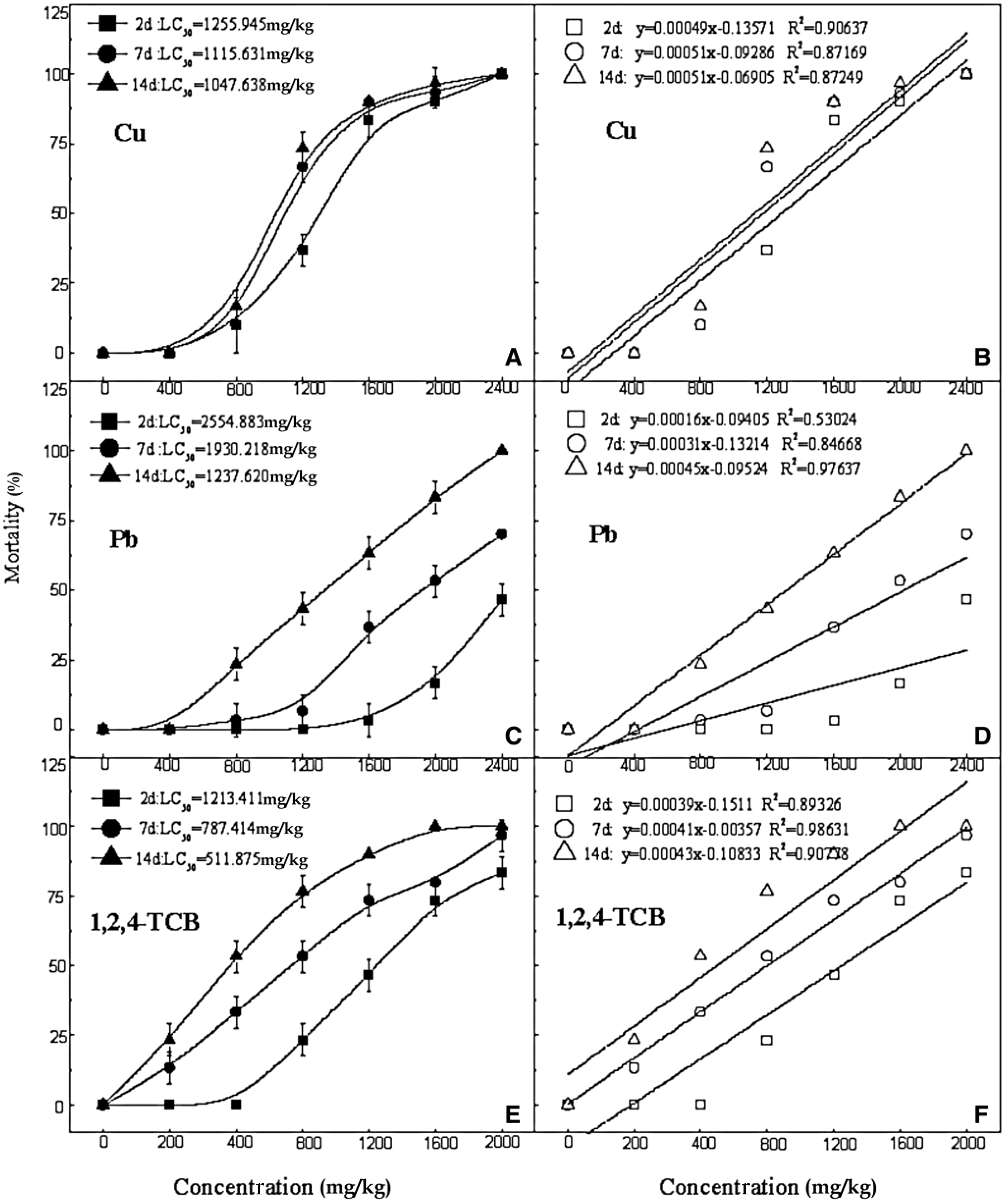
Relationship between mortality of Eisenia fetida and their exposure to different concentrations of Cu, Pb, or 1,2,4-trichlorobenzene (1,2,4-TCB) after 2, 7, and 14 days exposure.
Combined effects of Cu and 1,2,4-TCB on ACP, ATPase, and GST activities
The effects of Cu and 1,2,4-TCB alone and in combination on ACP, ATPase, and GST activities in E. fetida after 2, 7, and 14 days of exposure are shown in Fig. 3. According to Fig. 3, the combined treatments of these two compounds had increased effects on ACP activity, which were 244.44% and 211.32% of the control after 2 days of exposure to Cu (200)+TCB (200) and after 14 days exposure to Cu (25)+TCB (200), respectively. For any given concentration of Cu, the joint toxicity of Cu and 1,2,4-TCB on the ACP activity was higher than the toxicity of Cu or TCB alone. The influence of these two compounds on ATPase was similar to that of ACP, but on the 7th day of exposure, ATPase activity sharply decreased in all treatments, and these levels were far lower than those of other treatments.
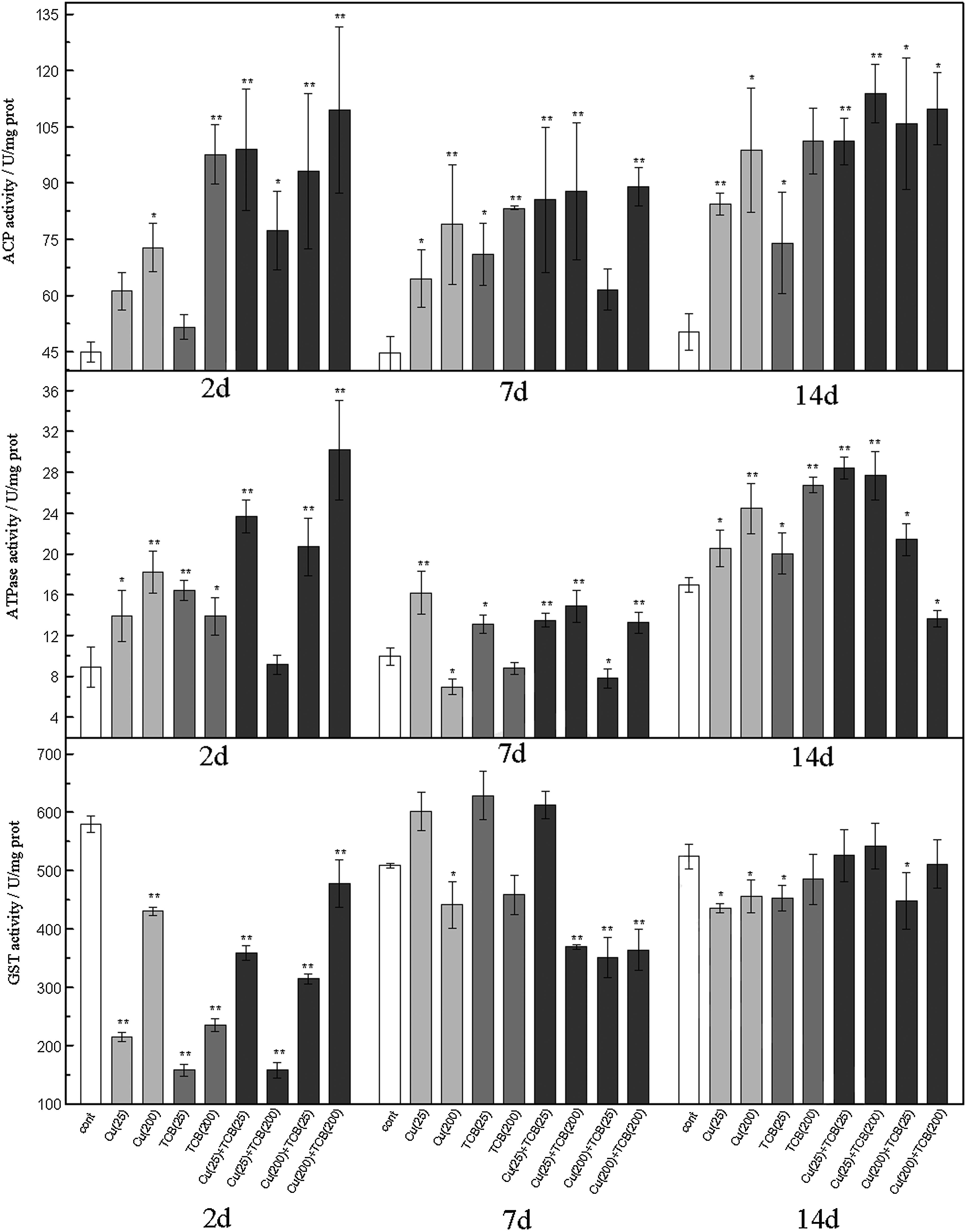
Effects of Cu and 1,2,4-TCB, singly and in combination, on acid phosphatase (ACP), adenosine triphosphatase (ATPase), and glutathione S-transferase (GST) activities in E. fetida after 2, 7, and 14 days exposure. Statistical significance vs. control group: *p<0.05, **p<0.01.
After 2 days of exposure, the combination of Cu (25)+TCB (200) and Cu (200)+TCB (25) caused decreased GST activity to levels much lower than that of the control (19.30% and 56.14% of the control, respectively). For 25 mg/kg Cu, the joint toxicity was higher than Cu alone. For 25 mg/kg TCB and 200 mg/kg Cu, the joint toxicity was lower than that of TCB alone. In other words, at 200 mg/kg Cu, the interaction effects of Cu and TCB were antagonistic. At 25 mg/kg Cu, the joint toxicity was higher than the single toxicity of TCB (Cu 25+TCB 200>TCB 200). There may be additive effects on each other. With increased exposure time, the joint toxicity of Cu+TCB increased with the mortality. The two-way ANOVA indicated that concentration of combined Cu and 1,2,4-TCB (p<0.001) and exposure duration (p<0.001) had a significant interaction effect on ACP, ATPase, and GST activities (p<0.001, Table 3).
ACP, acid phosphatase; ATPase, adenosine triphosphatase; GST, glutathione S-transferase.
CBs and metals are frequently found together as soil contaminants. These pollutants affect the physiological activity of soil organisms, especially enzyme activities, and they can be used to evaluate the soil microbial properties. In many cases, the activities of ACP, ATPase, and GST appear to be more sensitive to pollution than those of other enzymes (Yang and Liu, 2000). Within a certain concentration range, in a single case of contamination, enzyme activity changes showed a certain degree of regularity. This finding was in contrast with microbial ACP activity upon heavy metals pollution (Yang and Liu, 2000). In compound pollution, although the enzyme activity changes were irregular, the activities were significantly activated compared with the control group. Thus, in this case of combined concentrations, lysosomes underwent no irreversible damage. This view has been proven by a previous experiment on earthworms continually exposed to albendazole(ABZ). Lysosomal membranes are reportedly easily injured, resulting in generally irreversible decreased ACP activity (Gao et al., 2007). Therefore, we believe that ACP can be used as a biomarker to indicate soil contamination by Cu and TCB, not only individually but also in combination. ACP activity can change with the extent of soil contamination, and the ACP activity of earthworm excellently indicated environmental changes in the soil.
Combined effects of Pb and 1,2,4-TCB on ACP, ATPase, and GST activities
Figure 4 shows the effects of Pb and 1,2,4-TCB, alone or in combination, at various exposure times on ACP, ATPase, and GST activities in E. fetida. In single Pb pollution, the toxicity symptom was similar to that of Cu and the enzyme activities fluctuated in all the treatments. There was a clear concentration–response relationship between the enzyme activities and amount of Pb added to the soil. According to the results in Fig. 4, the joint effects of Pb and 1,2,4-TCB on the ACP enzyme activity significantly increased on days 2 and 14 of exposure but abruptly decreased on day 7. On day 2 (Fig. 4), ATPase was slightly inhibited by single Pb (50 or 400) pollution but significantly inhibited by single 1,2,4-TCB (50 or 400) pollution. Combined Pb and 1,2,4-TCB stimulated ATPase activities, and the level of stimulation was significantly higher than that of other treatments. On days 7 and 14, the combined treatments of two compounds had an inhibited effect on ATPase activity, and the severity of the antagonistic response increased with increased Pb and 1,2,4-TCB concentrations (Fig. 4). GST activity exhibited a similar response to Pb and 1,2,4-TCB on ATPase. As regards the combined treatments of two compounds, GST activity was lower than that of Pb and 1,2,4-TCB alone, but the decrease was not positively correlated with the increase in Pb and TCB concentrations. In other words, the interaction effects of Pb and 1,2,4-TCB were synergistic (Fig. 4).
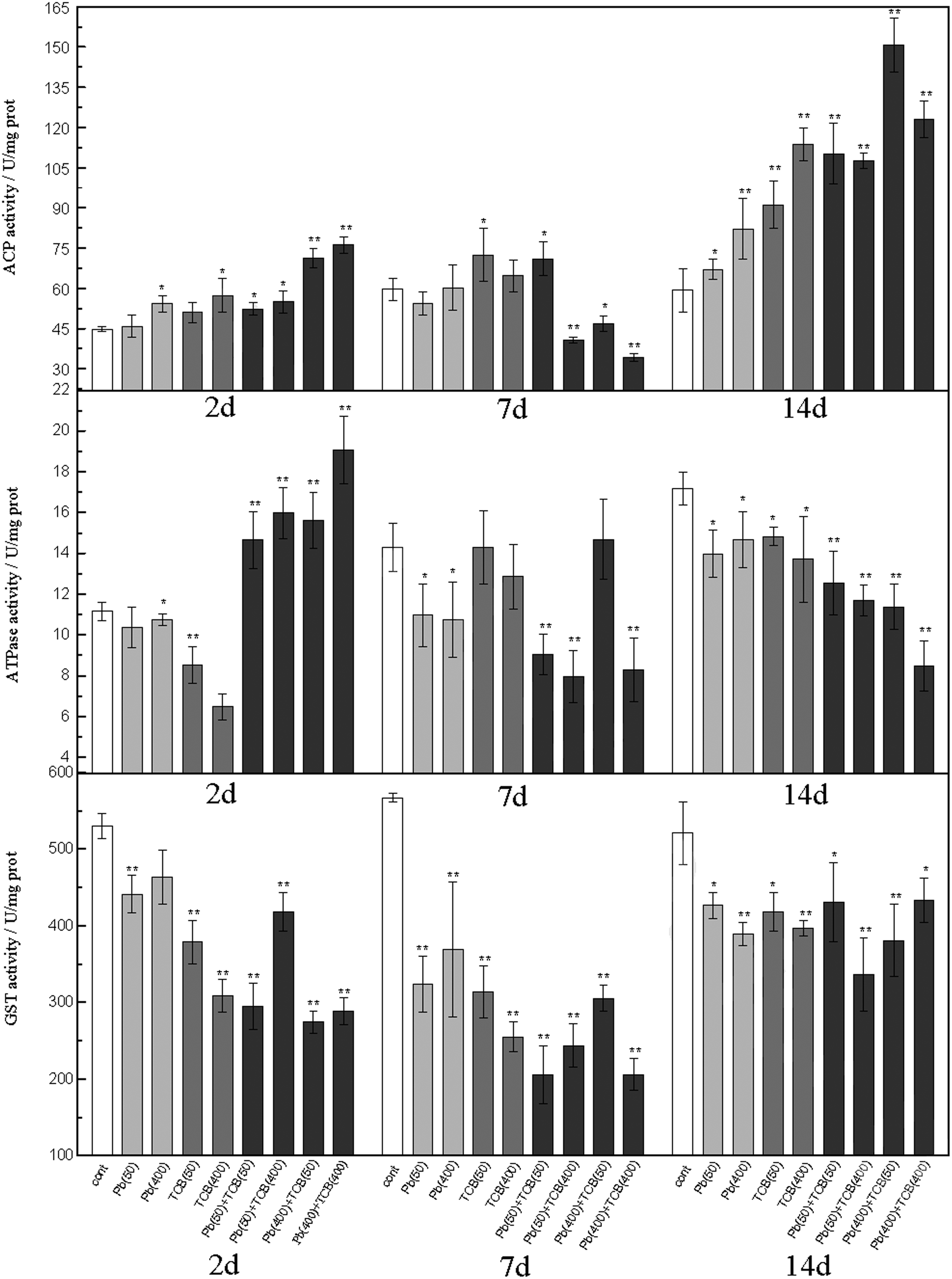
Effects of Pb and 1,2,4-TCB, singly and in combination, on ACP, ATPase, and GST activities in E. fetida after 2, 7, and 14 days of exposure. Statistical significance vs. control group: *p<0.05, **p<0.01.
Joint effects of pollutants may be similar (additive) to the expected effects of separate exposures, or stronger (synergistic, more than additive) or weaker (antagonistic, less than additive) than those of separate exposures (Yang and Liu, 2000). The earthworm in the current work suffered more stress from pollutants combined at higher concentrations, which can be attributed to saturated natural antioxidant defenses. Grosell et al. (2004) have also reported that ATPase activity in earthworms is stimulated by Cu at low doses and inhibited at higher doses. Under normal physiological conditions, ATPase maintains a dynamic balance and can meet the need of the organism to export or eliminate toxicants. However, the balance between the accumulation and removal of toxicants can be easily broken by stress (Grosell et al., 2004).
ANOVA revealed that the combined concentration of Pb and 1,2,4-TCB (p<0.001) and exposure duration (p<0.001) had a significant interaction effect on ACP, ATPase, GST activities in E. fetida (p<0.001; Table 3).
Conclusions
Toxic effects followed the trend 1,2,4-TCB>Cu>Pb for E. fetida. Mixtures of Cu+TCB and Pb+TCB exhibited more toxic effects (synergism) than expected on E. fetida within 14 days of exposure based on individual components. Thus, metals and CBs interactions may be influenced by the exposure periods and combination of components. The strictly synergistic effects on E. fetida that were observed suggest the need for the inclusion of mixture considerations in the risk assessment of metals.
Footnotes
Acknowledgments
This work was financially supported by the Natural Science Foundation of China (20977087) and the Natural Science Foundation of Zhejiang Province (LY13B070008).
Author Disclosure Statement
The authors have no competing financial interests.