




Abstract
Abstract
Granular sludge formed in upflow anaerobic sludge blanket reactors play an important role in the field of anaerobic treatment due to their engineering advantages over conventional flocculent forms, such as rich microbial diversity, high solid retention time due to its superior settling characteristics, maximizing the microorganisms-to-space ratio, and greater ability to withstand shock loadings or temperature changes. A better understanding of granule characteristics is highly useful and vital for efficient operation of bioreactors. Recently, developments in the characterization of microbial granules have been made with innovative approaches and sophisticated technologies. This article provides an up-to-date review from the past two decades in the understanding of physicochemical and morphological characteristics of granular sludge with regard to granule size, settling velocity, specific gravity, sludge volume index, volatile suspended solids–to–suspended solids ratio, ash content, inorganic chemical content, crystalline structure, molecular functional groups, microbial structure and composition, microbial communities, and methanogenic activity. Addition of external additives such as synthetic and natural polymers and vitamins may enhance the characteristics of granular sludge. Bioaugmentation might be a useful tool for improving the stability and significantly reducing the length of start-up periods. Application of easily degradable cosubstrates such as glucose, sucrose, cellulose, molasses solution, and volatile fatty acids is highly beneficial in treating toxic wastewaters and improving sludge characteristics. Emerging knowledge on such characteristics might exhibit the optimization of microbial granulation as one of the most reliable techniques in anaerobic treatment. Future research directions are also highlighted.
Introduction
Several review articles have been published in the last few years, and they cover almost every aspect of microbial granulation. Hulshoff-Pol et al. (2004) have extensively reviewed different theories on anaerobic sludge granulation in UASB reactors that have been proposed during the past two decades. Liu and Tay (2004) reviewed various aspects, including the models of biogranulation, major factors influencing biogranulation, characteristics of biogranules, and their industrial applications. Tiwari et al. (2006) reported a minireview on the influence of extrinsic factors on granulation in a UASB reactor. Liu et al. (2009) reviewed the physicochemical characteristics of microbial granules: settleability and permeability, morphology, mechanical stability, rheology, porosity, surface adsorbability, surface hydrophobicity and thermodynamics, and extracellular polymeric substances. Recently, Habeeb et al. (2011) reviewed granule initiation and development inside a UASB reactor and the main factors affecting the granule formation process. The performance enhancements of UASB reactors for domestic sludge treatment were reviewed by Chong et al. (2012). The important aspects of their review are (1) enhancing the start-up and granulation in UASB reactors, (2) coupling with the post-treatment unit to overcome the temperature constraint, and (3) improving the removal efficiencies of the organic matter, nutrients, and pathogens in the final effluent.
Granulation is a process involving the development from seed sludge to compact aggregates, further to granular sludge, and then finally to mature, nearly spherical granules. The key factor of the successful operation of a UASB reactor is mainly granulation evolution. Granular sludge offers various engineering advantages over the flocculent form, such as high solid retention time due to its excellent settling property, providing maximum microorganisms-to-space ratio, and application of high loading rates (Ghangrekar et al., 2005). Hence, the characteristics of sludge developed are of vital importance for maximizing advantages of UASB reactors and affecting the process economy. On the other hand, granulation technology has some drawbacks, such as a long start-up period—generally 3–8 months required for the development of granules (Zhou et al., 2007) and wash out of biomass (Vlyssides et al., 2008). Therefore, it is essential to elucidate the physicochemical and morphological characteristics of granular sludge to overcome the shortcomings of the granular sludge processes.
The main objective of this review is to summarize the findings in the investigations into the physicochemical and morphological characteristics of granular sludge. Recently, incredible developments in the characterization of microbial granules have been made with innovative approaches and sophisticated technologies. Characterization of microbial granules is highly useful and vital for efficient operation of bioreactors, including granule size, settling velocity, specific gravity, sludge volume index (SVI), volatile suspended solids–to–suspended solids (VSS/SS) ratio, ash content, inorganic chemical content, crystalline structure, molecular functional groups, microbial structure and composition, microbial communities, and methanogenic activity. So far, no article has been published covering all these crucial aspects.
Discussion
Granule size
Sludge granules are developed by self-granulation of microorganisms, and a dynamic balance between granule growth and decay results in coexistence of UASB sludge with different sizes in the reactor (Ahn et al., 2002). Based on the Reynolds number and settling velocity, diameter of particles ≥0.34 mm should be considered as good granules (Bhunia and Ghangrekar, 2006) from the engineering aspect of reactor operation. Physicochemical characteristics of granular methanogenic sludge grown on various carbon sources in UASB reactors are shown in Table 1. The maximum granule size (6 mm) was observed on sludge grown on an easily degradable substrate, lactate (Fukuzaki et al., 1991a), and on a mixture of glucose, peptone, and meat extract (Yan and Tay, 1997). Yan and Tay (1997) reported that 55% of the total bioparticles were <0.5 mm, indicating their significant role in maintaining the dynamic granular balance and stability. The granules formed were relatively small, ranging mainly from 0.4 to 0.5 mm (Chang et al., 1993), and granules sized from 0.5 to 2.5 mm (Subramanyam and Mishra, 2013b) were observed using glucose as a substrate, indicating that granule size depends on the operational conditions. Fukuzaki et al. (1995) advocated starch- and sucrose-grown granules were larger in size than the ethanol- or fatty acid-grown granules. The average size of the biomass granules in a sucrose-fed UASB reactor was slightly larger than that of a phenol-fed reactor (Chou and Huang, 2005). Tay et al. (2001) found that the use of an easily degradable cosubstrate along with the phenolic wastewater helps in the growth of the larger-sized granules in a UASB reactor. Addition of synthetic (Percol 763 as a cationic synthetic acrylamide polymer and poly acrylamide 8265) and natural polymers (chitosan and reetha), and vitamins (C, B3, and B12) exhibits positive effects on granulation, start-up, and reactor performance (El-Mamouni et al., 1998; Show et al., 2004; Tiwari et al., 2005; Fermoso et al., 2010; Abbasi et al., 2012; Hudayah et al., 2012) in a UASB operation. Chitosan in solution enhanced the granulation process and the UASB performance more than chitosan in bead or powder forms (Nuntakumjorn et al., 2008). The superior granulation performance of chitosan was probably related to its polysaccharide structure, hence acting similarly to the extracellular polymeric substances in aggregating anaerobic sludge (El-Mamouni et al., 1998). However, enhancement of granulation due to polymer addition need not always be indicated by the size of granules, rather it can be best represented by the combination of granule size, settling velocity, and its strength and activity (Show et al., 2004). The size distribution of granules across the height of the sludge bed showed that granules of smaller size were found at the top and middle zones of the sludge bed, while larger-diameter granules were mainly concentrated at the lower active zones (Gupta and Gupta, 2005). Bartrolí et al. (2011) found that bioaugmentation is a useful tool for improving stability and significantly reduced the length of the start-up period to achieve partial nitrification in a biofilm airlift reactor.
Sl. no, sludge number.
Settling velocity
The successful operation of a UASB reactor mainly depends on formation of large granules with a high settling velocity. The high settling velocity is obtained due to compaction and aggregation of the microbial mass, resulting in high density and large size of the granules (Lens et al., 1998). It is helpful for the sludge to reduce washout of active sludge from the reactor. Schmidt and Ahring (1996) have divided granular sludge into three fractions based on the reported settling velocities: a poor settling fraction, a satisfactorily settling fraction, and a good settling fraction, with settling velocities up to 20 m/h, from 20 to 50 m/h, and over 50 m/h, respectively. The general range for settling velocity of a good granular sludge was reported as 23–94 m/h (Table 1). However, a settling velocity of ∼60 m/h is considered to be very good for granular sludge (Hulshoff-Pol et al., 2004). With good settling properties, thickened sludge of high solids concentration can be obtained, particularly in the lower part of the reactor. It has been proven that the addition of a cationic polymer at a concentration of 80 mg/L and vitamin C at a concentration of 0.5 mg/L enhanced the settling velocity (Show et al., 2004; Abbasi et al., 2012). The presence of Ca2+ in sludge granules has been found to enhance the settling property (Lettinga et al., 1980).
The settling velocity of granules varied along the height of the reactor. Chang et al. (1995) reported that the granule size and settling velocity in the lower part of the reactor were comparatively greater than those in the upper part. A similar conclusion was drawn by Gupta and Gupta (2005), that the size distribution of granules across the height of the sludge bed showed that granules of larger diameter having a higher settling velocity are mainly concentrated at the lower active zones, while smaller-sized granules having a lower settling velocity were found at the top and middle zones of the sludge bed. Winkler et al. (2012) observed a twofold slower settling velocity for the same granules when the temperature of water decreased from 40°C to 5°C. Settling velocities also decreased with increasing salt concentrations. These results suggest that temperature and salt concentrations are important parameters to consider in the design, start-up, and operation of granular sludge reactors. Monitoring of these parameters will aid in a better control of sludge management in anaerobic granular sludge technology.
Specific gravity
Specific gravity (also known as relative density) is an important property of sludge. It varies based upon water content in the sludge. A high specific gravity is indicative of a good sludge that settles at the bottom. The specific gravity with the range of 0.97–1.355 reported in the literature for the granules grown on different substrates in UASB reactors is shown in Table 1. Fukuzaki et al. (1995) reported that the granules grown on a butyrate–propionate mixture exhibited high specific gravity and a low settling velocity in spite of their small sizes. Ethanol under slightly acidic conditions showed the lowest specific gravity compared with granules grown on starch, sucrose, and butyrate plus propionate. The microbial density of the phenol-fed UASB reactor was significantly higher than of the sucrose-fed UASB reactor, implying that the granules were more compact in the phenol-fed UASB reactor.
Sludge volume index
The SVI is an important property of sludge. A low SVI value indicates good settling, leading to settlement of more sludge and helping to maintain a high SRT. Yan and Tay (1997) reported that the granules grown on synthetic feed composed of glucose, peptone, and meat extract had an SVI of 9.5 mL/g (Table 1), and such excellent settling properties mainly owe to the aggregation of the microorganisms. The SVI of the granular sludge grown on a glucose solution decreased from 43 mL/g of seed sludge to 20–25 mL/g (Subramanyam and Mishra, 2013b). The SVI of the sludge decreased with an increase in the OLR. The possible explanation could be based on washout of the bulking sludge, leaving the compacted granular sludge inside the reactor.
VSS/SS ratio
The VSS/SS ratio is significant because it indicates the amount of viable sludge in total sludge measured as SS. If the ratio is high, it indicates a larger percentage of viable sludge. An increase in the VSS/SS ratio of sludge was observed with increase in the loading rate (Ghangrekar et al., 2005). The low VSS/SS ratio (0.4) was observed at lower loading rates (∼1.5 kg COD/m3 per day), and a high ratio (0.6–0.65) was observed at higher loading rates (>6.0 kg COD/m3 per day) (Shen et al., 1993; Ghangrekar et al., 2005). The change in the VSS/SS ratio and specific gravity was observed with the size of granules (Bhunia and Ghangrekar, 2007). Granular sludge generally had VSS/SS ratios between 0.6 and 0.85 in the reviewed literature (Lin and Yang, 1991; Yan and Tay, 1997; Lens et al., 1998).
Ash content
Ash content is a very important parameter in sludge characterization. High ash content is responsible for the high specific gravity and high settlability of the granules. In addition, it is thought that these precipitates or plate crystals of inorganic salts function as spontaneous inert supports for the formation of microbial aggregates (Fukuzaki et al., 1991a). Normally, ash contains inert materials similar to silica and/or silt, which might originate from the nongranular inoculum sludge and from impurities in the feed chemicals used (Ghangrekar et al., 2005). The formation of inorganic precipitates that help as support materials is also essential for the granulation of sludge (Chang et al., 1993). Bhatti et al. (1995) reported that silica and/or silt may also be an important ingredient of granular sludge and may help provide a three-dimensional matrix for bacterial aggregation.
Divalent cations such as calcium and iron may enhance granulation by ionic bridging and linking exocellular polymers. However, their presence in excess may lead to cementation due to precipitation, leading to increased ash content and mass transfer limitation. The addition of nonacidified substrate improves the quality of sludge with a high ash content by retarding agglomeration (Yu et al., 2000). The resistance to substrate diffusion inside the granules increases proportionally with the physical granular size and ash content, making the substrate less available to the granule core and eventually resulting in substrate deficiency or depletion inside granules (Alphenaar et al., 1993).
Bhatti et al. (1995) reported that the ash content of granular sludge ranged from 11% to 21% when analyzing the characteristics of methanogenic granular sludge treating industrial wastes under different conditions. It seems that the amount of ash formed is dependent on the feed substrate. Although the ash content of the sludge used as an inoculum was the same, the granules that formed on the feed containing glucose had a very low ash content (ranging from 11% to 13%) compared with the granules grown on propionate or lactate (ranging from 44% to 53%; Table 1). Such high contents are probably attributable to local alkaliphilic conditions caused by the bioconversion of fatty acids to CH4 in microbial biotopes inside the granules, where the deposition of inorganic salts would occur even when the mineral concentrations in the feed medium are low (Fukuzaki et al., 1991a, 1991b). It was also concluded that the ash content of the granules increased from 11.4% in the lower part of the reactor to 13.6% in the upper part (Chang et al., 1993). Table 1 depicts that granules grown on ethanol under slightly acidic conditions showed the lowest ash content, and fatty acid–grown granules contained more inorganic salts among all of the granules grown on starch, sucrose, and butyrate plus propionate (Fukuzaki et al., 1995). It is predicted that relatively large amounts of ash would accumulate in methanogenic granules, regardless of starting substrates, because of the reactions of methanogenesis from volatile fatty acids (VFAs) (Fukuzaki et al., 1991b). Ramakrishnan and Gupta (2006) reported that the ash content of granules decreased with an increase in the OLR, decreasing from 14%–18% at 0.8 kg COD/m3 per day to 11%–13% at 2.248 kg COD/m3 per day while treating the phenolic waste. The granules grown on complex wastewater have lower ash content than simple substrates such as acetate, propionate, or butyrate (Ahring et al., 1993). The ash content of the granules ranges from 10% to 90% of the dry weight of the granules, and it has a positive effect on some reactor operational parameters—temperature (Dolfing, 1986), pH (Chang et al., 1993), OLR (Fukuzaki et al., 1995), period of operation (Quarmby and Forster, 1995), and influent mineral concentration (Shen et al., 1993)—while exhibiting a negative effect on the complexity of the wastewater composition (Alibhai and Forster, 1988; Schmidt and Ahring, 1994). Dolfing et al. (1985) reported that 30% of ash content was FeS, presumably responsible for the black color of the granules. The ash fraction of 20–25 mg/g of dry sludge is favorable for better sludge characteristics and for a higher COD removal efficiency (Ghangrekar et al., 2005). The extracellular polymeric material of granular sludge contained 1.7%–2.7% carbohydrates, 2.5%–5.1% nucleic acids, and 8.3%–16.3% proteins of total suspended solids treating industrial wastes under different conditions (Bhatti et al., 1995). Fukuzaki et al. (1995) reported that the major components of the ash were calcium (28%–32%), phosphorus (18%–21%), magnesium (3%–4%), sodium (2%–3%), potassium (0.5%–l%), and trace elements (0.4%–0.6%) such as iron, nickel, and cobalt, regardless of the carbon sources degraded in the UASB reactors.
Inorganic chemical content
The main mechanisms involved in the metal accumulation within biofilms are complex formation, chelation of metals, sorption onto minerals (such as iron sulfides and calcium carbonates), ion exchange, microprecipitation, and translocation of metals into the bacterial cells. The chemical composition of granular sludge depends on the seed sludge and the chemical composition of the wastewater (Batstone et al., 2004). The concentrations of essential macro-and micronutrients such as calcium, iron, magnesium, copper, phosphorus, cobalt, and aluminum in the feed play a very important role in the aggregation of the cells and deposition of precipitates. Phosphorus, nitrogen, and potassium are found to inhibit the effect of shock loading and prevent the flotation of granules (Alphenaar et al., 1993; Blaszczyk et al., 1994). Metal accumulation in the sludge depends on many factors, including the nature of the mineral and organic constituents, the pH, and the nature of the metal (Van Hullebusch et al., 2003). Precipitation of metals as carbonates or sulfides is usually reported to be the main mechanism involved in metal accumulation (van Hullebusch et al., 2005). Divalent ions (such as calcium, iron, and barium) were reported to play an important role in microbial aggregation. Introduction of Ca2+ at concentrations from 150 to 300 mg/L enhanced the biomass accumulation and granulation process. On the other hand, the presence of too much calcium in the granules could damage the environment required for maintenance of the granular structure or the bacterial activity (Yu et al., 2001). Singh and Viraraghavan (2003) reported that divalent cations such as calcium and magnesium facilitated the adhesion of cells, resulting in the formation of pellets and granular type of aggregation. The presence of calcium strongly enhances the adhesion of the cells by microbial appendages and/or polymers. Extracellular polymers (ECPs) prefer to bind to divalent metals when they are available due to their more stable complexes (Rudd et al., 1984). However, when Ca2+ is added, mineral precipitates such as CaCO3 and Ca5OH(PO4)3 are formed, and there is a risk of cementation in the UASB reactor (van Langerak et al., 1998). van Langerak et al. (2000) reported that the precipitation of CaCO3 rarely takes place at the surface of well-formed granules, because CaCO3 is rapidly dissolved or covered with a layer of fast-growing, acid-forming biomass.
Introduction of Fe2+ at concentrations of 300 and 450 mg/L enhanced the granulation process through bridging between negatively charged groups on the cell surfaces and linking ECPs in the UASB reactors. However, a very high influent Fe2+ concentration led to a higher ash content and severe mass transfer limitations in granules (Yu et al., 2000). Cobalt is an essential micronutrient for both acetogens and methanogens, and phosphorus is essential for the growth and maintenance of cells (Jarrell and Kalmokoff, 1988). Cobalt gets internalized by the microbial species and may be found in the form of corrinoids in the cells. It enhances the methanogenic activity. Dolfing et al. (1985) reported that FeS contributed to 30% of the ash content of UASB granules, as a result of metabolic activities and physicochemical reactions, and are accumulated either inside or on the surface of granules. Al3+ can bridge between negatively charged groups on cell surfaces, which is important in adhesion phenomena. Guiot et al. (1988) found that the presence of trace metals, such as Fe2+, Ni2+, Co2+, and Mn2+, enhance sludge granulation. Hulshoff-Pol (1989) reported that iron and sulfur present in a significant quantity on the surface of granules possibly contributed to the aggregation of biomass.
The mineral composition of granular sludge mainly depends on mineral composition of feed, but specific uptake of preferred minerals may take place depending on the operational and environmental conditions (Bhatti et al., 1995). The microbiological treatment process requires nutrients and trace metals to sustain growth and to carry out biochemical transformations. Bacteria in granules are efficient in collecting trace elements, which are in very low concentration and from the impurity of feed chemicals (Shen et al., 1993). Kida et al. (2001) reported that trace metals took an active part in the enzymatic activities of acidogenesis and methanogenesis. Table 2 shows the mineral content of the sludge reported by various investigators. Fukuzaki et al. (1991b) identified high amounts of calcium and phosphorus, but small amounts of magnesium and sodium in a UASB reactor treating propionate as a substrate. The mineral compositions of ash in the granular sludge grown on feed containing lactate had high amounts of calcium and phosphorus, with slight amounts of other minerals (magnesium, potassium and sodium). Sulfur and trace elements (iron, nickel, and cobalt) were detected in trace amounts. Uemura and Harada (1995) reported that elemental species such as potassium, sodium, nickel aluminum, magnesium, manganese, zinc, strontium, copper, silicon, molybdenum, and boron were much less abundant, and calcium and phosphorus were major elements of methanogenic granular sludge grown in a thermophilic UASB reactor with sucrose as a major substrate. The main ash content of granules is calcium, potassium, and iron (Dolfing et al., 1985; Dubourguier et al., 1988). Ghangrekar et al. (2005) reported that calcium, magnesium, iron, sodium, and phosphorus (in decreasing order) were the dominant minerals in granular sludge in UASB reactors treating synthetic feed with sucrose as a substrate. The calcium concentration in the granules was nearly proportional to the calcium concentration in the feed, and calcium carbonate was the main calcium precipitate in the granules (Yu et al., 2001).
Sources: aFukuzaki et al. (1991b), bGhangrekar et al. (2005).
Ramakrishnan and Gupta (2006) reported that the mineral content of sludge revealed that a relatively higher percentage of iron and calcium, and a lower percentage of other inorganic components, including sodium, potassium, zinc, cobalt, copper, molybdenum, and nickel, were incorporated in the granules during the treatment of phenolic waste. Inorganic precipitates of calcium, iron, and phosphorus play an important role as support materials essential for sludge granulation and are stimulated by the alkaline pH due to the degradation of acidic substances in the phenolic wastewaters (Dolfing et al., 1985). Zandvoort et al. (2003) advocated that the retention of different metals by anaerobic granular sludge requires more attention with respect to the optimization of their dosage to anaerobic reactors.
Fang and Liu (1995) analyzed the cross-section of both types of biogranules (fed on sodium benzoate and sulfate) using X-ray dot-mapping for the pictorial distribution of a number of elements, including metals (such as ferrous, copper, calcium, potassium sodium, nickel, cobalt, and manganese) and nonmetals (such as sulfur, phosphorus, silica, and chloride). However, results showed that only three elements, namely, ferrous, copper, and sulfur, were present in significant quantities in the granules treating wastewater containing concentrated sulfate, and the other elements appeared to be insignificant.
Crystalline structure
XRD analysis has been used by several researchers to understand the crystalline structure of sludge. Fukuzaki et al. (1991b) reported that XRD analysis of crystals observed in the interstitial spaces of the sludge bed indicated the existence of ammonium magnesium phosphate, in a UASB system treating propionate as a substrate. Uemura and Harada (1995) reported that the XRD patterns proved the existence of two types of calcium carbonate: calcite and aragonite. Although the presence of calcium-bound phosphorus compounds was suggested by the energy-dispersive analysis X-ray spectroscopy (EDAX) elemental mapping, no distinctive pattern of calcium phosphate was obtained by XRD. Structural and microbial properties of the granular sludge were examined using scanning electron microscopy (SEM) EDAX and serum vial activity tests in a UASB under thermophilic conditions (55°C) for 160 days by feeding a wastewater containing sucrose as the major carbon source (Uemura and Harada, 1995). All of the thermophilic granules showed a double-layered structure comprised of a black core portion and a yellowish exterior portion. The interior core portion contained abundant crystalline precipitates of calcium carbonate. Calcium-bound phosphorus was also present more prominently in the core portion than in the exterior portion. Wu et al. (1987) also used EDAX to find sludge granules containing calcium, iron, phosphorus, and silicon.
Recently, Subramanyam and Mishra (2008b) used XRD to identify that the inorganic precipitates localized in the sludge granule were mainly in the form of graphite (C), vuagnatite [CaAl(OH)SiO4], and struvite [MgNH4PO4(H2O)6]. The vuagnatite and struvite are probably formed autogenically by the transfer, complexation, and precipitation of cations such as calcium, silicon, aluminum, and magnesium. The local concentration of elements on the sludge was observed by SEM EDAX, including metals (such as sodium, magnesium, aluminum, potassium, calcium, and iron) and nonmetals (such as carbon, silicon, phosphorus, and sulfur) (Subramanyam and Mishra, 2008b). The EDAX analysis indicated considerable constitutional transformation of the granules during the treatment of glucose, catechol-bearing synthetic wastewater (SWW), and, thereafter, catechol- and resorcinol-bearing SWW in the UASB reactor (Subramanyam, 2007).
In a recent study, Mañas et al. (2012) examined the location and chemical composition of microbially-induced phosphorus precipitates in anaerobic granular sludge and found that mineral precipitation occurred in the core of microbial granules under different operating conditions. The relationship between the solid-phase precipitation and the chemical composition of the wastewater was investigated with PHREEQC software, and the results showed that pH, Ca:P ratios, and biological reactions played a major role in controlling the biomineralization phenomena (Mañas et al., 2012).
Molecular functional groups
Subramanyam and Mishra (2008b) applied Fourier-transform infrared (FTIR) spectral analysis for characterization of sludge in a UASB. The FTIR spectral analysis confirmed the accumulation of VFAs, mineral matter, and other aliphatic components in the granular sludge during the start-up period. The granules observed during catechol treatment indicated that microbes utilize aliphatic and peptide structures and carbohydrates to meet their energy needs. After catechol and resorcinol treatment, the reduction of amine salts, that is, mineral matter, was observed, along with slight accumulations of VFAs, aliphatic components, aromatic ethers, and polysaccharides in the granules. It was concluded that the FTIR spectroscopy technique has been successfully used as a powerful tool to study the changes in sludge characteristics in terms of composition and structure of molecular functional groups (Subramanyam, 2007).
Microbial structure and composition
The microbial structure of the granules is very important, and the type of morphotypes plays a crucial role in the induction and development of granular sludge. The granular aggregates grown under mesophilic conditions using sucrose as the carbon feed consist of three-layered structures (MacLeod et al., 1990). The exterior layer of the granule contained rods, cocci, and filaments of various sizes. The middle layer predominantly consisted of bacterial rods. The inner layer consisted of a large number of Methanosaeta-like cells. Fang et al. (1994) tested the UASB granules grown on sucrose, glutamate and brewery wastewaters under mesophilic conditions and stated that the granule microstructure was dependent on the nature of the substrate. They observed the three-layered structure for wastewaters treating sucrose and brewery wastewater and a uniform structure for glutamate-degrading granules. Fang and Liu (1995) have reported that butyrate-degrading granules exhibited a simpler structure, with a skin layer and an interior mainly composed of Methanosaeta-like bacteria. Zhou et al. (2007), however, reported that the granules found in UASB reactors running with a slight overload condition, with OLR exerted step by step or under a quickly increased high loading rate, did not exhibit a multilayered structure; they were mostly homogeneous in their microbial composition. They also found that near-neutral pH values and low VFA levels in the reactor nurtured the filamentous bacteria.
SEM is widely used by researchers to examine the biofilm and granular sludge. This method enables the visualization of the spatial organization and the morphology of bacteria. The formation of granules includes a role for the ECP produced by the bacteria (Shen et al., 1993) and is a requirement for inorganic nuclei (Fukuzaki et al., 1991b). It has also been suggested that filamentous bacteria of the genus Methanosaeta play an important role in binding the granule components together (Macleod et al., 1990). The evidence shows that anaerobic granulation can be accomplished by gradually increasing the OLR during start-up (Kosaric et al., 1990; Tay and Yan, 1996). At a low OLR, microorganisms are subjected to nutrient starvation, while a high OLR sustains fast microbial growth (Bitton, 1999). Most theories on granulation confirm that the acetotrophic methanogen Methanosaeta plays a key role in granulation. Some believe that Methanosarcina clumps enhance granule formation. The only theory that states that other organisms cause granulation is the Cape Town Hypothesis, which is based on the excessive ECP production of Methanobacterium strain AZ under conditions of high H2-partial pressures, unlimited ammonium, and cysteine limitation (Hulshoff-Pol et al., 2004). The vast number of Methanosarcina-like cells that appeared on the surface of granules may be associated with relatively high acetate concentrations (500 mg/L or more), which was favorable for the growth of Methanosarcina species (Brummeler et al., 1985). Methanosarcina species have irregular spheroid bodies (1–3 μm in diameter), occurring alone or, more typically, in aggregates of cells (aggregates up to 1000 μm in diameter).
SEM can also be used to examine the surface of granules. Cavities and holes are often observed on the surface of the granules (Fig. 1a–c) (Subramanyam, 2007; Subramanyam and Mishra, 2013b). The magnified skin layer of a granule (Fig. 1a) shows a number of holes and cavities on the granule surface. Figure 1b shows a complete view projection of the surface of the granule. The many holes with large openings were found on the surface of the granule; these are likely being used for the transfer of the substrate and intermediate products to the inside of the granule. These holes also provide an escape route for the biogas produced due to methanogenesis within the granule. Figure 1c illustrates the higher magnification of one hole seen on the surface of the granule from Fig. 1b. The magnification shows a long opening of a slightly circular cross-section with a number of rings attached to each other. This hole may be providing a route for escape of biogas produced by methanogens. Figure 1d illustrates the diverse morphology at the dense surface of a sludge granule. Three thick rods having smooth surfaces are observed that look like the Methanosaeta species. An SEM analysis showed that the Methanosaeta spp. appeared dominant over the granules using lactate and glucose as a substrate (Fukuzaki, et al., 1991; Chang et al., 1993). Chang et al. (1995) reported that filamentous cells might be Methanosaeta spp. as dominant methanogens found on the granule surface as well as within it. Fang et al. (1996) observed that the granules were composed of Syntrophus buswellii, Methanothrix, Methanospirillum hungatei, and Methanobrevibactor-like bacteria. They also reported that phenol-degrading granules were densely packed with intertwined bacteria with different morphologies throughout the granule section and did not exhibit a layered microstructure. This was attributed to the slow reaction rate of the acidogenesis process that converts phenol to benzoate. Three-layer (MacLeod et al., 1990; Fang et al., 1994) to two-layer (Zhou and Fang, 1997) to uniform structure (Fang et al., 1994, 1996) to no-layer (Grotenhuis et al., 1991) is the spectrum of opinions existing in the literature. However, a normal layered structure of granules seems to give them a superior ability to degrade acetate in the presence of toxic chemicals such as toluene and trichloroethylene (Bae and Lee, 1999). Various researchers have also found Methanosaeta-like bacteria as the predominant species in the interior of many other UASB granules (Fang et al., 1994). Brito et al. (1997) reported that filamentous-like bacteria, with a morphotype resembling Methanosaeta spp., were more abundant in an SEM microphotograph taken at day 104 than in a previous examination of the similar type of the biomass inoculum.
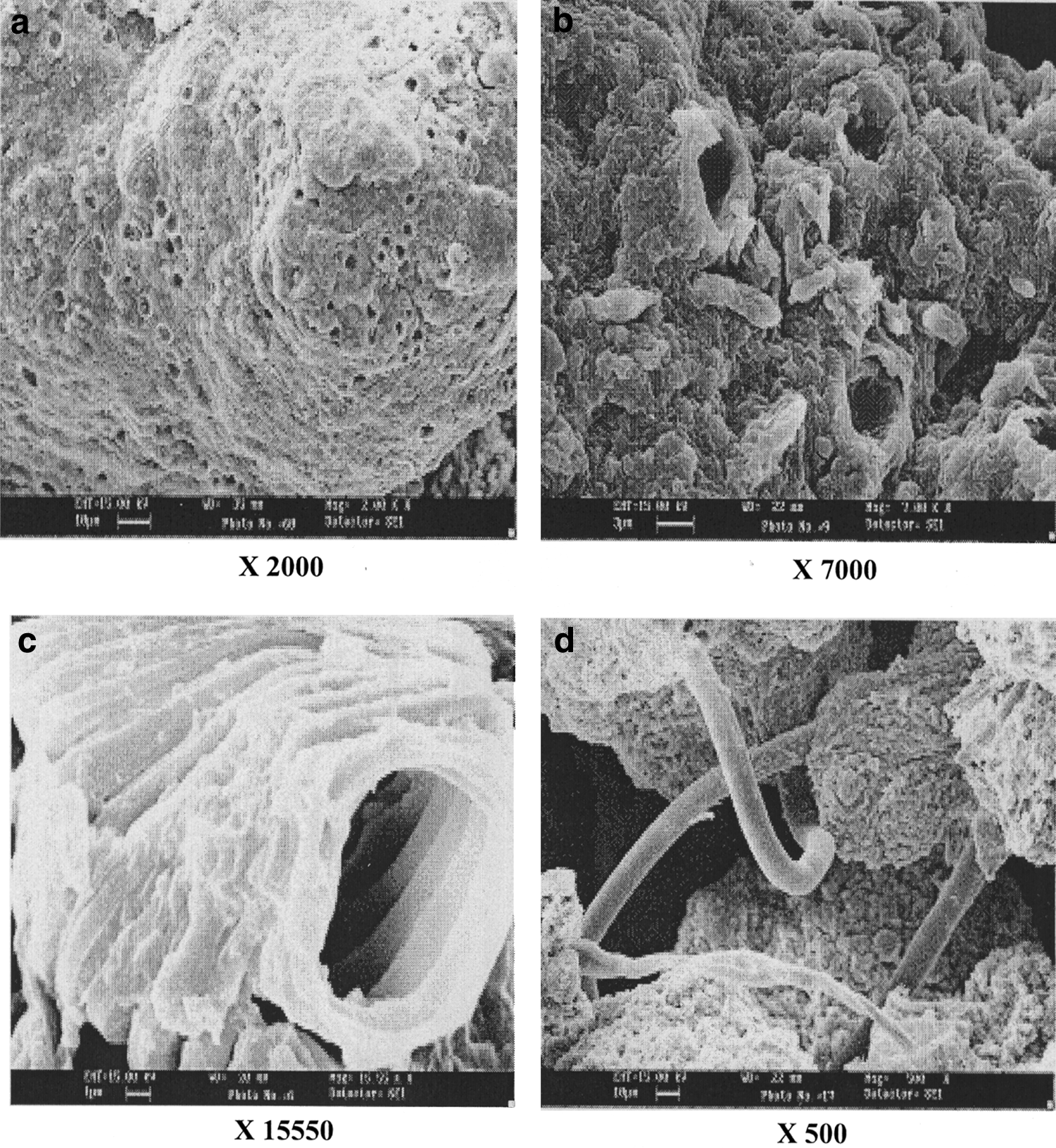
Scanning electron microscopy (SEM) micrographs observed during the operational period of a UASB reactor (Subramanyam, 2007).
Ramakrishnan and Gupta (2006) examined granulation in four similar anaerobic hybrid reactors during the treatment of synthetic coal wastewater at the mesophilic temperature of 27°C±5°C. Morphological examination of the granules revealed the predominance of Methanosarcina and Methanosaeta on the surface of the granules. The bridging effect of inorganic elements such as calcium and iron could be seen on the granule surface. Visual examination of granular biomass revealed a black color with a spherical shape. Slight irregular projections were also seen on the surface of the granules. Baloch et al. (2008) reported that the bacteriophage present in the granular biomass could be responsible for destroying cells and weakening the internal structure of granules, and thus possibly causing the breakdown of granules. They also observed protozoa-like microorganisms on the exterior zone of granular structure, which were believed to control the growth of bacterial cells.
Transmission electron microscopy (TEM) is a useful method to investigate the inner structure of anaerobic sludge granules (Subramanyam, 2007). Thin sectioning of embedded sludge granules was used for this observation. Cutting or cleaving is required to investigate the spatial arrangement inside the granule. Fang et al. (1996) reported that phenol-degrading granules were composed of S. buswellii-, Methanothrix-, Methanospirillum- and Methanobrevibacter-like bacteria while analyzing TEM micrographs. The bamboo-shaped cells with electron-opaque bodies and a sheath-like structure strongly resembled acetoclastic Methanosaeta-like organisms. Methanobrevibacter has rod-shaped cells (0.5–0.75 μm×1.8–3.5 μm) which occur singly, in pairs, or in chains. Methanosaeta, which was normally found in different kinds of anaerobic granules, can be identified by its fluorescence-emitting, bamboo-shaped filament, rod-shaped cell (0.6–0.8 μm×2.0–3.5 μm) with flat ends, and on an ultrastructure within the outer and inner cell walls (Zehnder et al., 1980).
Microbial communities
The fluorescence in situ hybridization (FISH) technique was used by many researchers to investigate the evolution of the microbial communities in UASB sludge (Beristain-Cardoso et al., 2011; Zhang et al., 2012). The development of molecular biology techniques has enabled more in-depth exploration of the microbial communities. The 16S rRNA gene is currently the most commonly used target gene for community analysis. It is apparent that the phylogenetic properties of 16S, as well as the large amount of sequences available, offer a considerable advantage. The methonogens in various anaerobic sludge have been investigated by FISH targeting for 16S rRNA genes (Zhang et al., 2012). Beristain-Cardoso et al. (2011) used FISH oligonucleotide probes for Thiobacillus denitrificans, Sulfurimonas denitrificans (formerly classified as Thiomicrospira denitrificans), genus Paracoccus, and Pseudomonas spp. to follow the microbial ecology. Ricardo et al. (2011) evaluated the physiological and kinetic behavior of a denitrifying granular sludge exposed to different sulfide-loading rates in an UASB reactor fed with acetate, ammonium, and nitrate. The FISH analysis suggested that Thiob. denitrificans might be involved in acetate and sulfide consumption.
Methanogic activity
The specific methanogenic activity (SMA) assay is one of the widely used methods in anaerobic treatment processes. It represents the rate at which methanogens utilize the substrate to produce methane and carbon dioxide. The activity depends on various factors such as the nature of the sludge, age of sludge, methanogenic population, nutrient availability, environmental factors, and also the presence or absence of inhibitory materials. The SMA of granules seems to be dependent on the size of bioparticles, and SMA was found to increase in the range of 0.27–3.03 mm (Bhunia and Ghangrekar, 2006). The SMA also depends on the type of bacteria present in the biomass. Various researchers used the seed sludge collected from anaerobic digesters having an SMA of 0.0625–0.26 kg CH4-COD/kg VSS per day (Yan and Tay, 1997; Tay et al., 2001; Yu et al., 2001).
Yu et al. (2001) reported that SMA of granules increased steadily with increasing OLR. The SMA observed on days 0, 30, 60, 90, and 146 were 0.26, 0.7, 1.04, 1.28, and 1.32 kg CH4-COD/kg VSS, respectively. The SMA of glucose-degrading granules increased linearly with an increasing age of sludge as well as OLR (Subramanyam and Mishra, 2013b). A high methanogenic activity is a very important characteristic of granular sludge. The SMA of granular sludge ranges 1–1.72 kg CH4-COD/kg VSS per day (Brito et al., 1997; Yan and Tay, 1997; Yu et al., 2001). El-Mamouni et al. (1998) advocated that the specific activity of granules could be enhanced in reactors supplemented with polymers. However, the methanogenic activity might become negatively affected when calcium carbonate precipitates within the granules (El-Mamouni et al., 1995). Serious losses of SMA were reported for sludge with a high ash content (El-Mamouni et al., 1995).
Tables 3 and 4 show the SMA of the sludge from a UASB reactor treating phenolic wastewaters as reported in the literature. It depicts that the SMA depends on the nature of the substrate as well as substrate concentration. The SMA of granules from phenol degradation was found to be 0.23–0.38 and 0.16–0.22 kg CH4-COD/kg VSS per day at phenol CODs of 1000 and 2000 mg/L, respectively. It was found that granules grown on phenol with glucose as a cosubstrate have better activity than that grown only on phenol. The SMA ranges from 1.02 to 1.1 kg CH4-COD/kg VSS per day using acetate at a COD concentration of 2500 mg/L. The activity is very high when using easily degradable acetate as a substrate, even at higher concentrations on phenol-grown granules. Gali et al. (2006) reported that the SMA of the granular sludge on the biodegradation of phenol with easily degradable molasses-based wastewater as a cosubstrate in a UASB at different phenol loadings (phenol COD=10%–80%) ranged from 0.19 to 0.33 kg CH4-COD/kg VSS per day for the substrate-to-sludge ratio of 1.0 at an acetate COD concentration of 4000 mg/L. With an R/C ratio of 1/4 in feed mixture with a resorcinol concentration of 200 mg/L, and the mixture COD being 1900 mg/L, the SMA was obtained as 0.158 kg CH4-COD/kg VSS per day (Table 4). The SMA values for mixtures of phenolic compounds reported in the literature (Tables 3 and 4) are higher than those obtained by Subramanyam (2007). This can be attributed to the difference in the operating conditions and the feed during the start-up of the reactor.
Phenol with glucose and without glucose.
Phenol with aqueous molasses solution (phenol COD=10%–80%).
VSS, volatile suspended solids; SMA, specific methanogenic activity.
HRT ∼0.5–0.33 day and HRT ∼1 day.
Conclusions
In view of the above scenario, as buttressed by the literature review, it is concluded that the physicochemical and morphological characteristics of microbial granules play a vital role on the performance of UASB reactors. Addition of vitamins and polymers exhibits a positive effect on granulation, start-up, and reactor performance. The size of granules depends on the operating conditions and the type of carbon source used. Addition of alternative and easily degradable cosubstrates along with toxic wastewater helps in the growth of the larger-sized granules. The temperature and salt concentrations of water are important parameters to consider in the design and operation of UASB reactors. The amount of ash formed is dependent on the feed substrate, and major components of the ash are calcium, magnesium, phosphorus, sodium, potassium, iron, nickel, and cobalt, regardless of the carbon sources degraded in the UASB reactors. Phenol-degrading granules were densely packed with intertwined bacteria with different morphologies throughout the granule section and did not exhibit a layered microstructure. The XRD and SEM EDAX analyses are helpful in recognizing the crystalline structure of the sludge. The FTIR spectroscopy technique is a powerful tool to study the changes in the composition and structure of molecular functional groups. Many researchers have used the FISH technique to investigate the evolution of the microbial communities in UASB sludge. SEM analysis of the granules during the transformation of digested sludge to granular sludge showed the predominating genera of methanogens resembled in appearance Methanobacterium, Methanosaeta, and Methanosarcina. The bacteriophage present in the granular biomass could be responsible for breakdown of granules. Utilization of TEM is a good technique to explore the inner structure of sludge granules.
The physicochemical and morphological characteristics of microbial granules have been studied by many researchers over the last two decades and vast knowledge has been gained on various aspects. However, many questions are still unanswered about the successful application of this technology. Based on the foregoing literature review, further research is needed to make the system robust as outlined below.
The cultivation of microbial granules takes a long start-up period in UASB reactors. One obvious research need is to reduce the start-up period and simultaneously to produce highly efficient granules. In this concern, further research is needed about the addition of various synthetic and natural polymers, vitamins, and their granular characteristics. The anaerobic degradation rate of toxic compounds was found to be enhanced in the presence of easily degradable cosubstrates, which provide high resistance to shock load and help to withstand temperature changes. Research in the area of application of easily degradable cosubstrates such as glucose, acetate, sucrose, cellulose, molasses solution, butyrate, methanol, ethanol, and VFAs in the treatment of toxic wastewater and its sludge characteristics would be highly beneficial. Granule characteristics, particularly settling velocities, are highly influenced by salt concentrations and temperature of water. Meticulous research is needed in this aspect and may be considered in the design and operation of biological reactors. Recent studies found that bioaugmentation (addition of selected bacterial strains) is a useful tool in anaerobic treatment for improving stability and significantly reducing the length of the start-up period. An application of bioaugmentation strategy on UASB reactor performance and study of its sludge characteristics may be extensively favorable. The concentrations of metals and nutrients in the feed solution are highly important in granule formation. Optimization of these contents is essential for good granulation. Research is needed in this area with different compositions of wastewater for better startup. The knowledge gained on sludge characteristics needs to be correlated with the reactor-operating conditions using scientific and engineering tools and software. Development of such simulations and mathematical models is highly advantageous in future usage. It is impossible to provide perfect information on the characterization of microbial granules without appropriate methods. Innovative approaches and sophisticated technologies are essential to exploit the granular characteristics for engineering applications.
Footnotes
Author Disclosure Statement
The author declares that there are no relevant financial or nonfinancial relationships to disclose.