




Abstract
Abstract
Acid mine drainage (AMD) generated by some coal mines in New Zealand is currently neutralized by the addition of alkaline reagents, triggering the precipitation of dissolved metals as insoluble hydroxides. This study investigated the addition of lignite-derived humic substances (HSs) before, during, and after neutralization of AMD based on two Stockton Mine treatment scenarios: the Blackwater Treatment Plant (BTP) and the Mangatini Stream-Sump (MSS). Supernatant samples collected during the sedimentation period were analyzed for basic water quality parameters: turbidity and suspended solids (SSs). The BTP scenario used calcium hydroxide [Ca(OH)2] neutralization, resulting in low supernatant turbidity (<2 NTU, nephelometric turbidity units) and SSs (<5 mg/L) regardless of the HS addition sequence. The MSS scenario used calcium carbonate (CaCO3) neutralization, and showed HS dosing enhanced flocculation and sedimentation of residual CaCO3 SSs when added after neutralization, resulting in up to 75% reduction in SSs compared to CaCO3 neutralization alone. When added after neutralization (pH 7), HSs remained dissolved and were incorporated into settling metal precipitates as an organic coating, promoting the coagulation of undissolved CaCO3 by charge neutralization. Improvement in water quality was optimized at shorter residence times (0.5–6 h) and smaller HS doses (5–20 mg/L). Addition of HSs before (pH 2.6) and during (pH 4.5) neutralization resulted in the formation of HS precipitates, which probably acted as nucleation sites for adsorption and coprecipitation of metal hydroxides, resulting in good incorporation of HSs into floc, but rendering HSs unavailable for coagulation of residual CaCO3 at pH 7. This article shows that incorporation of HSs into AMD treatment is more advantageous for CaCO3 than Ca(OH)2 neutralization with respect to water quality, and presents a novel method for improving the water quality of CaCO3-neutralized AMD.
Introduction
The dominant AMD treatment method involves neutralization by dosing with alkaline reagents followed by oxidation and sedimentation, which can be accomplished by active or passive systems (Johnson and Hallberg, 2005; Trumm, 2010). Alkaline reagents are added to AMD to increase pH, triggering the precipitation of metal hydroxides. Precipitates then coalesce either naturally or under the effects of polymers to form a loose, open-structured floc that settles due to gravity (Lee et al., 2002; Younger et al., 2002; Tchobanoglous et al., 2003).
In New Zealand, hydrated lime (calcium hydroxide [Ca(OH)2]) and limestone [calcium carbonate (CaCO3)] are commonly used as alkaline reagents for AMD neutralization (Weber et al., 2008). However, incomplete dissolution of CaCO3 can result in elevated turbidity and suspended solids (SSs) in effluent (Davies et al., 2011), potentially exceeding resource consent limits set by the local regulatory authority. To enhance particle aggregation and flocculation, there have been a variety of proposed refinements such as multiple-step dosing of neutralizing agents and addition of polymers (Younger et al., 2002; Johnson and Hallberg, 2005; Trumm, 2010).
In water treatment plants or natural streams, humic substances (HSs) may be incorporated into settling floc of metal precipitates via cation bridges, polar interactions, hydrogen bonding, or van der Waals forces (Randtke, 1988; Warren and Zimmerman, 1994; Illes and Tombacz, 2006). Rapid aggregation and deposition of HSs were observed in Ca solutions at circum-neutral pH (Chen and Elimelech, 2007; Tsang et al., 2009). As HSs are naturally present in New Zealand West Coast streams in the concentration range of 0–30 mg/L (Collier and Winterbourn, 1987; Collier, 1989), addition of lignite-derived HSs in Ca-based alkalinity neutralization of AMD may enhance the particle removal by sedimentation without potential introduction of anthropogenic chemicals to the environment. Recent studies also suggested that peat- and lignite-HSs can be used as a sorbent for toxic metals in AMD treatment (Havelcova et al., 2009; Bogush and Voronin, 2011; Olds et al., 2013).
This study evaluated the settling kinetics and removal of SSs during AMD neutralization using HSs extracted from a commercially mined lignite deposit together with alkalinity reagents [Ca(OH)2 and CaCO3] in jar tests. The experiments were designed to simulate three possible treatment scenarios, with HS dosing before, during, and after neutralization at varying HS concentrations. The application of HSs derived from lignite as a polymer is a novel method for improving the treatment of AMD.
Experimental Methods
Site characteristics and sample collection
Coal has been mined at the Stockton Mine on the West Coast of New Zealand since 1908. Coal is currently excavated from the Brunner Coal Measures by open cast techniques, resulting in significant disruption of potentially acid-forming overburden (Weber et al., 2008; Pope et al., 2010). The AMD characteristics vary across the mining site, with pH ranging from 2.15 to 4.05, Fe concentration from 0.09 to 1,410 mg/L, and Al concentration from 0.46 to 607 mg/L (McCauley et al., 2010). The AMD used in this study was collected from the headwaters of the Mangatini Stream within the Stockton Mine, and had a pH of 2.6, acidity to pH 7.0 of 815 mg/L CaCO3. Its element concentrations are shown on Table 1, as determined by inductively coupled plasma mass spectrometry.
Determined by spectrophotometer.
The Blackwater Treatment Plant (BTP) is an active AMD neutralization treatment plant, which treats AMD from coal processing areas. The AMD is rapidly neutralized by flash mixing with a hydrated lime [Ca(OH)2] slurry for 20 s before entering a paddle flocculation tank, where slow mixing promotes floc aggregation. At the outlet of the flocculation tank, a polymer is added before the neutralized AMD enters a lamella clarifier, where the floc settles and forms sludge, which is removed and disposed of onsite. The design residence time in both the flocculation tank and clarifier is ∼30 min.
The Mangatini Stream-Sump (MSS) system treats the AMD-impacted Upper Mangatini Stream, by continuously dosing ultrafine limestone (CaCO3, 90 wt.%<106 μm) slurry at the head of the stream. In-stream turbulent flow of approximately one hour results in neutralization to pH 6–7. The stream discharges into the man-made Mangatini Sump that has an estimated residence time of up to 7 days to enable sedimentation processes. The treated effluent from both the BTP and MSS are discharged into the Lower Mangatini Stream and eventually into the Ngakawau River and out to the Tasman Sea.
Chemical reagents and HSs
To simulate the dosing of alkaline reagents in the field, stock slurries of 1 M Ca(OH)2 (74 g/L) and 1 M CaCO3 (100 g/L) were prepared using laboratory-grade Ca(OH)2 powder (>99.5% purity) and a sample of the ultrafine limestone, obtained from the Murchison Limestone Quarry, and used at the Stockton Mine (>99% purity), respectively. The solubility of Ca(OH)2 and CaCO3 at room temperature is ∼1.73 and 0.013 g/L, respectively, so these slurries were significantly supersaturated. The AMD was neutralized by volumetric dosing (up to 18 mL per liter of AMD) from stock slurries that were continuously mixed by a magnetic stirrer or homogenized by vigorous shaking, replicating the slurry dosing conditions in the field.
The solid energy humic acid (SEHA) was derived by caustic extraction [0.5 M sodium hydroxide (NaOH)] of W7 lignite (<500 μm), from the New Vale Mine in Southland, New Zealand, at a solid to liquid ratio of 1:5 by mass. The mixture was stirred inside a digester for half an hour, and then heated to 90°C and digested for 2 h. The digester was allowed to cool overnight and the liquid fraction was separated by centrifuge. As a product of caustic extraction, the SEHA had a high pH (∼10) resulting in the deprotonation of functional groups, which was favorable for acid neutralization and metal complexation. The SEHA product (∼67,000 mg HA/L, determined by using ISO 5073:1999) was stored in a nontransparent plastic bottle out of direct sunlight.
Dosing regimes for jar tests
The BTP neutralization dose to pH 7 was 845 mg CaCO3/L, as determined by the jar test. This corresponds to a Ca(OH)2 neutralization efficiency of 96%, when compared to the acidity of 815 mg CaCO3/L (to pH 7) as determined by NaOH titration. The MSS neutralization dose to pH 6 was 1800 mg CaCO3/L after one hour mixing at 100 rpm, as determined by the jar test. An endpoint of pH 6 was used in view of the slow dissolution kinetics of CaCO3 at circum-neutral pH. This represented a low CaCO3 neutralization efficiency of 42% (after one hour neutralization), which was within the reported range of 30–70% (Trumm, 2010); and comparable to Weber et al. (2008) who reported AMD neutralization efficiencies of 56–68% to pH 5.0 using Murchison limestone.
The HS dosing and mixing regimes are shown in Table 2. Three dose orders (addition of HSs before, after, and during neutralization) and two dose concentrations that represent natural HS concentrations in the West Coast rivers (20 and 100 mg/L HS) were used. Theoretically, HS addition before neutralization (at pH 2.6) is favorable for precipitation of HSs (due to low HS solubility at acid pH) and subsequent Fe and Al adsorption. The carboxylic groups on HS deprotonate at a low pH (Milne et al., 2001), resulting in negatively charged HS surfaces for Fe and Al adsorption (Kretzschmar and Sticher, 1997; Sparks, 2003). Addition of HSs after neutralization (at pH 7) is conducive to adsorption and incorporation of dissolved HSs onto already precipitated Fe and Al floc. Addition of HSs during neutralization (at pH 4.5) is approximately halfway through the hydrolysis of Al, providing HS coprecipitation and adsorption opportunities with Fe and Al hydroxides.
About 0.3 mL of the SEHA stock solution added for 20 mg/L and 1.5 mL SEHA stock solution added for 100 mg/L SEHA conditions.
BTP, Blackwater Treatment Plant; Ca(OH)2, calcium hydroxide; HS, humic substance; MSS, Mangatini Stream-Sump; CaCO3, calcium carbonate; SEHA, solid energy humic acid.
For the BTP scenario, control samples were conducted following the standard jar test method (ASTM 2008), where addition of 8.45 mL of 1 M Ca(OH)2 slurry to 1 L of AMD was followed by an initial flash mix period of 1 min at 100 rpm and then flocculated for 25 min at 20 rpm. After the flocculation period, supernatant samples for turbidity analysis (10 mL collected from ∼10 mm below the water surface using a syringe) were collected at 30, 60, and 120 min into the sedimentation period, which were representative of expected BTP residence times. After 120 min of sedimentation, 500 mL of supernatant was gently decanted into a measuring cylinder for SS measurement. Table 2 shows the mixing conditions for the other HS-dosed BTP scenarios.
For the MSS scenario, control samples were conducted with an addition of 18 mL of 1 M CaCO3 slurry to 1 L of AMD, followed by one hour rapid mixing at 100 rpm before sedimentation (NB: no flocculation period). Samples were collected for turbidity and SS analysis at 2, 6, 24, 72, 120, and 168 h into the sedimentation period. Table 2 shows the mixing conditions for the other HS-dosed MSS scenarios.
In addition, trials to evaluate the potential application of SEHA as a polymer for removal of residual CaCO3 SSs were undertaken. AMD was neutralized and mixed for 55 min at 100 rpm before dosing with SEHA at 5, 10, 20, and 50 mg/L and mixed for a further 5 min at 100 rpm. Turbidity and SSs were analyzed in the supernatant samples at 0.5, 1, 2, 3, 6, and 24 h into the sedimentation period.
Chemical analysis and material characterization
Sample turbidity was measured using a Hach 2100 turbidimeter and solution pH was measured using an EDT Instruments RE357Tx pH meter. To measure SSs, 500 mL of supernatant was filtered through preweighed Whatman glass-fiber filter paper, with a nominal pore size of 1.2 μm, and then dried at 105°C before reweighing. The detection limits of turbidity and SSs were 1 NTU (nephelometric turbidity units) and 2 mg/L, respectively.
The elemental analyses were conducted to determine the carbon, hydrogen, oxygen, nitrogen, and sulfur content of HSs (lignite and SEHA), on a wt.% basis, using an Elementar Combustion Analyzer. Qualitative information about the surface functional groups was obtained by Fourier-transform infrared (FTIR) spectroscopy using a Perkin Elmer SpectrumOne FTIR. The HSs and parent material were slowly dried at below 40°C, ground to a powder, and mixed with potassium bromide (KBr) at a range of 0.5–2 wt.% for optimizing the peak detection. The samples were blanked against KBr and the absorbance of samples over the wavelength range of 600–4,000 cm−1 was used for analysis. All analyses were run in duplicates or triplicates.
Results and Discussion
Characteristics of HSs
Table 3 shows the elemental composition of lignite and SEHA. Compared to the carbon–hydrogen–nitrogen–oxygen (CHON) results of lignite (parent material), SEHA products displayed a significantly lower carbon content and a much higher oxygen content. This indicates that the HS extraction process resulted in substantial loss of carbon and oxidation of functional groups, probably affecting the molecular structure of the SEHA. Alkali extraction releases fulvic acids (FAs) as well as HAs. Based on the CHON analysis (Table 3), the SEHA product appears more characteristic of a FA.
Figure 1 illustrates the FTIR spectra of the lignite and SEHA, which identified the major functional groups of the HSs: hydroxyl or phenolic (O-H stretch at 3600–3200 cm−1), aliphatic or carbohydrate carbons (C-H stretch at 2930–2910 and 2860–2840 cm−1, and C-O stretch at 1100–1020 cm−1), carboxylic or carbonyl carbons (C=O stretch at 1740–1700 cm−1), and aromatic carbons (C=C-C stretch at 1615–1580 and 1515–1480 cm−1) (Chen et al., 2002; Weber et al., 2006). A comparison between the relative peak intensities suggests that functional groups (such as hydroxyl, aliphatic C, and aromatic C) were more abundant in lignite than SEHA. Moreover, the peaks of carboxylic or carbonyl groups were identified in lignite, but not in SEHA. These results indicate a portion of the functional groups and carbon structures were lost due to alkali extraction, which was in line with the CHON results. It should be noted that both oxygen-containing functional groups (via complexation) and aliphatic/aromatic structures (via hydrophobic interactions) are important for aggregation and coprecipitation of HSs with metal precipitates (Jung et al., 2005; Illes and Tombacz, 2006; Tsang et al., 2009).

Fourier-transform infrared spectra of humic substances:
Role of HSs in Ca(OH)2 neutralization
Figure 2a shows that under all HS dosing conditions in the Ca(OH)2, neutralized BTP scenario samples had turbidity of <1.6 NTU. Although the addition of HSs after neutralization resulted in a slightly higher turbidity, all cases were in compliance with the water quality guidelines in New Zealand (4.1 and 5.6 NTU for upland and lowland rivers, respectively) (ANZECC, 2000). Figure 3a shows the clear and colorless supernatants of AMD treated by Ca(OH)2 neutralization and HS addition. Figure 2b compares the residual SSs in the supernatant. All samples contained <5.2 mg/L of SSs, meeting the recommended guidelines for the protection of aquaculture species in freshwater (40 mg/L) (ANZECC, 2000).

Acid mine drainage water quality after calcium hydroxide [Ca(OH)2] neutralization with addition of humic substances:
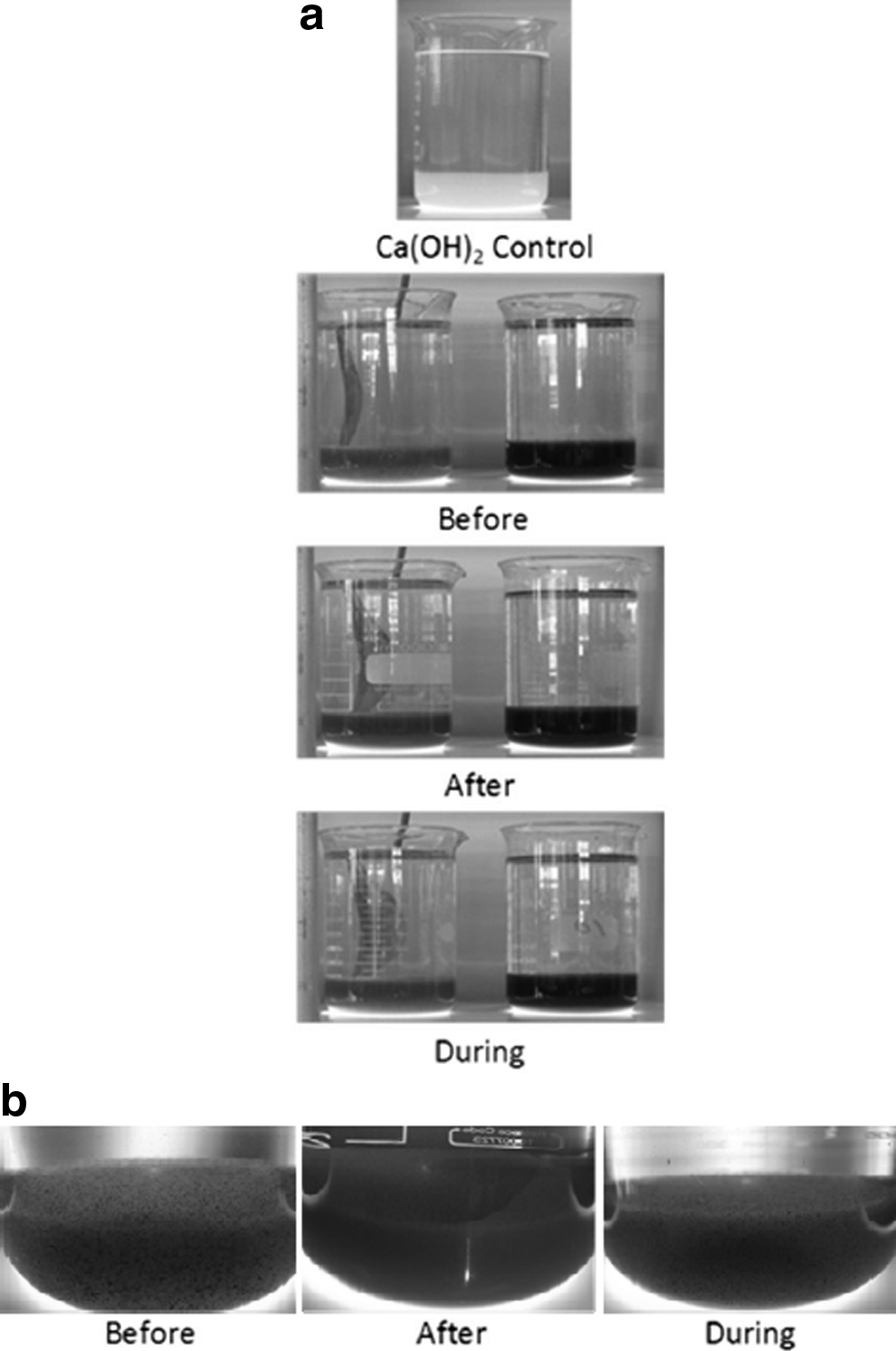
Ca(OH)2 neutralization with addition of humic substances:
Figure 3b illustrates that, when SEHA was dosed before or during neutralization, dark precipitates of HSs were visible as discrete particles in the settled sludge. By contrast, HS addition after neutralization resulted in a uniformly brown sludge, with no indication of precipitated HSs. Despite being an alkaline liquid stock (pH>10), SEHA addition before (pH 2.6) and during neutralization (pH 4.5) resulted in facile precipitation, probably because of spontaneous protonation of the surface functional groups that led to aggregation of SEHA via intramolecular bonding. These HS precipitates were directly incorporated into settling floc (Fig. 3b) and not resolubilized at circum-neutral pH.
Fate of HSs is therefore vastly different depending on the dosing regime, despite similarities in residual SSs for Ca(OH)2-dosed AMD (Fig. 2b). HSs added before or during neutralization precipitated upon addition to AMD, probably serving as a nucleation site for adsorption and coprecipitation of Fe(OH)3 and aluminum hydroxide (which precipitate at ∼pH 3 and 4.5, respectively). This nucleation may enhance particle aggregation and sedimentation (Randtke, 1988; Kretzschmar and Sticher, 1997; Jung et al., 2005). Moreover, during Ca(OH)2 neutralization, rapid formation and growth of HS precipitates were probably promoted by charge neutralization and intramolecular bridging via Ca complexation (Kretzschmar and Sticher, 1997; Chen and Elimelech, 2007; Tsang et al., 2009). Conversely, when HSs were added after neutralization, they remained largely dissolved with an expanded structure and were probably negatively charged due to deprotonation of carboxylic groups at circum-neutral pH (Milne et al., 2001; Tipping, 2002). The vast majority of Fe and Al had already been precipitated well below pH 7. As a result, some HSs were probably adsorbed as a coating on the surface of the already precipitated Fe and Al hydroxides, as shown by the brown and homogenous sludge that settled (Fig. 3b).
Removal of residual CaCO3
The MSS scenario (using CaCO3 neutralization) control samples resulted in maximum turbidity and SSs of 23 NTU and 17.0 mg/L, respectively, which decreased over time to a steady 1 NTU and 2.5 mg/L after a 72-h sedimentation (Fig. 4). Such time dependence is typical of discrete particle settling (Tchobanoglous et al., 2003). At 42% neutralization, efficiency ∼1044 mg/L of the CaCO3 neutralization dose remained undissolved. A fraction of the undissolved CaCO3 remained suspended, contributing to a cloudy supernatant before settling to form a white layer above the sludge.
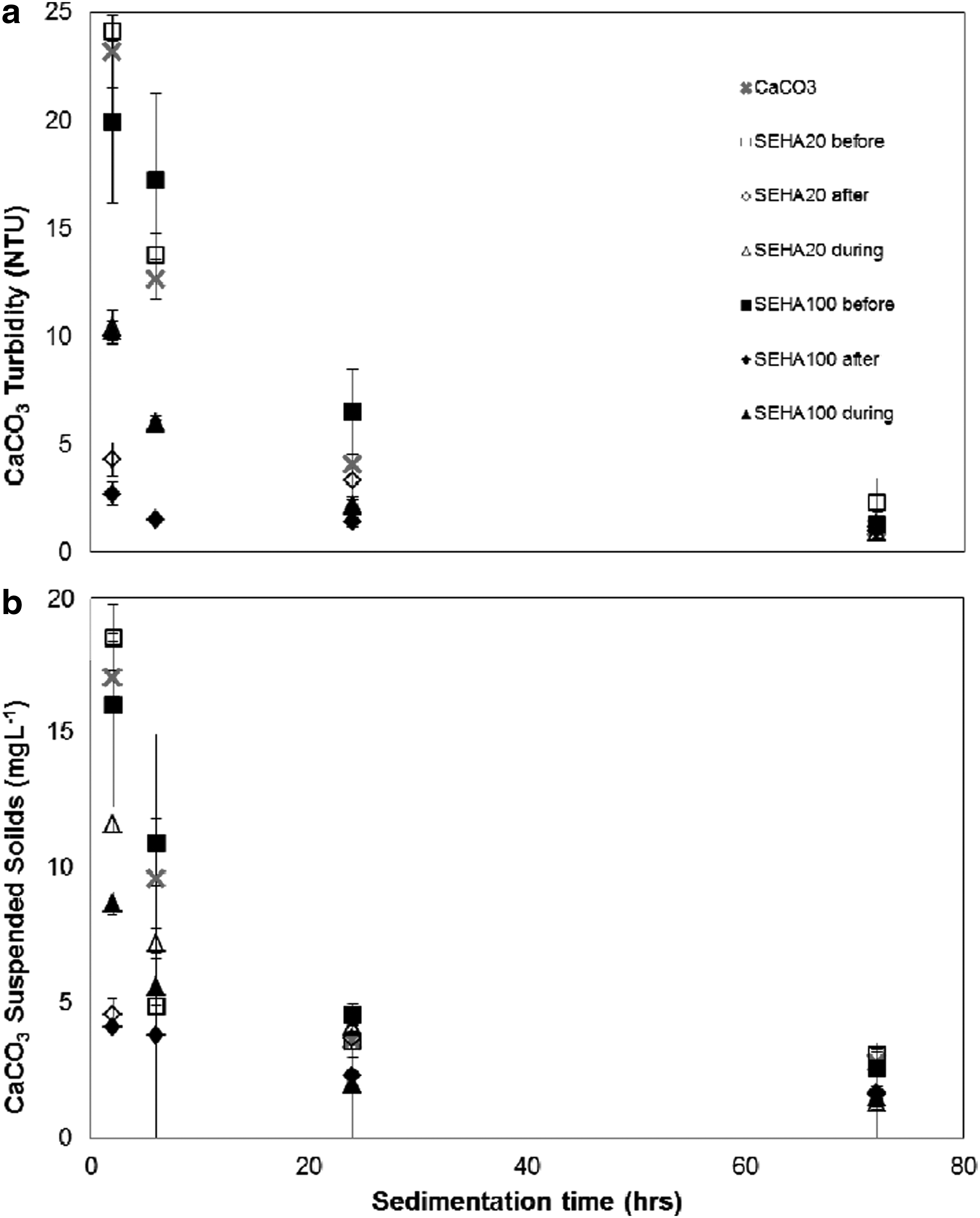
AMD water quality after calcium carbonate (CaCO3) neutralization with addition of humic substances:
Figure 4 shows that HS dosing after neutralization enhanced the removal of residual CaCO3 SSs, especially during the first 24 h of sedimentation. After 24 h of sedimentation, the SSs for the SEHA addition after, during, before neutralization, and the control samples were 4.1, 8.7, 16, and 17 mg/L, respectively. When added after neutralization (pH 6), negatively charged HSs (Milne et al., 2001; Tipping, 2002) and positively charged CaCO3 particles [point of zero charge is pH 8 (Wolthers et al., 2008)] probably agglomerated to form larger floc, which settled faster. The HS sorption capacity of calcite has been shown to increase with concentrations of HSs (Lee et al., 2005). Conversely, HS addition before neutralization (pH 2.6) resulted in HS precipitation, rendering them unavailable to enhance sedimentation of residual CaCO3 SSs.
Figure 5a shows the kinetic supernatant SSs after addition of varying concentrations of SEHA in the polymer trial. Higher SEHA dosages resulted in increased settling rates, to a critical dose of 20 mg SEHA/L. The use of SEHA resembled the utilization of polymer strands that bridge two or more particles and rapidly increase the floc size and settling kinetics (Younger et al., 2002; Johnson and Hallberg, 2005; Trumm, 2010). Figure 5b shows the additional removal of SSs (compared to the control condition) on a weight basis of SEHA addition. Dosing with SEHA was most beneficial at shorter residence times, between 0.5 and 6 h. With longer residence times, discrete CaCO3 particles were removed by sedimentation; so, the SEHA-enhanced flocculation became less effective. The SS removal efficiency decreased with increasing HS doses, suggesting that, in under-dosed scenarios, SEHA removal would still be effective.

Addition of humic substances as a flocculating polymer after CaCO3 neutralization:
Summary
This study investigated the potential application of lignite-derived HSs for facilitating particle aggregation and flocculation when added before, during, and after neutralization by the alkaline reagent. Two treatment scenarios at the Stockton Mine were evaluated by modified jar testing. The incorporation of HSs into Ca(OH)2 neutralization (BTP scenario) resulted in low turbidity (<1.6 NTU) and SSs (<5.2 mg/L) that were in compliance with the recommended ANZECC guidelines, although there was little additional improvement in water quality. On the other hand, HSs added after CaCO3 neutralization (MSS scenario) facilitated the flocculation and sedimentation of residual calcite SSs, resulting in an up to 75% reduction in SSs. By contrast, the addition of HSs before and during neutralization resulted in the formation of visible, discrete precipitates of HSs at acidic pH that did not enhance the removal of residual calcite SSs. The polymer trial showed that improvement was most beneficial at shorter residence times (0.5–6 h) and lower HS dosages (5–20 mg/L). The engineering implication of this article relates to the reduction in sedimentation residence time, that is, the sizing of sedimentation structures. The turbidity limit of 5.6 NTU could be achieved with a sedimentation period of 2 h by HS dosing after neutralization, while the control sample took up to 24 h to reach the same turbidity, potentially requiring sedimentation structures 12 times the size. Thus, this study presents a novel application of lignite-derived HSs for improving CaCO3 neutralization of AMD.
Footnotes
Acknowledgment
The authors wish to thank the Foundation for Research Science and Technology Fund provided by the Royal Society of New Zealand for the financial support of this study.
Author Disclosure Statement
No competing financial interests exist.