




Abstract
Abstract
Taiwan has a unique subtropical island climate. In the development of a green building material (GBM) evaluation system for Taiwan, evaluation criteria should differ from those in the frigid or temperate zones of the world. We aimed to provide academia and industry with an appropriate GBM evaluation method and to enhance the effectiveness of GBM. It means GBM should be concerned with creating more value with less impact to achieve “eco-efficiency”. Eco-efficiency is the balance of competitively priced goods and services that satisfy human needs and quality of life, while progressively reducing ecological impacts and resource intensity throughout the life-cycle within the Earth's estimated carrying capacity. We applied this method (eco-efficiency=quality/load) to comprehensively consider the efficiency of GBM. The first step was to review the literature to summarize GBM evaluation factors. Second, we conducted a two-stage survey by the fuzzy Delphi method to analyze the evaluation indicators' eco-efficiency dimension (quality or load) and the importance of evaluation factors for establishing the GBM Eco-Efficiency Evaluation System. Third, we analyzed the priority vector of the evaluation indicators by an analytic hierarchy process method before finally achieving the goal of constructing the GBM Eco-Efficiency Model. The achievement was the creation of the Taiwan GBM Eco-Efficiency Evaluation System and the GBM Eco-Efficiency Model. For academia, industry, and users, it could lead to the enhancement of GBM quality as well as provide feedback to modify the process in advance, reduce adverse environmental loads, and minimize the negative impact on the global environment. This method responds positively to human health and global sustainable development.
Introduction
Taiwan has been promoting GBM labeling for nearly 10 years. The GBM labeling system has four main categories (ecological, healthy, high performance and recycling) and concerns about environmental toxicity and the utility of energy and resources (Chiang et al., 2009). In addition to GBM evaluation, this research applied the Eco-Efficiency Method (eco-efficiency=quality/load) (Ehrenfeld, 2005) in comprehensively considering the efficiency of GBM.
As defined by the World Business Council for Sustainable Development (Lehni, 2000), “Eco-efficiency is achieved by the delivery of competitively priced goods and services that satisfy human needs and bring quality of life, while progressively reducing ecological impacts and resource intensity throughout the life-cycle to a level at least in line with the Earth's estimated carrying capacity.” In short, eco-efficiency involves creating more value with less harmful effects (Stigson, 2000). This research applied eco-efficiency theory to further understand the relationship between GBM quality and environmental load to explore the ecological effectiveness of promoting GBM in Taiwan.
The research was performed in the following steps. First, we reviewed a number of GBM-related international sustainability evaluation systems and summarized literature about GBM evaluation factors (Table 1). The life-cycle assessment of ISO14040 was used as the summary basis to generalize GBM evaluation factors for developing the Initial GBM Evaluation System (Fig. 1). Second, we conducted a two-stage analysis and screen using the fuzzy Delphi method (FDM). The first stage involved an analysis of the evaluation indicators' eco-efficiency dimension (quality or load) and the importance of the evaluation factors. In the second stage, a questionnaire concerning the modified evaluation factors was used to analyze the importance of the evaluation factors for establishing the Taiwan GBM Eco-Efficiency Evaluation System. Third, we analyzed the priority vector of the evaluation indicators using the analytic hierarchy process (AHP) method before finally achieving the goal of constructing the GBM Eco-Efficiency Model. Therefore, the purposes of this research are providing an appropriate GBM evaluation method and the enhancement of Taiwan's GBM eco-efficiency for responding positively to human health, global environment and sustainable development.

Initial Green Building Material (GBM) Evaluation System.
References: aISO/TC 207, 2008; bUSGBC, 2009; ciiSBE, 2012; dBRE Global, 2012; eJaGBC/JSBC, 2012; fInternational EPD System, 2012; gBSi, 2011; hEnvironmental Label Jury et al., 2012; iNordic Council of Ministers, 2012; jEuropean Commission, 2012; kJEA, 2012; lGreen Seal, 2012; mABRI, 2011; nLippiatt et al., 2010; oCSI, 2012; pCalRecycle, 2012.
◯, green building material (GBM) evaluation items.
Research Method
Eco-efficiency theory
Eco-efficiency has been proposed as one of the main tools to promote a transformation from unsustainable development to sustainable development (Guenster et al., 2011). Eco-efficiency is based on the concept of creating more goods and services, while using fewer resources and creating less waste and pollution. “It is measured as the ratio between the value of what has been produced and the environmental impacts of the product or service” (Yadong, 2013). The term was coined by WBCSD in the 1992 publication “Changing Course.” At the 1992 Earth Summit, eco-efficiency was endorsed as a new business concept and as a means for companies to implement Agenda 21 in the private sector (OECD, 2002). The term has become synonymous with a management philosophy that is geared toward sustainability through the combination of ecological and economic efficiency (BSD Global, 2013). The equation for eco-efficiency is as follows:
The fuzzy Delphi method
The traditional Delphi method, which was developed by Dalkey and Helmer (1963), has been widely used to obtain a consistent flow of answers through the use of questionnaires (Hwang and Lin, 1987; Reza and Vassilis, 1988). The Delphi method is an expert opinion survey method with three features: anonymous response, iteration and controlled feedback, and statistical group response. Because people use words, such as “good” or “very good” to reflect their preferences, the concept of combining fuzzy set theory and Delphi became known as FDM. Noorderhaben (1995) indicated that applying FDM to group decisions can solve the fuzziness involved in reaching a common understanding of expert opinions.
This research applied triangular membership functions and fuzzy theory to solving the group decision. The FDM was used for the screening of alternate factors during the first stage. The efficiency and quality of questionnaires could be improved. Thus, more objective evaluation factors could be screened through the statistical results.
This investigation applied the method of Lee et al. (2006), who designed an Excel program based on the fuzzy Delphi operation model and the statistical software Excel Expert Choice 2000 to calculate relative values (Fig. 2). This research utilized the “bi-triangular fuzzy number” to identify the evaluation indicator, and then analyzed questionnaires completed by experts to analyze the importance of each of the evaluation items and to determine the most suitable GBM Eco-Efficiency Evaluation System.
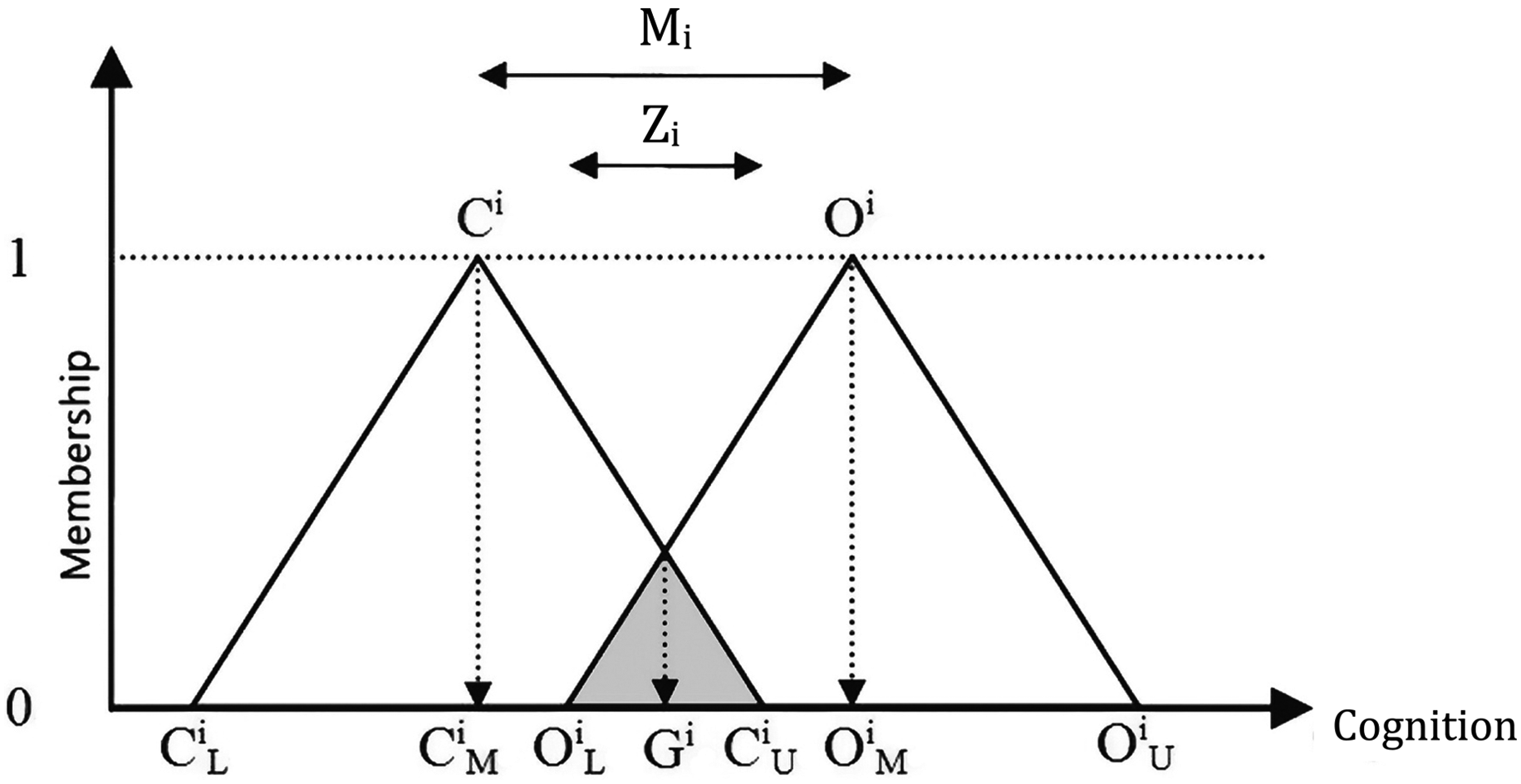
Fuzzy Delphi method model. Ci, conservative cognitive value; Gi, expert consensus value; Mi, interval between geometric means of conservative and optimistic cognitive values; Oi, optimistic cognitive value; Zi, interval of overlap (gray zone) between minimum optimisitic and maximum conservative cognitive values; L, minimum value; M, geometric mean; U, maximum value.
Analytic hierarchy process
The AHP is a structured technique for organizing and analyzing complex decisions (Saaty, 1980). Based on mathematics and psychology, this process was developed by Thomas L. Saaty in the 1970s. The AHP is particularly applicable to group decision making (Saaty and Peniwati, 2008) and is used around the world in a wide variety of decision situations. Rather than prescribing a “correct” decision (Bhushan and Kanwal, 2004), the AHP helps decision makers to identify the choice that optimally suits their goal and understanding of the issue. This process provides a comprehensive and rational framework for structuring a decision problem, representing and quantifying its elements, relating those elements to overall goals, and evaluating alternative solutions (Tiwari and Banerjee, 2001). The AHP is most useful in teams of people who are working on complex problems involving human perceptions and judgments and for resolutions that may have long-term repercussions. The use of the AHP has unique advantages when important elements of a decision are difficult to quantify or compare or when communication among team members is impeded by their different specializations, terminologies, or perspectives (Eddi and Hang, 2001). This research applied AHP to analyze the priority vector of the GBM evaluation indicators.
Review of the Literature on GBM Evaluation Factors
By summarizing international sustainability evaluation systems (ISO Guide 64, LEED, SBTool, BREEAM, CASBEE, EPD, and PAs 2050), international GBM labels (The Blue Angel, Nordic Ecolabel, EU-flower, Eco-Mark, Green Seal, and Taiwan GBM [TGBM]), and relevant building material evaluation mechanisms (BEES, CSI, and CalRecycle), we found that 37 evaluation items are used to evaluate GBM (Table 1) (Braat, 1991; ISO/TC 207, 2008; USGBC, 2009; Lippiatt et al., 2010; ABRI, 2011; BSi, 2011; BRE Global, 2012; CalRecycle, 2012; CSI, 2012; Environmental Label Jury et al., 2012; European Commission, 2012; Green Seal, 2012; iiSBE, 2012; International EPD System, 2012; JaGBC/JSBC, 2012; JEA, 2012; Nordic Council of Ministers, 2012).
After a methodical synthesis of the literature using the life-cycle assessment process (from raw material extraction through material processing, manufacture, distribution, use, repair and maintenance, and disposal or recycling) (Malin, 2010), the 37 evaluation items were integrated with 13 evaluation factors and 6 evaluation indicators.
The 6 evaluation indicators are resource utilization (R), energy utilization (E), greenhouse gas emission (G), high performance (H), eco-friendly (F), and economic (V), and they provide the basis for establishing the Initial GBM Eco-Efficiency Evaluation System (Fig. 1).
Empirical Research and Analysis
The importance of the evaluation items
First survey
Expert questionnaire: This research utilizes the FDM to design an expert questionnaire and appraises the relative importance of criteria in the form of numbers based on the fundamental scale of the FDM. This procedure was adopted in the questionnaire distribution phase to avoid any ambiguity or difficult readability issues that may affect the external nature of answers provided by the interviewees and to facilitate understanding.
Reza and Vassilis (1988) noted that the number of experts interviewed should be relatively limited and that interviewing 5–15 individuals is generally optimal. In addition, the expert consensus threshold (Gi) should be greater than 5; therefore, this research set the expert consensus threshold (Gi) greater than 6.
The first survey was conducted by integrating the opinions of experts from various fields using the FDM to cover the dimensions of eco-efficiency. The objective of the questionnaire was to query experts in the areas of building, building materials, equipment, energy, and eco-environment. Of a total of 18 questionnaires, 17 valid responses were received (response rate of 94.4%).
The results of the first survey:
The dimension of the GBM eco-efficiency evaluation indicator: The results were grouped into two categories. The first, GBM environmental load (Ln), included resource utilization (R), energy utilization (E), greenhouse gas emission (G), and eco-friendly (F)—4 evaluation indicators. The second, GBM quality (Qn), comprised high performance (H) and economic (V)—2 evaluation indicators. The evaluation indicators and factors are summarized in Table 2.
1. Resource utilization: The highest expert consensus score was R-5-1 “Low-poison processing” (Gi=8.68). The minimum expert consensus value was R-1-3 “Use natural resources” (Gi=7.45>6, expert consensus threshold; Table 3 and Figs. 3–12).
2. Energy utilization: The highest expert consensus value was E-1-1 “Increase the use of perpetual resources” (Gi=7.88). The minimum expert consensus value was E-4-1 “Materials for energy recovery” (Gi=7.38>6, expert consensus threshold; Table 4 and Figs. 13–17).
3. Greenhouse gas emission: The highest expert consensus value was G-1-2 “Emission of greenhouse gases during manufacture” (Gi=9.18). The minimum expert consensus value was G-1-4 “Emission of greenhouse gases during consumer use” (Gi=7.41>6, expert consensus threshold; Table 5 and Figs. 18–22).
4. High performance: The highest expert consensus value was H-1-5 “Building material performance in upgrading indoor air environmental quality” (Gi=8.52). The minimum expert consensus value was H-1-6 “Upgrade factor (building material's performance)” (Gi=7.39>6, expert consensus threshold; Table 6 and Figs. 23–28).
5. Eco-friendly: The highest expert consensus value was F-1-3 “Hazardous waste disposal” (Gi=9.16). The minimum expert consensus value was F-1-5 “Packaging” (Gi=6.77>6, expert consensus threshold; Table 7 and Figs. 29–33).
6. Economic: The highest expert consensus value was V-1-5 “Wearing parts and components for repair and replacement” (Gi=7.73). The minimum expert consensus value is V-1-4 “Customer satisfaction” (Gi=6.84>6, expert consensus threshold; Table 8 and Figs. 34–39).
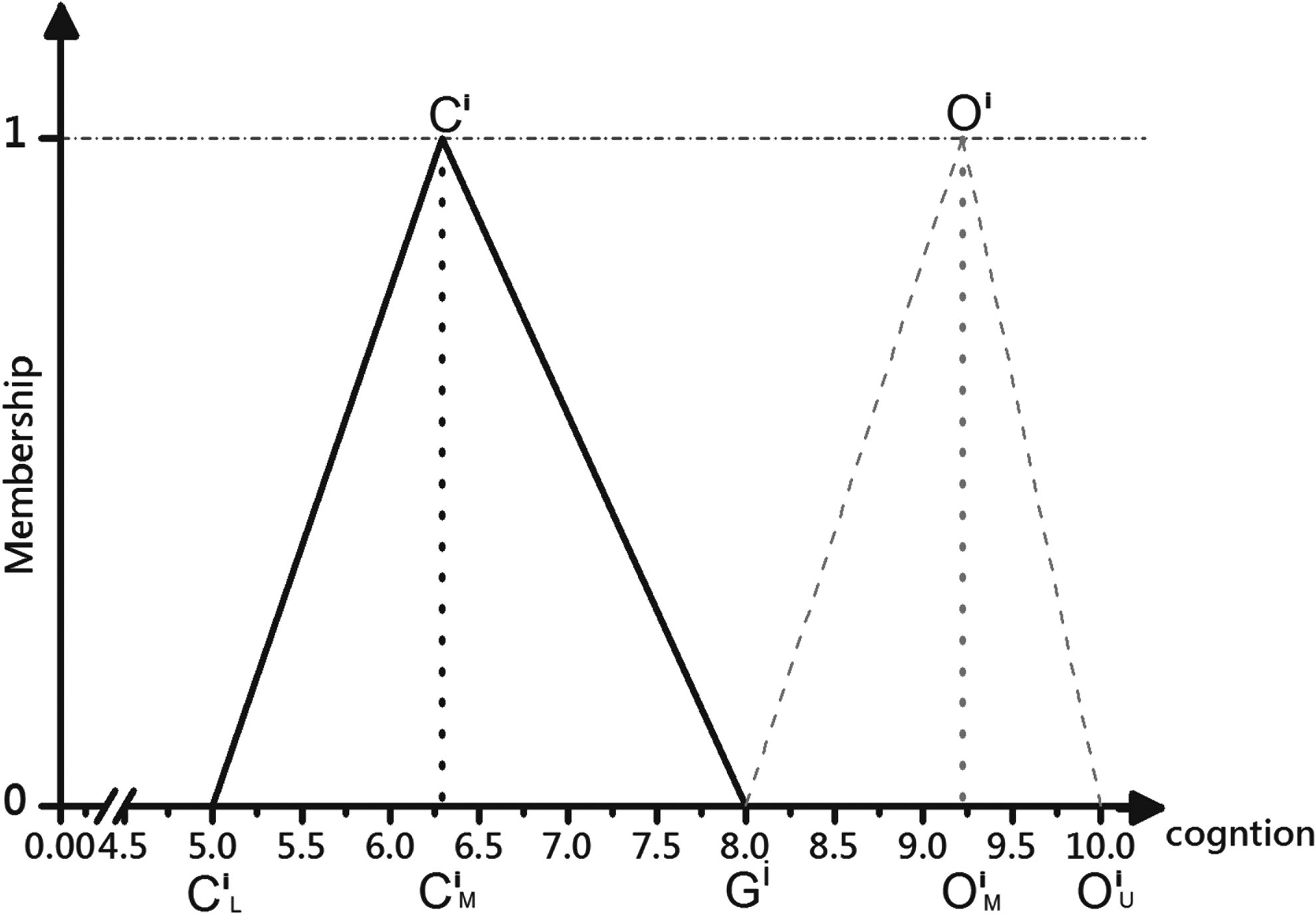
Importance of evaluation factors (R-1-1).
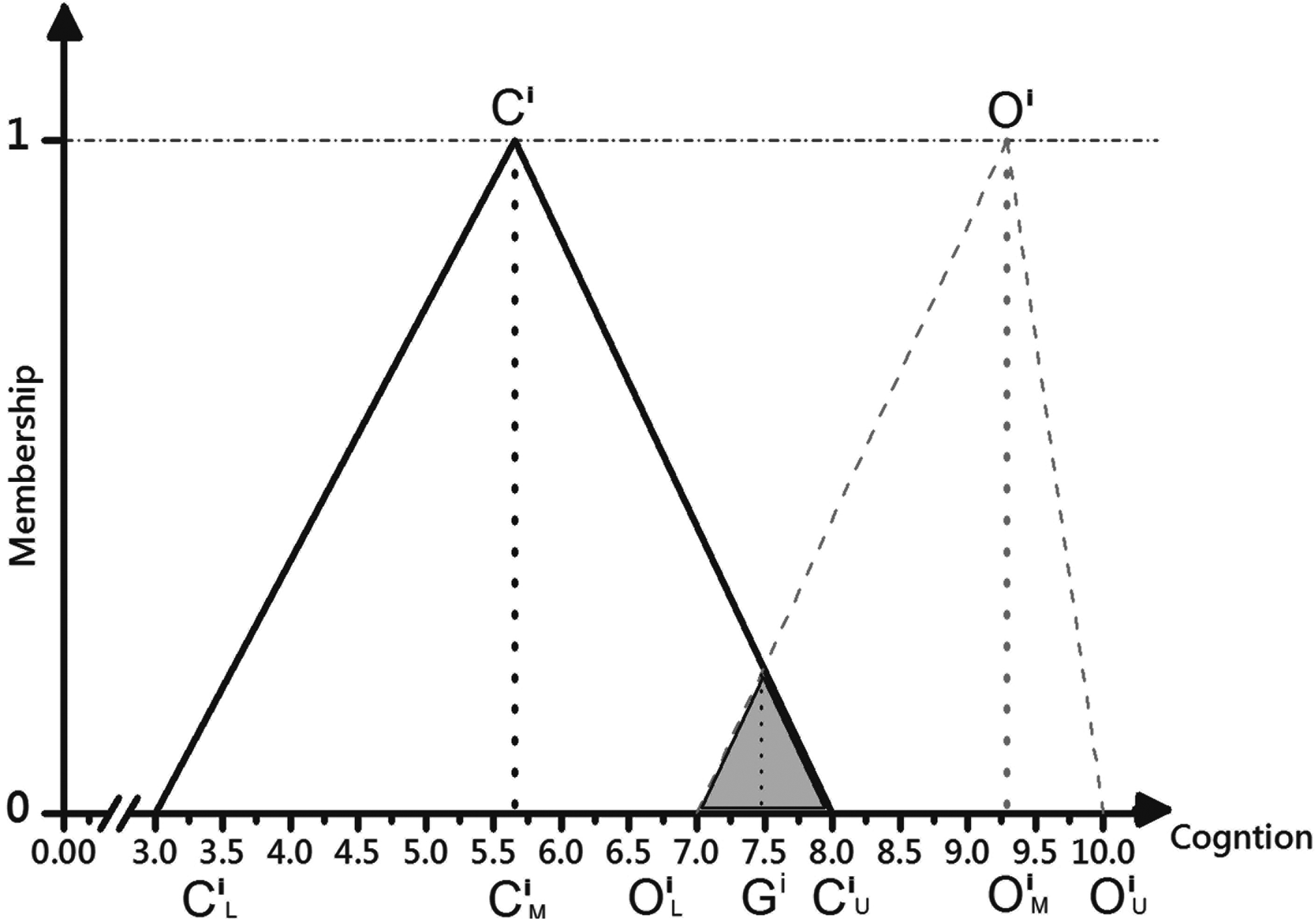
Importance of evaluation factors (R-1-2).
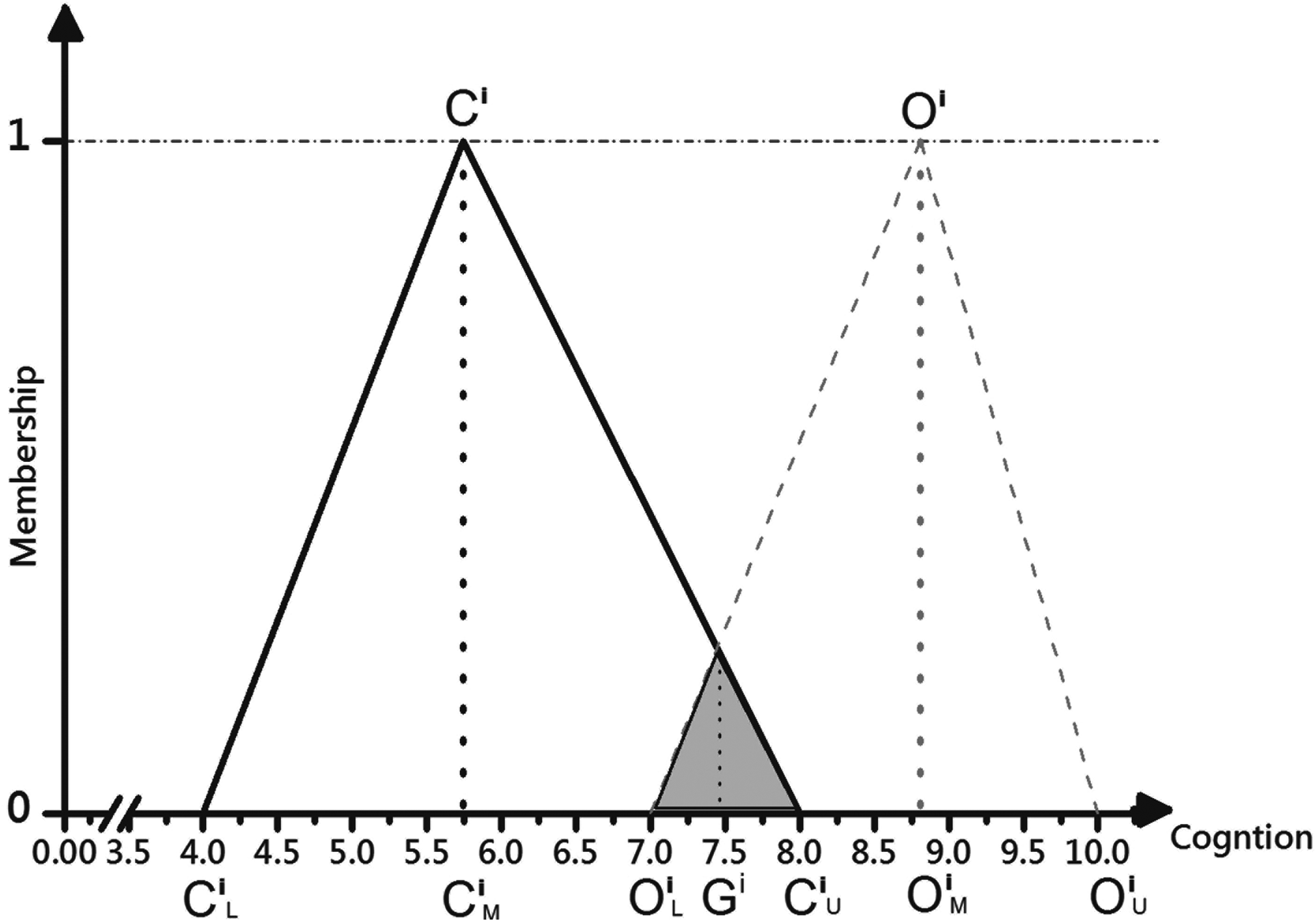
Importance of evaluation factors (R-1-3).

Importance of evaluation factors (R-1-4).
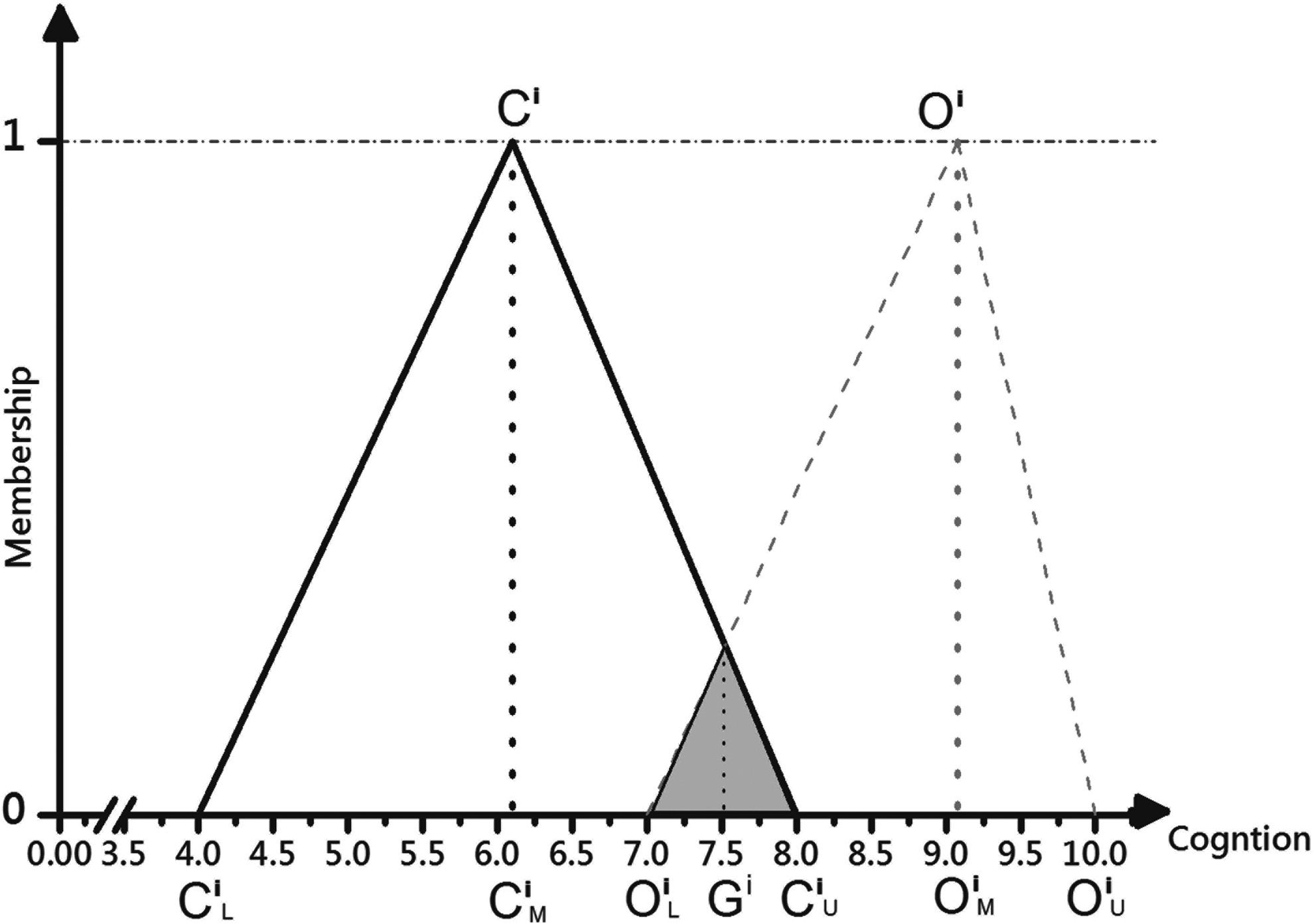
Importance of evaluation factors (R-2-1).

Importance of evaluation factors (R-2-2).

Importance of evaluation factors (R-2-3).
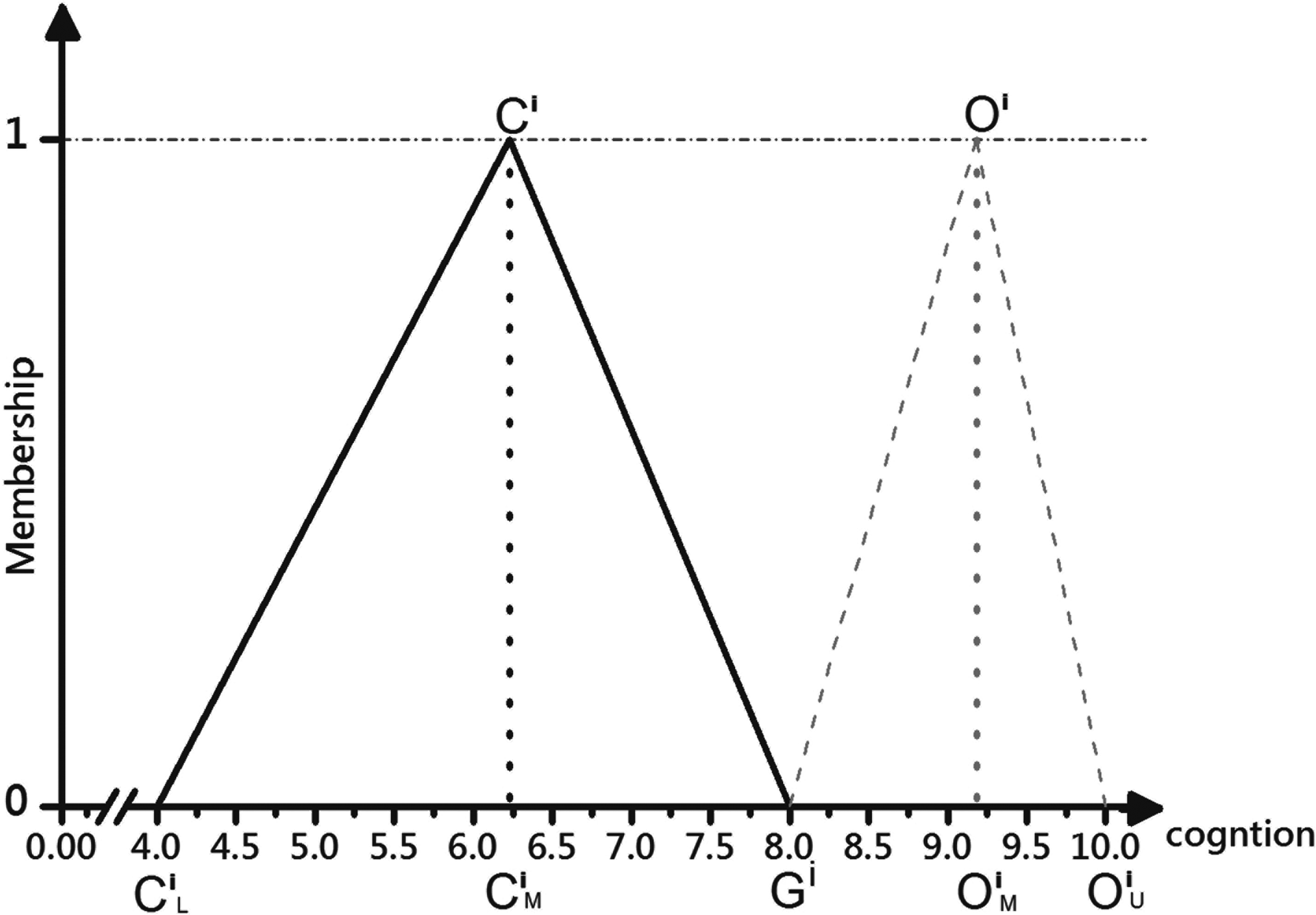
Importance of evaluation factors (R-3-1).
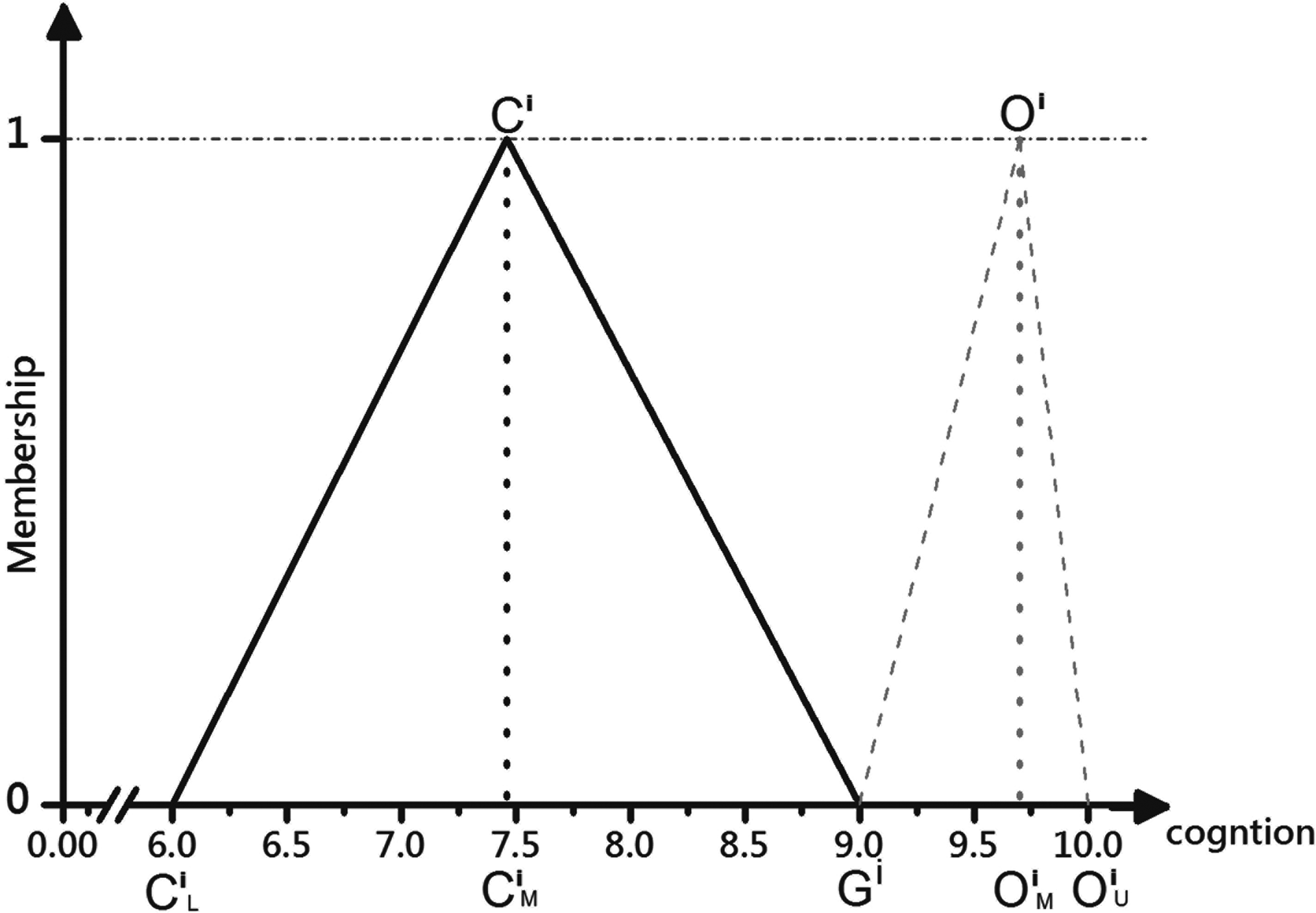
Importance of evaluation factors (R-4-1).

Importance of evaluation factors (R-5-1).

Importance of evaluation factors (E-1-1).
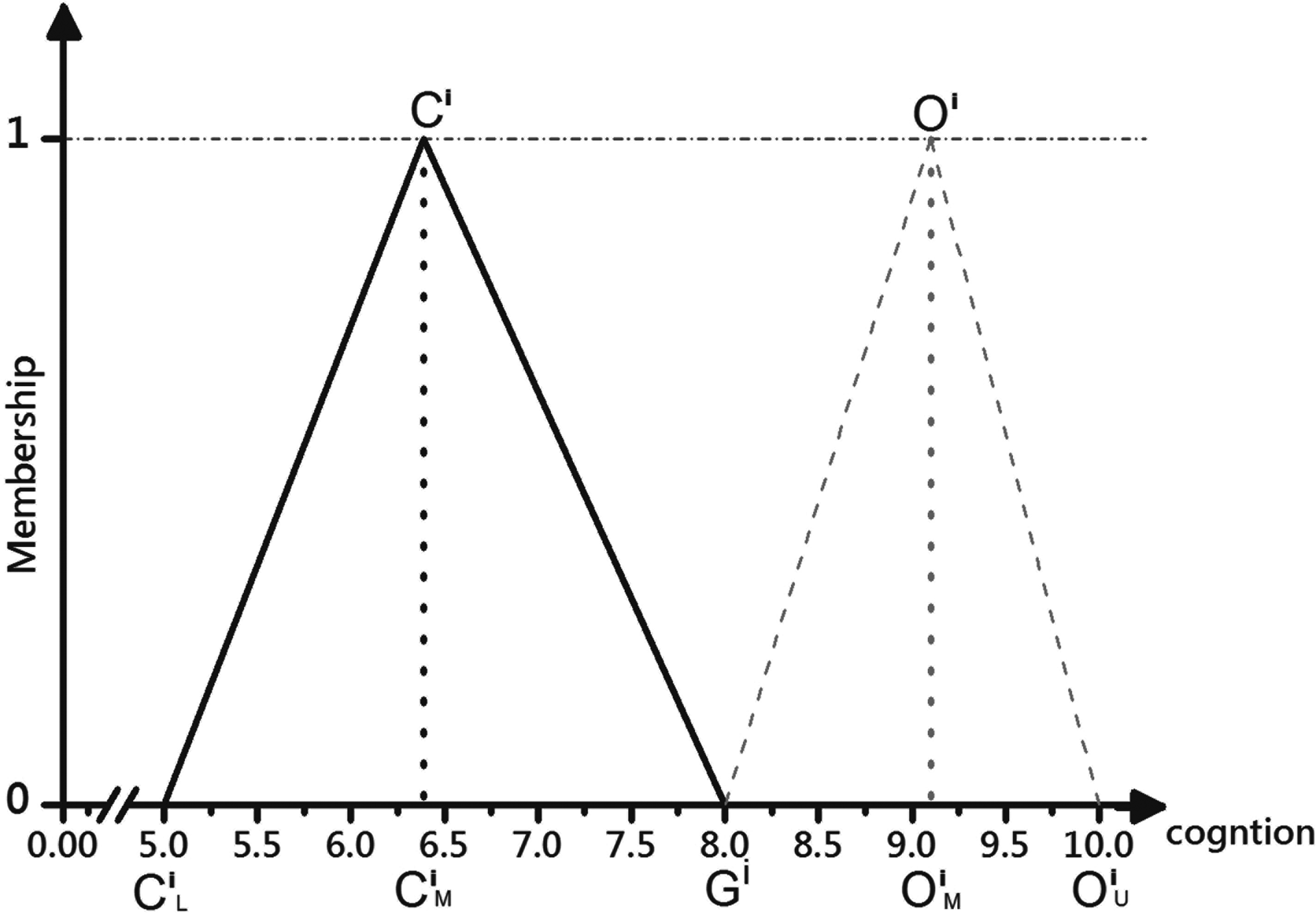
Importance of evaluation factors (E-2-1).

Importance of evaluation factors (E-3-1).
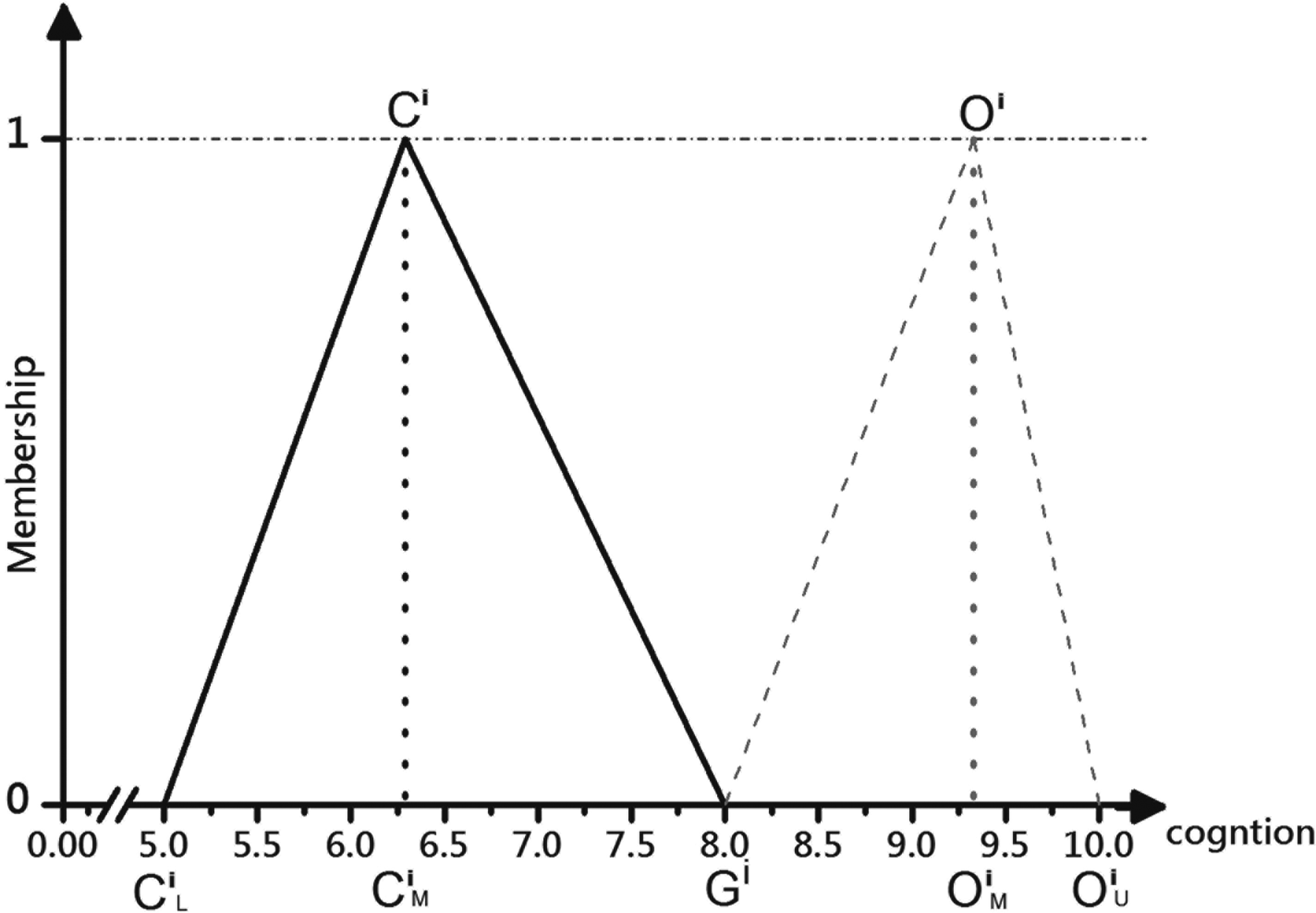
Importance of evaluation factors (E-3-2).

Importance of evaluation factors (E-4-1).
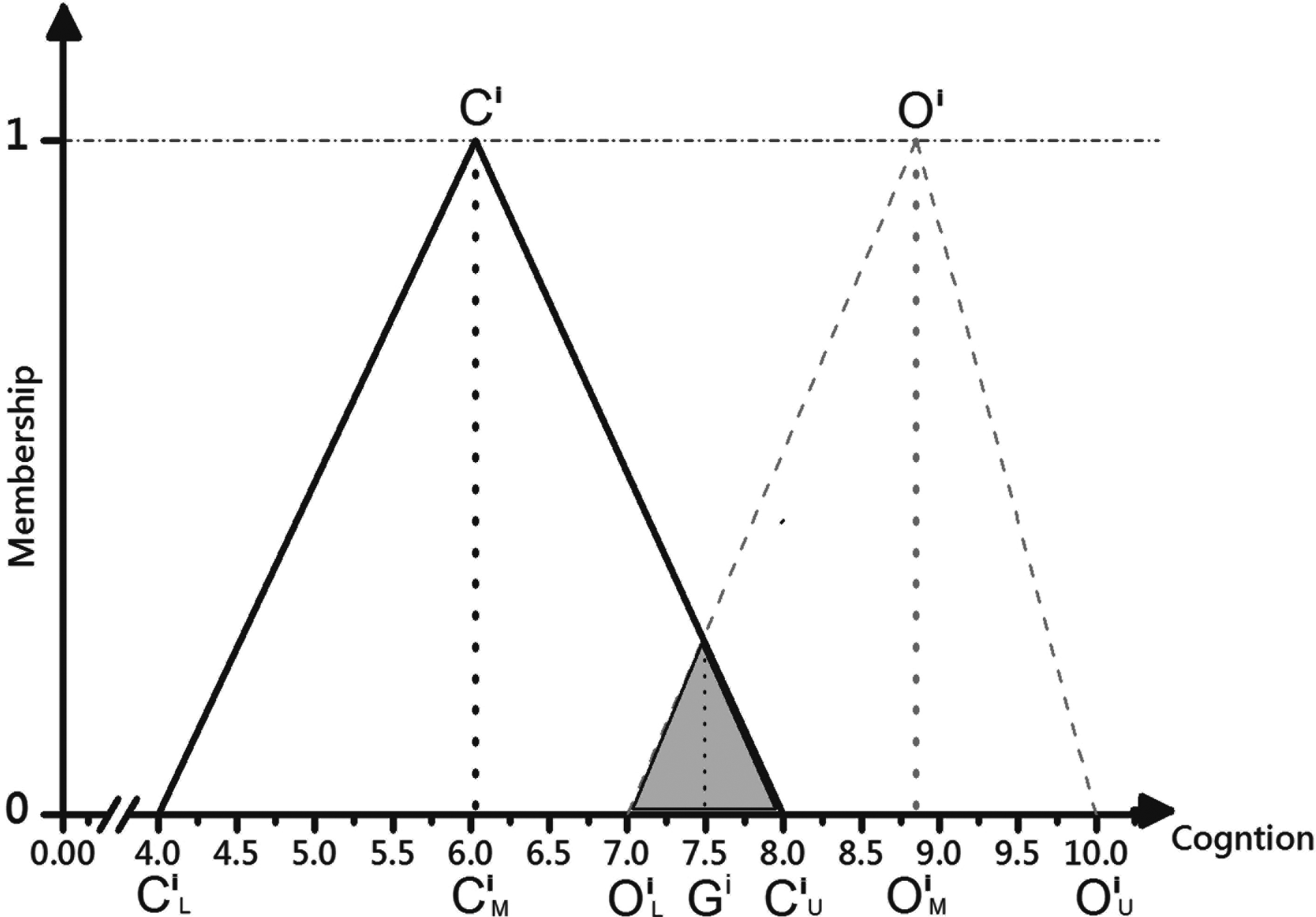
Importance of evaluation factors (G-1-1).

Importance of evaluation factors (G-1-2).
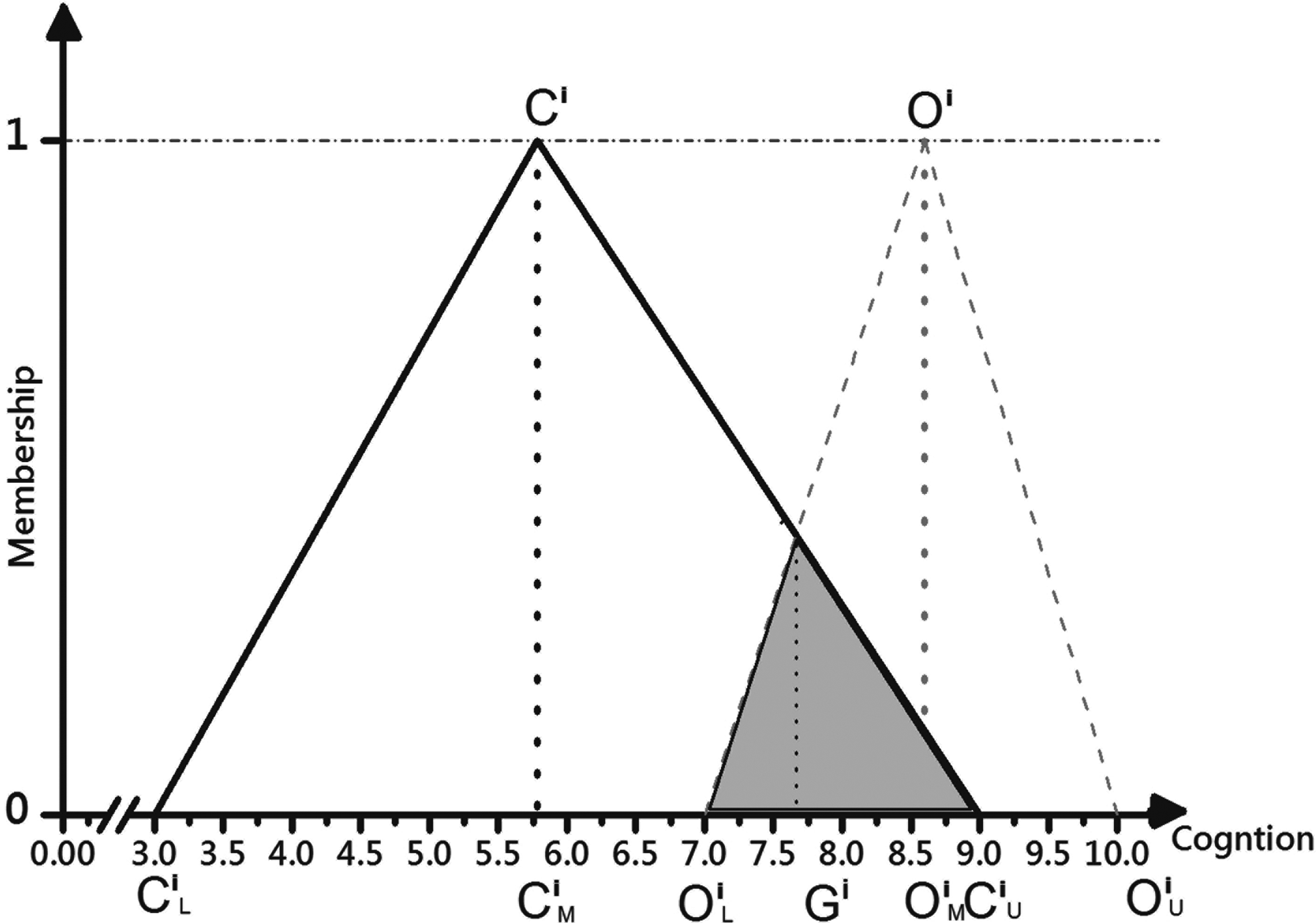
Importance of evaluation factors (G-1-3).
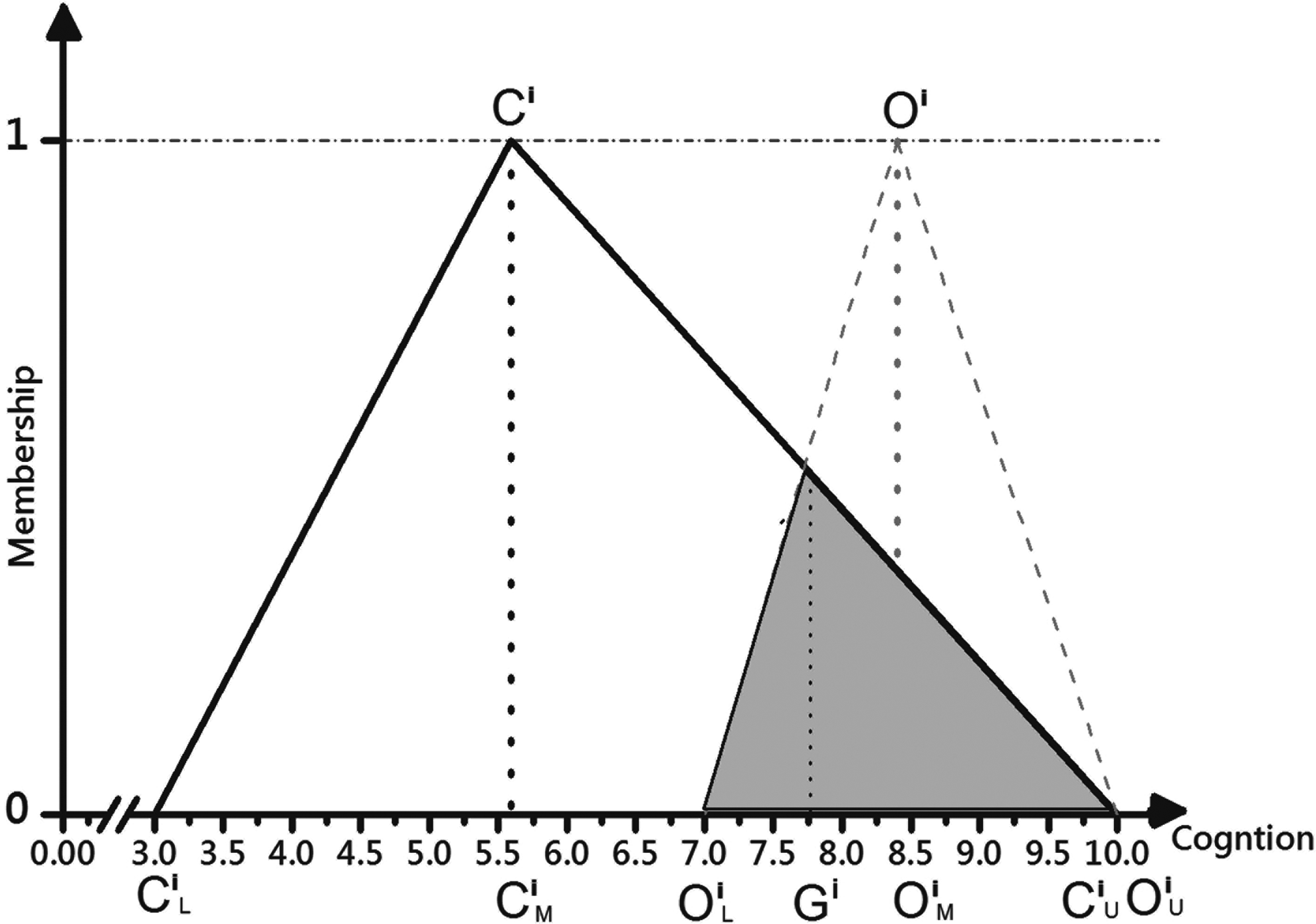
Importance of evaluation factors (G-1-4).

Importance of evaluation factors (G-1-5).
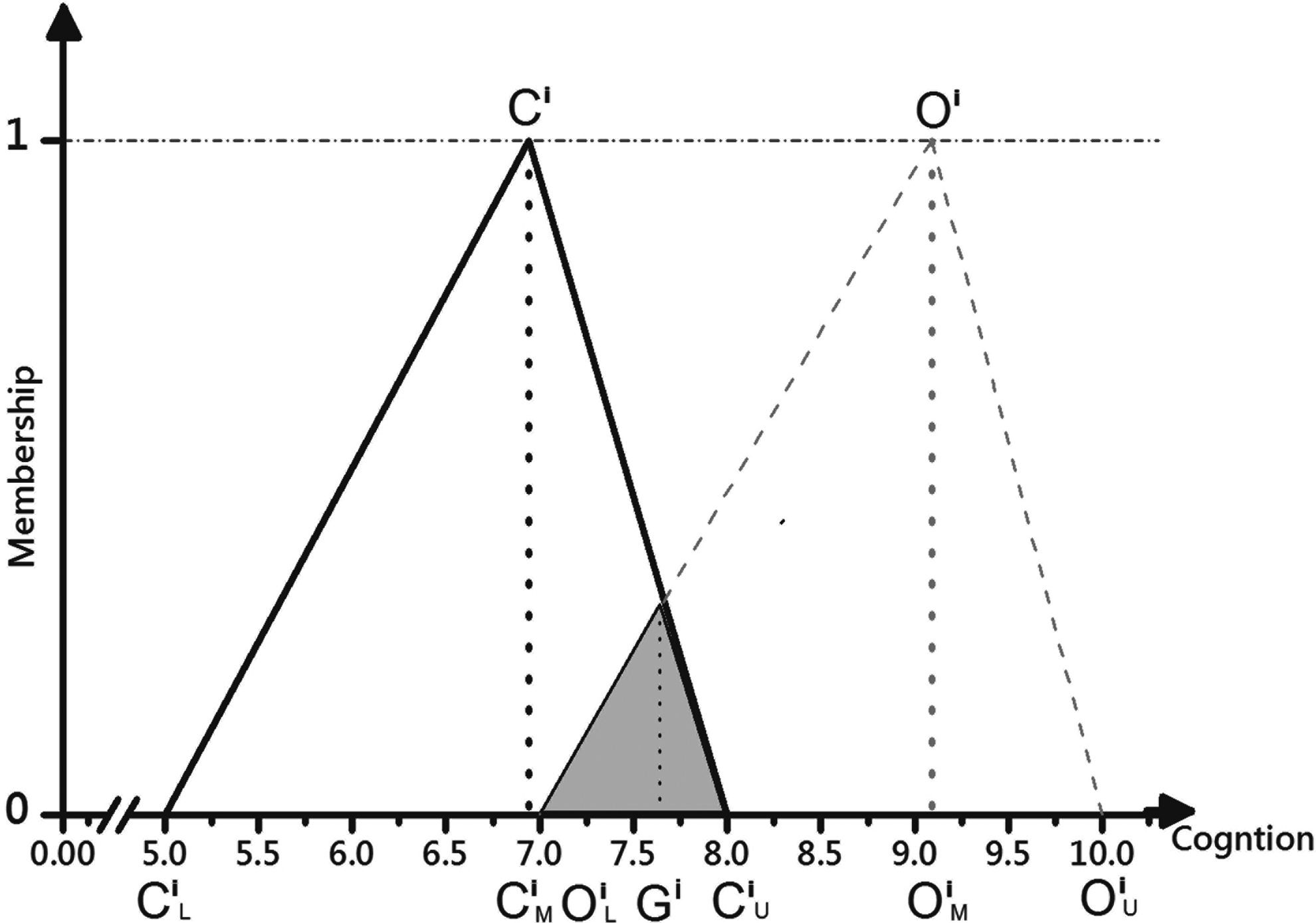
Importance of evaluation factors (H-1-1).
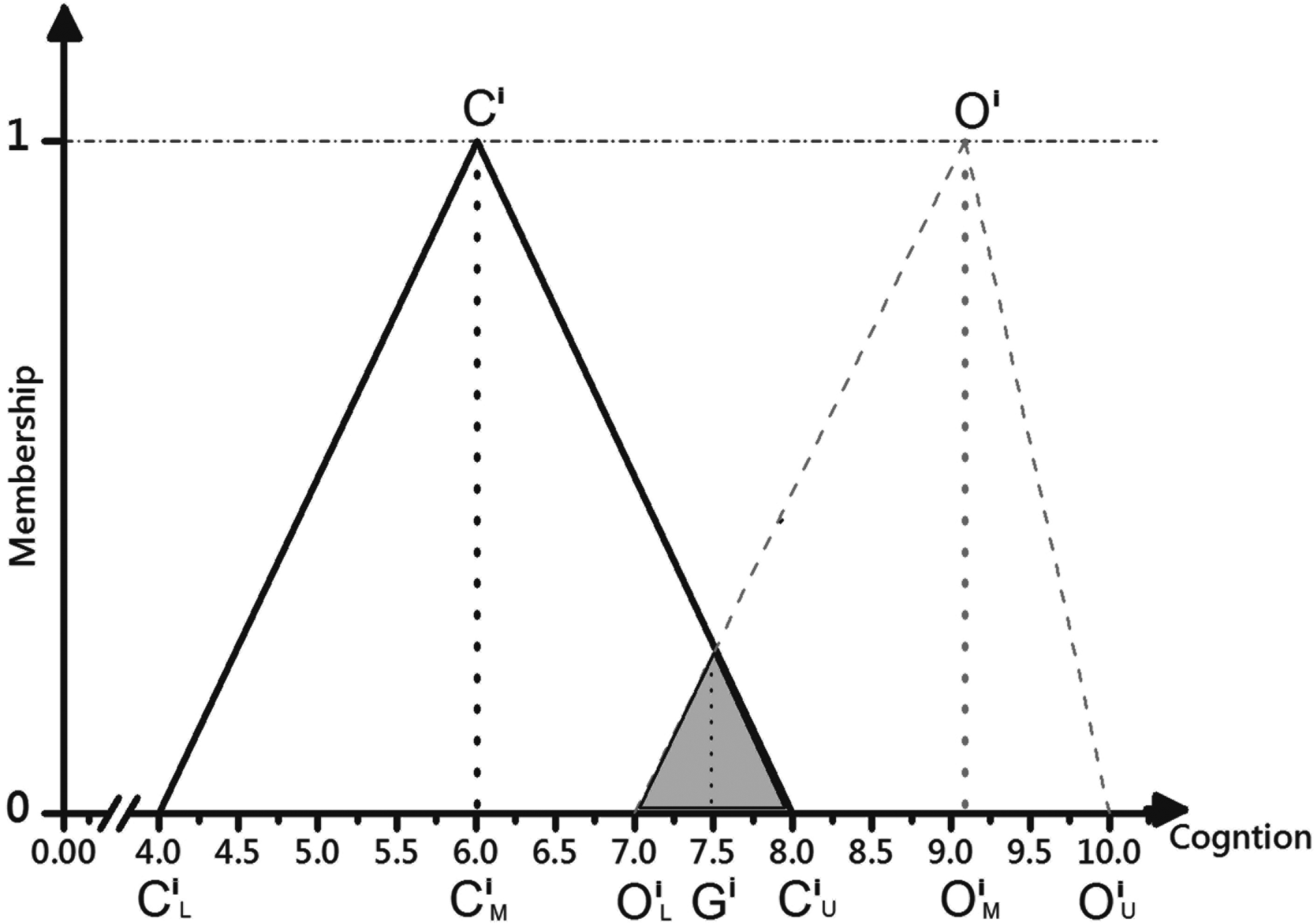
Importance of evaluation factors (H-1-2).

Importance of evaluation factors (H-1-3).
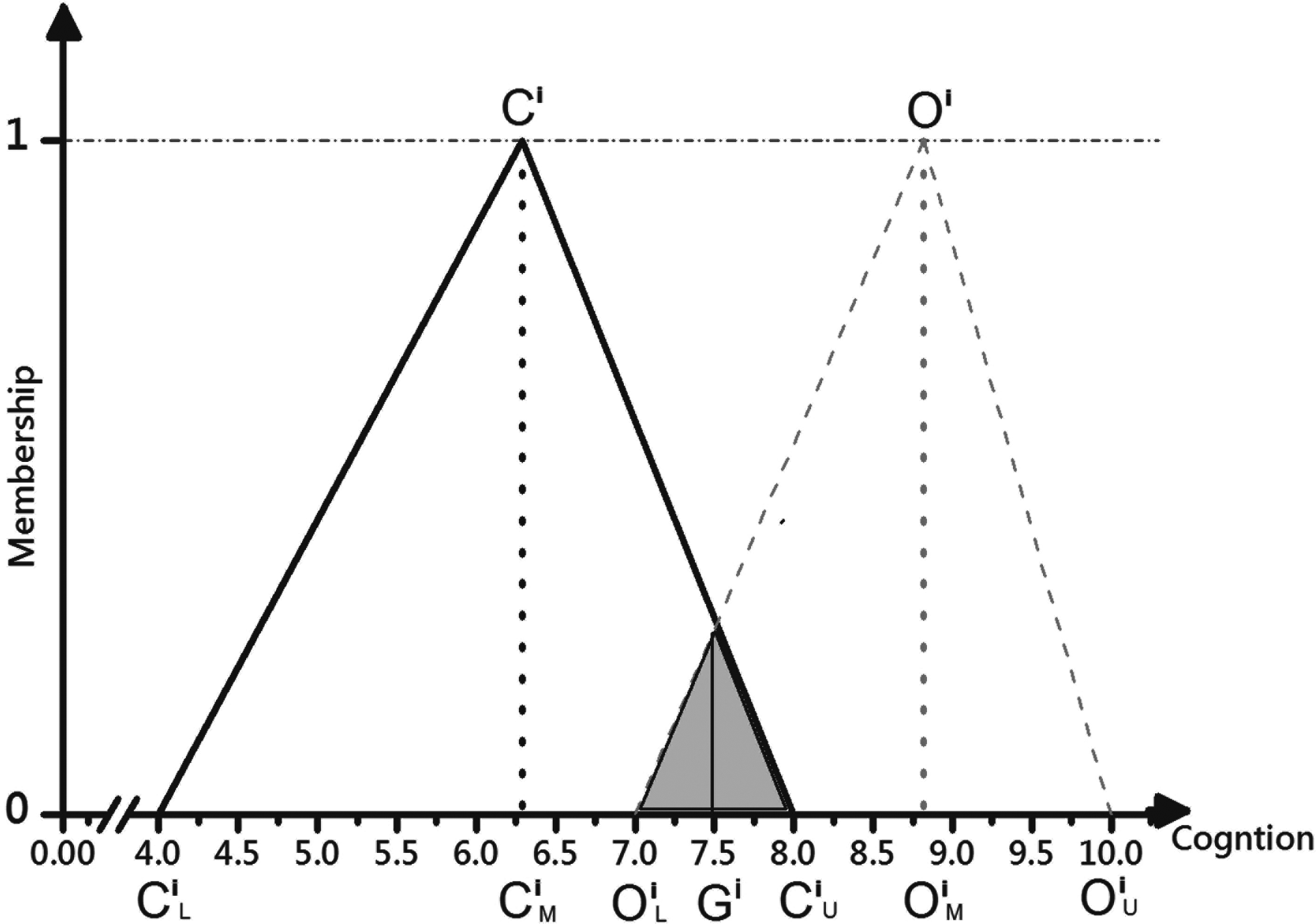
Importance of evaluation factors (H-1-4).

Importance of evaluation factors (H-1-5).
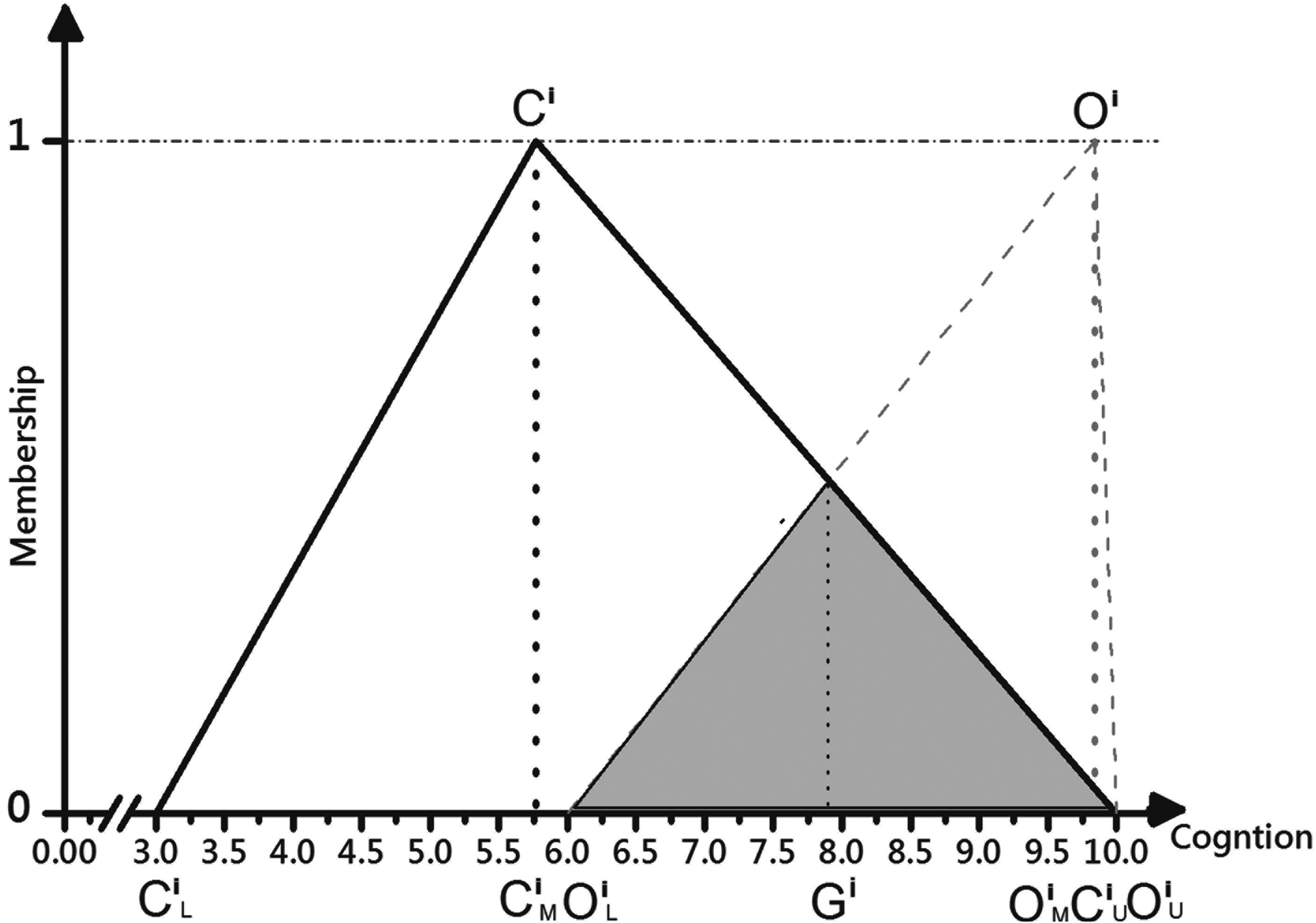
Importance of evaluation factors (H-1-6).
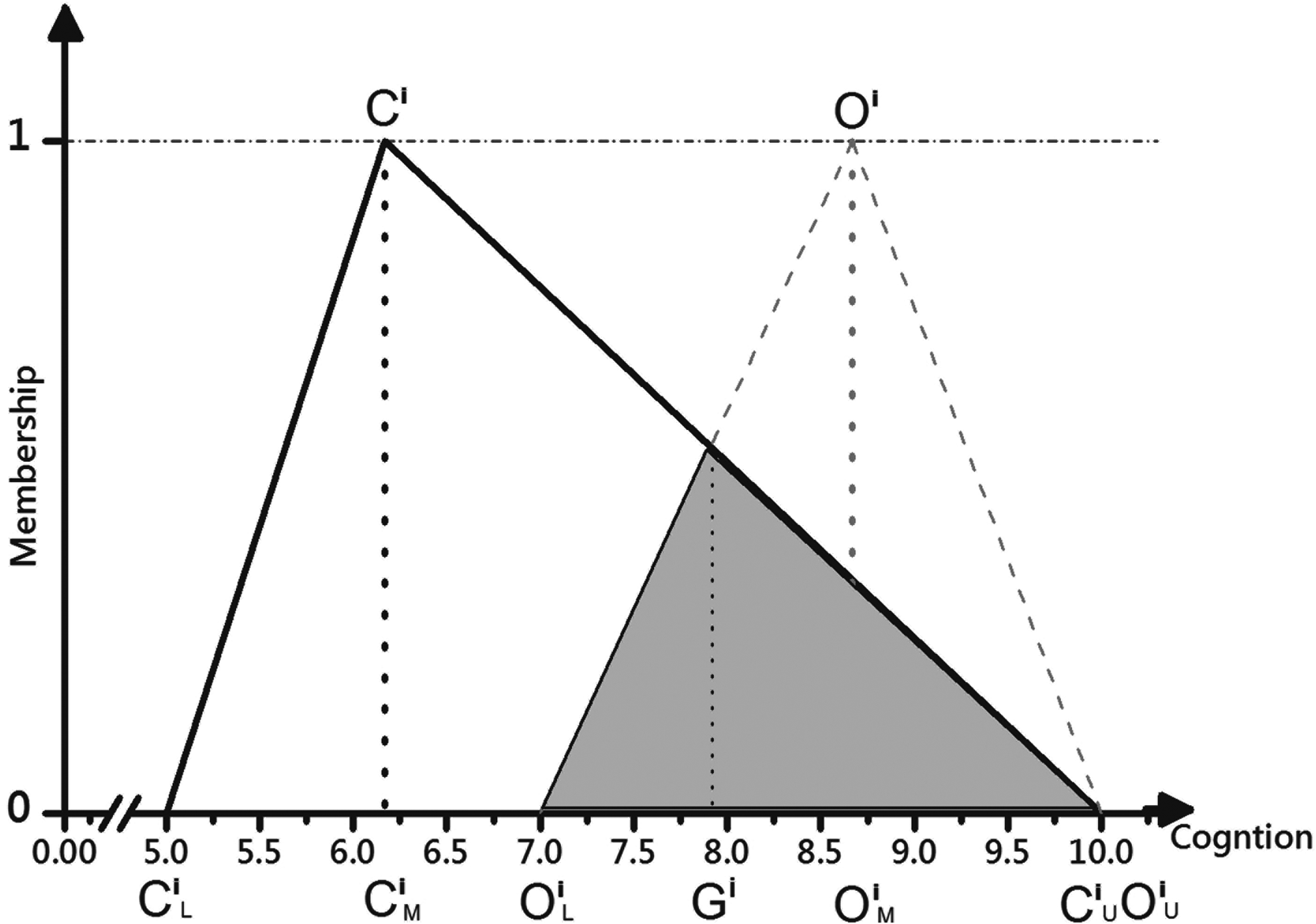
Importance of evaluation factors (F-1-1).
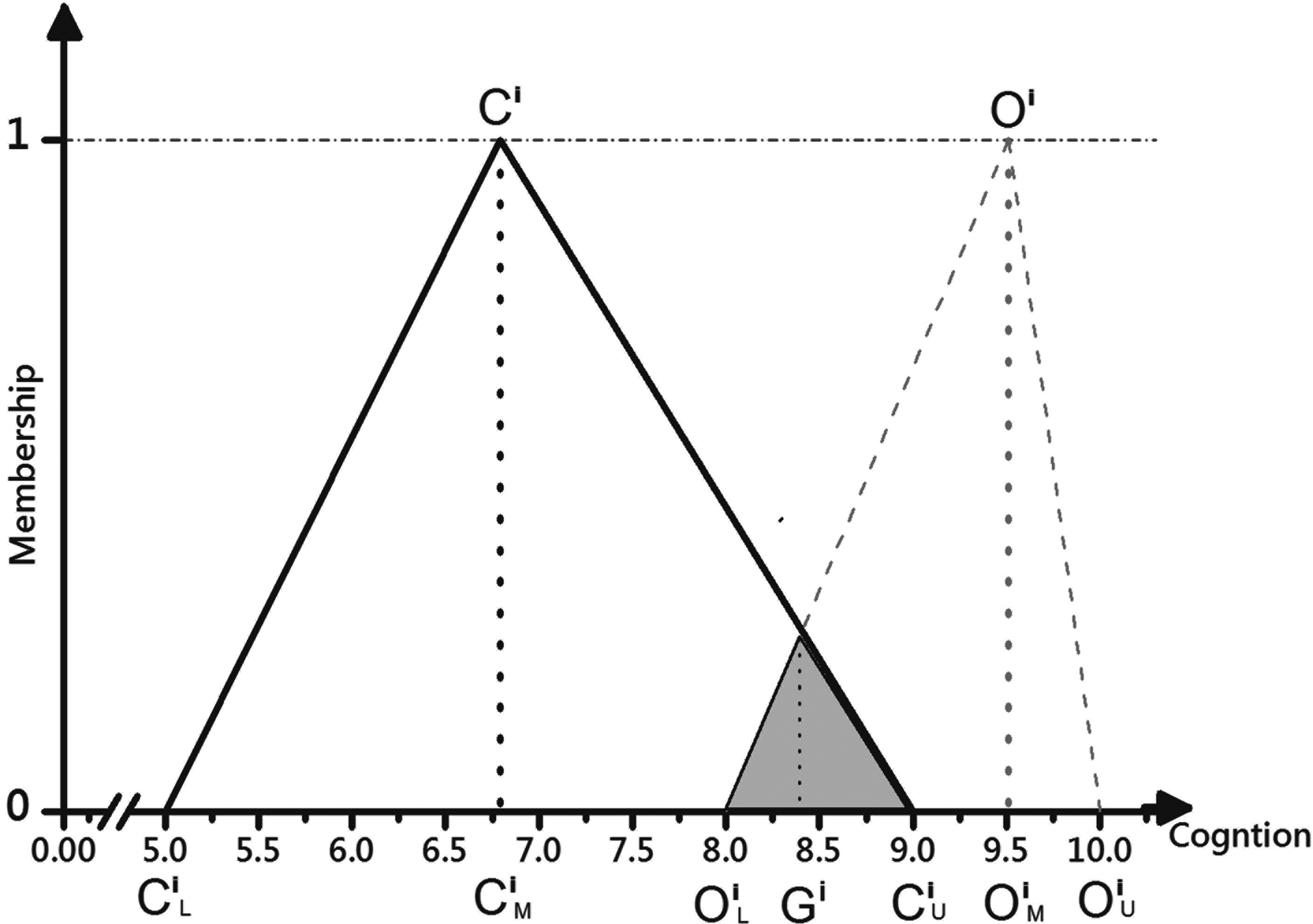
Importance of evaluation factors (F-1-2).
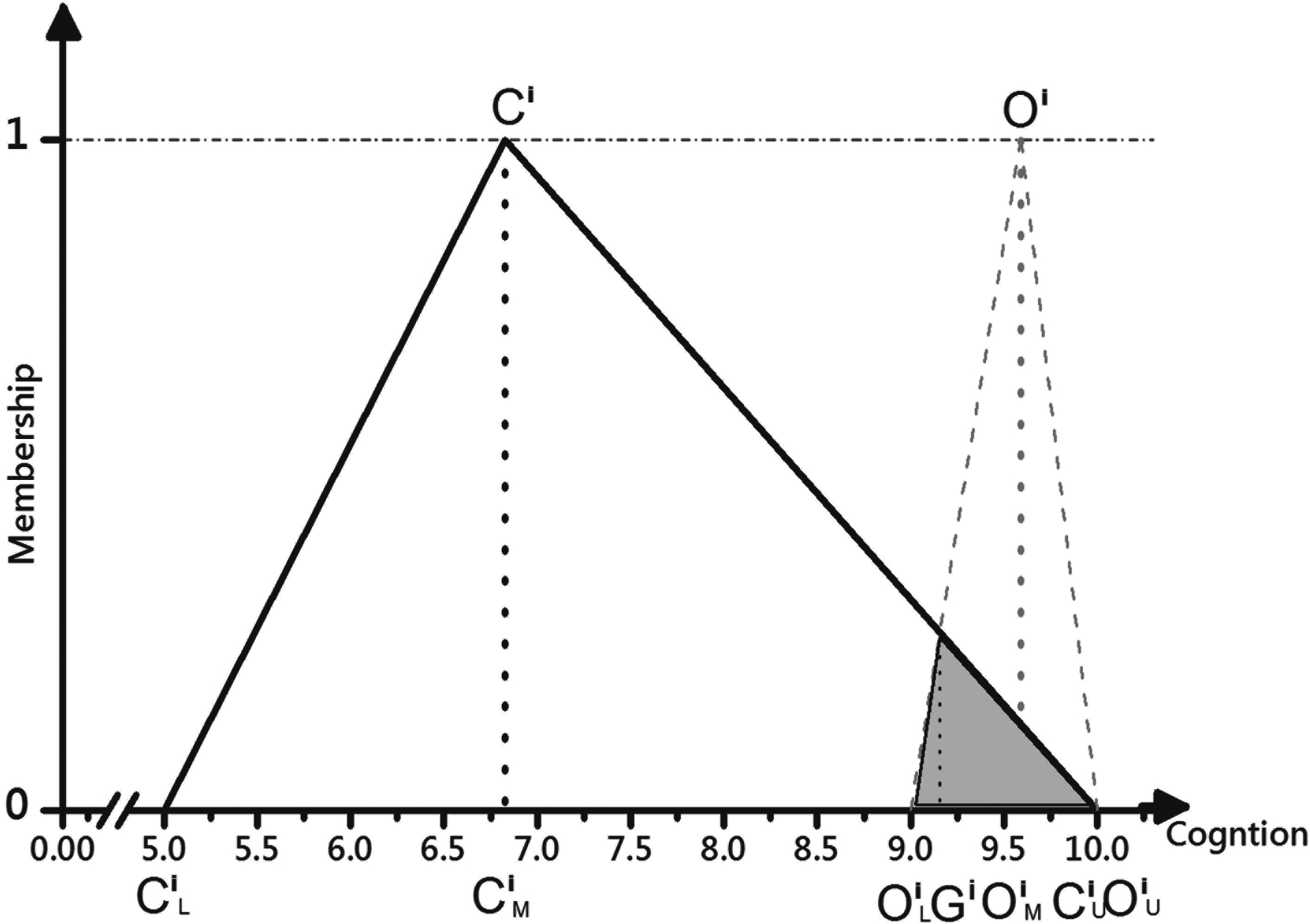
Importance of evaluation factors (F-1-3).

Importance of evaluation factors (F-1-4).

Importance of evaluation factors (F-1-5).

Importance of evaluation factors (V-1-1).

Importance of evaluation factors (V-1-2).

Importance of evaluation factors (V-1-3).

Importance of evaluation factors (V-1-4).

Importance of evaluation factors (V-1-5).
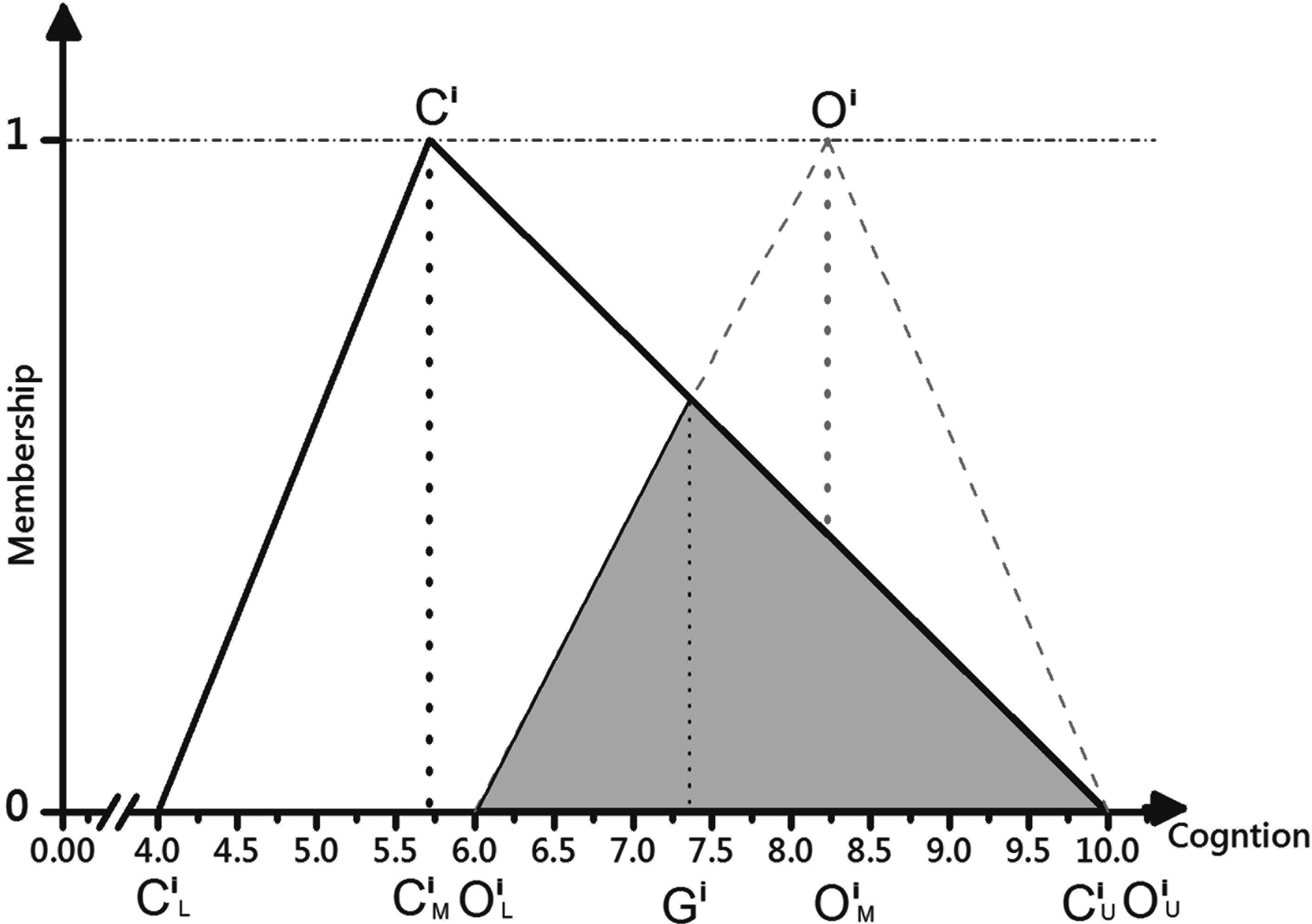
Importance of evaluation factors (V-1-6).
Boldface indicates the more important dimension of each evaluation factor.
Expert consensus threshold: 6. Boldface indicates expert consensus values exceeding the threshold.
Ci, conservative cognitive value; Gi, expert consensus value; Mi, interval between geometric means of conservative and optimistic cognitive values; Oi, optimistic cognitive value; Zi, interval of overlap (gray zone) between minimum optimisitic and maximum conservative cognitive values; L, minimum value; M, geometric mean; U, maximum value.
Expert consensus threshold: 6. Boldface indicates expert consensus values exceeding the threshold.
Expert consensus threshold: 6. Boldface indicates expert consensus values exceeding the threshold.
Expert consensus threshold: 6. Boldface indicates expert consensus values exceeding the threshold.
Expert consensus threshold: 6. Boldface indicates expert consensus values exceeding the threshold.
Expert consensus threshold: 6. Boldface indicates expert consensus values exceeding the threshold.
The revision of evaluation factors: After the analysis of the first stage, several evaluation factors were modified:
1. R-4 “Pollutant content limit” and R-5 “Harmful substance content” were amended to R-4 “Harmful substance content” and itemized as R-4-1 “Avoid material containing pollutant” and R-4-2 “Low-poisoned processing.” 2. F-1 Eco-friendly was amended to F-1 “Waste disposed” and itemized as F-1-1 “Hazardous waste disposed,” F-1-2 “Waste reduction or reuse,” and F-1-3 “Potential environmental impact.”
After the first survey, 37 evaluation items, 13 evaluation factors, and 6 evaluation indicators were revised to include 32 evaluation items, 12 evaluation factors, and 6 evaluation indicators in the Initial GBM Eco-Efficiency Evaluation System.
1. GBM environmental load (Ln): resource utilization (R), energy utilization (E), greenhouse gas emission (G), eco-friendly (F). • Resource utilization (R): R-1 Ecological material, R-2 Renewable material, R-3 Sustainable material, and R-4 Harmful substance content limit. • Energy utilization (E): E-1 Perpetual resources, E-2 Nonrenewable resources, E-3 Energy efficiency, and E-4 Energy recovery. • Greenhouse gas emission (G): G-1 Greenhouse gas emission of building material. • Eco-friendly (F): F-1 Waste disposed. 2. GBM Quality (Qn): high performance (H), economic (V). • High performance (H): H-1 High-performance upgrade factor. • Economic (V): V-1 Value.
Second survey
Expert questionnaire: The objective of the questionnaire was to query experts in the areas of building, building materials, equipment, energy, and eco-environment. Of a total of 17 questionnaires, 16 valid responses were received (response rate of 94.1%).
The results of the GBM Eco-Efficiency Evaluation System: All of the 12 evaluation factors and 32 items met the Gi threshold. Consequently, there are 2 dimensions, 6 evaluation indicators, 12 evaluation factors, and 32 evaluation items in the GBM Eco-Efficiency Evaluation System (Fig. 40).
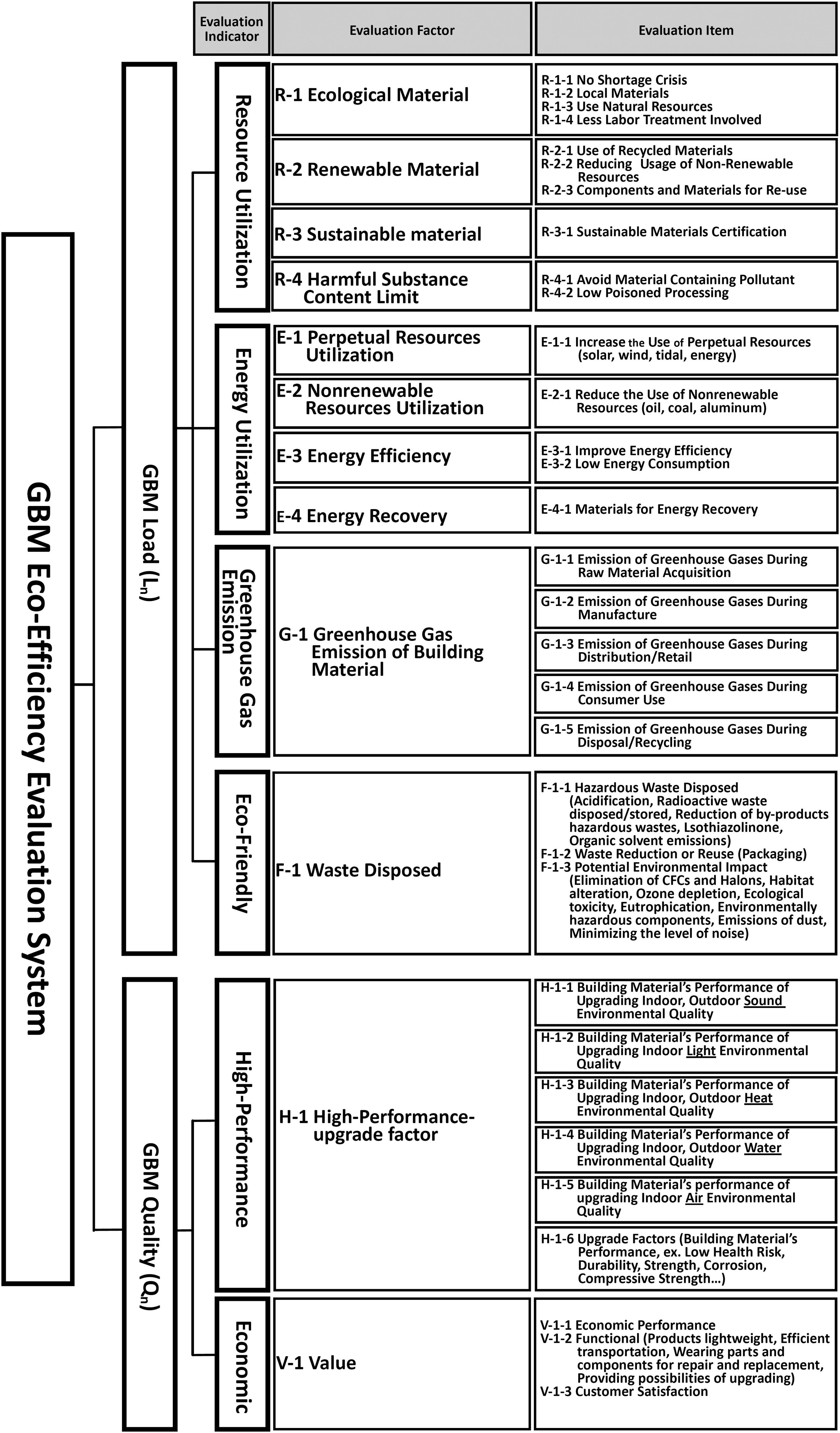
GBM Eco-Efficiency Evaluation System.
GBM Eco-Efficiency Model: According to the Eco-Efficiency Model and the analysis results from the GBM Eco-Efficiency Evaluation System, the GBM Eco-Efficiency Model was derived as in Equations (1)–(3):
Priority vectors of the evaluation indicators
Expert questionnaire: The objective of the questionnaire by AHP was to analyze the priority vectors of the evaluation indicators and the evaluation factors (Kablan, 2004). The consistency ratio (CR) is a measure of the extent to which a given matrix compares to a purely random matrix in terms of consistency indices. A value of CR≤0.1 is considered acceptable; greater values indicate that judgments must be revised (Saaty, 1990).
This questionnaire queries experts from industry, government, and academia from the fields of building, building materials, equipment, energy, and eco-environment. Of the total of 53 questionnaires, 51 valid responses were received (response rate of 96.2%; Table 9).
Results of the priority vector analysis
All of the results from the priority vector analysis of the evaluation indicators and evaluation factors met the requirements of the consistency test (CR<0.1). In addition, all of the survey results were consistent. The results of the comprehensive analysis of the priority vector are shown in Tables 10 and 11.
CI, consistency index; CR, consistency ratio.
Priorities for the evaluation indicators:
1. GBM Environment Load (Ln): Resource utilization (0.3668), Energy utilization (0.2515), Greenhouse gas emission (0.229), and Eco-friendly (0.1527). 2. GBM Quality (Qn): High performance (0.744) and Economic (0.256).
Priorities for the evaluation factors:
1. Resource utilization indicators: R-4 Harmful substance content limit (0.4396), R-1 Ecological material (0.22), R-3 Sustainable material (0.1724), and R-2 Renewable material (0.168). 2. Energy utilization indicators: E-3 Energy efficiency (0.4003), E-1 Perpetual resource utilization (0.3175), E-2 Nonrenewable resources (0.1468), E-4 Energy recovery (0.1354).
Research Findings
A GBM Eco-Efficiency Model is proposed based on the analysis results, as shown in Equations (2)–(4):
H: High performance evaluation value
V: Economic evaluation value
R: Resource utilization evaluation value
=0.2200R1+0.168R2+0.1724R3+0.4396R4
R1: Ecological material
R2: Renewable material
R3: Sustainable material
R4: Harmful substance content limit
E: Energy utilization evaluation value
=0.3175E1+0.1468E2+0.4003E3+0.1354E4
E1: Perpetual resources utilization
E2: Nonrenewable resources
E3: Energy efficiency
E4: Energy recovery
G: Greenhouse gas emission evaluation value
F: Eco-friendly evaluation value
Conclusion
The contribution of this research is the creation of the Taiwan GBM Eco-Efficiency Evaluation System. The evaluation indicators included resource utilization (R), energy utilization (E), greenhouse gas emission (G), eco-friendly (F), high performance (H), economic (V), and the GBM Eco-Efficiency Model.
For academic researchers, the current study could provide a systematic reference for the GBM Eco-Efficiency Model in response to enhancing indoor environmental quality and green building environments and could aid in guaranteeing ecological community quality. For users, the value of the GBM Eco-Efficiency Model could facilitate the selection of superior GBM. The model could also lead to enhancements in the quality of Taiwan's GBM and provide feedback to modify the process as well as reduce adverse environmental loads and negative effects on the global environment and human health. Beginning with eco-efficiency, this model could assist in the optimal strategy of ensuring efficiency GBM and sustainable development.
Footnotes
Acknowledgment
The authors would like to thank the National Science Council of Taiwan for supporting this research under Contract No. NSC 100-2221-E-006-227.
Author Disclosure Statement
The authors declare that no competing financial interests exist.