




Abstract
Abstract
Removal of nonylphenol ethoxylates (NPEOs) in aqueous solution by Fenton oxidation process was studied in a laboratory-scale batch reactor. Operating parameters, including initial pH temperature, hydrogen peroxide, and ferrous ion dosage, were thoroughly investigated. Maximum NPEOs reduction of 84% was achieved within 6 min, under an initial pH of 3.0, 25°C, an H2O2 dosage of 9.74×10⁻³ M, and a molar ratio of [H2O2]/[Fe2+] of 3. A modified pseudo-first-order kinetic model was found to well represent experimental results. Correlations of reaction rate constants and operational parameters were established based on experimental data. Results indicated that the Fenton oxidation rate and removal efficiency were more dependent on the dosage of H2O2 than Fe2+, and the apparent activation energy (ΔE) was 17.5 kJ/mol. High-performance liquid chromatography and gas chromatograph mass spectrometer analytical results indicated degradation of NPEOs obtained within the first 2 min stepwise occurred by ethoxyl (EO) unit shortening. Long-chain NPEOs mixture demonstrated a higher degradation rate than shorter-chain ones. Nonylphenol (NP), short-chain NPEOs, and NP carboxyethoxylates were identified as the primary intermediates, which were mostly further degraded.
Introduction
N
Physical and chemical processes such as coagulation, adsorption by activated carbon, filtration, and advanced oxidation have been proposed to degrade endocrine disrupting contaminants from wastewater. The coagulation-flocculation process (Westerhoff et al., 2005) was generally found to be difficult to remove endocrine disrupting chemicals (EDCs; efficiency <20%). The sorption capacity of granular activated carbon for NP was at least 100 mg/g. (Tanghe and Verstraete, 2001). Lee et al. (2008) compared the removal efficiencies of EDCs by various treatment technologies. Their experimental results showed an NP decomposition rate of 55%, 74%, and 83% using membrane bioreactor, nanofiltration, and reverse osmosis methods, respectively. Ike et al. (2002) applied ozone treatment to degrade NPEOs, resulting in a reduction of NP concentration by 70–80% in 6 min. There are disadvantages and advantages in removing NPEOs for each of the mentioned treatment process. In recent decades, the Fenton process had been applied to wastewater treatment processes (Neyens and Baeyens, 2003). It has been proved that a variety of refractory organics can be effectively degraded by this process (Kwon et al., 1999; Benitez et al., 2001; Deng and Englehardt, 2006; Bautista et al., 2007; Lucas and Peres, 2009; Wu et al., 2010). The Fenton process entails hydrogen peroxide catalysis by the ferrous ion to product hydroxyl radicals (•OH), which has a high oxidation potential (E=2.86 V) (Neyens and Baeyens, 2003). The classical Fenton free radical mechanisms mainly involved the following key reactions (Neyens and Baeyens, 2003; Deng and Englehardt, 2006; Lucas and Peres, 2009; Wu et al., 2010):
Hydroxyl radicals generated oxidized organic compounds (RH) by the abstraction of protons producing highly reactive organic radicals (R●), which can be further oxidized and degraded by Fe3+ (Deng and Englehardt, 2006; Lucas and Peres, 2009):
Early works on NPEO degradation by Fenton oxidation showed typically limited effectiveness in its removal capacity in comparison with various advanced oxidation processes (Fuente et al., 2010; Nagarnaik and Boulanger, 2011) or with different surfactants (Kitis et al., 1999; Pagano et al., 2008). Effects of operation conditions on the removal of NPEOs by the Fenton oxidation process and their kinetics are still unknown, especially for the degradation intermediates. Our purpose here is to investigate the influence of the principal operating parameters, including pH, temperature, and H2O2 and Fe2+ concentrations. In addition, we made a kinetic model using modified pseudo-first-order kinetics to determine the kinetic constants. Both high-performance liquid chromatography (HPLC) and the gas chromatograph mass spectrometer (GC-MS) were employed to detect the degradation products and their evolution during the reaction. Our results provide fundamental knowledge with regard to the efficacy of the Fenton oxidation process in the treatment and assessment of NPEO contamination.
Materials and Methods
Reagents
A commercial NPEO (Igepal CO-630), with an average of nine ethoxyl units, was obtained from Sigma-Aldrich. According to the manufacturer's information, the average molecular weight of the NPEOs is 617. Analytical standards for NP (technical grade), nonylphenol monoethoxylate (NP1EO), nonylphenol diethoxylate (NP2EO), nonylphenoxy carboxylate (NP1EC), nonylphenoxy ethoxy carboxylate (NP2EC), nonylphenoxy diethoxy carboxylate (NP3EC), and 4-n-NP2EO were obtained from Dr. Ehrenstorfer (Augsburg, Germany). Bis(trimethylsilyl)trifluoroacetamide (BSTFA), trimethylchlorosilane (TMCS), and Chrysene-d12 were obtained from Supelco. HPLC-grade methanol (MeOH) and gas chromatography (GC) resolve-grade dichloromethane (DCM) were purchased from Anpel. High-purity Milli-Q water was produced in a Milli-Q plus system (Millipore). Analytical-grade hydrogen peroxide solution (H2O2, 30%, w/w), ferrous sulfate heptahydrate (FeSO4·7H2O), sulfuric acid (H2SO4), and sodium hydroxide (NaOH) were purchased from Yongda. All other chemicals and solutions were of analytical grade and required no further purification.
Experimental procedure
All the NPEOs oxidation experiments were conducted in a 250 mL beaker, which was placed in a cylindrical water jacket reactor. Temperature control was achieved by a thermostat, and a magnetic stirrer was used to mix reaction solutions. For each experiment, the appropriate volumes of NPEOs stock solutions in MeOH (10 g/L) and ferrous sulfate solutions were added into the reactor followed by dilution with deionized water to 100 mL. The pH value was measured with a PHS-3C pH meter (Leici) and adjusted to the desired value by adding predetermined amounts of 1.0 M H2SO4 and 1.0 M NaOH. The reaction was initiated by adding calculated amounts of hydrogen peroxide to the reactor. Samples were taken out from the reactor periodically using a pipette followed by adding Na2S2O3 to stop the reaction immediately.
Sample extraction and preparation
Samples were prepared by performing liquid–liquid extraction before analysis, which was modified as previously described (Stephanou and Giger, 1982; Montgomery-Brown et al., 2003; Lu et al., 2008a). In summary, 2 mL of dichloromethane was added to the samples in vials and mixed completely for 1 min. After 2 layers were formed, the lower layer liquid was sucked out to another untapped vial. The top layer was again treated in the same way. The extracted bottom-layer liquids were blended together and evaporated to dryness by a stream of nitrogen. The residue was redissolved in 1 mL n-hexane and divided into four portions of 250 μL each. 4-n-NP2EO was used as an internal standard for NP, NP1EO, and NP2EO. A volume of 100 μL of BSTFA and TMCS was added, respectively, for derivatization before GC-MS analysis. For NP1EC, NP2EC, and NP3EC, a 250 μL n-hexane solution was blown to dryness by nitrogen gas stream again followed by derivatization. The carboxylated intermediates were converted to propyl esters by adding 1.5 mL n-propanol/acetyl chloride (9/1, v/v) and heating the samples for 1 h at 85°C. After cooling, 2 mL of dichloromethane was added to the reaction mixture followed by 5 mL of 2% potassium bicarbonate solution. The sample was mixed vigorously, and the upper aqueous phase was discarded. The remaining extract was dried using sodium sulfate. Next, 20 μL of a 1 mg/L chrysene-d12 solution was added as an internal standard. The mixture was blown to dryness and redissolved in 100 μL of n-hexane. Finally, the n-hexane solution was transferred to a 200 μL glass insert and evaporated to 50 μL before the injection. To determine the total NPEOs concentration, the third 250 μL n-hexane solution was blown to dryness by a nitrogen gas, redissolved in 100 μL mixture of methanol/water (50/50, v/v), for reverse-phase HPLC analysis. The fourth and final n-hexane solution was directly injected into normal-phase HPLC for branched-NPEOs detection.
HPLC analysis
An Agilent HPLC-1220 with ultraviolet detection was used to analyze the concentration of total NPEOs and branched NPEOs under different conditions, using methods modified from the literature (Goel et al., 2003; Lu et al., 2008b). The chromatographic separations were carried out with an Agilent Poroshell 120 EC-C18 column (dimensions 50 mm×4.6 mm, 2.7 μm; Agilent). The injection volume was 10 μL. The mobile phase used was a mixture of Milli-Q water and methanol at a flow rate of 1 mL/min. Gradient elution was performed starting with 80% methanol, which went up linearly to 90% in 10 min and to 100% in another 5 min (post time: 5 min). The UV detection wavelength was 225 nm. All oligomers of NPEOs were co-eluted as the total concentration of NPEOs, giving a single peak. Igepal CO-630 (2, 20, 50, and 100 mg/L) was used for the recovery test. Our results showed a recovery rate of 87.2%±3.1% for the total of NPEOs. For the determination of branched-NPEOs oligomers in the range from 3 to 18 EO units, an Agilent ZORBAX NH2 (250 mm×4.6 mm, i.d. 5 μm; Agilent) was employed. A binary gradient was applied for the elution. The mobile phases A and B were mixtures of n-hexane/2-propanol (9/1, v/v) and 2-propanol/water (9/1, v/v), respectively. A linear gradient program from 90% A and 10% B to 50% A and 50% B in 20 min at a flow of 1.5 mL/min was used. The UV detection options was invariant. Acquired chromatograms were analyzed for individual oligomers by integrating the corresponding peak areas using the HPLC Chemstation software.
GC-MS analysis
A GC-MS 7890A/5975C (Agilent) with a DB-5MS capillary column (30 m×0.25 mm, i.d., 0.25 μm film) was performed for the identification and quantification of oxidation products. The carrier gas was helium and was maintained at a constant flow rate of 1.0 mL/min. A 1 μL sample was injected in splitless mode at an inlet temperature of 280°C. For NP and short-chain NPEOs, the temperature program was as follows: at 50°C for 2 min, from 80°C to 200°C at 20°C/min for 2 min, from 200°C to 260°C at 5°C/min for another 2 min, and from 260°C to 280°C at 20°C/min. The final temperature was held for 5 min. The EI conditions were as follows: ionization energy, 70 eV; electron multiplier voltage, 1.19 kV; and ionization temperature, 230°C. The scan model was carried out and mass rage m/z, 50–600; scan time, 0.5 s. In case of short-chain NPECs, the column temperature was programmed as follows: The initial temperature of 130°C was increased with a gradient of 5°C/min for approximately 280°C. The final temperature was maintained for 20 min. Compared with the former EI conditions, the ionization temperature became 200°C. The identification was performed according to the characteristic ions that were given former references (Ding and Tzing.1998; Montgomery-Brown et al., 2003). The identification of NP, short-chain NPEOs, and NPECs was also confirmed in a full scan mode by matching the retention time and mass spectrum with authentic standards. The quantification was performed directly after intermediate identification, using selected ion monitoring (SIM) mode. The chosen ions for SIM were 117, 161, and 246 for 4-n-NP2EO (internal standard); 237, 251, 265, 279, and 293 for NP1EO; 295, 309, 323, 337, and 351 for NP2EO; 240 for Chrysene-d12 (internal standard); 221, 235, 249, and 263 for NP1EC; 265, 279, 293, 307, and 321 for NP2EC; and 309, 323, 337, 351, and 365 for NP3EC.
Results and Discussion
Effect of initial pH
The pH effect was particularly studied through experiments p-1, p-2, p-3, p-4, and N-21 (Table 1). Figure 1 depicted the decrease of NPEOs concentration in aqueous solutions under different initial pH values. These results revealed that Fenton's reagent was sensitive to pH, and the best removal efficiency was obtained at a pH of 3.0. This result is confirmed by the elaborate NPEO removal revealed in Supplementary Figure S1, with initial pH from 2.5 to 4.0.

Effect of initial pH value on the removal ratio of NPEOs. Experimental conditions: [NPEO]0=3.25×10⁻⁵ M; [H2O2]0=9.74×10⁻³ M; [Fe2+]0=3.25×10⁻³ M; T=25°C; reaction time 10 min.
Figure 1 indicated the significant decline in NPEOs removal from 87.42% to 42.15%, with a pH change from 3 to 6. It was principally due to the formation of the ferrous/ferric hydroxide complexes that lead to deactivation of the ferrous catalyst, resulting in a smaller amount of ●OH (Benitez et al., 2001; Deng and Englehardt, 2006). Besides, the precipitation of Fe3+ as Fe(OH)3 obstructs the regeneration of Fe2+ from the reaction between Fe3+ and H2O2 (Lucas and Peres, 2009).
For pH values below 3.0, the reaction of H2O2 with Fe2+ was seriously affected by the formation of the [Fe(H2O)6]2+ complex, which reacted more slowly with H2O2 than [Fe(OH)(H2O)5]+ (Benitez et al., 2001). Besides, H2O2 got solvated in the presence of a high concentration of H+ ion and formed the stable oxonium ion [H3O2]+, which also restricted the generation of ●OH (Kwon et al., 1999). In addition, the scavenging effect of H+ on ●OH was another reason for the lower removal efficiency of NPEOs at a pH of 2.0 (Deng and Englehardt, 2006; Bautista et al., 2007).
Our study found that a pH of 3.0 was a suitable initial pH for the removal of NPEOs by Fenton oxidation in accordance with previous results (Benitez et al., 2001; Bautista et al., 2007; Lucas and Peres, 2009).
Effect of H2O2 concentration
H2O2 played an important role as a source of ●OH generation in Fenton's reaction. The effect of H2O2 dosage on the decomposition of NPEOs was examined by varying the initial H2O2 concentration (experiments H-5, H-6, H-7, H-8, H-9, H-10, and N-21, Table 1), and the results were depicted in Fig. 2. From the figure, it could be observed that the removal efficiency of NPEOs was obviously enhanced from 39.13% to 86.38% within 2 min, by increasing the dosage of H2O2 from 3.25×10⁻³ to 1.30×10⁻² M. However, the degradation rate that decreased with the H2O2 dosage was more than 1.30×10⁻² M. This might be due to the so-called critical concentration of hydrogen peroxide. Generally, under the critical concentrations, a higher dosage of H2O2 leads to a higher production of ●OH [Eq. (1)], which promoted the rate of NPEOs decomposition. If the H2O2 concentration reached a critical concentration, the degradation rate of NPEOs decreased with an increase in the H2O2 dose, because ●OH could be scavenged by the additional H2O2 and be transformed to HO2● [Eq. (6)],which had lower oxidation potential than ●OH. Furthermore, the incremental generation of HO2● can also be consumed ●OH according to Equation (8).

NPEO removal under different H2O2 doses. Experimental conditions: [NPEO]0=3.25×10⁻⁵ M; [Fe2+]0=3.25×10⁻³ M; T=25°C; pH=3.0.
Effect of Fe2+ concentration
Fe2+ is another main parameter in the Fenton reaction that catalyzed the conversion of H2O2 to ●OH. Figure 3 showed the effect of Fe2+ dosage on the removal of NPEOs with different initial concentrations from 8.12×10⁻⁴ to 4.87×10⁻³ M (molar ratio of [H2O2]/[Fe2+] from 12 to 2). The removal of NPEOs increased with Fe2+ concentration as a result of the higher production of hydroxyl radicals according to Equation (1). However, an increase in Fe2+ concentrations (above 3.25×10⁻³ M) did not improve the removal efficiency as expected. In this case, the Fe2+ would react with ●OH functioning as a radical scavenger [Eq. (2)]. The usage of a high Fe2+ dose was not practicable, because it entailed a higher cost of reagent as well as additional processing costs to remove the residual iron in the effluent.

NPEO removal under different Fe2+ doses. Experimental conditions: [NPEO]0=3.25×10⁻⁵ M; [H2O2]0=9.74×10⁻³ M; T=25°C; pH=3.0.
In fact, the ferrous ion also took part in the complex propagation of the Fenton process [Eqs. (3)–(5)]. As depicted in Figs. 2 and 3, the degradation of NPEOs in this process was a two-step reaction, and the reaction rate was limited by the second step as reported in previous literature (Bautista et al., 2007; Masomboon et al., 2011). First, a large amount of ●OH generated in Equation (1) could rapidly react with NPEOs, causing a fast removal rate of NPEOs. Besides, the newly formed ferric ion also reacted with the available hydrogen peroxide, producing HO2● radicals according to Equation (3). Both ●OH and HO2● could degrade NPEOs. The rate constant of Equation (1) was faster than that indicated in Equation (3) (Neyens and Baeyens, 2003; Bautista et al., 2007), which suggested that the regeneration of fresh ferrous ion according to Equation (3) was a limiting step of the entire reaction. Moreover, these ferrous/ferric ions in the earlier redox reactions reacted with hydroxide ions and formed oxyhydroxide, which accounted for the coagulation capability of Fenton's reagent (Neyens and Baeyens, 2003). Unfortunately, those small flocs contributed very slightly to the removal of NPEOs (Westerhoff et al., 2005). Thus, most of the NPEOs degraded only rapidly in the first step of the reaction.
It was, therefore, important to determine the optimum molar ratio of [H2O2]/[Fe2+] in the Fenton reaction to optimize oxidation. According to our study, 3.25×10⁻³ M of Fe2+ (molar ratio of [H2O2]/[Fe2+]=3) was considered a proper dosage for the removal of NPEOs, in agreement with the studies of nonionic surfactant oxidation (Pagano et al., 2008; Nagarnaik and Boulanger, 2011). However, the optimal ratio determined in this study was lower than the ratio of 15 reported by Lucas and Peres (2009) for the removal of COD from olive mill wastewater. It suggested that a higher dose of Fe2+ was required for the maximum removal rate of NPEOs, and the result might be attributed to the chemical nature and the intermediates formed during the reaction (Tang and Tassos, 1997).
Effect of NPEOs concentration
Experiments N-20, N-21, and N-22 (Table 1) were carried out to investigate the effect of the initial concentration on the removal of NPEOs. The NPEO concentration varied between 16.2 and 48.7 μM. Figure 4 revealed that an increase in the NPEO concentration led to a reduction in their removal efficiency. One reason for this was that the amount of ●OH produced was constant under the condition in Fig. 4; therefore, the molar number of NPEOs decomposed was also constant due to the oxidation of ●OH. The other reason was that a higher concentration of intermediates would compete with NPEOs for ●OH. These results were similar to p-nitroaniline degradation by the Fenton oxidation process (Sun et al., 2007) and the decolorization of dye with Fenton and photo-Fenton processes (Muruganandham and Swaminathan, 2004).
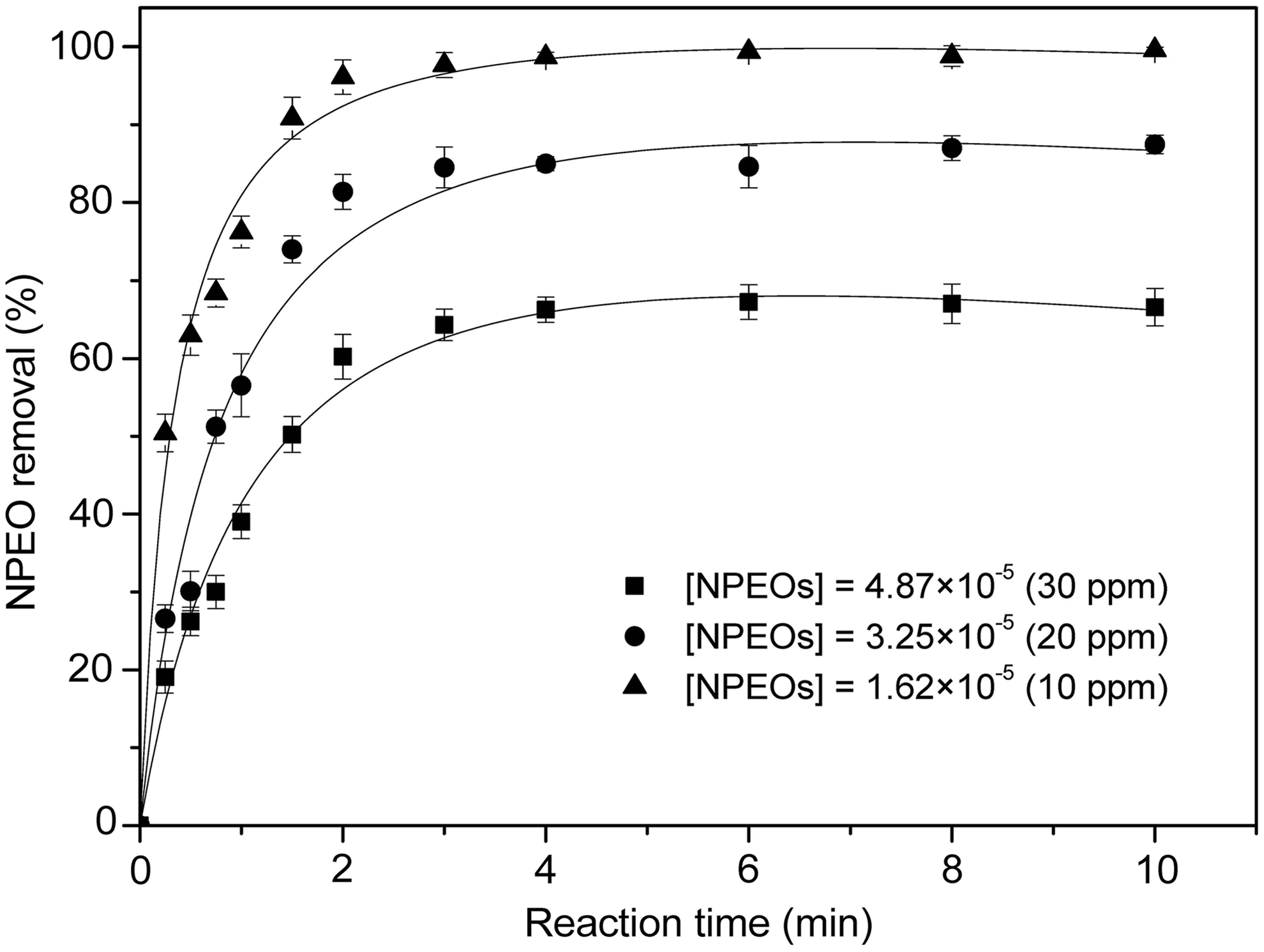
NPEO removal under different initial concentrations of NPEOs. Experimental conditions: [H2O2]0=9.74×10⁻³ M; [Fe2+]0=3.25×10⁻³ M; T=25°C; pH=3.0.
Effect of temperature
Usually, NPEO degradation rates increase with the operating temperature. The effect of temperature on the removal of NPEOs by Fenton oxidation was studied at 20°C, 25°C, 30°C, 35°C, and 40°C under initial pH 3.0, hydrogen peroxide and ferrous ion dosage of 9.74 and 3.25 mM, respectively. As shown in Fig. 5, increasing the temperature has a positive effect on the decomposition of NPEOs. The removal efficiency increased from 77.31% to 90.45% by increasing the temperature from 20°C to 40°C, within 2 min of the reaction. This effect may be due to the acceleration of ●OH production as the temperature increased, which enhanced the oxidation of NPEOs.

NPEO removal under different temperatures. Experimental conditions: [NPEO]0=3.25×10⁻⁵ M; [H2O2]0=9.74×10⁻³ M; [Fe2+]0=3.25×10⁻³ M; pH=3.0.
Kinetics
As discussed in Effect of H2O2 concentration, a large number of ●OH were produced and available during the first stage of decay. Subsequently, the reaction slowed down due to the competition of most of the hydrogen peroxide in competing reactions. Here, the kinetic study in this work was conducted from the first step of the reaction.
Oxidation of NPEOs in the Fenton reaction could be represented by the following αth-order reaction kinetics:
where C represented the NPEO concentration, α was the order of the reaction, k was the reaction rate constant, and t was the time. For a first-order reaction, the equation just cited becomes
in which C0 was the initial NPEO concentration. According to the this equation, a plot of ln(C/C0) against t will yield to a straight line with a slope of k. The reaction rate constants and the correlation coefficients were collected in Table 1, indicating that the degradation of NPEOs followed first-order kinetics.
Considering the significant influence of H2O2 and Fe2+ concentrations as discussed earlier, the rate constants obtained according to Equation (11) can be expressed by the following equation:
in which [H2O2]0 and [Fe2+]0 were the initial concentrations of H2O2 and Fe2+ with the unit of molar, respectively; m and n were the reaction orders that were derived from Fig. 6. The rate constants are clearly linear with regard to the added Fe2+ (Fig. 6a) and H2O2 (Fig. 6b) with the slopes of 0.5784 and 1.0495 on a log–log scale, respectively. The kinetic parameter k0 in Equation (12) is related to the operation temperature by the following Arrhenius equation:

Plots of ln k vs. ln C for the degradation of NPEOs by Fenton oxidation process:
where A was the frequency factor (min−1); ΔE was the activation energy (J/mol); T was the temperature (K); and R was the ideal gas constant (8.314 J/[mol·K]). lnk derived from Table 1 versus 1/T were plotted in Fig. 7. According to the slope (−ΔE/R) and intercepts (ln A) of the plot in Fig. 7, ΔE=1.75×10⁴ J/mol and A=42.76 min−1. Therefore, a combination of Equation (12), frequency factor, and activation energy yields, Equation (13) can be detailed as follows:

Plot of ln k vs. (l/T) for the degradation of NPEOs by Fenton oxidation process. Experimental conditions: [NPEO]0=3.25×10⁻⁵ M; [H2O2]0=9.74×10⁻³ M; [Fe2+]0=3.25×10⁻³ M; pH=3.0.
Typical intermediates of NPEOs oxidation
The low-molecular degradation products were analyzed by GC-MS for reliable identification. Apart from NP and short-chain NPEOs, low-molecular carboxylated intermediates (such as short-chain NPECs) were identified as primary intermediates. Figure 8 summarizes the histogram evolution of the intermediate concentration of NPEOs during the Fenton oxidation process. The overall concentration of NPEOs decreased over time from an initial concentration of 20 to 1.42 mg/L. The sharp decrease in the relative concentration of longer NPEOs (n≥6) within 1 min of reaction time indicated that the NPEOs with more EO units could be degraded easier than those with shorter ones. In addition, stepwise EO unit shortening processes occurred. The concentration peak distributions gradually shifted to lower polymerization numbers with an increase in oxidation time. Consequently, the concentration of NPEOs with short EO units clearly increased during earlier stages of the reaction, especially for NP and short-chain NPEOs (NP1EO and NP2EO). NPECs were important degradation products. The reaction could be described as a carboxlation of the terminal ethoxyl unit, which often occurred in combination with shortening of the EO chain (Ahel et al., 1994a, 1994b; Tanghe et al., 1998). The accumulation of short-chain NPEOs caused a rapid increase in the concentration of short-chain NPECs. However, the majority of those intermediates as well as NP and short-chain NPEOs were further degraded with prolonged oxidation.

Changes in intermediate concentrations of NPEO samples during the Fenton oxidation process. Experimental conditions: [NPEO]0=3.25×10⁻⁵ M; [H2O2]0=9.74×10⁻³ M; [Fe2+]0=3.25×10⁻³ M; pH=3.0.
Conclusion
Fenton oxidation was a feasible method that was used to degrade NPEOs in aqueous solution. NPEO removal could reach 81% within 2 min under the following optimal condition: pH 3.0, temperature 25–30°C, [NPEO]=3.25×10⁻⁵ M, [H2O2]=9.74×10⁻³ M, and [Fe2+]=3.25×10⁻³ M. The degradation of NPEOs followed pseudo-first-order kinetics. The rate constants of the kinetic model were correlated to the initial dosages of H2O2 and Fe2+ by a double log scale and to the experimental temperature by the Arrhenius equation. The derived equations of rate constants indicated that the Fenton oxidation was more related to dosages of H2O2 than Fe2+. The apparent activation energy (ΔE) for this process was determined to be 17.5 kJ/mol. The HPLC and GC-MS analytical results indicated that a stepwise EO unit shortening process took place. They also showed that NP, short-chain NPEOs, and NPECs were the primary intermediates, most of which degraded at the end of the reaction.
Footnotes
Acknowledgments
This work is financially supported by the Water Pollution Control and Treatment Special Project (2012ZX07206-003) and the National Natural Science Foundation of China (grant no. 21307036). The authors also wish to thank the anonymous reviewers for their reading of this article, and for their suggestions and critical comments.
Author Disclosure Statement
No competing financial interests exist.
References
Supplementary Material
Please find the following supplemental material available below.
For Open Access articles published under a Creative Commons License, all supplemental material carries the same license as the article it is associated with.
For non-Open Access articles published, all supplemental material carries a non-exclusive license, and permission requests for re-use of supplemental material or any part of supplemental material shall be sent directly to the copyright owner as specified in the copyright notice associated with the article.
