




Abstract
Abstract
Benzene is a toxic, volatile organic pollutant and does great harm to both human beings and atmospheric environment. Vacuum ultraviolet (VUV) photooxidation, an emerging efficient process for the oxidation of pollutants, was used to destroy gaseous benzene. The effect of key operating parameters such as relative humidity, residence time, initial benzene concentration, and reaction temperature was investigated to study the performance and mechanism of benzene VUV photooxidation. Results indicated that vapor can greatly improve benzene removal efficiency and inhibit ozone formation since it can be used by energetic VUV photons to produce hydroxyl radicals (•OH), highly reactive for benzene oxidation. The increase of residence time and decrease of initial benzene concentration can greatly improve both the removal efficiency and mineralization rate of benzene. •OH is mainly responsible for benzene oxidation in the VUV photooxidation process.
Introduction
W
Benzene, a typical important VOC pollutant, does great harm to both human being and atmospheric environment (Korologos et al., 2011). It is highly toxic and carcinogenic. Some methods such as adsorption, catalytic oxidation, biological degradation, plasma and photocatalysis have been applied to remove it (Ollis, 1985; McGregor et al., 1988; Sundstrom et al., 1989; Kang et al., 2002; Daifullah and Girgis, 2003; Wang et al., 2005; Farhadian et al., 2008; Darracq et al., 2012). As for the adsorption system, the absorbents easily get saturated and need frequent regeneration, which leads to tedious operation and extra energy consumption. Catalytic oxidation is one of the most efficient processes for VOC abatement. However, it is greatly limited by disadvantages such as high cost and deactivation of catalysts (Kosusko et al., 1988; Agarwal and Spivey, 1993; Driessen et al., 1998; Jeong et al., 2005). It is very interesting to develop other VOC destruction processes without catalysts.
Vacuum ultraviolet (VUV) photooxidation, as an emerging, efficient, and simple process for pollutant oxidation, has been paid much attention recently. VUV lamps can emit partial 185 nm UV light and energetic photons. Under VUV irradiation, oxygen and water are dissociated into highly reactive oxidants such as hydroxyl radicals (•OH) (Alapi and Dombi, 2007). VUV photooxidation has been intensively studied for the treatment of wastewater. Some efforts have also been made to destruct gaseous pollutants such as naphthalene (Zhao et al., 2013), α-pinene (Chen et al., 2010), and chlorinated methanes (Alapi and Dombi). The removal efficiency of benzene photocatalytic oxidation under the irradiation of 254 nm is less than 10% of that of VUV photooxidation under similar conditions (such as operating parameters, the power of UV lamp) to this study (not shown here). Therefore, VUV photooxidation provides an economic and efficient method for VOC removal. However, few attempts were made to the study on benzene removal and its mechanism. Especially, the way that water vapor is involved in the reaction and the contribution of different active species in this process is still unclear.
In this experiment, a VUV low-pressure Hg-lamp was used to destruct benzene. The VUV lamp has a peak spectral emissive power at 254 nm and a smaller (about 8%) emission at 185 nm. The removal efficiency of benzene, mineralization rate, and ozone concentration were studied under different key operating parameters such as relative humidity (RH), residence time, initial benzene concentration, and reaction temperature. The mechanism of benzene VUV photooxidation was also proposed. This study provided an insight into VUV photooxidation in benzene abatement.
Experimental
Experiments were performed in a home-made flow reactor under different ranges of RH (0–95%), flow rate (0.5–2 L/min), initial benzene concentration (25–200 ppm), and temperature (21°C, 36°C, 48°C). The experimental setup is shown in Fig. 1. The setup constituted three parts: gas distribution, VUV photooxidation, and gas analysis system. The gas from zero air generator is dry and free of CO, CO2, and hydrocarbon. It was used to bubble water and benzene liquid to generate water and benzene vapor, respectively. The benzene concentration, humidity, and gas flow can be regulated by the mass flow controllers (S49; Horibametron). Two VUV lamps (4 W; Sungreen) were vertically placed inside a glass reactor with a diameter of 7 cm and an effective volume of 0.5 L. The effluent concentrations of benzene, CO, and CO2 formed from benzene oxidation were monitored by gas chromatography (GC) (GC9790II; Fuli) equipped with an FID and methanizer online. The ozone concentration at the outlet was measured by an ozone analyzer (202; 2B Technology). Residual ozone was decomposed by an ozone decomposition catalyst before emission to the air.
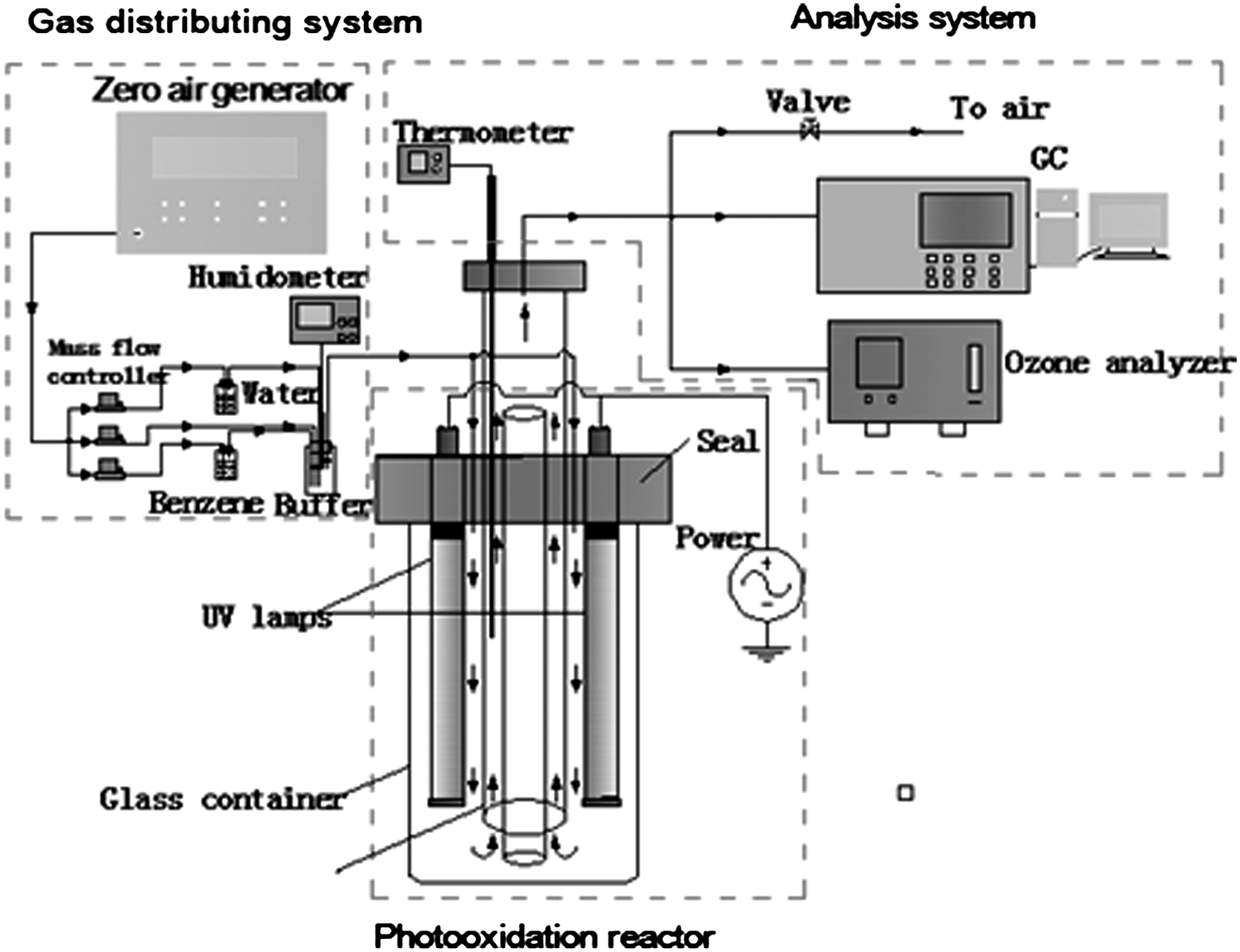
Schematic diagram of experimental setup.
Results and Discussion
Effect of water vapor
To study the effect of water vapor, the initial benzene concentration and the flow rate were fixed at 50 ppm and 1 L/min, respectively, and RH was in the range 0–95%. Figure 2 shows the effect of RH on benzene removal efficiency. Results indicated that benzene photooxidation is significantly affected by water vapor. Benzene removal efficiency was only 12.5% at 0% RH, while it was greatly increased to 27.1% at 25% RH. Benzene removal efficiency reached 37.9% at 50% RH, which is about 3 times of that at 0% RH. With further increased RH, benzene removal efficiency did not significantly change when RH was higher than 50%. Therefore, water vapor can greatly promote benzene oxidation.
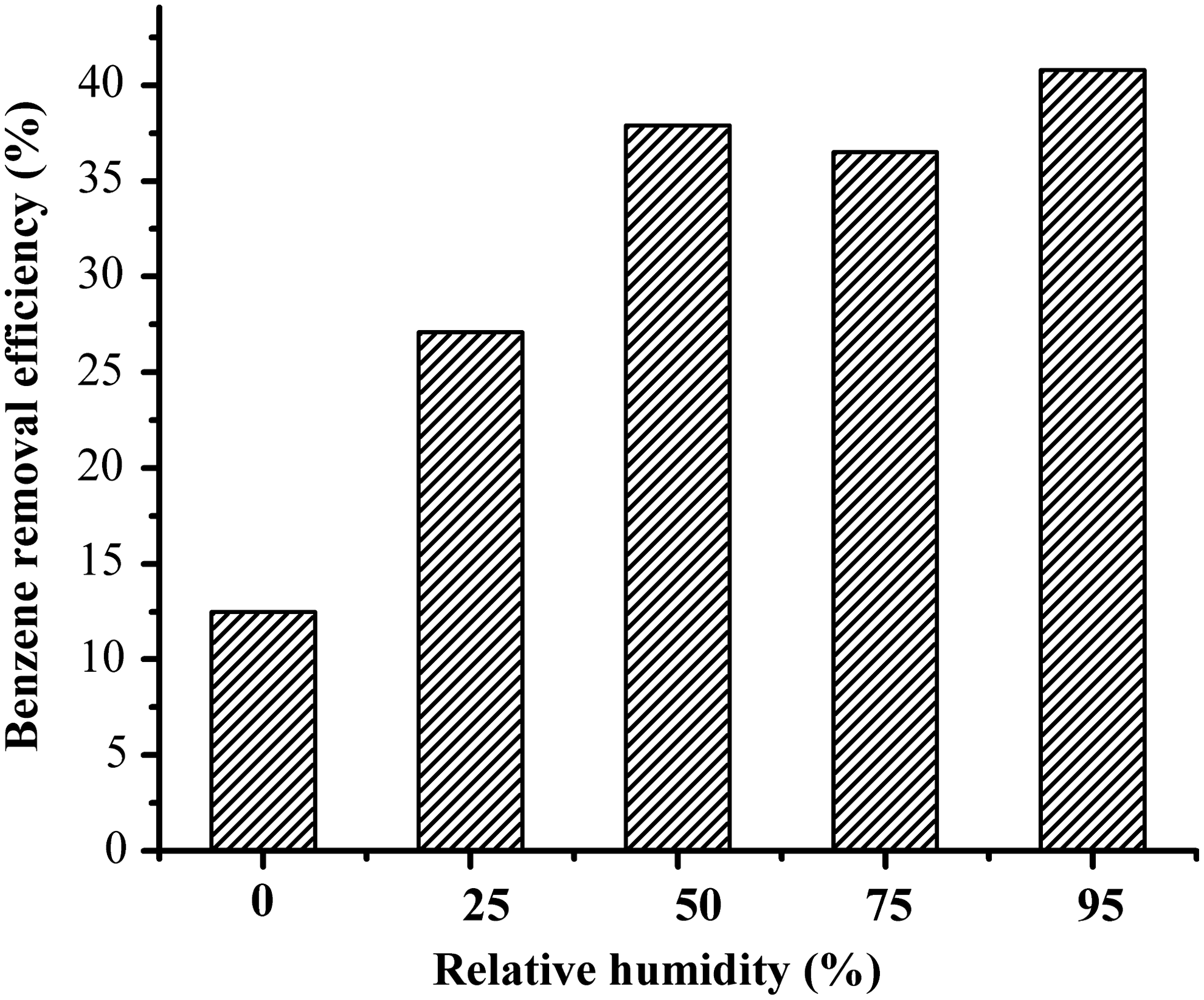
Effect of relative humidity (RH) on the removal efficiency of benzene under vacuum ultraviolet (VUV) photooxidation (initial benzene concentration: 50 ppm, flow rate: 1 L/min).
The possible pathways for benzene destruction under VUV irradiation include (1) direct photolysis by energetic photons emitted from 185 nm VUV light, (2) oxidation by active oxygen generated from oxygen dissociation by 185 nm photons, and (3) oxidation by hydroxyl radicals (•OH) (Bergonzo and Boyd, 1993; Hashem et al., 1997; Zhang et al., 2004). The pathways to form active species are as follows:
where •O represents the first excited state as in O(1D), which is highly active and can react with H2O to form hydroxyl radicals.
It is necessary to clarify the contribution of various pathways and active species to benzene oxidation. To study the contribution of photolysis, the experiment was conducted in dry N2 gas flow, in which there is no H2O and oxygen. •O and •OH is not involved and photolysis is the only pathway to benzene oxidation. The removal efficiency of benzene is only 5.5%. To identify the contribution of •O, the experiment was conducted in dry air flow, in which there is no H2O and •OH is not involved in benzene oxidation. The removal efficiency of benzene is 12.5%, as shown in Fig. 2. It can be deduced that only about 7% benzene was oxidized by •O after excluding the contribution of photolysis. In case of 50% RH, the removal efficiency of benzene reached 37.9%. It can be deduced that 25.4% benzene was oxidized by •OH after excluding the contribution of photolysis and •O. The contribution of different pathways on benzene removal is shown in Fig. 3. It is clear that •OH is mainly responsible for the removal of benzene.
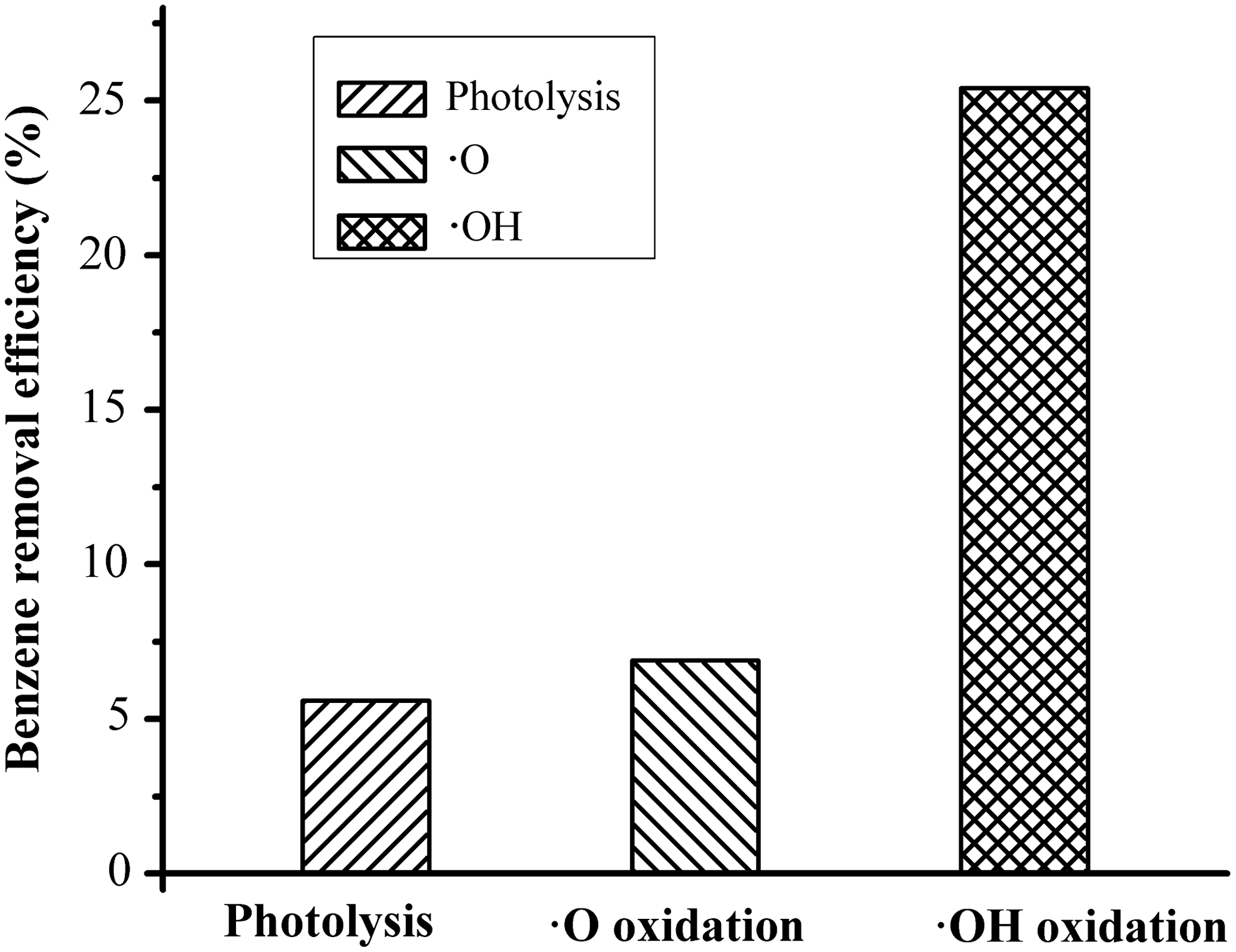
Contribution of different pathways on benzene removal under VUV photooxidation (initial benzene concentration: 50 ppm, flow rate: 1 L/min).
VUV light with 185 nm wavelength corresponds to photon energy of 6.7 eV, which is larger than the bond dissociation energy (BDE) of the C—C bond of benzene (6.04 eV). One hundred eighty-five nanometer energetic photons can directly destruct the benzene ring. However, the BDE of benzene is larger compared with the O—H bond of water molecule (5.11 eV) (McKoy, 2003) and O—O bond of oxygen molecule (5.12 eV). Therefore, water and oxygen molecules are easier to be broken down by energetic photons than benzene. In addition, the concentrations of water and oxygen are much higher compared with benzene. As a result, the contribution of direct photolysis to benzene removal is not crucial, as confirmed in Fig. 3. Compared with the reaction of O3 generation (•O+O2→O3), the reaction of •OH generation (•O+H2O→2•OH) can proceed quickly since its reaction rate constant is 2.2×10⁻¹⁰ cm3/(mol·s), while that of O3 generation is only 5.6×10⁻³⁴ cm3/(mol·s) (Atkinson et al., 2004). The rate constant of •OH with benzene (1.23×10⁻¹² cm3/[mol·s]) (Taatjes et al., 2010) is much larger compared with •O (1.16×10⁻¹⁴ cm3/[mol·s]) (Atkinson, 1994). •OH is much more active for benzene oxidation than •O. As a result, •OH dominated benzene oxidation in the VUV photooxidation process, as confirmed in Fig. 3. Since the molar absorption coefficient of oxygen (ɛH2O=36 mol/dm3) at 185 nm wavelength is larger compared with water (ɛH2O=19 mol/dm3) (Alapi and Dombi, 2007), the oxygen concentration (about 21 vol.%) is also much larger than the water concentration (∼0.5 vol.%). Energetic photons from 185 nm irradiation have more chance to be absorbed by oxygen to form •O than by water. •OH should be mainly formed from the reaction of H2O with •O instead of direct water photolysis, which well agreed with Alapi and Dombi (2007). Therefore, it is understandable that water vapor played a vital role in the VUV photooxidation process since water vapor is essential to •OH formation. It is also found from Fig. 2 that benzene removal efficiency was slightly increased with the further increase of RH higher than 50%. It is possibly subject to the limited amount of energetic photons and concentration of •OH.
Ozone formed from 185 nm UV irradiation is also greatly influenced by water vapor. The effect of RH on the ozone concentration is shown in Fig. 4. It is quite different from its effect on benzene removal. The ozone concentrations were decreased with the increase of RH in the range of 0–50%, and then showed little changes with the further increase of RH over 50%. The ozone concentration is 266 ppm at 0% RH, while it dropped to about 120 ppm at 50% RH and to nearly 100 ppm at 95% RH. VUV light can be absorbed by the increased moisture, leading to less irradiation by O2 and O3 formation. In addition, the increase of water vapor can promote the reaction of •OH generation (•O+H2O→2•OH), which inhibits the reaction of O3 generation (•O+O2→O3), as discussed above. Furthermore, benzene oxidation by •O and •OH can promote the decomposition of O3, resulting in the decreased O3 concentration.
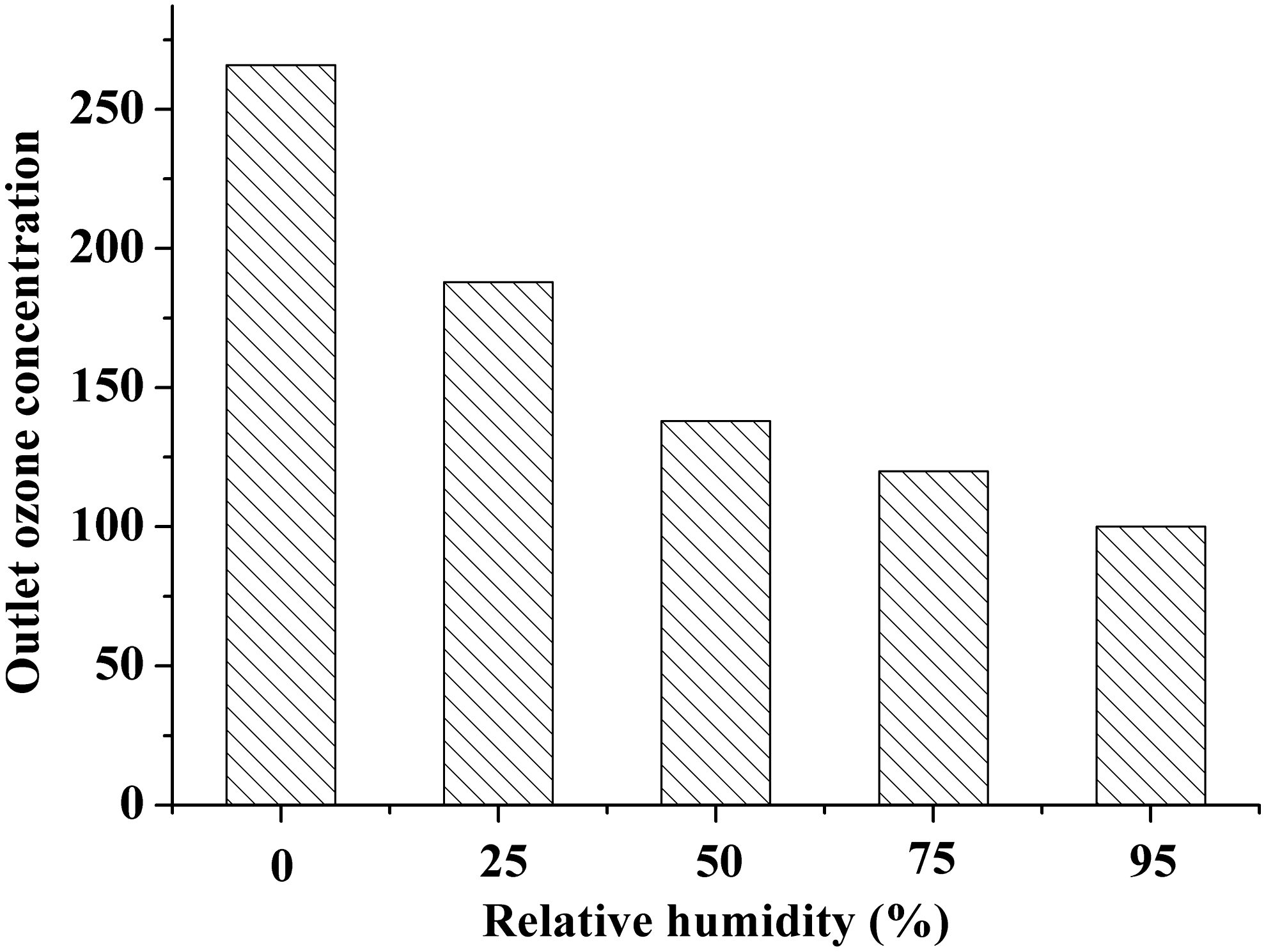
Effect of RH on the ozone concentration under VUV photooxidation (initial benzene concentration: 50 ppm, flow rate: 1 L/min).
Effect of residence time
To study the residence time on benzene removal efficiency, the initial benzene concentration and RH were kept at 50 ppm and 50%, respectively. The flow rates varied from 0.5 to 2 L/min, and the corresponding residence times spanned from 60 to 15 s. As shown in Fig. 5, benzene removal efficiency decreased from 65.5% to 20% with the increase of flow rates. A similar behavior was observed in photocatalytic oxidation of toluene by Sleiman et al. (2009). In the VUV process, the amount of photons absorbed by per unit volume air was decreased with the increase of flow rate. Oxygen, water, and benzene molecules have less chance to be activated by energetic photons at a higher flow rate. The •O and •OH amount is limited by the amount of energetic photons emitted from 185 nm irradiation. The decrease of residence time led to the drop of benzene removal efficiency. However, the actual amount of removed benzene, which took account of both the gas flow rate and benzene removal efficiency, was only slightly increased with the increase of gas flow rate, as shown in Fig. 5.
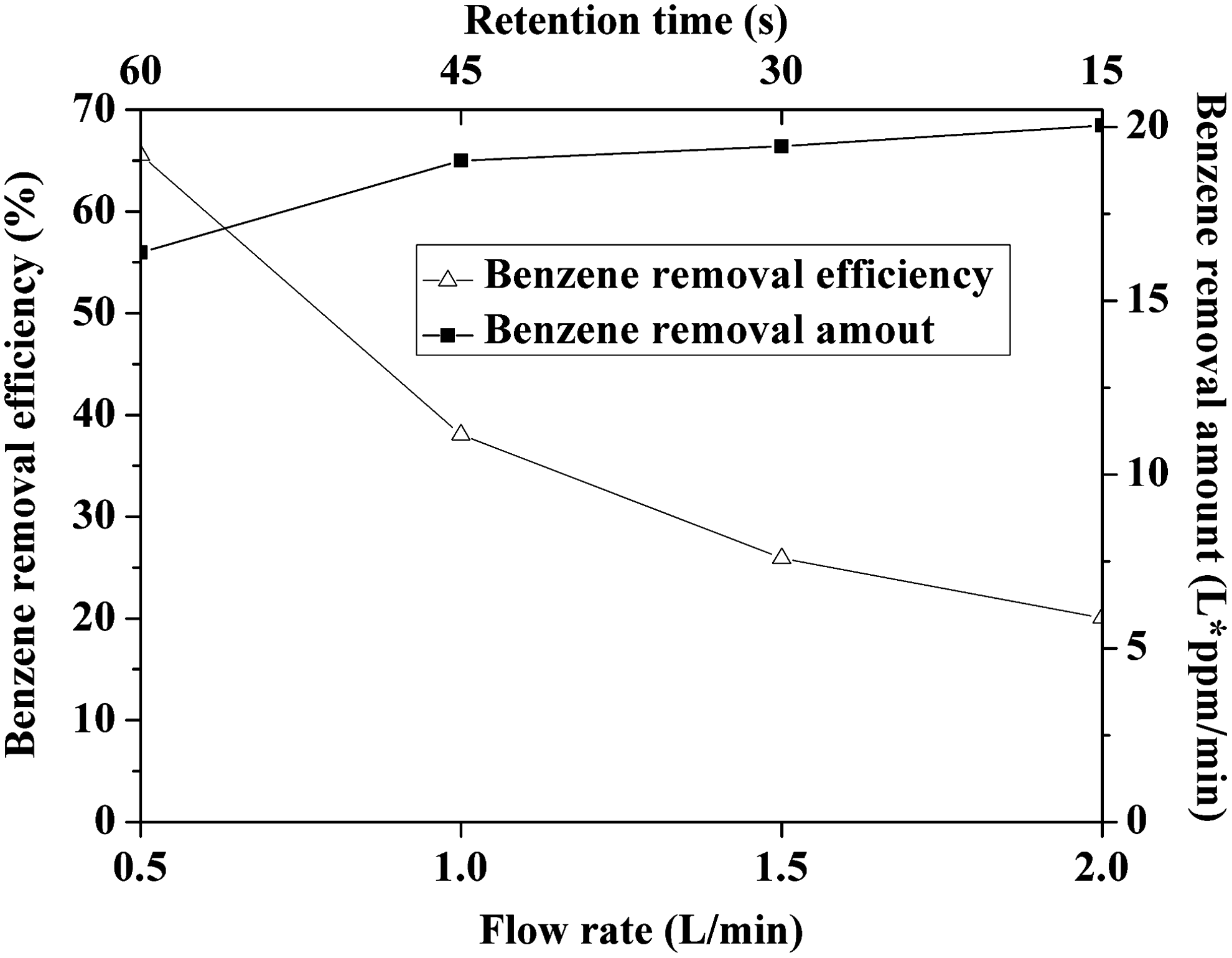
Effect of flow rate and residence time on benzene removal efficiency and amount under VUV photooxidation (initial benzene concentration: 50 ppm, RH: 50%).
The benzene mineralization rate represents the degree of complete oxidation of removed benzene. It is defined as follows:
where [CO2]out and [CO]out represents the concentration of CO2 and CO generated from benzene oxidation, and [Benzene]out and [Benzene]in is the benzene concentration at the outlet and inlet of the reactor, respectively.
Although benzene cannot be efficiently mineralized by the direct irradiation of VUV, •OH from the irradiation of VUV in the presence of moisture is highly active and can completely oxidize benzene into CO2. Figure 6 shows the variation of the benzene mineralization rate as a function of flow rates. As it can be seen, the mineralization rates of benzene at stable stage are decreased with the increasing gas flow rate. The mineralization rates of benzene reached 90% at a flow rate of 0.5 L/min, while it dropped to about 60% at a flow rate of 2 L/min. It is proposed that there was not enough residence time to completely oxidize benzene due to the increasing flow rates and benzene molecules. The results also imply that some intermediates are formed from benzene destruction. Further work will be focused on the identification and elimination of the intermediates.

Effect of flow rate on the mineralization rate of benzene under VUV photooxidation (initial benzene concentration: 50 ppm, RH: 50%).
Effect of initial benzene concentration
The concentrations of benzene emitted from industrial processes generally vary from dozens of ppm to hundreds of ppm. To study the effect of benzene concentration, the RH and flow rate were fixed at 50%, respectively. The benzene concentration varied from 25 to 200 ppm. The effect of initial concentration on benzene removal efficiency is shown in Fig. 7. It was decreased significantly from 48% to 14% when the initial concentration was increased from 25 to 200 ppm. Since the benzene photooxidation strongly depends on the amount of oxidants, benzene molecule under conditions of low concentration has more chance to be oxidized.

Effect of initial benzene concentration on removal efficiency of benzene under VUV photooxidation (flow rate: 1 L/min; RH: 50%).
The effect of initial concentration on the actual amount of removed benzene was also investigated, as shown in Fig. 8. It is noted that the amount of removed benzene was obviously increased when the initial benzene concentration was increased from 25 to 100 ppm. At low-concentration levels, partial energetic photons and active oxidants (•O and •OH) were attenuated and not involved in benzene oxidation. As the initial benzene concentration was increased, more energetic photons and active oxidants were absorbed and utilized. However, the actual amount of removed benzene negligibly changed as the initial benzene concentration was further increased from 100 to 200 ppm due to the limited energetic photons and active oxidants generated from VUV lamps. This might be because of the competitive adsorption of photons between benzene and oxygen molecules since they have similar absorbance at 185 nm. Less oxygen molecules would be decomposed to active oxygen atoms because of an increasing benzene concentration. This will accordingly reduce the concentration of •OH and, ultimately, lead to the decreased amount of removed benzene.

Effect of initial benzene concentration on the amount of removed benzene under VUV photooxidation (flow rate: 1 L/min; RH: 50%).
Figure 9 shows the variation of ozone concentration as a function of initial concentration. Obviously, the ozone concentration was decreased with an increase of initial concentration because most active oxygen atoms (•O) had reacted with benzene, leading to generate less O3 (•O+O2→O3). In addition, the adsorption competition of VUV light between oxygen molecules and benzene molecules, as discussed above, would also lead to the decrease of ozone concentration.
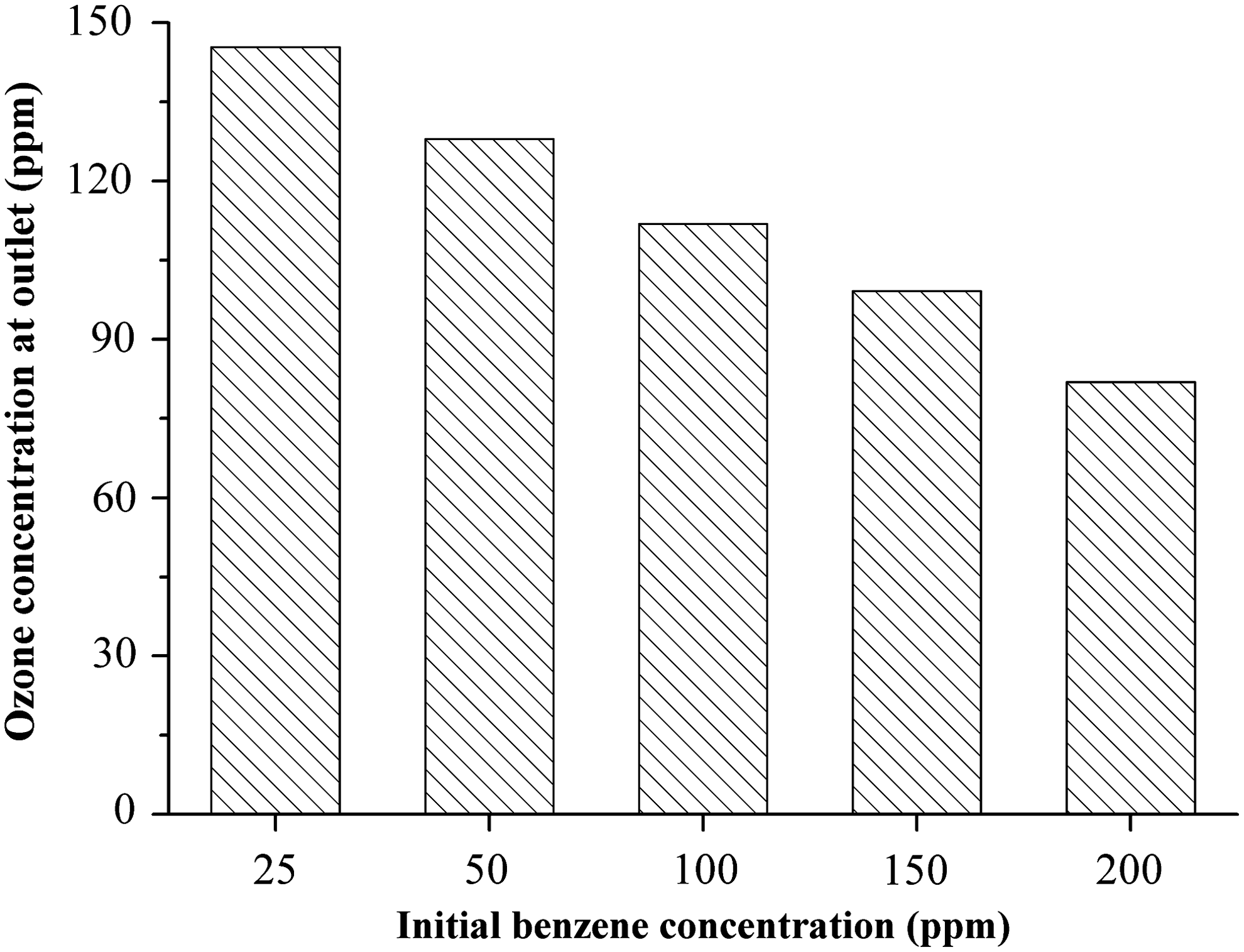
Effect of initial benzene concentration on ozone concentration under VUV photooxidation process (flow rate: 1 L/min; RH: 50%).
Effect of temperature
To evaluate the effect of temperature on benzene removal efficiency and outlet ozone concentration, the experiments were conducted at temperatures of 21°C, 36°C, and 48°C, respectively. Table 1 shows the results at three different temperatures. With increasing temperatures, the benzene removal efficiency and ozone concentration were increased from 25.9% to 37.7% and from 102.7 to 128 ppm, respectively. Increased temperature could not only promote the formation of hydroxyl radicals (•O+H2O→2•OH) but also accelerate reaction between •OH and benzene molecules. Similarly, the increase of reaction temperature can also accelerate the reaction (•O+O2→O3), leading to the increase of ozone concentration at a higher temperature.
Conclusions
The effect of key operating parameters such as RH, residence time, initial benzene concentration, and reaction temperature was investigated to study the performance and mechanism of benzene VUV photooxidation. Results indicated that vapor can greatly improve benzene removal efficiency and reduce the ozone concentration since it can be used by energetic VUV photons to produce •OH, which is highly reactive for benzene oxidation. The increased residence time and the decreased initial benzene concentration can greatly improve both the benzene removal efficiency and mineralization rate since benzene has more chance to be oxidized by active species. •OH dominates benzene oxidation in the VUV photooxidation process.
Footnotes
Acknowledgments
The authors gratefully acknowledge the financial support from the Research Fund for the Doctoral Program of Higher Education of China (No. 20120172120039), the National Nature Science Foundation of China (No. 51208207), the Research Fund Program of Guangdong Provincial Key Laboratory of Environmental Pollution Control and Remediation Technology (No. 2013K0001), and the Fundamental Research Funds for the Central Universities (No. 13lgzd03).
Author Disclosure Statement
No competing financial interests exist.