




Abstract
Abstract
Two novel silica-supported multidentate ligands adsorbents were synthesized by the reaction of tetraethylenepentamine-functionalized silica gel (SG) and Schiff's base functionalized SG with carbon disulfide. Fourier transform infrared spectroscopy (FT-IR) analysis and thermogravimetry analysis were used to characterize the synthesized adsorbents. Adsorption characteristics for Pb2+, Hg2+, Cu2+, Zn2+, and Cd2+ were investigated. Results showed that the two adsorbents exhibited good adsorption performance toward Pb2+ and Hg2+, especially toward Hg2+. Effects of adsorption time and initial metal ion concentration on adsorption capacity of the two adsorbents were investigated. Experimental data were exploited for kinetic and thermodynamic evaluations related to the adsorption process. Kinetic data indicated that the adsorption processes of Pb2+ and Hg2+ on the two adsorbents were governed by the film diffusion and followed pseudo-second-order model. The Langmuir model was applied to fit the experimental equilibrium data. The Scatchard model was applied to determine the binding affinity constants and binding sites of the two adsorbents to Pb2+ and Hg2+. The largest adsorption capacity to Hg2+ was found to be 225.8 mg/g on the adsorbent containing dithiocarbamate. The adsorbent containing dithiocarbamate and Schiff's base showed strong chelating affinity to Hg2+. Adsorbents synthesized in this work exhibited good performance to Hg2+ and will be conducive to efficient removal of Hg2+ from water bodies.
Introduction
D
Active charcoal, metallic oxides, polymeric substance, clay minerals, and biomasses are always used as adsorbents for heavy metal ions removal from aqueous systems (Bayramoglu and Arica, 2005). However, the inherent shortcomings of these materials are irreversible binding of the metal ions, difficult to separate, non-reusable, low selectivity for heavy metal ions, and relatively low adsorption capacities (Sales et al., 2004; Alothman and Apblett, 2010). To circumvent these disadvantages, some promising chelating adsorbents are prepared by grafting the inorganic supports with organic groups (Liu et al., 2008). These chelating adsorbents have relatively high adsorption capacities and selectivity for targeted metal ions (Alothman and Apblett, 2010).
Silica gel (SG) is the most typical inorganic solid adsorbent and is widely used in chromatography (Xi and Wu, 2004), pesticides removal (Prado and Airoldi, 2001), solid phase extraction (Osman et al., 2003), and metal ion preconcentration (Ngeontae et al., 2007) because of its outstanding physical and chemical stability, unique large surface area, and well-modified surface properties (Qu et al., 2008a). Recently, chemical modification of the surface of SG with organic functional groups has drawn great attention to the researchers, as it can evidently improve the adsorption properties of SG (Qu et al., 2006, 2008b). The functional groups on the surfaces of the SG have vital influence on the selectivity, capacity, and reusability of the adsorbents.
The amine groups have been discovered to be one of the most efficient functional groups for the removal of heavy metal ions (Zhang et al., 2009a) and various types of polyamines have been anchored to SG for removing and separating heavy metals from different systems (Yoshitake et al., 2005; Aguado et al., 2009). Nevertheless, those synthesized chelating adsorbents possessing polyamines as the sole functional group still suffer from disadvantages including weak binding affinity and low selectivity toward heavy metal ions (Bicak et al., 2000). Therefore, those polyamines-functionalized adsorbents are usually used as starting materials to prepare further chelating adsorbents, which show stronger binding affinity and higher selectivity toward targeted heavy metal ions.
Multidentate ligands are expected to have better chelating abilities to heavy metal ions in comparison with other polymer ligands because they are capable of forming stable metal complexes with heavy metal ions (Bicak et al., 2000). The dithiocarbamates (Bai et al., 2011), iminodiacetate (Dinu and Dragan, 2008), and phospho methyl (Yin et al., 2011) derivatives of polyamines are the most common multidentate ligands.
Among them, the dithiocarbamates synthesized by the reaction of carbon disulfide (CS2) with amines have a strong binding ability to toxic metal ions such as mercury (Goubert-Renaudin et al., 2009). Moreover, most of these reactions are generally conducted with secondary amines, which are more nucleophilic than primary ones (Goubert-Renaudin et al., 2007). On the other hand, the salicylaldehyde can react with primary amine to form Schiff's base, which is a typical multidentate ligand (Soliman et al., 2001; Zhang et al., 2009a); hence, polyamines can graft two kinds of multidentate ligands through its primary amine and secondary amines, respectively.
Most of the reported works about the synthesis of silica-supported dithiocarbamate resins have been conducted through the reaction between CS2 and the amines modified on the SG surface. However, the great majority of the active amines are polyamine compounds with small molecular weight, such as ethanediamine, diethylenetriamine, and triethylenetetramine, which may lead to the fewer amounts of the dithiocarbamate groups on the SG. Tetraethylenepentamine (TEPA) is a typical kind of polyamine compound with larger molecular weight and more amine moieties than the three polyamines mentioned above. Moreover, the SG modified with TEPA can graft dithiocarbamate and Schiff's base through the primary and secondary amines respectively.
In this work, a new silica-gel supported dithiocarbamate adsorbent (SG-TD) was synthesized through the reaction of TEPA-functionalized SG with CS2. Another novel silica-gel supported dithiocarbamate and Schiff's base adsorbent (SG-TSD) was synthesized by the reaction of TEPA-functionalized SG with salicyaldehyde and CS2 through the primary and secondary amines respectively. Their structures were characterized by fourier transform infrared spectroscopy (FT-IR) analysis and thermogravimetry analysis. The adsorption capabilities of the two synthesized adsorbents toward Cu2+, Zn2+, Pb2+, Cd2+, and Hg2+ were also studied and evaluated by static method.
Materials and Methods
Two hundred mesh SG was purchased from Jiyida Chemical Factory. 3-Chloropropyltrimethoxysilane (CPTS), TEPA, salicyaldehyde, and CS2 were obtained from Sinopharm Chemical Reagent Co., Ltd. Sources of metals for adsorption experiments were Zinc, Copper, HgCl2·Pb(NO3)2, and Cd(NO3)2 of analytical reagent grade that were obtained from Shanghai Chemical Factory of China. Metals or metal salts were dissolved in 20 mL 0.5 mol/L of HNO3 respectively and diluted to 1 L to prepare the stock solutions of heavy metal ions (1.00 g/L).
Infrared spectra were reported in the 4000–400 cm−1 region with a resolution of 4 cm−1, by accumulating 16 scans using a Nicolet 6700 Fourier Transform Infrared Spectrophotometer (Thermo Scientific Co.). KBr pellets were used for solid samples. Thermogravimetric curves recorded on a Germany Netzsch sta409pc luxx, using 10–20 mg of the sample under nitrogen at a heating rate of 10 K/min. The particle numbers per gram of the two synthesized adsorbents were determined by the Hemocytometer-microscope counting method. The two synthesized adsorbents were placed in the high-speed mixing water, sampled, and placed under a microscope to observe during the mixing process, and then the numbers of particles per gram adsorbent were calculated.
Synthesis of tetraethylenepentamine-functionalized silica gel and Schiff's base functionalized silica gel
Tetraethylenepentamine-functionalized silica gel (SG-T) was synthesized following the procedures previously reported to incorporate the diethylenetriamine to SG (Zhang et al., 2009a). Twenty grams of SG reacted with 20 mL of CPTS in toluene, under reflux of the solvent in dry nitrogen. After filtering and washing, the solid (SG-Cl) was dried. Then SG-Cl (10.0 g) was reacted with TEPA (50.0 mL) for 16 h and the product was filtered, washed and dried.
Schiff's base functionalized silica gel (SG-TS) was synthesized following the procedures previously reported to incorporate the Schiff's base to diethylenetriamine functionalized SG (Soliman et al., 2001). Five milliliter salicyaldehyde was dissolved in 50 mL ethanol, and then 10.0 g of SG-T was added to the solution. The mixture was refluxed for 2 h at 60°C, left to cool, filtered, washed with toluene and ethanol, and dried under vacuum at 80°C for 5 h.
Synthesis of silica-supported dithiocarbamate adsorbent
Silica-supported dithiocarbamate adsorbent (SG-TD) was synthesized following the procedures previously reported to incorporate the dithiocarbamate to other supports (Goubert-Renaudin et al., 2009): Under a nitrogen atmosphere, a mixture of 10.0 g of SG-T and 150 mL of CS2 was added to a 500 mL flask with 100 mL of toluene as solvent. The mixture was stirred at 25°C for 2 h. The product was then filtered off, rinsed with toluene, and dried in an oven at 100°C for 2 h.
Synthesis of silica-supported dithiocarbamate and Schiff's base adsorbent
SG-TSD was synthesized following the procedures: under a nitrogen atmosphere, a mixture of 10.0 g of SG-TS and 150 mL of CS2 was added to a 500 mL flask with 100 mL of toluene as solvent. The mixture was stirred at 25°C for 2 h. The product was then filtered off, rinsed with toluene, and dried in an oven at 100°C for 2 h.
The ideal synthetic scheme is illustrated in Scheme 1.
Adsorption experiments
Adsorption experiments were performed to investigate the adsorption characteristics of the two synthesized adsorbents. The experiments were carried out by shaking 50.0 mg of adsorbent with 50.0 mL of metal ion solution (pH 4.5) with a certain concentration. This mixture was mechanically shaken for predetermined time period at a certain temperature. Then, a certain volume of the solutions was separated from the adsorbents and the residual concentration of heavy metal ion was detected by means of atomic absorption spectroscopy (AAS). The adsorption amount was calculated according to the following equation: Q=V·(C0−Ct)/W, where Q is the amount of metal ions adsorbed onto unit amount of the adsorbents (mg/g), C0 and Ct are the initial and equilibrium concentrations of the metal ions in aqueous phase (mg/L), and W is the dry weight of the adsorbent (g).
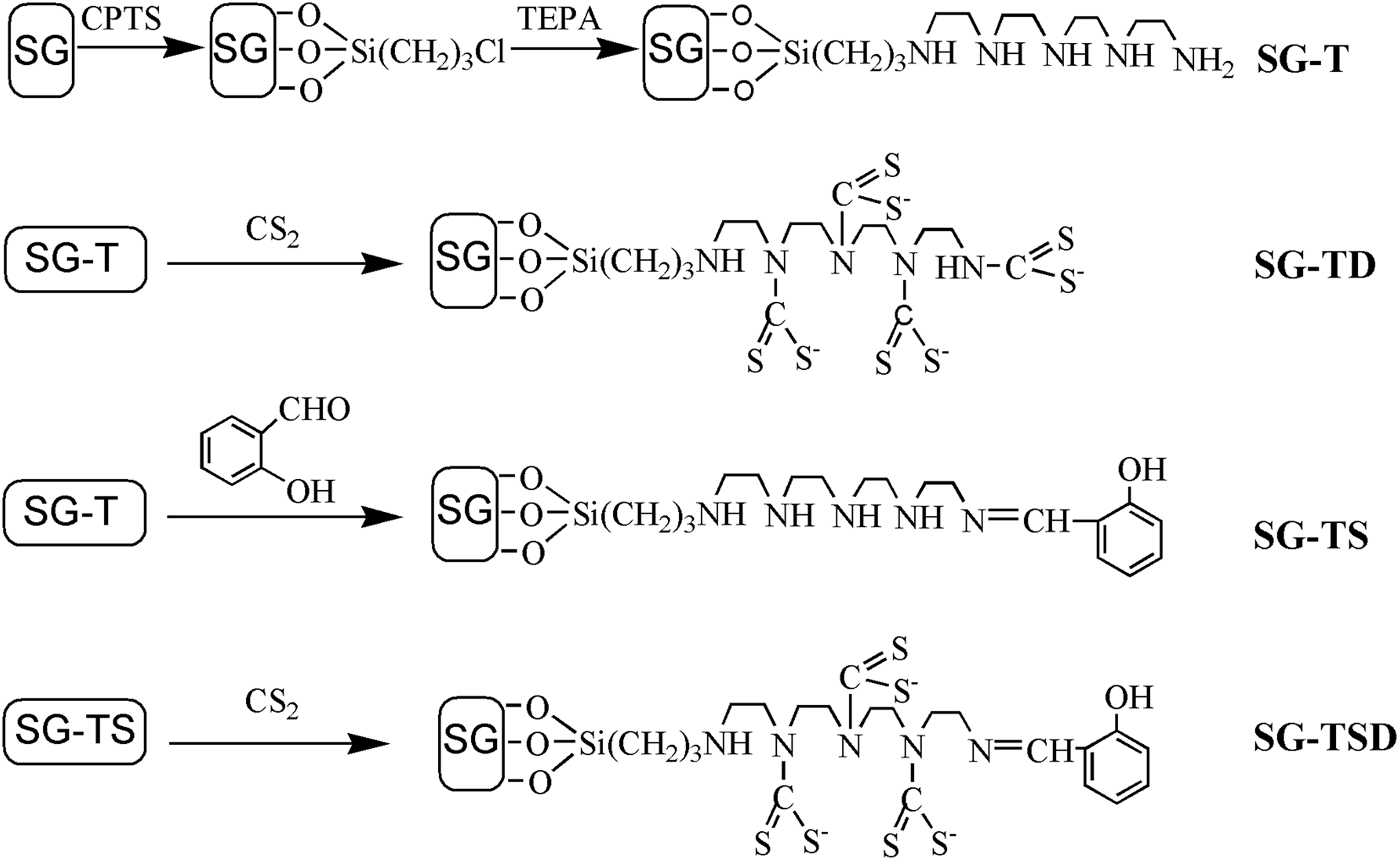
Synthetic routes of chelating adsorbents. SG, silica gel; CPTS, 3-chloropropyltrimethoxysilane; TEPA, tetraethylenepentamine.
Results and Discussion
Adsorption properties
The aim of anchoring functional groups onto the surface of SG was to prepare the modified SG with outstanding chelating properties. Adsorption capacities to heavy metal ions were essential parameters for evaluating the ability of synthesized adsorbents to separate different metal ions from aqueous systems (Zhang et al., 2009a). The adsorption experiments for Pb2+, Cd2+, Cu2+, Zn2+, and Hg2+ were performed at 298 K. To avoid formation of precipitate of metal ions at high pH and decrease of chelating ability of adsorbent at low pH, the pH 4.5 of metal ion solutions were chosen for quantitative adsorption. Twenty-four hours of contact time was selected in this work to ensure that the metal ions can be completely adsorbed.
Figure 1 shows the adsorption capacities of SG-T, SG-TD, SG-TS, and SG-TSD for Pb2+, Hg2+, Cu2+, Zn2+, and Cd2+. From Fig. 1, it can be seen that (1) When the SG-T was modified with Schiff's base, its adsorption capacities for Pb2+ and Hg2+ decreased, while the adsorption capacities for Cu2+ increased, implying that the Schiff's base group showed a better adsorption ability to Cu2+ but a weaker adsorption ability to Pb2+ and Hg2+ than amines. (2) The adsorption capacity for Cu2+ increased and for Zn2+ decreased as the SG-T was modified with dithiocarbamate; the adsorption capacity for Zn2+ increased and for Cu2+ decreased as the SG-TS was modified with dithiocarbamate. (3) When the SG-T and SG-TS was modified with dithiocarbamate, its adsorption capacities for Hg2+ increased significantly, implying that the dithiocarbamate group showed a stronger chelating ability for Hg2+.

Adsorption capacities of synthetic adsorbents for Pb2+, Hg2+, Cu2+, Zn2+, and Cd2+ at 298 K (adsorption conditions: initial concentration, 200 mg/L, pH 4.5, contact time: 24 h). Error bars indicate one standard deviation of three jar test measurements.
Characterizations of SG-TD and SG-TSD
Particle numbers characterization
Particle numbers of SG-TD and SG-TSD were 4.592±0.538 and 3.978±0.319 (×1011 g−1) respectively. The mole numbers of particles contained in each gram of SG-TD and SG-TSD were 7.628 and 6.608 (×10−13 mol/g) respectively calculated according to Avogadro's constant (6.02×10²³ mol−1).
FT-IR characterization
The FT-IR is usually employed to confirm the presence of the organic functional groups on the surface of SG. As shown in Fig. 2, all the samples show the bands around 472 cm−1, 801 cm−1, and 1100 cm−1, which are due to the typical bending vibrations, symmetric stretching, and asymmetric stretching of Si−O−Si of the silica network, respectively (Wang et al., 2005). The peak around 3422 cm−1 is also found, which is attributed to the O−H stretching vibration of the adsorbed water (Qu et al., 2008b). The two bands around 2851 and 2933 cm−1 in the spectrum of SG-T correspond to the symmetric stretching and typical asymmetric vibration of−CH2−, due to the presence of the carbon chain of 3-chloropropyltrimethoxysilane and polyamines anchored to the SG (Tian et al., 2010). Moreover, a new band appeared at 1391 cm−1 and is attributed to the bending vibration of N−H transferred to lower frequencies because of the stretching vibration of remaining Si−O of the SG, which strongly absorbed at 1633 cm−1 (Yin et al., 2011).
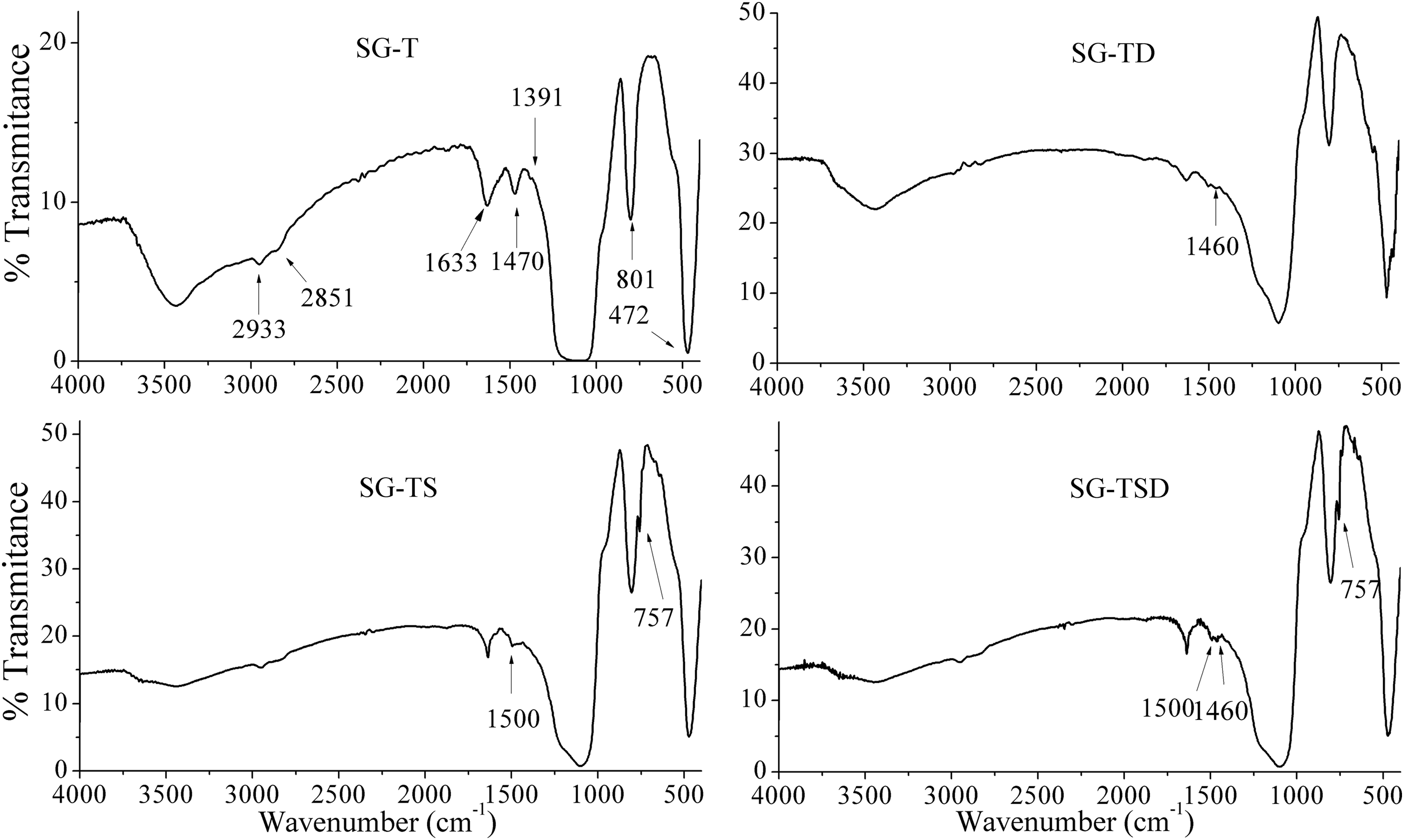
FT-IR spectra of SG-T, SG-TD, SG-TS, and SG-TSD. FT-IR, fourier transform infrared spectroscopy; SG-T, tetraethylenepentamine-functionalized silica gel; SG-TD, silica-supported dithiocarbamate adsorbent; SG-TS, Schiff's base functionalized silica gel; SG-TSD, silica-gel supported dithiocarbamate and Schiff's base adsorbent.
Compared with the spectrum of SG-T, the spectrum of SG-TD shows the vibration of N−C=S at 1460 cm−1, which shows the successful modification of SG-T with dithiocarbamate (McClain and Hsieh, 2004; Bai et al., 2011). The peaks of 757 and 1500 cm−1 in SG-TS should confirm the presence of aromatic rings of salicylic on the surface of SG-TS (Zhang et al., 2009b). After SG-TS was modified with dithiocarbamate, the spectrum of SG-TSD showed the vibration of N−C=S at 1460 cm−1, suggesting the successful modification of SG-TS with dithiocarbamate. The unobvious peak of 1500 cm−1 could be explained by the angular vibration of water molecules, which strongly absorbed at 1633 cm−1.
Thermal analysis
Thermal stabilities of the two adsorbents and their precursors have been determined by thermogravimetric analysis at the range of 25–800°C, as shown in Fig. 3. The two adsorbents and two precursors have two obvious weight loss process at the range of 25–800°C. The first loss of mass between 25°C and 200°C was due to physically adsorbed water. An increase in temperature caused the decomposition of organic functional groups on the surface of SG, which brings about a second mass loss step. The dehydration losses of physisorbed water are 3.87%, 3.62%, 4.26%, and 3.69% for SG-T, SG-TS, SG-TD, and SG-TSD, respectively. This fact indicated that the two adsorbents should be applied under temperature of 200°C. The second losses at this temperature range of 200–800°C were 10.46%, 14.34%, 12.97%, and 13.42% for SG-T, SG-TS, SG-TD, and SG-TSD, respectively, due to the breakage of the organic chain anchored on the SG surface (Zhang et al., 2009a). Therefore, the loss of mass at this temperature range of 200–800°C can be used to estimate the amount of organic molecules anchored in the SG surface. It should be noted that the order of relative organic functional groups molecular weight onto SG was SG-TS>SG-TSD>SG-TD>SG-T.

Thermogravimetric curves of SG-T, SG-TD, SG-TSD, and SG-TS.
Adsorption kinetics
Adsorption kinetics processes for Pb2+ and Hg2+ on SG-TD and SG-TSD are shown in Fig. 4a. In the beginning, adsorption processes of Pb2+ and Hg2+ were very fast, slowed later, and reached the adsorption equilibrium in the end. Usually, the adsorption process of adsorbents for metal ions is thought to happen through two mechanisms of particle diffusion and film diffusion (Ma et al., 2009). Usually, the Reichenberg (1953) and Boyd et al. (1947) models are used to fit the experimental data for distinguishing film diffusion from particle diffusion controlled adsorption.

Adsorption kinetic curves
To study the kinetic characteristics of adsorption processes of the two synthesized adsorbents to heavy metal ions, determine the adsorption rates and equilibrium time, pseudo-first-order (Galiatsatou et al., 2002) and pseudo-second-order (Ho and McKay, 1999) models were also adopted to analyze the experimental data. The results showed that the adsorption kinetic processes were not well fitted by Reichenberg model and pseudo-first-order model. Therefore, the equations and parameters of the two models were not shown in the text.
Parameters and equations of Boyd models are shown in Table 1. As shown in Table 1, the Boyd model provides better correlation coefficients R2 for the adsorption to Pb2+ and Hg2+ on the two synthesized adsorbents, which indicates that the Boyd model is more fit to describe the adsorption kinetics progresses of the two synthsized adsorbents to Pb2+ and Hg2+ and the adsorption rates of Pb2+ and Hg2+ on the two synthesized adsorbents are controlled by film diffusion.
Equation, constant (k) and correlation coefficient (R2) were estimated from the Boyd model−ln(1−Q/Qe)=k·t.
SG-TD, silica-supported dithiocarbamate adsorbent; SG-TSD, silica-gel supported dithiocarbamate and Schiff's base adsorbent; k, adsorption rate constant; Qc, equilibrium adsorption capacity; R2, correlation coefficient were estimated from the pseudo-second-order adsorption model ln(Qe−Qt)=lnQe−k·t; Qe, equilibrium adsorption capacities were obtained from the kinetics experiments.
The results of testing the pseudo-second-order models are shown in Fig. 4b. The corresponding results are given in Table 1. As Table 1 shows, the pseudo-second-order model provides good correlation coefficients (R2>0.994), indicating that the pseudo-second-order model is suitable to describe the adsorption kinetics processes of SG-TD and SG-TSD to Pb2+ and Hg2+. Moreover, the equilibrium adsorption capacities Qc (mg/g) calculated from pseudo-second-order model are close to the experimental data Qe (mg/g), which also proves the suitability of pseudo-second-order model. The adsorption rate (k) for Pb2+ is higher than for Hg2+ on both SG-TD and SG-TSD. Compared with SG-TD, SG-TSD that contained Schiff's base shows slightly higher adsorption rate (k) for Pb2+ and Hg2+.
Adsorption isotherms
The effect of initial concentrations of metal ions on adsorption capacities of SG-TD and SG-TSD was studied by varying the initial concentrations of metal ions at pH 4.5 and 24 h of equilibration time. The results are presented in Fig. 5. Figure 5 shows a sharp initial slope indicating that SG-TD and SG-TSD can act as high efficacy adsorbents at low metal concentration. In addition, when the concentrations of metal ions increase, the adsorption capacities of the two synthesized adsorbents to Pb2+ and Hg2+ increase. At the highest concentration of metal ions (Pb2+ of 400 mg/L; Hg2+ of 500 mg/L), the adsorption capacities of adsorbents to Pb2+ and Hg2+ are close to but do not reach the saturation constant value. At low concentration (<100 mg/L for Pb2 and <200 mg/L for Hg2+), the adsorption amounts for Pb2+ and Hg2+ on SG-TSD has no significant difference with the adsorption amounts on SG-TD. At high concentration (>100 mg/L Pb2+ and >200 mg/L Hg2+), SG-TSD, which contained two kinds of multidentate ligands, shows higher adsorption amount for Pb2+ but lower adsorption amount for Hg2+, compared with SG-TD.
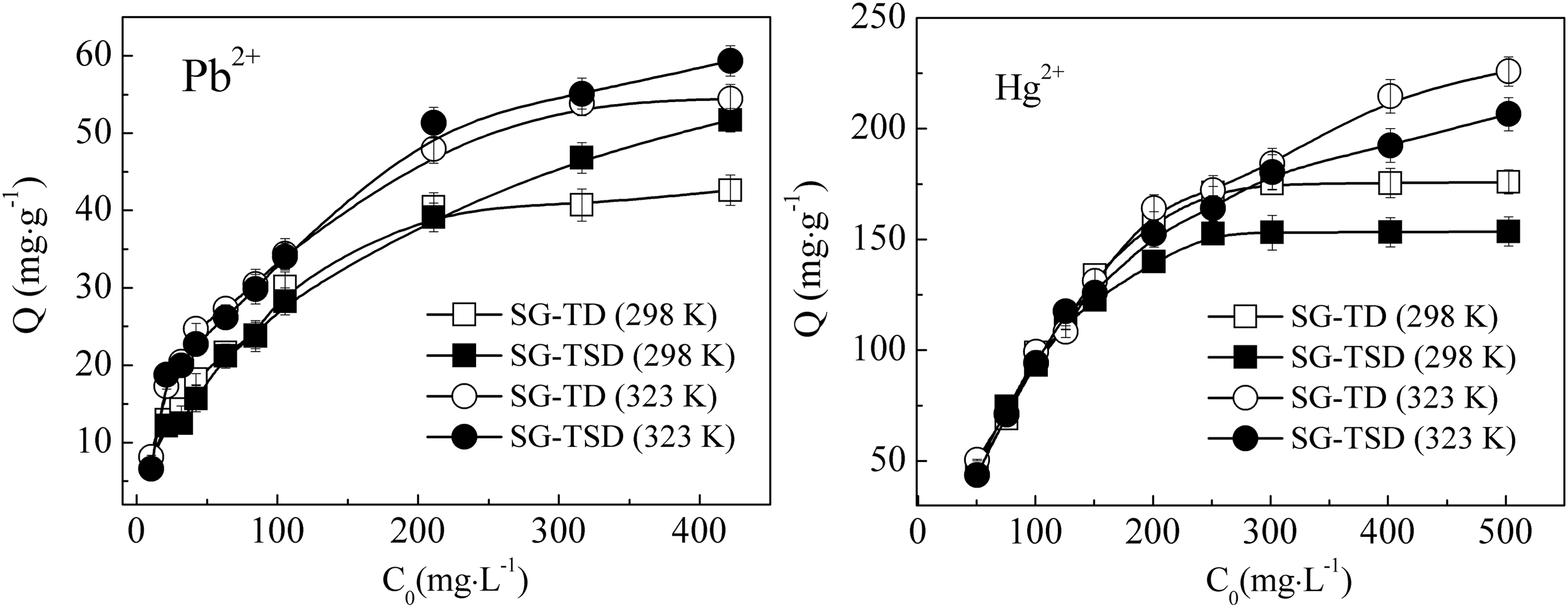
Effects of initial concentrations of metal ions on adsorption capacities of SG-TD and SG-TSD to Pb2+ and Hg2+ (adsorption conditions: Pb2+ concentration: 50–400 mg/L, Hg2+ concentration: 50–500 mg/L, pH 4.5, contact time: 24 h). Error bars indicate one standard deviation of three jar test measurements.
To well understand the adsorption behaviors, Freundlich and Langmuir equations were employed to fit the experimental data (Ma et al., 2009). The results showed that the adsorption processes were well fitted by Langmuir model. Langmuir equation: Ce/qe=1/(KLQm)+Ce/Qm, where qe is the amount of metal ion adsorbed on the adsorbent (mg/g), Ce is the equilibrium metal ion concentration in the solution (mg/L), Qm is the saturated adsorption capacity, and KL is the Langmuir adsorption constant(L/mg). The results of testing the Langmuir models are shown in Fig. 6. The fitting equation, Langmuir constants and correlation coefficients (R2) are listed in Table 2. As can be seen from Table 2, the Langmuir model provides good correlation coefficients (R2>0.991), suggesting the Langmuir model is suitable to describe the adsorption process of SG-TD and SG-TSD for Pb2+ and Hg2+. At the same time, the fact that the equilibrium adsorption capacities Qc (mg/g) calculated depending on the Langmuir model is much closer to the experimental data Qe (mg/g) also proves the suitability of the Langmuir model. The fact above showed that the adsorption processes of Pb2+ and Hg2+ on the two adsorbents are attributed to homogeneous monolayer adsorption (Qu et al., 2008b). Compared with SG-TD, SG-TSD, which contained dithiocarbamate and Schiff's base, shows higher adsorption capacity (Qm) for Pb2+ and higher equilibrium constant for Hg2+. With increasing temperature, the adsorption equilibrium constants and adsorption capacity of two adsorbents for Pb2+ and Hg2+ increase.
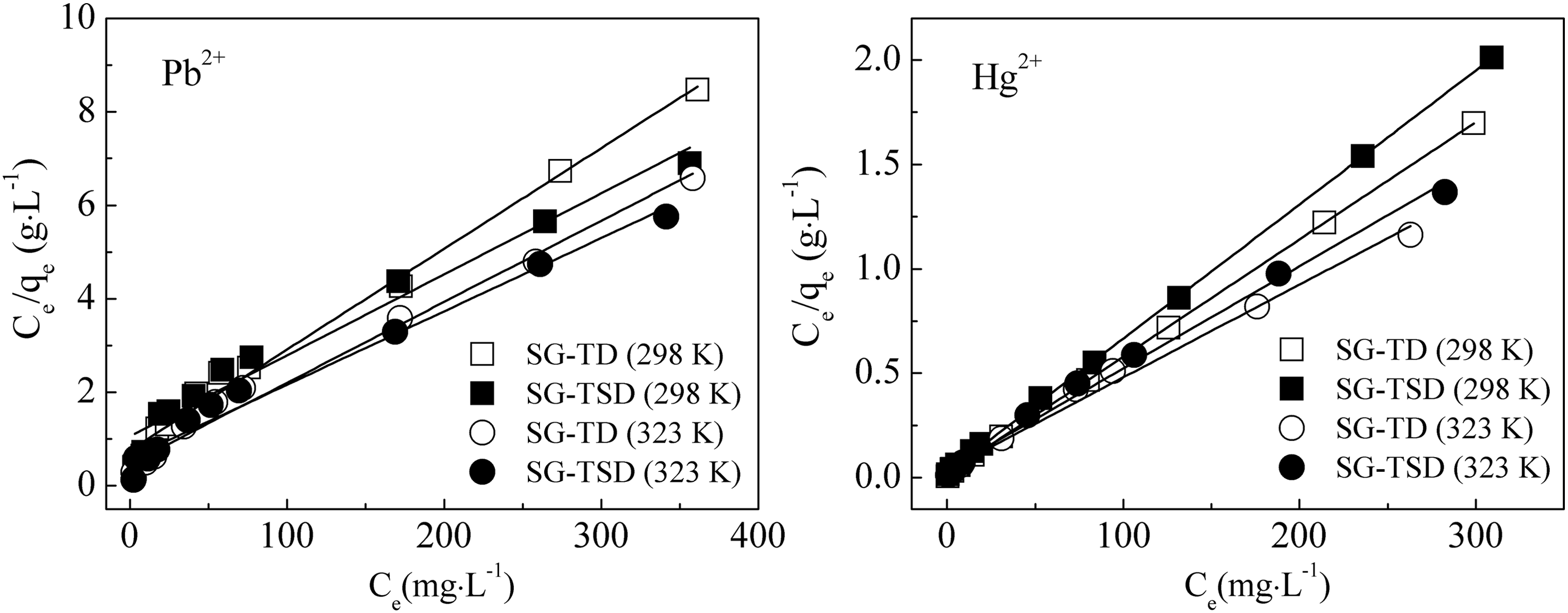
Langmuir curves of Pb2+ and Hg2+ adsorbed on SG-TD and SG-TSD.
KL, adsorption equilibrium constant; Qm(c), saturated adsorption capacity; R2, correlation coefficient were estimated from the Langmuir model; Qm(e), equilibrium adsorption capacity was obtained from the experiments.
Determination of affinity constants and binding sites
Saturated adsorption capacities for metal ions are essential parameters to evaluate the adsorption ability of adsorbent, while the binding affinity of adsorbent to targeted metal ions is another vital parameter to evaluate adsorbent's ability to bind and extract different metal ions from aqueous solutions. The strong and specific affinity of target heavy metal ions to the binding sites of adsorbents can be expressed by affinity constants (KA). The binding processes of heavy metal ions (M) to binding sites of adsorbents (S) can be expressed as Equation (1) (Dai et al., 2014):
In the state of reaction equilibrium, the KA can be formulated as Equation (2):
where [S]f is the concentration of free binding sites of adsorbents, [M]f is the equilibrium concentration of heavy metal ions, and [M·S] is the concentration of the heavy metal ions and adsorbents complex. Given that every single binding site of adsorbents is independent from each other and has the same ability to bind heavy metal ions, we can get that [M]b=[M·S] and [S]f=n[S]−[M]b, where [M]b is the concentration of bound metal ion; [S] and n is the concentration of adsorbent and the binding sites per adsorbent particle.
Equation (2) can be rearranged to give the following:
where μ represents [M]b/n·[S]. Equation (3) is the derivative of the Scatchard model (Feldman, 1972). According to Equation (3), KA and n can be determined from the plots of [M]f/μ versus [M]f, as shown in Fig. 7 and Table 3. As can be seen from Table 3, the Scatchard model provides good correlation coefficients (R2>0.99), suggesting the Scatchard model is suitable to describe the adsorption processes of SG-TD and SG-TSD for Pb2+ and Hg2+. With temperature increasing, affinity constants (KA) and adsorption sites (n) for Hg2+ and Pb2+ increased.
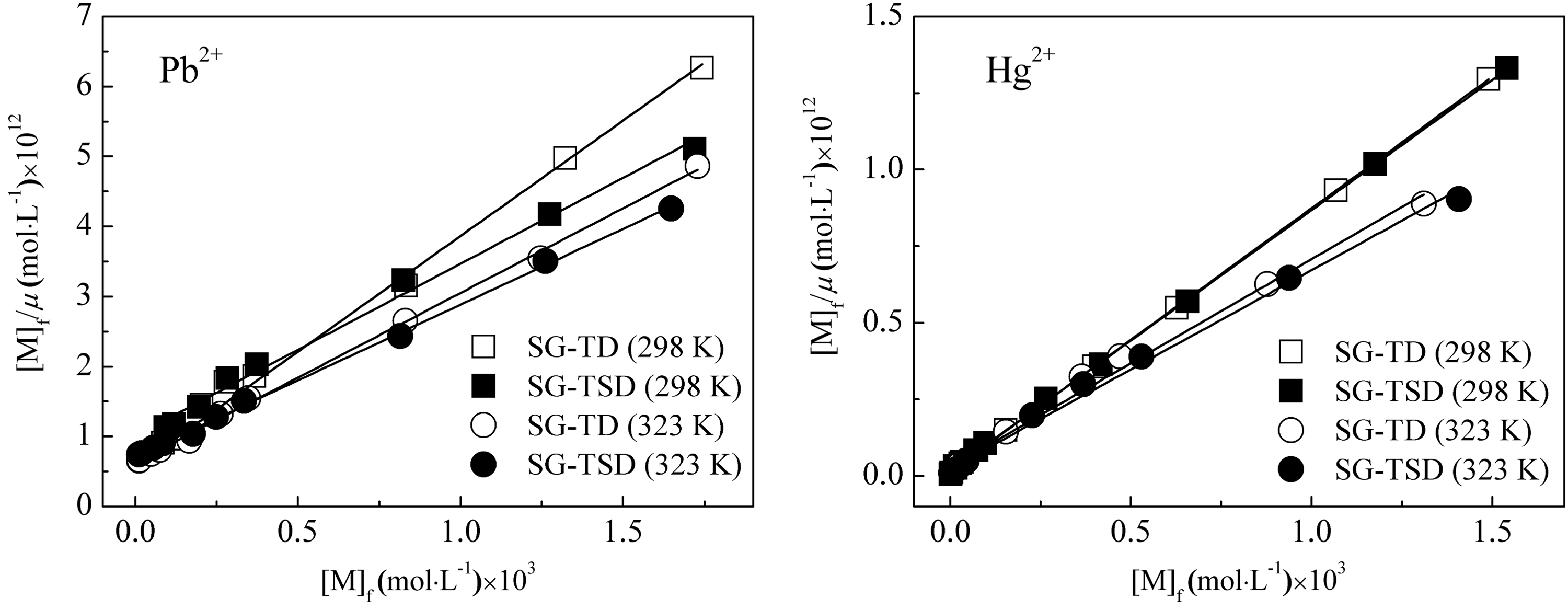
Scatchard curves of Pb2+ and Hg2+ adsorption on SG-TD and SG-TSD.
y represents [M]f/μ×1012; x represents [M]f×103.
KA, affinity constant; n, binding sites; R2, correlation coefficient were estimated from the Scatchard model.
Binding sites of adsorbents are the active functional groups that can be responsible for heavy metal ions adsorption. The two synthesized adsorbents in this work are silica-gel supported, with long chain TEPA grafting multidentate ligands (dithiocarbamate and/or Schiff's base) as the organic functional molecular layers. There are a large number of dense functional groups (amine and multidentate ligands) on the surface of SG. Among them, some functional groups distributed inside the organic layers and some distributed outside (Scheme 1). The possible mechanism is that, at low temperature, the organic functional molecular layers on the surface of SG vibrates weakly, some internal functional groups are difficult to capture heavy metal ions. The increasing temperature can enhance the vibration of the organic functional molecular layers, making the internal functional groups exposed to capture Pb2+ or Hg2+ easily. Therefore, the binding sites of adsorbents increase with higher temperature.
Both SG-TD and SG-TSD show much higher affinity constants and more binding sites for Hg2+ than for Pb2+. SG-TSD, which contains Schiff's base and dithiocarbamate, shows higher affinity constant for Hg2+ than SG-TD. Therefore, SG-TSD, which contains dithiocarbamate and Schiff's base, shows strong affinity to Hg2+ and it can be used to accumulate, remove, and recover Hg2+ from environment.
Discussion
To determine affinity constants and binding sites of the two synthesized adsorbents to Pb2+ and Hg2+, the Scatchard model was used to fit the data of adsorption isotherms and compared with the results obtained from the Langmuir model. The results obtained from the Scatchard model was consistent with the results obtained from the Langmuir model. As shown in Tables 2 and 3, the relationship between KL and KA is KL=KA/G and between Qm and n is Qm=(n·N/NA)·G, where N, NA, and G represent the mole numbers per gram adsorbent, Avogadro's Constant, and relative atomic mass of metal ions, respectively. Consequently, Scatchard model and Langmuir model can be integrated. The Scatchard model is focused on determination of affinity constant of adsorbent to heavy metal ions and binding sites per adsorbent particle, while the Langmuir model is widely used to determine the saturated adsorption capacity of adsorbent.
The types, amounts, cross-linking degrees and structures of functional groups have important influence on the adsorption capacity of chelating adsorbent for heavy metal ions. According to the principle of soft and hard acids and bases (HSAB), sulfur-containing groups are namely soft bases and efficient to chelate soft acids like Hg2+, while nitrogen-containing groups are namely hard bases and easy to combine hard and junction acids like Pb2+. In this work, Both SG-TD and SG-TSD showed much higher adsorption capacity to Hg2+ but lower adsorption capacity to Pb2+. All of these indicated that dithiocarbamate as a sulfur-containing group showed weaker chelating ability to Pb2+ but stronger chelating ability to Hg2+ compared with amines, which was in accordance with HSAB.
SG-T can be modified with dithiocarbamate through primary and secondary amines; while SG-TD can only be modified through secondary amines because its primary amines were occupied by Schiff's base. Thus, the amounts of dithiocarbamate on SG-TSD were fewer than SG-TD and SG-TSD showed relatively lower adsorption capacity to Hg2+ than SG-TD, consequently. However, SG-TSD, which contains Schiff's base and dithiocarbamate, showed higher affinity constants to Hg2+ than SG-TD. Therefore, SG-TSD, which contains dithiocarbamate and Schiff's base, not only showed relatively high adsorption quality to Hg2+ but also showed high affinity to Hg2+, which plays a vital role in heavy metal ion preconcentration, removal, and recovery.
Conclusion
In this article, two novel silica-supported multidentate ligands adsorbents were synthesized by anchoring multidentate ligands into modified SG. FT-IR confirmed the efficient grafting of TEPA-functionalized SG with multidentate ligands in the two synthesized adsorbents. Thermogravimetric analysis revealed the high thermal stability of the two synthesized adsorbents. The adsorption capabilities of the two synthesized adsorbents toward Cu2+, Zn2+, Pb2+, Cd2+, and Hg2+ were also studied. The results showed that the two synthesized adsorbents showed good adsorption capacities to Pb2+ and Hg2+, especially to Hg2+. The adsorption kinetics and adsorption isotherms of the two synthesized adsorbents for Pb2+ and Hg2+ were studied. The results showed that the adsorption kinetics of the two synthesized adsorbents can be modeled by pseudo-second-order rate equation wonderfully and Langmuir equations could well fit the adsorption of the two adsorbents for Hg2+ and Pb2+. The maximum adsorption capacity for Hg2+ was observed on SG-TD and the strongest chelating affinity to Hg2+ was observed on SG-TSD.
Footnotes
Acknowledgments
This work was supported by a grant from the National Natural Science Foundation of China (31270106, 31070054), the Natural Science Foundation of Fujian Province (2012J01136), and the Foundation of Key Laboratory of Urban Environment and Health, Institute of Urban Environment of Chinese Academy of Sciences (No. KLUEH201005).
Author Disclosure Statement
No competing financial interests exist.