




Abstract
Abstract
The adsorption mechanism of diethyl phthalate (DEP) on solid particles is still unclear due to the complicated properties of adsorbents. Carbon nanotubes (CNTs) have definite structures and uniform surfaces, thus they were chosen as the model adsorbents in this study. The site energy distribution may provide important information for adsorption mechanisms, but no study has applied site energy distribution to illuminate the DEP thermodynamic adsorption on CNTs. Thus, this study focused on the thermodynamic adsorption behavior of DEP on CNTs combining the site sorption energy distribution analysis. The adsorption coefficient Kd followed the order: MG>MH≈MC. Surface area was not the only factor for DEP adsorption on CNTs. Hydrophobic interactions, H-bonds, morphology of CNTs, and DEP molecule structure may control DEP adsorption. Electron donor-acceptor interaction was limited in this system. The thermodynamic parameters changes showed that the adsorption process is exothermic and spontaneous. The site energy distribution indicated that high energy adsorption sites would be occupied first, and sequentially, the DEP molecules adsorb on the relatively low energy sites of CNTs. Nonlinear adsorption isotherms result from the heterogeneous energy distribution. This study emphasized the importance of thermodynamic adsorption for assessing the environmental behavior of organic pollutants.
Introduction
D
In recent years, a great deal of attraction has been concentrated onto the application of carbon nanotubes (CNTs) as adsorbents for the removal of harmful and toxic chemicals from air and wastewater media (Herrera-Herrera et al., 2012). Their growing uses make them persistent in the environment and, thus, they are harmful to human beings and organisms (Lam et al., 2006; Nowack and Buchelli, 2007). Due to the strong interactions between CNTs and organic chemicals, CNTs may possibly alter the mobility and environmental fate of organic pollutants and thus influence the risks and toxicity of CNTs and organic pollutants. Importantly, CNTs are good model adsorbents for investigating adsorption mechanism because of their definite structures and uniform surfaces (Pan and Xing, 2008). In addition, according to different production processes, the changes of CNTs in size, shape, impurity, and morphology can be controlled, which can additionally provide a new angle to understand the adsorptive mechanism of CNTs for organic pollutants (Chen et al., 2007). Thus, many studies have been carried out to examine the adsorption of different organic compounds on CNTs (Wang et al., 2010a; Yang and Xing, 2010; Yang et al., 2010). Evidently, the interactions between organic compounds and CNTs surfaces include the π-π interactions, hydrophobic effects, hydrogen bond, and covalent and electrostatic interactions.
For DPEs adsorption on CNTs, Wang et al. (2010b) suggested the significance of π-π interaction. The morphology of CNTs was also an important factor for DPEs adsorption identified by a phenomenon that greater adsorption efficiency was observed in CNTs of a small diameter (Den et al., 2006). However, no studies were conducted to investigate thermodynamic adsorption behavior of diethyl phthalate (DEP) on CNTs. In addition, the site energy distribution may provide important information for adsorption mechanisms (Zhang et al., 2012), but no study applied site energy distribution to illuminate the DPEs adsorption mechanism on CNTs. Thus, in this study, the thermodynamic analysis and site sorption energy distribution were incorporated to study DEP (one of DPEs) adsorption on CNTs.
The objectives of this work were as follows: (1) to investigate the effects of pH on DEP adsorption on CNTs, and (2) to examine the thermodynamic adsorption behavior of DEP on CNTs combining the site sorption energy distribution analysis. Both goals will provide important data to understand DEP adsorption mechanisms on solid particles and to assess the environmental behavior of phthalates and CNTs.
Experimental Section
Adsorbents and adsorbates
Hydroxylized (MH), carboxylized (MC), and graphitized (MG) CNTs were purchased from Chengdu Organic Chemistry Co., Chinese Academy of Sciences. These CNTs are synthesized in the CH4/H2 mixture at 700°C (MG at 2,800°C) by the chemical vapor deposition method. All the other chemicals are higher than analytical grade. All the CNTs are characterized for their ζ-potential, surface area, elemental composition, and surface functional groups (X-ray photoelectron spectroscopy [XPS]). DEP (>99.5%) is purchased from Beijing Chemical Reagents Company. Selected physical and chemical properties of DEP are listed in Supplementary Table S1.
XPS characterization and elemental analysis
Briefly, the XPS and elemental analysis conditions are listed here. For XPS, the pressure ranges were set as fast entry chamber 2×10⁻⁶ mbar, preparation chamber 4×10⁻⁸ mbar, and sample analysis chamber 4×10⁻⁹ mbar. This setting for high transmission was used for the analysis at 90° electron take-off angle for normal noncharging samples. The analyzer slit width was set for 0.8 mm. The MULTIPAK software was used for data acquisition and data analysis.
For CHNS elemental analysis mode, 2 mg samples were added into the elemental analyzer. The temperatures of combustion tube and reduction tube were 1,150°C and 850°C. For O mode analysis, only combustion tube was used at 1,150°C. All analysis was run in duplicate.
Adsorption experiment
Two types of adsorption experiments were conducted in this study. The adsorption of DEP on CNTs was affected by temperature (A) and pH (B). Adsorption isotherms were obtained using a batch equilibration technique. Briefly, for experiment (A), DEP was dissolved in methanol as stock solution, which was diluted with the background solution containing 0.02 M NaCl and 200 mg/L NaN3 (bio-inhibitor) to seven different concentrations (0–50 mg/L). The volume percentage of methanol was kept below 0.10% (v/v) to minimize cosolvent effect. Adsorption experiments were conducted in 4 mL glass vials with Teflon-lined screw caps. The aqueous:solid ratios (v:w) were 4,000:1 for each CNTs. All vials' head space was minimal (<0.30 mL). The pH was adjusted to 7.0±0.2 using 0.1 M NaOH or 0.1 M HCl solution. The vials were kept in the dark and were shaken in a rotary shaker at 288, 298, or 318 K for 7 days, which was sufficient to reach apparent equilibrium. During this time period, DEP was stable and no apparent degradation was observed. All vials were centrifuged at 2,500 rpm for 10 min, and the supernatants were subjected to determination of DEP concentrations by high-performance liquid chromatography (HPLC). The same concentration series of DEP solutions without any CNTs were run under the same condition as the controls, showing that the loss of the initially added amounts of DEP was less than 3%. Each concentration point including control (without CNTs) was run in duplicate. Therefore, the amount of DEP adsorbed by CNTs was calculated by mass difference.
Experiment (B), the pH dependence adsorption, was conducted at different pHs from 2 to 9. The initial DEP concentration was 1 mg/L. The standard DEP curves were individually determined at each pH. All vials were kept in the dark and were shaken in a rotary shaker at room temperature for 7 days. Then, these vials were centrifuged at 2,500 rpm for 10 min, and the supernatants were subjected to determination of DEP concentrations by HPLC. Each concentration point including control (without CNTs) was run in duplicate.
Quantification of DEP
Concentrations of DEP in the supernatants were quantified at 228 nm by HPLC (Agilent Technologies 1260 series) equipped with a reversed-phase C18 column (5 μm, 4.6×150 mm) and a UV detector. The mobile phase was 25:75 (v:v) of deionized water and acetonitrile. The flow rate was 1 mL/min, and the column temperature was 35°C.
Data analysis
Adsorption isotherm fitting: Two different models were used in this work to fit the adsorption isotherms. The equations are described as follows:
where Se (mg/g) is the solid phase concentration, and Ce (mg/L) represents the aqueous phase concentration. KF is the Freundlich adsorption parameter, and n is the nonlinearity factor.
where SL0 (mg/g) is the LM adsorption capacity, and b (L/mg) is the LM adsorption affinity parameter.
Since the number of parameters used in the two models were not the same, the coefficient of determination (R2) could not be compared directly. The adjusted R
adj
2 was calculated and compared:
where m is the number of data points, and p is the number of parameters in the fitting equation.
Thermodynamic analysis
The study on temperature dependence of adsorption could provide valuable information regarding the energetic changes during adsorption process. The adsorption isotherms of DEP on CNTs at 288, 298, and 318 K were obtained to determine the thermodynamic parameters. The adsorption coefficient K0 was defined as follows:
The standard Gibbs free energy change (ΔG0), standard enthalpy change (ΔH0), and standard entropy change (ΔS0) were determined from K0 by the following equations:
Rearrangement of Equations (5) and (6) yields
The ΔH0 and ΔS0 were obtained from the slope and intercept of the linear plot of lnK0 against 1/T. R is the universal gas constant (8.314 kJ/mol/K), and T is the temperature (K).
Site energy distribution
The relationship between the adsorption energy and the equilibrium aqueous solute concentration can be described as follows:
where E* (kJ/mol) is the site adsorption energy of absorbent for adsorbate. Combining Equations (1) and (8) yields
F(E*) was derived from the FM as follows:
Differentiating Equation (9) with regard to E* and combining it with Equation (10) yields
Equation (11) was used for site adsorption energy distribution analysis for adsorption data.
Results and Discussion
Characterization of CNTs
Characteristics of CNTs have been reported in our previous study (Zhang et al., 2010); thus, only the important results were simply discussed here. XPS and elemental analyzer (MicroCube) were used for determining the elemental composition of CNTs. The XPS results showed that the calculated O contents were 4.2% for MC and 4.1% for MH. However, the O contents from elemental analyzer were 0.5% for MC and 2.9% for MH. The different results from two types of analysis were attributed to the different measurement area for CNTs. XPS measurement represents surface-sensitive quantitative composition, whereas elemental analysis provides the bulk composition of the total mass. The functional groups are mostly settled on the surface of CNT aggregates as indicated by the higher O contents on CNT surfaces. The results form XPS that will be discussed for data explanation in the next section, because the adsorption of DEP mainly occurred on CNTs surface. The surface area of MG (117 m2/g) is half of MH (228 m2/g). Zeta potentials of CNTs as a function of pH are given in Supplementary Fig. S1. The results showed that zeta potential changed from positive to negative at pH 3–4 for MC and MH, indicating that pHzpc of MC and MH is around pH 4.
DEP adsorption at different temperatures and different pHs
Adsorption isotherms of DEP on CNTs at different temperatures and different pHs are presented in Figs. 1 and 2, respectively. Figures 1A and 2A compare the adsorption of DEP on a unit mass basis, while Figs. 1B and 2B compare the adsorption on a unit surface area basis. Freundlich isotherm (FM) and Langmuir isotherm (LM) models were used to describe the isotherms, but FM fitted the adsorption isotherms better as identified by a higher R adj 2 (0.982–0.998, Table 1). In addition, the adsorption nonlinearity can be easily compared based on the nonlinearity factor “n,” and FM-based thermodynamics and energy distribution analysis are widely available in literatures and thus the comparison with the literature data could be readily made. Thus, the results from FM fitting are discussed here and the results of LM are just listed in Supplementary Table S2 for the reference.
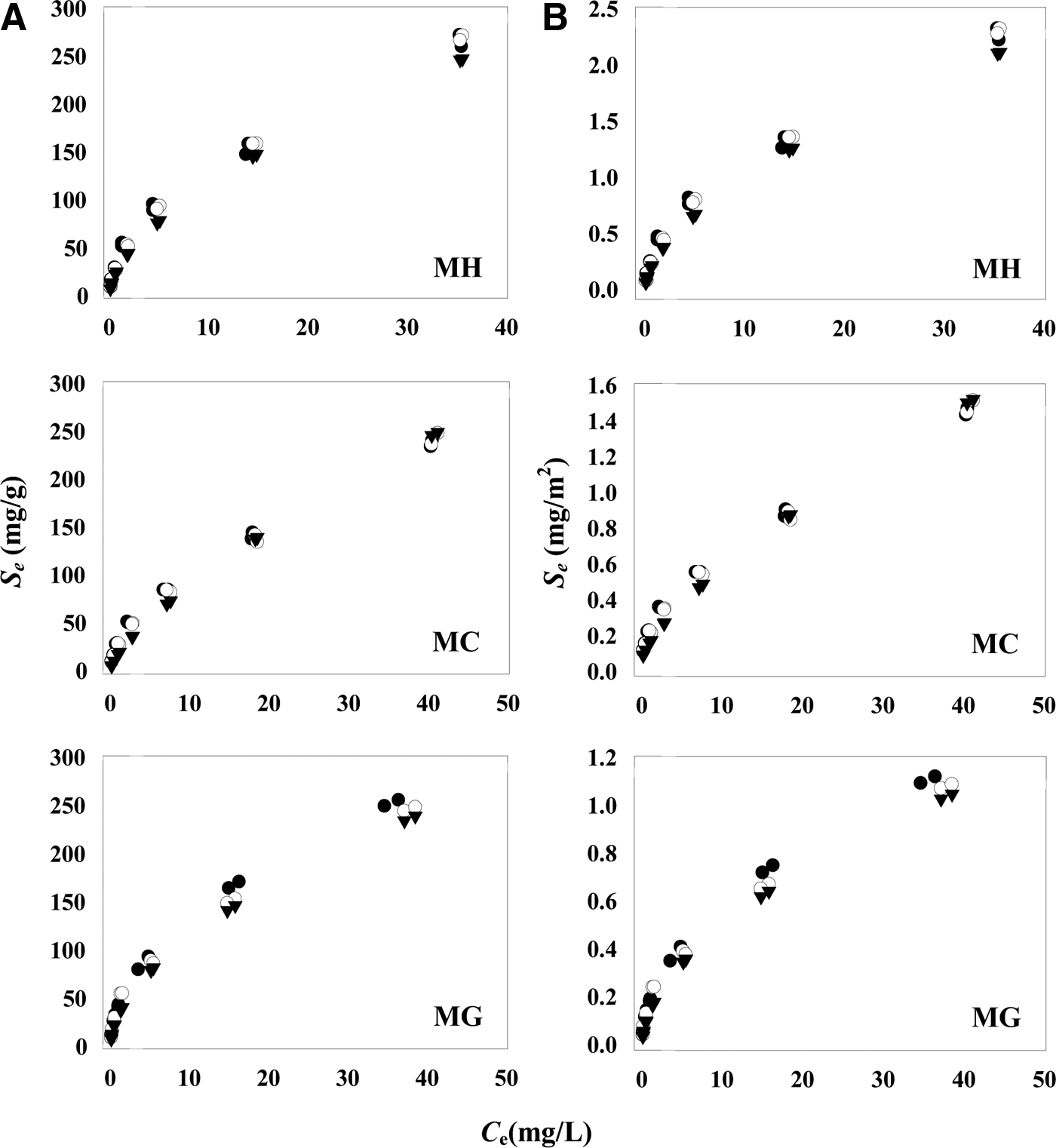
Adsorption of diethyl phthalate (DEP) on carbon nanotubes (CNTs) at 288 K (●), 298 K (○), and 318 K (▾).

Adsorption of DEP on MH (●), MC (○) and MG (▾) as a function of pH.
K′ is the adsorption coefficient per unit surface area, K′=K/A surf .
SEE, Standard Error of Estimate.
For all CNTs, the adsorption of DEP was nonlinear (n=0.50–0.73) (Table 1), suggesting the heterogeneous distribution of adsorption energy. In general, the single-point adsorption coefficients (log K) calculated from FM followed the order of MG>MH≈MC at same temperature and same pH. Although the surface of CNTs is essential for adsorption of organic chemicals (Yang et al., 2006; Lin and Xing, 2008), the higher DEP adsorption on MG which has the smallest surface area indicates that other factors play important roles in DEP adsorption. Thus, the normalized adsorptions (S e /A surf ) on the basis of CNTs surface area are calculated. The S e /A surf should be similar if A surf is the only factor in adsorption process, but the adsorption differences became more obvious after normalizing (Figs. 1B and 2B). This indicates that surface area is not the only factor affecting adsorption of DEP, and the surfaces of MG are more available for DEP adsorption than other CNTs. The S e /A surf is almost kept within an order of magnitude for each DEP on CNTs, indicating that there is some degree of similarity at the molecular-level interactions of DPEs with the graphene sheets of different CNTs (Bucheli and Gustafsson, 2000).
It is also known that the sites on CNT surfaces are highly ordered (Pan and Xing, 2008). DEP molecule has a planar benzene ring with two hydrocarbon chains (Supplementary Table S1). The optimized three-dimensional structure of DEP based on minimized steric energy calculated by ChemBioOffice 2008 shows that the angle between benzene ring and hydrocarbon chains is 90°. Thus, DEP molecules could have high packing efficiency on the axis direction of CNTs (Supplementary Fig. S2). However, the functional groups on CNTs surface could disrupt the “orderliness” of CNTs surface morphology (Zhang et al., 2012). Thus, MG has the higher “orderliness” than other CNTs due to its lower O contents and surface functional groups. The higher packing efficiency due to the higher “orderliness” may be the reason for the higher adsorption of DEP on MG (Supplementary Fig. S2). Previous studies indicated that besides the surface of CNTs offering the major adsorption sites, other potential adsorption sites of CNTs included the groove, interstitial, and inner areas (Pan and Xing, 2008). The heterogeneous adsorption sites of CNTs results in the nonlinear adsorption of DEP.
Hydrophobic interaction between DPEs and CNTs was considered one of the primary mechanisms (Wang et al., 2010a). Oxygen-containing functional groups, including −OH and −COOH groups, could affect the adsorption of organic molecules via reducing the hydrophobicity of CNTs surface (Cho et al., 2008; Shen et al., 2009). Thus, the higher hydrophobicity of MG due to its lower O contents may be another mechanism for the higher adsorption of DEP on MG. A linear relationship was reported between the maximum adsorption capacity for naphthalene and the oxygen contents of CNTs, a roughly 70% decrease in maximum adsorption capacity on account of 10% surface oxygen concentration (Cho et al., 2008; Shen et al., 2009). This result suggested that surface functional groups inhibited the adsorption of naphthalene molecules. H-bonds are the major interactions between acidic groups of CNTs and water molecules, and the water molecule clusters will be formed. The formed water molecule clusters suppress the direct interactions of CNTs with organic molecules and exclude the adsorption of organic molecules on CNTs through steric hindrance (Cho et al., 2008; Shen et al., 2009). The direct competition of water molecules for adsorption sites on CNTs and steric hindrance of water clusters could explain the lower adsorption of DEP on functionalized CNTs (MH and MC).
The π-π electron donor-acceptor (EDA) interaction has been considered one of the predominant mechanisms responsible for the adsorption of chemicals with benzene rings on CNTs. DEP may act as electron acceptors because of the ester functional group. Carboxyl groups on CNTs make MC electron acceptors, while hydroxyl groups make MH electron donors (Keiluweit and Kleber, 2009). As proposed in the EDA theory, the interactions between a π-donor compound and a π-acceptor compound are much stronger than that between donor–donor or acceptor–acceptor pairs. If EDA interactions play a significant role in adsorption of DEP on CNTs, MH should show a higher adsorption for DEP than MC. However, there was no obvious difference between MH and MC for DEP adsorption. Thus, the contribution of EDA interactions to the overall adsorption may be limited in this study.
Hydrogen bonds (H-bonds) are another interaction for understanding adsorption of organic chemicals on CNTs (Keiluweit and Kleber, 2009). In this study, H-bonds may also be formed between CNT surface functional groups and DEP molecules (Ahnert et al., 2009). However, the lower DEP adsorption on MH and MC indicates that the hydrogen bonds between acidic groups of CNTs and water molecules are major rather than between CNTs and DEP. Thus, in this study, H-bonds between water molecules and CNTs may inhibit EDP adsorption on CNTs.
The effects of pH are known to change the density of surface functional groups on CNTs surfaces, thus affecting the extent of adsorption of target compounds (Hickey and Passino-Reader, 1991). According to this theory, the lower pH could cause a small quantity of acidification of CNTs, which would inhibit the adsorption of DEP due to the direct competition of water molecules for adsorption sites and steric hindrance of water clusters by H-bonds. This may be the reason for the higher DEP adsorption at pH 9 than 2 or 4 (Table 1).
In general, the adsorption of DEP on CNTs decreased with the increased temperatures (Fig. 1 and Table 1). Thus, the adsorption of DEP on CNTs may be an exothermic process. The thermodynamics parameters are calculated in the following section to supply more information for understanding DEP adsorption.
Adsorption thermodynamics and site adsorption energy
Thermodynamic parameters, ΔG0, ΔH0, and ΔS0, can provide information on the inherent energetic changes involved during the adsorption process. Thermodynamic equilibrium can be affected by temperature with a consequent effect of altering the adsorption capacity of CNTs. The adsorption isotherms of DEP were obtained at 288, 298, and 318 K to determine thermodynamic parameters. As mentioned earlier, it was observed that the lower temperature increases DEP adsorption, showing an exothermic nature of the adsorption processes (Fig. 1 and Table 1). This point could be proved by the negative ΔH0 values for all CNTs. ΔH0 increases with increasing DEP loading on CNTs, reflecting that the adsorption process becomes less exothermic with increasing solid-phase loading.
As shown in Fig. 3, all of ΔG0 values are negative, indicating that the adsorption process is spontaneous. The less negative the ΔG0, the weaker the driving force of adsorption. The increased ΔG0 values with increasing solid-phase concentrations illuminate that the driving force of adsorption decreases with increasing solid-phase concentrations. This indicates that the high energy adsorption sites would be occupied first, and consequently, DEP molecules have to adsorb on the relatively low energy sites of CNTs (Do and Do, 1997; Huang et al., 2007). In addition, the adsorption of DEP is more favorable on MG than on MH and MC as indicated by the lower ΔG0 values (more negative). This is thermodynamic evidence for higher adsorption of DEP on MG.
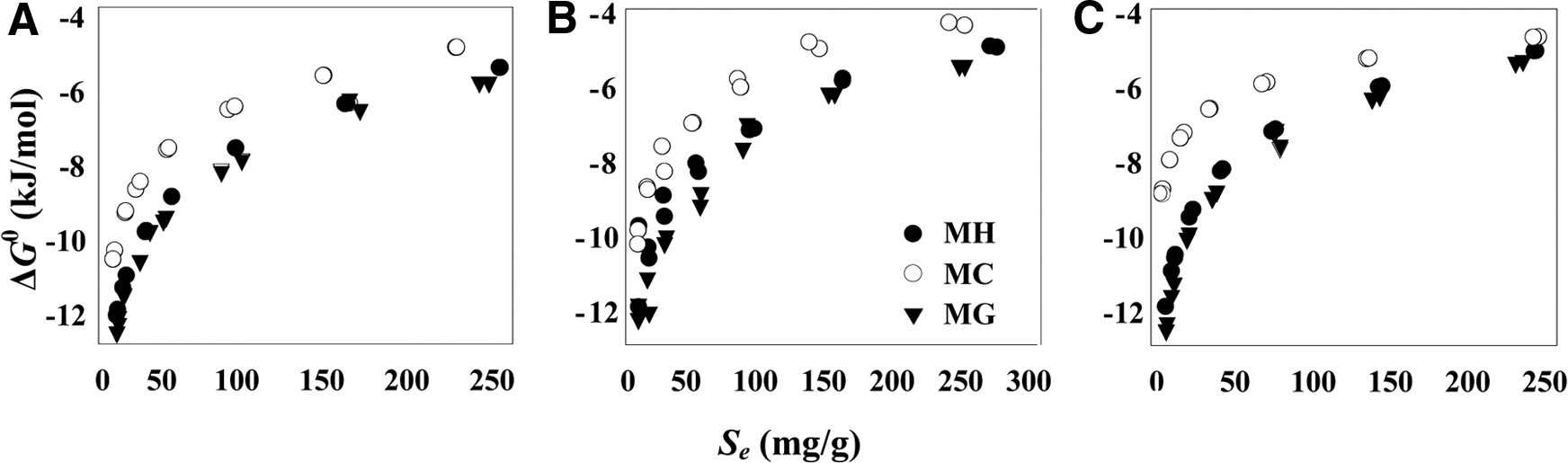
Standard Gibbs free energy change (ΔG0) for adsorption of DEP at 288 K
ΔS0 was used to suggest randomness in the solid-solution system. Figure 4 displays the plots of ΔS0 against Se for adsorption of DEP on various CNTs. ΔS0 decreases with the increase in Se, indicating that the higher loading of DEP on CNTs results in the decreased randomness of system. This is consistent with the exothermic nature of the system.

Standard enthalpy change (ΔH0)
Generally, the affinity of the sorbate with the sorbent surface will be reflected by means of energy distribution on the energy axis (E*). It is clear that E* decreases significantly with the increased Se, suggesting that the higher energy adsorption sites are readier and quicker to absorb DEP molecules; thus, the other excess DEP molecules have to occupy the lower energy adsorption sites of the CNTs (Fig. 5). However, no significant difference in E* values under different temperatures is observed for all CNTs, indicating a weaker temperature driving effect. This is consistent with the lower absolute value of ΔH0 (0.010–0.045). In addition, the range of energy distribution is from 5 to 25 kJ/mol, which is the direct evidence for the nonlinear adsorption of DEP on CNTs.
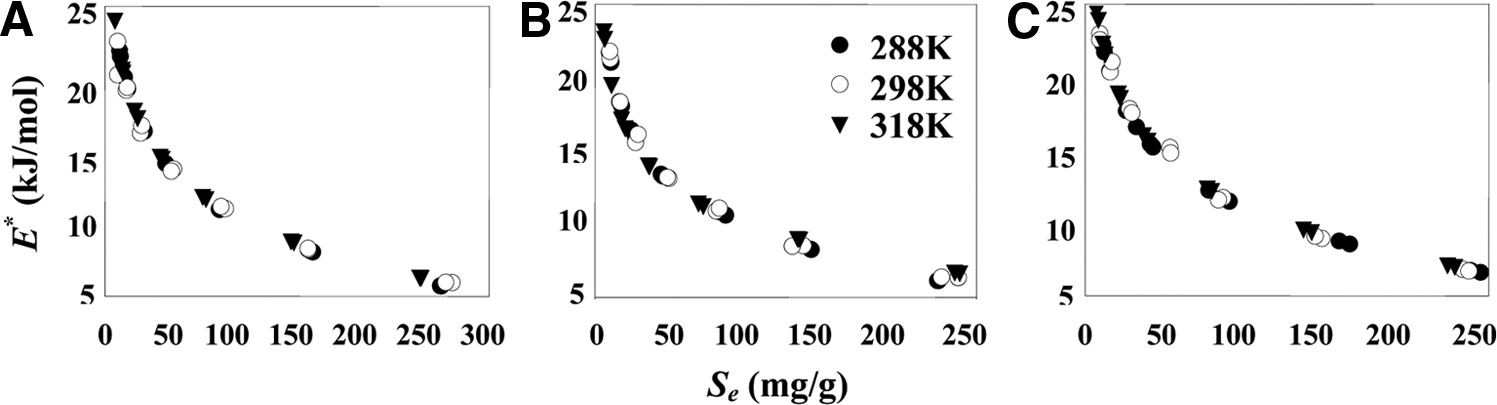
E* against solid phase concentration (Se) on MH
Summaries
CNTs are considered a special group of sorbents, because of their strong adsorption affinity and capacity for organic contaminants. This study investigated the adsorption of DEP on CNTs at different temperatures and pHs, with a particular emphasis on the highly heterogeneous adsorption energy distribution on CNTs surface. The adsorption equilibrium is well described by the FM. Surface area is not the only factor for DEP adsorption on CNTs. Other important interactions or factors include hydrophobic interactions, H-bonds, morphology of CNTs, and DEP molecule structure. EDA interaction is limited in this system. The thermodynamic analysis shows that the adsorption process is exothermic and spontaneous. The site energy distribution indicates that the higher energy adsorption sites are readier and quicker to absorb DEP molecules; thus, the other excess DEP molecules have to occupy the lower energy adsorption sites of CNTs, leading to the nonlinear adsorption. Obviously, CNTs potentially affect the environmental fate and transport of DPEs and possibly their toxicity and risks. Detailed studies need to be performed to better elaborate the interaction mechanisms of DPEs and various CNTs. The results are expected to help a better understanding and evaluation of the environmental behavior of both DPEs and CNTs.
Footnotes
Acknowledgments
This research is supported by the National Scientific Foundation of China (41303093, 41303092), the Scientific Foundation of Yunnan Province (2014FB121), and the Scientific Foundation of Kunming University of Science and Technology (14118762).
Author Disclosure Statement
The authors declare that no competing financial conflicts exist.
References
Supplementary Material
Please find the following supplemental material available below.
For Open Access articles published under a Creative Commons License, all supplemental material carries the same license as the article it is associated with.
For non-Open Access articles published, all supplemental material carries a non-exclusive license, and permission requests for re-use of supplemental material or any part of supplemental material shall be sent directly to the copyright owner as specified in the copyright notice associated with the article.
