




Abstract
Abstract
To evaluate environment hazards of tetracyclines (TCs) on different soils from the north of China, desorption hysteresis index and partition coefficients (Kd) were obtained by sorption–desorption experiments. Five different soils, including black soil (BLA), cinnamon soil (CIN), cultivated loessial soil (CUL), castanozems, and brown soil (BRO), were collected to test the sorption–desorption properties of oxytetracycline (OTC). Molecular properties of TC, chlortetracycline (CTC), and OTC were acquired by quantum chemistry calculations to explain the sorption–desorption differences on CUL. Among the five soils, BLA exhibits strongest adsorption of OTC and the adsorption follows the order of BLA>CIN≈BRO>CUL≈CAS, and the hysteresis index (HI) has an opposite trend at low contamination levels. Among the TCs investigated, sorption follows the order of CTC>TC>OTC on CUL, which is determined by both molecular polarity and steric hindrance. The order of HI is OTC>TC>CTC on CUL. It was found that CUL is most sensitive to TCs' contamination among the five soils and OTC is most labile to induce environment hazards considering its lower Kd than CTC and TC. This work will help researchers in identifying the most sensitive soil to TCs' contamination, the most dangerous compound among TCs, and the origin of sorption difference, and thus to ameliorate or avoid potential environment hazards of TCs.
Introduction
T
On contaminated soils, the hazards of TCs include the triggering of resistant bacteria (Hu et al., 2013), ecotoxicity (Kim et al., 2014), food contamination, and groundwater contamination (Grote et al., 2007; Kim et al., 2011). Moreover, the half-life of oxytetracycline (OTC) is 31–56 days under simulated natural conditions (Wang and Yates, 2008; Zhang and Guan, 2013). The long life of TCs will aggravate their environmental hazards. Due to the hazards and their long life in a natural environment, it is a must to monitor the occurrence and migration of TCs and predict their possible environmental hazards.
Desorption hysteresis significantly affects the occurrence and migration of TCs and thus possibly induces different hazard levels. Desorption hysteresis is usually evaluated with the hysteresis index (HI) and can be determined by sorption–desorption experiments (Gao and Jiang, 2010; Li et al., 2014). Soils with different physical and chemical properties would have different sorption–desorption behavior of TCs. Consequently, it is beneficial to study the sorption–desorption of TCs on different soils. The sorption–desorption of TCs has been reported on cinnamon soil (CIN), red soil (Bao et al., 2010; Wan et al., 2010a), marine and river sediments (Xu and Li, 2010; Zhang et al., 2011), montmorillonite (Parolo et al., 2012; Zhao et al., 2012), kaolinite (Zhao et al., 2011), and so on. Most of these works concern the influence of chemical and physical parameters on TC sorption, such as pH, cation exchange capacity, metal cations, clay contents, phosphate, and so on.
Black soil (BLA), brown soil (BRO), castanozems (CAS), cultivated loessial soil (CUL), and CIN are the major types of soils in the north of China, according to Chinese Soil Taxonomy. Except CIN, the sorption–desorption of OTC on these soils has not been reported in the literatures. Meanwhile, nearly no work inspects deeply the sorption–desorption parameters of TCs to evaluate environment hazards on different contaminated soils. The objectives of this study were to investigate the sorption–desorption of OTC on typical soils in North China and to evaluate environment hazards of TCs on different soils. Consequently, the most sensitive soil to TCs' contamination is determined and the most dangerous compound among the investigated TCs is identified by comparing partition coefficients and hysteresis index.
Experimental
Chemicals and soils
TC (97.5%), OTC (97.5%), and chlortetracycline (CTC, 100%) were purchased from Dr. Ehrenstorfer. Other analytical reagents were from Sinopharm Chemical Reagent. Ultrapure water was made with the system from Aquapro International.
BLA was collected from Hebei Town, Keshan County, Heilongjiang Province; CAS from Budonghe, Shangdu County, Inner Mongolia; CIN from Qiaozi town, Huairou District, Beijing; BRO from Wulian County, Rizhao, Shandong Province; and CUL from Heyang County, Weinan, Shaanxi Province. The types of soil were determined according to literatures and data given by the local soil and fertilizer department. All of the soils were surface soil samples (0–20 cm) and without TCs (determined by high-performance liquid chromatography [HPLC]). The samples were air-dried, gently crushed to pass through a 0.5-mm sieve, thoroughly mixed, and stored in closed containers at room temperature before use.
Measurement of soil properties
Clay content was determined by the pipette method according to the National Standards of China (LY/T 1225-1999); cation exchange capacity was determined by the ammonia chloride-ammonium acetate exchanging method according to LY/T 1225-1999. All of the above data were provided by the Pony Testing International Group. Soil pH was measured with a pH electrode (InLab Science Pro, Mettler Toledo) according to the National Standards of China (NY/T 1121.2-2006). Organic carbon content was measured with a TOC analyzer (OI Analytical Aurora 1030D) and then multiplied with a factor of 1.724 to obtain organic matter contents.
Sorption–desorption experiments
The sorption and desorption experiments of TCs on different soils were conducted according to the OECD (organization for economic cooperation and development) guideline 106. CaCl2 (0.01 M) was used to minimize the suspension of soil particles and simulate natural soil water (Wan et al., 2010b) and 0.01 M NaN3 to prevent the growth of bacteria (Zhang et al., 2011). In each polystyrene test tube, 0.500 g of soil and 25 mL of antibiotic solution were mixed and kept in a thermostat shaker (DLHR-Q200) with a speed of 200 rpm. The sorption temperature was fixed at 25°C. Control solutions were treated the same way as above to eliminate the adsorption of test tubes. Chromatograms of control solutions immediately after preparation and 9 h of incubation also indicate that TCs have no significant degradations under experimental conditions (Supplementary Fig. S1). After sorption, the adsorption solutions were centrifuged at a speed of 3,000 rpm for 5 min. The supernatants were collected, filtered through 0.45 μm membranes, and stabilized with a drop of 6 M HCl. The amount of antibiotics in solutions was finally determined by HPLC. The precipitates were used for desorption experiments. In each tube containing precipitates, 25 mL of desorption solution containing 0.01 M CaCl2 and 0.01 M NaN3 was added and then shaked for 24 h to fully desorb TCs. After desorption equilibrium, the supernatants were treated and analyzed as above.
TCs were analyzed by HPLC (Agilent 1260). The column was Zorbax RX-C18 reverse-phase column (4.6×250 mm, 5 μm). Mobile phase A consisted of 0.01 M citric acid and 50 μM EDTA, B was acetonitrile, and C was methanol. Isocratic elution (72% A, 20% B, and 8% C) was performed with a flow rate of 0.8 mL/min. TCs were monitored at 365 nm with a diode-array UV/Vis detector and an injection volume of 10 μL. To test free TCs accurately in supernatants, we measured the limit of detection (LOD) and all experiment points were designed to keep real TC concentrations above the quantitative LOD.
For sorption kinetics, the primary [OTC] is 30.0 mg/L and [OTC] is determined in supernatants at 10, 20, 80 min, 2.5, 4.5, 6, 9, and 24 h. For sorption isotherms, the concentration of TCs ranges from 2.0, 5.0, 10.0, 20.0, 35.0, 50.0 to 80.0 mg/L with sorption temperature at 25°C.
Theoretical calculations
Theoretical calculations were performed in Yunnan University. Gaussian 09 was used to optimize the molecular structure of TCs and then calculate Gibbs free energy, molecular volume, dipole moment with a semiempirical method (PM6). The solvent was water and the model was Polarizable Continuum Model using the Integral Equation Formalism Variant. Molecular Connolly accessible area was calculated by Chem3D after structure optimization with a probe radius of 1.4 Å. The percentage of 0, −1, and −2 charged antibiotics was calculated by Eq. (1) according to pKa and pH after sorption equilibrium. The percentage of TCs with different intramolecular hydrogen bond was calculated according to Eq. (2).
where pKa is minus logarithm of dissociation constant;
Results and Discussion
Sorption behaviors of OTC on different soils
Antibiotics must be stable enough in sorption–desorption experiments to obtain convincing results and conclusions. One work reported that no significant extraneous peaks were observed in the chromatograms of the sample extracts run under various mobile phase compositions and gradients suggesting that degradation of TCs are not significant (Sassman and Lee, 2005). In another work, it is proved that the degradation rate of OTC in manure is less than 5% under sterilized conditions on acidic soils (Wang and Yates, 2008). Teixidó et al. (2012) indicated that no significant degradations were observed for TCs on 13 natural soils. Due to similar experimental conditions with the above literatures, degradation of TCs is negligible in our experiments.
In recent years, the detected concentrations and detection frequencies of OTC are highest in various soil samples from China, while CTC and TC are generally similar and lower than OTC by an order of magnitude (Supplementary Table S1). Therefore, OTC was selected as a representative of TC to study the sorption behaviors on soils. Figure 1 exhibits the sorption kinetics of OTC on different soils. After adsorption for 9 h, OTC adsorbed almost reach equilibrium. Since longer sorption time would not produce higher sorption, the sorption time was set for 9 h in the following experiments. For the adsorption rate within the first 2 h, BLA>CIN≈BRO>CAS≈CUL. Among the chemical and physical properties of soils, both soil pH and cation exchange capacity follow a similar trend (Table 1). However, it is probable that the sorption rate depends on the cation exchange capacity, as it is reasonable the more the cation exchange sites exposed to OTC, the faster OTC adsorbed on soils.

Sorption kinetics of oxytetracycline (OTC) on different soils.
BRO, brown soil; BLA, black soil; CAS, castanozems; CIN, cinnamon soil; CUL, cultivated loessial soil.
Sorption isotherms of OTC on different soils are presented in Fig. 2. Obviously, for the sorption of OTC, BLA>CIN≈BRO>CUL≈CAS. Many works prove that soil pH, clay content, and cation exchange capacity strongly affect the sorption of TCs on soils. For instance, Sassman and Lee (2005) found that soils with acidic pH, high cation exchange capacity and clay content strongly adsorb OTC, CTC, and TC. In addition, humic acid, as a main component of soil organic matter, will improve TC sorption under acidic conditions (pH<6) (Zhao et al., 2011, 2012). Clearly, the soil pH of BLA is 5.31 and organic matter content and cation exchange capacity are highest among these soils. These characters endow BLA with highest sorption to OTC. CIN bears the highest clay content and similar cation exchange capacity with BLA, but the low organic content (means low content of humic acid) and almost neutral pH make it second in the list of OTC sorption. CAS and CUL are similar with each other on OTC adsorption, which is due to comparable clay content and cation exchange capacity. Although the organic matter content of CAS is higher than CUL, the soil pH of CAS and CUL is around 8.2, which means that organic matter content would not affect OTC sorption on the two soils.
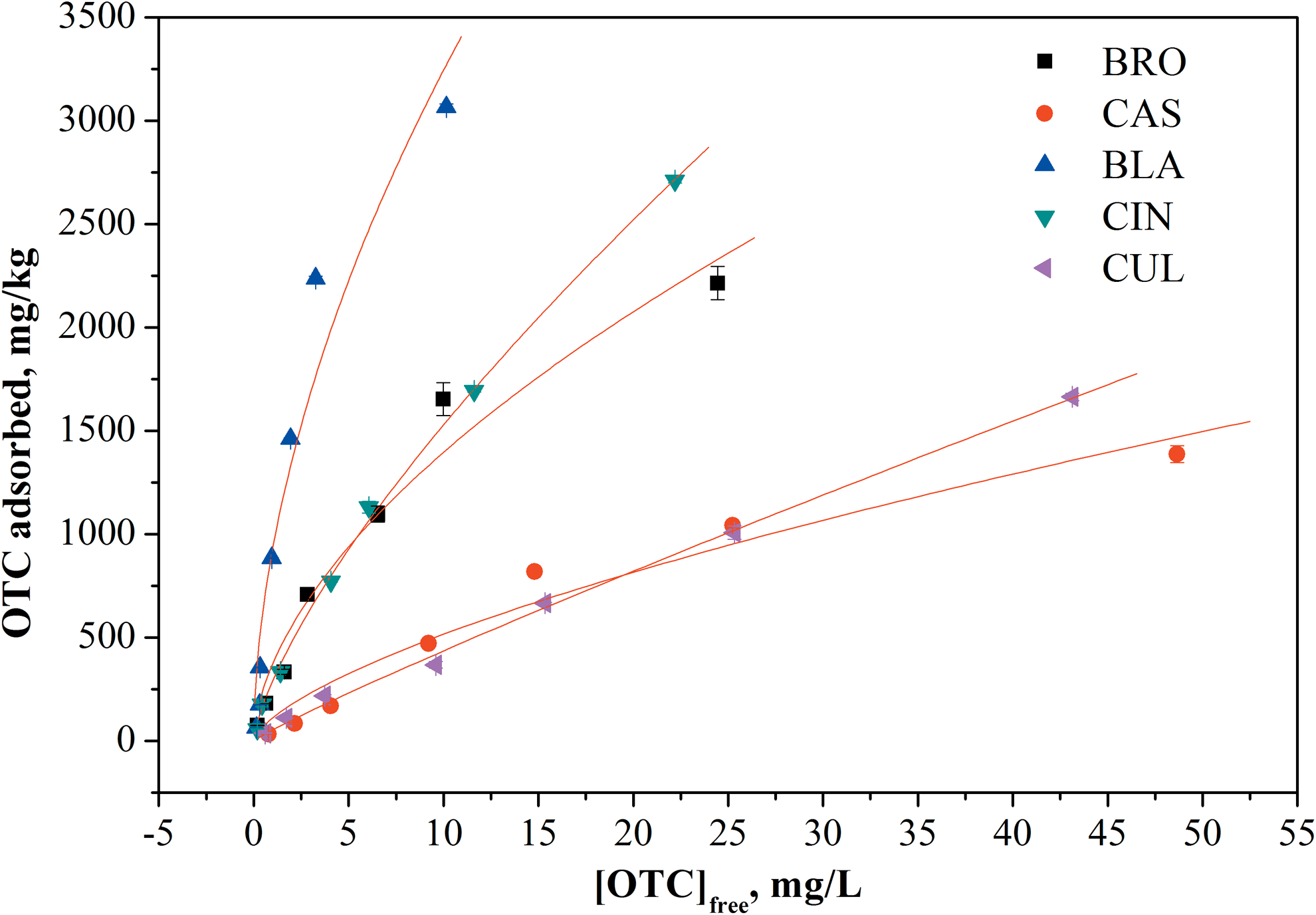
Sorption isotherms of OTC on different soils.
The isotherms were fitted by Langmuir, Freundlich, and the linear model, respectively. The model parameters and correlation coefficients are listed in Table 2. The KF of OTC on soils varies from 53.0 to 928, KL from 0.003 to 0.291. The magnitude of KF values are coincident with Teixidó's report, but the KL values are one order lower than his work (Teixidó et al., 2012). Just considering adjusted coefficient of determination (Adj. R2), the Freundlich model is best to describe the sorption isotherms of BRO and CAS; the Langmuir model is best for BLA and CIN; and both the Freundlich and linear models can be used to describe the isotherm of CUL. Therefore, it is not easy to decide which model is better for these isotherms just considering Adj. R2. The simulation software (Origin®) indicates that the standard error (SE) of fitted parameters could reflect the precision of the fitted values and the magnitude of the SE values should be lower than the fitted values. SE takes up 16.6–57.6% and 6.1–11.9% of KL and b for the Langmuir model, 5.1–29.6% and 2.6–14.8% of KF and N for the Freundlich model, and 2.27–20.9% and 38.1–68.2% of KD and B for the linear model. Considering both Adj. R2 and SE values, the Freundlich model is best to describe sorption isotherms of OTC on the five soils.
Sorption behaviors of TCs on CUL
CUL is used to study the sorption of different TCs because it is widely distributed in North China (about 21% of total area of North China). OTC, CTC, and TC are frequently detected with high concentrations (Supplementary Table S1). Consequently, the sorption behaviors of different TCs were compared on CUL. Figure 3 shows the sorption isotherms of OTC, TC, and CTC on CUL. The isotherms were also applied with the Langmuir, Freundlich, and linear models. After comparison, it is found that the Freundlich model is best to describe these isotherms (Table 3).

Sorption isotherms of OTC, tetracycline (TC), and chlortetracycline (CTC) on cultivated loessial soil (CUL).
CTC, chlortetracycline; OTC, oxytetracycline; TC, tetracyclines.
According to Fig. 3, the sorption magnitude follows the order of CTC>TC>OTC on CUL, which is consistent with Bao's reports (Bao et al., 2010, 2012). It is reported that the steric hindrance between the hydroxyl group at C5 and protonated dimethyl amino group makes the sorption of OTC smaller than TC (Avisar et al., 2010). However, the hydroxyl group does not exist in CTC and TC at C5 (Supplementary Fig. S1), but the sorption of CTC is larger than TC. Steric hindrance, therefore, cannot be used to explain the higher sorption of CTC than TC.
Various forms of TCs exist in real sorption solution due to intramolecular hydrogen bonding, different pKa, and ambient pH. On the same soils, the sorption difference must be determined by the molecular properties of these TCs. It is assumed that the high ionic strength in the sorption solutions affects the molecular properties of OTC, CTC, and TC at the same degree and could be negligible. Under the above hypothesis, four forms of TCs were determined under the experimental conditions by theoretical calculations (a, b, c, and d, Supplementary Fig. S2 and Fig. S3). Other forms of TCs are not realistic because of their extremely high molecular energy. a and b are neutral (zero charge) but with different intramolecular hydrogen bonding; c is charged with −1 and deprotonated at C12 hydroxyl group; d is charged with −2 and deprotonated at C12 hydroxyl group and the dimethyl amino group.
Table 4 lists the contents of the four forms of TCs and their molecular properties, including pKa, dipole moment, surface area, and molecular volume. After weighted average of different forms, the molecular volume and solvent accessible surface area of OTC, TC, and CTC have no significant difference and thus will not influence their sorption on CUL. However, the mean molecular polarity (dipole moment) of CTC is significantly larger than the others, while OTC and TC are similar. The larger the molecular polarity the higher the sorption of TCs on polar soils. CTC has the highest polarity and its sorption on CUL is maximum, and the presence of steric hindrance on OTC makes it less adsorbed than TC on CUL. Thus, it is concluded that the sorption difference of OTC, CTC, and TC is determined by molecular polarity together with steric hindrance.
pH after sorption equilibrium with primary antibiotic concentration of 20 mg/L.
Mean value was weighted-average of different species
DM, Dipole moment; MCA, molecule accessible surface area; MV, molecular volume.
Environment hazards analysis with partition coefficients and hysteresis index
Generally, environment hazards include four aspects on TC contaminated soils. The primary hazard is the proliferation of resistance bacteria and it makes TCs ineffective in the treatment of several diseases now and in the near future (Liu et al., 2010; Suzuki, 2010; Homem and Santos, 2011; Ullah et al., 2012; Hu et al., 2013). Second, TCs have significant ecotoxicity, and high concentrations of TCs may kill microorganisms, animals, and plants in soil (Farombi et al., 2008; Du and Liu, 2012; Yang et al., 2013; Kim et al., 2014). Third, TCs can be enriched in many edible plants and fishes. For instance, CTC can be enriched in corn, onions, cabbage, wheat, and other plants (Kumar et al., 2005; Grote et al., 2007); in aquaculture fishes, high levels of TCs were detected (Navrátilová et al., 2009; Yuan et al., 2010; Lv et al., 2013). These plants and fishes would endanger food safety once they become food on the table. Finally, TCs and their metabolites may migrate from soil to groundwater and deteriorate groundwater quality (Chen, 2010; Kim et al., 2011).
The hazard levels of TCs are greatly dependent on static parameters (the adsorbed amount, partition coefficients, etc.), dynamic parameters (hysteresis index, migration rates, etc.), local climate and irrigation, and so on. By sorption–desorption experiments, the adsorbed amount, partition coefficients, and hysteresis index are obtained at three equilibrium concentrations (Table 5). Desorption hysteresis of TCs is widely reported on soils and will slow down the migration rate varying with soils. HI [Eq. (3)] was first used to describe this phenomenon (Huang and Weber, 1997, 1998). A large HI means antibiotics accumulate on soil easily and a small HI reflects an easy migration in soil. HI has been linearly correlated with possible factors (clay content, cation exchange capacity, organic matter content, and pH). However, no significant correlation could be found, which is probably due to the complex composition of soils. Further experiments should be done to find out the underlying reasons.
Data were slightly beyond experiment range.
HI, hysteresis index.
where
To find out the most sensitive soil to TCs' contamination, we assume that all soils are contaminated by the same amount of OTC and the water content of soils is equal. Meanwhile, we focus on the discussion of Kd and HI obtained at Ce=0.5 mg/L since it approaches the real contamination levels. Kd of OTC on different soils follows the order of CUL<CAS<CIN<BRO<BLA and HI has an opposite trend (Table 5). Consequently, in a rainless area with insufficient irrigation where migration would be negligible, the free OTC concentration would be highest in CUL and lowest in BLA. Thus, the possibility is great to induce resistance bacteria and endanger ecology and food safety. For farm lands on CUL, it is necessary to prevent the application of manure with TCs.
Under heavy rain and continuous irrigation, migration would be significant. In this case, Kd would decide the migration rates of OTC on different soils (Chen, 2010). Consequently, OTC would migrate faster on CUL than on other soils and is quite possible to pollute groundwater. However, due to the small HI on BLA, OTC would show a persistent character since the OTC concentration in soil waters is similar after cycles of sorption–desorption. Although the OTC concentration is lower than on other soils, it is proved that low concentrations of TCs could also induce resistant bacteria (Gullberg et al., 2011). Meanwhile, the toxicity to soil, animals, and plants increases and also the possibility of OTC accumulation in edible plants. In general, CUL is most sensitive to TCs' contamination among the soils investigated.
For the comparison of different TCs, Kd and HI on CUL are listed in Table 6. Obviously, the HI of CTC and TC is significantly lower than OTC, and therefore, CTC is easiest to desorb from CUL, while OTC is hardest. This is probably because the number of active sorption centers (B) in CUL is fixed, the higher the adsorption of TCs (N), the lower the average affinity (B/N) that allows easy desorption from soil. The extremely low HI of CTC and TC and higher Kd herald their persistent character on soils under heavy rain or continuous irrigation. However, OTC has the lowest Kd and makes it the dangerous compound among the TCs investigated.
In summary, among the five soils investigated, CUL is most sensitive to TCs' contamination. Among the three TCs, OTC is most dangerous considering its low Kd. It is quite necessary to consider the sorption–desorption properties, local climate, and agriculture irrigation to retard or eliminate potential hazards of TCs.
Conclusions and Prospects
Due to the large usage of TCs, especially in livestock and poultry, the concentration and detection frequency are very high in China. Among the five soils, BLA exhibits strongest adsorption of OTC and the adsorption follows the order of BLA>CIN≈BRO>CUL≈CAS, and HI has an opposite trend at low contamination levels. For different TCs, the sorption follows the order of CTC>TC>OTC on CUL, which is determined by both molecular polarity and steric hindrance. The order of HI is OTC>TC>CTC. It is concluded that CUL is most sensitive to TCs' contamination among the five soils, and OTC is most dangerous considering its lower Kd than CTC and TC. All of these results indicate that soils should be tested and evaluated carefully to avoid potential environment hazards. For the control pollution sources, it is suggested that low-cost composting techniques should thus be developed to reduce the amount of TCs in manure from livestock and poultry. For governments and policymakers, reasonable plans and use of lands should be based on the evaluation of sorption–desorption parameters on local lands.
However, the hazard analysis in this work is qualitative and more direct and suitable parameters should be identified to predict, retard, or eliminate environmental hazards of TCs.
Footnotes
Acknowledgment
This research was supported by the Beijing Natural Science Foundation (Grant No. 8142020).
Author Disclosure Statement
No competing financial interests exist.
References
Supplementary Material
Please find the following supplemental material available below.
For Open Access articles published under a Creative Commons License, all supplemental material carries the same license as the article it is associated with.
For non-Open Access articles published, all supplemental material carries a non-exclusive license, and permission requests for re-use of supplemental material or any part of supplemental material shall be sent directly to the copyright owner as specified in the copyright notice associated with the article.
