




Abstract
Abstract
Titania (TiO2)-graphene oxide (GO) composites have been synthesized by the sol–gel method and characterized by XRD, SEM, EDS, BET, and UV-Vis DRS. Experiments investigated photocatalytic reduction of nitrite and explored the mechanisms of enhancement of photocatalysis by graphene oxide. Results showed that nitrite conversion and selectivity for N2 could be up to 97.80% and 92.66% under the optimal conditions. Photocatalytic efficiency of TiO2-GO was found to be significantly higher compared with pure TiO2. Results could be important for wastewater treatment where reducing conditions may commonly occur.
Introduction
N
In principle, the conventional technologies for removing nitrite include physicochemical methods (ion exchange (Bae et al., 2002; Samatya et al., 2006), reverse osmosis (Schoeman and Steyn, 2003), and electrodialysis) and biological methods (Wasik et al., 2001). However, physicochemical methods often generate cost issues due to specific requirements for supervision, maintenance, and secondary treatment. Biological denitrification processes are relatively slow and complex. Photocatalysis is particularly suitable for the abatement of nitrite because it is an effective process and also has environmental benefits. Titania (TiO2) and titania-based materials are widely employed as photocatalysts due to their chemical stability and nontoxicity (Minero and Vione, 2006). Meanwhile, TiO2 and titania-based materials have some disadvantages; for example, electrons and holes are easy to recombine, thus reducing efficiency of photocatalytic reaction. Graphene oxide (GO) is able to considerably improve the photocatalytic activity of TiO2 because of its excellent charge transfer properties (Chen et al., 2013). The combination of TiO2 with GO is applied to decrease the recombination rate of electrons and holes and improve the photoactivity.
The aim of this work was to synthesize the TiO2-GO composite by the sol–gel method, evaluate its activity and selectivity in nitrite reduction in water and formic acid as a hole scavenger, and understand the mechanisms of enhancement of photocatalysis by GO.
Experimental
Preparation of graphene oxide
GO was synthesized from natural flake graphite powder by a modified Hummer's method (Hummers and Ofleman, 1958). The preparation process was as follows: under the condition of an ice water bath, 5 g of flake graphite was added to 120 mL of concentrated sulfuric acid, stirred, and mixed sufficiently; then, 21 g of potassium permanganate was added and stirred into a paste, and finally, a water bath to control the reaction temperature at 10–15°C for 2 h. After being shifted into a water bath at 35°C, stirring was continued for 30 min. Then, 400 mL of deionized water was slowly added to the reaction mixture and the temperature was controlled at 80°C for 20 min. Hydrogen peroxide (30%) was added until no bubble was generated in the solution. The cake was washed with 5% hydrochloric acid and deionized water until the filtrate was neutral. Graphite oxides were obtained after drying for 36 h.
Synthesis of TiO2-GO
Briefly, 10 mL of butyl titanate was put into a mixture of 100 mL of ethanol, 5 mL of acetic acid, and 3 mL of deionized water. Then, the GO solution was added gradually under stirring for 1 h. After drying at 60°C for 12 h and calcining at 450°C for 2.5 h, the final desired product was obtained.
Photocatalyst characterization
XRD patterns of the structured catalysts were acquired with a D/max-RB instrument (Rigaku, Japan) using Cu Kα radiation at 40 kV and 50 mA, geometry 5–90,° and λ=0.154178 nm. The samples were examined in SEM, JSM26700F, equipped with an X-ray energy dispersive spectrometer (EDS), and OXFORD INCA. UV-Vis DRS was obtained with the Hitachi of U-3010 ultraviolet-visible diffuse reflection spectrum (with integrating sphere), the scanning speed of which is 120 nm/min, scanning step length is 2 nm, and scanning wavelength range is 250–800 nm.
Reaction experiments
Photocatalytic reduction of nitrite was performed in a batch reactor equipped with a magnetic stirrer (800–1000 rpm) and a low-pressure mercury lamp that emits radiation at 254 nm with an output power of 15 W. Experiments were carried out at the temperature of 25°C and atmospheric pressure. The reaction started when formic acid (0.03 mol/L) as a hole scavenger was added into the reactor. Samples were withdrawn from the reactor for the determination of nitrite and ammonium using the colorimetric technique (Marchesini et al., 2008). The experimental setup figure is given in Fig. 1.
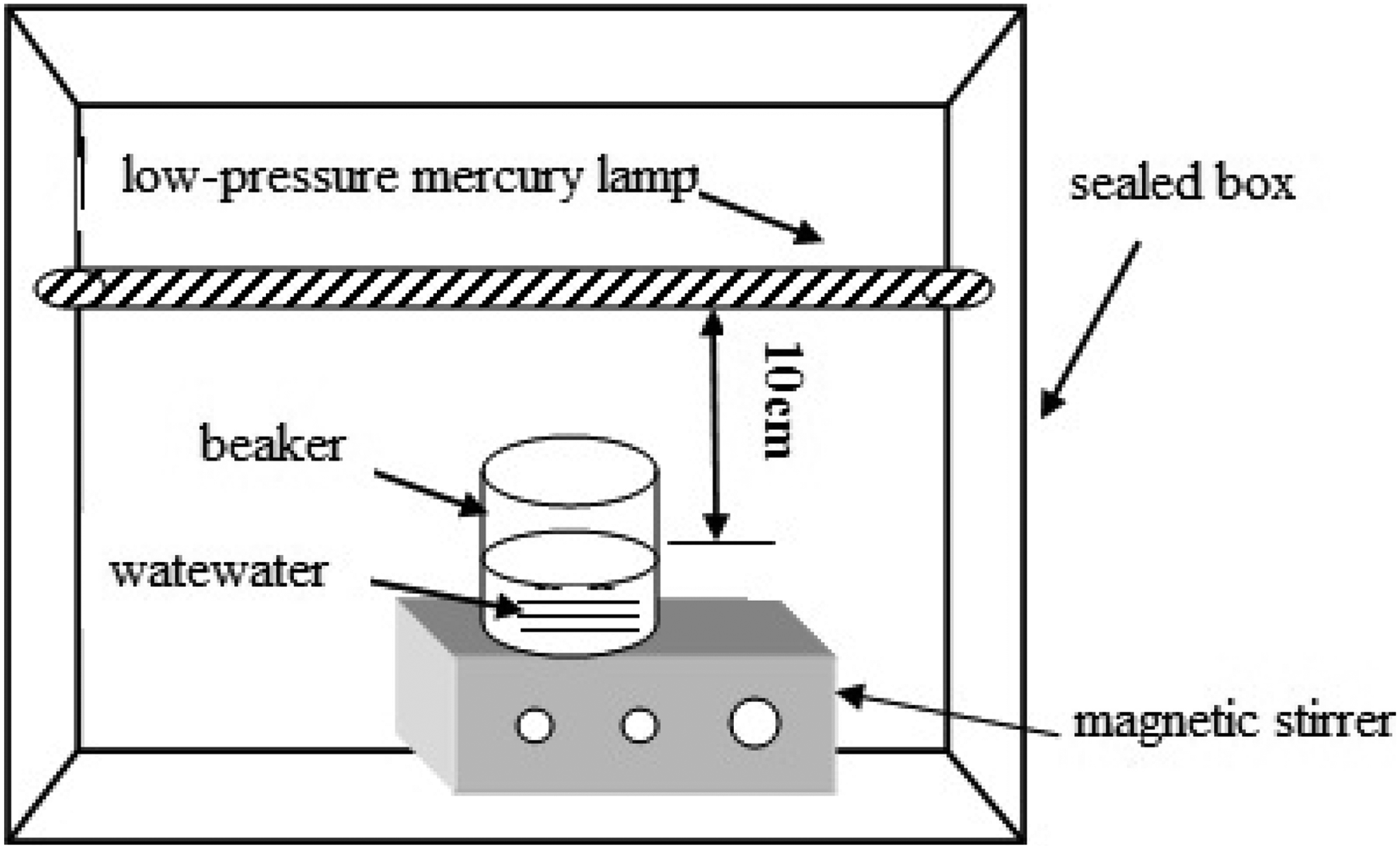
Equipment for photocatalysis.
Nitrite reduction could be expressed as follows (Zhang et al., 2005b):
The conversion of nitrite (C) [Eq. (9)] and selectivity toward N2 (S) [Eq. (10)] were also evaluated. The sample, which had the highest values of both S and C, was considered to be the best photocatalyst. The conversion of nitrite is reported as the percentage of nitrite reduced. The selectivity toward nitrogen is defined as the ratio between the concentration of nitrite reduced to form nitrogen and the total concentration of nitrite reduced considering that only by-product ammonium was formed.
where c0=initial concentration, ct=concentration at time t.
Results and Discussion
Catalytic characterization
Crystalline phases of structured catalyst
Conclusions can be made from Fig. 2a; natural flake graphite had been absolutely oxidized to GO. TiO2 and TiO2-GO exhibit several diffraction peaks at 25.34°, 37.89°, 48.02°, 53.94°, 55.16°, and 62.94°, corresponding to (101), (004), (200), (105), (211), and (204) planes of TiO2 (JCPDS: 01-071-1167), which demonstrates that the addition of GO does not result in the development of new crystal orientations or the changes in preferential orientations of TiO2. As the GO was added, the peak at 2θ=25.34° for the TiO2-GO samples was increased in intensity along with sharpening of the peak, indicating that the presence of GO was favorable to improving the crystallinity of TiO2. The crystallinity of TiO2 particles was quantitatively evaluated through the relative intensity of the (101) diffraction peak of the anatase (Yu et al., 2002). In comparison with the intensity in the composite without GO, the relative intensity of the (101) diffraction peak of anatase was increased from 1251 to 1807. No characteristic diffraction peaks of the GO in the composite samples were observed, which is possibly due to the destruction of the regular stack of GO during preparation of the composite (Liu et al., 2010), or the relatively low amount and low diffraction intensity of GO in the composite that covers the peaks by the diffraction signals of TiO2 (Xu and Wang, 2009).
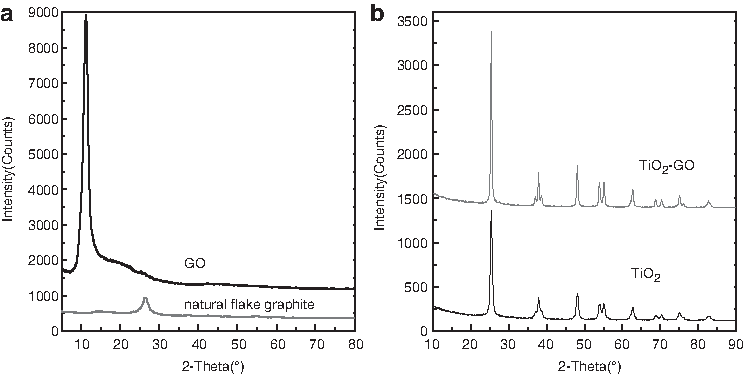
XRD patterns of natural flake graphite and graphene oxide (GO)
Morphology and element distribution of TiO2 and TiO2-GO
The surface morphology and homogeneity of TiO2 and TiO2-GO were further observed with SEM. As shown in Fig. 3, the morphology of pure TiO2 significantly differed from the TiO2-GO. Bare TiO2 particles were microsized and have a great tendency to agglomerate. However, in the presence of GO, such type of agglomeration is reduced and TiO2-GO particles were nanosized because the formation of well-dispersed GO can accelerate the nucleation of TiO2 particles, and therefore, further particle size growth might be hindered.

SEM micrographs of TiO2
Composition of TiO2-GO was identified by EDS linked to SEM. The peaks in Fig. 4 of EDS spectra indicated that the TiO2-GO was composed of Ti, O, and C and GO of C and O.

Energy dispersive spectrometer spectrum of TiO2-GO
Surface area measurements of TiO2 and TiO2-GO
The BET results in in Table 1 showed surface area increased with the combination of GO.
UV-Vis DRS of TiO2 and TiO2-GO
From Fig. 5, the band gap of TiO2 has no change with the addition of GO. However, the absorption has been enhanced not only in ultraviolet light but also in visible light.
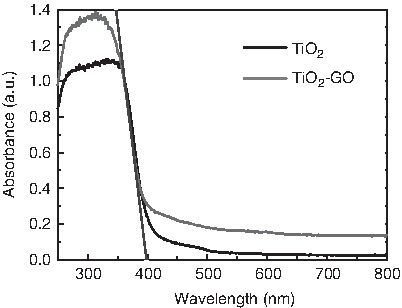
UV-Vis DRS of TiO2 and TiO2-GO.
Catalytic activity
Selection of photocatalyst
Figure 6 shows changes in the degradation of nitrite and selectivity toward N2 in the reaction solution versus reaction time for the photocatalytic reduction of nitrite by the GO, TiO2, and TiO2-GO under UV lamp irradiation.
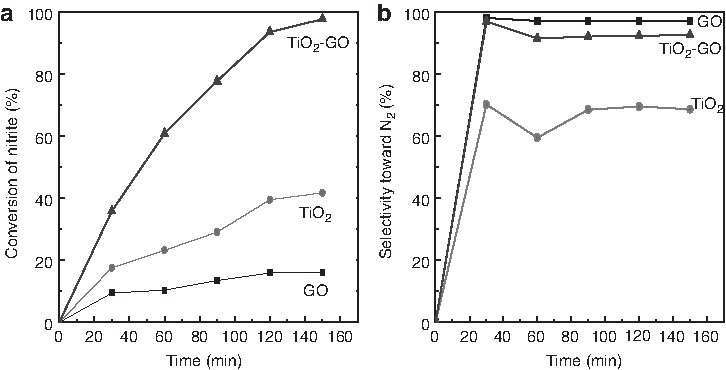
Conversion of nitrite
It can be seen that the conversion and selectivity increased with increasing reaction time. In addition, GO has little effect on the removal of nitrite, playing a role of adsorption. The photocatalytic efficiency of TiO2-GO was higher compared with pure TiO2. Nitrite was almost completely reduced to nitrogen in the presence of TiO2-GO after exposing under UV light for 120 min. However, the degradation percentage of pure TiO2 was only 41.82%. The selectivity of TiO2-GO was 92.66%, while pure TiO2 was 68.77%. The results indicated that TiO2-GO favored the nitrite reduction to nitrogen against the over-reduction to ammonia. Meanwhile, it implied that the GO plays a crucial role in the enhancement of photocatalytic activity of TiO2.
Effect of photocatalyst dosage on nitrite photocatalytic reduction
When the dosage of the photocatalyst was increased, the conversion and selectivity increased, reaching a maximum at ∼1.0 g/L, at which point the conversion and selectivity began decreasing gradually (Fig. 7). The result indicated that increasing the photocatalyst dosage resulted in improved nitrite reduction, but only to a limiting concentration at which the conversion and selectivity decreased, presumably due to irradiation shielding.

Conversion of nitrite and selectivity toward N2 at a different photocatalyst dosage.
Effect of system pH on nitrite photocatalytic reduction
Figure 8 shows the effect of pH on the conversion and selectivity in an aqueous suspension of TiO2-GO particles for 150 min. The initial value of pH was changed using sodium hydroxide solution (aq. NaOH) or formic acid (aq. HCOOH). The best reaction property was obtained in the reaction with pH=5, which was same as the result of Garron et al. (2005). With the increase in pH of the suspension, the conversion and selectivity decreased. However, decrease in the selectivity was smaller than the conversion. As pH increased, the amount of nitrite adsorbed on TiO2-GO particles and the number of protons available for reduction reactions were decreased, resulting in a decrease in the conversion and selectivity.
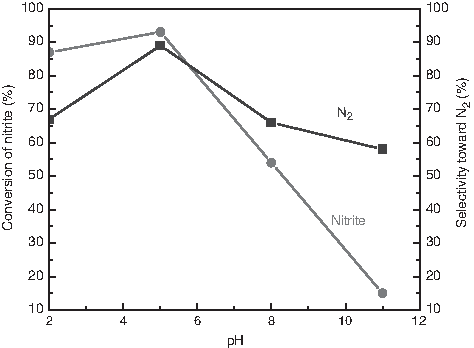
Conversion of nitrite and selectivity toward N2 at a different initial pH.
Effect of initial nitrite concentration on nitrite photocatalytic reduction
With the increase of nitrite concentration, the conversion increased, reaching a maximum at ∼50 mg/L, at which point the conversion began decreasing. Since the formic acid concentration was constant, the amount of formic acid adsorbed on the catalyst surface decreased as the nitrite concentration increased, resulting in the decrease of protons. The nitrite concentration had little influence on the selectivity toward N2 showed in Fig. 9.
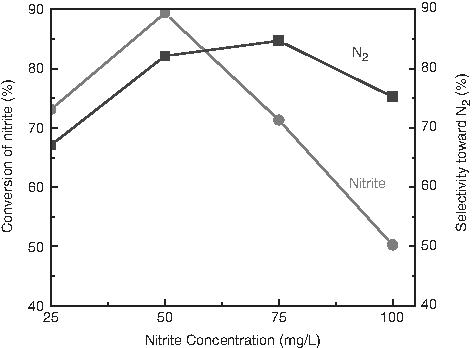
Conversion of nitrite and selectivity toward N2 at different initial nitrite concentrations.
Mechanisms of enhancement of photocatalysis by GO
The roles that GO played in the enhancement of photocatalysis can been concluded as follows.
(1) Enhancing the adsorption ability of the composite (Chen et al., 2013). The large number of π electrons in GO can interact with nitrite molecules through π–π conjugation, which enhances the adsorption of nitrite, thereby improving the efficiency of photocatalytic reduction. GO possesses the largest specific surface area because of its single-layer, two-dimensional planar structure, as shown in Fig. 10, which can provide additional reaction space. Meanwhile, GO also helps to disperse TiO2 by decreasing agglomeration and promoting the contact between TiO2 and nitrite.
(2) The particular electronic properties of GO. When GO is added into the photocatalytic system and because the conduct band of TiO2 is higher than the Fermi level of GO, the photogenerated electrons are readily transferred from the TiO2 to the GO. The electrons are then rapidly transferred to nitrite at high rates because the two-dimensional planar π-conjugated structure of GO facilitates charge transfer. This increases the free path of electrons and reduces the recombination of photogenerated electrons and holes, which enhances the photocatalytic quantum efficiency of TiO2-GO (Ren et al., 2012; Yoo et al., 2012; Wang et al. 2012). The analysis is consistent with the results of Zhang et al. (2010).
(3) Increasing the intensity of light absorption. When TiO2 is combined with GO to form a composite under favorable reaction conditions, the element of carbon as a photosensitizer could enhance the absorption of light (Nguyen et al., 2011; Yan et al., 2010). The conclusion could be made according to the results of UV-Vis DRS.
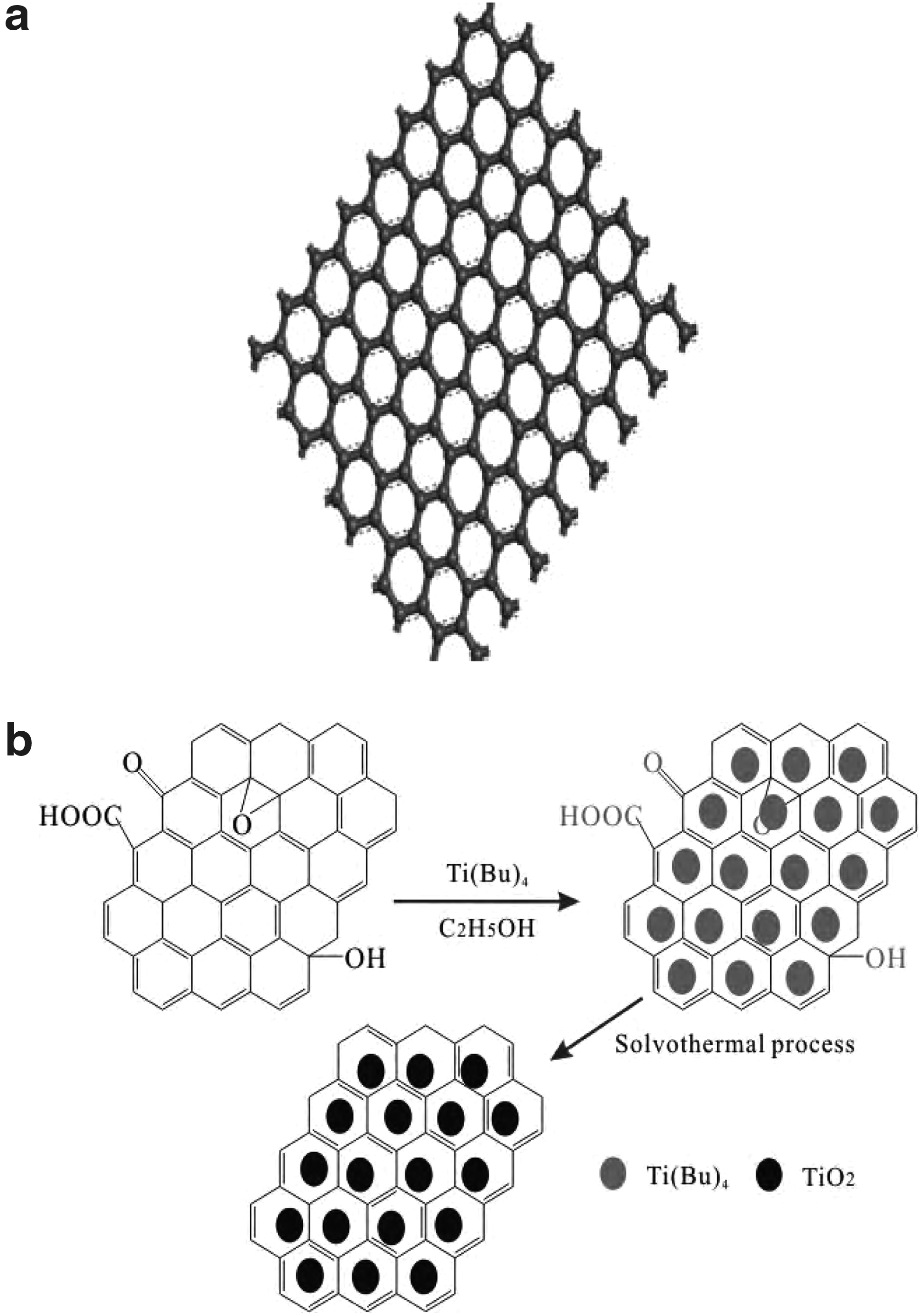
Structural characteristic
Conclusions
In summary, a novel photocatalyst of the TiO2-GO composite has been successfully prepared through a sol–gel approach. The photocatalytic experimental results showed that the TiO2-GO composite exhibited a better photocatalytic performance than pure TiO2 and GO in the reduction of nitrite under UV irradiation for 150 min due to the increased adsorption capacity and the effective transfer and separation of photogenerated electrons. Considering the green and effective method for the reduction of nitrite, the present investigation opened a new opportunity for the design and preparation of graphene-based functional composite materials for various potential applications relating to a number of environmental issues.
Footnotes
Acknowledgments
The authors received financial support from the Natural Science Foundation of the Shaanxi Province (Grant No. 2012JM2012). The authors thank Mrs. X.J. Du for her help in measurements of XRD, SEM, and UV-Vis DRS.
Author Disclosure Statement
No competing financial interests exist.