




Abstract
Abstract
Biofilm is an integral element of the ecosystem in each device of the technological process in wastewater treatment plants (WWTP). Until now, no comprehensive analysis of the occurrence of morphological groups in the biofilm of wastewater treatment devices has been performed. Wanting to fill this gap, the aim of the present article was to determine the structure of the biofilm in the technological system of a WWTP in Lublin (Poland). Abundance of individuals from the following morphological groups was assessed: fungi, flagellates, algae, testate amoebae, ciliates, rotifers, and nematodes. Additionally, values of three biocoenotic indices were determined, that is, the Shannon Diversity, McIntosh Evenness, and Berger–Parker (dominance). Results have demonstrated differences in the structure of the biofilm between the devices. Flagellates and fungi dominated in the mechanical part, whereas the biological elements were dominated by ciliates, amoebae, and rotifers and the treated wastewater by algae and ciliates. Indices indicated the simplest biofilm structure (the lowest biodiversity) at the mechanical stage and at site of discharge of treated wastewater to the receiver. Knowledge of the biofilm structure may be useful for assessment of conditions prevailing in wastewater treatment devices. Moreover, it can be a starting point to develop a quick and low-cost bioindication method applicable in all devices, which can be complementary to standard physicochemical methods.
Introduction
A
From the ecological and technological point of view, research focused on determination of the abundance of organisms occurring within activated sludge and biofilm, is of great importance (Martín-Cereceda et al., 2001a, 2001b; Pérez-Uz et al., 2010). Analysis of the structure of the biological communities mentioned and description thereof by means of relevant indices are also often employed (Madoni, 1994; Łagód et al., 2009). In this area, there are interesting investigations of the impact of the presence of protozoa in activated sludge or biofilm, their structure, and morphology on the course of the wastewater treatment process (Martín-Cereceda et al., 2001a, 2001b; Pajdak-Stós et al., 2010). Measurement techniques based on the image analysis procedure and applied for characterization of the composition of biological material samples are directly connected with the research area described above (Amaral et al., 2008; Saur et al., 2014). Some researches try to develop methods or models that could describe or predict functioning of a wastewater treatment bioreactor based on integrated biological–ecological and physical–chemical measurements (De Gregorio et al., 2011; Canals et al., 2013).
As indicated in the literature cited above, numerous scientific investigations have been focused on the process factors in the biological part of WWTPs, that is, activated sludge, technological biofilm growing on various (stationary or mobile) beds, and various types of mixtures (since in this article the term biofilm is used for another organism formation, the biofilm, which is the process factor, will be distinguished by the word technological). This is caused by the fact that organisms that are elements of the process factor play the major role in removal of carbon, nitrogen, and phosphorus compounds from wastewater. Importantly, the activity of activated sludge or technological biofilm beds is supported by the activity of organisms colonizing all wastewater treatment devices at all stages of wastewater treatment (Chindah et al., 2009; Jaromin et al., 2010; Łagód et al., 2010). Organisms that spontaneously colonize available surfaces, irrespective of (or sometimes even against) the intended actions of the facility user, will be called the biofilm hereinafter.
It can be assumed a priori that the amount and species composition of the biofilm will differ from the species composition of activated sludge. Furthermore, the structure of biofilm communities (in terms of abundance and composition) will depend on environmental parameters, which are a function of the treatment process and differ at the respective stages of the process (Jaromin et al., 2010; Łagód et al., 2010). However, although there are many publications on biofilm present in a variety of water reservoirs (Pizarro et al., 2002; Murdock et al., 2004; Magbanua et al., 2013), articles describing the biofilm from wastewater treatment systems are considerably less numerous (Vymazal et al., 2001; Toet et al., 2003; Chindah et al., 2009). The problem of the quantity and quality of biofilm inhabiting the elements of WWTPs is understood relatively poorly.
Biofilm analyses seem to be essential for two reasons. One of them, that is, the utilitarian aspect mentioned already, addresses involvement of the biofilm in the wastewater treatment process (Davis et al., 1990; Toet et al., 2003; Chindah et al., 2009). The other equally important reason is the cognitive aspect, which can contribute to further improvement of the wastewater treatment technology on the one hand and help elucidate the interrelationships between various groups of organisms on the other hand. A WWTP is an excellent object of research, as biofilm organisms develop in the environmental conditions of a small area. Additionally, this environment is characterized by a varied level of organic matter, which is a source of nutrients, and by changeable concentrations of substances exerting an adverse effect on the growth of the organisms (Łagód et al., 2010). The chain begins with elements of the heavily pollutant-loaded mechanical pretreatment part, where biofilm is formed in conditions offered by raw sewage. In turn, the final part of the technological system comprises a channel discharging treated wastewater, which is virtually pure water with a low content of biodegradable organic compounds and with low levels of biogenic elements. On the way, there are stages where biofilm coexists with activated sludge (Jaromin et al., 2010; Babko et al., 2012). Therefore, each device offers highly specific conditions ensuring potential variability of the structure of the communities, which provides excellent ground for research.
Literature review indicates that there are no articles analyzing changes in the composition of biofilm communities in the successive stages of the wastewater treatment process. Therefore, the aim of this study was to identify the structure of biofilm colonizing the devices of the technological system in a municipal flow-type WWTP, which conducts the process of organic pollutants and biogenic elements removal with the activated sludge method.
Experimental Protocols
The analyzed WWTP was a flow-type purification plant with the mechanical pretreatment (screen, grit separator, and primary clarifier) and biological part working as a modified Bardenpho system, with no chemical reagents added in any of the analyzed devices. The scheme of the WWTP is shown in Fig. 1.
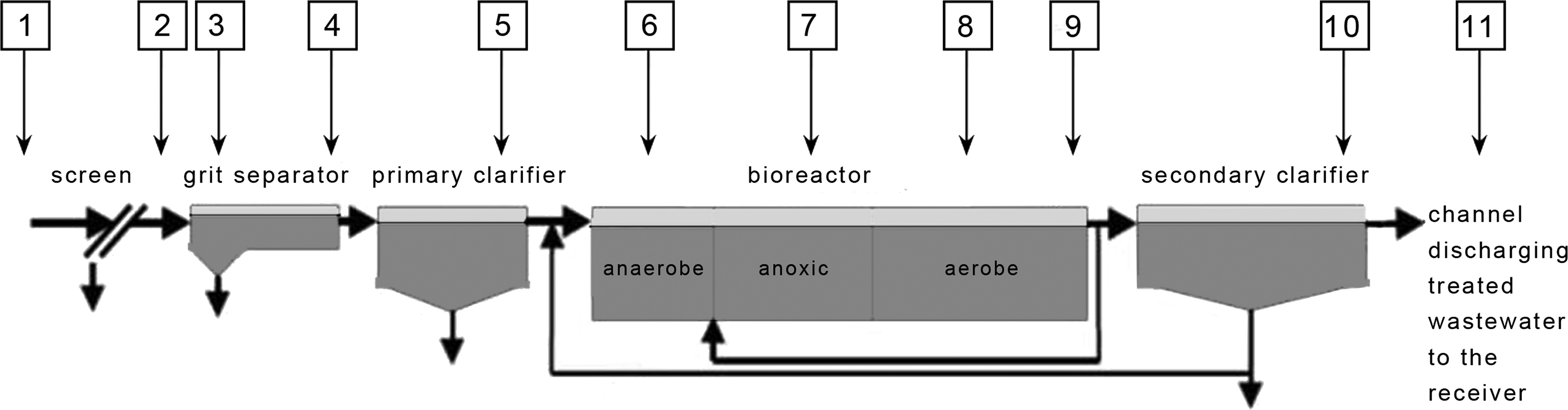
Scheme of wastewater treatment plant devices.
Research material comprised biofilm sampled from 11 devices constituting the technological system of the “Hajdów” mechanical–biological WWTP in Lublin (south-eastern Poland). These included: (1) prescreen chamber, (2) postscreen chamber, (3) pregrit separator chamber, (4) postgrit separator chamber, (5) primary clarifier, (6) anaerobic bioreactor chamber, (7) anoxic chamber, (8) oxic bioreactor chamber, (9) bioreactor outlet, (10) secondary clarifier, and (11) channel discharging treated wastewater to the receiver, that is, the Bystrzyca River. It should be noted that the first four points are hermetic that is, closed at the top by covers with seals. This was aimed at protection against odor; however (what is important in the context of the investigations), the covers also protect against sunlight.
Biofilm formation depends largely on the environmental conditions. These conditions parameters within a single appliance change relatively infrequently. However, the changes between the successive devices in the processing line are large. This is particularly evident between the groups of devices associated with the particular parts of the WWTP. The first part (mechanical treatment of wastewater points 1–5 in Fig. 1) was characterized on an average by a decrease in BOD5 from ∼500 to ∼350 mg/cm3, COD from ∼1000 to ∼650 mg/cm3, and TSS from ∼450 to ∼150 mg/cm3. The same parameters in the biological part and discharge channel (points 6–11 in Fig. 1) were decreasing as well, however, at a much lower level: BOD5 from ∼12 to ∼7 mg/cm3, COD from ∼125 to ∼75 mg/cm3, and TSS from ∼25 to ∼10 mg/cm3. The biogenic load in the mechanical part showed a slightly decreasing trend and the values were at a level of N-NH4 ∼55–∼50 mg/cm3, Ntot ∼75–∼73 mg/cm3, and Ptot ∼14–∼11 mg/cm3. In the biological part and discharge channel, the biogenic load was at the level of N-NH4 ∼15–∼4 mg/cm3, Ntot ∼35–∼20 mg/cm3, and Ptot ∼6–∼1 mg/cm3. The pH changed in the mechanical part from 7.53 to 7.45, and in the biological part and discharge channel from 7.49 to 7.85. The temperature of wastewater inside the WWTP devices during the sampling period was stabilized at a level of 19°C (±1.5°C).
Series of samples were collected once a week at a fixed time of day in July, August, and September. Since the structure of the biofilm organisms is sensitive to any changes in the environment, the sampling period was chosen to be sure that there was no incident (for example: failure, repairs, and modification of technology) in the WWTP.
Samples were collected with a metal scraper (10-cm wide, equipped with a long shaft) at a depth of 10–20 cm below the wastewater level in each device. The surface area of the walls of the appliances from which the biofilm was sampled was ∼100 cm2. To standardize the humidity (amount of wastewater) in the sample before placing the biofilm into the container, the scraper blade was inclined at an angle of ∼25° and the wastewater was allowed to float away gravitationally from the biofilm. The sampled biofilm was placed in 300-cm3 plastic containers and filled to a volume of 100 cm3 clarified wastewater collected from the sampling site. Clarification was performed as follows: after wastewater collection into a separate container, solid parts or activated sludge contained therein were allowed to sediment and the supernatant obtained was filtered through a paper filter with a 125 mm diameter and pores approximately about 8–10 μm. The biological material prepared in this way was transferred to the laboratory ensuring air access to prevent anaerobic conditions. The samples were transported and stored before microscopic analysis at a temperature of 7°C.
Intravital preparations were made from vigorously shaken samples mixed with an inoculation loop, ensuring that each time the analyzed biological material was taken from fully homogenized content of the containers. Three preparations were made, each with a volume of 0.025 cm3, from each sample and the results were converted into 1 cm3, taking into account the dilution with the filtered wastewater.
Samples were analyzed under a transmitted light brightfield optical microscope (OPTA-TECH) with a magnification of 100, 250, and 400×. The method of data preparation for counting the organisms involved taking digital images of 21 nonoverlapping crosswise fields of view along the major axes of symmetry of the cover slip for each of the magnifications applied. Digital archiving of each field of view allowed possible reverification of the counting results if necessary.
Organisms analyzed in the fields of view were identified and classified into the following morphological groups: fungi, flagellates (>20 μm), algae, testate amoebae, ciliates, rotifers, and nematodes. The number of the organisms within all fields of view from material sampled in one point was regarded as one replicate. In turn, measurements performed on the successive days were replicates (n = 13) for each of the 11 sites. Additionally, three biocoenotic indices were determined: (1) the Shannon Diversity Index–one of the most commonly used parameters for description of biodiversity (Gove et al., 1994; Krebs, 1994); (2) the McIntosh Evenness Index–used for description of habitats in terms of balance between individual groups of organisms (McIntosh, 1967); (3) the Berger–Parker (dominance) index–a measure of the heterogeneity of the communities comprising the morphological groups investigated in the present study (Magurran, 1988).
The similarity of the biofilm communities in the successive devices was analyzed with the cluster analysis (Hammer et al., 2001; Łagód et al., 2009). A detrended correspondence analysis (DCA) was performed to explore whether there were organisms or groups assigned exclusively to some wastewater treatment devices, which could be considered as indicator organisms for each device. Therefore, it can be generally said that the DCA was used to assess the temporal and spatial morphological group turnover throughout the study period in the WWTP sites.
Results
Values of the three indices analyzed (Shannon, McIntosh, and Berger–Parker Index) are presented in Fig. 2. Analysis of the data shown in the figure reveals that differences in the values of the indices vary between the technological system devices.

Changes in index values in biofilm of successive devices of the wastewater treatment plant. Numbers denote the following devices: 1. prescreen chamber, 2. postscreen chamber, 3. pregrit separator chamber, 4. postgrit separator chamber, 5. primary clarifier, 6. anaerobic bioreactor chamber, 7. anoxic chamber, 8. oxic bioreactor chamber, 9. bioreactor outlet, 10. secondary clarifier, and 11. channel discharging treated wastewater to the receiver.
Samples collected in the first two devices are characterized by a highly similar structure of biofilm organisms. The values of the Shannon Diversity Index suggest a poorly structured habitat, and the values of the McIntosh Evenness Index and Berger–Parker Index indicate dominance of certain groups of organisms.
A similar correlation (as in the case of the first two sampling points) between the indices can be observed for the biofilm from the pregrit separator chamber and the postgrit separator chamber, as well as the primary clarifier. However, in these sampling points, the higher value of the Shannon Index (∼0.9), the increasing value of the McIntosh Evenness Index, and the decreasing value of the Berger–Parker Index are worth noting. Although the values do not differ considerably, there is a visible trend indicating that the treatment processes induce changes in the biofilm structure. Taken together, it can be claimed that, before it is mixed with activated sludge, wastewater passing the successive devices of the mechanical part of the WWTP does not comprise a well-developed organism community in these stages of the treatment process. Although the biofilm constitutes a specific spontaneous and independent community, its structure implies quite clearly the hardly stable conditions in the early stages of the mechanical wastewater treatment, which should be stabilized with each stage of the process.
The next four sampling points (the anaerobic bioreactor chamber, anoxic chamber, oxic bioreactor chamber, and bioreactor outlet) are part of the treatment process, where wastewater is exposed to activated sludge. This part is characterized by substantially greater biodiversity. However, the relativity of the increase should be emphasized given the fact that, although the value of the McIntosh Evenness Index increased over 60% of its range and the Berger–Parker Index declined below that value, the Shannon Diversity Index value persisted at a relatively low level (slightly above 1) despite an increase. The highest values of the Shannon Diversity Index and the McIntosh Evenness Index among the analyzed sampling points (6, 7, 8, 9) were found in the anaerobic bioreactor chamber.
The composition of the biofilm sampled at the final stage of the treatment process (in the secondary clarifier and the channel discharging treated wastewater to the receiver) becomes less diverse, as indicated by the values of all the three indices comparable to those reported for the biofilm colonizing raw sewage.
Changes in the abundance of the analyzed morphological groups of the biofilm sampled at the successive stages of the WWTP are presented in Fig. 3.

Changes in abundance of
Analysis of the results obtained for the biofilm organisms present in the devices of the municipal WWTP shows the greatest abundance of representatives of filamentous fungi and heterotrophic flagellates in devices with raw sewage. The number of flagellates is an indicator of the level of contamination and the condition of the process factor in the plant (Fig. 3A). The number gradually declines in the successive devices of the WWTP, which provides evidence for the effectiveness and reliability of the treatment process, particularly aerobic processes taking place in the biological treatment. In turn, filamentous fungi disappear after treatment in the grit separator and they are not detected in the analyzed sampling period until the end of the treatment process.
In the first four sampling points (prescreen chamber, postscreen chamber, pregrit separator chamber, and postgrit separator chamber), there were virtually no substantial amounts of algae (Fig. 3B). They appeared only in the preliminary clarifier and reached a value of ∼23,620 ind/cm3. Next, in the anaerobic bioreactor chamber, their abundance declined significantly (to the level of 1060 ind/cm3) and was stabilized at the level of ∼4780–6080 ind/cm3 in the next 3 sampling points. The algal abundance increased significantly in treated sewage (No. 10 and 11).
In terms of the capability of the organisms of active movement and adsorption on chamber walls, two groups colonizing the treatment plant surfaces can be distinguished, that is, ciliates and rotifers. Furthermore, ciliates, particularly those from the sedentary group, are a predominant element in biofilm (Martín-Cereceda et al., 2001a; Madoni, 2011). However, analysis of the graphs presented in Fig. 3B and C indicates varied abundance of these organisms in the biofilm community. The greatest numbers of ciliates were found in both clarifiers (greater abundance in the secondary clarifier); in the bioreactor chambers (No. 6, 7, 8, and 9), they ranged from 3600 to 5160 ind/cm3. The lowest numbers of ciliates were noted in the biofilm of the devices preceding the grit separator (screen chambers and the inlet of the grit separator chamber). It should be noted that the presence of ciliates was associated with the occurrence of algae.
Noticeably abundant populations of rotifers, which exhibit trophic preferences for filamentous bacteria, were detected only in points 5–11. They exceeded the rate of 400 individuals per cm3 in only two cases, that is, the anoxic chamber and the bioreactor outlet, (Fig. 3C). It can, therefore, be concluded that, their abundance in the biofilm is noticeable, however, it is difficult to compare one individual of ciliate or flagellate to one rotifer due to their size and activity in biofilm communities.
To summarize the information about the abundance of the analyzed ciliates and rotifers, it can be claimed that the abundance of rotifers is minimal in sites where ciliates reach their maximum abundance between the primary clarifier and the treated wastewater channel. The maximum abundance of rotifers is even six-fold lower than that of ciliates, for example, the ratio in point 9 is 570/3600, whereas in point 10, where the maximum abundance of ciliates was detected, the ratio is ∼350/28,200.
Testate amoebae are elements of activated sludge. Their presence, particularly in the oxic treatment stage, can be regarded as evidence for absence of failure of the bioreactor. Analysis of the biofilm composition in the consecutive treatment stages (Fig. 3C) shows relatively low level of amoebae abundance (less than 80 ind/cm3) up to the postgrit separator chamber. They occurred more abundantly (over 400 ind/cm3) in the primary clarifier and reached a maximum (1040 ind/cm3) in the anaerobic bioreactor chamber. In the further stages of the treatment process, amoeba abundance persisted at a level of 480–920 ind/cm3.
Nematodes occur in the biofilm regularly, but in relatively small amounts (Fig. 3C). Notably, their abundance exhibits a steady upward trend in the subsequent treatment stages, reaching an average level of 120 ind/cm3 in the secondary clarifier and the receiver channel.
The total abundance of the biofilm organisms occurring in the successive stages of the treatment process is presented in Fig. 4.

Total abundance of biofilm organisms in successive devices of the “Hajdów” wastewater treatment plant and all organisms, except for algae. Numbers denote the following, 4. postgrit separator chamber, 5. primary clarifier, 6. anaerobic bioreactor chamber, 7. anoxic chamber, 8. oxic bioreactor chamber, 9. bioreactor outlet, 10. secondary clarifer, and 11. channel discharging treated wastewater to the receiver.
Analysis of the data presented in Fig. 4 indicates the maximum total number of organisms colonizing the biofilm of the devices of the WWTP in the secondary clarifier, that is, ∼74,620 ind/cm3. Great abundance of the organisms was also detected in the primary clarifier and in the channel discharging treated wastewater to the receiver; in both cases it was nearly 38,000 ind/cm3. Due to the clarity of the treated wastewater, the devices offered favorable conditions for maximum growth of algae, which dominated; therefore, Fig. 4 shows the number of organisms, except algae.
Exclusion of algae from the total number of organisms significantly decreased the values obtained in the biofilm sampled in the channel discharging treated wastewater to the receiver. However, the highest values were still noted in both clarifiers: the mean value in the secondary clarifier was ∼29,400 ind/cm3 and in the primary clarifier it was ∼15,000 ind/cm3.
To compare the structure of the biofilm sampled in the subsequent devices of the WWTP, two independent and complementary tools were used. The results of the cluster method analysis of grouping of saprophytic organisms based on the variation in the biofilm community structure are presented in Fig. 5.

Dendrogram of the similarity of wastewater treatment plant devices calculated on the basis of the biofilm community abundance, using the paired group linkage and Bray-Curtis similarity. The numbers denote the following devices: 1. prescreen chamber, 2. postscreen chamber, 3. pregrit separator chamber, 4. postgrit separator chamber, 5. primary clarifier, 6. anaerobic bioreactor chamber, 7. anoxic chamber, 8. oxic bioreactor chamber, 9. bioreactor outlet, 10. secondary clarifier, 11. channel discharging treated wastewater to the receiver.
Analysis of the dendrogram presented in Fig. 5 confirms the dependence of the biofilm community structure on the conditions prevailing in the successive devices. The shape of dendrogram is influenced mainly by trophic condition, but also availability of sunlight in a particular device of the WWTP, what one should have in mind analyzing the situation in successive points of the treatment plant. Primarily, two main clusters can be distinguished, one cluster comprises devices of the mechanical part of the WWTP, that is, the pre- and postscreen chambers as well as the pre- and postgrit separator chambers (on the right in Fig. 5). The other cluster groups all the other devices of the analyzed technological system, that is, both clarifiers (primary and secondary), bioreactor chambers, and the channel discharging treated wastewater to the receiver (on the left in Fig. 5). The two main branches are joined at a low level, that is, below 20%.
Analysis of the data from the right branch of the dendrogram shows a decrease in the level of similarity together with passage of sewage to the subsequent devices. The left branch of the dendrogram (Fig. 5) is split into two smaller branches. One comprises the anoxic chamber, oxic chamber, and bioreactor outlet, as well as the anaerobic chamber attached to the branch at a relatively low level. The second sub-branch comprises the primary clarifier and the outlet channel, the similarity of which reaches ∼83%, followed by the secondary clarifier, whose biofilm exhibits ∼65% similarity to that of the two aforementioned sampling points. Both sub-branches of the left branch are joined at an ∼35% similarity level.
Likewise the dendrogram, the DCA method allows identification of similarities between analyzed structures. Its advantage is the possibility of identification of the most important factors/criteria for assessment of the similarity of the biofilm sampled from the WWTP devices. The results of the DCA are presented in Fig. 6.

Detrended correspondence analysis of organisms occurring in different sampling points. Numbers denote the following devices: 1. prescreen chamber, 2. postscreen chamber, 3. pregrit separator chamber, 4. postgrit separator chamber, 5. primary clarifier, 6. anaerobic bioreactor chamber, 7. anoxic chamber, 8. oxic bioreactor chamber, 9. bioreactor outlet, 10. secondary clarifier, and 11. channel discharging treated wastewater to the receiver.
Based on the DCA method (Fig. 6), three groups of objects, from which biofilm was sampled, can be distinguished. The grouping on the right comprises the first 4 biofilm sampling points, that is, the prescreen chamber, the postscreen chamber, the pregrit separator chamber, and the postgrit separator chamber. The greatest similarity (expressed by the shortest distance between the points on the graph) in the biofilm structure is visible between points 1 and 2. Fungi are the basic criterion of similarity in this case. The similarity between these two points and point 3 is slightly lower, and heterotrophic flagellates are the criterion. Since point 4 is located in the positive side of Axis 1, likewise, points 1, 2, and 3 were also included in this grouping, although its similarity to the other three points is substantially lower.
All the other biofilm-sampling points are grouped in quadrants with negative values of x (Fig. 6). However, they are located on both sides of the ordinate axis (y). The third quadrant comprises the primary clarifier, the secondary clarifier, and the receiver channel. Points 5 and 10 located at a shortest distance exhibit the greatest similarity in the biofilm structure, which is determined by the similar abundance of algae. The fourth quadrant contains all the other points, except for point 6 (anaerobic bioreactor chamber). The similarities between these points are mainly determined by the abundance of testate amoebae, nematodes, and rotifers. In turn, the abundance of ciliates can be regarded as criterion of similarity between the two subgroups located on the left side of the graph. Given the substantial remoteness of the results obtained for the anaerobic bioreactor chamber, this point was not assigned to any of these areas.
Discussion
In general, all sampling points and hence the devices of the technological system of the WWTP assigned can be divided into three groups. The division is best illustrated in Fig. 5, in which the respective points constitute branches or sub-branches of the dendrogram. The differences/similarities resulting from the structure of the morphological groups serve as a criterion of the division.
The first group (described as G1) consists of the first 4 sampling points associated with the stage of mechanical wastewater treatment. Noteworthy, point 5 (primary clarifier), also part of the mechanical treatment stage, is not included in this group. The second group (described as G2) comprises devices associated with the biological part of the treatment process (inherently, with the bioreactor). The decision to assign point 6, which is specifically situated at the interface between the mechanical devices and the biological treatment reactor, to group G2 was made arbitrarily. The third group (described as G3) comprises the preliminary clarifier and points associated with the final stages of wastewater treatment. The complete reflection of the division into the 3 groups described above can also be found in Fig. 6.
Analysis of the data obtained for group G1 reveals certain trends in the changes in the indices and the total number of organisms. Sewage entering the treatment plant (No. 1) contacts with biofilm with a relatively simple structure, which is confirmed by the lowest value of the Shannon and McIntosh Indices and the highest dominance expressed by the Berger–Parker Index within the group (Fig. 2). Concurrently, the total number of organisms at this point (No. 1) is the greatest in this group (Fig. 4). In the successive points of group G1, the values of the Shannon and McIntosh Indices increase, and the Berger–Parker Index declines. Therefore, it can be concluded that in the conditions of mechanical treatment devices the slight increase in biodiversity is accompanied by a decrease in the total number of organisms. Explanation of these trends would be difficult without analysis of the biofilm structure.
Figure 3 shows that the biofilm present in the section before the screen comprises relatively large numbers of heterotrophic flagellates and filamentous fungi. Their abundance, however, decreases in the successive sampling points of group G1. This can be explained by their inflow from the sewer system and colonization of the successive WWTP devices. Both groups of organisms find favorable growth conditions in the first stage of the mechanical process, that is, high content of organic substances and a low concentration of oxygen. Their disappearance in the successive facilities may be caused by the presence of oxygen in the treated sewage. The effluent from the sewer system is intensively mixed and thus aerated at contact with the screen. Oxygen supplied in this way is instantaneously utilized by microorganisms (hence its concentration does not rise), but its presence can be sensed by heterotrophic flagellates and filamentous fungi. The amount of oxygen continues to rise in the grit separator chamber as compressed air is pumped thereto to force spiral sewage flow in the channels. Analysis of the graphs representing heterotrophic flagellates (Fig. 3) shows considerable scatter of the results expressed by a high value of standard deviation and the resultant insignificance of the differences. This can be explained by the fact that flagellates are a group of protozoa that response dynamically to changes in the level of organic matter. The variability of the conditions prevailing in the mechanical part of the system, caused by the differences in the quality of raw sewage flowing into the WWTP, resulted in such a large scatter of abundance. However, despite the insignificance of the differences, the downward trend mentioned above is evident (Fig. 3).
Numbers of testate amoebae, rotifers, and nematodes in all points of group G1 are constant, although at low abundance level. Algal abundance depends largely on the access of light. Ciliates are the organisms showing an upward trend in their abundance detected in the devices of this group. The very small number of algae found in the first four points of the mechanical part of the WWTP results from hermetization of the devices aimed at minimization of smell nuisance and, hence, blockage of sunlight. The low quantity and diversity of ciliates in the biofilm of the mechanical part of the plant are associated with the relatively high level of the organic matter load beyond the tolerance range of most species occurring in the WWTP.
Group G2, consisting of devices of the biological stage of wastewater treatment, is characterized by considerably greater biofilm biodiversity than that in group G1, although in absolute terms it is still low (Fig. 2). The increased biodiversity in the devices of the biological part can be assigned to the increased number of ecological niches at a moderate pollutant load and the increased diversity of environmental conditions. Additionally, the biological part offers a certain degree of stability of the environmental conditions in terms of both the sewage quality and lower variations of the flow rate and turbulence intensity. The total abundance of the organisms in the biofilm of the sampling points in group G2 was insignificantly higher than those detected in the biofilm of group G1 (Fig. 4). In turn, the composition of the analyzed community changed substantially (Fig. 3). The biofilm comprised algae, ciliates, testate amoebae, and rotifers. The last three morphological groups contributed to the similarity of the biofilm from these sampling points (Fig. 6). The number of flagellates decreased gradually and nematodes were represented by single individuals. The decrease in the number of flagellates is related to an increase in the oxygen concentration. The biofilm of group G2 comprised inconsiderable numbers of algae, primarily due to the limited access to light in the deeper layers caused by the thick layer of activated sludge. The fluctuations in the number of amoebae may be caused by passive deposition of these organisms from the activated sludge community. Noteworthy is the upward trend in the number of rotifers within the sampling points in group G2. The explanation for this fact seems to be relatively simple—the biofilm is in contact with activated sludge and rotifers are one of the sludge elements.
An important issue is the classification of the biofilm from the anaerobic bioreactor chamber into group G2, particularly in the context of the divergence of point 6 from the other points analyzed with the DCA method. Similarly, analysis of the dendrogram (Fig. 5) indicates that inclusion of this point to G3 would be characterized by ∼65% similarity. The explanation for the divergence of the point from the others may be found in the specific conditions at the site of mixing the recirculate of activated sludge with raw sewage, which yields the highest biodiversity in the entire WWTP, communities that are associated with the devices of the biological stage are mixed with those from the mechanical part. This is confirmed by the values of each index (Fig. 2). The decision concerning classification of the anaerobic bioreactor chamber into group G2 was made on the basis of the analysis of the quantitative composition of the biofilm and the total number of organisms. As shown in Figs. 3 and 4, the values for point 6 are similar to those from the other points of this group.
Group G3 comprises the two final sampling points and the primary clarifier. The similarity in the biofilm composition between the secondary clarifier and the channel discharging treated wastewater to the receiver (Figs. 5 and 6) is fully justified, since wastewater flowing through these devices has been treated. The only significant difference between the mentioned two points is the number of analyzed organisms. The flow rate of treated wastewater at the outlet channel is substantially higher than in the secondary clarifier; therefore, the organisms are removed from the biofilm. This phenomenon is analogous to that in stagnant and flowing waters (Buffagni et al., 2009; Risse-Buhl and Kusel, 2009). However, the similarity (at a relatively high level of 65%, Fig. 5) between the two final points and the point No.5 may be surprising. This can be explained by the high abundance of algae colonizing these points (Fig. 3B). The largest numbers of algae are usually reported from sites with the greatest access to light indispensable for CO2 assimilation, as is the case of the primary clarifier and, even to a greater extent, the secondary clarifier. Sludge sedimentation and clarification of the suspended solids take place in both these points.
The community of organisms associated with various surfaces in natural waters (known as periphyton, epiphyton), besides bacteria, algae, and protozoa, usually contains a variety of invertebrates such as annelids, nematodes, rotifers, tardigrades, molluscs, sponges, bryozoans, and larvae of various insects (e.g., Sladeckova, 1962; Foissner et al., 1992; Grigorovich and Babko, 1997; Burns and Ryder, 2001; Cheruvelil et al., 2001;Wetzel, 2001; Babko and Kuzmina, 2004; and Magbanua et al., 2013). As the conditions in WWTPs are much less favorable or more extreme than these in natural water bodies, the community structure of biofilm in WWTPs, compared to the biofilm from natural reservoirs, is greatly simplified. Therefore, such typical representatives of natural biofilms as molluscs, sponges, bryozoans, or larvae of insects are not found in the technical devices of studied WWTP.
The structure of the biofilm communities in WWTP is largely determined by the conditions emerging in various types of bioreactors. For example, Flemming et al., (2000) described biofilms from a continuous flow biofilm reactor (CFBR) and a sequencing batch biofilm reactor (SBBR), which significantly differed from each other. In CFBR, ciliates dominated among protozoa. High density of flagellates has been found only in sediments with reduced oxygen supply. In SBBR, there were temporal shifts of dominant groups with an alternating maximum of different groups, for example, a period of mass reproduction of amoebae was followed by a period of maximum colorless flagellates. The authors attribute such a difference both to the discontinuous feeding pattern and to the hydraulic stress in bioreactors, and note the similarity to the community structure specific for the starting phase in the operation of treatment facilities or overloading (Kinner and Curds, 1987; Flemming et al., 2000). In SBBR, the abundance of ciliates can reach a level higher than 3700 ind/mL, nematodes more than 13,000 ind/mL, and rotifers more than 2000 ind/mL (Fried et al., 2000; Fried and Lemmer, 2003).
In an Anoxic/Oxic shortcut biological nitrogen removal moving-bed biofilm reactor, flagellates were the dominant group in biofilm communities and in the surrounding mixed liquor, whereas ciliates had low diversity and abundance (Canals et al., 2013).
Unlike the Anoxic/Oxic reactor (Canals et al., 2013), in biofilm from rotating the biological contactor (RBC) system, ciliates, which reached 56.6–95% of the total number of protozoa and metazoans, were the most numerous organisms (Martín-Cereceda et al., 2001a, 2001b). Also, relatively high abundance and percentage of abundance can be achieved by heterotrophic flagellates (up to 8.3%), naked amoebae (up to 13.25%), rotifers (up to 10.74%), and nematodes (up to 14.46%). The spatial dynamics of the biofilm community composition during the cleaning process described in this publication had some similarities with the dynamics identified in our research. Therefore, a decrease in the number of heterotrophic flagellates was observed. Our studies also showed reduction in the number of these organisms from the initial to the final purification phase. In the RBC system, there is relatively low abundance of amoebae, rotifers, and nematodes on initial RBC's biofilm, and on biofilm of final RBC their abundance sharply increases. As for the examined WWTP, there is low abundance of these organisms in the sampling points 1–4, whereas the abundance of these organisms was relatively high at the point No. 5, and in the successive devices. In our devices, we did not register such an expressive dominance of ciliates as in RBC. In the total abundance of organisms, taking into account the significant number of algae, ciliates dominated only in the anaerobic bioreactor chamber (51.3%), while in the remaining devices they occupied 30–40% of the total abundance (in No. 4–5 and 7–10) or less (in No. 1–3 and 11). However, among heterotrophic organisms, ciliates were the most abundant group in the devices No. 5–11, with a particularly high prevalence in both clarifiers and in the oxic bioreactor chamber (78–96%).
We can compare the abundance of organisms in our WWTP with the abundance in an Anoxic/Oxic shortcut biological nitrogen removal moving-bed biofilm reactor, where it is expressed in the same units (ind/mL = ind/cm3), and where there are oxygen-free and aerobic conditions (Canals et al., 2013). In the aerobic biofilm in this reactor, the average number of ciliates was 6165 (max. 14,063 ind/cm3) and testate amoebae 1.1 ind/cm3 (max. 16 ind/cm3), but nematodes were absent in the biofilm, although they occurred in the aerobic mixed liquor. Comparison with our data shows that the average number of ciliates in the biofilm of the aerobic chamber (about 4000 ind/cm3) was comparable to those in the A/O biofilm reactor, and the abundance of testate amoeba was considerably higher (about 500 ind/cm3); in addition, there were also nematodes (120 ind/cm3) in our devices. In the anaerobic biofilm of A/O biofilm reactor, the abundance of organisms is many times lower than those in aerobic conditions (number of ciliates accounted for 3.7–21 ind/cm3), and some groups such as testate amoebae and nematodes are absent. As for our WWTP, the structure of communities in the anaerobic, anoxic, and oxic bioreactor chambers, particularly the abundance of ciliates and nematodes, differed slightly (except that the abundance of amoebae in anaerobic bioreactor chamber 2 was two-fold higher than in the oxic bioreactor chamber).
In SBBR, the number of ciliates can achieve over 37,000 ind/mL, nematodes over 13,000 ind/mL, and rotifers over 2000 ind/mL (Fried et al., 2000; Fried and Lemmer, 2003).
Thus, it can be concluded that the high diversity of organisms and their abundance in the investigated WWTP proves that the conditions are quite favorable for the formation of biofilms.
Summaries
In classical WWTPs using activated sludge, biofilm is not regarded as an essential factor influencing the efficiency of the wastewater treatment process, and its development is not controlled during the process. However, the composition of biofilm may be a good bioindicative criterion for assessment of the proper treatment process, since it is present in all facilities of the main wastewater treatment system, irrespective of the changeable process factors and parameters.
The biofilm structure changes in the subsequent treatment stages and devices of the technological wastewater treatment system. The changes are associated with the varied availability and quality of nutrients, access to light and oxygen, and contact with a community that contains considerable numbers of flocculent suspension organisms in the biological stage of treatment with activated sludge.
Based on the analyzed indices and the abundance of the groups of organisms, the devices of the technological wastewater treatment system can be divided into three groups. The first group comprises devices of the mechanical part, excluding the primary clarifier, another group consists of points located in the bioreactor, and the third group includes the primary and secondary clarifiers and the channel discharging treated wastewater to the receiver.
The biodiversity of the community, which is low at the inlet to the treatment plant, increases in the mechanical treatment stage, is relatively high in the biological treatment stage, and then declines in the stage of discharge of treated wastewater to the receiver.
Footnotes
Acknowledgment
Research project financed from the budget for science in the years 2012–2013 within the “Diamond Grant” program. Grant 0013/DIA/2012/41.
Author Disclosure Statement
No competing financial interests exist.