




Abstract
Abstract
China has a large population in comparison with its arable land area, as well as environmental problems caused by metal pollution, leading to significant food supply pressure. Therefore, safe agricultural production in metal-contaminated soil is of great significance. To explore the effectiveness of techniques designed to inhibit metal uptake and accumulation in maize cultivated in calcareous metal-contaminated soil, a pot experiment was performed. Effects of KH2PO4 (P), Na2SiO3 (S), chicken manure (M), bentonite (B), P+M, S+M, P+M+B, and S+M+B on Cd and Pb concentrations in maize grain were assessed. Amendments of P, P+M, and P+M+B fortified into the soil reduced soil Cd and Pb availability significantly and decreased the soil pH, but other amendments did not cause such changes. Results also showed that all tested soil amendments improved maize yield and decreased grain Cd and Pb concentrations. Among the amendments, P + M was most effective. A high dose increased maize yield by 48.2% and 38.9% for low-Cd-accumulating cultivar Tiantai 60 (maize A) and high-Cd-accumulating cultivar Longping 206 (maize B) and decreased Cd content in grain from maize A and maize B by 64% and 41.9% and decreased Pb content by 61.0% and 52.3%. Experimental results demonstrated that addition of P + M into the calcareous soil could reduce soil metal bioavailability and ultimately reduce metal concentrations in grain to levels deemed safe for human consumption.
Introduction
D
Various inorganic and organic materials are used as in situ soil amendments to immobilize metals in contaminated soil. Inorganic materials, such as phosphate rock (Cao et al., 2004, 2009), hydroxyapatite (Chen et al., 2010), bentonite, zeolite, (Chlopecka and Adriano, 1997), silicate (Gu et al., 2011), and lime (Mench et al., 2000; Hong et al., 2009), have been tested successfully to reduce Pb, Cd, Cu, and Zn availability. Organic amendments, such as animal manure and organic compost (Park et al., 2011), are readily available and low-cost materials that will add plant nutrients and improve soil water-holding capacity (Li et al., 2001) may also help decrease bioavailability of metals in soil and crop plants (Pichtel and Bradway, 2008). At present most studies focus on the effects of soil amendments on acidic soil rather than calcareous soil. Due to a certain amount of free CaCO3, calcareous soil has larger environmental capacity on heavy metals than acidic soil. Calcareous soils are widely distributed in chief agricultural areas of China. However, because of sewage irrigation and the mining of metal mines, more and more calcareous soils are also polluted by heavy metals; thus it is essential to investigate the feasibility of safe agricultural production in heavy metal-contaminated calcareous soil by soil passivating technology.
The objective of this study was to find effective, environmentally benign soil amendments suitable for remediation of calcareous soil that has been naturally and heavily contaminated with metal over a long period of time. Pot experiments were carried out to study the effects of different soil amendments on maize (Zea mays L.), including KH2PO4, sodium silicon (Na2SiO3), chicken manure, and bentonite, as well as different combinations thereof.
Experimental Protocols
Soil collection and characterization
Aged metal-contaminated soil used for this study was collected from the surface soil layer (0–20 cm) of farmland near Yuguang Gold & Lead Factory (Jiyuan City, Henan Province, China). The soil samples were air-dried, cleaned of stones and coarse plant roots/residues, and ground sufficiently to allow them to pass through a 2-mm nylon sieve. The chemical characteristics of the soil were determined according to the methods of Datta et al. (2010) and are shown in Table 1.
Experimental design
A pot experiment was conducted in Jiyuan City, China. Polyethylene pots were filled with 4 kg of air-dried soil. Nine treatments (1 control and 8 experimental) were tested in quadruplicate in a randomized block design, shown in Table 2. The control soil was not supplemented with amendments, and the experimental soil samples were fortified with low, medium, and high dose for each amendment treatment. The soil amendments and base fertilizers were thoroughly mixed with the soil. The base fertilizers for each pot were 5.1 g N (urea), 0.945 g P2O5, and 4.05 g K2O. In addition, 1.8 g N per pot was applied at the seedling and bell-bottom stages, respectively. Unless otherwise stated, all chemicals used in this study were of analytical grade and obtained from Beijing Chemical Reagents Co. (Beijing, China).
Tiantai 60 and Longping 206 were used in this study and are referred to here as maize A and maize B, which showed high Cd accumulation and low Cd accumulation characteristics in previous studies of cultivar screening, respectively. Three seeds were sowed directly into the prepared soil of each pot on 15th June 2012, and the seedlings were thinned to 1 per pot at the 3-leaf stage. Maize grains were harvested on 28th August 2012 for chemical analysis.
Plant and soil analysis
Soil pH was determined by means of the glass-electrode method (soil-to-water ratio, 1:2.5 (w/v)). To determine Cd and Pb accumulation, dry plant samples were ground with a mortar and pestle to a fine powder and sieved through a 2-mm nylon mesh sieve. The plant samples (0.2 g) were digested with 5 mL of a mixture of HNO3/HCLO4 (5:1 v/v) (Huang et al., 2011), and impurities were removed by filtration through a Whatman No. 42 filter paper.
Soil samples were ground and passed through a 2-mm nylon mesh sieve. The soil samples (0.5 g) were digested with 5 mL of aqua regia, and impurities were removed by filtration. After digestion, metal concentrations in plant and soil samples were measured by graphite furnace atomic absorption spectrometry (GFAAS). Bioavailable metals were extracted from the soil using diethylene triamine pentaacetic acid (DTPA) (GB/T 23739–2009). The definition of metal bioavailability is the potential for living organisms to take up metals from the abiotic external environment, to the extent that the metals may become involved in the metabolism of the organism (Vangronsveld and Cunningham, 1998).
Statistical analyses
All statistical analyses was carried out using Microsoft Excel (Microsoft, Redmond, WA) and SPSS software (version 19.0; IBM Corp., Armonk, NY). Graphical work was performed using Origin v.7.5. All reported values are the mean of four independent replicates. To evaluate statistically any significant differences among mean values, a single factor Duncan test was used. The relationships between labile soil C, extractable nutrients, and grain yield were tested using the Pearson product-moment correlation coefficient.
Results
Effects of amendments on metal availability in soil
Cadmium
Metal contamination in plant-derived foods, such as cereal crops and vegetables, is mostly due to uptake of metals from the soil, especially exchangeable metal ions. As shown in Fig. 1, treatment with Na2SiO3 (S), chicken manure (M), bentonite (B), S+M, or S+M+B did not significantly change Cd availability in the soil. However, available Cd was decreased dose dependently by KH2PO4 (P), P+M, and P+M+B. In maize A treatment (Fig. 1A), the low doses of P, P+M, and P+M+B decreased Cd availability in soil by 17.0%, 18.3%, and 19.9%, respectively, whereas the medium doses of P, P+M, and P+M+B decreased Cd availability by 31.2%, 30.9%, and 30.5%, respectively, and the high doses of P, P+M, and P+M+B decreased Cd availability by 35.9%, 35.4%, and 38.0%, respectively. In maize B treatment (Fig. 1B), the low doses of P, P+M, and P+M+B decreased Cd availability by 0.9%, 14.0%, and 27.7%, respectively, whereas the medium doses of P, P+M, and P+M+B decreased Cd availability by 21.9%, 26.6%, and 25.1%, respectively, and the high doses of P, P+M, and P+M+B decreased Cd availability by 37.8%, 35.8%, and 36.0%, respectively. Comparison analysis of reduction proportion showed that there was no obvious Cd inactivation caused by M or B when the soil was treated with P + M or P+M+B. Therefore, it is very impossible that P played a key role in decreasing Cd availability in the soil. Another notable point is that there were differences in available metal between soils for maize A and maize B, which is the consequence of soil amendments and plant root exudates in combination. Root exudates could activate or inactivate heavy metals in soil and their kinds and amount varied with plant cultivars (Miyasaka et al., 1991; Pellet et al., 1995; Marion et al., 2001).
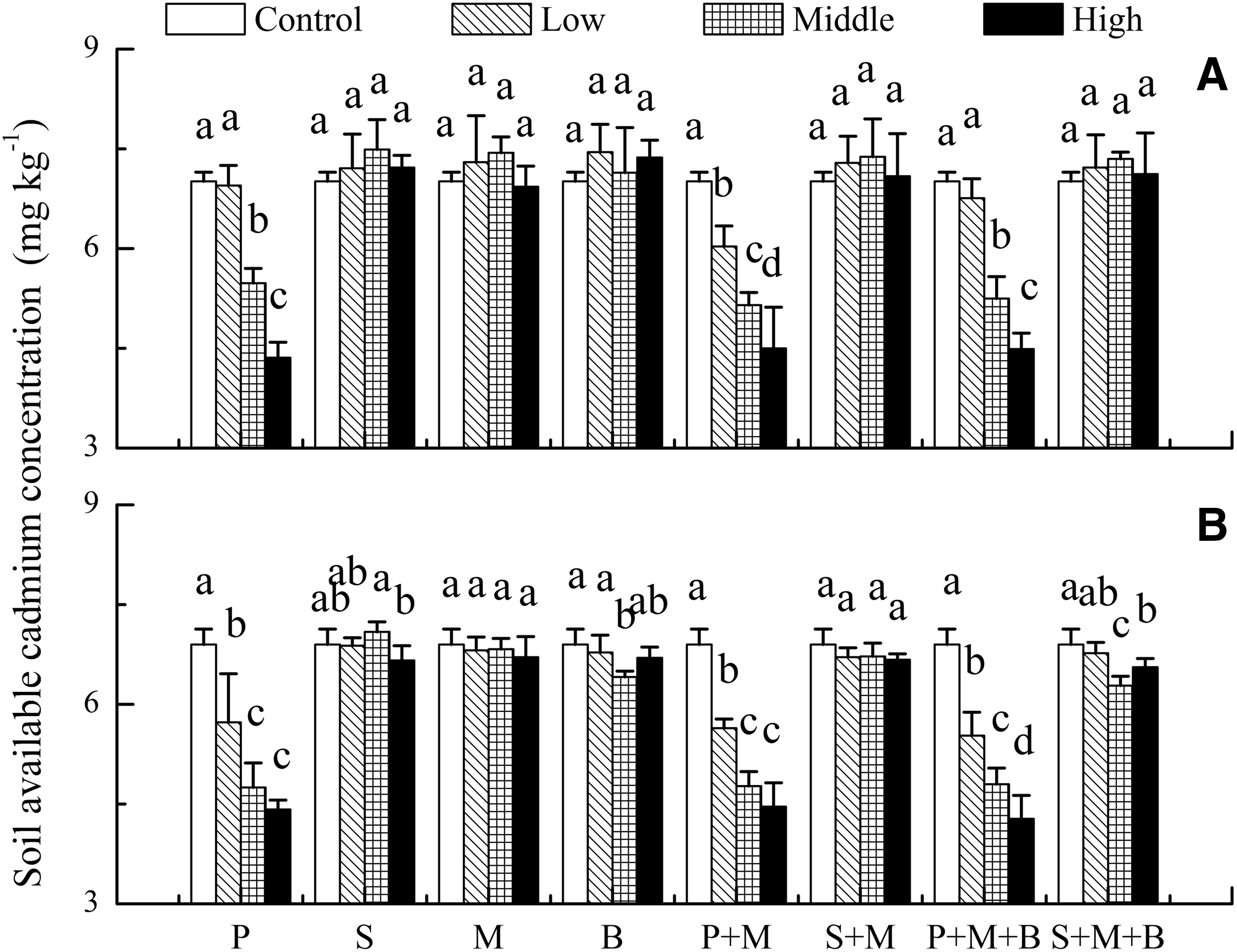
Effects of different amendment types and doses on soil available Cd concentration.
Lead
As shown in Fig. 2, treatment with S, M, B, S+M, or S+M+B did not significantly change the availability of Pb in the soil. However, P, P+M, and P+M+B dose dependently decreased Pb availability. In the maize A treatment (Fig. 2A), the medium and high doses of P, P+M, and P+M+B decreased Pb content by 4.4–13%, 20.9–29.4%, and 21.8–25.2%, respectively. In the maize B treatment (Fig. 2B), the medium and high doses of P, P+M, and P+M+B decreased Pb content by 25–25.1%, 22–29.8%, and 23.8–28.8%, respectively. Comparison analysis showed that P, P+M, and P+M+B passivated Cd more effectively than Pb.
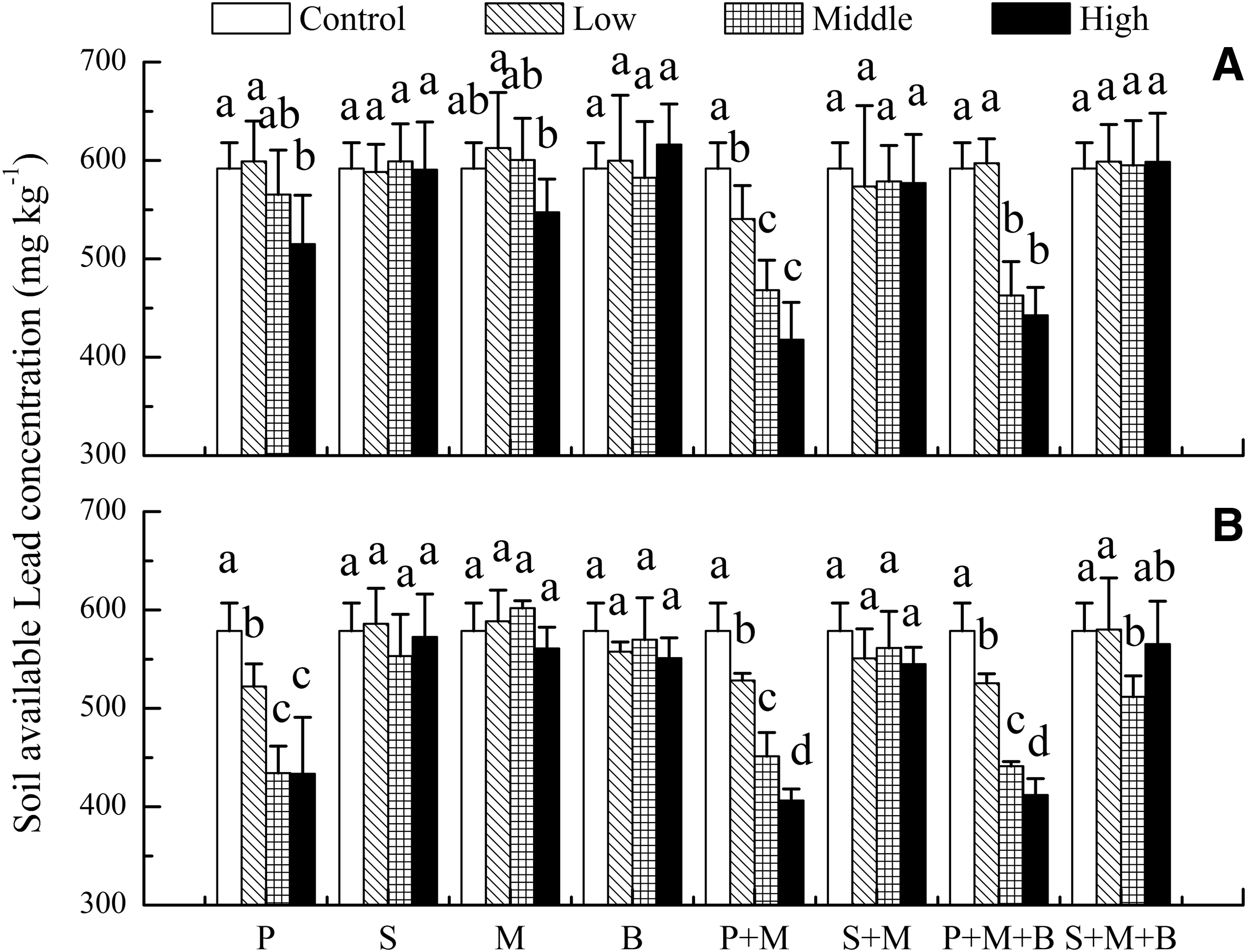
Effects of different amendment types and doses on soil available Pb concentration.
Effects of amendments on soil pH
Soil pH plays an important role in absorption of metals by plants. Cadmium ions in soil solutions will precipitate at pH >6.5, and these sediments are difficult to dissolve at pH >7. It is generally believed that increased soil pH is an important mediator of metal passivation by most soil amendments, especially in acidic soil; however, the results of this experiment do not support this belief (Liang et al., 2005). As shown in Fig. 3, exogenous S, M, B, S+M, or S+M+B did not significantly change soil pH. Moreover, the pH value decreased as the doses of P, P+M, and P+M+B increased. For calcareous soil, reduced pH could promote adsorption and fixation of metals by clay minerals and, thus, reduce Cd availability in the soil (Zhou and Xu, 2007). Lee and Doolittle (2002) reported the similar result that KH2PO4 could reduce calcareous soil pH, but increase the adsorption of Cd on the soil.

Effects of different amendment types and doses on soil pH.
Effects of amendments on maize grain yield
Grain yield is the core metric of crop production and a suitable indicator of the resistance of crops to metals. As shown in Fig. 4, the grain yields of maize A and maize B were 93.3 g/pot and 65.5 g/pot, respectively. The addition of each of the tested amendments to the soil increased the grain yield. Application of P, S, M, B, P+M, S+M, P+M+B, and S+M+B at high doses (Fig. 4A) increased the yield of maize A by 21.4%, 12.3%, 30.9%, 8.2%, 48.2%, 19.8%, 19.1%, and 19.8%, respectively, whereas these treatments increased the yield of maize B by 28.7%, 20.8%, 12.2%, 15.5%, 38.9%, 21.3%, 26.7%, and 25.3%, respectively. These results show that the yield-improving effect of P + M treatment was significantly greater than those of the other treatments for both cultivars. Indeed, P + M treatment increased grain yield of maize A and maize B by up to 138.32 g/pot and 91.02 g/pot, respectively.

Effects of different amendment types and doses on grain yield.
Effects of amendments on Cd and Pb concentrations in maize grain
Cadmium
Metal content in maize grain is directly related to food safety and is an important indicator of amendment performance. In China, guidelines on maximum levels of contaminants in foods (GB2762-2012) state that the maximum allowable contents of Cd and Pb in maize grain are 0.1 mg/kg and 0.2 mg/kg, respectively.
In maize A and maize B plants from the control treatment, Cd content was 0.25 and 1.29 mg/kg, respectively, confirming that maize A is a low-Cd-accumulating cultivar. As shown in Fig. 5, grain Cd content was decreased dose dependently by all of the tested amendments, although some of these changes were not statistically significant. In maize A, treatment with the medium doses of P, S, B, M, P+M, S+M, P+M+B, and S+M+B decreased Cd content by 41.1%, 19.9%, 32.3%, 18.6%, 59.4%, 41.5%, 73.4%, and 41.3%, respectively, whereas these treatments at high doses decreased Cd content by 44.1%, 21.4%, 41.4%, 37.6%, 66.0%, 59.4%, 74.6%, and 44.2%, respectively. Treatment with P + M and P+M+B at the high and medium doses resulted in grain Cd content below 0.1 mg/kg in maize A.

Effects of different amendment types and doses on Cd concentration in maize grain.
In maize B, treatment with the medium doses of P, S, B, M, P+M, S+M, P+M+B, and S+M+B decreased Cd content by 22.6%, −1.9%, 15.1%, 0.8%, 24.5%, 27.7%, 37.8%, and 44.8%, respectively, whereas these treatments at high doses decreased Cd content by 33.2%, 8.7%, 28.6%, 4.5%, 42.2%, 30.8%, 43.7%, and 51.6%, respectively. The lowest Cd content was produced by treatment with S+M+B at the high and medium doses, which resulted in Cd content of 0.62 mg/kg and 0.71 mg/kg, respectively. The comparison analysis showed that amendments reduced Cd content more effectively in maize A, with the exception of S+M+B. These results demonstrated that the tested amendments are more effective in low-Cd-accumulating cultivars.
Lead
In China, guidelines on maximum levels of contaminants in foods (GB2762-2012) state that the maximum allowable contents of Cd and Pb in maize grain are 0.1 mg/kg and 0.2 mg/kg, respectively. In the control treatment, the Pb content of maize A was 1.41 mg/kg, whereas that of maize B was 1.32 mg/kg. As shown in Fig. 6, application of the tested amendments to the maize grain reduced Pb content to different degrees. In maize A, treatment with the medium doses of P, S, B, M, P+M, S+M, P+M+B, and S+M+B decreased Pb content by 20.6%, 17.3%, 23.8%, 15.1%, 43.0%, 10.8%, 34.3%, and 12.7%, respectively, whereas these treatments at high doses decreased Pb content by 24.3%, 12.8%, 43.6%, 16.3%, 61.0%, 35.3%, 35.3%, and 24.7%, respectively. In maize B, treatment with the medium doses of P, S, B, M, P+M, S+M, P+M+B, and S+M+B decreased Pb content by 26.8%, 7.8%, 7.8%, 11.9%, 30.2%, 23.9%, 14.9%, and 8.0%, respectively, whereas these treatments at high doses decreased Pb content by 34.5%, 25.9%, 28.9%, 28.8%, 52.0%, 32.7%, 39.5%, and 13.3%, respectively. These results showed that Pb content was decreased significantly by separate application of high dose S, M, or B. At each dosage level, treatment with P + M resulted in the lowest Pb content in the maize seeds.
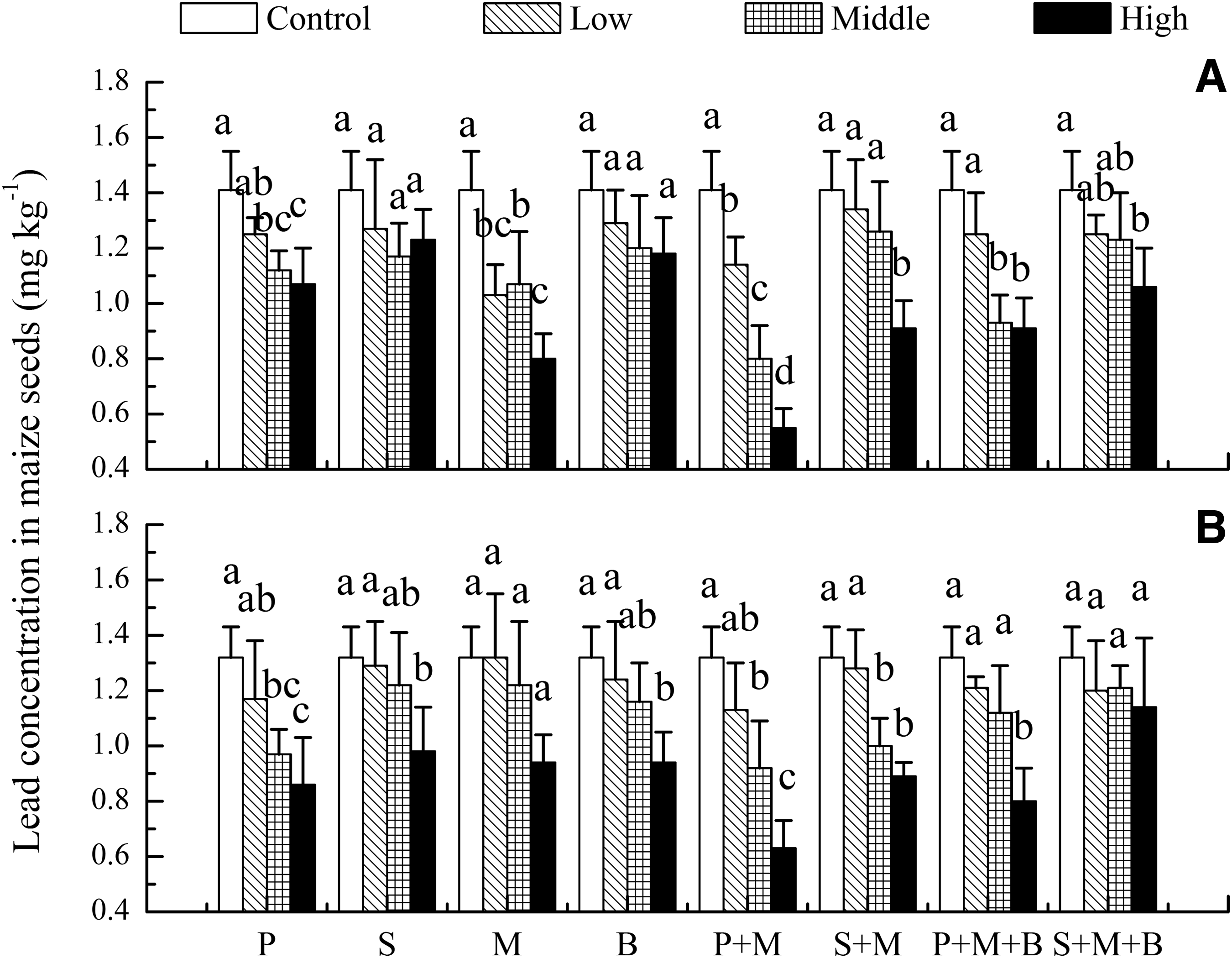
Effects of different amendment types and doses on Pb concentration in maize grain.
Correlation analysis
To investigate the relationship between changes in metal content in the grain and the other measured parameters, we calculated the Pearson correlation coefficients for the grain Cd/Pb content with available Cd/Pb content, grain yield, and soil pH. For the P + M and P+M+B treatments (shown in Table 3), almost all of the correlation coefficients were greater than 0.6, suggesting that the decreases in Cd content and Pb content in the grain caused by the amendments resulted from the joint effects of soil pH and the reduction of available Cd and Pb and showing that these parameters were directly associated with the grain yield.
P, S, M, and B represent KH2PO4, Na2SiO3, chicken manure, and bentonite, respectively. Data are represented as mean ± SD (n = 4). * means that the correlation of metal concentrations in grain with soil metal availability, grain yield, or soil pH was significant at 5% level; and ** means the correlation was significant at 1% level.
Discussion
Manure compost, sodium silicon, and bentonite on metal accumulation
Organic amendments, such as manure compost, municipal solid wastes, and biosolids, are used on land as soil fertilizers and conditioner (Barrutia et al., 2009), due to the presence of nitrogen, phosphorus, potassium, and other nutrients, which can effectively improve the physical–chemical properties and fertility of soils (Lin et al., 2009; Pathak et al., 2009; Sarwar et al., 2010), so as to ultimately affect the plant growth. For example, Rizzi et al. (2004) demonstrated that compost could improve the growth of ryegrass and tall fescue, and Pichtel and Bradway (2008) reported that the composted peat had a positive effect on spinach and cabbage growth. In addition, numerous researches demonstrated that the addition of organic amendments to soils increases the immobilization of metal, through the enhanced adsorption reactions caused by the increased surface charge or formation of metal-organic matter complexes (Bolan et al., 2003, 2014; Hettiarachchi et al., 2003). However, in this experiment, single application of chicken manure did not significantly impact soil pH or available Cd and Pb in the soil, but improved grain yield and decreased grain Cd and Pb content, which may be the result of dilution effect (Palmgren et al., 2008) or inhibited metal transfer in plant. Perez-Esteban et al. (2014) found that manure can effectively reduce metal concentrations in shoots, as well as the bioconcentration factor.
Silicon plays an important role in normal growth and development of many plants (Kamenidou et al., 2009) and mitigates multifarious biotic and abiotic stresses (Liang et al., 2007). Si-containing materials can induce a rise in soil pH, increase the proportion of nonexchangeable metal ions, and reduce available metal concentrations in the soil (Liang et al., 2005, 2007; Li et al., 2012). Soluble silicate hydrolyzes to generate gelatinous H2SiO3 in aqueous solution, and metals are deposited as their silicates in Si-rich soil (Gu et al., 2011), thus reducing the metal availability for plant uptake. However, in this experiment, Na2SiO3-induced increment of soil pH and reduction of soil available Cd and Pb concentrations cannot be observed. Therefore, it can be inferred that decreased Cd and Pb concentrations in maize grain were resulted from improved grain yield, that is, dilution effect, or suppressive metal transport to the shoot (Wu et al., 2013; Kim et al., 2014), or structural changes in plants, which are Si-mediated alleviation of metal toxicity (Doncheva et al., 2009; Vaculik et al., 2009).
Because of its abundance and high specific surface area, bentonite is a low-cost adsorptive material that can be used to remove metals from soil, while simultaneously creating appropriate conditions for plant cultivation (Gadepalle et al., 2007). Similar to Na2SiO3, bentonite decreased Cd and Pb content in maize grain and improved grain yield, but did not significantly impact soil pH or soil available metal concentrations.
Phosphate compounds on metal accumulation
Grain metal contents and grain yield are important evaluation content for effects of amendments added into metal-contaminated soil. Through comprehensive analysis of the tested amendments, we found that the treatment of P + M was the best soil amendments for long-aged metal-contaminated calcareous soil. The reductions of grain Cd and Pb contents in both cultivars were greater than 40%, and the Cd content in maize A was less than the Chinese national limit for grain (0.2 mg/kg). Moreover, P + M produced the largest changes in grain yields, increasing yields in maize A and maize B by up to 48.2% and 38.9%, respectively. Therefore, utilization of P + M in metal-contaminated calcareous soil will ensure the safe agricultural production and can also decrease the total metal content in soil with the passage of time.
A large number of studies have provided conclusive evidence for the value of P compounds to immobilize metals in soil, thereby reducing their bioavailability for human and plant uptake and mobility. Phosphate modifiers enhance the immobilization of metals in soils through various processes, including direct metal adsorption onto these P compounds through increased surface charge, P anion-induced indirect metal adsorption, and precipitation of metal with solution P. In most metal-contaminated soils, the formation of metal-P precipitation has been proved to be one of the main mechanisms for the immobilization of metals, such as Pb and Zn in soils (Yang et al., 2001; Tang et al., 2009). According to the solubility equilibrium constant of metals and phosphate, lead-phosphate minerals are extremely stable, whereas copper/cadmium-phosphate minerals are difficult to generate (Cao et al., 2004).
In this experiment, addition of KH2PO4 and all KH2PO4-containing amendments induced the reduction of soil pH, but decreased the bioavailability of Cd and Pb in the soil and the accumulation of Cd and Pb in the grain. The reduced proportions of metal concentrations in soil were bigger than those in grain, which leads to the conclusion that P compounds may also have inhibited metal translocation from root to shoot of plant (Cao et al., 2003), caused by undissolved metal phosphate in plant cells (Su et al., 2014). Another notable point is that for the maize A, Cd low-accumulating cultivar, the reductions of Cd concentration in soil and grain were bigger than those of Pb concentration, which cannot be observed in maize B, low-Cd-accumulating cultivar. It may suggest that phosphate compounds have more potential for the low-accumulating cultivar.
Conclusion
This study assessed the effects of KH2PO4, Na2SiO3, chicken manure, bentonite, and combinations thereof and found that P + M was the best soil amendment for calcareous soil that had been naturally contaminated with metal over a long period of time. P + M significantly reduced Cd and Pb availability in the soil and immobilized Cd more effectively than Pb, and in this combination, KH2PO4 played a key role in decreasing Cd availability in the soil. P + M reduced soil pH, which may promote adsorption and fixation of metals by clay minerals. P + M decreased Cd and Pb content in maize A grain by up to 64% and 61%, respectively, and all of the tested amendments were more effective in low-Cd-accumulating cultivars.
Footnotes
Acknowledgments
This research was funded by the Key Science and Technology Research Project of Henan province (122102310031) and National Natural Science Foundation of China (U1504313).
Author Disclosure Statement
No competing financial interests exist.