




Abstract
Abstract
Long-root Eichhornia crassipes (L.R.E. crassipes), as a new kind of macrophyte, was used in Dianchi Lake in recent years, but its comparison in eliminating metals with traditional Eichhornia crassipes was never conducted. In this article, a comparative study on the removal of toxic metals from aqueous solutions by L.R.E. crassipes and E. crassipes was first studied. In total, the removal percentage of toxic metals followed the order of Pb>Cd>Cu>Zn, and L.R.E. crassipes was better than that with E. crassipes. Meanwhile, L.R.E. crassipes had a higher relative growth rate than E. crassipes, and solutions had a better physicochemical property after dealing with L.R.E. crassipes. Results also showed that maximum removal capacity for Zn, Cu, and Cd with L.R.E. crassipes was reached at pH 5. An orthogonal of L16 (44) in the multimetal system was designed to study the effects of cometals on removal of a single metal. Metal removal from the solution involves two stages: adsorption and absorption. Removal mainly occurred in the roots, and the main removal process was adsorption. Adsorption percentages of Pb, Zn, Cu, and Cd were 75%, 43%, 29%, and 61% in the root surface, respectively. Bioconcentration factors of Pb, Zn, Cu, and Cd were 267, 102, 230, and 173 with L.R.E. crassipes, respectively. Based on these results, L.R.E. crassipes could be used as a biodegradable absorbent to purify polluted water bodies fast and effectively.
Introduction
P
It is well known that some aquatic plants could accumulate toxic metals from the water environment. Therefore, aquatic macrophytes have been used during the last three decades for metal removal, competing with other secondary treatments, being the principal mechanism for metal uptake through roots (Miretzky et al., 2004). For some aquatic plants, although they possess roots, they do not have direct contact with sediments. Water is undoubtedly the direct way of removing elements. Several species of aquatic macrophytes such as water hyacinth (Eichhornia sp.), duckweeds (Lemna sp.), small water fern (Azolla sp.), and water lettuce (Pistia sp.) present a high growth rate and have been used for the removal of toxic metals from waste water (Vajpayee et al., 1995; Axtell et al., 2003; Weis and Weis, 2004; Liu et al., 2007; Mishra and Tripathi, 2009). According to Boyd (1970) and Mitchell (1978), the macrophytes used in any treatment system should meet several criteria: rapid growth, easy spreading, and high-pollutant uptake capacity. Most studies on pollutant bioaccumulation in macrophytes are aimed at assessing removal efficiency or toxic effects without taking into account the metal bioaccumulation process by macrophytes. However, there are usually two kinds of processes: sorption by roots (a combination of physical and chemical processes as chelation, ionic exchange, and chemical precipitation), and the biological processes, including translocation to the aerial part.
Among various macrophytes used for phytoremediation, Eichhornia crassipes has been shown to serve the purpose for the elimination of several toxic metals (Delgado et al., 1993; Schneider et al., 1995; Zaranyika and Ndapwadza, 1995; Soltan and Rashed, 2003; Verma et al., 2007; Muthukrishnan and Guha, 2008). The removal of metals by E. crassipes is influenced by several factors, such as pH, conductivity (Greger, 1999), and the presence of other metals in the water, which alter the uptake of heavy metals into the tissues.
Although several studies have documented that E. crassipes is a good metal accumulating plant, none of them has documented the Long-root Eichhornia crassipes (L.R.E. crassipes) for metal remediation. L.R.E. crassipes is induced from E. crassipes by spraying inducers and distinguished by its long roots, which account for more than 80% of the whole plant (Lin et al., 2012). Many studies refer, in general, to the removal of only one or two metals, few of them refer to the simultaneous removal of various metals, and the synergy and antagonism between the metal removing were scarcely evaluated. A better understanding of the removal mechanisms and removals parts in L.R.E. crassipes was very necessary too.
The objective of this study was to investigate the removal efficiency of Pb, Zn, Cu, and Cd from aqueous solution by E. crassipes and L.R.E. crassipes. The change of physicochemical property and plant growth in metal solutions was determined after dealing with two kinds of E. crassipes. An orthogonal of L16 (44) in the multimetal system was designed to study the effects of cometals on the removal of single metal. The adsorption was measured by ethylenediaminetetraacetic acid (EDTA), and the bioconcentration factor (BCF) was also applied to evaluate the absorption of toxic metals by L.R.E. crassipes.
Materials and Methods
Materials
L.R.E. crassipes and E. crassipes were both collected from the Dianchi Lake located at 24°48′02″ N, 102°40′17″ E in Kunming of China in August 2014 and transferred to a greenhouse. The collected plants were washed with tap water and grown in plastic reactors with lake water, where they grew successfully for 3 weeks. Lake water was used in all the experiments (the following data were the average values determined in 3 weeks: Temp = 17.56°C, pH = 8.57 ± 0.14, DO = 8.3 ± 0.5 mg/L, TP = 0.138 ± 0.007 mg/L, TN = 3.23 ± 0.0033 mg/L, Ca2+ = 10.3 ± 1.6 mg/L, Mg2+ = 3.9 ± 0.4 mg/L, K+ = 4.2 ± 0.4 mg/L, and Pb, Zn, Cu, and Cd were not detected in the water).
Reagents and apparatus
Metallic compounds [Pb(NO3)2, Zn(NO3)2, Cu(NO3)2, and Cd(NO3)2] were all purchased from Aladdin, China (AR, 99%). Different concentration solutions were prepared by dissolving Pb(NO3)2, Zn(NO3)2, Cu(NO3)2, and Cd(NO3)2 into lake water, respectively. Pb(II), Zn(II), Cu(II), and Cd(II) were purchased from Aladdin, China (GR, 99.9%) for preparing calibration solutions. The samplings were determined when the calibration curve was ≥0.990 and relative standard deviation (RSD) ≤5%. Calibration concentrations for Pb, Zn, Cu, and Cd were 0, 0.5, 1, 2, and 5 mg/L; 0, 0.15, 0.3, and 0.45 mg/L; 0, 1, 2, and 4 mg/L; and 0, 0.3, 0.6, and 0.9 mg/L, respectively. Values of R2 for the calibration concentrations respect to each metal were 99.93%, 99.95%, 99.99%, and 99.89% for Pb, Zn, Cu, and Cd. All the reactors were soaked in 15% HNO3 solutions and then rinsed with deionized water before use. Results from three replicate solutions of toxic metals were averaged for analysis. Control experiments with different metal solutions, but without plants, were performed simultaneously.
Microwave-assisted extraction was applied to digest the plant samples by the ETHOS advanced microwave extraction system (Milestone, Italy). A flame atomic absorption spectrometer (FAAS, Varian Instruments AA240FS) was used for sample analysis in this study.
Experimental design
Equal quantities of 800 g L.R.E. crassipes and E. crassipes were placed into separate 48 plastic reactors, which contained lake water. Solutions of Pb(NO3)2, Zn(NO3)2, Cu(NO3)2, and Cd(NO3)2 were added to the reactors with different initial concentrations of Pb (0.1, 1, and 10 mg/L), Zn (5, 10, and 20 mg/L), Cu (1.5, 5, and 15 mg/L), and Cd (0.1, 1, and 10 mg/L). To monitor water qualities, protect the environment from pollution, and ensure people to keep healthy, the State Environmental Protection Administration in China issued the National Standard of Surface Water Quality (Wang et al., 2008). State Environmental Protection Administration in China divided water into five kinds of standards according to different contaminant concentrations in the water. We chose the V standard of Pb, Zn, Cu, and Cd in water as the low concentration in this article, which was the most serious pollution in water for each metal and can only be used for landscape water in China (State Environmental Protection Administration, 2002). The macrophytes were raised in these solutions, and each concentration for different metals was with three parallel samples. Control experiments with different metal solutions, but without plants, were performed simultaneously to assess sorption to plastic walls. Deionized water was added daily to compensate for water lost through plant transpiration and sampling evaporation. Toxic metal concentrations in the reactors were determined during 16 days, and the variations of pH and conductivity in the reactors were detected simultaneously.
After a series of research, L.R.E. crassipes was chosen for further study. Previous studies on heavy metal biosorption had shown that solution pH was the single most important parameter affecting the biosorption process (Chen et al., 2002). In the biosorption processes, the initial solution pH is an important experimental parameter that affects both the dissociation degree of functional groups from the biomass surface and the solubility and speciation of metal ions (Volf et al., 2014). For this reason, its value should be optimized. The best removal percentage obtained for Pb, Zn, Cu and Cd were 10, 10, 5 and 10 mg/L, respectively. These concentrations were selected and pH values ranged from 5 to 9 were evaluated in pH influence experiment. An orthogonal array of L16 (44), that is, four factors (Pb, Zn, Cu, and Cd) and four levels (control, low concentration, medium concentration, and high concentration), was conducted to investigate the removal efficiency of toxic metals in the multimetal system and the competitive uptake among different metals. Equal quantities of 800 g L.R.E. crassipes were placed into 16 plastic reactors. The water samples were taken at the 1st, 2nd, 4th, 6th, 8th, 12th, and 20th day, determined by FAAS on the actual day of preparation. After the experiments, L.R.E. crassipes was taken out, washed, and sorted into three lots of an equal mass. Afterward, a lot was placed for 2 h in a 0.2 M Ca2+ solution [Ca(NO3)2] as a competitive cation, another lot was placed into an 0.2 M EDTA solution to release metals by chelation, and the third lot was placed into distilled water (Sune et al., 2007). EDTA is the most common chelating agent used to desorb metals to differentiate adsorption to the surface from intracellular accumulation since early literature (Table 1). However, one of the problems encountered so far is that there are no standard methodologies, and the used ratio EDTA/metal varies within an extremely large range (from 13 to 10,000) (Olguín and Sánchez-Galván, 2012). In this article, the ratio of EDTA/metal varies from 27.37 to 4,358.
EDTA, ethylenediaminetetraacetic acid.
After each treatment, L.R.E. crassipes was harvested after the experiment was completed. The plants were washed thoroughly twice with tap water followed by distilled water. Then, the plants were divided into tops and roots and dried at 80°C to remove the moisture. The divided samples were grounded into powders and stored for BCF analysis.
Analysis methods
The average relative growth rate R was calculated using the following equation (Hadad et al., 2011):
where w1 and w2 (g) were plant weights at time T1 and T2 (days), respectively.
The BCF was calculated for aerial parts and roots using the following formula (Maine et al., 2001):
where Ce = contaminant concentration in tissue (mg/g dw) during contaminant exposure, Ci = initial contaminant concentration in tissue (mg/g dw) before contaminant exposure, and Cw = contaminant concentration in water (mg/L).
Results and Discussion
Plant growth
Average relative growth rate R was given according to formula (1). As shown in Table 2, two kinds of E. crassipes had the lowest R value in Zn solutions and E. crassipes even had negative R values in Zn solutions. High concentration of Cu can also lead a negative R value to E. crassipes. For most metals, the macrophytes had the maximum average relative growth in the medium concentration level except for Cd, which was similar with Cordes' study (Cordes et al., 2000). The higher Cd pollution in water, the higher R was observed. Chaney (1993) reported that some plant species became chlorotic when they were exposed to high Zn concentrations. Delgado et al. (1993) reported that E. crassipes did not show weight reduction when exposed to concentrations under 2 mg/L Zn. Mishra and Tripathi (2009) found that chlorophyll concentration showed a decrease due to accumulation of Zn in E. crassipes after a 7-day incubation period. The results are in agreement with Prasad (2013), who reported an inhibition of the chlorophyll pigment synthesis attributed to the impact of high levels of Zn as well as structural and functional damage. In addition, a Zn effect on chlorophyll degradation was reported in Lemna gibba by Megateli et al. (2009). Indeed, excessive Cu accumulation in plant tissues can affect several physiological and biochemical processes such as changes in nitrogen metabolism with reduction of total nitrogen, increase of free amino acids (Llorens et al., 2000; Mazen, 2004), and reduction of photosynthetic activity and growth (Weckx and Clijsters, 1996; Babu et al., 2003). In this article, phytotoxicity increased with time for E. crassipes, showing chlorosis and some necrosis in the aerial parts. L.R.E. crassipes had a high relative growth in all of the toxic metals than E. crassipes.
Comparative study on removal of toxic metals by two types of E. crassipes
As shown in Figure 1, the removal of Pb by two kinds of E. crassipes both increased sharply with the concentration increased. The removal percentage reached 97% when the Pb concentration was 10 mg/L. The results demonstrated that the removal efficiencies and abilities with L.R.E. crassipes were better than that with E. crassipes. Initial concentration of Pb may affect the removal mechanisms due to the increase in the driving force of the concentration gradient. The removal of Zn with L.R.E. crassipes was much better than that with E. crassipes in three concentrations (Fig. 2). The maximum value of removal was observed at 10 mg/L, and Zn may influence the growth when the solution was more than 15 mg/L (Dixit and Dhote, 2010). With respect to Cu, the removal process by two kinds of E. crassipes decreased with the concentration increased (Fig. 3), and the removal percentage was nearly 80% in the three concentrations. As we can see from Figure 4, the removal percentage of Cd was more than 96.4% when at a low concentration and the removal percentage decreased to 92.2% with the increasing concentration.
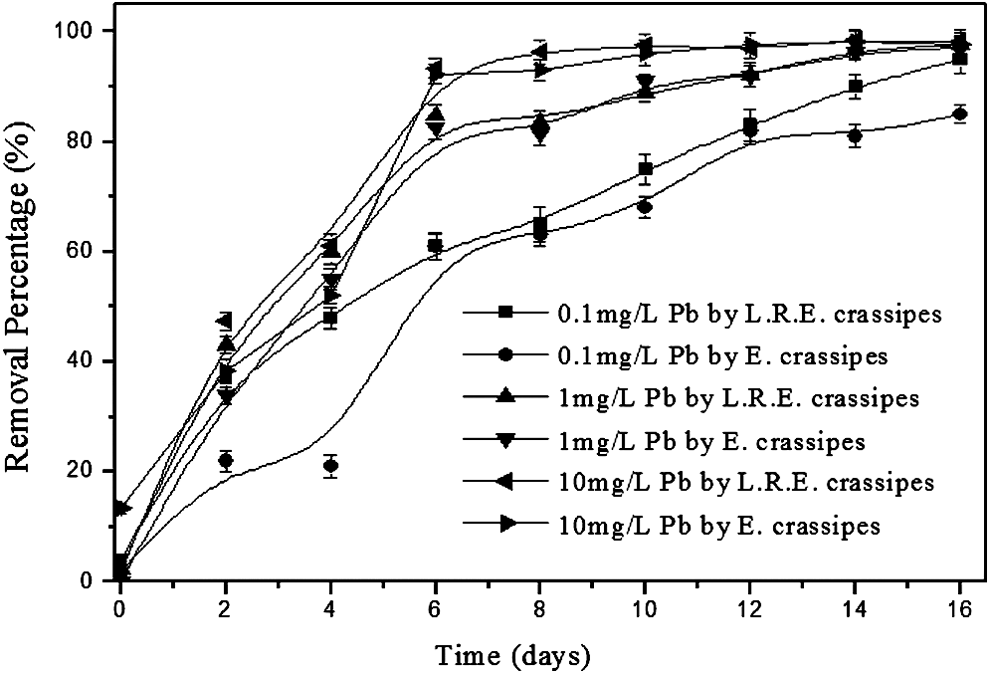
Removal percentages of Pb with different initial concentrations by two kinds of Eichhornia crassipies.
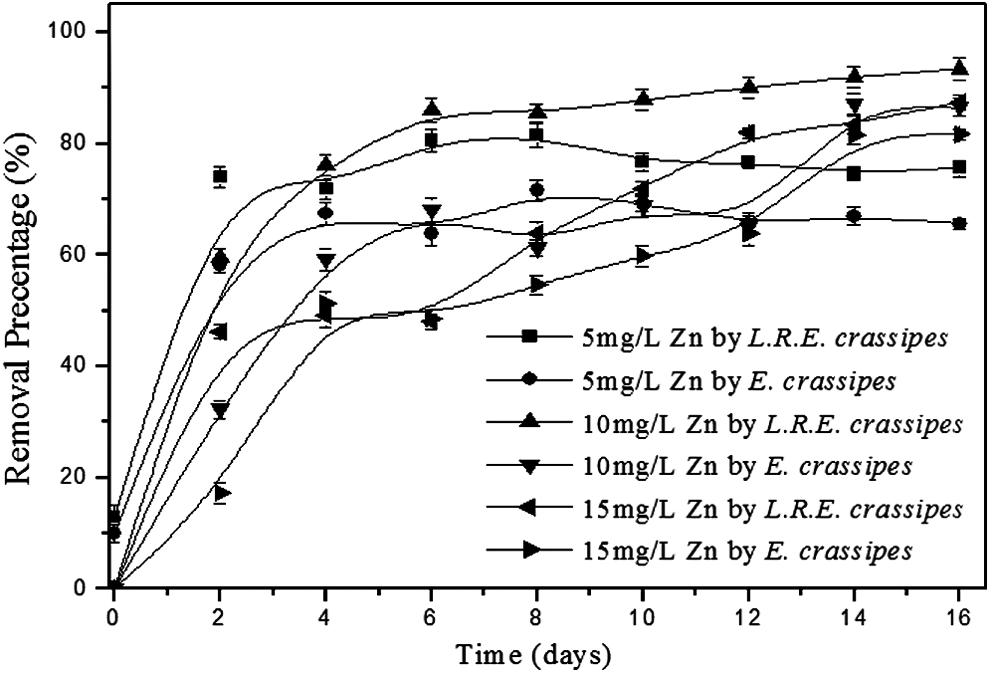
Removal percentages of Zn with different initial concentrations by two kinds of Eichhornia crassipies.
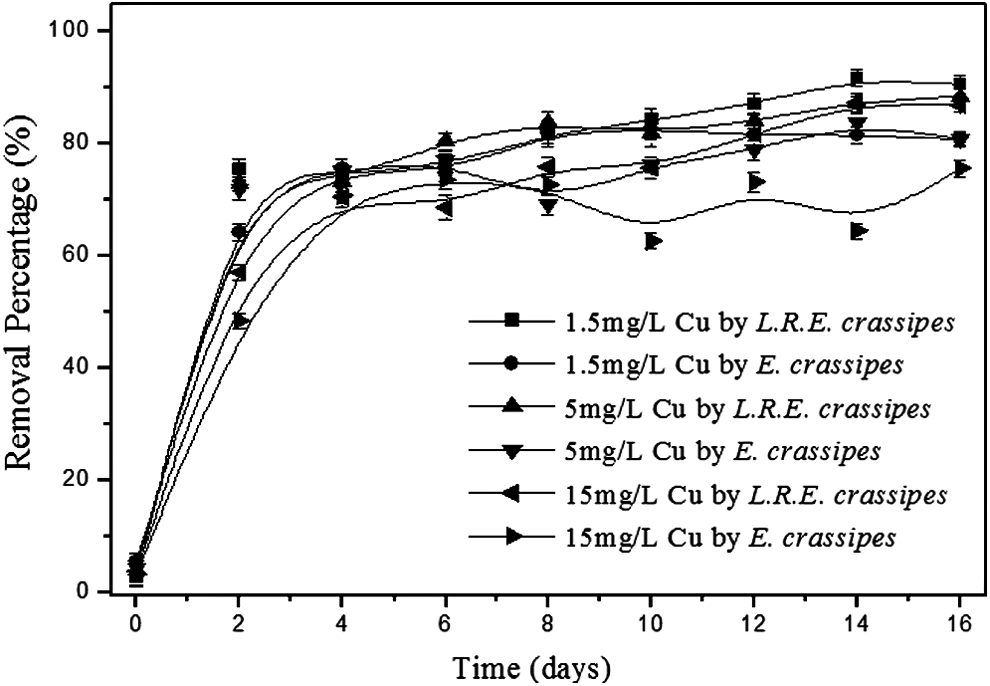
Removal percentages of Cu with different initial concentrations by two kinds of Eichhornia crassipies.
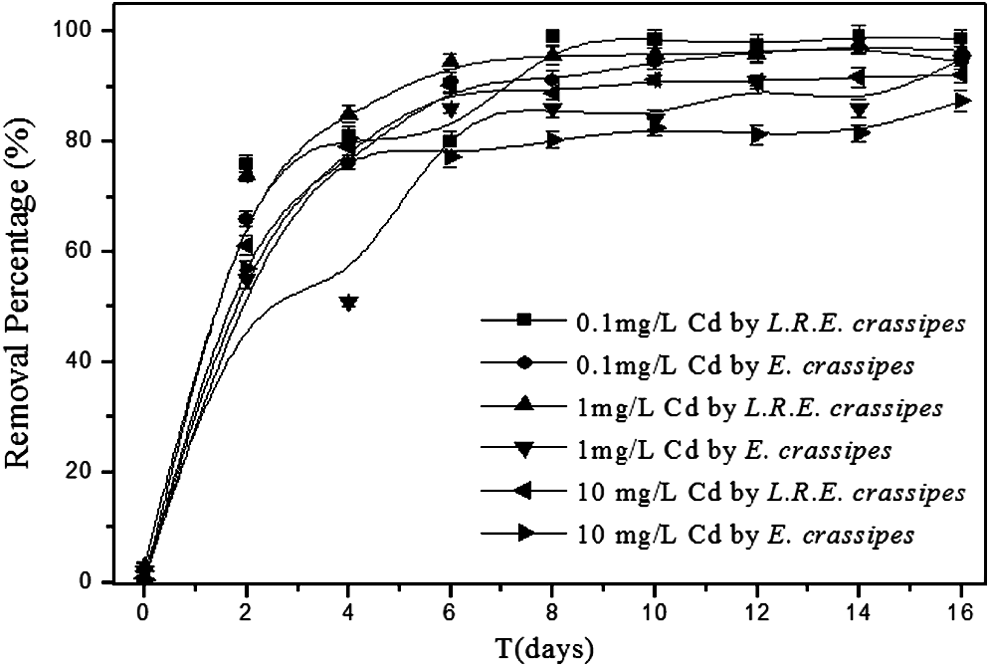
Removal percentages of Cd with different initial concentrations by two kinds of Eichhornia crassipies.
In total, the removal percentage was in the order of Pb>Cd>Cu>Zn, and it was a little better with L.R.E. crassipes than that with E. crassipes for all the toxic metals. Pb and Cd have larger metal ions, which may increase their affinity toward biomass, primarily due to strong electrostatic interaction with binding sites of biomass (Al-Qunaibit, 2009). Some literatures have focused on the removal of heavy metals by macrophytes, such as Pistia stratiotes L, Spirodela polyrrhiza, and E. crassipes. Pb, Zn, and Cu removed from water by P. stratiotes L were 99.74%, 84.3%, and 73.5% when the solution concentrations were 4 mg/L (Miretzky et al., 2004). The removal percentages were 82%, 76%, and 65% for Zn, Cu, and Cd by S. polyrrhiza in the 12-day incubation period when the solution concentration was 5 mg/L (Mishra and Tripathi, 2008). For E. crassipes, the removal percentage was high for metals. However, when the concentration was greater than 10 mg/L, the plant started wilting and the uptake reduced quickly (Dixit and Dhote, 2010).
Observations obtained from the above batch studies concluded that both E. crassipes and L.R.E. crassipes were capable in removing heavy metals, but L.R.E. crassipes was more suitable. L.R.E. crassipes had more tolerance toward toxicity compared to E. crassipes, and there were not any chlorosis and necrosis in the aerial parts of L.R.E. crassipes. The removal percentages of four metals were more than 80% (almost all the Pb and Cd were wiped off in high concentration) and close to the maximum within 6 days for L.R.E. crassipes.
Measurements of pH and conductivity are useful in rivers for the management of temporal variations in total dissolved solids and major ions (Fawzy et al., 2012). Therefore, the physicochemical properties of water, including pH and conductivity values, were tested before and after the experiment. Initial pH and conductivity values of lake water were nearly 8.57 and 251 us/cm, respectively. After dealing with L.R.E. crassipes, pH values reached the neutral level and the conductivities suffered a drop to 244 us/cm in the metal solutions. Such an aquatic macrophyte can be termed as an active biomonitor. Plants lowered pH because the macrophyte roots' respiration may be increased by the elevated CO2, which changed into H2CO3 in water and lowered pH. Metal ion was electrolyte, and the greater the metal concentration, the greater the conductivity. Conductivity decreased in the water illustrated plants decreased the metal concentration through absorption and adsorption. Effect of pH on the removal of metals by L.R.E. crassipes.
As shown in Table 3, maximum removal capacity for Zn, Cu, and Cd was obtained at pH 5. In contrast, the removal percentage of Pb was above 90% for all the pH values. pH influence was related to the competition existing between H+ and metal ions for the available absorption sites at a low pH value, and the metals would precipitate at a high pH value.
Removal effect of metals in a multimetal system by L.R.E. crassipes
Parameters of orthogonal array are shown in Tables 4 and 5. As can be seen from image 1 to image 3 in Figure 5, the competition effect was not obvious at a low metal concentration and the removal percentage of Zn and Cd can reach a very high level. With the concentration of the three metals increasing, the removal percentages of Zn and Cd had a descent. By contrast, the effective removal of Pb was achieved and it was not affected obviously by other coexisting metals. Antoniadis et al. (2007) also found that the removal of Zn and Cd would decrease with the total concentration of Pb increasing. From image 4 to image 6 in Figure 5, it was indicated that Cu had great effect on the removal percentage of Cd and Zn in the experimental conditions. Since the specific removal of Cu on L.R.E. crassipes predominantly occurred, it can be expected that increasing the amounts of Cu would reduce the binding sites available for Cd and Zn. As shown from Figure 6, the addition of Zn resulted in the decrease of Cd absorption. Cadmium contamination often occurs together with Zn, and thus, it is likely to specifically adsorb to the same sites as Zn. Voegelin et al. (2001) has reported that Zn and Cd occupy the similar active sites competitively due to the fact they are in one group in the periodic table. Furthermore, no effect occurred when Cu and Pb coexisted. In total, Cu and Pb suppressed the absorption of Cd and Zn, because of the higher relative binding strength, electronegativity, hydrolysis constant, and lower ionization potential of Cu and Pb, showing higher competitive capacity (Sdiri et al., 2012).
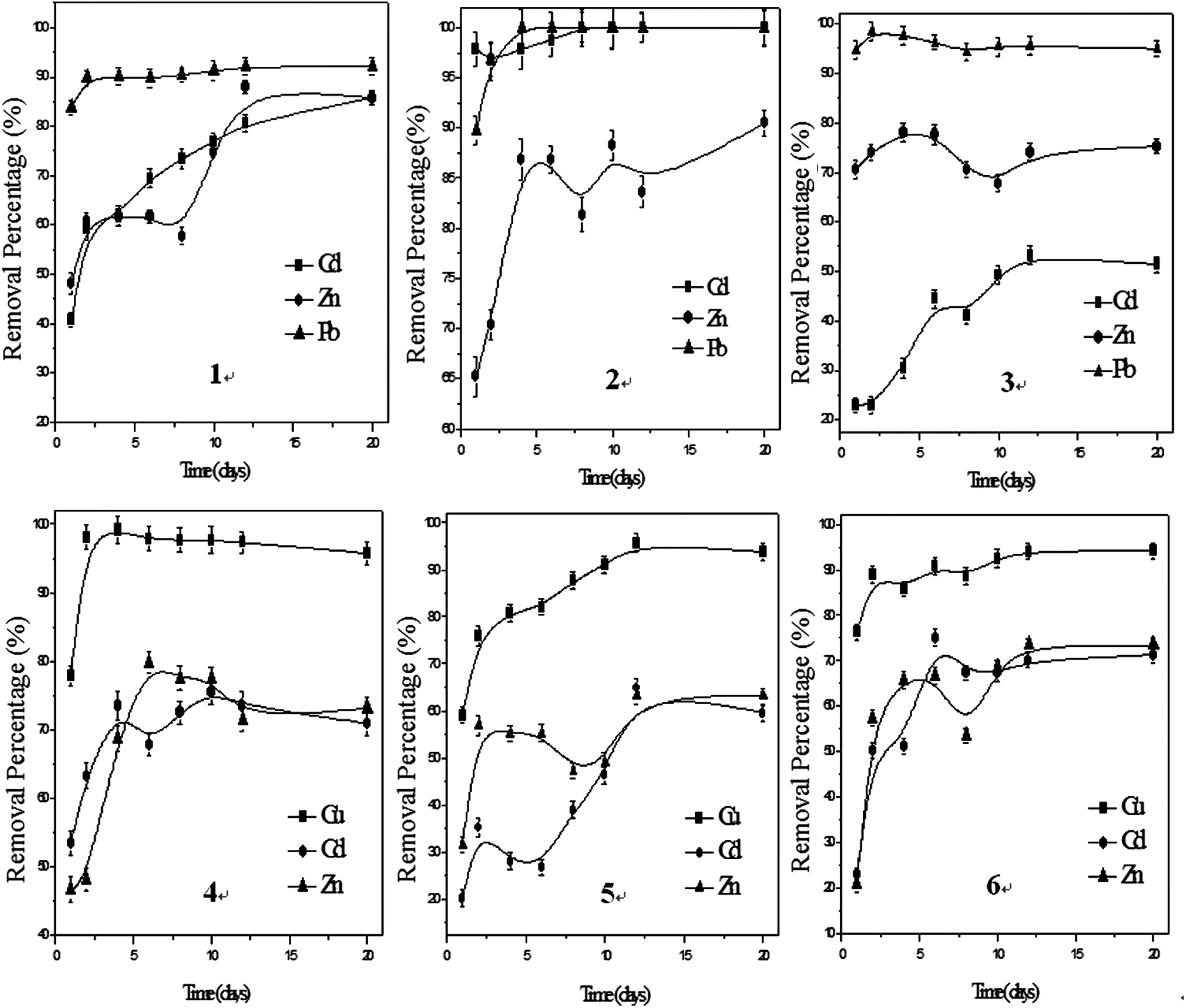
Removal percentage of metals in multi-metal system (Pb-Zn-Cd and Cu-Zn-Cd).
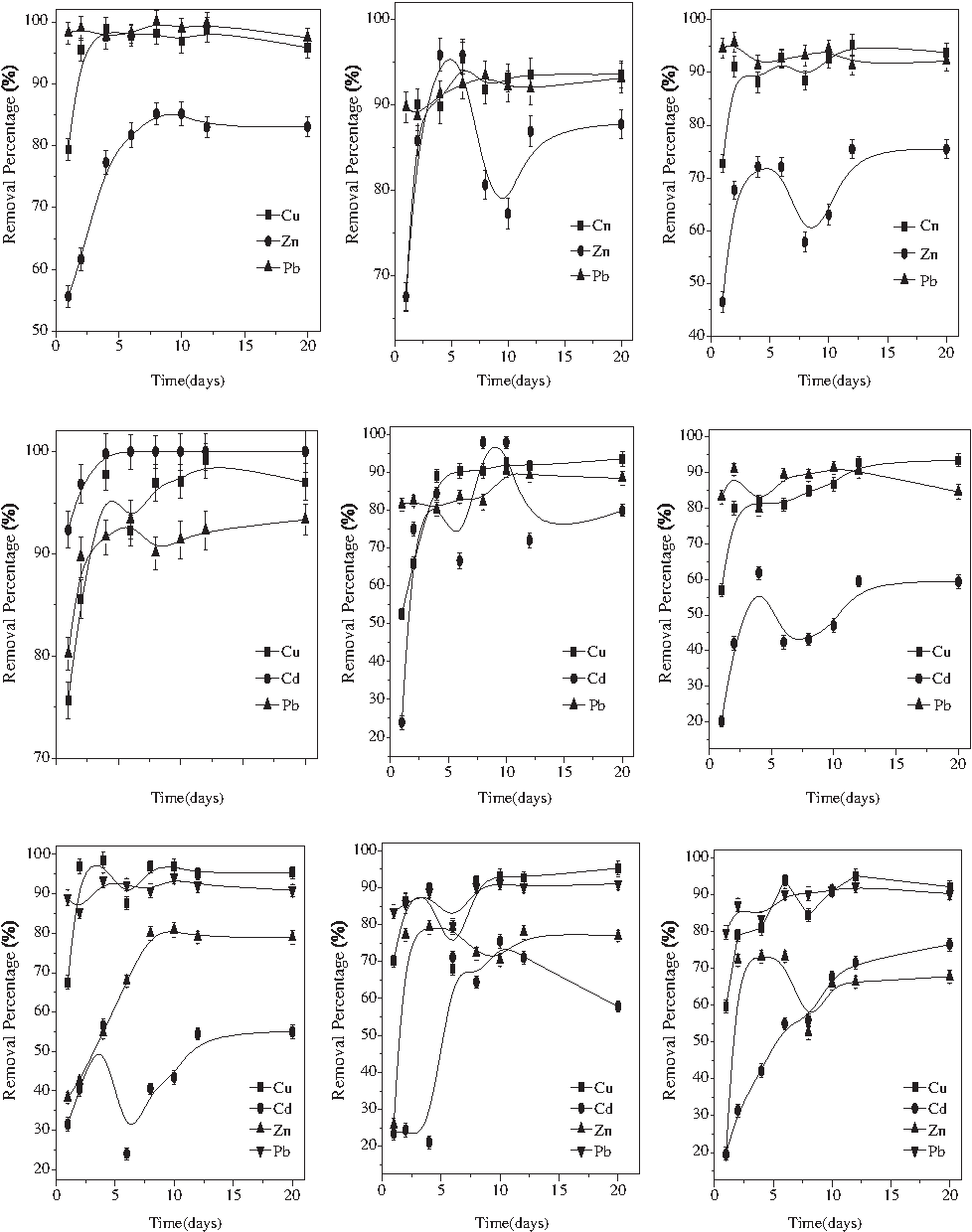
Removal percentage of metals in multi-metal system (Cu-Pb-Zn, Cu-Pb-Cd and Pb-Zn-Cu-Cd).
Removal mechanisms and BCF in L.R.E. crassipes
In the solutions of high concentrations with Pb, Zn, Cu, and Cd, desorptions in distilled water were lower than 3% in all cases for L.R.E. crassipes. As shown in Table 6, Ca2+ exchanged 17%, 13%, 18%, and 20% of Pb, Zn, Cu, and Cd. EDTA removed 75%, 43%, 29%, and 61% of Pb, Zn, Cu, and Cd. These indicated that physical adsorption was an important removal process, including the processes of sorption as chelation and ion exchange. In Figure 7, scaning electron microscope (SEM) showed that the particle did not present a clear crystal form and its surface was irregular. Pb, Zn, Cu, and Cd were adsorbed on the surface of the root after adsorption, which can be clearly observed from the energy spectrum analysis (Li et al., 2016). Every metal had two peaks due to the energy level transition, and the Cu peak also appeared in the images after adsorption of Pb, Zn, and Cd because the root powders were fixed on the thin copper plate when the SEM instrument ran.

SEM images and energy spectrum analysis of the root powder of long-root Eichhornia crassipes after adsorption of Pb (a), Zn (b), Cu (c) and Cd (d).
Intracellular absorption (transported through the plasmalemma into the cells) was responsible for another stage of metal removal from the solution. Before the experiment, the content of metals in L.R.E. crassipes was detected. The original values in plant roots were as follows (mg/g): 0.043 (Zn), 0.052 (Cu), 0.008 (Pb), and 0.0006 (Cd). In plant tops, the original content (mg/g) was 0.018 (Zn), 0.008 (Cu), 0.0023 (Pb), and 0.0001 (Cd). The initial content in the whole plants was 0.061 (Zn), 0.060 (Cu), 0.031 (Pb), and 0.007 (Cd). Then, the L.R.E. crassipes were placed into the reactors with the solution concentrations (mg/L) of Pb (10), Zn (10), Cu (5), and Cd (10). After 6 days, the concentration of Pb, Zn, Cu, and Cd in plant tissues was analyzed. As the results shown in Table 7, the roots of L.R.E. crassipes played an important role in toxic metal uptake. The roots are thought to be important for element uptake in free-floating plants (Sharma and Gaur, 1995). Previous studies on the accumulation of various metal ions by aquatic plants had shown that the uptake of most metals was higher in roots than the other parts of plants (Zaranyika and Ndapwadza, 1995; Chandra and Kulshreshtha, 2004). According to formula (2), the BCF of Pb, Zn, Cu, and Cd was 267, 102, 230, and 173. Higher BCF values suggested that L.R.E. crassipes can enrich these metals efficiently.
Conclusions
From the results, we concluded that metal removal from the solution by L.R.E. crassipes involves two stages: adsorption and absorption. The removal parts mainly occurred in the roots, and the main removal processes were adsorption. L.R.E. crassipes was superior to E. crassipes for toxic metals sequestration from aqueous solutions and had a better tolerance to the metals. In the multimetal system, the removal of Zn and Cd by L.R.E. crassipes was depressed by Pb and Cu. The roots were verified to be important for element uptake in the plants, and this may be the main reason that L.R.E. crassipes was better, whose roots accounts for more than 80% of the whole plant.
Footnotes
Acknowledgment
This work was supported by a grant from the National High Technology Research and Development Program of China (863 Program; Grant No. 2010AA06Z301).
Author Disclosure Statement
No competing financial interests exist.