




Abstract
Abstract
The opportunity to produce algal biofuel cost-effectively from waste materials, such as piggery-digested waste, drives research to optimize piggery waste effluent as an algal growth medium. Therefore, the aim of this study was to investigate the potential of newly isolated wastewater-born yeast to optimize growth parameters and maximize pollutant degradation in digested wastewater bioremediation. One isolate was identified as Galactomyces geotrichum through morphological observation and DNA sequencing. Growth parameters regarding pH, temperature, and inoculum amount were optimized by orthogonal design to maximize pollutant removal. Results showed that optimal growth conditions were pH 6, 25°C, and 2.5 g mycelium pellet moisture weight. Chemical oxygen demand (COD) reached 60% and total phosphorus (TP) reduction reached 45% under these conditions. Our observations demonstrate that pH had an overall significant effect on COD and TP reduction. More importantly, results suggested that pretreatment with locally isolated yeast is a nontoxic and ecofriendly method when compared to chemical reagents in preparing piggery waste as a medium for algal growth. This study provides a new microbial resource for removal of pollutants from piggery-digested wastewater. In this study, for the first time, algal biofuel feedstock was prepared by yeast pretreatment of undiluted and unsterilized piggery-digested waste, cost-effectively answering both energy needs and environmental concerns with a renewable resource.
Introduction
T
Treatment of piggery-digested waste is necessary to remove excess phosphorus and COD through typical biological methods, part of widely applied processes before discharge of waste effluent (Obaja et al., 2003). However, some biological processes do not achieve sufficient nutrient efficiency to meet increasingly stringent regulations and limits on wastewater discharge. In China, piggery waste is a major pollutant, with a total annual discharge of 6.0 billion m3. Currently, many pig farms do not opt to utilize recovery plants. Mostly untreated waste is released into rivers and oceans, which is one of the leading causes of water body eutrophication (Wang et al., 2013). One reason is that chemical wastewater treatment is costly, thus many pig farms do not have such facilities.
Current physical and/or chemical methods, such as chemical oxidation, flocculation, filtration, adsorption, and membrane processes, are unsuitable owing to high cost, low efficiency, and inapplicability to a wide range of pollutants (Waghmode et al., 2011). Moreover, the high energy input required and secondary pollution problem in the form of sludge inhibit the application of these methods (Waghmode et al., 2011). Some new technologies, such as electrochemical destruction, advanced oxidation, and absorption, have been used for pollutant removal, but these methods involve complicated processes and/or are not economically feasible (Waghmode et al., 2012a). Compared to chemical/physical agents, biological processes have received more attention due to their cost-effectiveness, lower sludge residue, and eco-friendliness (Waghmode et al., 2012b). Bioremediation using microorganisms is already an established technology, while fungi are the only known microbes that can degrade biomass almost completely under mild conditions with no harsh chemical or physical treatment (Ray et al., 2012).
In the last two decades, pollutant removal-oriented yeast has gained a great deal of attention worldwide. Yeast can metabolize various carbon substrates, although they rely mostly on sugars (e.g., glucose, sucrose, and maltose). Therefore, the concept of using yeasts to bioconvert high-carbohydrate wastewater has long attracted the attention of single-cell-protein researchers (Yang and Zheng, 2014). A particular yeast often selects for preferred carbon sources before using other carbon sources or uses metabolic byproducts generated by other yeast in mixed culture (Yang and Zheng, 2014). Most yeasts directly assimilate soluble substances, such as ammonium ions, urea, inorganic phosphates, and sulfates. Higher nutrient (e.g., COD and phosphorus) uptake in the yeast cells results in higher nitrogen removal for yeast systems compared to bacterial systems. A yeast strain was isolated and identified from piggery-digested waste effluent samples. A preliminary screening of high-performance strains in undiluted piggery-digested waste effluent provided a basis for further experiments. This also focuses on optimized growth conditions of this yeast in piggery waste effluents, while investigating this yeast's degradation efficiency on pollutants (e.g., COD, TP, and Total suspended solids [TSS]).
Materials and Methods
Wastewater characteristics
The effluent was collected from a biogas digester on a pig farm in Pingxiang, Jiangxi, China, which produces ∼150 m3/day of wastewater. This piggery-digested waste effluent contains organic and inorganic compounds (i.e., nitrogen, phosphorus, potassium, and heavy metals). Before being used for the subsequent studies, the wastewater was filtered using a screen filter (0.66 mm) to remove large suspended solids and stored in small closed containers at low temperature (−18°C) to prevent natural degradation. Characteristics of the wastewater are shown in Table 1.
COD, chemical oxygen demand; TN, total nitrogen; TP, total phosphorus; TSS, total suspended solids.
Isolation
Isolates were derived from unprocessed piggery-digested waste effluent. Samples in 100 mL suspension were cultured on plates with a potato-dextrose agar medium (PDA) supplemented with 0.5 mg/mL ampicillin sodium. Samples were incubated at 28°C in preparation for isolation of fungal mycelia and then were subcultured until pure mycelium was obtained. Pure mycelia of all fungal isolates were maintained at 4°C on PDA. All purified isolates were first investigated for their ability to survive in piggery-digested wastewater. The isolate exhibiting highest performance in wastewater was selected for identification. This isolate was cultured on PDA plates and inoculated at 20°C, 25°C, 30°C, 35°C, and 40°C. Daily colony diameter measurements formed the growth indicator for this study, which was also characterized based on appearance aspects, such as color, texture, and microscopic observation of spore formation. The growth kinetics of the chosen yeast were tested for specific growth rate and uptake rate of growth-limiting substrate (e.g., glucose) using the Monod kinetics equation [Eq. (1)], a homologue of the Michaelis–Menten expression (Doran, 1995):
Here S is the concentration of the growth-limiting substrate,
Selected fungus was grown for 7 days on PDA with a glucose gradient (i.e., 0, 5, 10, 15, 20, and 25 mg/L). All treatments were carried out in triplicate. The fungus biomass was determined as dry weight. Two milliliters of broth was collected by centrifuge and washed twice with distilled water at 8,000 rpm for 10 min. The sample pellet was freeze dried for 2 days, and then dry weight was calculated. A regression equation results from plotting the glucose gradient against the dry weight, as indicated by Equation (2).
Yeast identification
DNA of the chosen isolate was extracted by single-tube Ezup yeast DNA extraction kit, and fragments of ∼1,300 bp at the 5′ end of the 18S rDNA were amplified using the primers NS1 (5′-GTAGTCATATGCTTGTCTC-3′) and NS6 (5′-GCATCACAGACCTGTTATTGCCTC-3′). Polymerase chain reactions (PCR) were performed in 50 mL of reaction mixture containing 10 mM Tris-HCl, 50 mM KCl, 1.5 mM MgCl2, 2.5 mM of each dNTP, 0.2 IU of Taq polymerase, 0.5 mM of each primer, and 0.5 mL of DNA template. Under the following conditions, PCR amplification was conducted: initial denaturing at 98°C for 3 min, 30 cycles at 98°C for 25 s, 55°C for 25 s, and 72°C for 1 min, final extension at 72°C for 10 min, and storage at 4°C. The amplified products were purified and sequenced. The obtained sequence data were submitted to the GenBank database and compared with all known yeast in the database.
Fungal inoculum preparation
The yeast was transferred to sterile PDA slants and stored at 4°C before use. To produce enough fungus, a sterile broth medium with 200 mL working volume in 500 mL Erlenmeyer flasks was inoculated with 0.5 cm2 agar plug. The broth medium contained glucose 10 g/L, NH4Cl 0.1 g/L, MgSO4.7H2O 0.5 g/L, KH2PO4 2 g/L, K2HPO4 0.5 g/L, FeSO4.7H2O 0.05 g/L, CaCl2.2H2O 0.1 g/L, veratryl alcohol 0.4 mM, casein peptone yeast extract 5 g/L, malt extract 10 g/L, and thiamine hydrochloride 0.01 g/L. The culture was grown at 28°C in a rotary shaker at 135 rpm for 8 days. Five milliliters of broth medium containing fungal mycelia was filtered onto a 0.45 mm nylon filter. To remove residual glucose, fungal mycelia were then washed twice with sterile distilled water and homogenized with sterile glass beads (8 mm) before use in effluent treatment. The moisture weight of mycelium pellets was 0.5 g/mL.
Experimental design
A series of preliminary experiments and literature survey identify pH, temperature, and inoculum amount as variables, which were subsequently optimized using an orthogonal design. The variable levels in the experiment are shown in Table 2. A total of nine experimental runs were conducted with three variables designated as A (pH), B (temperature), and C (inoculum amount). Unsterilized piggery-digested wastewater was used as the medium and its pH was modified by adding 1 M HCl/NaOH. The experiment was carried out with 150 mL working volume in the 250-mL Erlenmeyer flasks according to experimental design. Cultures were grown under static conditions without aeration. All experiments were performed in triplicate. Flasks without fungal inoculation served as our control (CK).
Analytical procedures
Analyses were performed according to Standard Methods for the Examination of Water and Wastewater (APHA, 2005). COD was determined according the closed-reflux colorimetric method (HJ/T399-2007), where 2 mL of effluent was oxidized with chemical reactants for 15 min at 165°C and then cooled to room temperature before adding 3 mL distilled water. After this process, the COD was determined at 620 nm using a Hach DR/2500 spectrophotometer. After centrifugation at 14,000 rpm for 10 min, the TSS of the samples were measured. The pellet of TSS was dried at 105°C ± 2°C and then TSS were calculated through mass balance (APHA, 2005). Two milliliters of effluent was collected to measure the absorbance at 400 nm using spectrophotometry as the color index. The concentrations of ammonium and total nitrogen were determined using an API test kit in a DR2800 spectrophotometer (Hach Lange Company). The standard curves of ammonia nitrogen concentration were established by Nessler's reagent spectrophotometry (Liu et al., 2012). TP was determined by continuous flow analysis and ammonium molybdate spectrophotometry. TP samples were digested with K2SO4 under 107°C ± 1°C and the absorbance of TP samples was measured at wavelength of 880 nm against blank samples. The heavy metals of the wastewater were determined by using a Perkin Elmer Model Optima 5300 DV spectrometer (Perkin Elmer) ICP-OES equipped with an Ultrasonic Nebulizer CETAC U-6000AT+ (CETAC) and an auto sampler AS 93-plus (Marin et al., 2011). An analysis of variance (ANOVA) was generated using SPSS 19.0 to determine the main and interaction effects for COD and TP data. A 95% confidence level (p < 0.05) was applied for statistical analyses and Duncan tests were performed to assess statistical differences between treatments.
Results
Isolation and identification
First, all purified isolates were investigated for their ability to survive in piggery-digested wastewater (Fig. 1). On the basis of 18S rDNA gene sequence analysis, isolates PH2 and PB1 were identified as Galactomyces geotrichum. The phylogenetic tree for G. geotrichum is shown in Fig. 2. This provided a new microbial resource for removal of pollutants from piggery-digested wastewater. With high performance in wastewater, PH2 was selected to investigate biodegradation of wastewater under varied food to microorganism ratios (F/M) (Fig. 3). The gray and turbid yeast-like PH2 colony matched the known morphology of yeast, demonstrating that standard taxonomy was observed (Kurtzman and Fell, 1998). This PH2 grows well between 25°C and 30°C as demonstrated by the maximum mycelial diameter. The 18S ribosomal DNA of strains PH2 was 1,300 bp and highly homologous with the G. geotrichum strain LMA-436 in the GenBank database (Accession No. JF262194.1). The homology of PH2 strains reached 99%.
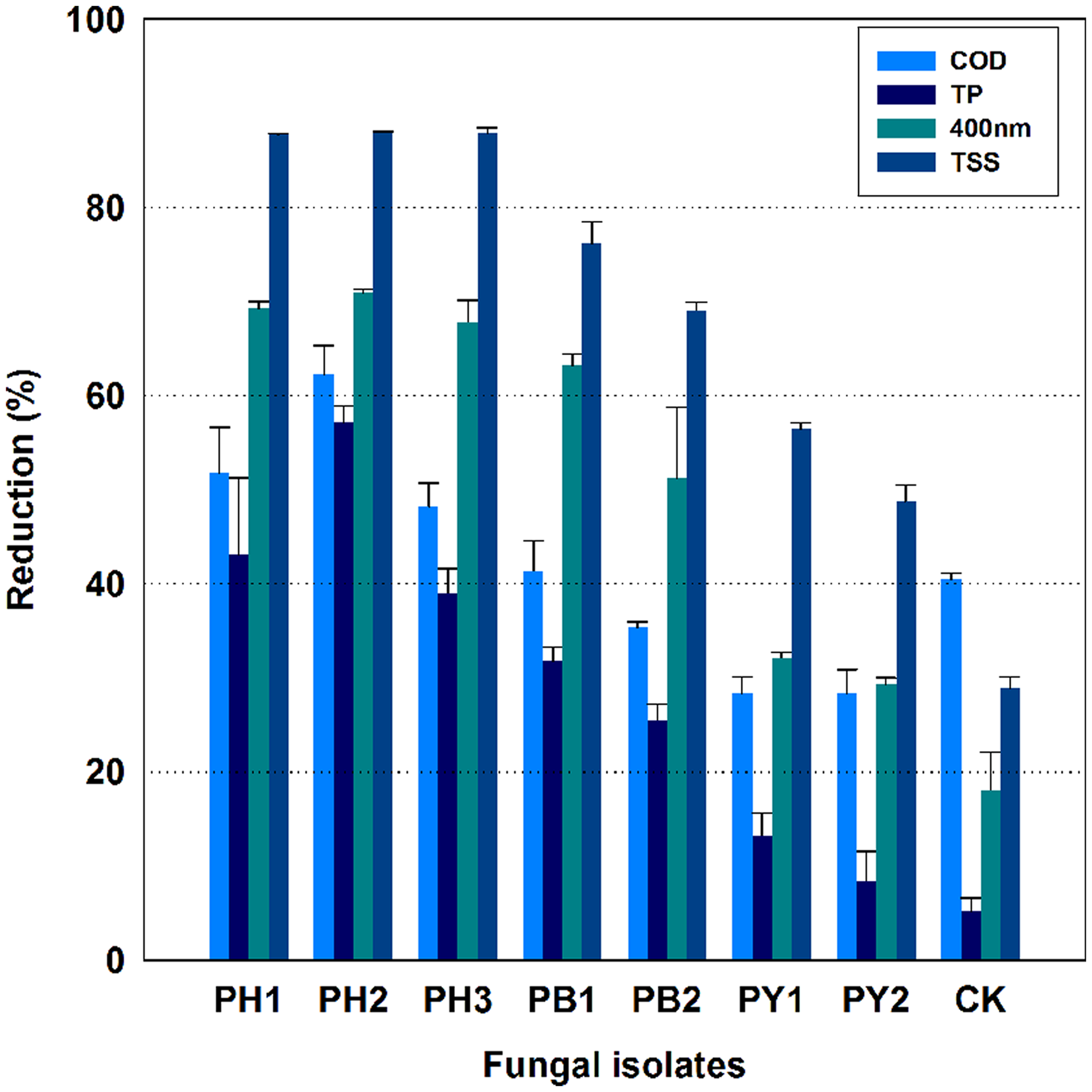
Reduction of COD, TP, TSS, and color (400 nm) by fungal isolates. COD, chemical oxygen demand; TP, total phosphorus; TSS, total suspended solids.
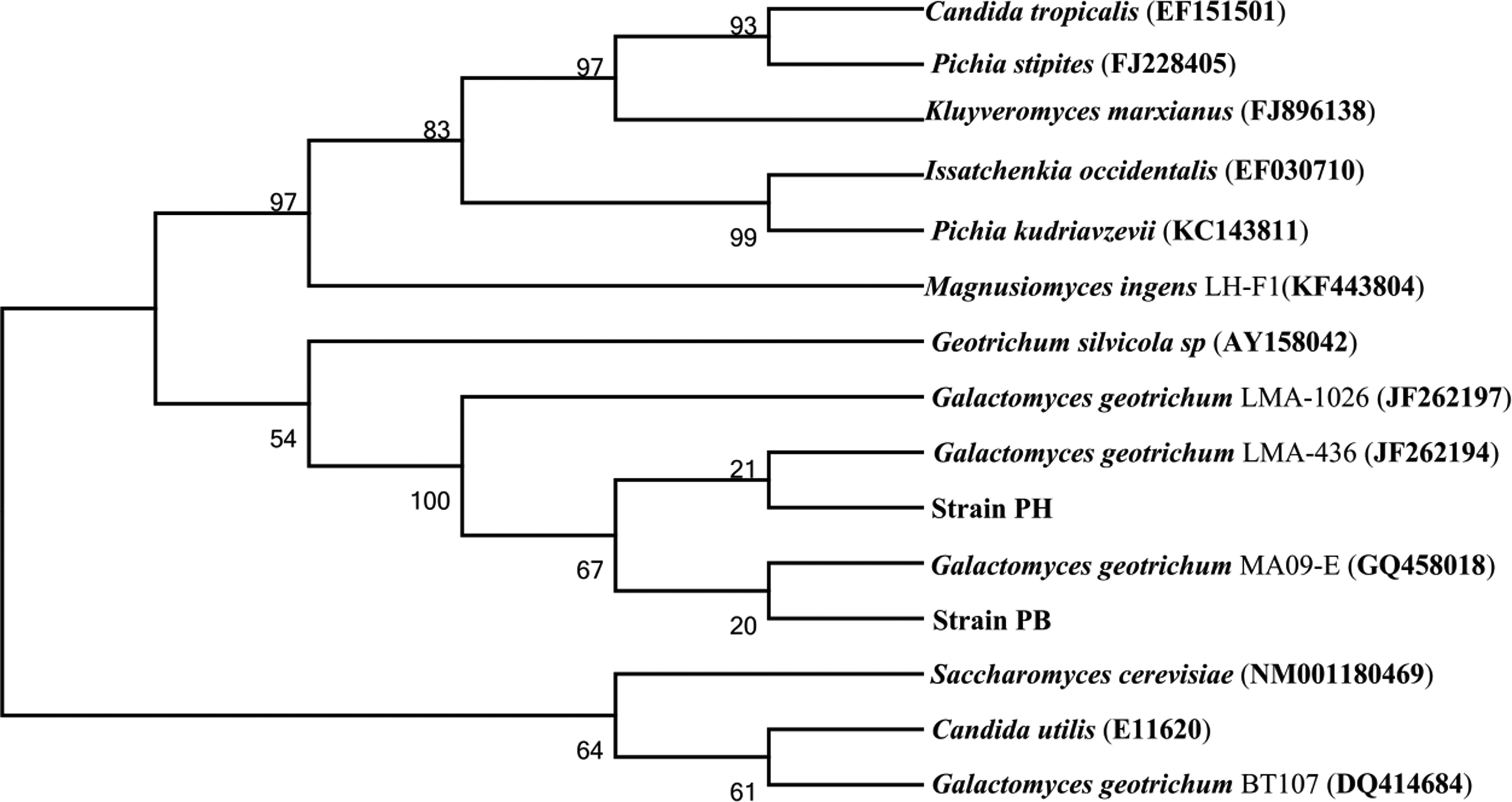
Phylogenetic tree derived from 18S rDNA sequence data of strain PH and PB and other related yeast species, which were used for waste treatments. (Values at nod represent percentage of 1,000 bootstrap replicates. Numbers in parentheses represent GenBank accession numbers).
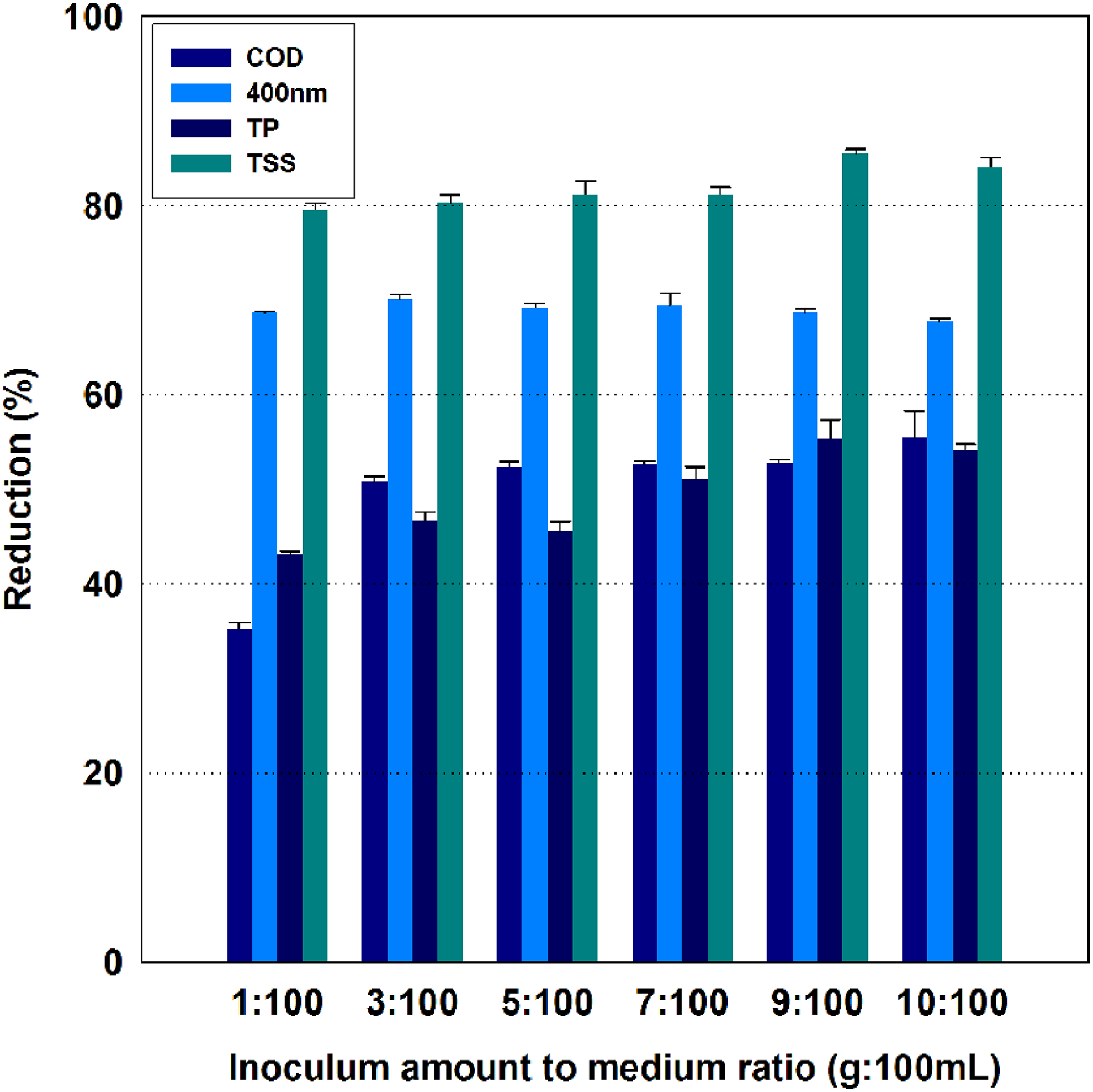
Reduction of COD, TP, TSS, and color (400 nm) by PH2 under different inoculum amount to medium ratio (g:100 mL).
Effect of parameters on COD and TP reductions
In this study, the reduction of COD and TP by G. geotrichum was investigated, the results are depicted in Figs. 4 and 5. The trend of COD decrease reveals that treatment at pH 6 generally achieves better reduction than the other two treatments. Among nine treatments (from No. 1 to No. 9), the highest reduction of COD was achieved by No. 6 at 65%, whereas treatments at less than pH 4 generally show lower reduction of COD than those at pH 8 (Fig. 3). In total, the TP was reduced in all treatments, of which No. 1 to No. 4 reached the lowest values on day 3 and consequently increased to varying extents (Fig. 5). Other treatments decreased TP gradually. Treatment No. 7, with initial pH 8, achieved the highest TP reduction of all treatments. Fig. 6 shows pH kinetics over the course of experiments and bifurcated pH change (e.g., from pH 4 to a more acidic condition and from pH 6 to a more alkaline condition). The treatments at pH 4 remained flat, even decreasing slightly to a more acidic condition, while the treatments under a slightly acidic condition (pH 6) increased to a more alkaline condition (pH at the range of 8–9) at the end of experiment. The treatments under alkaline conditions and CK increased slightly to around pH 9.
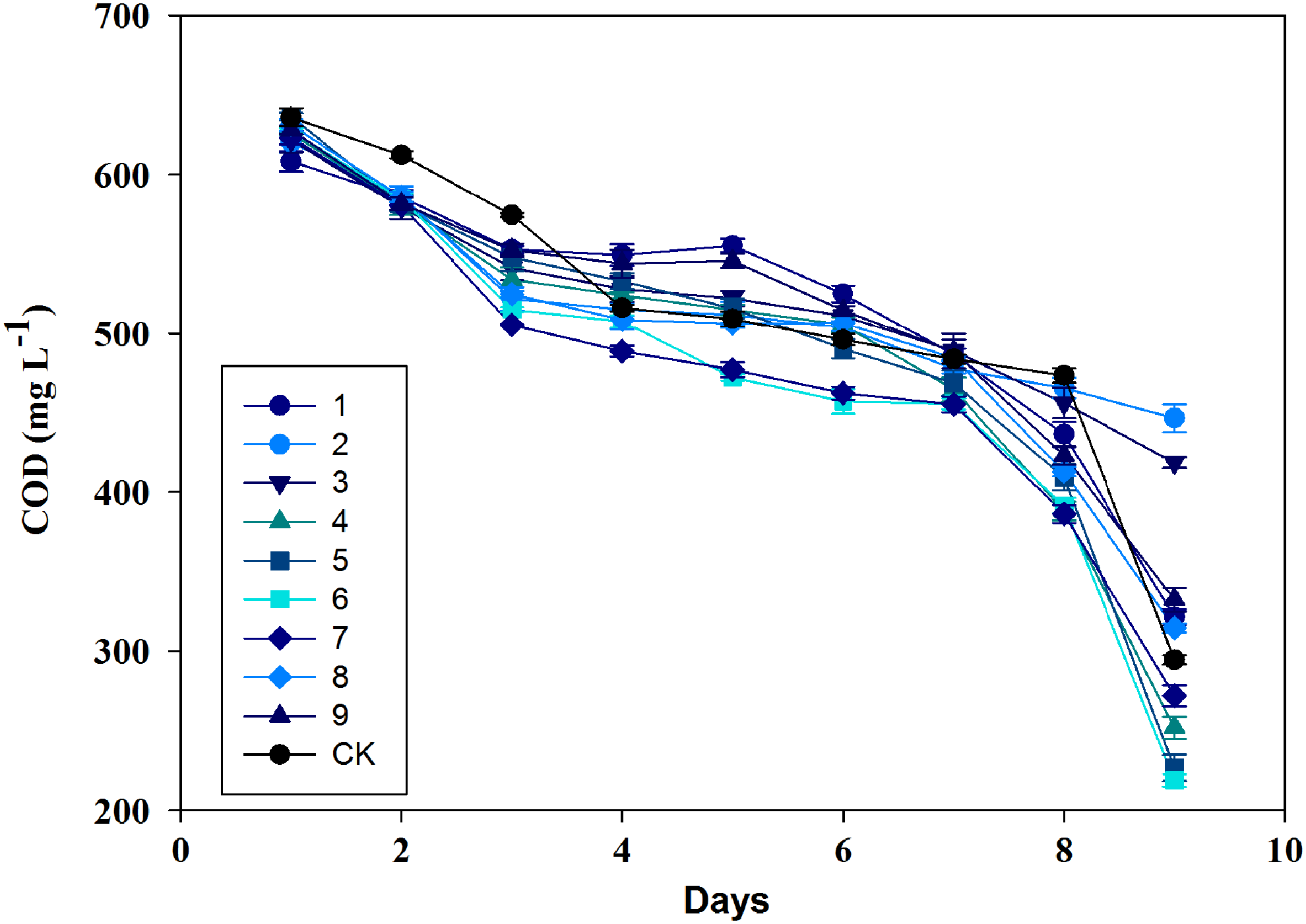
COD change over course of experiment. Numbers represent the treatment from No. 1 to No. 9 (Table 2); CK represent control.

TP removal by PH2 over the course of experiment. Numbers represent the treatment from No. 1 to No. 9 (Table 2); CK represent control.

pH change over the course of experiment. Numbers represent the treatment from No. 1 to No. 9 (Table 2); CK represent control.
Optimization of pollutant removal parameters
Since various factors potentially affect the removal process, the optimization of the experimental conditions is a critical step in the development of wastewater treatment methods. In fact, pH, temperature, and inoculum amount are generally considered the most important parameters. Thus, optimization of removal conditions can be carried out using an orthogonal design. The selected factors were investigated using an orthogonal experimental design. Statistical method was applied to the total evaluation index. The results of orthogonal test and extreme difference analysis are shown in Tables 3 and 4. The ANOVA was performed by statistical software SPW 19.0.
Significant difference at 0.1 level.
Significant difference at 0.05 level.
Effect of factors on the reduction of COD decreases in the order of importance as A>C>B, according to the magnitude order of Rf (Max Dif). With some contrast, the effect of factors on TP reduction was found to decrease in the order A>B>C. From this comparison, the most important determinant of COD and TP reduction was found to be pH. According to the outcomes and analyses, the optimal condition is generally A2B2C1. In other words, when pH is 6, temperature is 25°C, and inoculum is 2.5 g, the pollutants are most thoroughly removed. Table 3 shows that pH had a significant effect on the COD reduction from piggery-digested effluents by G. geotrichum, while significant effect by temperature and inoculum amount on the COD reduction is lacking. The pH also has a significant effect on the reduction of TP. The suitability of near-neutral medium is evidenced by better removal of pollutant and growth of yeast.
Verification test
G. geotrichum was grown in triplicate in piggery-digested waste effluent with 2.5 g of inoculum at pH 6 and 25°C. The results show reduction of COD and TP by 60% and 45%, respectively, slightly lower than the highest values before optimization. Thus, the selected conditions maximize pollutant removal from piggery-digested waste.
Discussion
Yeast isolates used in this study have been applied for piggery-digested wastewater treatment toward algal biodiesel production. The ratio of N/P in the optimal algal growth medium is around 10:1, depending on species (e.g., 37:1 for Chlorella vugaris), while piggery wastewater is around 4:1 (Olguín, 2012). One yeast (G. geotrichum) stood out among them, showing a very high pollutant removal efficiency (Rana et al., 2013). G. geotrichum is the teleomorph of G. candidum, which usually secretes two or more lipases, possibly the products of separate genes (Yan et al., 2007). The isolate identified as G. geotrichum in this study has been used for dye wastewater treatment and the degradation of a wide range of dyes (Yang and Zheng, 2014). The mechanisms underlying the adaptation of yeasts to higher ammonia-ridden and high-organic-strength piggery-digested wastewater involve the polyphosphate-synthesizing activity of yeast, which is similar to polyphosphate kinase enzymes in bacteria (Yang and Zheng, 2014). In this study, G. geotrichum has a significant effect on COD and TP reduction. The mechanism behind the effect involves biodegradation and biosorption, which includes physicochemical interactions such as adsorption, decomposition, and ion exchange (Nguyen and Juang, 2013). The possible biodegradation way adapted by this wastewater-born yeast might be mediated by oxidative enzyme laccase (Yang and Zheng, 2014).
ANOVA results show that pH is a critical factor affecting yeast growth and performance under treatment system conditions. Higher pollutant removal rate at pH 6 may be due to optimized enzyme activity by laccase. The optimum enzymatic condition for laccase and manganese peroxidase is around pH 8 (Phillips et al., 1995). Optimal pH range was generally selected for yeast treatment processes to maximize yeast growth and limit bacterial growth under nonsterile conditions (Yang and Zheng, 2014). It should be noted that, following the yeast treatment process, the pH-level acidic wastewater often decreases to more acidic conditions, which has a negative effect on the performance of yeast because the binding properties of biosorption by yeast can be improved by alkali treatments (Nguyen and Juang, 2013). Contrastingly, the pH level of the slightly acidic wastewater (i.e., pH 6) generally rose to neutral due to the degradation of humic acid, which may reduce wastewater treatment costs and facilitate subsequent procedures (Yang and Zheng, 2014), since the average pH of digested piggery waste effluent is around 7–8 or slightly alkaline (Kalpana et al., 2012). Therefore, any requirement to reduce pH to an acidic range of 4–5 before fungal treatment would be uneconomical (Raj et al., 2007). In this study, the optimal pH value was close to 7, indicating that pH adjustment of natural effluent should be minor and economical. Pollutant removal from effluent should be performed by employing unsterilized and unfiltered piggery wastewater without pH adjustment (Garg and Tripathi, 2011). In addition, effluent that decreased slightly from an initial pH 4 to more acidic conditions did not reach high COD reduction levels, inconsistent with a previous study (Prasongsuk, 2009). The mechanism underlying this phenomenon remains unclear. The temperature is also one of important factors affecting the efficiency of degradation by yeast in wastewater due to the enzymatic activity. The higher temperature may enhance the biosorption ability of yeast because some new biosorption sites are generated or intraparticle diffusion of molecule increased the rate to the pores of the adsorbent. However, a too high temperature can decrease biosorption ability and deactivate the enzymatic activity (Wu et al., 2010). Laccase lost all the activity within 35 min at 56°C, but was stable at pH 5–8 at 4°C for weeks without a significant loss of activity (Phillips and Pretorius, 1991). The optimum temperature for oxidative degradation induced by laccase is 30°C within the temperature range (5°C, 30°C, and 50°C) (Jadhav et al., 2008). In addition, the dark brown color of the digested effluent is not only aesthetically unacceptable but also prevents the passage of sunlight through water, restricting photosynthesis. Therefore, a further treatment may be required to remove color before use in algal biodiesel production.
Conclusion
G. geotrichum is a pollutant-clearing yeast, adapted to and isolated from unprocessed composted hog wastewater. This yeast PH2 strain succeeded in cultural isolation and was successfully applied to wastewater treatment. The requirements of G. geotrichum allow an approach that proves to be a highly efficient, low cost, and simple process, which is easy to employ.
Footnotes
Acknowledgment
This work was financially supported by International collaboration in genome-wide metabolic network reconstruction of oleaginous algae (20151BDH80007), International collaboration in microalgae cultivation and biorefinery (2014DFA61040).
Author Disclosure Statement
No competing financial interests exist.