




Abstract
Abstract
This study investigated how two factors, extraction solvent and time, affected extraction efficiencies of ultrasonic extraction (UE) for polycyclic aromatic hydrocarbons (PAHs). The initial extraction has great impact on the final extraction efficiencies of PAHs, and further affects the quantitative analysis of PAHs. In this study, the former factor inspected parameters of type of extraction solvent, composition of solvent, and solvent dosage, while the latter concerned UE duration per cycle and number of UE cycles. Results showed that single solvents, n-hexane, dichloromethane (DCM), and acetone, provided average recovery rates of 53.76% ± 63.21% (average value ± standard deviation), 37.81% ± 19.48%, and 67.66% ± 60.76%, respectively, for the total PAHs targeted. However, binary solvents, n-hexane/DCM (1:1), DCM/acetone (1:1), and acetone/n-hexane (1:5), yielded average recovery rates of 112.08% ± 39.23%, 82.56% ± 48.78%, and 52.77% ± 30.45%, respectively, for the total target PAHs. The three single solvents yielded average recovery rates of 0–22.32% for 3-ring PAHs, 6.01–41.76% for 4-ring PAHs, and 46.53–85.71% for 5- and 6-ring PAHs, while the three binary solvents provided 29.64–31.00%, 19.65–40.62%, and 28.38–49.78% for the three types of PAHs, respectively. The other three parameters supplied with similar recovery rates for these types of PAHs. When applying n-hexane/DCM (1:1) as PAH extraction from real airborne particulate matter, the three types of PAHs occupied 9.31%, 21.40%, and 69.29% over total PAHs, respectively.
Introduction
P
The benchmark techniques of Soxhlet extraction (SE) have not increasingly been chosen as extraction method for PAHs since large volumes of organic solvent are needed (Ahmad et al., 2004; Kronholm et al., 2004; Khan et al., 2005; Enell et al., 2008; Joa et al., 2009; Liu et al., 2015). Different from SE, ultrasonic extraction (UE) is known for shorter extraction times when considering the type of contaminants and matrix (Song et al., 2002). Rey-Salgueiro et al. (2009) compared the performance of different extraction methods for PAHs in peat and claimed that UE required no sophisticated equipment and long extraction times. In addition, UE has advantages of low cost and small volumes of organic solvent without the use of elaborate glassware and instrument as well as allows leaching of thermolabile analytes, which would volatize or are oxidized in SE (Chen et al., 1996; Oluseyi et al., 2011). As for other extraction method, García-Falcón et al. (2004) investigated the extraction strategies for free and bound PAHs in runoff waters with rich organic matter and stated that solid-phase extraction was preferred to overall PAH determination, while stir bar sorptive extraction was preferred to free PAH determination.
The extraction efficiency of an extraction method can be greatly impacted by various factors, especially by extraction solvent and time, no matter what organic compounds are of interest. Normally, PAH extraction with single solvent has been the common choice for many researches, such as acetone (Ahmad et al., 2004; Vane et al., 2008), dichloromethane (DCM) (Baran and Oleszczuk, 2002; Arditsoglou et al., 2003; Kronholm et al., 2004), and n-hexane (Guerin, 1999; Szolar et al., 2002). However, solvent mixture has increasingly been preferred for its better performance than single solvent. Shu and Lai (2001) reported that n-hexane/acetone (1:1, v/v) yielded higher PAH recoveries than DCM from spiked soils under focused microwave-assisted extraction. However, many literatures provide no valuable reasons while just suggesting the well application of solvent mixtures than single solvents. There is also a major challenge that the extraction solvent has no selectivity toward PAHs and other coextracted materials, which are more reactive and soluble and can negatively impact the solubility of PAHs. Gao et al. (2015) also pointed out the worry of coextraction of thermally degraded lignocellulosic materials with interested compounds. The choice of extraction time for an extraction method for PAHs also varies from study to study. Banjoo and Nelson (2005) studied both the two subparameters and found that the overall extraction time changed from 60 min to 30 min has no significant impacts on the final results, but the increase in number of extraction cycles could provide better results.
This study would simultaneously investigate the effects of the two factors on the extraction efficiency of UE of PAHs in APM. The first factor includes three single solvents frequently used in UE and their binary mixtures along with the dosage of solvents, while the other factor involves UE duration per cycle and number of UE cycles. The performances of the five parameters were evaluated in terms of the recovery rates of spiked blank sample and real APM samples.
Experimental Protocols
Material and chemical
Mixed standard solution of 9 U.S. Environmental Protection Agency (USEPA) priority PAHs (USEPA, 1999), mixed solution of four internal standard compounds of PAHs, and two surrogate recovery standards from AccuStandard were provided as shown in Table 1. As the Method TO-13A regulated (USEPA, 1999), surrogate recovery standards are required since their recovery rates would indicate unusual matrix effects and gross sample processing errors. The two surrogate recovery standards were selected since they can be quantified by the internal standards used and do not interrupt the quantification of target compounds. Organic solvents, including n-hexane, DCM, and acetone (chromatographic grade; Tianjin Institute of Chemical Reagents), were used as extraction solvents. Before experiment, the pure glass fiber filters (Φ81; Wuhan Tianhong Instruments Co., Ltd.) were roasted at 550°C for 12 h, enclosed in aluminum foil packages, sealed in plastic bags, and laid in refrigerator at −4°C until used.
PAH, polycyclic aromatic hydrocarbon.
Orthogonal design
How the two factors impact UE of PAHs is conducted through the orthogonal design form of L18 (6 × 36) with spiked blank samples. Five parameters and two error blanks are investigated involving composition of solvent (factor A), type of extraction solvent (factor B), solvent dosage (factor C), error 1 (factor D), error 2 (factor E), UE duration per cycle (factor F), and number of UE cycles (factor G) as shown in Tables 2 and 3. These parameters are variables, which have significant impacts on the recovery rate and appropriate extraction of PAHs from environmental media (Lau et al., 2010). Considered that n-hexane, DCM, and acetone are used in major part of current researches (Shu and Lai, 2001; Tsai et al., 2002; Banjoo and Nelson, 2005; Bourotte et al., 2005; Li et al., 2014; Yang et al., 2014; Buczyńska et al., 2015), the three single solvents and their binary combinations were applied in this study. The ratio of 1:0 of factor A and other ratios of factor A combined with factor B refer to experiments with single solvents and binary solvents, respectively, for the purpose to evaluate the differences between single extraction solvents and binary solvents. The order of factor B was also designed to assure the application of three of the single solvents. According to this study, the average mass of the glass fiber filter after sampling was 3 mg. Since the sampling filter should be cut into pieces (around 0.5 × 1 cm) and gathered into a conical flask, 30 mL of extraction solvents is the volume, which could exactly immerse the filters, and therefore, the 30 mL/3 mg (v/w) was the basic level (level 1) of factor C. Factors D and E refer to the error blank columns, which would record experimental errors and indicate the reliability of the overall orthogonal experiments (Wu and Leung, 2011). The levels of factors F and G are selected according to a series of literatures as well (Guerin, 1999; Gu et al., 2013; Marini and Frapiccini, 2013; Iwegbue et al., 2014). To avoid any subjective bias, the eighteen trials of orthogonal experiment were carried out without obeying the normal array of the matrix shown in Table 3 and were randomly conducted.
DCM, dichloromethane; UE, ultrasonic extraction.
L18(6 × 36)
Sample collection
APMs were collected at the rooftop (around 20 m above ground level) of a building on the campus of the Hunan University. APM samples were collected on glass fiber filters with an Anderson Non-Viable Ambient Particle Sizing Sampler (ANVAPSS) with an 8-stage nonviable cascade impactor (Westech Instrument Services Ltd.) for 85 h at 28.3 L/min. The ANVAPSS had nine sampling stages, each collecting APM in certain range of particle sizes. Our research groups had examined that the fifth sampling stage (APM with particle size ranging from 3.3 μm to −2.1 μm) collects the most concentration of PAHs, and the APM samples collected in this stage were used in this study.
Preparation of spiked solution for orthogonal experiment
This study self-prepared the solution for orthogonal experiment, and then, the solution was added to the pure glass fiber filters. Then, the spiked blank filter samples were analyzed through the steps mentioned in the “Extraction and analytical procedure of PAHs” subsection. The spiked solution was prepared to monitor the real samples of PAHs in APM. The solution here consisted of PAH standard solution and surrogate recovery standards, with a final concentration of 0.7 μg/mL (0.7 μg/mL PAHs, 0.7 μg/mL 2-Flu, and 0.7 μg/mL Ant-d10). The preparation method is based on the standards of HJ 646-2013 (Standards, 2013) and METHOD TO-13A (USEPA, 1999). Table 4 shows the used solutions and their concentrations for preparing spiked solution. 0.35 mL PAH reserving standards, 0.7 mL 2-Flu practical solution, and 0.7 mL Ant-d10 practical solution were transferred to a volumetric flask with volume of 100 mL and diluted to scale with n-hexane as solvent. After shaking the flask, the final solution was prepared.
Extraction and analytical procedure of PAHs
Concentrations of 9 target PAHs, 2-Flu, and Ant-d10 were determined by internal calibration curves with five concentration calibration solutions (0.10, 0.25, 0.5, 1.25, and 2.50 ng/μL). The concentration (0.7 μg/mL) of the mixed solution is chosen depending on the middle level of calibration standards. This study simply monitored the practical extraction of particulate-phase PAHs in the part of orthogonal experiment and used pure glass fiber filters as the support of PAHs. One milliliter of the mixed solution was added to the pure glass fiber filters for further extraction. As for the real APM sample, its filter would be directly applied to the sample preparation process.
In the sample preparation process, the filter containing the mixed solution or real APM sample was first cut into small pieces (around 0.5 × 1 cm) for the aim to increase the surface of exchange with the extraction solvent. The pieces together with extraction solvent(s) were then gathered into a conical flask. After simple seal and mix, the conical flask was sonicated for certain cycle and certain time per cycle. After each UE cycle, previous extraction solvents should be accumulated into another conical flask through filtration with anhydrous sodium sulfate to remove residual water at the same time. New solvents should be added into the original conical flask for the next UE cycle. Following UE, the combined solution was concentrated by rotary evaporator to nearly dry. 0.5 mL n-hexane was added to wash the concentration flask. The washing liquor was then transferred to GCMS vials and added with the mixed internal standard solution (0.2 mL and 2.5 μg/mL) and diluted to 1 mL by n-hexane and finally collected at −4°C until analysis.
The 9 target PAHs were analyzed through gas chromatograph–mass spectrometer (GCMS; Shimadzu QPlus 2010; Shimadzu; GC column: DB-5MS, 30 m × 0.25 mm × 0.25 μm). N-hexane was used as the solvent, and 1 μL of liquid sample was injected in splitless mode with the injector temperature of 250°C and the carrier gas of helium. The column oven temperature procedure is as follows: 50°C (2-min hold), increase to 200°C (2-min hold) at a rate of 18°C/min, then up to 240°C (2-min hold) at 4°C/min, then up to 255°C (3-min hold) at 2.5°C/min, and finally up to 300°C at 4.5°C/min (Li et al., 2014; Zhai et al., 2016). Selected ion monitoring (SIM) was used in MS system with 70 eV of electron impact. Chromatographic peaks of samples were identified by match of retention times and fragmentation profiles according to standard matters of 16 target PAHs. In this study, the recovery rates of target compounds, including PAH and surrogate recovery standards, are calculated using the following equation:
where Cd = concentration determined by GCMS analysis (μg/mL) and Ca = concentration added to pure glass fiber filters (μg/mL).
Quality control/quality assurance
Field blanks, method blanks, and spiked blanks were measured, and the average recovery rates of 2-Flu and Ant-d10 in these blanks were between 40 and 127%. No interested PAHs were detected in these blanks. Limits of quantification of PAHs were between 0.001732 ng/m3 for Pyr, BaA, Chr, and BkF and 0.5587 ng/m3 for BghiP.
Results and Discussion
Effect of single solvents
The recovery rates of PAHs under the three single solvents are presented in Fig. 1. As shown in Fig. 1, n-hexane, DCM, and acetone yielded average recovery rates of 53.76% ± 63.21% (average rate ± standard deviation), 37.81% ± 19.48%, and 67.66% ± 60.76%, respectively. Acetone seemed to provide with higher recovery rates of PAHs, followed by n-hexane, than DCM. The order of logarithmic octanol–water partition coefficients (log Kow) among n-hexane, DCM, and acetone is as follows: n-hexane (3.9) > DCM (1.25) > acetone (−0.24) (Sangster, 1989). The three single solvents would result in different solubility of PAHs within them. Cui et al. (2002) used DCM, DCM/acetone (1:1), and n-hexane/acetone (1:1) to extract PAHs from soil samples and reported that DCM/acetone provided the highest average recovery rates of PAHs and similar recovery rates of each PAH congener. Since PAHs are chemical organics with higher electric density and a strong nucleophilic character, Cui et al. (2002) claimed that acetone and DCM have strong nucleophilic characters, which contribute to the competition of PAHs with soil particulates. Since acetone provided the highest average recovery rates of PAHs in this study, it could be concluded that acetone has stronger dissolution of PAHs than DCM and therefore can extract more PAHs from particulate phase to liquid phase. DCM is the solvent having mediate Kow, which therefore can extract organic compounds in a wide range from nonpolarity to polarity. Rey-Salgueiro et al. (2004) studied the effects of extraction methods on the quantitative measurement of PAHs in wood ashes and found that DCM had the highest recovery rates than other solvents, such as ethyl acetate, acetone/hexane (1:2), and hexane. Owing to this character, DCM had extracted the most number of PAH congeners in this study. However, the average recovery rate of total targeted PAHs was the lowest among the three single solvents used. Gao et al. (2015) reported that the use of the higher polar solvent in pressurized liquid extraction method resulted in more coextractions while that of less polar solvent led to lower level of matrix dissolution. APM sample is not simply the particulate itself but integrated with various chemical compositions not limited to PAHs. From this perspective, the resulting extracts under DCM might be disrupted by coextracted materials. As for the n-hexane, the kind of solvent might have less dissolution of PAHs attached to sampling filters due to its low polarity and result in the loss of PAHs. Oluseyi et al. (2011) suggested the principle to select extraction solvents, that is, the ability to avoid loss of volatile PAHs and increase the extraction efficiencies. The three organic solvents had significant disadvantages when considering application to PAH extraction.

Recovery rates of PAHs using the three single extraction solvents. PAH, polycyclic aromatic hydrocarbon.
PAHs could be analyzed through classifying them into three types based on their numbers of benzene rings to avoid complex descriptions: ΣPAHs (3 rings) (Acl and Ant), ΣPAHs (4 rings) (Pyr, BaA, and Chr), and ΣPAHs (5 + 6 rings) (BkF, InP, DBA, and BghiP). 5- and 6-ring PAHs accounted for the highest proportion among the three types of PAHs, no matter what single solvent used. The difference is that n-hexane provided most of its recovery rates for 5- and 6-ring PAHs, while DCM and acetone obtained around 50% of recovery rates as shown in Fig. 2. Acetone provides no recovery rate for 3-ring PAHs.
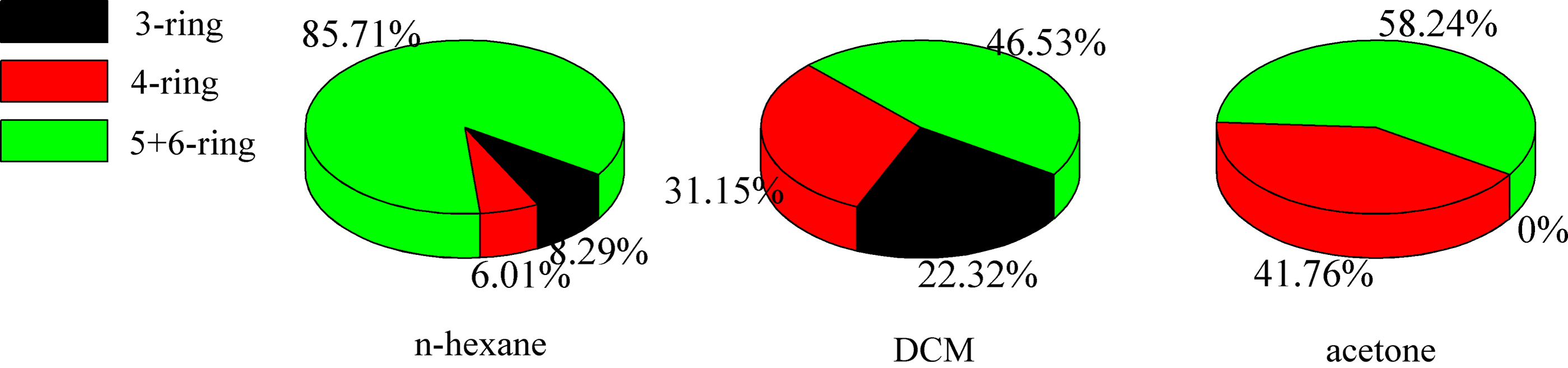
Efficiency distributions of three single solvents among PAHs with three types of benzene ring structure. “3-ring” refers to 3-ring PAHs (Acl and Ant), “4-ring” refers to 4-ring PAHs (Pyr, BaA, and Chr), and “5 + 6-ring” refers to 5- and 6-ring PAHs (BkF, InP, DBA, and BghiP).
The values of log Kow for Acl, Ant, Pyr, BaA, Chr, InP, BghiP, and DBA are 4.07, 4.50, 4.88, 5.63, 5.63, 6.58, 6.78, and 6.86, respectively (Columbia, 2016). The Ministry of British Columbia (Columbia, 2016) does not offer the value of log Kow for BkF (Yingge, 2009). However, Ma reported that BkF had a lower log Kow than BaA but larger Kow than InP. Therefore, the order of polarity of these PAHs is Acl > Ant > Pyr > BaA ≈ Chr > BkF > InP > BghiP > DBA. Accordingly, the order of polarity of PAHs with different number of rings should be 3-ring PAHs >4-ring PAHs >5 + 6-ring PAHs. If simply considering the corresponding relationship between the polarities of extraction solvents and of PAH congeners, the polarity of 3-ring PAHs is close to that of acetone. Thus, when using acetone as extraction solvents, the order of proportion over total PAHs should be 3-ring PAHs >4-ring PAHs >5 + 6-ring PAHs; in the case of DCM, the order should be 4-ring PAHs >5 + 6-ring PAHs >3-ring PAHs; in the case of n-hexane, the order should be 5 + 6-ring PAHs >4-ring PAHs >3-ring PAHs.
The assumption of extraction efficiency order of PAHs under the three single solvents was totally overturned by the experimental fact in Fig. 2. As shown in Fig. 2, the recovery rates of 5 + 6-ring PAHs were the highest, regardless of solvents with different polarities applied. The high extraction efficiency of 5 + 6-ring PAHs might result from the fact that the vapor pressure increases as the PAH molecular weight decreases (Allen et al., 1996). 3-ring PAHs have low vapor pressure and thus might be transformed from particulate phase to gas phase during the preparation progress and result in the low recovery rate results. Compared with 3- and 4-ring PAHs, 5 + 6-ring PAHs have high vapor pressure and preferred to exist in particulate phase, and therefore, the recovery rates of them are high under each single solvent. Therefore, it could be concluded that no matter what degree of polarity the solvent has, 5+-6-ring PAHs might be extracted in the first priority and thus have the highest extraction efficiency than 4- and 3-ring PAHs.
From Fig. 2, 4-ring PAHs had moderate extraction efficiencies, while 3-ring PAHs had the lowest under the extraction solvents of acetone and DCM. However, despite 5 + 6-ring PAHs, 3-ring PAHs had slightly higher extraction efficiency than 4-ring PAHs in the case of n-hexane. It might be reasonable to consider that organic solvents with lower polarity would prefer to extract 3-ring PAHs than 4-ring PAHs immediately after 5 + 6-ring PAH extraction, while solvents with higher polarity have priority to extract 4-ring PAHs than 3-ring PAHs after 5 + 6-ring PAH extraction.
Effect of solvent mixture
The three single solvents were combined two by two and categorized into three kinds of binary solvents, including n-hexane/DCM, DCM/acetone, and acetone/n-hexane. Figure 3 shows the recovery rates of PAHs under these binary solvents with various compositions. Compared with the extraction efficiency of single solvent in Fig. 1, the binary solvent combination provided obviously better extraction efficiencies since all the PAH congeners were extracted and the average recoveries of PAHs were much higher, except the binary solvent with composition of 1:5. N-hexane/DCM and DCM/acetone showed greater extraction efficiencies than acetone/n-hexane.

Recoveries of PAHs under each type of binary solvents, each with five different compositions.
The solvent mixtures, n-hexane/DCM (1:1), DCM/acetone (1:1), and acetone/n-hexane (1:5), extracted all the kinds of targeted PAHs and the high efficiency among their diverse compositions with the average recovery rates of 112.08% ± 39.23%, 82.56% ± 48.78%, and 52.77% ± 30.45%, respectively. The results were not surprising since these solvent combinations have proven to be effective for PAH extraction in environmental analysis. Li et al. (2014) used UE with n-hexane/DCM (1:1, v/v) as the extraction of PAHs, and the average recoveries for 16 PAHs varied from 72.4% to 106.6%. Yang et al. (2014) used the 20 mL n-hexane/DCM (1:1, v/v) as solvent to extract PAHs in soils (2 g) by ultrasonication with 3 cycles and provided average recoveries ranging from 70% to 106%. Cecinato et al. (2000) used DCM/acetone (5:1, v/v) as extraction solvent for PAHs from APM and provided recoveries varying from 60% to 100%. Cecinato et al. (2003) used DCM/acetone (3:1, v/v) as SE for PAHs from APM. Pekpahan et al. (2011) claimed that the binary mixture solvent of acetone/n-hexane (1:1, v/v) was the most effective solvent due to its comprehensive extraction of target PAHs and highest yields of total PAHs from the petroleum sludge cake, while n-hexane solvent and n-hexane/DCM (1:1, v/v) were less effective.
Compared with the single solvents, three of the binary solvents presented more even recovery rates among PAHs with different number of rings in Fig. 4. When using n-hexane/DCM (1:1) as extraction solvent, the efficiency order of PAHs with different rings shown in Fig. 4 was 5 + 6-ring PAHs >4-ring PAHs ≈3-ring PAHs. As shown in Fig. 2, DCM has the efficiency order of PAHs of 5 + 6-ring PAHs >4-ring PAHs >3-ring PAHs, while n-hexane has the order of 5 + 6-ring PAHs >3-ring PAHs >4-ring PAHs. It can be seen that when applying low-polarity solvent, such as n-hexane with DCM (n-hexane/DCM), the extraction efficiency of 3-ring PAHs can be promoted. Acetone/n-hexane (1:5) provided different distributions among the three kinds of PAHs. The recoveries of 4-ring PAHs turned to be the highest under the solvent, followed by 3-ring PAHs, and the recoveries of 5 + 6 PAHs was the lowest. It is interesting to find that the occupation of 5 + 6-ring PAHs decreased from 49.78% to 28.38%, while that of 3-ring PAHs was stable around 30%. However, when n-hexane, the lower polarity solvent, was combined with the higher polarity solvent, acetone, the extraction efficiency of 3-ring PAHs can also be improved. As shown in Fig. 2, n-hexane provided low recovery rates of 3- and 4-ring PAHs owing to low level of matrix dissolution. Back to the binary solvent scenario, the fact that n-hexane/DCM (1:1) and acetone/n-hexane (1:5) had better extraction result than single n-hexane might result from the mechanism described below. The solvents with higher polarity can dissolve the matrix fully, which exactly solves the problem for n-hexane when combining n-hexane with DCM or acetone. Since n-hexane has priority to extract 3-ring PAHs, the kind of PAHs was positively dissolved in the solvent when acetone or DCM actively dissolved the matrix, and there the extraction efficiency of 3-ring PAHs was promoted.

Efficiency distributions of the three binary solvents among PAHs with three types of benzene ring structure. “3-ring” refers to 3-ring PAHs (Acl and Ant), “4-ring” refers to 4-ring PAHs (Pyr, BaA, and Chr), and “5 + 6-ring” refers to 5- and 6-ring PAHs (BkF, InP, DBA, and BghiP).
When DCM/acetone (1:1) applied to extraction solvents, the order of PAH extraction efficiency was 5 + 6-ring PAHs >3-ring PAHs >4-ring PAHs. In Fig. 2, acetone provided 5 + 6-ring PAHs >4-ring PAHs >3-ring PAHs order of PAH extraction efficiency. Both DCM and acetone could provide higher extraction efficiencies for 5 + 6- and 4-ring PAHs. When combined the two solvents together, they would compete the extraction of 5 + 6- and 4-ring PAHs. From Fig. 2, both 5 + 6- and 4-ring PAHs occupied higher among the total kinds of PAHs in the case of acetone than in the case of DCM. It could be regarded that acetone had “win” in the competition and took efforts to extract 5 + 6- and 4-ring PAHs while DCM focused on 3-ring PAH extraction as shown in Fig. 4.
Effect of solvent dosage and UE-specific parameters
Figure 5 shows the efficiency distributions of the three types of PAHs under diverse solvent dosages, UE duration per cycle, and number of UE cycles. Pan et al. (2013) studied the optimum volume of extraction solvent for PAHs in soil sample (1 g), and the results showed that the extraction efficiency increased with the increasing solvent volume from 10 to 25 mL and stabilized from 25 to 30 mL. Banjoo and Nelson (2005) reported that no significant improvement was achieved when the overall extraction time decreased from 60 to 30 min using n-hexane/acetone (1:1, v/v) as extraction solvent. However, Banjoo and Nelson (2005) also found that higher quantities were greatly improved when increasing the extraction cycles from two to three. As shown in Fig. 5, in spite of the different compositions of three parameters here, they provided similar extraction efficiency among these PAHs. These three parameters provided higher proportion of 5- and 6-ring PAHs on ΣPAHs, followed by 3-ring PAHs and finally by 4-ring PAHs. The three parameters might have no significant effects on the extraction efficiency of PAHs in APM.

Ternary distributions of three types of PAHs under parameters of solvent dosage, UE duration per cycle, and number of UE cycles, respectively. The symbols “★,” “◯,” and “♦” refer to parameters of solvent dosage, UE duration per cycle, and number of UE cycles, respectively. UE, ultrasonic extraction.
Validation on Real APM Samples
The binary solvent, n-hexane/DCM (1:1), was validated with real APM samples. Since the solvent dosage and UE-specific parameters provided similar impacts on the final extraction results, the real APM samples were also conducted with 30 mL/3 mg (v/w) solvent dosage, a total of 6 cycles, and 10 min per cycle. The recovery rates of 2-Flu and Ant-d10 were 82.31% ± 34.87% and 87.19% ± 54.78%, respectively. Ant was not found in the samples. The total PAHs observed in the real APM samples had average concentration of 6.03 ± 2.02 ng/m3, and concentration of each PAH congener ranged from 0.12 ± 0.11 ng/m3 of BkF to 2.01 ± 0.34 ng/m3 of InP as shown in Fig. 6. Ma et al. (2013) provided similar concentration of PAHs in Shanghai. Pontevedra-Pombal et al. (2012) studied the PAH accumulation in blanket bog in Iberian Peninsula and found that BaA and BkF had concentration not exceeding 5% of the total PAHs before the 18th century, but their concentration had gradually increased since then. As for the high-molecular weight PAHs, InP also showed no detectable levels until the 18th century, and their content also rose sharply since then (Pontevedra-Pombal et al., 2012). 5- and 6-ring PAHs occupied most of the total PAHs observed, followed by 4-ring PAHs and finally by 3-ring PAHs. It could be seen that the binary solvent used here had provided good extraction efficiencies for PAHs in APM.

Average concentrations of PAHs in APM samples under the binary solvent of n-hexane/DCM (1:1) and the extraction efficiency on ΣPAHs (3 rings), ΣPAHs (4 rings), and ΣPAHs (5 + 6 rings), respectively. Error bars in the histogram represent standard deviations of PAH concentration in the APM samples. ΣPAHs (3 rings) include Acl and Ant. ΣPAHs (4 rings) involve Pyr, BaA, and Chr, and ΣPAHs (5 + 6 rings) consist of BkF, InP, DBA, and BghiP. APM, airborne particulate matter.
Summary
An extraction method of PAHs from APM sample can be affected by its extraction solvent and time. The single solvent, acetone, provided higher extraction efficiency than DCM and n-hexane. Acetone with higher polarity had strong dissolution of PAHs and thus extracted more kinds of PAH congeners. N-hexane provided uneven recovery rates among PAHs with different number of rings due to its low polarity and therefore low level of matrix dissolution. DCM had the lowest average recovery rates compared with other two solvents, which might result from the coextracted materials, but provided even recovery rates among PAHs with different number of rings. From the perspective of solvents used, 5 + 6-ring PAHs might be the first priority for solvent, regardless of the polarity it has. Then, solvents with higher polarity might prefer to extract 4-ring PAHs than 3-ring PAHs, while those with lower polarity might prefer to extract 3-ring PAHs than 4-ring PAHs.
Binary extraction solvent provided higher recovery rates than single solvent and was preferred as the extraction solvent for PAH analysis. N-hexane/DCM (1:1), DCM/acetone (1:1), and acetone/n-hexane (1:5) were the solvent combinations, which had higher extraction efficiencies among their own diverse compositions. No matter what kind of single or binary solvents used, 5- and 6-ring PAHs were presented by higher proportion of the total PAHs. The proportions of 3-ring PAHs over total PAHs were promoted under binary solvents, especially when combined with n-hexane. N-hexane/DCM (1:1) and acetone/n-hexane (1:5) having better extraction efficiencies benefited from the collocation mechanism, while DCM/acetone (1:1) resulted from competitive mechanism. The parameter of solvent dosage and the two UE-specific parameters, including UE duration per cycle and number of UE cycles, had provided the similar extraction efficiency on ΣPAHs (3 rings), ΣPAHs (4 rings), and ΣPAHs (5 + 6 rings). The type of extraction solvent and its composition had significant impacts on the extraction efficiencies of ultrasonic method for PAH analysis, while the other three parameters provided slight effects on the UE extraction efficiencies. The binary solvent, n-hexane/DCM (1:1), also provided good extraction efficiency for the real APM samples. The factor of extraction solvent might have more significant impacts on the extraction efficiencies of UE for PAHs in APM compared with the factor of extraction time.
Footnotes
Acknowledgments
This work was supported by the Program for New Century Excellent Talents in University under grant NCET-12-0169, the progress of science and technology innovation plan launched by the Department of Transportation of Hunan Province under grant no. 2014318, and the Ministry of Education Scientific Research Foundation for Returned Overseas Scholars under grant no. 757210011.
Author Disclosure Statement
No competing financial interests exist.