




Abstract
Abstract
Laboratory experiments evaluated two shale caprock formations, the Gothic Shale and Marine Tuscaloosa Formation, at conditions relevant to carbon dioxide (CO2) sequestration. Both rocks were exposed to CO2-saturated brines at 160°C and 15 MPa for ∼45 days. Baseline experiments for both rocks were pressurized with argon to 15 MPa for ∼35 days. Varying concentrations of iron, aqueous silica, sulfate, and initial pH decreases coincide with enhanced carbonate and silicate dissolution due to reaction between CO2-saturated brine and shale. Saturation indices were calculated and activity diagrams were constructed to gain insights into sulfate, silicate, and carbonate mineral stabilities. Upon exposure to CO2-saturated brines, the Marine Tuscaloosa Formation appeared to be more reactive than the Gothic Shale. Evolution of aqueous geochemistry in the experiments is consistent with mineral precipitation and dissolution reactions that affect porosity. This study highlights the importance of tracking fluid chemistry to clarify downhole physicochemical responses to CO2 injection and subsequent changes in sealing capacity in CO2 storage and utilization projects.
Introduction
G
Laboratory experiments provide valuable insight into geochemical and mineralogic changes induced by interactions among shale, brine, and CO2 (e.g., Kaszuba et al., 2003, 2005; Kohler et al., 2009; Alemu et al., 2011). Other experimental studies have addressed additional specific aspects of shale-brine-CO2 interactions of potential CCUS caprocks, the Gothic Shale and Marine Tuscaloosa Formation. Karamalidis et al. (2013) and Marcon and Kaszuba (2015) evaluated the potential for metal mobilization from the Marine Tuscaloosa Formation and from the contact of the Gothic Shale with an underlying carbonate reservoir, respectively, under conditions relevant to CCUS. Jung et al. (2013) and Zhong et al. (2014) examined the potential for organic and metal mobilization from the Gothic Shale in response to CO2 injection. In Part I of this two-part study, Mouzakis et al. (2016) investigated the impacts of geochemical reactions on nano- and micron-size porosity development under experimental conditions relevant to CCUS. Neutron scattering, electron microscopy, and other pore network characterization techniques were used to examine nanoscale changes on mineralogic aspects of porosity, pore connectivity, pore size distribution, and internal surface area of both the Gothic Shale and the Marine Tuscaloosa Formation. Changes to these pore network characteristics can significantly affect fluid saturation distribution, hydraulic conductivity, and wettability of caprock and reservoir rock which, in turn, may impact fluid containment and hydrocarbon production, respectively (Kaveh et al., 2014; Yao et al., 2014; Sarmadivaleh et al., 2015; Arif et al., 2016).
In this work, which is a continuation of the Mouzakis et al. (2016) study, we evaluate how aspects of the aqueous geochemistry of these same experiments evolve over the duration of the experiments. This information is synergistic with the mineralogic data determined in Part I of this study and constrains how porosity and pore connectivity, and ultimately geofluid storage and production, may change with time as a result of coupled physicochemical processes. As Song and Zhang (2013) highlight, understanding geochemically induced changes to pore networks is vital to accurately predicting the long-term behavior of caprock formations.
Experimental Protocols
Batch experiments
Samples of Gothic Shale or Marine Shale of the Tuscaloosa Group (henceforth referred to as the Marine Tuscaloosa) were reacted with formation specific brine and supercritical CO2 in hydrothermal experiments at 15 MPa and 160°C as described by Mouzakis et al. (2016). Two control experiments were also conducted (in which argon was used to pressurize the reactors in lieu of CO2) to establish a baseline understanding of brine-rock interactions and provide a basis for evaluating CO2-brine-rock interactions. In this article, the brine-reacted experiments are referred to as Gothic-Brine and Marine-Brine, and the CO2-reacted experiments are referred to as Gothic-CO2 and Marine-CO2. The rocks are described in detail by Mouzakis et al. (2016) and Heath et al. (2011).
Analytical methods
Brine samples were periodically sampled and analyzed during the experiments. Extracted brine samples cooled and depressurized to ambient conditions within a few seconds and were subsequently processed. Retrograde reactions with minerals that may occur during a prolonged quench process were consequently avoided and solution composition was analyzed along a reaction pathway. Fluid samples were filtered using a Millipore 0.45 μm filter. To prevent mineral precipitation, the samples for cation analysis were acidified to pH 2 using trace metal grade nitric acid. Mineral precipitates were not observed in any of the brine samples. Major cation, anion, and minor constituent concentrations in the aqueous samples were determined by inductively coupled plasma optical emission spectroscopy, ion chromatography, and inductively coupled plasma mass spectrometry, respectively. Additionally, pH and total dissolved inorganic carbon were measured at “bench” conditions (degassed samples at 25°C and 0.1 MPa) using a carbon coulometer according to the methods of Chopping and Kaszuba (2012). In situ values of total dissolved inorganic carbon were determined by analyzing a sample of brine collected in a glass gas-tight syringe.
Upon termination, or “quench,” the heated, insulating pressure vessel jackets were removed to quickly cool the experiments to minimize retrograde reactions of the fluids and rocks. After terminating each experiment, the remaining brine was filtered using a Millipore 0.45 μm filter and analyzed according to the same protocols used for the other aqueous samples. The geochemistry of the quench sample and the aqueous sample collected immediately before the quench were compared to determine retrograde reactions that may have occurred while cooling and degassing the experiments.
Geochemical models and calculations
Geochemical calculations were performed to determine in situ pH, aqueous species activities, and the saturation state of the brine with respect to different minerals. We used Geochemist's Workbench 10.0 (GWB), the b-dot ion association model, and the resident thermo.tdat database (Bethke and Yeakel, 2014) according to published methods (Chopping and Kaszuba, 2012; Lo Ré et al., 2014; Marcon and Kaszuba, 2015). We used thermo.tdat because it is internally consistent and handles aluminum speciation more adeptly than other available databases (Kaszuba et al., 2011). The ion size parameter for CO2(aq) in this database was changed to −0.5 to correctly simulate the salting-out behavior of CO2 (Allen et al., 2005). Initial oxygen values were assumed to be negligible due to sparging of the brine (Mouzakis et al., 2016).
The pH at in situ pressure and temperature conditions was calculated for samples collected from the brine-reacted baseline experiments by speciating the fluid at 160°C using bench pH, total dissolved inorganic carbon measured at the bench and at in situ conditions, and the aqueous geochemical data (Table 1). In situ pH was calculated for CO2-reacted experiments using the method of Newell et al. (2008) and total dissolved inorganic carbon calculated for in situ conditions using the equation-of-state of Duan et al. (2006). Hereafter, unless otherwise specified, in situ pH will be simply referred to as pH. Total dissolved inorganic carbon was measured for samples withdrawn from the CO2-reacted experiments, but the results were inconsistent due to analytical difficulties and were therefore not used in the pH calculations. We were able to justifiably substitute equation-of-state values for measured values because the brine was saturated with CO2 for the duration of the experiments.
Calculated value, see Experimental Protocols section for explanation of methods.
Composition of initial, unreacted brine.
Anomalously low dissolved inorganic carbon analysis contributes to lower in situ pH.
Composition of brine after experiment is terminated.
Measured values were inconsistent and unreliable, values of 705.3 mmol/kg (Marine) and 656.9 mmol/kg (Gothic) were determined using the Duan et al. (2006) equation of state and used for in situ pH calculations, as explained in Experimental Protocols section.
Analysis not available, for calculation of in situ pH we assumed the median value of the preceding (305 h) and subsequent (694 h) samples.
Analysis not available, for calculation of in situ pH we assumed the same value as measured for sample at 308 h.
CO2, carbon dioxide; DL, below detection limit; na, not applicable.
Results and Discussion
Aqueous geochemical data from the four experiments are presented in Table 1 and selected data are shown in Figs. 1–5.

Values of in situ pH versus time for brine-reacted (left) and CO2-reacted (right) experiments of Marine Tuscaloosa (filled circle) and Gothic Shale (open squares) at 160°C and 15 MPa. The pH of CO2-reacted experiments evolves at approximately two pH units less than the pH of the brine-reacted experiments due to the dissolution of supercritical CO2 and formation of carbonic acid in brine. Analytical uncertainties are depicted for each sample. CO2, carbon dioxide.
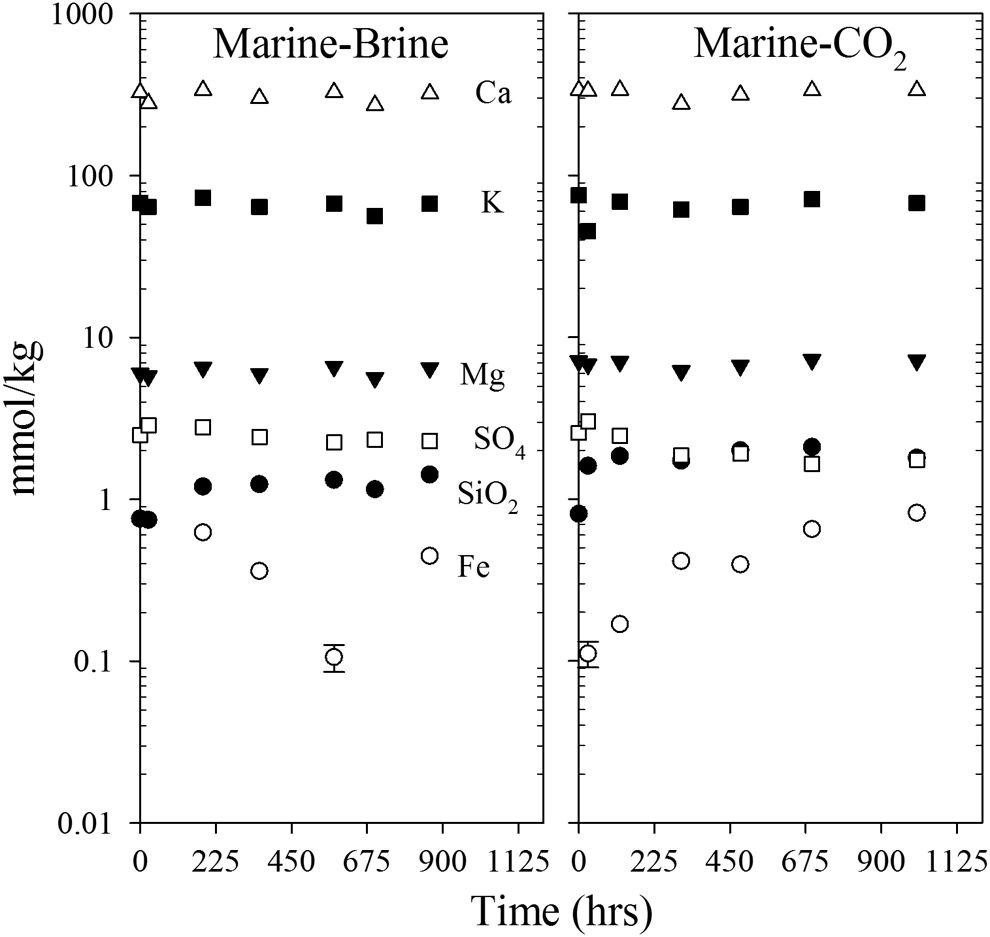
Aqueous geochemistry versus time for select analytes in brine-reacted (left) and CO2-reacted (right) Marine Tuscaloosa experiments. For clarity, only error bars that are larger than the size of the symbol are included.

Saturation index versus time for select sulfate (top), carbonate (middle), and silica (bottom) minerals in brine-reacted (left) and CO2-reacted (right) experiments of the Marine Tuscaloosa. The horizontal line at log(Q/K) = 0 indicates the brine is saturated with respect to the plotted minerals. Data that plot above the line indicate the brine is supersaturated with respect to the mineral whereas data that plot below the line indicate the brine is undersaturated with respect to the mineral. Mineral abbreviations and symbols: am-SiO2, amorphous silica (open triangles); Anh, anhydrite (closed circles); Cal, calcite (closed circles); Chal, chalcedony (closed triangles); Crs, cristobalite (open circles); Dol, dolomite (open circles); Gp, gypsum (open circles); Mgs, magnesite (open triangles); Qtz, quartz (closed circles); Trd, tridymite (open squares).

Aqueous geochemistry versus time for select analytes in brine-reacted (left) and CO2-reacted (right) Gothic shale experiments. For clarity, only error bars that are larger than the size of the symbol are included and potassium is not shown due to the large uncertainties relative to the concentrations (Table 1).
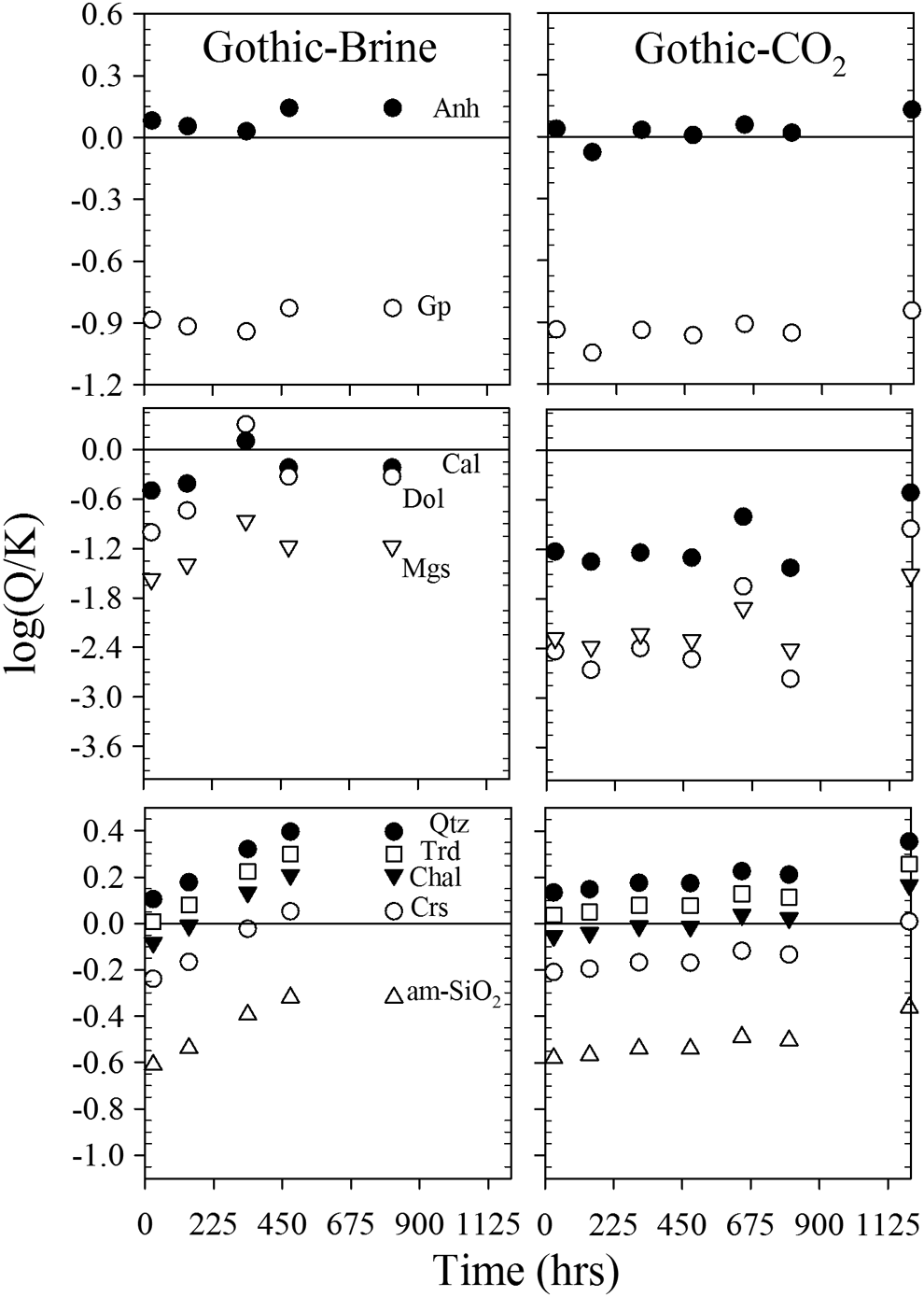
Saturation index versus time for select sulfate (top), carbonate (middle), and silica (bottom) minerals in brine-reacted (left) and CO2-reacted (right) Gothic shale experiments. The horizontal line at log(Q/K) = 0 indicates the brine is saturated with respect to the plotted minerals. Data that plot above the line indicate the brine is supersaturated with respect to the mineral whereas data that plot below the line indicate the brine is undersaturated with respect to the mineral.
Temporal evolution of pH
The pH of the Marine-Brine experiment decreased from a value of 5.8 (24 h sample) to 5.2 (187 h sample) and, with the exception of the anomalous sample at 354 h (Table 1), remained relatively constant for the duration of the experiment (Fig. 1). In contrast, pH in the Gothic-Brine experiment and both CO2-reacted experiments remained relatively constant (Fig. 1). The pH values of the Marine-CO2 and Gothic-CO2 experiments were approximately 1.5–2 pH units lower than those of the brine-reacted baseline experiments (Fig. 1), results consistent with other experimental studies of CO2-water-rock interactions (Chopping and Kaszuba, 2012; Lo Ré et al., 2014; Marcon and Kaszuba, 2015). The lower pH of the CO2-reacted experiments was caused by dissolution of supercritical CO2 into the brine and subsequent generation of carbonic acid. The pH in these two experiments remained relatively constant (∼3.5) for the duration of each experiment. This uniform pH is due to the supercritical CO2 headspace, which functions as an infinite reservoir of CO2 that controls the carbonic acid equilibria.
Marine Tuscaloosa experiments
Concentrations of magnesium and calcium remained relatively constant at ∼6.5 and ∼315 mmol/kg, respectively, for the duration of both the Marine-CO2 and Marine-Brine experiments (Fig. 2). In contrast, concentrations of dissolved silica, iron, and sulfate exhibited important differences between the two experiments. Relative to the brine chemistry of the Marine-Brine experiment and the initial (0 h) brine composition of the Marine-CO2 experiment, iron concentrations in the brine steadily increased throughout the duration of the 1,006 h Marine-CO2 experiment (Table 1 and Fig. 2). Similar behavior was observed for silica, except the increase was an initial spike in concentration after 24 h of reaction, followed by a gradual attainment of a steady state concentration that was elevated by ∼0.6 mmol/kg relative to that of the Marine-Brine experiment. Elevated aqueous silica is consistent with silicate dissolution and scanning electron microscopy imaging of reacted Marine-CO2 samples reported by Mouzakis et al. (2016), which revealed that new pores developed on the sheet silicates. Lastly, both experiments exhibited initial spikes of aqueous sulfate concentrations after ∼24 h, after which the concentrations gradually decreased to or below initial the sulfate concentrations of ∼2.5 mmol/kg (Fig. 2). The magnitude of the decrease was twice as much for the Marine-CO2 experiment than that of the Marine-Brine. As described in the following paragraphs, these aqueous trends are consistent with removal from, and addition to, the brine by mineral precipitation and dissolution, respectively.
Saturation state calculations (Fig. 3) provide insight into mineral stability at experimental conditions. Throughout the duration of both experiments, the brine was saturated with respect to anhydrite and undersaturated with respect to gypsum. The Marine-Brine fluid was always supersaturated with respect to anhydrite, while the Marine-CO2 brine started supersaturated and became saturated after 300 h. These saturation states are consistent with neoformed calcium sulfate precipitates observed by Mouzakis et al. (2016) and indicate that these precipitates are likely anhydrite. Those workers observed a greater extent of calcium sulfate precipitation in the Marine-CO2 than the Marine-Brine experiment. Trends in anhydrite saturation indices, decreasing aqueous sulfate concentrations, and the relative abundance of precipitates observed are consistent with enhanced anhydrite precipitation in Marine-CO2 compared to Marine-Brine experiments.
The brine was undersaturated with respect to the carbonate minerals calcite, dolomite, and magnesite for both Marine-CO2 and Marine-Brine experiments (Fig. 3). The saturation indices display no coherent trend, and continuous carbonate undersaturation is the only commonality for both experiments. On average, brine in the Marine-CO2 experiment is more undersaturated with respect to carbonates than that of the Marine-Brine baseline experiment. This relationship is consistent with the decreased pH conditions induced by dissolution of CO2 into brine. Elevated iron concentrations in Marine-CO2 are likely due to enhanced dissolution of iron-containing carbonates. While the iron could, in principle, also be derived from another mineral such as chlorite or pyrite, carbonate dissolution is the more likely source due to the elevated dissolution kinetics of carbonates at lower pH (Palandri and Kharaka, 2004; Kaszuba et al., 2013). Additionally, the chlorite in the sandstone reservoir below the Marine Tuscaloosa was found to be a nonreactive armoring component (Lu et al., 2012). Although oxidative pyrite dissolution has been observed in experiments that react rocks with CO2 and an oxygen additive (Jung et al., 2013), imaging by Mouzakis et al. (2016) did not reveal evidence of pyrite dissolution, likely due to the argon sparging of the initial brine. Due to the high concentrations of calcium in the initial brines and the high water to rock ratio of ∼54:1 (Mouzakis et al., 2016), contributions from magnesium- and calcium-releasing carbonate dissolution and juxtaposed calcium-consuming anhydrite precipitation reactions were not evident in the near-constant aqueous calcium concentration trends.
Lastly, the elevated silica concentrations in the Marine-CO2 brine correspond to saturation indices greater than zero for quartz and other silica polymorphs, and are consistent with silicate mineral dissolution. Compared to the Marine-Brine results, the Marine-CO2 saturation indices for quartz, chalcedony, cristobalite and tridymite, and amorphous silica experienced greater increases (Fig. 3). Saturation indices for opal proxies, cristobalite and tridymite, were calculated to provide insight into a broad range of cryptocrystalline and/or amorphous silica behavior. Silica supersaturation and inhibition of quartz precipitation in acidic, CO2-charged fluids is consistent with previous experimental work (Kaszuba et al., 2005) and field observations at CO2 injection sites (Kaszuba and Janecky, 2009).
Gothic Shale experiments
In contrast with the Marine Tuscaloosa experiments, the brine chemistry of both Gothic Shale experiments exhibited similar behaviors in regards to aqueous sulfate concentrations and corresponding calcium sulfate saturation indices (Figs. 4 and 5). Both brines were saturated with respect to anhydrite and undersaturated with respect to gypsum. Silicate mineral dissolution did not appear to be enhanced in the Gothic-CO2 experiment relative to the Gothic-Brine experiment. In the Gothic-Brine experiment, aqueous silica concentrations increased to a maximum of 3.4 mmol/kg after only 476 h. In contrast, it took 1,195 h of steadily increasing silica levels to reach 3.0 mmol/kg in the Gothic-CO2 experiment. Silica concentrations in the Gothic-Brine experiment appear to have been approaching steady state values, whereas silica concentrations in the Gothic-CO2 experiment continued to increase throughout the duration of the experiment. It is possible that silica concentrations may have continued to increase in the Gothic-CO2 experiment given longer reaction timescales.
Iron concentrations in the Gothic-CO2 experiment steadily increased throughout the duration of the 1,195-h experiment; no iron was measured in the initial (0 h) brine (Table 1 and Fig. 4). In contrast, aqueous iron was detected in only two samples withdrawn from the Gothic-Brine experiment (143 and 336 h). These relationships have been observed in other experimental studies of CO2-water-rock interactions in carbonate-bearing rocks (Chopping and Kaszuba, 2012) and are consistent with dissolution of iron-bearing carbonate minerals in CO2-charged brine relative to the control brine experiment. Despite fluctuations in the saturation states (Fig. 5), it is clear that the CO2-charged brine was more undersaturated with respect to the carbonate minerals, which indicates enhanced carbonate dissolution in the Gothic-CO2 experiment relative to the Gothic-Brine experiment.
Mineral precipitation
Understanding secondary phase formation is important, as it has the potential to alter caprock wetting properties and subsequent effectiveness as a seal (Chiquet et al., 2007). To provide insight into potential mineral transformations, activity diagrams were developed to investigate mineral stability relationships in the system Na2O-Al2O3-SiO2-H2O. Other than the 24-h sample (Table 1), brine in the Marine-Brine experiment is in equilibrium with albite and kaolinite and the silica activity is controlled by the solubility of quartz (Fig. 6). These relationships are consistent with the mineralogy of the Marine Tuscaloosa shale (Heath et al., 2011; Mouzakis et al., 2016). In contrast, brine samples from the Marine-CO2 experiment cluster in the middle of the kaolinite stability field, indicating the potential for albite dissolution and kaolinite precipitation when the shale-brine system is exposed to supercritical CO2 (Fig. 6). Additionally, the silica activity shifts to being controlled by the solubility of chalcedony and tridymite (opal proxy) instead of quartz. The predicted mineral stabilities for the Gothic-Brine experiment are consistent with the mineralogy of the Gothic Shale (Heath et al., 2011; Mouzakis et al., 2016). The fluid chemistries of the Gothic-Brine experiment indicate that albite and muscovite (illite proxy) are in equilibrium, whereas albite dissolution and muscovite precipitation are favored in the Gothic-CO2 experiment (Fig. 7). In both Gothic Shale experiments, the controls on silica activity shift from tridymite to chalcedony and finally to cristobalite solubility (Figs. 5 and 7). The solubility of amorphous silica could ultimately control silica activity in a longer-duration Gothic-CO2 experiment.

Mineral stability relationships for the system Na2O-Al2O3-SiO2-H2O constructed for Marine Tuscaloosa experiments at 160°C and 15 MPa. The dashed vertical lines represent saturation with respect to quartz, chalcedony, proxies for opal (cristobalite and tridymite), and amorphous silica. The chemistry of the CO2-saturated brine (Table 1) was used to construct the diagram. Activities of aqueous species for individual samples are plotted on the diagram; brine-reacted experiments are denoted by filled symbols and CO2-reacted experiments in open symbols. Numbers in the inset legend indicate the hours of reaction time in the experiment (Table 1).

Mineral stability relationships for the system Na2O-Al2O3-SiO2-H2O constructed for Gothic experiments at 160°C and 15 MPa. The dashed vertical lines represent saturation with respect to quartz, chalcedony, proxies for opal (cristobalite and tridymite), and amorphous silica. The chemistry of the CO2-saturated brine (Table 1) was used to construct the diagram. Activities of aqueous species for individual samples are plotted on the diagram; brine-reacted experiments are denoted by filled symbols and CO2-reacted experiments in open symbols. Numbers in the inset legend indicate the hours of reaction time in the experiment (Table 1).
Potential for secondary mineral formation has implications for the evolution of porosity and permeability in shale formations. Precipitation in pores and pore throats and/or mobilization of neoformed precipitates (fines migration) derived from silicate mineral alteration and from silica-laden waters could potentially decrease the permeability of caprocks, which would be beneficial for carbon storage. In the context of hydrocarbon production in tight formations, these processes have the potential to negatively impact injectivity and reservoir transmissivity.
Mouzakis et al. (2016) reported newly formed, possibly sodium-bearing, aluminosilicate precipitates in reacted rock samples recovered from both brine-reacted experiments but not the CO2-reacted experiments. These minerals may be sodium-zeolites, potentially analcime, minerals that have not been identified in either the unreacted Gothic Shale or the unreacted Marine Tuscaloosa. Precipitation of analcime is consistent with the aqueous geochemistry of the 24-h sample of the Marine-Brine experiment (Fig. 6) and with temporal trends of the aqueous geochemistry of both brine-reacted experiments (Figs. 6 and 7). Other experimental brine+rock ± CO2 studies observed analcime precipitation only in brine-reacted experiments, as the high silica concentrations and low pH of CO2-saturated brine are not conducive to analcime stability (Alemu et al., 2011; Lo Ré et al., 2014). While analcime was observed in some CO2-reacted experiments (Kaszuba et al., 2003, 2005), its formation in those studies is likely due to much higher initial concentrations of sodium in the brine, which promotes analcime stability.
Comparative physicochemical reactivity
Differences in the evolution of the aqueous geochemistry in the experiments suggests that the Marine Tuscaloosa was more reactive than the Gothic Shale after exposure to CO2-saturated brine, which is consistent with the results of Mouzakis et al. (2016). Mobilization and scavenging of aqueous constituents by dissolving and precipitating minerals was pronounced in the Marine-CO2 experiment, while differences in aqueous geochemistry between the Gothic-Brine and Gothic-CO2 experiments were minor. The evolution of the aqueous geochemistry in these experiments is consistent with mineralogic and petrophysical changes described by Mouzakis et al. (2016), who observed relatively limited differences between pore network features of Gothic-Brine and Gothic-CO2 samples. However, the specific surface area, total porosity, and unconnected porosity increased in the Marine-CO2 sample compared to unreacted Marine Tuscaloosa and Marine-Brine samples (Mouzakis et al., 2016). The agreement between the rock- and fluid-focused studies emphasizes the importance of aqueous geochemistry as an effective tracer of in situ processes and highlights the continued value of experimentally derived geochemical data for clarifying coupled physicochemical subsurface processes.
Conclusions
This study utilized experimentally derived aqueous geochemistry to evaluate the effects of CO2 on brine-shale interactions for two distinct and representative CCUS caprock samples. Mineral stabilities, reaction paths, and extent of transformation were investigated. Evidence of caprock alteration includes release of iron from carbonate dissolution, supersaturation of brine with respect to quartz from silicate mineral dissolution, and precipitation of anhydrite. Differences in geochemical evolution of brine reacting with caprocks highlight the variable susceptibility of shales to reaction with CO2-saturated brines. Distinctive geochemical signatures that developed are consistent with mineral precipitation and pore-developing dissolution of the shales (Mouzakis et al., 2016). Coupling aqueous geochemistry with mineralogic data is vital for constraining parameters that are used in reactive transport models to predict the fate and transport of CO2 in the subsurface (Gaus et al., 2005; Xu et al., 2005).
We recommend that future work evaluate three additional aspects of shale reactivity. First, workers should investigate how fluid-rock ratios impact reactions, as the ratios may vary spatially and temporally in these systems, and the resultant data would be useful for parameterizing reservoir models. Secondly, reactions involving both minerals and organic matter, such as ion exchange, adsorption, and intercalation, do not conform to the simplified framework of mineral dissolution and precipitation. These reactions may obscure predicted aqueous trends and complicate interpretation of experimental data; therefore, these interactions need to be evaluated. Lastly, the potential for mineral transformations induced by interactions between water-bearing supercritical CO2 and shale (McGrail et al., 2009; Loring et al., 2012; Schaef et al., 2015) requires evaluation.
Footnotes
Acknowledgments
Q.R.S.M. acknowledges support from the University of Wyoming School of Energy Resources and a Center for Advanced Energy Studies Graduate Assistantship award. Q.R.S.M. also acknowledges support from the U.S. Department of Energy, Office of Science, Office of Workforce Development for Teachers and Scientists, Office of Science Graduate Student Research (SCGSR) program. The SCGSR program is administered by the Oak Ridge Institute for Science and Education for the DOE under contract number DE-AC05-06OR23100. The authors acknowledge support from an EPA Star Grant R834387 to J.M., R.J. Maxwell, A.K.N.-S., and J.K., and by a United States Department of Energy Grant DE-FE0000730 to J.M. and A.K.N.-S. J.K.'s work was also supported by the University of Wyoming School of Energy Resources. G.R. was supported as part of the Nanoscale Control of Geologic CO2 Center, an Energy Frontier Research Center funded by the United States Department of Energy Office of Science and Office of Basic Energy Science. We acknowledge The Laboratory for Environmental and Geological Studies at the University of Colorado, particularly Fredrick G. Luiszer, for aqueous analyses. The authors also are grateful for the feedback of three anonymous reviewers, whose suggestions helped strengthen the article.
Author Disclosure Statement
No competing financial interests exist.