




Abstract
Abstract
Rapid development of hydraulic fracturing for natural gas production from shale reservoirs presents a significant challenge related to the management of the high-salinity wastewaters that return to the surface. In addition to high total dissolved solids (TDS), shale gas-produced brines typically contain elevated concentrations of radium (Ra), which must be treated properly to prevent contamination of surface waters and allow for safe disposal or reuse of produced water. Treatment strategies that isolate radium in the lowest volume waste streams would be desirable to reduce disposal cost and generate useful treatment by-products. The present study evaluates the potential of a commercial strong acid cation exchange resin for removing Ra2+ from high-TDS brines using fixed-bed column reactors. Column reactors were operated with varying brine chemistries and salinities in an effort to find optimal conditions for Ra2+ removal through ion exchange. To overcome competing divalent cations present in the brine for exchange sites, the chelating agent, EDTA, was used to form stable complexes predominantly with the higher concentration Ca2+, Mg2+, and Sr2+ divalent cations, while isolating the much lower concentration Ra2+ species. Results showed that Ra2+ removal by the resin strongly depended on the TDS concentration and could be improved with careful selection of EDTA concentration. This strategy of metal chelation coupled with ion exchange resins may be effective in enhancing Ra2+ removal and reducing the generation and disposal cost if volume reduction of low-level radioactive solid waste can be achieved.
Introduction
A
While recycling and reuse of flowback water rely on adequate treatment, the presence of naturally occurring radionuclide materials (NORMs) at elevated levels in these waters poses a unique challenge to conventional treatment strategies. For example, Marcellus Shale-produced water contains total radium (Ra) activity up to 18,000 picocuries per liter (pCi/L), with a median value of 2,470 pCi/L (Rowan, 2011). Current EPA regulations, in comparison, mandate that Ra activities in drinking water and industrial effluents must be below 5 and 60 pCi/L, respectively (U.S. Nuclear Regulatory Commission, 2013). Conventional treatment technologies, such as osmosis, distillation, and electrodialysis, are either cost prohibitive or nonselective for Ra removal from flowback wastewater (Fakhru'l-Razi et al., 2009). Soluble over a wide range of pH and redox conditions, radioisotopes, 226Ra and 228Ra, can be easily transported from geologic reservoirs to surface facilities, together with an abundance of alkaline metals and organic compounds (Fisher, 1995). Radium activity in produced waters has been found to positively correlate with total dissolved solid (TDS) concentrations, particularly from Marcellus Shale wells (Fisher, 1998; Rowan, 2011). Previous studies have implicated the accumulation of Ra in stream sediments of western Pennsylvania due to inadequate removal of Ra from high-salinity NORM-rich Marcellus waste fluids (Warner et al., 2013). High Ra levels were also observed in reserve pit sludge from hydraulic fracturing and drilling activities (Rich, 2013). The exposure of Ra through inhalation and ingestion can introduce an internal dose of radioactivity and potentially cause cancer (Boice and Lubin, 1997). The decay products of Ra, that is, gaseous and highly toxic radon (Rn), can lead to an additional health hazard (Zhang et al., 2015). Therefore, effective management of the large volumes of wastewaters containing dissolved Ra isotopes is required to minimize the environmental and health risks.
The most cost-effective existing approach to remove Ra from high-TDS brines is sulfate precipitation (Zhang et al., 2014). Radium coprecipitates with barite [BaSO4(s)] during secondary treatment to remove Ba2+ from brine, generating (Ba,Ra)SO4 solid solution with a Ba:Ra ratio on the order of 1,000:6 (Grandia et al., 2008). However, this strategy may result in large volumes of low-level radioactive (Ba,Ra)SO4(s) sludge that must be properly disposed of in landfills permitted to handle this type of waste material. Such sludge by-products, classified as technology enhanced-NORM (TENORM), may contain radioactivity far exceeding the threshold values of management regulations in the United States and require additional dilution with NORM-free solids for safer handling (Zhang et al., 2014). To reduce disposal cost and enhance the potential for reuse or sale of barite or other salt residuals, novel approaches to remove or separate Ra from the salts and nontoxic substances present in shale gas wastewater are highly desired.
This study is motivated by the need to effectively separate Ra from shale gas production wastewater to reduce the volume of Ra-contaminated phases during treatment steps. Solid-phase partitioning provides an opportunity to concentrate Ra in a lower volume solid waste form and, in some cases, could allow subsequent separation steps (e.g., coprecipitation) to produce solid phases that are almost Ra-free, with potential commercial value (e.g., barite and CaCl2 salts). Ion exchange materials are potentially well suited for the removal of Ra and other ionic species due to relatively high removal efficiency, low regeneration costs, and effective response to alternations of pollutant concentration levels (International Atomic Energy Agency, 2002; Chalupnik et al., 2013). Cation exchange resins have been successfully used for the removal of naturally occurring Ra in groundwater (Snoeyink et al., 1987; Deng, 2005; El-Shrakawy et al., 2013). The effective application of resin in the treatment of high-TDS brines associated with shale gas production, however, has not been demonstrated.
The present work aims to test the feasibility of using ion exchange resin to effectively remove Ra from synthetic high-TDS brines. The cation exchange reaction was performed in a fixed-bed column reactor packed with Purolite® C100E resin. The concentrations of individual salt and TDS in the synthetic brines were varied to examine their influence on Ra removal capacity and efficiency of the resin. The chelating agent EDTA was added to enhance Ra removal by reducing the competition from divalent cations for exchange sites. The combined effects of varying salinity and EDTA concentration were also investigated to determine the optimal levels of EDTA for enhancing Ra ion exchange. The results provide a first assessment of the capacity and controlling factors of ion exchange processes for Ra removal from high-TDS brines, which have practical implications for developing ion exchange processes for treating NORMs in shale gas wastewater.
Materials and Methods
Reagents and samples
Unless stated otherwise, all chemicals used for solution preparation were of analytical reagent grade. MilliQ water with a resistivity of 18.3 MΩ·cm was used throughout. Raw, synthetic brine solutions containing sodium, magnesium, calcium, barium, and strontium were prepared in the laboratory by dissolving NaCl, MgCl2•6H2O, CaCl2•2H2O, BaCl2•2H2O, and SrCl2•6H2O salts in a 1-L volumetric flask. The resulting ion concentrations covered a range of ion mixtures and levels of TDS (4,500–69,800 mg/L), which are close to median values of typical brine composition of Marcellus Shale gas fluids. In this study, Ra was used to represent total Ra isotopes under the assumption that 226Ra and 228Ra have similar ion exchange behavior. A stock 226Ra(NO3)2 standard solution in 1 M HNO3 was purchased from Eckert & Ziegler (Catalog No. 7226) at a radioactivity of 10.6 μCi/L. One milliliter of the Ra stock solution was added to the 1-L flask to achieve a final activity of 10.6 nCi-Ra/L. The pH of the initial solution was then adjusted to pH 2 or 6 using a 1 M hydrochloric acid or sodium hydroxide solution, respectively. A summary of chemical properties of the synthetic brine solutions used in this study is provided in Table 1 and Supplementary Table S1.
Supplementary Table S1 shows different units for concentration (ppm) and radioactivity (Bq) of radium.
TDS, total dissolved solids.
To test the effect of metal-complexing ligand on Ra removal by ion exchange, high-TDS water was amended with varied concentrations of ethylenediaminetetraacetic acid disodium salt (disodium-EDTA) before passing through a resin column. Disodium EDTA salt was dissolved in the Ra-containing solution described above by adjusting the solution pH to a value of 6. The pH value was selected to facilitate dissolution of EDTA and complexation of deprotonated EDTA with metal cations. The solution was then continuously stirred overnight to reach equilibrium for metal complexation. The final EDTA concentration in the high-TDS water was adjusted to be approximately the same value as the total divalent cation concentration. The purpose of doing so was to complex nearly all of the higher concentration divalent cations (i.e., Mg2+, Ca2+, Sr2+, and Ba2+) with EDTA to limit their potential for competition with Ra2+ for ion exchange sites. Speciation modeling simulations (Supplementary Fig. S1) showed that this strategy was feasible for isolating free Ra2+ from other divalent cations present. Most divalent ions except Ra2+ were complexed by EDTA, so their interactions with cation exchange resin would be minimized.
Commercial SAC resin
Purolite C100E is an inexpensive Na-form strong acid cation (SAC) exchange resin with a macroreticular cross-linked polystyrene–divinylbenzene (DVB) matrix structure and anionic sulfonate groups. This resin has been commonly used for industrial water softening and demineralization due to its high affinity for alkaline earth metals and heavy metals (Abo-Farha et al., 2009; Radosavlevici and Robescu, 2013). A package of 1 pound of resin was supplied by Purolite (Bala Cynwyd, PA). The total capacity of this resin, defined as the total number of charge equivalents available for exchange per unit weight, is ∼2.2 meq/g. Other characteristics of the resin are listed in Table 2.
Method approach
Fixed-bed column for Ra removal by Purolite resin
Column experiments were carried out in fixed-bed glass columns (10 mm i.d., 300 mm depth) (Kimble-Chase Kontes™) consisting of a glass barrel and two PTFE end fittings with 20 μm porosity polyethylene bed supports. A schematic of the column reactor system used in this study is shown in Figure 1. The column was uniformly packed with 10.2 g Purolite C100E resin, which corresponds to a bed volume (BV) of ∼12 cm3. Before the start of experiment, the column was backwashed by MilliQ water so that the resin was suspended for 30 min to remove air bubbles trapped between particles. For the experiments amended with EDTA, the resin was preconditioned by 100 mL of 100 g/L (1.7 M) NaCl solution to remove residual H+ in the resin. The preconditioning process included two stages: a slow rinse with a flow rate of 1.5 mL/min for 45 min, followed by a final rinse at 2 mL/min for 18 min. The resin was then rinsed by 100 mL MilliQ water in counterflow mode and allowed to settle by gravity for a compact bed. Preconditioning allowed a stable effluent pH to be maintained at high salinity during Ra2+ removal.

Schematic of fixed-bed column reactor system for Ra2+ removal by Purolite® C100E cation exchange resin.
During column operation, 1 L of high-TDS water containing ∼10.6 nCi/L Ra was pumped downward through the column at a flow rate of ∼1.2 mL/min using a Masterflex 7553 peristaltic pump (Cole-Parmer Instrument Co., Vernon Hills, IL). Varied salt concentration was used to investigate the impact of TDS on ion exchange. EDTA-amended high-TDS water was used for reducing salt interference and improving Ra2+ removal. The empty bed contact time was designed to be ∼10 min. Periodically, the pH and conductivity of the effluent were monitored with probes installed at the end of the supply line. Samples of ∼4 mL were collected from the effluent end of the column every 30 min. The samples were then acidified with 2% nitric acid (pH <2) and transferred to high-density polyethylene plastic tubes. All samples were stored in a refrigerator at 4°C before measurement, and then analyzed within 1 week of sample collection date. In all experiments, the resin columns were eluted up to exhaustion to obtain the complete S-shape Ra2+ breakthrough curve, which was plotted as BVs of processed wastewater vs. effluent Ra2+ concentration. Most experiments were run in duplicates to test the reproducibility of Ra2+ removal under a given set of experimental conditions. All experiments were performed at room temperature (23°C ± 1°C).
Ra measurement
An Agilent 7900 inductively coupled plasma mass spectrometer (ICP-MS) was used to determine the concentrations of 226Ra and other major cations (i.e., Na, Ca, Mg, Sr, and Ba) in reference standards and samples. The measurement of Ra was conducted in HEHe mode using a nonreactive helium gas and kinetic energy discrimination process. Detection limit was determined to be 0.1 ng/L (equal to 0.1 nCi-Ra/L). The uncertainty of Ra measurement by ICP-MS was estimated to be 10% above 0.5 nCi/L and >20% below 0.5 nCi/L. The effluent samples were diluted with 2% nitric acid before analysis to limit interference during metal analysis. The reproducibility of this analytical procedure is within 5% for alkaline metals. Details of instrument components, operating conditions, and data acquisition parameters are summarized in the Supporting Information (Supplementary Table S2).
Mathematical description
The concentration of Ra (nCi/g) and other metal ions (mmol/g) bound on the resin at equilibrium QE corresponds to the maximum capacity of the resin at the exhaustion point qE, and it is defined as the total amount of metal ions bound per gram of resin at the exhaustion time:
where nE (nCi or mmol) is the quantity of metals bound during the process in the column and m (g) the mass of resin.
The total quantity of metals bound in a fixed bed of resin for a given feed concentration and flow rate through the column is determined by integrating the area above the breakthrough curve and can be calculated according to the following equation:
where nE (nCi or mmol) is the total amount of metal ions bound in a fixed bed of resin; c0 (nCi/L or mmol/L) is influent concentration; c (nCi/L or mmol/L) is effluent concentration of metal ions; Q (L/h) is flow rate; t (h) is time; and tE (h) is time necessary to reach the point of exhaustion of the resin bed.
The total amount of metal ions nT (nCi or mmol) that enter the resin column is calculated by the following equation:
The Ra2+ removal efficiency by resin is defined as the ratio of the total quantity of Ra2+ removed until exhaustion (nE) to the total amount of Ra sent to the column (nT) and is given by the following equation:
Results and Discussion
Preferential removal of Ra by ion exchange resin
Synthetic high-TDS brine containing Ra (Table 1) was treated by directly passing it through fixed-bed column reactors packed with Purolite C100E resin. Figure 2 shows an example (Experiment No. 1) of breakthrough curves of Na+, Mg2+, Ca2+, Ba2+, Sr2+, and Ra2+ collected in the effluent as a function of time. With TDS of ∼52,800 mg/L, the SAC resin showed preferential removal of divalent cations, which followed the order of Ra2+ >Ba2+ >Sr2+ >Ca2+ >Mg2+. The Ra2+ remained negligible in the effluent for the first nine BVs, after which the concentration continuously increased over the next 30 BVs until reaching the initial influent concentration (10.6 nCi/L). The slope of the breakthrough curve indicates incomplete removal of Ra2+ by the resin before its exhaustion. The removal efficiency [Eq. (4)] is estimated to be 50%, indicating the presence of a concentration gradient of Ra2+ within the column. Duplicate experiments demonstrate consistent resin performance for Ra removal from this high-TDS water. The total capacity of resin for Ra2+ based on the breakthrough curve [Eq. (2)] is estimated to be 2.47 nCi, with a mass-normalized working capacity of 0.24 ± 0.06 nCi/g.
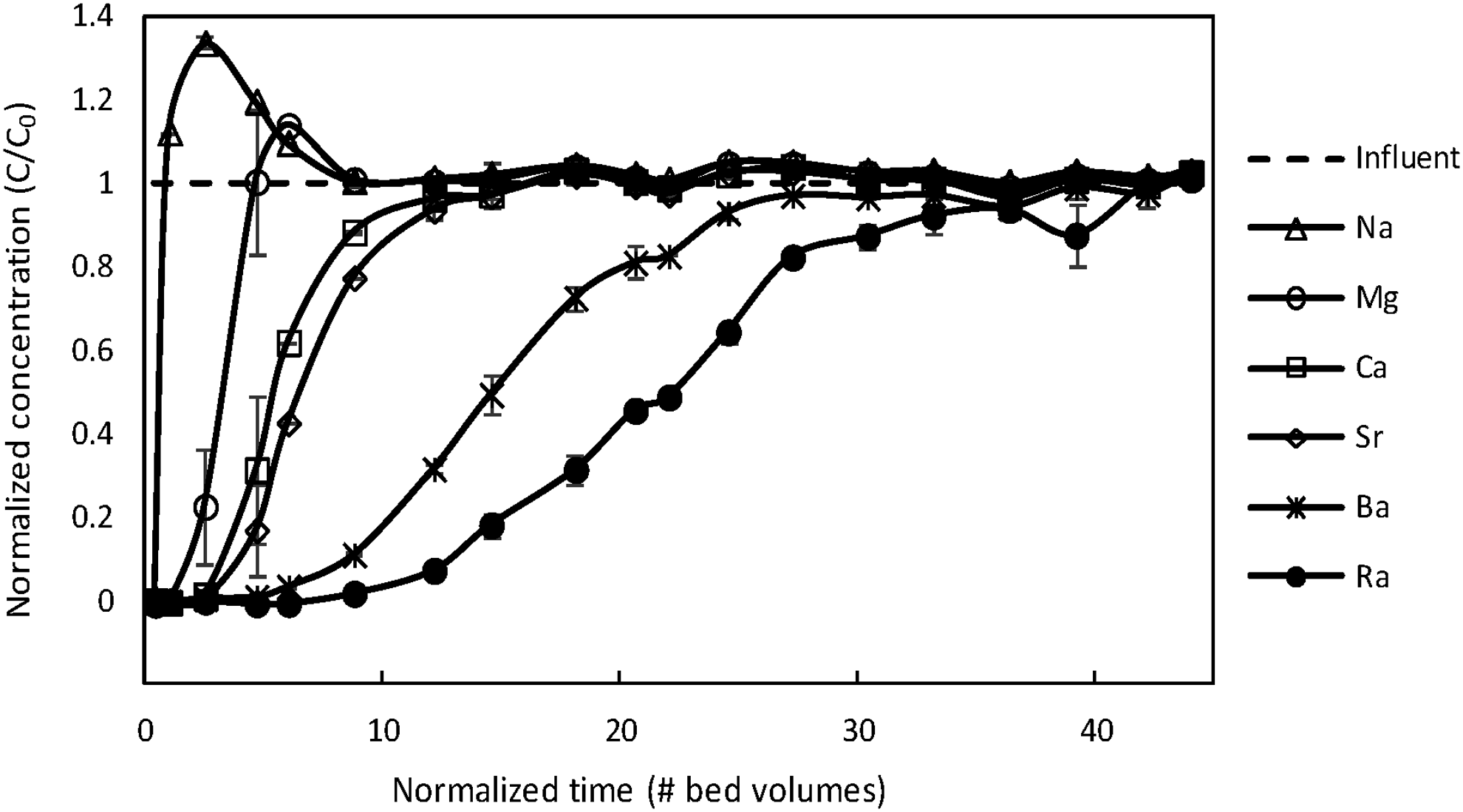
Breakthrough curves of Na+, Mg2+, Ca2+, Ba2+, Sr2+, and Ra2+ during the treatment of synthetic high-TDS brines by Purolite C100E cation exchange resin. Concentrations of cations are normalized to the influent values (C/C0). Data points are the average concentrations of duplicate experiments; error bars for each point represent the range of concentration from duplicate experiments. TDS, total dissolved solids.
At a feed concentration of 0.94 mM, the breakthrough of Ba2+ occurred slightly before Ra2+, taking ∼30 BVs until the resin reached saturation. Compared with the Ra2+, Ba2+ concentration in the effluent increased at a faster rate, reflected by a steeper slope of the breakthrough curve. Between 10 and 30 BVs, clear separation between Ba2+ and Ra2+ was achieved by the SAC resin. By the time the effluent concentration of Ra2+ reached the concentration of ∼1.0 nCi/L, the Ba2+ effluent concentration was already 38% of its influent value (0.36 mM). The higher selectivity for Ra2+ reflects greater affinity of the resin for larger cations, which have lower hydration energy and greater ability to shed waters of hydration upon ion exchange (International Atomic Energy Agency, 2002). Although the influent Ba2+ concentration is more than 10 orders of magnitude higher than Ra2+, selectivity of the resin for Ra2+ still surpasses that for Ba2+. In comparison, the resin capacity for Ba2+ is estimated to be 0.033 meq/g, which is ∼106 times greater than for Ra (Table 3).
The removal of different divalent cations by the resin was calculated based on their individual breakthrough curves.
Utilized capacity is the ratio of calculated total resin capacity to the theoretical capacity (2.2 meq/g).
At influent concentrations of 98 mM and 10.3 mM, respectively, Ca2+ and Sr2+ followed close trends in the breakthrough curves and required much shorter time to reach their influent levels (Fig. 2). The faster breakthrough is consistent with expected lower selectivity for these cations based on their smaller ionic radii (IR) compared with Ba2+ and Ra2+. With the smallest IR among the divalent cations, Mg2+ exhibited the weakest interaction with SAC resin and was detected in the effluent immediately after initiation of the experiment. Between 4.5 and 8.5 BVs, Mg2+ concentration was observed to be greater than its influent level, suggesting a displacement of Mg2+ as a result of competition for exchange sites by other divalent cations. The three cations, that is, Mg2+, Ca2+, and Sr2+, consumed a combined capacity of ∼1.43 meq/g, which accounted for >90% of total capacity of the resin (Table 3). Clearly, Purolite C100E is not an Ra2+-selective resin, although it showed preferential removal of this radionuclide. With a sharp breakthrough curve, Na+ was detected in the effluent almost immediately without any significant breakthrough. The high effluent concentration of Na+ between one and nine BVs exceeds its influent level caused by release of Na+ from initial Na-saturated exchange sites after being replaced by divalent cations. It should be noted that while the influent Na+ concentration (0.65 M or 15,000 mg/L) is common for shale gas wastewater, it is substantially higher than [Na+] normally encountered in natural waters. Such high Na+ concentration may negatively affect resin capacity for other cations by saturating resin sites, and in fact, concentrated NaCl solution (up to 2 M) flushes are often used to regenerate SAC resin by replacing previously sorbed cations after repeated flushing. At this high Na+ concentration, the total divalent cation exchange capacity of the resin is 34% lower than the theoretical value (2.2 meq/g) provided by the manufacturer, likely a result of substantial Na+ competition.
Impact of sodium and competing divalent cation concentrations on Ra removal
Sodium ion is typically the most concentrated cation found in flowback wastewater, with the median Na+ concentration in Marcellus Shale wastewater of ∼25,000 mg/L (Abualfaraj et al., 2014). To assess the impact of high Na+ concentration on resin performance, experiments were performed in the absence of Na+ (Experiment No. 2, Table 1). By removing Na+ from the synthetic high-TDS water, the breakthrough of Ra2+ was delayed compared with the previous experiment using 0.65 M Na+. The removal capacity of the resin for Ra2+ increased by ∼50% to 0.36 nCi/g (Fig. 3 and Table 1). Clearly, a high concentration of Na+ can significantly reduce Ra removal by the SAC resin. This reduction essentially results from Na+ ions replacing or blocking trace quantities of Ra2+ from the exchange sites, causing an earlier Ra2+ breakthrough in effluent. Thus, the effective capacity of Purolite C100E for Ra2+ would be limited unless the concentration of Na+ is reduced before ion exchange.
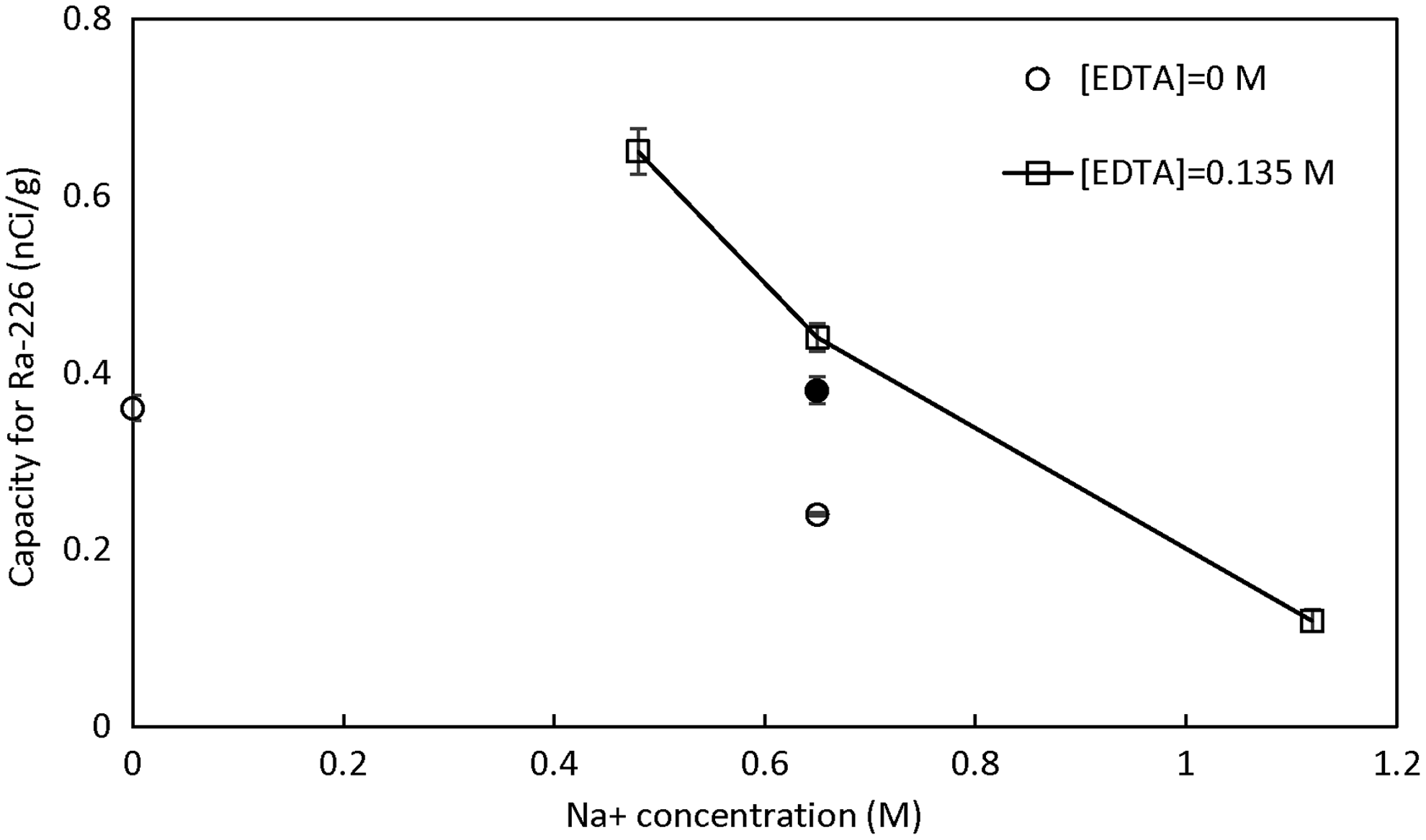
Impact of Na+ concentration (M) on resin capacity for Ra2+ removal (nCi/g) in the absence (circles) and presence (squares) of 0.135 M EDTA. The filled circle represents the experiment with 0.65 M Na+ and half the concentrations of divalent salts compared with the empty circle.
To examine the influence of competing divalent cation concentration, that is, Mg2+, Ca2+, Sr2+, and Ba2+, on resin performance, an experiment was conducted using a synthetic brine with a 50% reduction in the original concentrations of divalent cations while keeping influent Ra at 10.6 nCi/L and Na+ at 0.65 M (Experiment No. 3, Table 1). The result (Fig. 3) shows that the capacity for Ra2+ increased from 0.24 nCi/g in Experiment No. 1 to 0.38 nCi/g, responding to the lowered divalent ion concentrations. Compared with monovalent Na+, divalent cations have a greater impact on Ra2+ removal given that the sulfonated resin exchange sites generally have a greater affinity for higher charge cations. As noted previously, it is expected that divalent ions with larger IR, such as hydrated Ba2+, will be stronger competitors with Ra2+ for cation exchange sites than smaller ions, such as Ca2+ or Mg2+. By lowering the concentration of divalent cations in the brine solution, the efficiency of resin for Ra2+ removal would be expected to improve significantly.
Ra2+ removal efficiency significantly increased in an experiment with a lower total ion concentration (i.e., lower TDS, Experiment No. 4, Table 1). When both the monovalent and divalent cations were reduced to 1/10 of the initial concentration in Experiment No. 1, the effluent concentration of Ra2+ remained negligible (<0.1 nCi/L) throughout the entire period of the experiment (up to 50 BVs). Along with the greater uptake on the resin and lower Ra2+ effluent concentration, the breakthrough of every other divalent cation was also significantly delayed. The more effective removal of Ra2+ translates to a resin capacity of >0.46 nCi/g, which is almost double the value in Experiment No. 1. Consistent with previous interpretation, the improved capacity for Ra2+ is primarily attributed to the low divalent salt concentration in synthetic wastewater. In most shale gas wastewaters, Ra2+ concentration is found to be positively correlated with the TDS concentration (Rowan, 2011). Given the large variation of TDS concentration in shale gas wastewater (Chapman et al., 2012), the effectiveness of ion exchange for Ra2+ removal is likely strongly dependent on both TDS concentration and composition of the water. For example, the highest Ba2+ concentration surveyed in Marcellus flowback water is two orders of magnitude greater than those used in the present study (Abualfaraj et al., 2014). When treating such brines, the ion exchange service time and resin capacity for Ra2+ removal are expected to be negatively impacted.
Impact of EDTA on Ra removal
EDTA is a strong hexadentate chelating agent and is widely used to dissolve limescale and sequester metal ions, such as Ca2+ and Fe3+. EDTA can be used in the treatment of high-TDS water to convert positively charged cations to negatively charged anions because of the negative charge of EDTA-metal complexes and the high equilibrium stability of metal-EDTA complexes (Supplementary Table S3). The capacity of resin for competitive divalent cations may hence be reduced, enhancing the capacity of resin for uncomplexed Ra2+. According to thermodynamic modeling results (Supplementary Fig. S1), EDTA preferentially forms complexes with cations following an order of Ca2+ >Mg2+ >Sr2+ >Ba2+ >Ra2+ in a typical TDS composition for flowback wastewaters. To test its effect on Ra2+ removal, synthetic high-TDS water was amended with 0.135 M EDTA (Experiment No. 5, Table 1) based on equilibrium calculations so that >99% of Ca2+, Mg2+, and Sr2+; >80% of Ba2+; and <3% of Ra2+ became complexed by EDTA. The total metal concentrations in the amended synthetic brine remained the same as in Experiment No. 1. The negatively charged metal-EDTA, such as Ba-EDTA2−, would pose less competition with Ra for sulfonate groups, and subsequently the capacity for removal of Ra would be enhanced.
The breakthrough of Na+, Mg2+, Ca2+, and Sr2+ in the resin column occurred almost immediately for the EDTA-amended brine (Fig. 4) as expected from speciation modeling. The breakthrough of Ba2+ also shifted to an earlier time compared with Fig. 2, while the exit of Ra2+ was delayed. The results demonstrated that EDTA improved separation of Ra2+ from other divalent mineral ions. The capacity of resin for Ra2+ increased to 0.42 nCi/g, which was about 1.8 times the value without treatment by EDTA. It should be noted, however, that the effectiveness of EDTA treatment depends on its quantity relative to original salt concentrations in the brine. If the EDTA dose is excessively high, Ra2+ could also become complexed and negatively charged. In a subsequent experiment, 0.17 M EDTA was added and more than 90% of Ra2+ was calculated to be transformed to Ra-EDTA2−. The breakthrough of Ra2+ thus occurred shortly after the start of experiment, causing significantly reduced Ra2+ removal of 0.04 nCi/g. Therefore, when selecting an EDTA dose to complex competing divalent cations to enhance Ra2+ removal through ion exchange resins, the chemical composition of TDS in the wastewater would need to be relatively well characterized. Knowing the total concentrations of the competitive ions that may otherwise out-compete Ra2+ for exchange sites on the resin would be needed to optimize the treatment process for maximum Ra2+ removal efficiency. For wastewater accumulating in waste ponds, and waiting for treatment, this would likely be a relatively easily obtainable quantity.

Breakthrough curves of Na+, Mg2+, Ca2+, Sr2+, Ba2+, and Ra2+ in the presence of 0.135 M EDTA. Data points of Ra2+ in the figure are the average of duplicate experiments; error bars represent the range of concentration determined in duplicate experiments.
Impact of Na+ on Ra2+ removal in the presence of EDTA
Because Na+ does not form strong complexes with EDTA, the presence of Na+ ions in solution may have a negative impact on Ra2+ exchange on the resin, as noted previously, even when EDTA has been added. An experiment was performed to assess this possibility at the same 0.135 M EDTA, but a higher Na+ concentration of 1.12 M (Experiment No. 8, Table 1). In this case, Ra2+ removal capacity of resin decreased to 0.12 nCi/g (Fig. 3 and Table 1). Conversely, by reducing the Na+ concentration to 0.48 M (Experiment No. 7, Table 1), the removal capacity for Ra2+ increased to 0.65 nCi/g. Noticeably, however, even this high value of Ra2+ capacity of the resin was still significantly lower than the theoretical maximum value (2.2 meq/g) reported for the resin cation exchange capacity (Table 2). While the complexed divalent cations no longer exhibited strong competition with Ra2+ for exchange sites, the preponderance of Na+-bound sites still substantially diminished Ra2+ ion uptake by the resin. Because EDTA was added to the solution in the form of disodium-EDTA, Na+ was inherently present in the amended wastewater for the experiments in this study. In addition, to dissolve EDTA and facilitate metal complexation, the solution pH solution was adjusted to 6.0 by adding NaOH solution, which also increased the total Na+ concentration. Since more Na+ was introduced by adding EDTA, the present study was not optimal for enhancing Ra2+ removal. For instance, after adding 0.11 M EDTA to a wastewater with the same composition as Experiment No. 1 (0.65 M Na+), the Ra2+ removal capacity of the resin (0.23 nCi/g) stayed relatively unchanged (Table 1). The resulting higher concentration of Na+ (0.93 M) essentially neutralized the potential effectiveness of EDTA amendment for Ra2+ removal. Thus, EDTA should be added at a concentration or chemical form that minimizes Na+ addition to the extent possible to improve this process.
This work shows that the inclusion of a pretreatment step of adding EDTA can help improve Ra2+ removal through cation exchange by sequestering competing major divalent cations in high-TDS wastewater. However, implementation of the process relies on knowing the amount of EDTA that would need to be added (e.g., such as could be estimated based on TDS). In addition, the coincident introduction of Na+ by a sodium EDTA salt form would need to be avoided to the extent possible to take full advantage of the beneficial effect of complexing the competing major divalent cations, that is, Mg2+, Ca2+, Sr2+, and Ba2+, in high-TDS brines. An initial treatment step for lowering the Na+ concentration after EDTA addition may be necessary for getting the full benefit of adding EDTA. Alternatively, Ra2+ chelating ligands with greater selectivity over other divalent cations may be needed for optimizing ion exchange resins for effective Ra2+ removal from high-TDS wastewater (Chiarizia et al., 1998). The recent development of chelating agents, such as crown ethers, has shown promise for extracting Ra2+ from gas field-produced water (van Leeuwen et al., 2005). It is likely that generic cation exchange resins with sulfonate or diphosphonate groups can be functionalized with such compounds for improved selectivity and separation of Ra2+ from other constituents (Dietz et al., 1997), but the feasibility and effectiveness of more highly selective chelating agents will require further investigation.
Conclusions
Presence of radioactive Ra isotopes in shale gas wastewater poses a unique challenge to common pretreatment strategies because of its propensity to coprecipitate with scaling minerals (e.g., BaSO4(s)). This study has demonstrated that a commercially available cation exchange resin (Purolite C100E) can be utilized to separate radioactive Ra2+ from other salt constituents and remove Ra2+ from high-salinity brines commonly encountered during shale gas extraction. The removal efficiency by the resin strongly depended on TDS composition and concentration in the wastewater. Both monovalent and divalent ions can negatively affect Ra2+ removal by acting as competitors for resin exchange sites. Based on cationic charge, divalent cations (i.e., Mg2+, Ca2+, Sr2+, and Ba2+) exhibited a greater influence on Ra2+ removal by ion exchange resin than Na+. A pretreatment step of adding chelating agents could be used before Ra2+ removal through ion exchange to minimize the competition from divalent cations. The amendment of wastewater with EDTA was shown to improve Ra2+ removal by the same resin. However, the dose of EDTA needs to be carefully selected to prevent overdosing and formation of Ra-EDTA2− complexes. High Na+ concentration was shown to be an important factor in limiting Ra2+ removal efficiency. When using chelating agents such as EDTA, steps would need to be taken to keep Na salt addition as low as possible or to lower Na ion concentration following chelate addition for improving the resin capacity for Ra2+.
Among the current treatment technologies for shale gas wastewater, including osmosis, distillation, and electrodialysis, ion exchange has the highest selectivity for Ra removal and requires the least energy input (International Atomic Energy Agency, 2002; Crittenden and Montgomery Watson, 2012; Hickenbottom et al., 2013). This unconventional treatment strategy of metal chelation coupled with ion exchange resins may be effective in reducing the generation and disposal cost of low-level radioactive solid waste. It should be noted that inorganic components in the real flowback water are not limited to Na+, Mg2+, Ca2+, Sr2+, and Ba2+. The wastewater may also contain a range of organic contaminants, such as oil and grease, biocides, and other organic chemical additives used in the drilling process. To use ion exchange for Ra2+ removal, pretreatment to remove these impurities may also be necessary; however, the influence of these components on the effectiveness of this removal strategy (or other Ra2+ removal approaches) has yet to be investigated.
Footnotes
Acknowledgment
The authors would like to thank Tom Yavaraski for his technical assistance in 226Ra analysis by ICP-MS. This research was supported by NSF CBET Grant No. 1336719 and a discretionary research account of the corresponding author (K.F.H).
Author Disclosure Statement
No competing financial interests exist.
References
Supplementary Material
Please find the following supplemental material available below.
For Open Access articles published under a Creative Commons License, all supplemental material carries the same license as the article it is associated with.
For non-Open Access articles published, all supplemental material carries a non-exclusive license, and permission requests for re-use of supplemental material or any part of supplemental material shall be sent directly to the copyright owner as specified in the copyright notice associated with the article.
