




Abstract
Abstract
Intensive use of organophosphorus pesticides (OPs) leads to their accumulation in most compartments of the environment, creating an issue of international concern that demands development and implementation of analytical methods for the assessment of environment quality. Official protocols require the use of sophisticated instruments, such as high performance liquid chromatography-mass spectrometry or gas chromatography/mass spectrometry, for the accurate and sensitive determination of OPs; however, methods based on these techniques are inconvenient for routine analysis of large numbers of samples or on-site analysis. Therefore, simple and fast alternative methods for the determination of OPs are needed. In this work, a colorimetric assay based on decrease in catalytic activity of chloroperoxidase (CPO) enzyme has been developed for the detection and quantification of OPs. Decrease in standard catalytic activity of CPO (halogenation of thionin acetate) was due to competition by OPs for the enzyme's active site, which affected CPO kinetic constants. Consequently, a correlation was observed between concentration of OPs and decrease in CPO catalytic activity, enabling indirect determination of OPs in water samples. The proposed method demonstrated mean recoveries between 92.3% and 106.5%, with a measuring time of 20 s per sample. The enzymatic analytical method was applied to groundwater samples. Performance of the developed assay is comparable to that of commercial assay kits based on the enzyme acetylcholinesterase, but has a shorter analysis time and does not require a preoxidation step. Therefore, this approach constitutes a sensitive, fast, and high-throughput method for OPs screening in aquatic environments.
Introduction
O
Concern about ubiquity and persistence of pesticides in the environment has led the European and American communities to limit the concentration of pesticides in different environmental compartments. Directive 98/83/EC on water quality for human consumption limits individual and total pesticides to 0.1 and 0.5 μg/L, respectively, whereas U.S. Environmental Protection Agency (EPA) Method 525 has a maximum allowable level of risk for OPs in drinking water ranging from 1 to 250 μg/L (EPA, 1995). This implies that the analytical methods of detecting OPs must be highly sensitive to attain those ranges in target systems. Chromatographic techniques coupled to mass spectrometry detectors are most frequently used to analyze the presence of OPs in environmental samples due to their accuracy, sensitivity, and reliability (Sharma et al., 2010; Xie et al., 2013; Sharafi et al., 2015).
However, these methods are complex, very costly, time consuming, and require highly trained personnel, as well as the use of the latest generation equipment and sample pretreatment, which may sometimes be laborious. Thus, these methods may not be recommended to examine a large number of samples or to perform on-site analysis. Therefore, several researchers have focused on alternative methods based on enzyme inhibition for the analysis of OPs (Obare et al., 2010; Van Dyk and Pletschke, 2011; Liu et al., 2013). In fact, enzyme-based inhibition assays have high selectivity, sensitivity (limits of detection and quantification in the order of ng/L range), rapidity (seconds), linearity, robustness, and simplicity (Van Dyk and Pletschke, 2011; Pundir and Chauhan, 2012).
As mentioned above, OPs inhibit the function of the enzyme AChE, thereby increasing both the level and function of the neurotransmitter acetylcholine. The more cholinesterase levels decrease, the more likely symptoms of poisoning from cholinesterase-inhibiting pesticides are shown. Therefore, methods based on AChE inhibition are a logical route for OP detection (Miao et al., 2010; Pundir and Chauhan, 2012; Dhull et al., 2013).
In general, the development of these biosensing systems is based on the quantitative measurement of the enzyme activity before, during, or after exposure to the enzyme inhibitor or competitor (i.e., analyte). The resulting percentage of inhibited or decreased enzyme activity is related to the analyte concentration. The high specificity of AChE-substrate interactions and the high turnover rates of the enzymes allow tailoring of sensitive and selective enzyme-based biosensor devices, as well as methods or kits (Dai Yunrong and Junfeng, 2012; Arduini and Amine, 2014).
However, two main disadvantages are reported for AChE-based methods. First, AChE assays for nonmetabolized organophosphates with a P = S moiety show very low inhibition of AChE due to the low reactivity of the pesticides and sometimes require preactivation of OPs (chemical or biochemical oxidation) to produce the corresponding P = O group (oxon derivative), which exhibits higher inhibiting activity toward AChE (Schulze et al., 2004; Walz and Schwack, 2007; Roepcke et al., 2010). Second, a preincubation period is usually required for AChE assays to allow the irreversible reaction between the pesticide and the enzyme, which produces an inactive enzyme whose catalytic activity is decreased proportionally to the pesticide amount (Montesinos et al., 2001; Andreescu et al., 2002; Prodromidis and Karayannis, 2002; Pogačnik and Franko, 2003; Schulze et al., 2005).
This is the basis for determination of pesticides by AChE. Therefore, improved assays are needed to overcome these limitations.
Enzymes such as tyrosinase (Andreescu et al., 2002; Liu et al., 2011), butyrylcholinesterase (Eddleston et al., 2008), alkaline phosphatase (García Sánchez et al., 2003; Mazzei et al., 2004), and organophosphorus hydrolase (Rogers et al., 1999; Deo et al., 2005) have been investigated due to their ability to detect OPs. In addition, oxidative enzymes such as chloroperoxidase (CPO; Walz and Schwack, 2007; Roepcke et al., 2010), cytochrome P450 (Schulze et al., 2004; Wu, 2011), and myeloperoxidase (Lazarević Pašti et al., 2010, 2011) have been coupled to AChE enzyme for OP detection in electrochemical biosensors. These assays are sensitive (detection limits at μg/kg) and fast (5 min). CPO is a hemoenzyme that oxidizes OPs (along with some other compounds of environmental interest) to their oxon derivatives with high activity and affinity (Hernandez et al., 1998).
This substrate variability makes CPO a potential enzyme for the development of methods or devices for multipollutant determination. The kinetics and reaction mechanism of CPO are known, and its three-dimensional structure is well defined. In this work, a colorimetric assay based on the decrease in CPO activity is proposed for the detection of OPs. The developed assay involves determining the abatement of the standard halogenating activity of CPO due to the competition of OPs (Scheme 1) for the same enzyme intermediary (oxidized enzyme called Compound I of peroxidases).
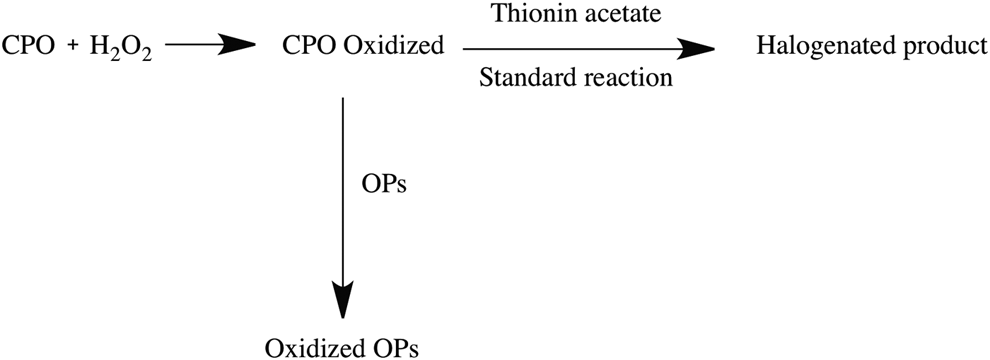
Reaction scheme of proposed inhibition mechanism of enzyme chloroperoxidase by OPs during halogenation of standard substrate thionin acetate. OP, organophosphorus pesticide.
The competition from the OPs for the enzyme is the basis of the relationship between the pesticide concentration and the decrease in catalytic activity for the halogenation of thionin acetate. Moreover, the method was applied to the analysis of matrices of groundwater samples, obtaining good results in terms of accuracy (mean recovery from 92.3% to 109.3%), low detection (0.2 μM, or 0.06–0.07 ppm), and rapidity (20 s). The detection threshold found in this study is far below the maximum allowable limits for pesticide concentration in drinking water established by the EPA.
Experimental Protocols
Chemicals
Parathion, azinphos-methyl, chlorpyrifos, dichlofenthion, dimethoate, parathion, phosmet, terbufos, thionin acetate, 3-aminopropyl-triethoxysilane (APTES), pyrene, estradiol, naphthalene, 4,6-dimethyldibenzothiophene (DMDBT), carbazole, 3-chlorophenol, and paracetamol were purchased from Sigma (St. Louis, MO). CPO solution (230 μM) from Caldariomyces fumago (MW 42 kDa, purity index Rz 1.4) was purchased from Alta enzymes (Edmonton, Canada). Buffer salts, hydrogen peroxide, and isopropanol were procured from J.T. Baker (Phillipsburg, NJ). All chemicals were used without further purification.
Enzymatic activity
Enzymatic activity was colorimetrically measured by monitoring the transformation of colored thionin acetate to its colorless halogenated product, which is proportional to CPO activity. The assay was performed in a 60 mM phosphate buffer at pH 3 and 25°C using 1.15 nM of CPO, 1 mM H2O2, 20 mM KCl, and 40 μM of thionin acetate. The total reaction volume was 1 mL. The progress of the reaction was monitored continuously by measuring absorbance changes resulting from the decrease of thionin acetate concentration for 2 min at 598 nm (Manoj and Hager, 2006) using a Cary 50 spectrophotometer. The initial enzyme activity was measured during the first 20 s.
The enzymatic activity of CPO was calculated by dividing the changes in absorbance per minute obtained from the spectrophotometer by the molar absorptivity coefficient of thionin acetate (ɛ = 6 × 10⁴/M/cm) (Manoj and Hager, 2006) and the enzyme concentration (Ayala et al., 2000; Vazquez-Duhalt et al., 2001; Bisswanger, 2011). Therefore, the enzymatic activity is reported in mole of substrate transformed per mole of enzyme per minute or, simply, in min−1. The reported values are the means of three replicates.
Competition assays
Effect of the OPs on CPO activity was determined by measuring the changes in the reaction rates for thionin acetate oxidation at increasing concentrations of each OP, varying from 0.2 to 4 μM (0.06–1 ppm).
The percentage of decrease in catalytic activity was calculated according to Equation (1):
where V0 and V1 are the initial reaction rates measured during the first 20 s in the absence and presence of different OP concentrations, respectively. The assays were also carried out at different enzyme (0.115 and 0.23 μM) and thionin (40, 20, and 10 μM) concentrations. The reported values are the means of three replicates.
Kinetic constants
To determine the kinetic constants Vmax and Km, the initial reaction rates were determined at steady state conditions for the transformation of thionin acetate (as described in a previous section) at increasing H2O2 concentrations from 0.1 to 1.2 mM, where enzyme saturation was observed. The reaction rates were adjusted to the Michaelis–Menten Equation [Eq. (2)], which shows the dependence of the initial rate on the substrate (H2O2) concentration:
where Vi is the initial reaction rate, Vmax the maximal rate of the reaction for thionin acetate transformation, Km is the Michaelis–Menten constant, and S is hydrogen peroxide concentration. An iteration procedure following the Marquardt–Levenberg nonlinear least-squares algorithm from Origin software (v7.0) was applied to obtain the Vmax and Km values.
The same kinetic parameters for thionin acetate oxidation were also evaluated at increasing OP concentrations ranging from 0.2 to 2 μM (0.06–0.7 ppm). The reported values are the means of three replicates.
Selectivity of the assay
Enzymatic activity was colorimetrically measured in the presence of chlorpyrifos and other CPO substrates to identify compounds that could potentially interfere with the halogenation reaction of thionin acetate. For this purpose, the halogenation of 40 μM thionin acetate was measured as described in a previous section in the presence of one of the following compounds: pyrene, estradiol, naphthalene, DMDBT, carbazole, 3-chlorophenol, or paracetamol. The interfering compounds were added at concentrations of 2 μM. Each reaction was carried out in the presence and absence of 2 μM (0.7 ppm) chlorpyrifos. The percentage of decrease was calculated according to Equation (1). Reported values are the means of three replicates.
Analysis of spiked water samples
To evaluate potential environmental interferences of the sample matrix in OP detection, spiked groundwater samples were analyzed at three different OP concentrations: 0.5, 1, and 1.5 μM. Three replicate experiments were performed for all samples 24 h after OP addition. The determination of enzyme catalytic activity was carried out as described in a previous section using 30 μL of the spiked groundwater sample.
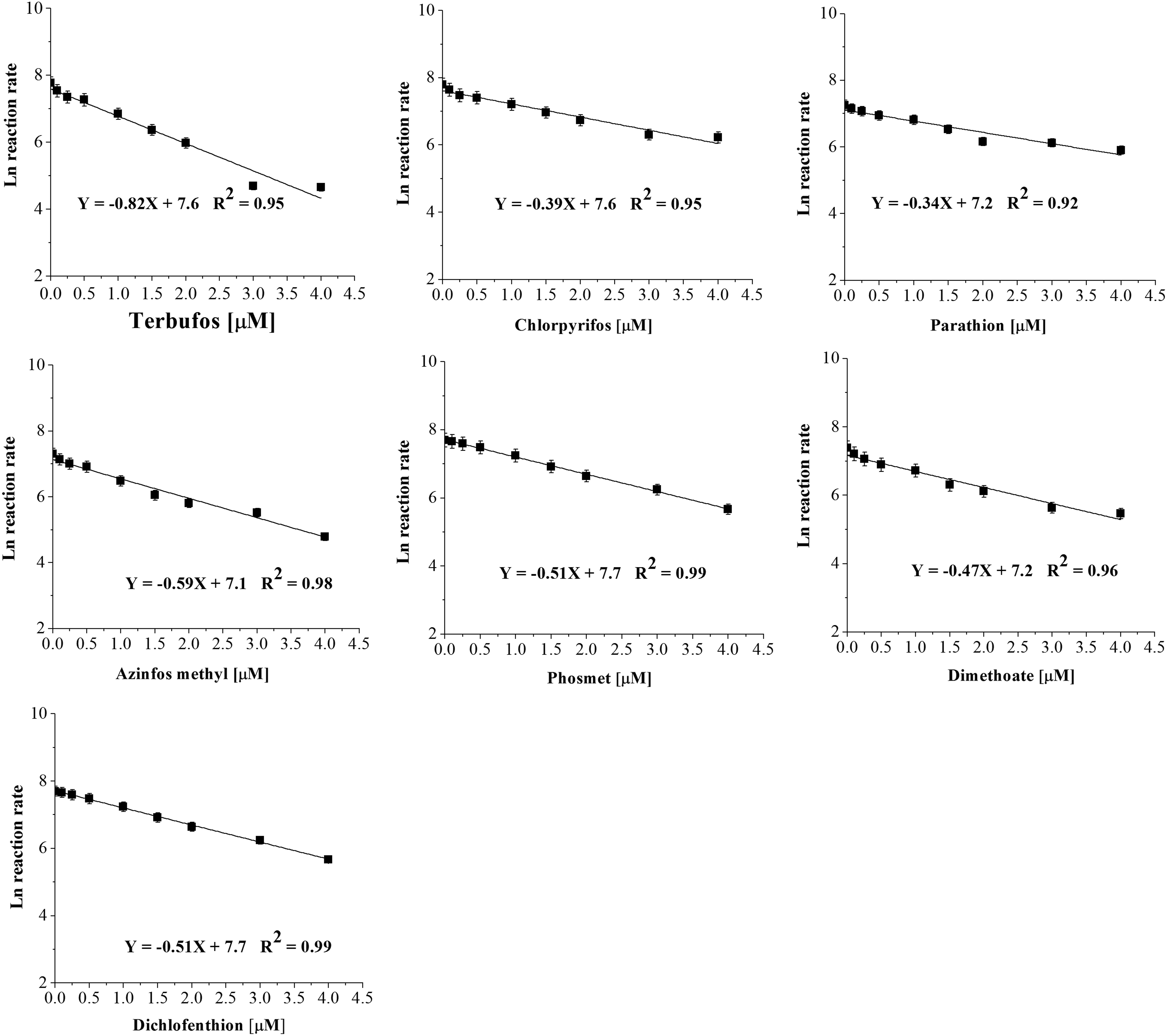
The groundwater samples used in this study were obtained from La Paz Valley, Mexico. To construct a representative bulk sample, a mixture was assembled by adding equal aliquots of each of 10 collected samples. The resulting mixture of pH 7.2 had a conductivity of 3,146.7 μS/cm and contained 197.9 mg/L Ca2+, 85.3 mg/L Mg2+, 292.3 mg/L Na+, 5.39 mg/L K+, 868.9 mg/L Cl−, 384 mg/L HCO3−, 133.4 mg/L SO4, 0.26 mg/L F−, and 31.96 mg/L SiO2. The determination of OPs was achieved by experimentally determining the enzyme activity of CPO as described in the previous section using 30 μL of spiked groundwater samples. The amount of OPs was calculated by solving for “x” in the equations in Fig. 1 (one equation for each OP). Finally, recovery percentage was calculated according to Equation (3).
where R is the recovery percentage (%), and Cs and Ca are the spiked and actual OP concentrations, respectively. Reported values are the means of three replicates.

Activity decrease profiles of CPO during halogenation of thionin acetate at increasing concentrations of OPs. Catalytic activity of CPO in absence of OPs was 3,990 min−1. OP, organophosphorus pesticide; CPO, chloroperoxidase.
Enzyme Immobilization
Immobilization of CPO on the mesoporous material SBA-15 was performed as previously reported (Guerrero et al., 2013). Briefly, SBA-15 was modified to yield reactive amino groups on its surface. Two hundred milligrams of SBA-15 was incubated with 2 mL of APTES for 24 h at room temperature in 10 mL anhydrous methanol. The modified material was then dried and subjected to a second modification with 3 mM glutaraldehyde in acetate buffer at pH 4 for 4 h with stirring.
Enzyme immobilization was carried out by mixing 50 mg of the modified material (SBA-15-glutaraldehyde) with 100 nM CPO at 4°C and pH 4 for 4 h with stirring. The material was then recovered by centrifugation and washed with 60 mM acetate buffer at pH 4 to wash off excess solvents. The amount of protein adsorbed was measured by adsorption difference, with protein concentrations determined at 398 nm (ɛ = 85,000/M/cm1) before and after CPO adsorption. The final enzyme preparation was kept in 1 mL of 60 mM acetate buffer at pH 4.
Results and Discussion
CPO is a potentially useful enzyme in the development of methods or devices to detect OPs due to its ability to recognize and transform OPs. The methods and devices available to detect OPs based on decreases in the enzyme catalytic activity are a relevant field of research that enable the determination of these contaminants in a fast and reliable way (Rodriguez-Mozaz et al., 2005; Amine et al., 2016). In this respect, this work focused on determining the decrease in CPO standard catalytic activity (i.e., halogenation of thionin acetate) by different OPs as an assay to detect or quantify OPs in groundwater samples.
An example of OP effects on CPO standard catalytic activity is shown in Supplementary Fig. S1, where the halogenation of thionin acetate at increasing terbufos concentrations can be observed. As shown, the presence of the pesticide decreases the enzyme's halogenase activity in a concentration-dependent behavior, where less thionin acetate transformed as terbufos concentration is increased in the reaction medium. Figure 1 shows the relationship between the change in rate and the pesticide concentration. As can be observed, the correlation coefficients of fitted equations were different for each OP, varying from 0.84 to 0.97.
In addition, it can be observed from Fig. 1 that the linear ranges are different for each pesticide. For dichlofenthion, dimethoate, phosmet, and parathion, the linear ranges were 0.2–4 μM (0.06 − 1 ppm), while for azinphos methyl and chlorpyrifos, the ranges were 0.2–2 μM (0.06–0.7 ppm). For the last pesticide, terbufos, the linear range was 0.2–1 μM (0.06–0.3 ppm). These detection ranges are within the reported values for enzyme-based OP detection assays reviewed elsewhere (Van Dyk and Pletschke, 2011).
When CPO activity was analyzed in the presence of the seven OPs at 4 μM (1 ppm), the percentage of decrease reached 80% except for the case of azinphos methyl, where the percentage of decrease reached 98% (Supplementary Fig. S2). Notably, the percentage of decrease profiles was very similar for the OPs except for terbufos. The analysis of variance confirmed that the means of the values were significantly different for the different concentrations of each OP at the 95% confidence level (p value <0.0001). The decrease in activity reached at 0.2 μM (0.06 ppm) OP was higher than 10% for most of the OPs, which is the percentage of decrease recommended when determining the limit of detection (Amine et al., 2016).
Two factors that influence the decrease in enzymatic activity are the enzyme and the substrate concentrations (Amine et al., 2006, 2016). For the first case, the change of thionin acetate concentration from 40 to 20 μM decreases the effect of all OPs on CPO activity (Fig. 2). The analysis of variance confirmed that the means of the values were significantly different at the 95% confidence level for 40 μM thionin acetate, but not for 20 and 10 μM (p values of 0.011 and 0.22, respectively).
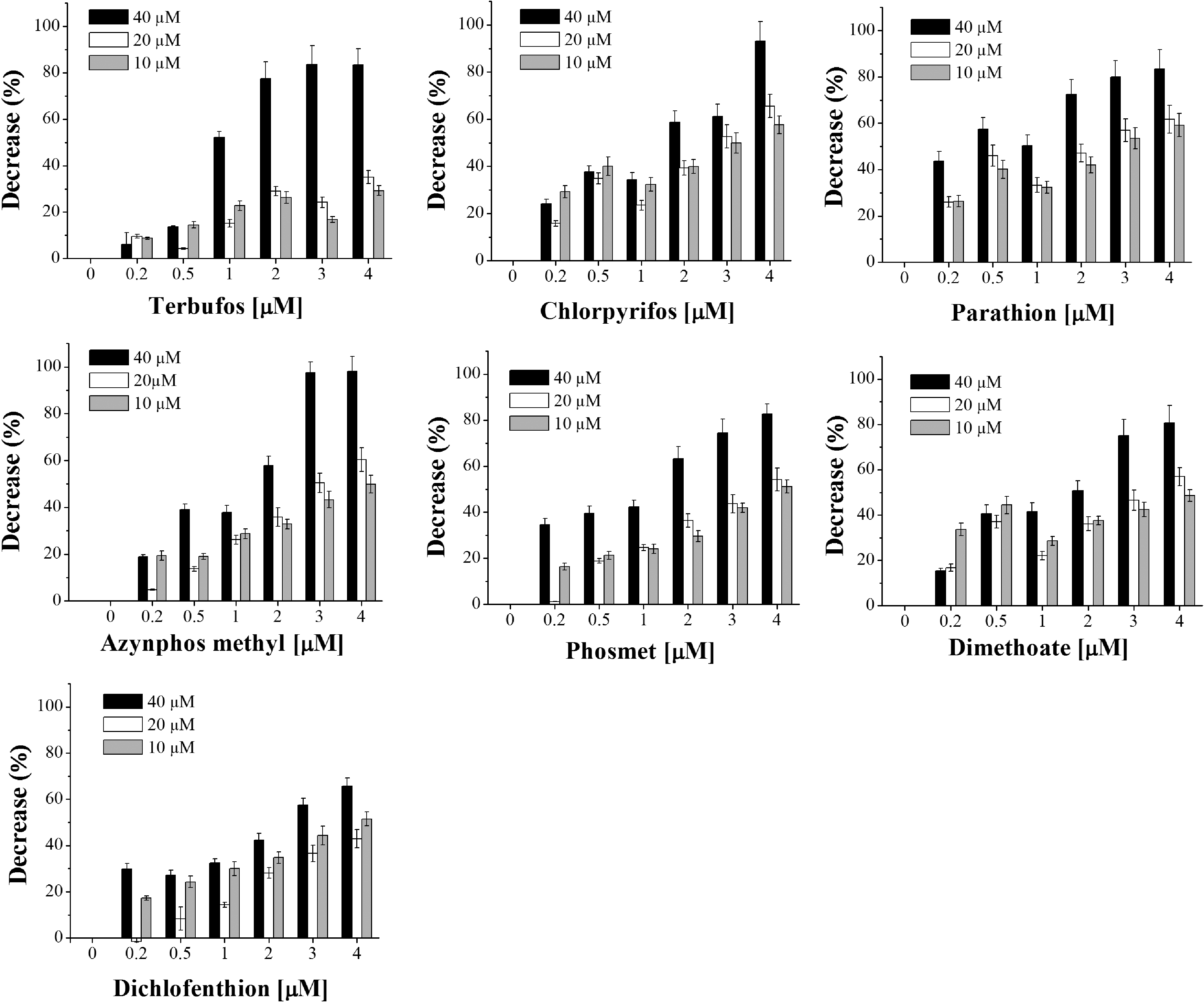
Activity decrease profiles of CPO by seven organophosphorus pesticides during halogenation at three concentrations of thionin acetate (40, 20, and 10 μM). Catalytic activity of CPO in the absence of OPs was 3,990 min−1. The analysis of variance confirmed that the mean values are significantly different for 40 μM thionin acetate, but for 20 and 10 μM, the percentages of decrease are not significantly different (at 95 confidence level, p values <0.011 and 0.22, respectively).
For the second case, the decrease of the enzyme concentration did not show any clear effect, as a higher effect was observed for dichlofenthion, dimethoate, and phosmet, but a slight effect was observed for terbufos and chlorpyrifos (Fig. 3). However, the analysis of variance confirmed that the means of the values obtained for the percentage of decrease were not significantly different at the 95% confidence level (p value of 0.12).
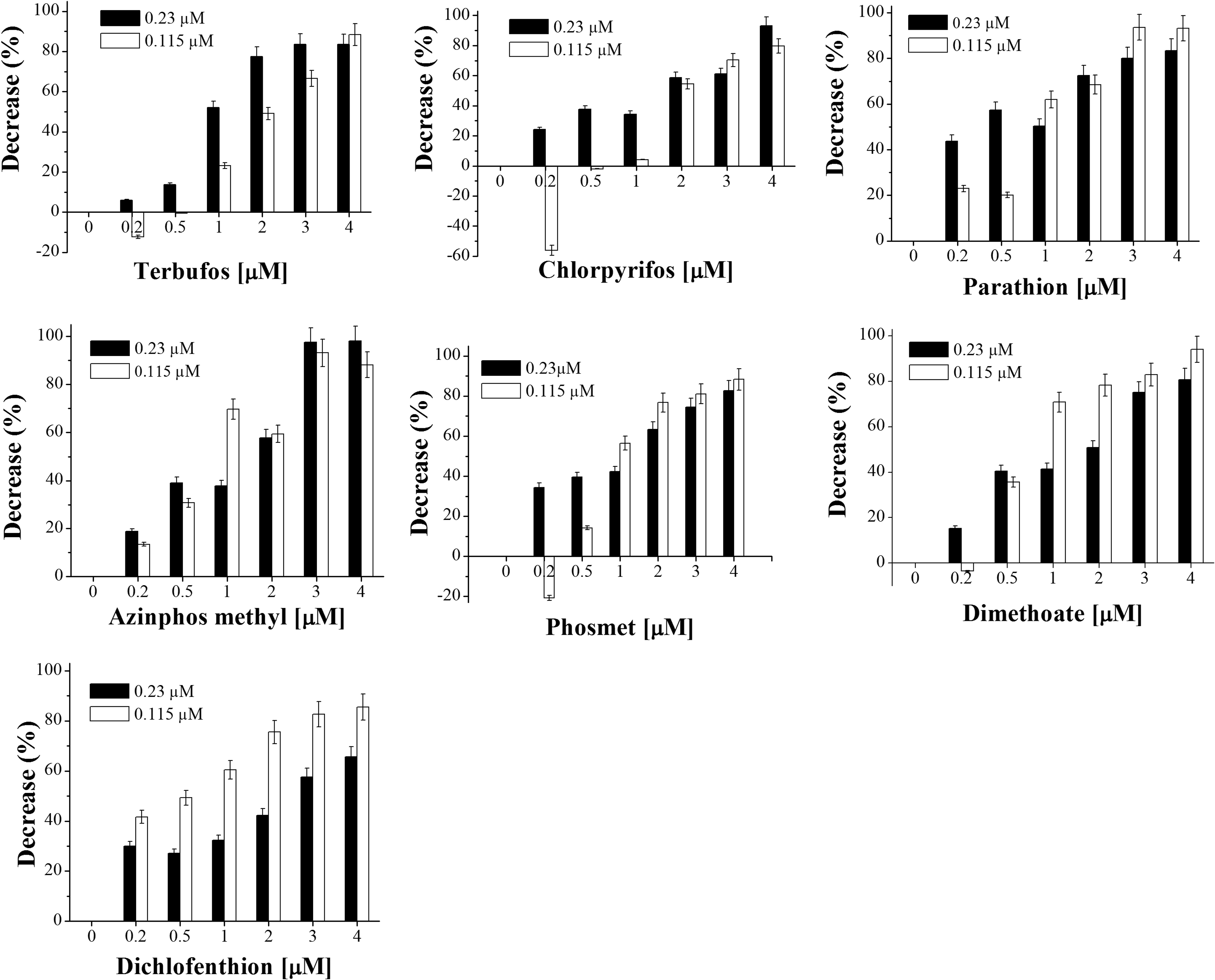
Catalytic activity decrease profiles of CPO by seven organophosphorus pesticides during halogenation of thionin acetate at two enzyme concentrations (0.115 and 0.23 μM). Analysis of variance confirmed that the means of the values obtained for the percentage of decrease are not significantly different at 95% confidence level (p values >0.12).
Enzyme kinetics
The thionin assay has been proposed as an index of chlorinating activity of CPO. This reaction allows easy processing of large volumes of samples with high catalytic activity values because the kinetics have been found to be similar to that of the established monochlorodimedone assay (Manoj and Hager, 2006). To characterize the competition reaction between thionin acetate and OPs, the kinetic constants Vmax and Km for thionin halogenation were determined in the absence and in the presence of each OP (Table 1). The analysis of variance confirmed that the means of Vmax and Km values are significantly different at the 95% confidence level (p values <0.001), and the correlation coefficients indicate a good fit to the Michaelis–Menten equation (R2 values >0.98). It can be observed from Table 1 that, in general, Vmax and Km values both changed, indicating a mixed effect on the reaction mechanism. A higher effect was observed for parathion, which is one the OPs more easily get oxidized by CPO and has a high reaction rate and affinity (Vmax value of 1 092 min−1 and a Km value of 1.2 μM) as reported elsewhere (Hernandez et al., 1998).
Correlation coefficient for fitting of kinetic data to Michaelis–Menten equation using a nonlinear adjustment. At 0.05 level, ANOVA for Vmax and Km values indicates that the means are significantly different (p values <0.001). All coefficients of variation are lower than 10%.
ANOVA, analysis of variance.
It is already known that CPO has four catalytic activities as follows: catalase, halogenase, peroxidase, and peroxygenase. The common reaction intermediary is Compound I of the peroxidases, an oxoiron(IV)–porphyrin radical or oxoiron(IV)–protein radical (Montellano, 2010), which is produced during the oxidation of the enzyme by hydrogen peroxide (Fig. 4). This intermediary can follow different paths depending on the reaction that is taking place. In the case of halogenase activity (thionin acetate halogenation), it has been reported that Compound I reacts with chloride ions that, in turn, give place to a diffusive halogenate species capable of halogenating the substrate outside the active site (Murali Manoj, 2006; Montellano, 2010) (Fig. 4, path I). For peroxygenase activity, which seems to be the mechanism of pesticide oxidation (Bello-Ramírez et al., 2000), Compound I reacts with another hydrogen peroxide molecule to obtain the complex FeIII−O−O−. The complex then transfers the oxygen to the pesticide to form the corresponding oxon (Fig. 4, path II).
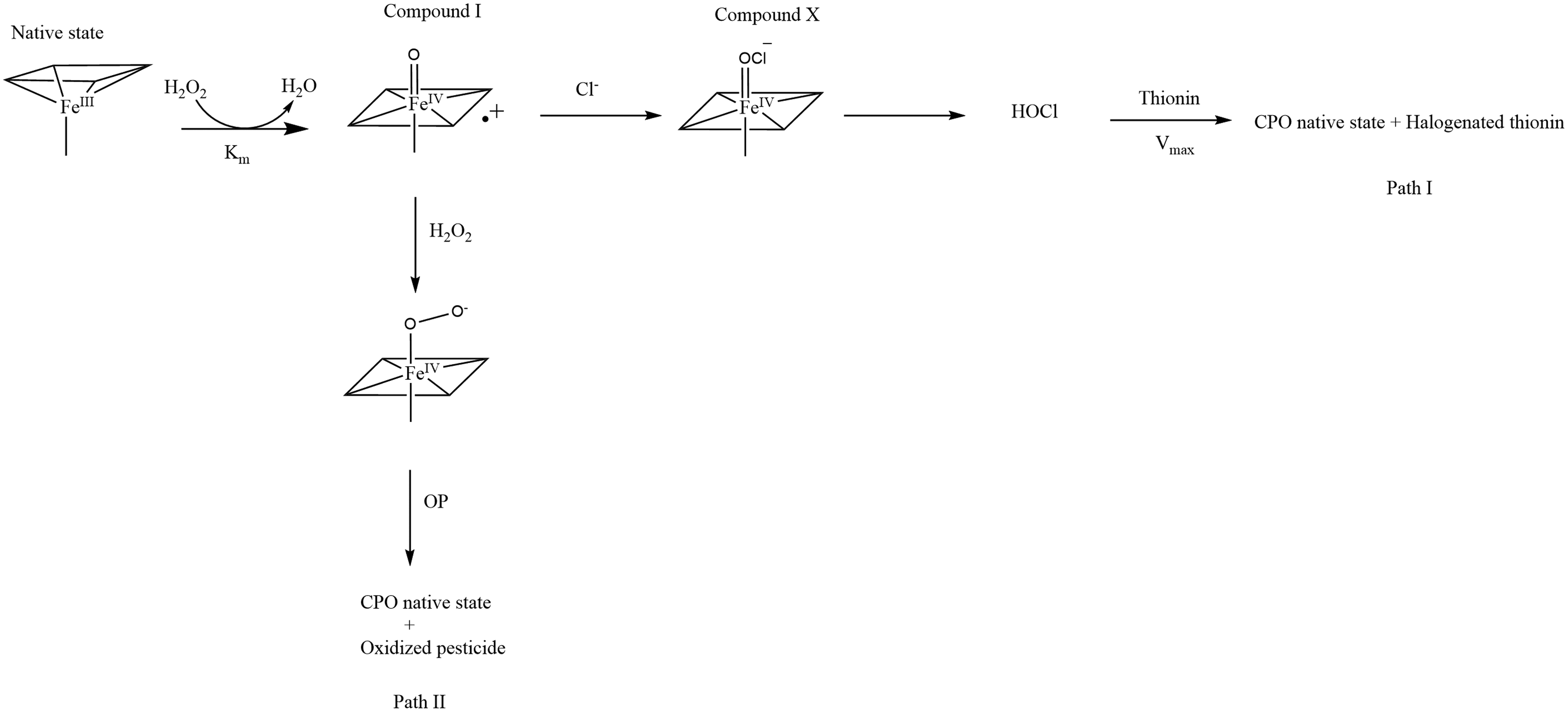
Proposed mechanism of reaction regarding competence between thionin acetate and the OPs.
Based on this mechanism, Compound I seems to be a common intermediary for both oxidation reactions. Therefore, in the presence of OPs as competing substrates, a change in the kinetic constants is expected, where Km is related to the reaction step producing Compound I and Vmax is related to the last step in the transformation of thionin acetate (Fig. 4). Km is expected to increase because more hydrogen peroxide is needed to reach the same velocity when OPs are present because some amount of the Compound I is deviated toward OP oxidation. Indeed, Km values increased from 0.08 mM to 0.25 mM when 2 mM of OPs was added (Table 1). Conversely, the decrease in the Vmax value may be partially explained by the fact that the presence of OPs competing for the same active site affects the reactivity of the halogenating species (HOCl), slowing the halogenation of thionin acetate.
Selectivity of the Assay
Selectivity of the assay was tested by determining the percentage of decrease in the CPO catalytic activity caused by chlorpyrifos in the presence of other reported substrates of the enzyme (Table 2). As shown, most compounds decrease the standard catalytic activity of CPO in the absence of chlorpyrifos; however, in the presence of the pesticide, the decrease in catalytic activity was mainly due to chlorpyrifos, indicating that the other substrates did not interfere in the assay. Interestingly, compounds such as DMDBT, 4-chlorophenol, and naphthalene showed a mixed effect: in the presence of chlorophenol and chlorpyrifos, no effect is observed on CPO catalytic activity (1.3%, Table 2) due to an activating effect of chlorophenol on the enzyme (−27% decrease, Table 2), but for DMDBT and naphthalene, the decrease in catalytic activity by chlorpyrifos is higher (66.7% and 65.5%, respectively) than the effect of chlorpyrifos alone (54.9%).
The halogenation of thionin acetate alone was taken as 100% catalytic activity (No decrease).
Activation of catalytic activity of CPO was observed.
DMDBT, 4,6-dimethyldibenzothiophene; CPO, chloroperoxidase.
The oxidation of aromatic compounds by CPO has been reported to be dependent on the ionization potential of the substrate (Ayala et al., 2000; Ayala, 2010), but hydrophobicity and size of the substrate also have a main role. Naphthalene, estradiol, pyrene, and carbazole are probably halogenated by a diffusible halogenating intermediary (Ayala et al., 2000). The small size and low hydrophobicity of naphthalene may be the reason for its marked decrease in catalytic activity. In the case of DMDBT, an organosulfur compound, its oxidation produces the sulfone probably by the transfer of oxygen into the active site (Torres and Aburto, 2005), and the sulfone, as in the case of chlorpyrifos, can compete for Compound I, increasing the effects on the CPO catalytic activity.
Finally, chlorophenol is dehalogenated by an oxidative mechanism in the active site (Osborne et al., 2006), and the activating effect observed is not currently understood. In conclusion, only chlorophenol seems to be a relevant interferent of the proposed assay. Chlorophenols are classified as priority pollutants by the EPA (ATSDR, 2007). Data from the literature indicate that chlorophenol levels in water are generally quite low (sub μM), but vary considerably from one location to another (Olaniran and Igbinosa, 2011). Disinfection of water by chlorination may increase chlorophenol concentrations 10-fold to the μM level. Therefore, 2 μM of chlorophenol seems suitable to indicate its potential interference in the developed assay.
Analysis of Spiked Water Samples
To test the applicability of the proposed assay, it was applied to the detection and quantification of OPs in groundwater samples (Table 3). For quantification, the fitted equations from Fig. 1 were used to predict the content of each OP in spiked groundwater samples. In addition, the recovery percentage was taken as a parameter to describe the analytical performance of the method and accuracy of the assay. Recovery is the amount of analyte measured as a percentage of the amount of analyte originally added to a sample of the appropriate matrix, which contains either no detectable level of the analyte or a known detectable level (Desimoni and Brunetti, 2015).
Reported values are the means of three replicates. RSD, relative standard deviation <9%.
Due to the narrow linear range, terbufos was assayed only at 0.5 μM.
As shown, this method adequately predicts the concentration of OPs in a groundwater matrix with a good recovery percentage, ranging from 92.7% to 106.7%. These results suggest that the concentration of salts in groundwater did not interfere with the analytic response. Acceptable recovery estimates are a function of the analyte concentration and also depend on the purpose of the analysis. Thus, recoveries near 100% can be accepted (Desimoni and Brunetti, 2015).
It is expected that the method does not distinguish the chemical nature of OPs, that is, it does not distinguish between the different OPs tested. However, it may represent an interesting preliminary assay to test the quality of water potentially polluted with OPs.
Immobilized Enzyme
One of the key objectives of the development of enzymatic biosensors is the immobilization of the enzyme in a selective and oriented way such that the catalytic activity of the enzyme is not markedly decreased and, thus, the sensitivity or selectivity of the method is maintained (Sassolas et al., 2012; Demirkol et al., 2014). Mesoporous materials are attractive for the development of optical sensors due to their high regularly arranged pores and their high surface area, which better disperse optically active components and allow rapid diffusion for sensing of chemicals (Scott et al., 2001). Recent advances in mesoporous silica-based optical sensors used for the detection of colorimetric pollutants have been reported (Balaji et al., 2005; Moorthy et al., 2013; Ding et al., 2015).
The synthesized mesoporous material had a surface area of 935 m2/g, total pore volume of 1.1 cm3/g, and pore size of 6.7 nm, as calculated by the desorption branch through the Barrett−Joyner–Halenda analysis (Guerrero et al., 2013). Reaction with APTES provides amino groups on the material surface, as previously reported (Guerrero et al., 2013). Thus, the amino groups of the material and the amino groups of the enzyme can be covalently bound through glutaraldehyde. Indeed, the incubation of modified SBA-15 with CPO and glutaraldehyde produces an enzyme load of 214 nmol of CPO per gram of SBA-15. Immobilized CPO showed excellent retention of catalytic activity in the oxidation of thionin acetate; ∼72% of the original standard catalytic activity was retained (2,872 min−1).
Figure 5 shows that the changes in the catalytic activity of the immobilized enzyme with respect to the concentration of OPs are directly related to the pesticide concentration, with a similar pattern to that of the free enzyme. Again, terbufos showed the largest effect on the enzyme activity. The linear range of the immobilized enzyme was wider compared with the free enzyme, from 0.1 to 4 μM for all cases. The immobilization of enzymes on porous supports may, in many cases, have a positive impact on the observed enzyme behavior. In this case, as CPO maintains its full activity, it is considered that the improvement in the linear range is probably due to higher diffusional OP gradients or to a better OP partition toward the enzyme from the environment (Rodrigues et al., 2013).
Activity decrease profiles of immobilized CPO during halogenation of thionin acetate at increasing concentrations of OPs. Catalytic activity of CPO in the absence of OPs was 3,990 min−1.
Supplementary Figure S3 shows the percentage of decrease profiles of the immobilized enzyme for all OPs. The analysis of variance confirmed that the means of the values are significantly different for the different concentrations of each OP at the 95% confidence level (p values <0.00001).
The immobilized enzyme has been reported to be more active and stable, and it can be stored for more than 90 days at room temperature without losing catalytic activity (Montiel et al., 2007; Guerrero et al., 2013). As mesoporous materials are transparent to light, the immobilized enzyme on SBA-15 has an interesting potential in the development of an optical biosensor based on the decrease of CPO catalytic activity.
The thionin assay is a simple, rapid, and convenient kinetic method to detect and quantify halogenation by CPO, as reported previously (Manoj and Hager, 2006). It presents several advantages as follows: it requires a simple colorimeter to measure absorbance changes in the visible region; it requires minimal amounts of enzyme (in the nM range); large numbers of samples can be analyzed using a multiwell plate device; and thionin acetate is a low-cost commercially available reagent. In addition, the visual colorimetric detection of the substrate solution results in less confusion in routine assays. All of these advantages were exploited in this work for the indirect detection of OPs. Thus, it can be concluded that coupling these reactions will allow detection of OPs in groundwater in a fast and simple way. The assay is practical because of its ease, rapidity, and relatively low cost in terms of reagents, equipment, and small quantities of enzyme used.
Conclusions
Decrease in the standard thionin acetate halogenation catalytic activity of CPO caused by OPs can be used for the detection and quantification of OPs in groundwater. This method was able to quantify 0.2 μM (0.06–0.07 ppm) concentrations of OPs in an accurate, rapid, and selective way. Selective immobilization improved the CPO linear range for OP detection. This assay based on the decrease of CPO catalytic activity is envisioned as a preliminary screening tool to simultaneously analyze multiple water samples in a fast and simple way. As discussed, the potential for using this technique to develop a future optical sensor is supported by these findings. Future work should explore the development of a practical device to optically sense OPs using this technique.
Footnotes
Acknowledgments
The authors are grateful to PRODEP (Grant 103.5/14/10819 and 103.5/13/6823) and CONACYT (Grant 221548) for financial support.
Author Disclosure Statement
No competing financial interests exist.
References
Supplementary Material
Please find the following supplemental material available below.
For Open Access articles published under a Creative Commons License, all supplemental material carries the same license as the article it is associated with.
For non-Open Access articles published, all supplemental material carries a non-exclusive license, and permission requests for re-use of supplemental material or any part of supplemental material shall be sent directly to the copyright owner as specified in the copyright notice associated with the article.
