




Abstract
Abstract
Fe/Cu bimetallic particles have been proposed as a viable technology for reduction of nitroaromatic pollutants from aqueous solution; however, little data are currently available on its applicability in actual ammunition wastewater. In this study, prepared microsized Fe/Cu bimetallic particles were used to pretreat toxic and refractory ammunition wastewater under oxic conditions. Four key operational parameters, including initial pH (2.0–7.5), aeration rate (0–2.0 L/min), Fe/Cu dosage (5–40 g/L), and reaction time (0–120 min), were optimized, respectively. Furthermore, a Fe0/air process as the control experiment of Fe/Cu/air process was set up under optimal conditions. According to results of COD removal, decoloration, and B/C ratio, the Fe/Cu/air process had a higher treatment efficiency for ammunition wastewater compared with Fe0/air process due to the high reactive Fe/Cu bimetallic particles. Finally, analysis of UV-vis, excitation and emission matrix, and fourier transform infrared reveals that the toxic and refractory pollutants in ammunition wastewater could be decomposed effectively by the Fe/Cu/air process, and they also confirmed the superiority of Fe/Cu/air process. Gas chromatography mass spectrometry (GC-MS) suggests that all nitro-aromatic pollutants in ammunition wastewater were removed completely.
Introduction
A
It has been reported that biological treatment processes, which are simple and cost effective, but cannot effectively degrade the toxic nitroaromatic pollutants because the four functional groups (3–NO2 and 1–CH3) and the electron-withdrawing properties of the nitro groups can shield π-electrons in the aromatic ring of TNT from any external attack (Guimet et al., 2004; García-Reiriz et al., 2007; Goicoechea et al., 2012). To decompose these nitroaromatic compounds, various methods, including combined ultrasound and Fenton (US-Fenton) process (Li et al., 2013), combined zero-valent iron (ZVI) and Fenton (Oh et al., 2003; Barreto-Rodrigues et al., 2009b), electro-Fenton (Chen and Lin, 2009), combined UV and H2O2 (Hwang et al., 2004), and vacuum distillation (Zhao et al., 2010), were used to treat this wastewater. However, all of these processes suffer from the limitations of high running costs or complex operation. Therefore, it is necessary to develop a cost-effective ammunition wastewater treatment technology.
For the past two decades, zero valent iron (ZVI or Fe0) has been successfully used to eliminate a wide range of contaminants from water because of nontoxic, abundant, cheap, and the operation requires little maintenance for Fe0. The reactivity of Fe0 drops over time, due to the direct involvement of H+ in the corrosion reactions and the surface passivation caused by the corrosion products (Lai et al., 2012b). One of the countermeasures to overcome this limitation is by coupling Fe0 with a noble metal. In recent years, Fe-based bimetallic particles have been increasingly used for wastewater treatment (Ma and Zhang, 2008; Fan and Ma, 2009; Ghauch et al., 2010). Furthermore, the Fe/Cu bimetallic process is widely considered as a promising method for the destruction of nitroaromatic pollutants due to the faster reaction kinetics, slower deposition of corrosion products on the particle surface, and the moderate price of copper (Xu et al., 2005; Koutsospyros et al., 2012).
Fe/Cu bimetallic particles are prepared by plating Cu on the surface of Fe0 through simple displacement (Bransfield et al., 2006; Lai et al., 2014a). Because of the high potential difference of 0.78 V between Cu and Fe, the corrosion of Fe0 could be improved by the plating Cu, resulting in the higher reactivity of Fe/Cu bimetallic particles and higher rate of pollutant reduction (Ma et al., 2004; Bransfield et al., 2006). Under anoxic condition, free hydrogen radical (H•) with strong reduction was generated from the Fe0 corrosion [Eq. (1)], thus reduction of ZVI plays a leading role in the pollutants removal, but only a lower COD removal could be obtained (Lai et al., 2012a, 2013b). In the presence of oxygen, the corrosion of Fe0 might also cause the reduction of O2 and generate H2O2, which could cause the Fenton-like reaction and generate the hydroxyl radicals (OH•) [Eqs. (2) and (3)] (Shimizu et al., 2012; Xiong et al., 2015). In Fe/Cu/air system, the occurring chemical reactions can be summarized as Equations (1)–(4) (Ren et al., 2016):
Acidic without oxygen:
Acidic with oxygen:
Neutral and alkaline with oxygen:
The objective of this study is to evaluate the feasibility of using Fe/Cu bimetallic system as a pretreatment before conventional biological treatment process for ammunition wastewater. Biodegradability of ammunition wastewater was analyzed and evaluated by COD (Chemical Oxygen Demand), BOD5 (Determination of Biochemical Oxygen Demand after 5 days), and BOD5/COD ratio. Effect factors of the Fe/Cu/air system for pretreatment of ammunition wastewater were discussed, and optimum conditions were proposed. In addition, under the optimal operating conditions, the degradation and transformation of the pollutants in ammunition wastewater were analyzed and evaluated by decoloration, UV-vis, three-dimensional excitation and emission matrix (EEM) fluorescence, gas chromatography–mass spectrometry (GC-MS), and Fourier transform infrared (FTIR) spectrometry.
Materials and Methods
Materials
Zero valent iron (Fe0) powders, sulfuric acid (H2SO4, 98%, analytical grade), sodium hydroxide (NaOH, analytical grade), and CuSO4·5H2O (analytical reagent) from Chengdu Kelong chemical reagent factory were used in the experiment. The zero valent iron powders have mean particle size of ∼120 μm, and their iron content was above 98%. The Fe/Cu bimetallic particles were prepared through displacement plating Cu on the surface of Fe0. The preparation process and the optimal theoretical Cu mass loading (0.41 g Cu/g Fe) were the same as that in our previous work (Lai et al., 2014b). The ammunition wastewater was collected from a military facility in China, and its pH, COD, BOD5, and color were 7.5, 580 mg/L, 0 mg/L, and 1,600 times, respectively. In addition, the main pollutants, including 1-methyl-1,3,5-trinitrobenzene, 1,3,5-trinitrobenzene, 1,3-dinitro-benzene, and alkanes in ammunition wastewater, were determined by GC-MS and shown in Fig. 7a.
Batch experiments
Pretreatment of ammunition wastewater by Fe/Cu/air process was carried out by batch experiments. Four major operating parameters, including initial pH (2.0–7.5), air aeration (0–2.0 L/min), Fe/Cu dosage (5–40 g/L), and reaction time (0–120 min), were investigated by COD removal efficiency of ammunition wastewater. One of four parameters varied while keeping other three parameters constant levels. While investigating the effect of initial pH (2.0–7.5), pH of wastewater was initially adjusted to different values with the range 2.0–7.5 while keeping 40 g/L of Fe/Cu dosage, 1.5 L/min of air aeration, and 60 min of reaction time. Corresponding ranges were 0–2.0 L/min for the effect of air aeration, 5–40 g/L for the effect of Fe/Cu dosage, as well as 0–120 min for the effect of reaction time. In each batch experiment, 400 mL wastewater with the desired pH (2.0–7.5) and Fe/Cu bimetallic particles (5–40 g/L) was added to a 500 mL beaker and the slurry was aerated with the desired air flow rates (0–2.0 L/min). In addition, the slurry was kept at 25 ± 1°C and mixed by a mechanical stirrer (250 rpm).
Finally, all the samples obtained in the experiment process were adjusted to a pH of 7.5–8.5, and then they were filtered through hydrophilic polyethersulfone syringe filters (0.45 μm) to remove Fe2+/Fe3+ ions. Measurements of the samples were routinely taken of COD. All experiments were carried out in triplicate.
Furthermore, a Fe0/air system was set up as the control experiment of Fe/Cu/air bimetallic system. In the control experiment, only Fe/Cu particles were replaced by Fe0 powders and the other operational conditions were all similar to the obtained optimal conditions of Fe/Cu/air process. Comparison study on treatment efficiency of Fe0/air and Fe/Cu/air was carried out according to the analyses of COD, BOD5, color, UV-vis, EEM, and FTIR.
Analytical methods
UV-vis absorption spectra of samples were carried out in 10 mm quartz cuvettes, and the UV-vis spectra were recorded from 190 to 500 nm using deionized water as blank. COD and BOD5 were determined by using COD analyzer (Lianhua, China) and BOD5 analyzer (OxiTop IS12; Germany), respectively. The pH was measured by a pHS-3C meter (Rex, China). The three-dimensional spectra of dissolved organic matter (DOM) in samples were measured by an EEM fluorescence spectrometry (F-7000 spectrophotometer, Hitachi, Japan) (Lai et al., 2013a). FTIR spectroscopy was used to assess the differences in the general functional groups of the influent and effluent of Fe/Cu/air process and Fe0/air process under the optimal conditions. Samples were dried at 40°C and grinded with KBr in a mortar with 1:100 ratio. The power mixture was compressed into a tablet under 10 tons force for 1 min. The samples were analyzed by using a Nicolet 6700 FTIR spectrometer and the wavenumbers of 4,000–400 cm−1. Both raw wastewater and treatment effluent of Fe/Cu/air were analyzed by a GC-MS, and the pretreatment analysis method was the same as that in our previous work (Lai et al., 2012a). Color of the samples was determined by using the dilution ratio method according to the China National Standard Method GB 11903-89.
Results and Discussion
Optimization of process parameters
To obtain satisfactory degradation efficiency for the toxic and refractory pollutants (i.e., nitroaromatic pollutants) in ammunition wastewater, the key parameters, including initial pH, Fe/Cu dosage, air flowing rate, and reaction time, should be optimized, respectively.
Effect of initial pH on COD removal
Figure 1a shows effect of initial pH (i.e., 2.0–7.5) on COD removal efficiencies of ammunition wastewater when it was treated by Fe/Cu/air process. The lower pH is beneficial to the degradation of ammunition wastewater because plenty H+ ions could improve the iron corrosion and formation of Fenton-like reaction in the presence of dissolved oxygen (DO) [Eqs. (1)–(3)] (Chang et al., 2009; Wang et al., 2010). When the initial pH decreased from 7.5 to 2.5, the COD removal efficiency was enhanced rapidly from 24.2% to 70.2%. Then, it only further increased a little to 72.5% when the initial pH was decreased from 2.5 to 2.0. Therefore, pH = 2.5 should be chosen as the optimal initial pH according to the consumption and cost of acid.
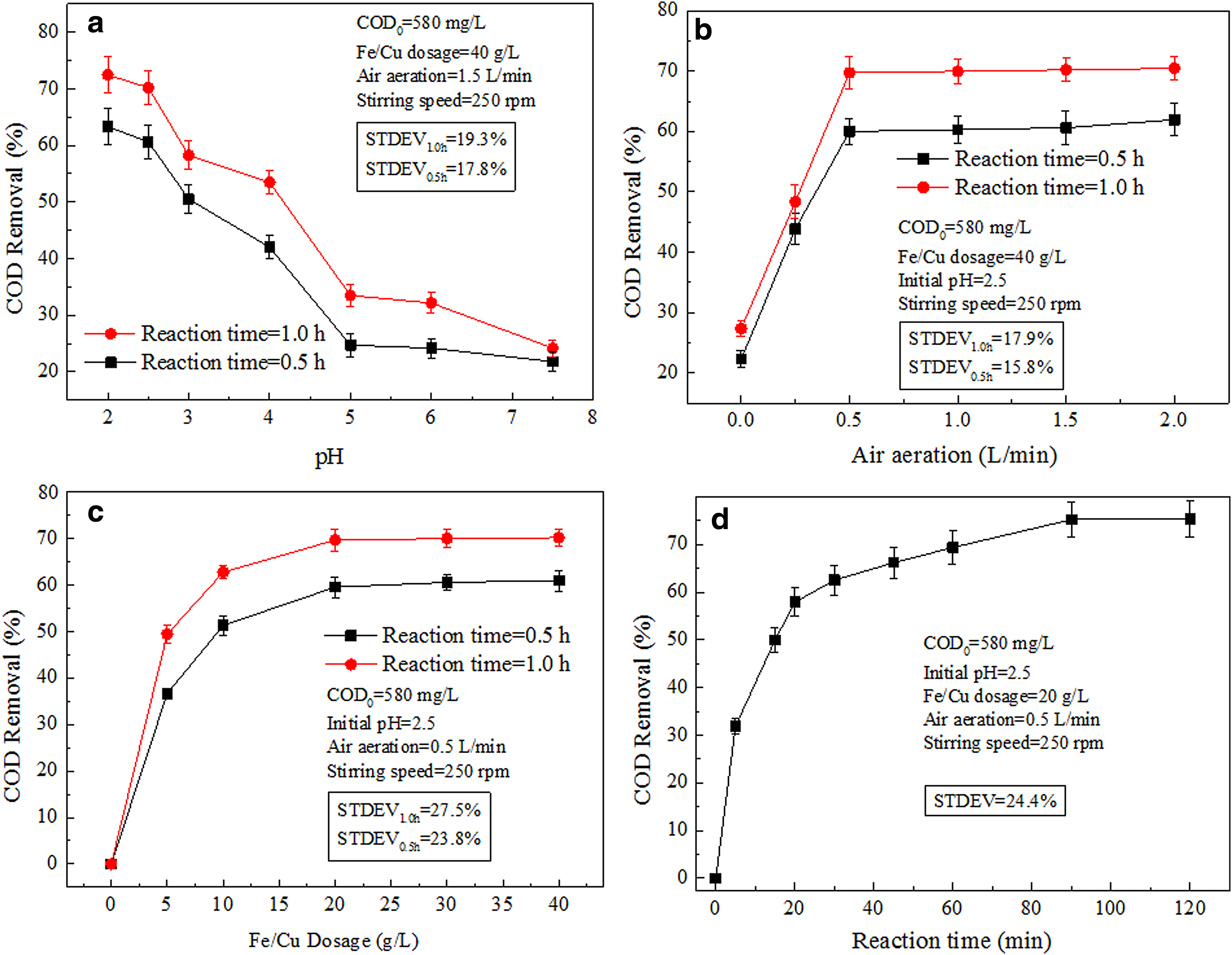
Effect of initial pH
However, the result was very different from the previous studies which illustrated the higher treatment efficiency could be obtained under a neutral condition when nitrobenzene as a model contaminant was treated by Fe/Cu/air process on laboratory scale (Sun et al., 2016). This phenomenon was attributed to the more complex components in the ammunition wastewater. Astratov et al. (1997) reported that about 31 compounds were identified by HPLC/TSP/MS in a groundwater sample near the former ammunition plant Elsnig, and all of them were the toxic and refractory pollutants, such as nitramines and their by-products, TNT and partially nitrated toluenes, 1,3,5-trinitrobenzene and partially nitrated benzenes, aminonitrotoluenes and nitroanilines, hexyl, nitrophenols, nitrobenzoic acids, and aminonitrobenzoic acids. Schmidt et al. (1998) also found many highly polar metabolites of nitroaromatic compounds in ammunition wastewater.
In Fe/Cu/air system, the pollutants removal was mainly resulted from adsorption, reduction, and oxidation. The lower initial pH (e.g., 2.5) could supply enough H+ ions, which would accelerate the corrosion rate of Fe/Cu bimetallic particles and keep their surface fresh. The corrosion of Fe0 could improve the release rate of Fe2+/Fe3+ ions and electrons. In general, removal of the pollutants by Fe/Cu bimetallic particles at the lower initial pH owns to the effect of the following pathways: (a) acidic condition and the plated Cu0 could improve corrosion rate of iron, which would enhance the Fenton-like reaction [Eqs. (2) and (3)] (Xiong et al., 2015), (b) copper in Fe/Cu/air system may improve the generation of OH• through catalytic decomposition of H2O2 in acidic condition (Ghauch and Tuqan, 2008; Liu et al., 2014), (c) contaminants would be reduced directly at copper electrode (Xu et al., 2005), and (d) the adsorption of Fe/Cu bimetallic particles and corrosion products [e.g., Fe(OH)2/Fe(OH)3]. However, the excess low initial pH (i.e., <2.5) could not significantly improve the pollutant removal because it was not a limiting factor. In other words, effect of pH on adsorption and redox reactions had already reached the maximum (i.e., pH = 2.5), and the excess H+ ions only could increase the operating cost. Therefore, the optimal initial pH of 2.5 was selected for the subsequent experiments.
Effect of air flow rate on COD removal
Effect of air flow rate (i.e., 0–2.0 L/min) on COD removal efficiency of ammunition wastewater by Fe/Cu/air process was evaluated. Figure 1b shows that increase of air flow rate from 0 to 0.5 L/min made the COD removal efficiency improve from 27.4% to 69.7% after 1.0 h treatment. However, a further increase in air flow rate (i.e., 2.0 L/min) did not significantly enhance COD removal.
This phenomenon could be explained by the following reasons: (a) in Fe/Cu/air system, DO was a key limiting factor for the generation of H2O2 that would trigger Fenton-like reaction [Eqs. (2) and (3)] and produce strong oxidants such as hydroxyl radical, which could enhance the oxidation capacity of Fe/Cu/air process (Keenan and Sedlak, 2008) and (b) COD removal efficiency obtained by Fe/Cu without aeration (0 L/min) reached 27.4%, which was mainly attributed to reduction and adsorption of microsize Fe/Cu bimetallic particles and their corrosion products [e.g., Fe(OH)2/Fe(OH)3] (Xiong et al., 2015). Thus, the optimal air flow rate of 0.5 L/min was selected in the following experiments.
Effect of Fe/Cu dosage on COD removal
Figure 1c shows the effect of Fe/Cu dosage on COD removal efficiencies at different reaction time. The increase of Fe/Cu dosage enlarged the number of galvanic cells and catalytic sites on the Fe0 surface area (He et al., 2012; Yuan et al., 2014), which could supply more opportunities to conduct reducing reaction when the dosage of Fe/Cu is below 20 g/L. When the dosage of Fe/Cu was over 20 g/L, mass transfer or other operating conditions would become the control factor. The similar results also are reported when the pollutants were treated by Fe0/air process (Yuan et al., 2016). In particular, no significant improvement of COD removal was observed when the iron dosage increased from 20 to 40 g/L. Thus, the optimal Fe/Cu dosage was 20 g/L.
Effect of reaction time on COD removal
Under the above optimal conditions (initial pH of 2.5, air aeration of 0.5 L/min, Fe/Cu dosage of 20 g/L), effect of reaction time on COD removal of the ammunition wastewater was evaluated. Figure 1d shows that COD removal efficiency reached 75.3% after 90 min treatment by Fe/Cu/air process, and then it did not increase with the further increase of treatment time (90–120 min). The results could be explained from two aspects, (a) most of H+ ions were consumed at the initial phase, and the high pH would limit the reactivity of Fe/Cu bimetallic particles due to the deposition of iron corrosion products (Chang et al., 2009). In addition, high pH also would inhibit the Fenton-like reaction [Eqs. (2) and (3)] (Wei et al., 2013). (b) The generated intermediates might be hard to be further decomposed by the Fenton-like reaction in Fe/Cu/air process. Therefore, the optimal parameters (i.e., reaction time of 90 min, initial pH of 2.5, Fe/Cu dosage of 20 g/L, air flow rate of 0.5 L/min, and stirring rate of 250 rpm) of Fe/Cu/air process were obtained for the treatment of ammunition wastewater.
Comparative study
To confirm the superiority of Fe/Cu/air process, Fe0/air control experiment was set up to comparatively investigate their treatment efficiency for the toxic and refractory ammunition wastewater. The operational conditions of Fe0/air process were similar to the above optimal conditions (initial pH of 2.5, air flow rate of 0.5 L/min, reactive time of 90 min, and stirring rate of 250 rpm) of Fe/Cu/air process, but other than that Fe/Cu particles (20 g/L) were replaced by Fe0 powders (20 g/L). The samples obtained from the two experiment processes were routinely taken of COD, BOD5, color, UV-vis, EEM, and FTIR analysis.
Decoloration efficiency
Figures 2a and b show the decoloration during the whole treatment process by Fe/Cu/air process or Fe0/air process. In particular, the wastewater color was decreased from 1,600 times to 80 times after 1.5 h treatment by Fe/Cu/air process (i.e., decolorization ratio = 95.0%), while the color only was decreased to 200 times after 1.5 h treatment by Fe0/air process (i.e., decolorization ratio = 87.5%). The logarithmic plots of residual color of the ammunition wastewater versus the reaction time are shown in Fig. 2b, which illustrates that a good linear fitting was observed in both Fe/Cu/air process and Fe0/air process. In the Fe/Cu/air process, the good linear fitting (R2 = 0.99) was observed during the whole 90-min treatment process and a higher Kobs (0.035 min−1) was obtained. In the Fe0/air process, however, there were two phases, and Kobs (0.011 min−1) obtained at the initial phase (0–60 min) was much lower than that (0.046 min−1) obtained at the second phase (60–90 min). The results suggest that in the Fe0/air process, the decolorization might be mainly attributed to the adsorption of the corrosion products [Fe(OH)2 or Fe(OH)3] because enough corrosion could be generated and accumulated after 60-min treatment. High color of ammunition wastewater was mainly attributed to the chromophoric groups (e.g., nitro group) of the pollutants. In literature, it is reported that the nitro group on the benzene ring could be effectively removed by Fe/Cu/air process (Xu et al., 2005). Therefore, Fe/Cu/air process had a higher decolorization efficiency for ammunition wastewater treatment compared with Fe0/air process.
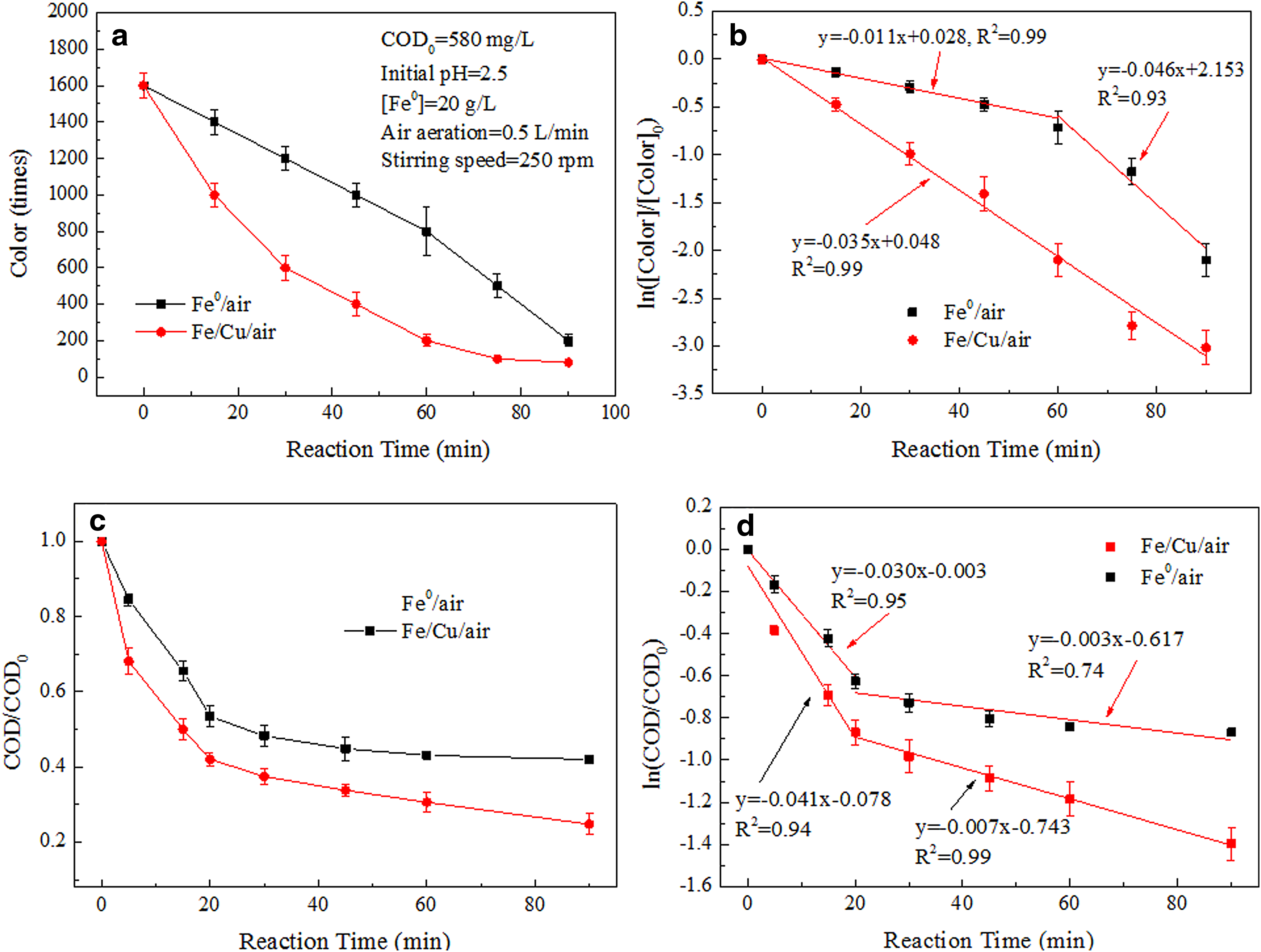
Chroma changes
COD removal efficiency and biodegradability
Figure 2c shows that in the whole 90-min treatment process, COD removal efficiencies obtained by Fe/Cu/air process were all higher than those of Fe0/air process. In addition, the logarithmic plots of residual COD concentration of ammunition wastewater versus the reaction time are shown in Fig. 2d, which illustrates that the good linear fitting was observed in the two different methods. The results indicate that COD removal efficiencies obtained by the two different methods were described by the pseudo first order. In particular, a two-phase reaction occurred in the whole treatment process by the two different methods (Fig. 2d).
The initial stage (0–20 min), called rapid consumption of H+ ions in wastewater [it could enhance the corrosion of Fe0 and formation of absorbed hydrogen ([H]abs) and facilitate the Fenton-like reaction], [H]abs or occupation of the catalytic activity sites (e.g., copper coating on Fe0 surface), was explained by the proposed reaction mechanism in previous works (Bransfield et al., 2007; Lai et al., 2014a). Kobs obtained at the initial phase (0.041 min−1 for Fe/Cu/air process and 0.030 min−1 for Fe0/air process) were much higher than those of the second phase (0.007 min−1 for Fe/Cu/air process and 0.003 min−1 for Fe0/air process). The lower reaction rate at the second phase was mainly attributed to the H+ consumption and the limitation of the mass transport rates of intermediates, products, and reactants between the solution phase and the Fe/Cu or Fe0 surface. In addition, the higher reaction rate could be obtained by Fe/Cu/air process in the whole treatment process because copper on the iron surface could be used as a catalyst to improve the corrosion of iron even if this process was performed under the neutral or alkaline condition (Xiong et al., 2015).
In addition, Fig. 3 illustrates that both COD removal efficiency (75.3%) and BOD5/COD (B/C) ratios (0.42) obtained by Fe/Cu/air process were higher than those (COD removal = 58.2%, B/C = 0.21) of Fe0/air process. It implies that the toxic and refractory pollutants in ammunition wastewater were relatively easier to be decomposed by Fe/Cu/air process. Subsequently, biodegradability of ammunition wastewater also could be significantly improved by the pretreatment of Fe/Cu/air process. Therefore, Fe/Cu/air process had a higher COD efficiency for ammunition wastewater compared with the Fe0/air process due to the higher reactivity of Fe/Cu bimetallic particles.

COD removal efficiencies and B/C ratio of effluent of Fe/Cu/air or Fe0/air.
UV-vis spectral analysis
Changes in UV-vis absorbance characteristics of ammunition wastewater during the whole treatment process by Fe/Cu/air process and Fe0/air process from 190 to 500 nm are shown in Fig. 4. With regard to the UV-vis spectrum of the influent, the broad absorption band between 190 and 300 nm can be assigned to the combination of benzene ring and nitro groups (i.e., nitro group) (Lai et al., 2012a, 2014a). As shown in Fig. 4, the broad absorption band (190–300 nm) of the effluent of the two different processes dropped rapidly with respect to the influent. However, the intensity of absorbance peaks of the effluent of Fe/Cu/air process was much lower compared with Fe0/air process. The results suggest that nitroaromatic compounds in ammunition wastewater were relatively easier to be decomposed by Fe/Cu/air process. This behavior was in accord with the former results of COD removal, decolorization, and the improvement of biodegradability (Ma et al., 2004; Fan and Ma, 2009).
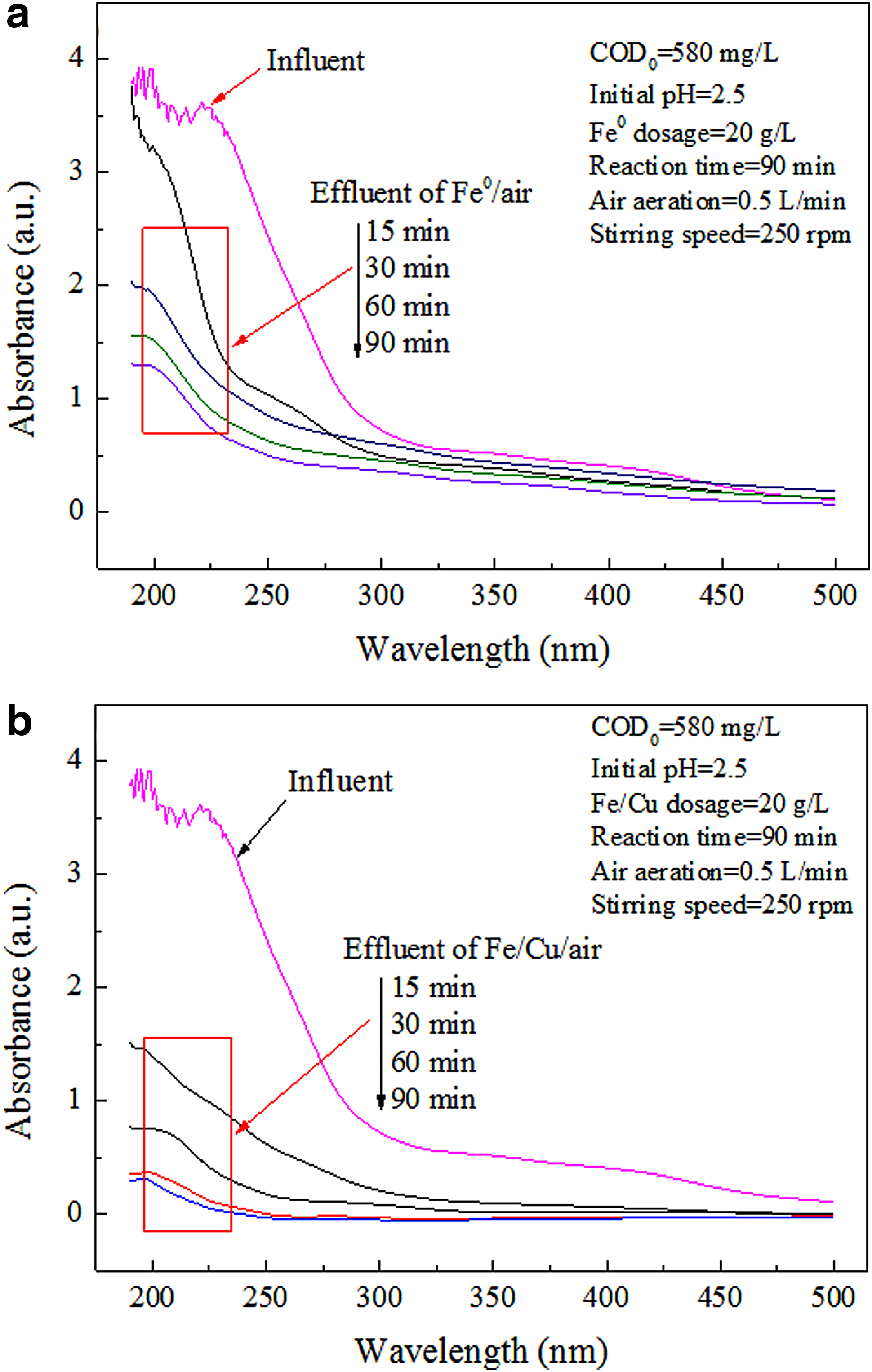
UV spectra of influent and effluent of Fe0/air
EEM fluorescence spectra analysis
During the whole treatment process, three-dimensional EEM fluorescence spectra of DOM in the influent and effluent of Fe/Cu/air and Fe0/air are shown in Supplementary Figure S1. Meanwhile, their fluorescence spectral parameters are listed in Table 1. In addition, it could be observed from Fig. 5 that both the total fluorescence intensity (TFI) of the effluent of two different processes increased to the maximum with the increasing of treatment time, and then they began to decrease with the further increase of the treatment time. However, the highest TFI (5,616 a.u.) obtained at 60 min by Fe/Cu/air process was much higher than that (3,607 a.u.) obtained at 30 min by Fe0/air process. In the initial phase, the increase of TFI was mainly attributed to the removal of electron withdraw group (e.g., nitro group) of the nitroaromatic compounds in ammunition wastewater.
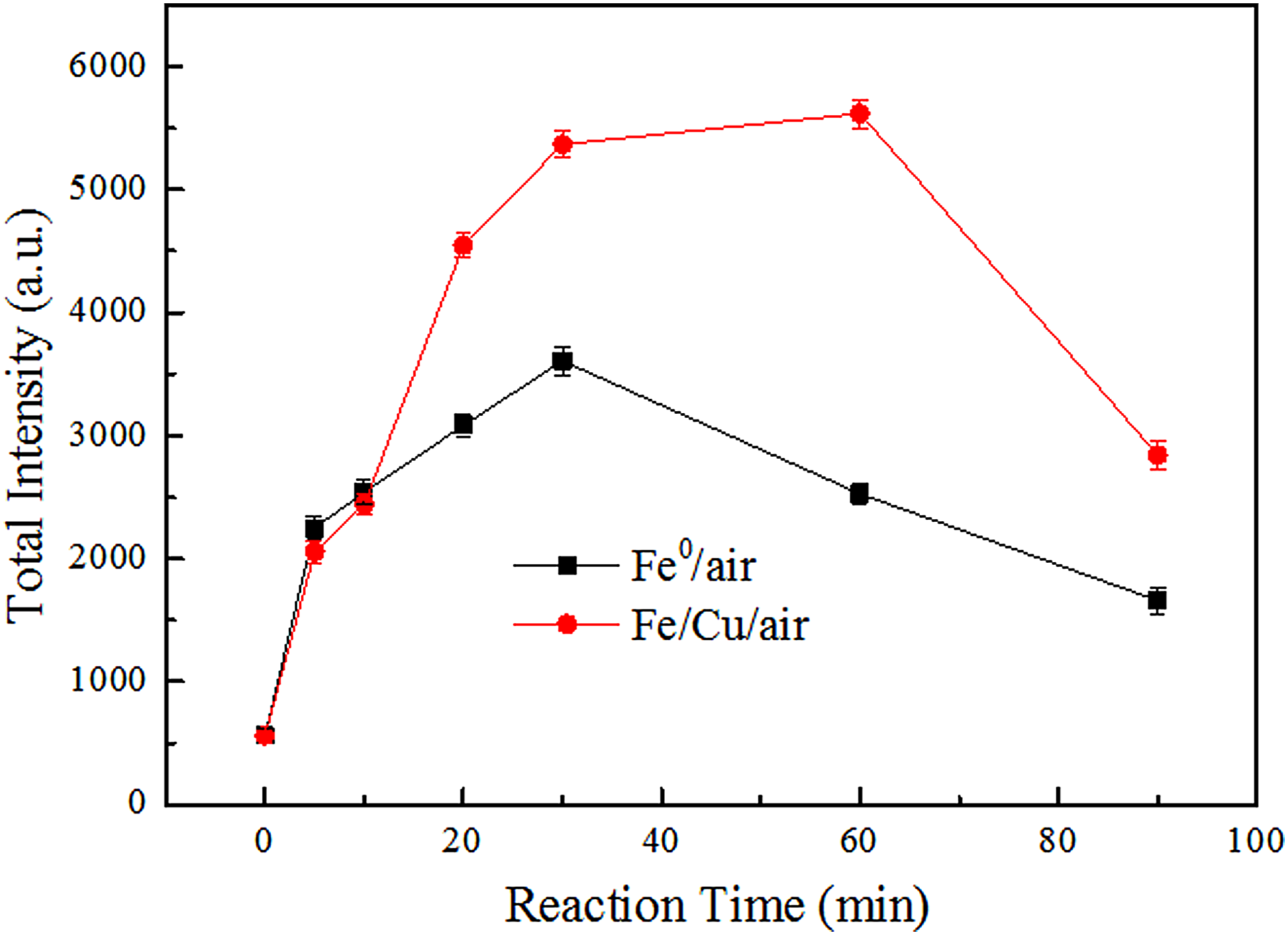
Changes of total fluorescence intensity during treatment by Fe0/air or Fe/Cu/air.
DOM, dissolved organic matter.
Similar phenomenon was also found in our previous work, the electron withdraw group would inhibit the fluorescence intensity of the compounds (Lai et al., 2013a). In the degradation pathway of the nitroaromatic compounds, the nitro group (−NO2) usually was first reduced to amino group (−NH2) and then it was further oxidized to hydroxy (−OH) (Schmidt et al., 1998; Keum and Li, 2004). For example, p-nitrophenol was first reduced to p-aminophenol, and then it was oxidized to hydroquinone (Martín-Hernández et al., 2012; Lai et al., 2014a). Both the amino group (−NH2) and hydroxy (−OH) were donor-acceptor group (Swietlik and Sikorska, 2004), which would significantly enhance the fluorescence intensity of the compounds. Subsequently, the decrease of TFI suggests that π-conjugated system of the main pollutants began to be decomposed with a further increase of the treatment time.
Finally, the higher TFI obtained during the treatment process of Fe/Cu/air could be explained by the following reason: the electron withdraw groups (e.g., −NO2) of the pollutants could be effectively removed by Fe/Cu/air process, while only a part of these groups could be decomposed by Fe0/air process. As a result, the EEM analysis also could confirm the superiority of Fe/Cu/air process for the pretreatment of ammunition wastewater.
FTIR spectra analysis
Figure 6a is the FTIR adsorption spectrum of the raw ammunition wastewater. According to the previous works (Sundaraganesan et al., 2007; Fu et al., 2012; Yuan et al., 2016), the main characteristics of these spectra are as follows: about 3,439 cm−1 (stretching vibration of C-H of unsaturated C and stretching vibration of O-H and hydrogen-bonded O-H); around 1,634, 1,447 cm−1 (asymmetric and symmetric stretching vibration of −NO2 and the aromatic C = C skeletal vibration); around 1,155, 881 and 634 cm−1 (nonplane angle vibration of substitution of benzene ring). It implies that the main organic pollutants of ammunition wastewater are aromatic compounds and nitroaromatic compounds. The results of FTIR spectra are mainly consistent with the results of UV-vis spectra.
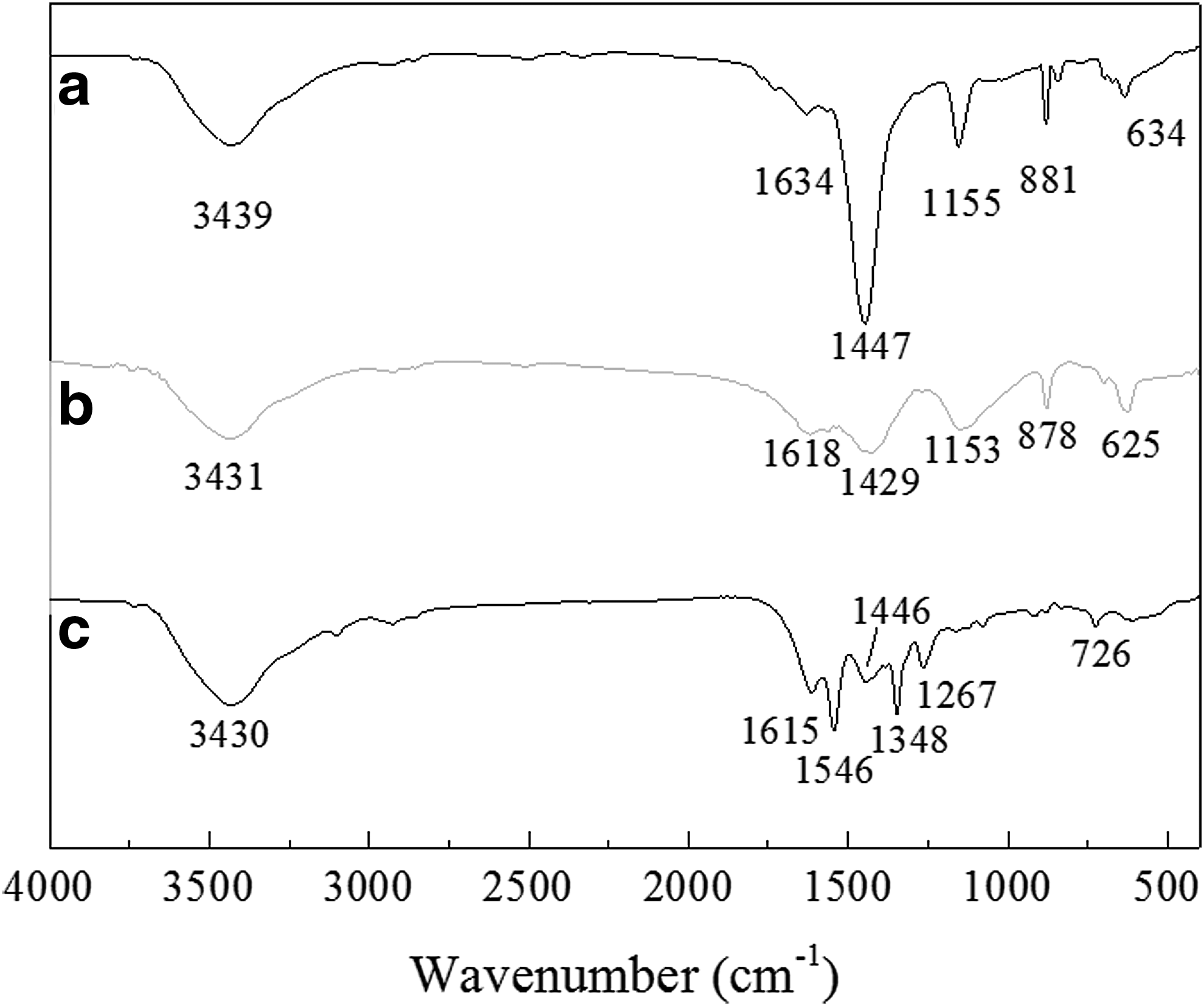
FTIR spectra of 400–4,000 cm−1 region of
Figure 6b is the FTIR adsorption spectrum of the effluent of Fe/Cu/air under the optimal conditions. It could be observed that the band at 1,447 cm−1 was almost removed completely, and the intensity of the band at about 1,155 cm−1 was decreased seriously. In addition, new bands at 1,618 and 1,429 cm−1 were generated. The results confirm that the toxic organic pollutants (e.g., nitroaromatic compounds) could be decomposed effectively by Fe/Cu/air process. Therefore, B/C ratio of ammunition wastewater could be reached up to 0.42 after 90 min treatment under the optimal conditions. Figure 6c is the FTIR adsorption spectrum of the effluent of Fe0/air process. It could be observed that the band at 1,447 cm−1 was also removed seriously, but four new peaks (1,615, 1,546, 1,348, and 1,267 cm−1) were generated.
Results suggest that the benzene ring structure of the pollutants in ammunition wastewater was not completely opened by Fe0/air process; meanwhile, some intermediates with benzene ring structure were formed. In other words, the toxic and refractory pollutants were hard to be decomposed effectively by Fe0/air process. Thus, B/C ratio of ammunition wastewater could be reached up to 0.21 after 90-min treatment by Fe0/air process. In a word, FTIR analysis also could confirm the superiority of Fe/Cu/air process for the pretreatment of ammunition wastewater.
GC-MS analysis
To further confirm the decomposition of the main pollutants in the raw wastewater by Fe/Cu/air process, the influent and effluent of Fe/Cu/air process were analyzed by GC-MS, respectively. The two chromatograms are presented in Fig. 7. Figure 7a shows that 1-Methyl-1,3,5-trinitrobenzene, 1,3,5-Trinitrobenzene, 1,3-Dinitro-benzene, and alkanes can be identified in raw ammunition wastewater, and half of them are nitroaromatics. However, there is only a small amount of alkane presented in the chromatogram of the effluent (Fig. 7b) and no new compound to be measured, which suggests that the nitroaromatics were transformed by Fe/Cu/air process. Therefore, Fe/Cu/air process is an effective treatment method to decompose the toxic nitroaromatic pollutants in ammunition wastewater.
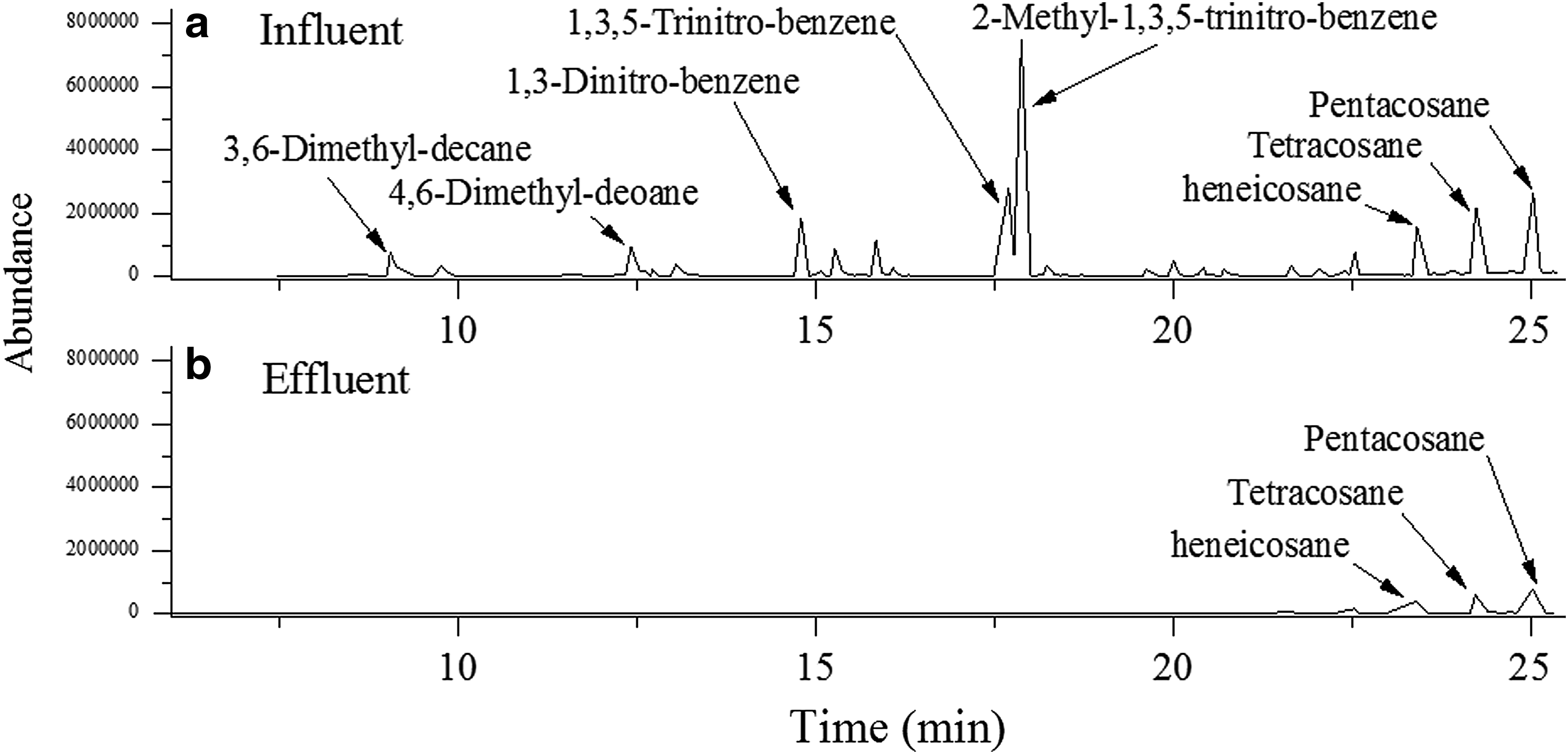
GC-MS of the influent
Conclusion
Ammunition wastewater was treated by Fe/Cu/air process, and the optimal operating parameters (initial pH = 2.5, air flow rate = 0.5 L/min, Fe/Cu dosage = 20 g/L, reaction time = 90 min) were obtained in this study. Under the optimal conditions, the higher COD removal (75.3%), decoloration (95.0%), and B/C ratio (0.42) were obtained by Fe/Cu/air process, while lower COD removal (58.2%), decoloration (87.5%), and B/C ratio (0.21) were obtained by Fe0/air process. All the analysis results of UV-vis, EEM, and FTIR could further confirm the superiority of Fe/Cu/air process for the pretreatment of ammunition wastewater. Moreover, GC/MS analysis shows that main pollutants in ammunition wastewater are decomposed by Fe/Cu/air system. As a result, the results of comparative study suggest that Fe/Cu/air process was much more superior than the Fe0/air process due to the high reactivity of Fe/Cu bimetallic particles. Therefore, Fe/Cu/air process could be considered as a promising process for the pretreatment of the ammunition wastewater and other nitrobenzene-containing wastewater.
Footnotes
Acknowledgments
The authors would like to acknowledge the financial support from National Natural Science Foundation of China (No. 21207094), China Postdoctoral Science Foundation Special Funded Project (No. 2013T60854), and Special S&T Project on Treatment and Control of Water Pollution (No. 2012ZX07201-005).
References
Supplementary Material
Please find the following supplemental material available below.
For Open Access articles published under a Creative Commons License, all supplemental material carries the same license as the article it is associated with.
For non-Open Access articles published, all supplemental material carries a non-exclusive license, and permission requests for re-use of supplemental material or any part of supplemental material shall be sent directly to the copyright owner as specified in the copyright notice associated with the article.
