




Abstract
Abstract
The aim of this study is to quantify the environmental exchanges associated with the mechanical–biological treatment (MBT) of mixed municipal waste, for a specific MBT plant, based on the annual operation data for the year 2015. Modeling of environmental performance of the MBT technology is done on actual, real data of the operating plant, taking into account particular, explicit outputs and efficiencies of the plant. Results contribute to quantitative understanding of MBT technology and its environmental impact, including the impacts from individual unit processes within MBT. The study is based on Life Cycle Assessment methodology, employing the EASETECH model. One megagram of mixed municipal waste entering the MBT plant is adopted as the functional unit. The system boundaries cover the whole value chain from collection and transport of mixed municipal waste through mechanical and biological operations until final treatment of end-waste generated in the MBT plant. Results of modeling show the MBT of mixed municipal waste, with accompanying final treatment processes of end-waste has negative impact on the environment. Significant impact categories include photochemical ozone formation, eutrophication, acidification, human toxicity. Aerobic biological treatment of the undersize fraction rich in organic material has the biggest share in total environmental impact, mainly due to ammonia and dinitrogen monoxide emissions. It may suggest that aerobic treatment is not the best option for MBT plants and biogasification with energy recovery can be more beneficial. Landfilling of ballast and stabilized waste, and use of compost for remediation of a closed landfill entail slightly lower environmental impact than the biological treatment. Recycling of secondary materials sorted from residual waste has positive effects on the environment.
Introduction
O
Implementation of the principles of sustainable development in relation to waste management is translated into application of waste hierarchy, that is, preventing waste generation, preparation for reuse, recycling, other recovery processes, and disposal of waste that cannot be recovered.
These principles were reflected in EU and Polish strategic documents, among others, Waste Framework Directive (European Commission, 2008), Landfill Directive (European Commission, 1999), and National Waste Management Plan (2010). The most important objectives defined in these documents include a reduction of landfilling, and increasing recycling and recovery level. Since 1st January 2016, a ban on landfilling has been in effect in regard to municipal waste and residues from sorting municipal waste, with heat of combustion exceeding 6 MJ/kg of dry matter (Regulation, 2013). Such legal requirements and the lack of operating municipal waste incinerators (one working incinerator in Warsaw and a several under construction or planned) enforced the need for municipal waste treatment by other methods.
This situation, in Poland, has led to the rapid development of installations of mechanical–biological treatment (MBT) of mixed municipal waste. The draft of the National Waste Management Plan published in March 2016 (National Waste Management Plan Draft, 2016) reports that at the end of 2014, 127 installations of MBT with the status of the regional plant operated in Poland. These installations had total capacity of almost 9.4 million Mg mixed municipal waste per year.
MBT, as the name suggests, combines mechanical treatment technologies (screens, sieves, magnets) with biological technologies (composting, anaerobic digestion). The aim of MBT was originally to reduce the amount of waste intended to landfill, but today the MBT technologies are used in plants recovering fuel (refuse derived fuel [RDF]), and material fractions–recyclables (Bilitewski et al., 2011).
According to the previous investigation (Malinowski, 2012), the share of separated metals, glass, paper, and plastics does not exceed 7% of the mass, and the share of fuels generated from municipal solid waste does not exceed 50% (average—37%).
MBT processes of municipal waste are also popular in other European countries, especially in new EU countries struggling to achieve the strict landfill diversion targets of the European legislation (2008/98/EC, 99/31/EC), including the regulations regarding the disposal of biodegradable waste (Abeliotis et al., 2012; Dębicka et al., 2013; Dziedzic et al., 2015).
Life cycle assessment (LCA) methodology is regarded as one of the most valuable tools for identifying and assessing the environmental impacts associated with waste management (Finnveden, 1999; Bjarnaddottir et al., 2002) or waste treatment plants. A systemic approach to life cycle analysis covers all areas of environmental impacts related to waste management, including each waste processing procedure. Such an analysis is a tool that enables evaluation of various waste processing technologies, which feature various power consumption and production patterns and various material recovery levels (Kirkeby et al., 2006a). The main objective of LCA is to provide a holistic insight into emission to environment and natural resources use caused by a waste management system or a waste management plant (Bjorklund et al., 2010).
There are a few LCA studies specifically focusing on MBT plants in the literature. Abeliotis et al. (2012) assessed the environmental profile of an MBT plant located in Athens. The results of this study indicate the MBT scenario with complete utilization of the MBT outputs (compost, RDF, metals) generates the most environmental benefits. An MBT plant sited in Attica region (Greece) was included in the study of Papageorgiou et al. (2009), the results show greenhouse gas (GHG) emissions of MBT scenarios depend on the existence of end markets for the RDF generated by the MBT processes. Bovea et al. (2010) considered material recovery facility scenarios in their Spanish case study. Scenarios that combine biogasification of organic material and landfilling with energy recovery of reject material are the best in terms of environmental performance for all impact categories.
What was generally missing was an assessment taking into account plant-specific outputs, and local actual plant efficiencies (i.e., materials and energy recovery) (Montejo et al., 2013). These may significantly affect the LCA results, as was reported by De Feo and Malvano (2009), when several waste management scenarios were analyzed and MBT plants were one of them.
The aim of this study is to quantify the environmental exchanges associated with the MBT of mixed municipal waste, for a specific MBT plant, based on the annual operation data for the year 2015. The assessment takes into account particular, explicit outputs and efficiencies of the plant. Modeling the environmental performance of MBT technology is done on actual, real data of the operating plant, therefore the results contribute to quantitative understanding of MBT technology and its environmental impact, including the impacts from individual unit processes within MBT.
The study is based on LCA methodology, employing the EASETECH model.
Materials and Methods
Municipal waste produced and characteristics
Input for MBT process was mixed municipal waste generated in Krakow (southern Poland) and suburban municipalities. Data on the morphological composition of waste and its properties originates from the report on waste testing carried out for Krakow from November 2010 to October 2011, for five selected measurement routes that represent three basic types of building development in Krakow: city center, multi-family housing, and single-family housing (Sieja et al., 2011). Mixed municipal waste produced in Krakow feature the following parameters: water content 41.1%; combustible substances 78.3% of dry matter, heat of combustion 13.82 MJ/kg of dry matter, calorific value 7.94 MJ/kg of dry matter, chloride content Cl 0.297% of dry matter, fluoride content F 0.0031%, and sulfur content expressed as SO3 0.168% of dry matter (Sieja et al., 2011).
The morphological composition of municipal waste is usually defined in Poland by 12 basic fractions (Jędrczak and Szpadt, 2006), however, the study by Sieja et al. (2011) provides more detailed composition, as within the basic 12 fraction, additional 34 subfractions are determined. Furthermore, the morphological composition of waste coming into the MBT plant was determined in studies by Malinowski (2013), Dziedzic et al. (2015), and Jakubowski et al. (2016). But these studies were limited to 12 fractions.
Material composition of municipal waste is extremely heterogeneous. Some similarities or differences could be observed within the seasonal changes and within the neighboring municipalities. Such similarities for waste generated in the city and in the suburban municipalities were proven in the study by Malinowski (2013). Material composition of residual municipal waste is shown in Table 1, comparing the results of studies by Sieja et al. (2011), Dziedzic et al. (2015), and Jakubowski et al. (2016). This LCA study uses the waste composition defined by Sieja et al. (2011), because of its detailed results—separating 34 subfractions. Waste subfractions are shown in Table 1.
SD, standard deviation.
Description of MBT plant
The MBT plant owned by MIKI Recykling Ltd. is one of the regional installations in the West Region of waste management in Malopolska Voivodship (Poland). The West Region, with capital of Malopolska Voivodhip—Krakow, is inhabited by almost 2 million people. Eight MBT plants were granted the status of regional installation in the West Region and seven out of eight installation has similar technology as MIKI Recycling Ltd., that is aerobic biostabilization. About 417,045 Mg of mixed municipal waste was generated in 2014 in the West Region (SAVONA Project, 2016). In 2014 and 2015 all mixed waste was submitted to the MBT regional installations for treatment.
MBT MIKI Recycling Ltd. is located in Krakow. The annual capacity of the plant totals 30,000 Mg of mixed municipal waste. Upon delivery, weighing, and unloading in the production hall, waste is directed to initial shredding (tearing of sacs) and then to magnetic and manual sorting, which results in retrieving recyclable materials: ferrous and nonferrous metals, glass, paper and cardboard, and plastics. The remaining waste stream is directed to sieving at a trommel screen with an 80 mm mesh, where waste is separated into undersize fraction of 0–80 mm grain size and into thick fraction over 80 mm.
Undersize fraction, which consists of organic matter mostly, undergoes biological treatment process, that is, aerobic stabilization (composting/biostabilization). Oversize fraction above 80 mm is directed to an air separation unit, where further separation into heavy and light fractions is performed. The heavy fraction constitutes ballast and is directed to landfilling. The light fraction, the so-called pre-RDF, which contains mostly of dry waste with high calorific value, is directed to final shredding, which ensures size reduction of fuel particles to maximum 10 cm2. Pre-RDF after final shredding goes to bio-drying in a reactor, where partial evaporation of water takes place. RDF prepared in such way is loaded into “walking floor” type vehicles and shipped to a cement plant for incineration. The flow chart of operations of MBT MIKI Recycling Ltd. is shown in Fig. 1.

System boundaries with mass flow of waste streams and electricity and diesel fuel consumption per functional unit.
Biological treatment process (composting/biostabilization) of undersize fraction rich in organic material is carried out in 28 bioreactors for 14 days. A bioreactor has total capacity of 36 m3 and a working capacity of 31.5 m3. The remaining volume of the bioreactor is the space under the bed used for injecting air and collect leachates. Humid postprocess air is transported to a biological filter (one filter with a capacity of 36 m3 per seven bioreactors) using a 0.5 kW fan.
In the process of biostabilization in bioreactors, the aeration of the undersize fraction is periodical and regulated depending on the temperature of the processed waste. During the process the temperature of the organic fraction increases up to 70°C, resulting in hygienization and preliminary stabilization of the waste stream. After 14 days of the process, the waste is unloaded from the bioreactors and composting windrows are formed for maturation phase of 6–10 weeks duration. Composting windrows are mechanically turned every 2 weeks.
After the biostabilization process, which takes 8–12 weeks altogether, the waste stream is sieved in a trommel in two fractions: below 20 mm and 20–80 mm. The fraction below 20 mm is low quality compost, which does not fulfill the requirements for fertilizers, and therefore it is utilized for remediation of a closed municipal landfill. The 20–80 fraction is considered stabilized waste (stabilisat).
After processing, the stabilized waste can be landfilled once meeting the following criteria (Regulation, 2013): loss of ignition < 8% dry matter (d.m.), total organic carbon < 5% d.m., and heat of combustion max. 6 MJ/kg d.m.
Characterization of products and end-waste generated in the MBT plant
Products and end-waste generated and leaving the MBT plant are as follows: recyclables (5.25% of input) sent to recycling plants, RDF (38.95% of input) sent to energy recovery in a cement plant, low quality compost (16.62% of input) sent to remediation of a closed landfill, stabilized waste (11.91% of input) sent to landfilling, and ballast—a heavy fraction above 80 mm (19.82% of input) sent to landfilling. The remaining part of input waste (7.45%) is a weight loss due to the decomposition of organic matter. The weight loss in the MBT MIKI Recycling Ltd. is quite low.
Adani et al. (2004), Dziedzic et al. (2015), Sugni et al. (2005), and Titta et al. (2007) in their experimental research and controlled conditions of the process reported more significant weight losses. Dziedzic et al. (2015) reported that weight loss in a real MBT plant with biostabilization could be almost 19%. However, in this study data was taken for the entire year 2015, taking into account winter conditions (lower weight loss) and summer (higher weight loss). The value of weight loss is therefore the result of the annual average based on the actual conditions of the installation.
Physical and chemical parameters of products and end-waste generated in the process of MBT at MBT MIKI Recykling Ltd. were determined based on laboratory analyses of samples collected in 2015. The samples of ∼200 g of dry mass were taken from particular streams of products and end-waste, such as: RDF, low quality compost, stabilized waste, and ballast. The water content and dry mass (PN-EN 14774-3, 2010), and loss on ignition (PN-EN 15169, 2007), heat of combustion, and net calorific values (PN-ISO 1928, 2002). (PN-Z 15008-04, 1993) were determined for the samples.
Samples were dried, homogenized, and subjected to dry mineralization in an open system for further chemical investigation. The samples of final waste were mineralized in a muffle furnace at 450°C and then solubilized in a solution of nitric acid (V). The analytical sample weight was 3 g of dry mass. The concentration of analyzed elements in the resulting solutions was determined by atomic emission spectrometry. The results of analyzes are presented in Table 2.
MBT, mechanical–biological treatment; TOC, total organic carbon.
Metal content in final waste depends on the presence of undesirable materials, such as ferrous and nonferrous metals or hazardous waste such as batteries and fluorescent lamps (Dziedzic et al., 2015). The concentration of bar and zinc in the waste were very high. The highest concentrations of metals were found in RDF, and the lowest in compost. For compost the acceptable levels of metal concentration set by the (Regulation, 2008) were not exceeded. The standards for RDF are set by cement producers, these standards were not exceeded either.
Results of laboratory analyses of end-waste were used in the software for verifying the correctness of the modeling.
LCA method for waste management system and treatment
This study has been carried out using the EASETECH model, which is based on the EASEWASTE concept. Both the EASEWASTE and EASETECH models address an entire solid waste management system, starting from the point where household waste is collected, ending at the point of final treatment (Kirkeby et al., 2006a). The EASEWASTE model was elaborated with a database including waste treatment options and external processes, which can appear both upstream and downstream of a waste management system.
Recycled materials and energy derived from the waste management system are regarded as substitutes for virgin materials or energy. Emissions into water, air, and soil alongside resource consumptions, which are avoided as a result are subtracted from the other emissions and resource consumptions in the waste system. The model calculates emissions into water, air, and soil, along with the consumption of resources. The model applies life cycle impact assessment (LCIA) methods for conversion of these exchanges into environmental impacts (Kirkeby et al., 2006a, 2006b).
Several LCIA methods are employed in the EASETECH model such as EDIP 1997 (Wenzel et al., 1997), EDIP 2003 (Hauschild and Potting, 2005), IPCC 2007 (impacts related to global warming) (Frischknecht et al., 2007), and methodologies recommended by the ILCD handbook (European Commission-Joint Research Center, 2011).
The EDIP 2003 methodology was updated from EDIP 1997. It has the wide range of impact categories: acidification, ecotoxicity acute in water, ecotoxicity chronic in soil, ecotoxicity chronic in water, eutrophication combined potential, eutrophication separate N potential, eutrophication separate P potential, terrestrial eutrophication, global warming, human toxicity via air, photochemical ozone formation impacts on human health, photochemical ozone formation impacts on vegetation, and stratospheric ozone depletion. For the ILCD handbook, the range of impact categories is narrower and IPPC 2007 methodology gives the impact only on global warming.
The comparison of impact categories of EDIP 1997, EDIP 2003, ILCD handbook, and IPCC 2007 is shown in Table 3. For this LCA study the EDIP 2003 was chosen because the impact categories cover thoroughly potential environmental impacts.
The EDIP 2003 methods give results in four levels: a life cycle inventory (LCI), characterization of impacts, a normalized impact profile, and finally a weighted impact profile (applying political reduction targets). The translation of the environmental exchanges into characterized, normalized, or weighted impacts facilitates the comparison of the waste treatment systems' overall environmental performance (Kirkeby et al., 2006a).
The EASETECH model calculates environmental impacts as normalized potential impacts. Normalization presents a relative expression of the environmental impact or resource consumption compared with that of one average person (i.e., normalization reference), providing a normalized impact potential in the unit of person equivalent (PE; Hansen et al., 2006). The calculated positive value of normalized impact potential presents a contribution to the impact, while a negative one indicates an avoidance of the impact or resource consumption (Kirkeby et al., 2006b).
Data collection for LCI
Data for the MBT plant modeling, for year 2015, were obtained through very close long lasting cooperation with MIKI Recycling Ltd. All mixed municipal waste entering the plant was weighted at the gate, and products and end-waste (post-treatment) coming out of the plant. For the purpose of this research each stream of mid-point waste, generated at the each stage of processing, was also weighted, to build a detailed and exact mass balance of the processed mixed municipal waste stream.
MIKI Recycling Ltd. processes not only mixed municipal waste but also other types of waste (packaging waste, selectively collected recyclables etc.). In 2015, MIKI Recycling Ltd. processed 47,348 Mg of waste in total, including 21,558 Mg of mixed municipal waste (45.5%). For processing both mixed municipal waste and other wastes the same equipment and machineries are used. Therefore, together with the company employees the exact masses of mixed municipal waste and other waste streams processed by each machinery unit were calculated.
It was also necessary to estimate the precise working time of each machinery unit for the purpose of the MBT of mixed municipal waste. As a result, it was possible to determine the consumption of electricity and diesel fuel only for the processing of mixed municipal waste. Electricity consumption for individual devices was calculated as the ratio of the working time (for processing the mixed municipal waste) of the device and the power of this device. The MIKI Recycling Ltd. plant has its own diesel fuel tank, all the equipment is refueled only by this tank and the quantity of fuel used for each machinery unit is strictly evidenced. Moreover, for each machinery unit, the working time for processing mixed municipal waste and other waste streams was calculated.
Fuel consumption for the collection (from households) and transport of mixed municipal waste was calculated on the basis of vehicles parameters such as engine power, cylinder capacity, number of kilometers covered, and the total mass of collected and transported mixed municipal waste. The value introduced to the system boundaries as fuel consumption for collection and transport of mixed municipal waste was the calculated annual average value for all vehicles collecting and transporting of mixed municipal waste in 2015.
Fuel consumption for transportation of products and end-waste (post-treatment) from the MBT plant to recycling facilities, landfilling, landfill remediation, and RDF to a cement plant was calculated in a similar way as for mixed municipal waste entering the plant. The distances to recycling, energy recovery, remediation (compost), and landfilling facilities vary and were calculated taking into account real facilities, where products and end-waste were sent in 2015 from the MBT plant.
Functional unit and system boundaries
In this research, 1 Mg of mixed municipal waste entering the MBT plant is adopted as the functional unit. The parameters of input waste are described in the section “Municipal waste produced and its characteristics” and Table 1. This LCA study uses the material composition of input waste determined by Sieja et al. (2011), because the material composition is more detailed than the analyses performed by Dziedzic et al. (2015) and Jakubowski et al. (2016). On the other hand there is a high correlation between the results by Sieja et al. (2011), and the results of analyses performed by Dziedzic et al. (2015) and Jakubowski et al. (2016).
Results of laboratory analyses of products and end-waste from the MBT plant were used in the EASETECH software for iterative verifying the correctness of the modeling. It was checked whether input waste along with modeled treatment processes gave the products and end-waste with the parameters determined in the chemical analyses, if not the modeling of the processes was done again.
System boundaries cover the whole value chain from collection and transport of mixed municipal waste through mechanical and biological operations to the final treatment of end-waste streams generated in MBT plant. Through the mechanical processes, the RDF and ballast are produced, whereas recyclables are sorted out. On the other hand, low quality compost and stabilized waste are generated in biological processes. Moreover, the system boundaries also include end-waste treatment processes:
– recycling of material fractions sorted out from mixed municipal waste: paper and cardboard, glass, ferrous metals, nonferrous metal, plastic; – use of low quality compost for remediation of a closed municipal landfill site; – landfilling of stabilized waste; – landfilling of ballast.
Landfilling is done at a well-equipped facility, where landfill gas is collected and converted at a combine heat and power (CHP) engine into heat and electricity. Leachate is captured by drainage system and then reaches a municipal wastewater treatment plant.
Transport of products and end-waste to final treatment facilities is also comprised within the system boundaries.
Incineration of RDF in a cement kiln is a very complex process, in which not only energy from alternative fuel is recovered but also various raw materials such as limestone, calcareous marl, silica, and clay are inputs to produce clinker. Moreover, in a cement kiln fossil fuels (pulverized coal, fuel oil) and other waste fuels: meat and bone meal, used tires, and spent solvents are utilized. Therefore, incineration of RDF needs detailed and very careful modeling and it is subject of a separate LCA study, not yet published. Thus, RDF incineration is excluded from the system boundaries of this study. However, preliminary screening modeling shows that 1 Mg of RDF substitutes 700 kg of coal, hence RDF incineration bring environmental benefits.
System boundaries of this analysis including mechanical and biological operations with accompanying final treatment processes of end-waste are presented in Fig. 1. Additionally, Fig. 1 shows the flow chart with mass balance of individual waste streams, and the consumption of electricity and diesel fuel in individual operations calculated per functional unit.
Results and Discussion
Significant impact categories and emissions contributing to them
After modeling the inputs, mass flows of waste streams, treatment processes, electricity and fuel consumption, outputs products, and end-waste, the EASETECH software calculates the LCI of elementary environmental exchanges. These are emissions of various substances, and substances taken from the environment as natural resources. The whole LCI table includes 1,396 positions of elementary exchanges. Emissions and substances taken from the environment contribute to the impact categories. For each impact category the value of category indicator is calculated; then the values of category indicators are normalized. Normalized results of the potential environmental impacts, in PE unit are presented in Fig. 2, for the MBT of mixed municipal waste with accompanying final treatment processes of end-waste.
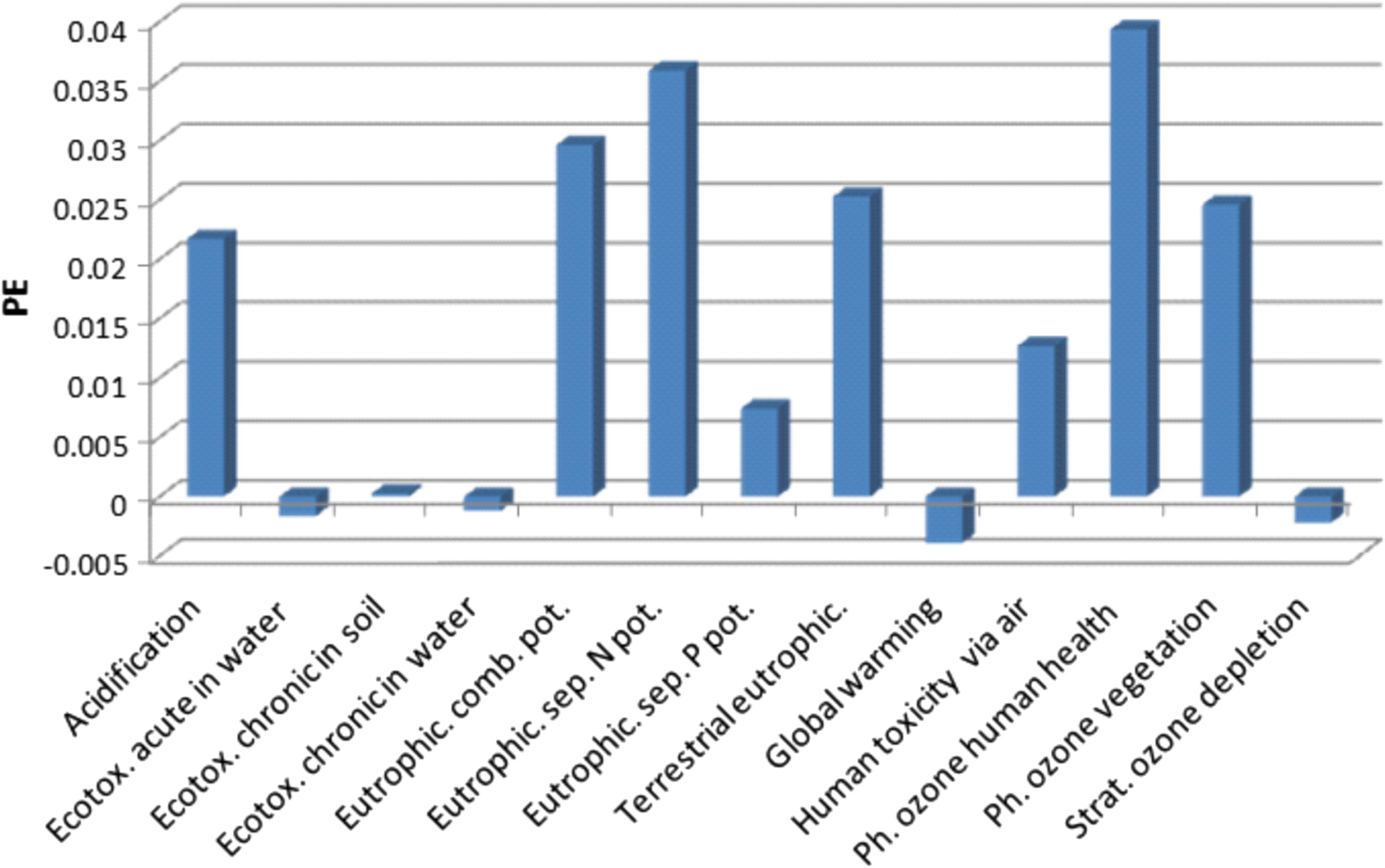
Normalized impact of mechanical–biological treatment of mixed municipal waste, with accompanying final treatment processes.
Significant impact categories include photochemical ozone formation (impact on human health and vegetation); eutrophication (N potential, combined potential, and terrestrial eutrophication); acidification; and human toxicity.
The most dominant contributor to photochemical ozone formation is methane of nonfossil origin, with the amount of 2.93 kg per functional unit, that is, 1 Mg of the processed mixed municipal waste. Methane emission is caused by landfilling process of ballast and stabilized waste and, to a smaller extent, by composting of fine fraction in bioreactors and windrows. Although the landfilling facility is equipped with a collection system for landfill gas and a CHP engine, part of produced methane is not collected and migrates to cover layers of the landfill, causing emission to air.
The gas collection efficiency of the landfill is modeled within 100 year horizon in the EASETECH software. For an average performing landfill 35% of the produced gas is collected in the first 5 years, and then the efficiency increases to 65% (5–15 years) and to 75% (15–55 years). At some point, after 55 years, it is no longer economically desirable to collect the gas and the collection stops (Olesen and Damgaard, 2014).
Composting of undersize fraction is an aerobic process, however, methane may be produced in the anaerobic zones, which occasionally appear in the composting piles.
Nitrogen oxides, with the amount of 0.27 kg and nonmethane volatile organic compounds (NMVOC) with the amount of 0.02 kg emitted to the air close to ground also contribute to photochemical ozone formation. These compounds come from collection and transport of mixed municipal waste, and transport of end-waste (post-treatment waste streams) to relevant treatment facilities, that is diesel fuel combustion.
Emissions of ammonia to air with the amount of 0.23 kg from composting process in reactors and windrows contribute to eutrophication (N potential, combined potential, and terrestrial eutrophication), and acidification. Emission of nitrate of 0.18 kg to surface water contributes to the eutrophication impact category as well. Apart from ammonia emissions, acidification is also caused by nitrogen oxides emitted to air close to ground from collection and transport of mixed municipal waste and transport of end-waste to the relevant treatment facilities. Nitrogen oxides with 0.27 kg coming from transport processes, more specifically diesel fuel combustion, also cause high value of the normalized impact potential in human toxicity.
Emission of nitrate to surface water from landfilling of ballast and stabilized waste, in the amount of 0.18 kg, also significantly contributes to this impact category. Moreover, high value of the normalized impact potential in human toxicity is caused by emissions of formaldehyde to air in the amount of 0.00005 kg, benzene in the amount 0.00003 kg, and hydrogen sulfide in the amount of 0.0003 kg from electricity consumption for mechanical processes, mainly final shredding of pre-RDF, magnetic and manual sorting of mixed municipal waste, and air separation of oversized fraction. As the electricity production in Poland is highly dependent on combustion of fossil fuels (coal and lignite), the above-mentioned substances come from electricity production.
Although global warming is not a very significant category in the overall normalized potential impact, it is worth mentioning because a negative value can be observed for this category. The negative value indicates an avoidance of the environmental impact caused by an emission or resource consumption. This is mainly due to avoided emissions of carbon dioxide from landfilling of ballast and stabilisat. Solid residues that are not further decomposed are assumed to have no interaction with the surrounding environment, thus it is assumed the carbon is stored and can be perceived as sequestered, being counted as negative fossil carbon dioxide emission. (Olesen and Damgaard, 2014).
Negative values of carbon dioxide emissions also come from recycling processes of aluminium, steel, plastic, and glass. Recycling processes are less energy consuming than the production from raw resources; therefore, carbon dioxide emission is avoided. Recycling processes of aluminium, steel, and plastic entail avoiding emissions of methane of fossil origin, which also contributes to the negative value in the global warming impact category.
Although the study by Montejo et al. (2013) assesses the environmental performance of eight MBT plants by means of LCA, using very similar methodology: EDIP 1997 (EDIP 2003 is updated version of EDIP 1997) and EASEWASTE software (EASTECH is based on the EASEWASTE concept), the study does not directly indicate the significant impact categories. The study by Montejo et al. (2013) covers following impact categories: global warming; photochemical ozone formation; stratospheric ozone depletion; acidification; nutrient enrichment (eutrophication); ecotoxicity in soil and water, and human toxicity via soil, water, and air.
The results in Montejo et al. (2013) study are expressed as characterized impacts, which means each impact category is expressed in different units; therefore impact categories values cannot be compared to each other. However, the (Montejo et al., 2013) study broadly discusses the results within individual categories.
On global warming all eight MBT scenarios contributed with environmental savings (negative values), most GHGs savings are provided by recycling, carbon sequestration in the landfill, and energy recovery. On acidification and nutrient enrichment (eutrophication) the most important contributors were ammonia emissions from composting (biological processes), ammonia and phosphate from landfilling (leachate), and NOx from transportation. On stratospheric ozone depletion the impact was caused by landfilling due to chlorofluorocarbons (CFCs) and ammonia emissions.
On photochemical ozone formation impacts were primarily caused by transportation (VOCs) and to a minor extent by landfilling and biological processes—methane emissions.
Normalized potential impacts per individual technological processes
Normalized potential impacts are also calculated per individual technological processes within the system boundaries. The analyzed system is modeled in a very detailed manner and 28 processes are specified within the system boundaries. Results calculated per functional unit, that is, 1 Mg of mixed municipal waste entering the MBT plant, are shown in PE units in Table 4.
RDF, refuse-derived fuel; CHP, combine heat and power.
As the analyzed system is defined in a very detailed manner, the processes are grouped to show the results transparently and comprehensibly. The grouping of processes is as follows:
– collection and transport of mixed municipal waste as an important stage of waste management system; – mechanical processes: manual and magnetic sorting of mixed municipal waste; initial shredding and trommel screening; air sorting; final shredding; and biodrying as stages of RDF production; – biological processes: composting in bioreactors, including belt conveyors operation and loading the reactors, composting in windrows, including forming of the windrows and air dynamic aerations of windrows, and finally trommel screening for low quality compost and stabilized waste for landfilling; – landfilling of stabilized waste and ballast and the use of a low quality compost for remediation of a closed landfill; – loading and transport of all end-waste streams (postprocessing waste); – recycling of all recyclables obtained from manual and magnetic sorting.
Normalized potential impacts per group of processes are shown in Fig. 3.

Normalized impact of the mechanical–biological treatment of mixed municipal waste, with accompanying final treatment processes, per group of processes.
The most significant processes are biological treatment operations of undersize fraction: biostabilization in bioreactors and maturation phase in windrows. Within these processes, eutrophication (N potential, combine potential, and terrestrial) and acidification due to ammonia and dinitrogen monoxide emissions constitute a considerable share.
Normalized impact potential for landfilling (and use of compost for landfill remediation) is slightly lower than for biological treatment. The two categories: photochemical ozone formation impact on human health and the impact on vegetation due to emission of methane of nonfossil origin have a significant share. For landfilling, the negative value of the normalized impact potential is observed in the global warming category, because of the avoided emission of carbon dioxide, which is caused by carbon sequestration.
Normalized impact potential for mechanical treatment is considerably lower than for biological treatment. The impact for mechanical processes is caused by electricity and diesel fuel consumption for the operation of heavy working machineries. Electricity and fuel consumption are also needed for biological treatment (belt conveyors, loading, fans, unloading, windrows forming and turning, and trommel screening), but additionally from composting process nitrogen compounds are emitted to air.
Acidification and human toxicity due to emissions of nitrogen oxides also have a significant share within the mechanical treatment.
The stage of collection and transport of mixed municipal affects the environment to a degree comparable to mechanical treatment. Therefore, collection and transport of municipal waste is not only a costly element of the system, but also is a stage of important environmental impact. The significant impact categories for this stage are: photochemical ozone formation, eutrophication, acidification, human toxicity, global warming, caused mainly by emissions of nitrogen oxides, NMVOC, sulfur dioxide and carbon dioxide from diesel fuel combustion in vehicles.
Recycling of secondary materials sorted out from mixed municipal waste shows negative values for normalized impact potential in all impact categories. The negative values of normalized impact indicate positive effects on the environment. The most significant categories are stratospheric ozone depletion, acidification, and eutrophication N potential, due to avoided emissions of ethane, 1,2-dichloro-1,1,2,2-tetrafluoro-, CFC-114 to air from aluminium recycling (stratospheric ozone depletion), sulfur dioxide to air mainly from aluminium and plastic recycling (acidification), nitrogen to surface water from paper recycling (eutrophication N potential).
In the study by Montejo et al. (2013) the processes were grouped into (i) transportation (waste collection and transport of recovered materials and rejects), (ii) mechanical treatment (mechanical material recovery), (iii) biological processes (composting or combined process with anaerobic digestion and postcomposting), (iv) recycling (facilities where recovered materials are reprocessed), and (v) landfilling (of all the compost, rejects, and RDF generated).
For all the scenarios in Montejo et al. (2013) study the environmental savings were primarily associated with (i) recycling, (ii) landfilling (carbon sequestration), and (iii) biological processes (substitution of fossil fuel through energy produced during anaerobic digestion).
It must be noted that the system boundaries of this LCA study exclude the incineration of refuse-derived fuel RDF in cement kilns. This process will be subjected for a detail analysis in a separate study, based on data obtained from a cement plant located in Poland. Analysis of Abeliotis et al. (2012) indicates that the utilization of RDF in a cement plant is a key factor toward improving the environmental performance of the MBT plant. However, an important limitation described in the study by Abeliotis et al. (2012) is that a potential emission source (i.e., the cement plant) has not been included due to lack of actual data.
Incineration of RDF brings notable environmental benefits (positive impact on environment) in the form of “avoided impacts.” By incineration of RDF, nonrenewable energy sources are saved, that is, exploitation of fossil fuels, and the entire processing of nonrenewable fossil fuels can be avoided. However, incineration of RDF in a cement kiln as a very complex production system of clinker and needs a detailed modeling in a separate study, based on actual operating data of an existing plant. Preliminary screening modeling of Chelm cement plant shows that 1 Mg of RDF substitutes 700 kg of coal.
Conclusions
MBT of mixed municipal waste, with accompanying final treatment processes of end-waste has a negative impact on the environment. The significant impact categories include photochemical ozone formation, eutrophication, acidification, and human toxicity.
Technological processes that affect environment to a great extent are biological treatment operations: composting/biostabilization of undersize fraction rich in organic material in bioreactors and maturation phase in windrows, mainly due to ammonia and dinitrogen monoxide emissions. Landfilling of ballast and stabilized waste, and the use of compost for remediation of a closed landfill entail slightly lower environmental impact than biological treatment. The environmental impact of landfilling is caused mainly by emission of methane of nonfossil origin, which is not collected by a system for gas recovery at a CHP engine.
Normalized impact potential for mechanical treatment is considerably lower than for the biological treatment and it is mainly caused by the emission of nitrogen oxides from electricity and diesel fuel consumption for the operation of heavy working machineries.
Stage of collection and transport of mixed municipal effects the environment to a degree comparable to mechanical treatment. The environmental impact at this stage is caused mainly by emissions of nitrogen oxides, NMVOC, sulfur dioxide, and carbon dioxide from diesel fuel combustion in vehicles.
Recycling of secondary materials sorted out from mixed municipal waste has positive effect on the environment due to the avoided emissions of ethane, 1,2-dichloro-1,1,2,2-tetrafluoro-, CFC-114 to air from aluminium recycling (stratospheric ozone depletion), sulfur dioxide to air mainly from aluminium and plastic recycling (acidification), nitrogen to surface water from paper recycling (eutrophication N potential).
Incineration of RDF in a cement kiln brings significant environmental savings, as 1 Mg of RDF substitutes 700 kg of coal, shown in a preliminary screening model of Chelm cement plant. However, the production of clinker in a cement kiln is a very complex system, which needs careful modeling in a separate LCA study.
As the aerobic biological processes have the biggest share in total environmental impact of the MBT of mixed municipal waste with associated end-waste treatment processes, it may suggest the aerobic treatment is not the best option for MBT plants. It would be more environmentally beneficial if aerobic processes are replaced by biogasification with energy recovery. This is also pointed out in the study by Bovea et al. (2010), in which the scenarios with biogasification of organic material are the best in terms of environmental performance. Recycling of secondary materials sorted out from mixed municipal waste has positive effects on the environment, thus increasing efficiencies of sorting out recyclables from residual waste will contribute to better environmental effects of MBT technology.
Footnotes
Acknowledgments
The publication and research were financed by the Ministry of Science and Higher Education of the Republic of Poland—means provided by statutory research 11.11.150.008 (AGH University of Science and Technology) and DS 3600 (University of Agriculture in Krakow).
Author Disclosure Statement
No competing financial interests exist.