This work investigates the extraction of cadmium (II) from aqueous solution through supported liquid membrane system (SLM). A microporous polypropylene (Celgard 2400) film with tridodecylamine (TDDA) in xylene was used as a membrane phase. Cadmium chloride and hydrochloric acid was used as a feed phase, while ammonia solution was used as stripping reagent. Effect of concentrations of feed, strip solution, and carrier was investigated for the extraction of cadmium. The optimized concentration of Cd(II) and hydrochloric acid, carrier, and striping reagent solution were 1.33 × 10⁻³ mol/L, 1 mol/L, 30%, and 6 mol/L, respectively. Ninety-two percent extraction of cadmium (II) was achieved under the optimized conditions. In this work, tridodecylamine has been used as a carrier for the first time for the extraction of cadmium ions from wastewater.
Introduction
Due to vast industrial use and applications of cadmium the water reservoirs are contaminated with this toxic metal ion (Emsley, 2011). So, it is necessary to develop effective and low cost methods for the removal of cadmium from wastewater before it is disposed off (Fua et al., 2012). Various wastewater treatment techniques, such as chemical precipitation, adsorption, reverse osmosis, ion exchange, and solvent extraction, are commonly used for the removal and recovery of heavy metals (Lee et al., 2011; Liang et al., 2011; Parhi et al., 2011; Park et al., 2012; Gu et al., 2012, 2013; Zhu et al., 2012; Gao et al., 2015; Ahluwalia et al., 2005; Kertes et al., 1986; Ricker, 1978; Shaban et al., 2003); their advantages and limitations are given below.
Chemical precipitation is a simple process with low capital cost; however, it is applicable to the solutions with high concentration of heavy metal ions. In ion-exchange method, the process of regeneration of resins is expensive and improper regeneration can cause serious secondary pollution. Adsorption is a familiar method for the removal of heavy metals from low concentration wastewater. The high cost of activated carbon limits its use in adsorption. Heavy metal ions can be removed by membrane filtration technique with high efficiency, but problems such as high cost, process complexity, membrane fouling, and low flux value have limited their use in heavy metal removal. Flotation method has several advantages over the other conventional methods, such as high metal selectivity, high removal efficiency, high overflow rates, low detention periods, and production of more concentrated sludge (Rubio et al., 2002). However, this method has certain drawbacks such as high maintenance and operational costs. The selection of the most suitable treatment technique depends on the plant flexibility, reliability, initial metal concentration, the components of wastewater, capital investment, operational cost, and environmental impact (Kurniawan et al., 2006).
In comparison to the aforementioned techniques, the supported liquid membrane (SLM) is one of the most attractive and promising techniques used for the wastewater treatment. The SLM system is simple and easy to operate. It has several advantages such as low cost, low energy consumption, less amount of chemical and solvent requirement, high percent recovery, and high flux (Ochromowicz and Apostoluk, 2010). The SLM finds its applications both in industry and analytical fields. It consists of solid support impregnated with extractant and placed between the feed and strip solutions present in respective compartments stirred by mechanical stirrers (Ho and Sirkar, 1992; Swain et al., 2004; Kittisupakorn et al., 2007; Ren et al., 2010; Zhang et al., 2010; Mondal et al., 2011).
Different methods for the removal of cadmium ions are summarized in Table 1.
Various Methods for Removal of Cadmium Metal Ions Using Liquid Membranes
A variety of extractants are reported in the literature for the extraction of Cd(II) from aqueous solution through SLM (Aguilar et al., 2001; Gunter and Gerhard, 2005; Tayeb et al., 2005; Gu et al., 2006; Kozlowski and Kozlowska, 2009). Tripathy et al. (2002) studied the extraction of cadmium by SLM, using a commercial organophosphoric acid-based extractant (TOPS-99) as a carrier. The extraction of cadmium was 97% at 5 mol/m3 of extractant concentration. Extraction of cadmium ions with trilaurylamine-kerosine through a flat sheet SLM has also been reported and the maximum extraction was observed at 0.5 M chloride solution, and permeability of the membrane was 1 × 10⁻⁶ m/s (Breambroek et al., 1998). The extraction efficiencies of bis-(2-ethylhexyl)phosphoric acid (D2EHPA), 2-ethylhexylphosphonic acid mono-2-ethylhexyl ester (PC-88A), and bis(2,4,4-trimethylpentyl) phosphinic acid (Cyanex 272) for cadmium in SLM have been reported by Parhi et al. (2009), and it was found that about 90% of cadmium was extracted through D2EHPA. Altin et al. (2011) employed Aliquat336 carrier for the transport of cadmium ions through SLM. Toluene was used as a solvent and EDTA as a stripping reagent. The optimum process conditions for the Cd(II) transport were experimentally found as follows: the feed solution as 2 M HCl, the carrier concentration as 0.1 M Aliquat 336, the stripping solution as 0.06 M EDTA, and the flow rates for the feed and stripping solutions as 50 and 80 mL/min, respectively. Under these conditions, the Cd(II) transport efficiency was found to be 82%. Kazemi et al. (2012) reported the extraction and permeation of cadmium ions through SLM impregnated with mixtures of D2EHPA and M2EHPA. The extraction percentage of cadmium and permeability coefficients rose by increasing M2EHPA and feed phase concentration. Alonso et al. (2006) investigated the kinetic modeling of cadmium transport by using Cyanex 923 as a carrier. Mass transfer coefficients were calculated as 5.1 × 10⁻⁶ and 3.8 × 10⁻³ cm/s for the organic and aqueous phases, respectively.
Other advantages and disadvantages of the method are summarized in Table 2. A careful consideration of Table 2 will indicate that the major constrains of the listed methods are extraction time, membrane stability, and percent extraction. Extraction time varies from 3 to 8 h in the listed methods, whereas in our case, it is 120 min, which is the minimum extraction time so far. Second, percent extraction in our case is 92%, which is among the highest extraction listed in Table 2. Finally, in our SLM system, the membrane was more stable compared to the other listed method, which was 50 h.
Advantages and Disadvantages of the Methods Used for Removal of Cadmium Metal Ions Using Liquid Membranes
S. No.
Separation system
Extractant
Advantages
Disadvantages
1
BLM
2-Acetylpyridine benzoylhydrazone
Simple, economical, enables eliminating matrix interferences, % extraction is 95
Extraction time was 4.5 h (Granado-Castro et al.,2004)
2
FSSLM
Cyanex921/Cyanex 923
High flux and permeability values
Membrane stability and metal transport dependent on the characteristics of the organic, limited solubility of the Cyanex 921 in aliphatic diluents precludes it use at high extractant concentration, which affects membrane performance and efficiency (Alguacil and Alonso, 2004)
3
PIM
Aliquat 336/D2EHPA
High selectivity and flux, good membrane stability,% recovery was 86
Extraction time was 8 h, the existence of peculiar interactions between the different constituents in D2EHPA/CTA membrane, accumulation of Cd(II), Pb(II), and Zn(II) in membrane containing D2EHPA as a carrier (Senhadji et al., 2008)
4
PILM
Cyanex 923
% recovery was 85.8, high permeability value 34 μm/s
Extraction time was 3 h, membrane stability was up to 6 h (Alguacil and Navarro, 2001)
5
FSSLM
D2EHPA
Use of activated carbon membranes, high permeability coefficient of 0.123 cm/min, % extraction was 98
Extraction time was 4 h, membrane was stable up to 4 days (Gum et al., 2000)
6
FSSLM
Aliquat 336
Coconut oil was used as a solvent, which is environment friendly, flux was 4.08 g/[cm2·s], permeability was 8.17 cm/s, SLM stable for at least 40 h
% extraction was 78, extraction time was 10 h (Bhatluri et al., 2014)
7
NDSXSD
CYPHOS IL 101
Use of coupling liquid membrane technology, % extraction was 83, mass transfer coefficient was 4.1 × 10⁻³ cm/s, the system was selective with respect to the presence of Cu(II), Zn(II), and Fe(II)
Extraction time was 180 min, the system was selective with respect to the presence of Cr(VI) (Comesana et al., 2011)
8
FSSLM
Aliquat 336
A high flux and permeability value, % extraction was 82, flow rates for the feed and stripping solutions as 50 and 80 mL/min, respectively.
Extraction time was 360 min, membrane was not stable for long process time (Altin et al., 2011)
9
SX/FSSLM/HFSD
Cyanex 923/Exxsol D100
% extraction was 99, the rate of transport of Cd(II) was faster in acidic chloride medium with HFSD system
Contact time was 48 h in case of FSSLM, formation of third phase in FSSLM in acidic chloride medium (Rathore et al., 2009)
10
FSSLM
Tri-dodecyl amine
% extraction was 92, extraction time was 120 min, membrane was stable up to 50 h
Selectivity of the target ions needs to be improved (This work)
SLM, supported liquid membrane system.
Various types of extractants/carriers (ketoximes, organophosphorus, and carboxylic acids) have been used for the separation and removal of cadmium from different sources. Among these, the amine-based extractants are comparatively low cost (Hong et al., 2001). The aliphatic amines and their salts in organic solvents have been extensively used in the extraction process. High capacity and high selectivity are two important characteristics of tertiary amines for the distribution coefficient and separation factor (Kennedy and Cabral, 1993).
We have used TDDA as an extractant in this work, which has also being used by one of our coauthors in a previous work (Rehman et al., 2012). The selection of TDDA was based on the fact that it is an amine extractant that is solubilized in organic solvents. Thus, extractant concentration, viscosity, and density can be controlled. Moreover, it is insoluble in water, which renders it a suitable extractant for extraction purpose. Second, its low toxicity (LD50 value in the range of 2,000–5,000 mg/kg) makes it environment friendly to be used in the extraction process (www.merckmillipore.com/INTL/en/product/Tridodecylamine,MDA_CHEM-821160).
There is no other report in which the extraction of Cd(II) ions has been carried out by using a TDDA carrier. The polypropylene film, as supported material, was impregnated with TDDA dissolved in xylene and used as a membrane phase. The various influential effects on Cd(II) extraction such as cadmium (II) and acid concentrations in the feed phase, TDDA concentration in the membrane phase, and NH3(aq) concentration in the strip phase were investigated. The optimized conditions were maintained to remove cadmium (II) from industrial wastewater.
Experimental Protocols
Chemicals and reagents
Tridodecylamine (TDDA, 98%) and xylene (99%) were purchased from Merck (Darmstadt, Germany). NH3 solution (30%), CH3COONH4 (98%), NH4NO3 (98%), and cadmium chloride (96%) were obtained from Fluka Company (Darmstadt, Germany). The HCl (A.G., 37%) was obtained from Riedel de Haen Company (Hanover, Germany). Some of the physical properties of these chemicals are listed in Table 3. All these chemicals were used without further purification. All the solutions were prepared in triply distilled water.
Properties of Chemicals Used
Chemicals
Molecular formula/molecular weight
% purity/analysis method
Boiling point
Melting point
Flash point
Density at 25°C
Vapor pressure
Viscosity
Tridodecylamine
C36H75N/522.00
97%/GC
220–228°C
—
113°C
0.823 g/mL
6.41E-12 mmHg at 25°C
36 mPa·s at 30°C
Xylene
C8H10/106.17
99%/GC
137–145°C
—
81–115°C
0.86 g/mL
18 mm Hg (37.7°C)
o-Xylene: 0.812 cP at 20°C, m-xylene: 0.62 cP at 20°C, p-xylene: 0.34 cP at 30°C
Cadmium chloride
CdCl2/183.31
99.9%/TraceSELECT® for trace analysis (metal basis)
964°C
568°C
—
4.047 g/cm3
10 mm Hg (656°C)
2.31 cP (597°C)
Ammonia
NH4OH/35.04
30% TraceSELECT for trace analysis (metal basis)
27°C
−57.5°C
—
0.91 g/cm3
—
138 × 10−6 (Pa·s)
Ammonium acetate
C2H7NO2/77.08
99.9%/TraceSELECT for trace analysis (metal basis)
117.1°C
113°C
136°C
1.073 g/cm3
13.9 mmHg at 25°C
—
Ammonium nitrate
NH4NO3/80.043
99.9%/TraceSELECT for trace analysis (metal basis)
210°C
169.6°C
—
1.725 g/cm3
1.5 kPa at 20°C
—
Membrane
Support for the SLM system was micro-porous polypropylene film (Celgard 2400, NC). The characteristics of Celgard 2400 membrane are given in Table 4 (Nawaz et al., 2015).
Characteristics Properties of Polypropylene Used as a Solid Support
Properties
Values
Thickness
25 μm
Gurley
620 s
Porosity
41%
Pore size
0.043 μm
TD Shrinkage at 90°C/1 h
0%
MD Shrinkage at 90°C/1 h
5%
Puncture strength
450 g
Tensile strength, MD
1,420 kg/cm2
Tensile strength, TD
140 kg/cm2
MD, polymer orientation in machine direction; TD, polymer orientation in transverse direction.
Sampling area
Samples of the wastewater were taken from the paint industry of Peshawar, Pakistan, and analyzed for different metal ions. The samples were filtered to remove any suspended particles and subjected to extraction process without any pretreatment. The composition of wastewater from the paint industry is shown in Table 5.
Composition of Paint Industry Wastewater
Compositions
Concentration (ppm)
Cd(II)
275
Cr(III)
168
Cu(II)
1.70
Mn(II)
0.40
SLM cell
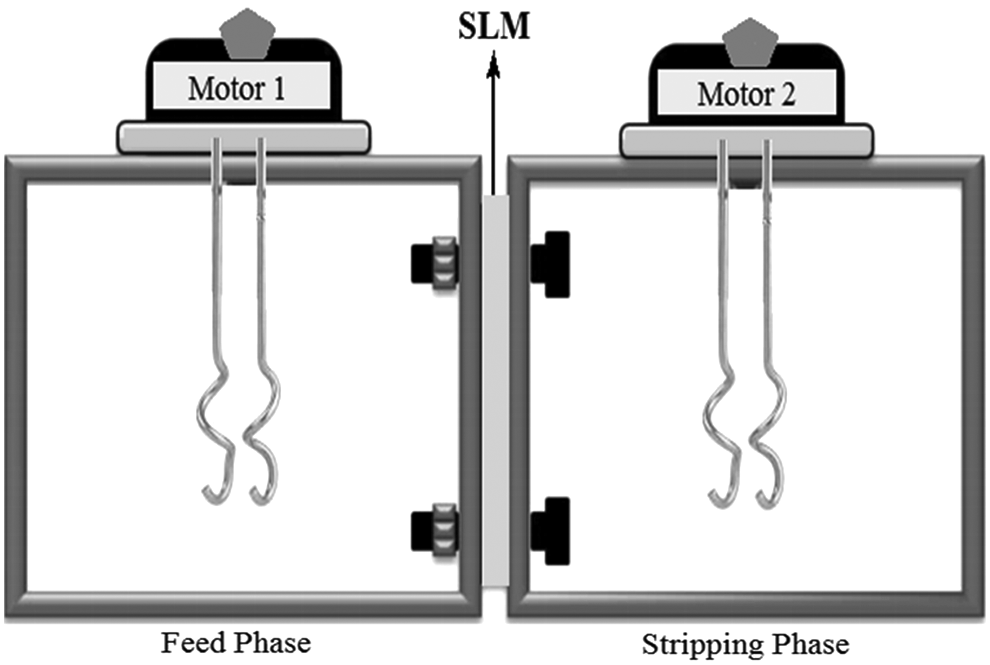
A simple permeator (cell), having two compartments, was used for all the experiments (Fig. 1) (Nawaz et al., 2016). Each compartment had enough volume capacity to accommodate 250 mL of test solution. The flanges were used to clutch the compartments together, which were separated by SLM whose contact area was 15.89 cm2. The electric stirrers were placed on the top of the compartments to agitate the solutions at a speed of 1,500 rpm.
Schematic setup of liquid membrane permeator cell.
Analytical techniques
Metal ion concentration was determined by an atomic absorption spectrometer (Perkin Elmer model 400, Perkin Elmer, Inc., Hopkinton, USA). The pH measurement was carried out by a pH meter NeoMet model 200L digital (isTEK, Seoul, South Korea). The viscosity measurement of TDDA in xylene was determined by Brookfield Viscometer/Rheometer LVDV-III (Brookfield Engineering Laboratories, Middleboro, MA). The scanning electron microscopic (SEM) analysis was carried out by Scanning Electron Microscope model JSM-5910 JEOL (Tokyo, Japan).
Preparation of SLM
The SLM was prepared by soaking the film in a solution of tridodecylamine in xylene for 24 h so as to fill the pores of film with the TDDA/xylene solution. Thereafter, the membrane was taken out of the carrier solution and allowed to drain off for 5 min to remove excess amount of carrier solution from the surface of the membrane before placing it in the permeation cell.
Procedure
The cell was filled with feed and stripping solutions in the respective compartments. The solutions in each compartment were stirred with an electric rod stirrer at a speed of 1,500 rpm to achieve smooth and nonturbulent stirring and avoid concentration polarization at the membrane faces (Nawaz et al., 2016). For the extraction experiments, different cadmium concentrations (4.44–22.2 × 10⁻⁵ mol/L) and ammonia solution (1–7 mol/L) were used in the feed and stripping phases, respectively. Samples from the feed and the stripping solutions were drawn after regular intervals of time and analyzed by atomic absorption spectrophotometer.
Flux calculations
The flux (J) was calculated by using the following equation:
\documentclass{aastex}\usepackage{amsbsy}\usepackage{amsfonts}\usepackage{amssymb}\usepackage{bm}\usepackage{mathrsfs}\usepackage{pifont}\usepackage{stmaryrd}\usepackage{textcomp}\usepackage{portland, xspace}\usepackage{amsmath, amsxtra}\usepackage{upgreek}\pagestyle{empty}\DeclareMathSizes{10}{9}{7}{6}\begin{document}
\begin{align*}
J = { \frac { { { \Delta } } C \times V } { A \times \Delta t } } , \tag { 1 }
\end{align*}
\end{document}
where ΔC is a change in concentration of cadmium (II) ions (mol/L), V is the volume of feed (L), “A” is membrane area (m2), and Δt represents the time interval (s).
Transport Mechanism
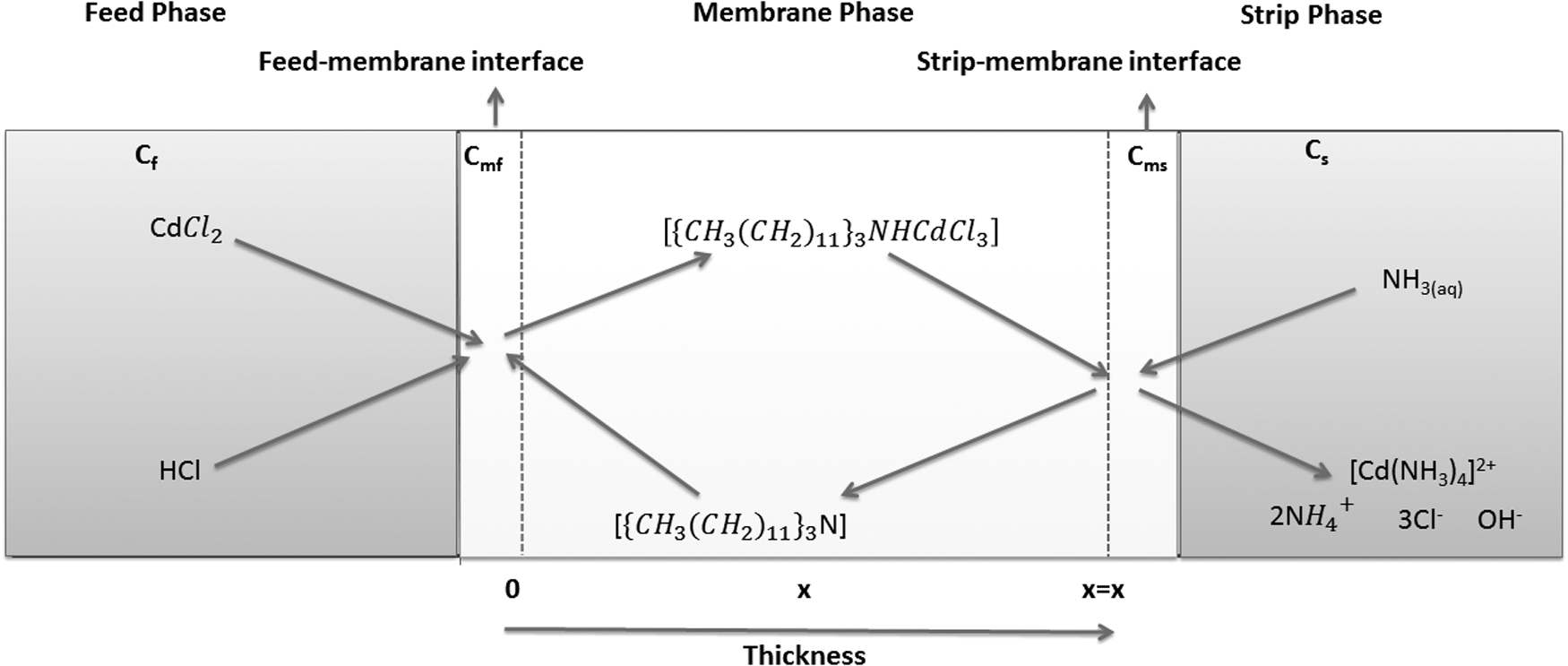
In the extraction process, the solute diffuses through the aqueous feed phase and reacts with extractant to form a complex inside the pores of the solid support membrane at the feed–membrane interface. The transport of cadmium ions follows the coupled co-ion mechanism as shown in Fig. 2 (Nawaz et al., 2016). Due to the concentration gradient, the complex diffuses out through the membrane to the stripping phase at the strip–membrane interface.
Coupled co-ion transport mechanism of Cd(II).
The reaction of HCl with \documentclass{aastex}\usepackage{amsbsy}\usepackage{amsfonts}\usepackage{amssymb}\usepackage{bm}\usepackage{mathrsfs}\usepackage{pifont}\usepackage{stmaryrd}\usepackage{textcomp}\usepackage{portland, xspace}\usepackage{amsmath, amsxtra}\usepackage{upgreek}\pagestyle{empty}\DeclareMathSizes{10}{9}{7}{6}\begin{document}
$$CdC{l_2}$$
\end{document} in aqueous solution results in the formation of complex \documentclass{aastex}\usepackage{amsbsy}\usepackage{amsfonts}\usepackage{amssymb}\usepackage{bm}\usepackage{mathrsfs}\usepackage{pifont}\usepackage{stmaryrd}\usepackage{textcomp}\usepackage{portland, xspace}\usepackage{amsmath, amsxtra}\usepackage{upgreek}\pagestyle{empty}\DeclareMathSizes{10}{9}{7}{6}\begin{document}
$${ \left[ CdC{l_{2 + n}} \right] ^{n - }}$$
\end{document} as follows (Ali et al., 2015):
\documentclass{aastex}\usepackage{amsbsy}\usepackage{amsfonts}\usepackage{amssymb}\usepackage{bm}\usepackage{mathrsfs}\usepackage{pifont}\usepackage{stmaryrd}\usepackage{textcomp}\usepackage{portland, xspace}\usepackage{amsmath, amsxtra}\usepackage{upgreek}\pagestyle{empty}\DeclareMathSizes{10}{9}{7}{6}\begin{document}
\begin{align*}
C{d^{2 + }} + 2C{l^ - } \leftrightarrow CdC{l_2} \tag{2}
\end{align*}
\end{document}\documentclass{aastex}\usepackage{amsbsy}\usepackage{amsfonts}\usepackage{amssymb}\usepackage{bm}\usepackage{mathrsfs}\usepackage{pifont}\usepackage{stmaryrd}\usepackage{textcomp}\usepackage{portland, xspace}\usepackage{amsmath, amsxtra}\usepackage{upgreek}\pagestyle{empty}\DeclareMathSizes{10}{9}{7}{6}\begin{document}
\begin{align*}
CdC{l_2} + C{l^ - } \rightleftharpoons { \left[ CdC{l_3} \right] ^ - } \tag{3}
\end{align*}
\end{document}
The number of chloride ions attached with \documentclass{aastex}\usepackage{amsbsy}\usepackage{amsfonts}\usepackage{amssymb}\usepackage{bm}\usepackage{mathrsfs}\usepackage{pifont}\usepackage{stmaryrd}\usepackage{textcomp}\usepackage{portland, xspace}\usepackage{amsmath, amsxtra}\usepackage{upgreek}\pagestyle{empty}\DeclareMathSizes{10}{9}{7}{6}\begin{document}
$$CdC{l_2}$$
\end{document} cannot be predicted at this stage; therefore, we assume “n” the chloride ions attached with \documentclass{aastex}\usepackage{amsbsy}\usepackage{amsfonts}\usepackage{amssymb}\usepackage{bm}\usepackage{mathrsfs}\usepackage{pifont}\usepackage{stmaryrd}\usepackage{textcomp}\usepackage{portland, xspace}\usepackage{amsmath, amsxtra}\usepackage{upgreek}\pagestyle{empty}\DeclareMathSizes{10}{9}{7}{6}\begin{document}
$$CdC{l_2}$$
\end{document} as follows
\documentclass{aastex}\usepackage{amsbsy}\usepackage{amsfonts}\usepackage{amssymb}\usepackage{bm}\usepackage{mathrsfs}\usepackage{pifont}\usepackage{stmaryrd}\usepackage{textcomp}\usepackage{portland, xspace}\usepackage{amsmath, amsxtra}\usepackage{upgreek}\pagestyle{empty}\DeclareMathSizes{10}{9}{7}{6}\begin{document}
\begin{align*}
CdC{l_2} + nC{l^ - } \rightleftharpoons { \left[ CdC{l_{2 + n}} \right] ^{n - }} \tag{4}
\end{align*}
\end{document}
The protonation of TDDA molecule under the acidic condition takes place as follows (Rehman et al., 2011, 2012):
If there is “n” number of H+ ions associated with \documentclass{aastex}\usepackage{amsbsy}\usepackage{amsfonts}\usepackage{amssymb}\usepackage{bm}\usepackage{mathrsfs}\usepackage{pifont}\usepackage{stmaryrd}\usepackage{textcomp}\usepackage{portland, xspace}\usepackage{amsmath, amsxtra}\usepackage{upgreek}\pagestyle{empty}\DeclareMathSizes{10}{9}{7}{6}\begin{document}
$$\left[\{ C{H_3} ( {C{H_2}{ ) _{11}}{ \} _3}N} \right]$$
\end{document}, then we can write
\documentclass{aastex}\usepackage{amsbsy}\usepackage{amsfonts}\usepackage{amssymb}\usepackage{bm}\usepackage{mathrsfs}\usepackage{pifont}\usepackage{stmaryrd}\usepackage{textcomp}\usepackage{portland, xspace}\usepackage{amsmath, amsxtra}\usepackage{upgreek}\pagestyle{empty}\DeclareMathSizes{10}{9}{7}{6}\begin{document}
\begin{align*}
\left[ \{ C{H_3} \ ( {C{H_2}{ ) _{11}}{ \} _3}N} \right] + n{H^{ + }} \rightleftharpoons { \left[ { \{ C{H_3} \ { ( C{H_2} ) _{11}} \} _3}N{H_n} \right] ^{ + n}}_{ \rm org} \tag{5}
\end{align*}
\end{document}
According to Fick's First Law, the rate of diffusion dn/dt of metal ions across an area A is known as diffusion flux (J) and it is given as follows (Ali et al., 2015):
\documentclass{aastex}\usepackage{amsbsy}\usepackage{amsfonts}\usepackage{amssymb}\usepackage{bm}\usepackage{mathrsfs}\usepackage{pifont}\usepackage{stmaryrd}\usepackage{textcomp}\usepackage{portland, xspace}\usepackage{amsmath, amsxtra}\usepackage{upgreek}\pagestyle{empty}\DeclareMathSizes{10}{9}{7}{6}\begin{document}
\begin{align*}
J = { \frac { dn } { dt } } = - DA { \frac { dc } { dx } } , \tag { 13 }
\end{align*}
\end{document}
where D is the diffusion coefficient, A is the area of the membrane, and \documentclass{aastex}\usepackage{amsbsy}\usepackage{amsfonts}\usepackage{amssymb}\usepackage{bm}\usepackage{mathrsfs}\usepackage{pifont}\usepackage{stmaryrd}\usepackage{textcomp}\usepackage{portland, xspace}\usepackage{amsmath, amsxtra}\usepackage{upgreek}\pagestyle{empty}\DeclareMathSizes{10}{9}{7}{6}\begin{document}
$$ { \frac { dc } { dx } } $$
\end{document} is rate of change of concentration across the membrane per unit distance or thickness of the film x in time dt.
If the distribution constants of metal ion between organic and aqueous phases at the membrane face in the feed and strip side are \documentclass{aastex}\usepackage{amsbsy}\usepackage{amsfonts}\usepackage{amssymb}\usepackage{bm}\usepackage{mathrsfs}\usepackage{pifont}\usepackage{stmaryrd}\usepackage{textcomp}\usepackage{portland, xspace}\usepackage{amsmath, amsxtra}\usepackage{upgreek}\pagestyle{empty}\DeclareMathSizes{10}{9}{7}{6}\begin{document}
$${{ \rm{ \lambda }}_f}$$
\end{document} and \documentclass{aastex}\usepackage{amsbsy}\usepackage{amsfonts}\usepackage{amssymb}\usepackage{bm}\usepackage{mathrsfs}\usepackage{pifont}\usepackage{stmaryrd}\usepackage{textcomp}\usepackage{portland, xspace}\usepackage{amsmath, amsxtra}\usepackage{upgreek}\pagestyle{empty}\DeclareMathSizes{10}{9}{7}{6}\begin{document}
$${{ \rm{ \lambda }}_s}$$
\end{document}, respectively, then,
\documentclass{aastex}\usepackage{amsbsy}\usepackage{amsfonts}\usepackage{amssymb}\usepackage{bm}\usepackage{mathrsfs}\usepackage{pifont}\usepackage{stmaryrd}\usepackage{textcomp}\usepackage{portland, xspace}\usepackage{amsmath, amsxtra}\usepackage{upgreek}\pagestyle{empty}\DeclareMathSizes{10}{9}{7}{6}\begin{document}
\begin{align*}
{ { \rm { \lambda } } _f } = { \frac { { C_ { mf } } } { { C_f } } } \tag { 14 }
\end{align*}
\end{document}\documentclass{aastex}\usepackage{amsbsy}\usepackage{amsfonts}\usepackage{amssymb}\usepackage{bm}\usepackage{mathrsfs}\usepackage{pifont}\usepackage{stmaryrd}\usepackage{textcomp}\usepackage{portland, xspace}\usepackage{amsmath, amsxtra}\usepackage{upgreek}\pagestyle{empty}\DeclareMathSizes{10}{9}{7}{6}\begin{document}
\begin{align*}
{ { \rm { \lambda } } _s } = { \frac { { C_ { ms } } } { { C_s } } } \tag { 15 }
\end{align*}
\end{document}
where Cm is concentration of metal ions in the organic phase and C is the concentration of the same ion in aqueous phase; f and s denote the feed and strip phases, respectively.
Considering Fig. 2 and Fick's First Law, the concentration gradient, dc/dx (or simply Δc/Δx) is negative as Δc is equal to \documentclass{aastex}\usepackage{amsbsy}\usepackage{amsfonts}\usepackage{amssymb}\usepackage{bm}\usepackage{mathrsfs}\usepackage{pifont}\usepackage{stmaryrd}\usepackage{textcomp}\usepackage{portland, xspace}\usepackage{amsmath, amsxtra}\usepackage{upgreek}\pagestyle{empty}\DeclareMathSizes{10}{9}{7}{6}\begin{document}
$${C_{mf}} - {C_{ms}}$$
\end{document}, which is positive since \documentclass{aastex}\usepackage{amsbsy}\usepackage{amsfonts}\usepackage{amssymb}\usepackage{bm}\usepackage{mathrsfs}\usepackage{pifont}\usepackage{stmaryrd}\usepackage{textcomp}\usepackage{portland, xspace}\usepackage{amsmath, amsxtra}\usepackage{upgreek}\pagestyle{empty}\DeclareMathSizes{10}{9}{7}{6}\begin{document}
$${C_{mf}} > {C_{ms}}$$
\end{document}, whereas Δx is negative as x varies from 0 to x. The final value of x is higher than the initial value, that is, 0 − x = −x.
By the Fick's First Law, the rate of flow through membrane is
\documentclass{aastex}\usepackage{amsbsy}\usepackage{amsfonts}\usepackage{amssymb}\usepackage{bm}\usepackage{mathrsfs}\usepackage{pifont}\usepackage{stmaryrd}\usepackage{textcomp}\usepackage{portland, xspace}\usepackage{amsmath, amsxtra}\usepackage{upgreek}\pagestyle{empty}\DeclareMathSizes{10}{9}{7}{6}\begin{document}
\begin{align*}
{ \frac { dn } { dx } } = DA \frac { { { C_ { mf } } - { C_ { ms } } } } { x } \tag { 17 }
\end{align*}
\end{document}
The diffusion coefficient D can be calculated from the measurement of the rate of flow; the area A, thickness x, and concentration difference \documentclass{aastex}\usepackage{amsbsy}\usepackage{amsfonts}\usepackage{amssymb}\usepackage{bm}\usepackage{mathrsfs}\usepackage{pifont}\usepackage{stmaryrd}\usepackage{textcomp}\usepackage{portland, xspace}\usepackage{amsmath, amsxtra}\usepackage{upgreek}\pagestyle{empty}\DeclareMathSizes{10}{9}{7}{6}\begin{document}
$${C_{mf}} - {C_{ms}}$$
\end{document} are readily determined.
From Equations (14) and (15) we obtain
\documentclass{aastex}\usepackage{amsbsy}\usepackage{amsfonts}\usepackage{amssymb}\usepackage{bm}\usepackage{mathrsfs}\usepackage{pifont}\usepackage{stmaryrd}\usepackage{textcomp}\usepackage{portland, xspace}\usepackage{amsmath, amsxtra}\usepackage{upgreek}\pagestyle{empty}\DeclareMathSizes{10}{9}{7}{6}\begin{document}
\begin{align*}
{C_{mf}} = {{ \rm{ \lambda }}_f}{C_f} \tag{18}
\end{align*}
\end{document}
In the light of Equations (18) and (19), Equation (17), changes to
\documentclass{aastex}\usepackage{amsbsy}\usepackage{amsfonts}\usepackage{amssymb}\usepackage{bm}\usepackage{mathrsfs}\usepackage{pifont}\usepackage{stmaryrd}\usepackage{textcomp}\usepackage{portland, xspace}\usepackage{amsmath, amsxtra}\usepackage{upgreek}\pagestyle{empty}\DeclareMathSizes{10}{9}{7}{6}\begin{document}
\begin{align*}
J = DA \frac { { \left( { { { \rm { \lambda } } _f } { C_f } - { { \rm { \lambda } } _s } { C_s } } \right) } } { x } \tag { 20 }
\end{align*}
\end{document}
As there is no extraction from the stripping phase to the membrane phase, \documentclass{aastex}\usepackage{amsbsy}\usepackage{amsfonts}\usepackage{amssymb}\usepackage{bm}\usepackage{mathrsfs}\usepackage{pifont}\usepackage{stmaryrd}\usepackage{textcomp}\usepackage{portland, xspace}\usepackage{amsmath, amsxtra}\usepackage{upgreek}\pagestyle{empty}\DeclareMathSizes{10}{9}{7}{6}\begin{document}
$${{ \rm{ \lambda }}_s}$$
\end{document} is taken as 0 and Equation (20) reduces to
\documentclass{aastex}\usepackage{amsbsy}\usepackage{amsfonts}\usepackage{amssymb}\usepackage{bm}\usepackage{mathrsfs}\usepackage{pifont}\usepackage{stmaryrd}\usepackage{textcomp}\usepackage{portland, xspace}\usepackage{amsmath, amsxtra}\usepackage{upgreek}\pagestyle{empty}\DeclareMathSizes{10}{9}{7}{6}\begin{document}
\begin{align*}
J = DA \frac { { \left( { { { \rm { \lambda } } _f } { C_f } } \right) } } { x } \tag { 21 }
\end{align*}
\end{document}
And we can consider \documentclass{aastex}\usepackage{amsbsy}\usepackage{amsfonts}\usepackage{amssymb}\usepackage{bm}\usepackage{mathrsfs}\usepackage{pifont}\usepackage{stmaryrd}\usepackage{textcomp}\usepackage{portland, xspace}\usepackage{amsmath, amsxtra}\usepackage{upgreek}\pagestyle{empty}\DeclareMathSizes{10}{9}{7}{6}\begin{document}
$${{ \rm{ \lambda }}_f}$$
\end{document} = \documentclass{aastex}\usepackage{amsbsy}\usepackage{amsfonts}\usepackage{amssymb}\usepackage{bm}\usepackage{mathrsfs}\usepackage{pifont}\usepackage{stmaryrd}\usepackage{textcomp}\usepackage{portland, xspace}\usepackage{amsmath, amsxtra}\usepackage{upgreek}\pagestyle{empty}\DeclareMathSizes{10}{9}{7}{6}\begin{document}
$${{ \rm{ \lambda }}_{Cd}}$$
\end{document} and Cf = \documentclass{aastex}\usepackage{amsbsy}\usepackage{amsfonts}\usepackage{amssymb}\usepackage{bm}\usepackage{mathrsfs}\usepackage{pifont}\usepackage{stmaryrd}\usepackage{textcomp}\usepackage{portland, xspace}\usepackage{amsmath, amsxtra}\usepackage{upgreek}\pagestyle{empty}\DeclareMathSizes{10}{9}{7}{6}\begin{document}
$${C_{Cd}}$$
\end{document}, where \documentclass{aastex}\usepackage{amsbsy}\usepackage{amsfonts}\usepackage{amssymb}\usepackage{bm}\usepackage{mathrsfs}\usepackage{pifont}\usepackage{stmaryrd}\usepackage{textcomp}\usepackage{portland, xspace}\usepackage{amsmath, amsxtra}\usepackage{upgreek}\pagestyle{empty}\DeclareMathSizes{10}{9}{7}{6}\begin{document}
$${{ \rm{ \lambda }}_{Cd}}$$
\end{document} is given by Equation (11), therefore Equation (21) can be written as follows:
\documentclass{aastex}\usepackage{amsbsy}\usepackage{amsfonts}\usepackage{amssymb}\usepackage{bm}\usepackage{mathrsfs}\usepackage{pifont}\usepackage{stmaryrd}\usepackage{textcomp}\usepackage{portland, xspace}\usepackage{amsmath, amsxtra}\usepackage{upgreek}\pagestyle{empty}\DeclareMathSizes{10}{9}{7}{6}\begin{document}
\begin{align*}
J = DA \frac {{{K_{Cd}} \left[ { { H^ + } } \right] ^n } [ \{ C {
H_3 } ( { C { H_2 }}) _ {11} \} _3 N ]} {x} \tag { 22 }
\end{align*}
\end{document}
According to Wilke–Chang relation (Nawaz et al., 2016)
\documentclass{aastex}\usepackage{amsbsy}\usepackage{amsfonts}\usepackage{amssymb}\usepackage{bm}\usepackage{mathrsfs}\usepackage{pifont}\usepackage{stmaryrd}\usepackage{textcomp}\usepackage{portland, xspace}\usepackage{amsmath, amsxtra}\usepackage{upgreek}\pagestyle{empty}\DeclareMathSizes{10}{9}{7}{6}\begin{document}
\begin{align*}
D = \frac { { { k^\prime } T } } { \eta } , \tag { 23 }
\end{align*}
\end{document}
where T is the absolute temperature, η is the viscosity of TDDA solution in toluene, and κ′ is constant, and so
\documentclass{aastex}\usepackage{amsbsy}\usepackage{amsfonts}\usepackage{amssymb}\usepackage{bm}\usepackage{mathrsfs}\usepackage{pifont}\usepackage{stmaryrd}\usepackage{textcomp}\usepackage{portland, xspace}\usepackage{amsmath, amsxtra}\usepackage{upgreek}\pagestyle{empty}\DeclareMathSizes{10}{9}{7}{6}\begin{document}
\begin{align*}
J = \frac { { k^\prime T } } { \eta } \ A \frac { { \left( { { K_
{ Cd } } [ { { H^+ }}]^n \left[ \{ C { H_3 } ( { C { H_2 }} ) _ {
11} \}_3 N \right] { {C_ { Cd } }}} \right) }} { x } \tag { 24 }
\end{align*}
\end{document}
Since κ′, KCd, T, x, and A are constants, moreover, flux is concentration dependent, any measurement of flux must be made at a particular constant concentration of the feed; therefore, we consider CCd in Equation (24) as constant; combining all these as K that is
\documentclass{aastex}\usepackage{amsbsy}\usepackage{amsfonts}\usepackage{amssymb}\usepackage{bm}\usepackage{mathrsfs}\usepackage{pifont}\usepackage{stmaryrd}\usepackage{textcomp}\usepackage{portland, xspace}\usepackage{amsmath, amsxtra}\usepackage{upgreek}\pagestyle{empty}\DeclareMathSizes{10}{9}{7}{6}\begin{document}
\begin{align*}
K = \frac { { k^\prime { K_ { Cd } } { \rm { T \ A } } \ { C_ { Cd } } } } { x } \tag { 25 }
\end{align*}
\end{document}
Since in a specially designed experiment, the concentration of TDDA, \documentclass{aastex}\usepackage{amsbsy}\usepackage{amsfonts}\usepackage{amssymb}\usepackage{bm}\usepackage{mathrsfs}\usepackage{pifont}\usepackage{stmaryrd}\usepackage{textcomp}\usepackage{portland, xspace}\usepackage{amsmath, amsxtra}\usepackage{upgreek}\pagestyle{empty}\DeclareMathSizes{10}{9}{7}{6}\begin{document}
$${ \{ C{H_3}{ ( C{H_2} ) _{11}} \} _3}N$$
\end{document}, was kept constant, thus Equation (28) reduces to
\documentclass{aastex}\usepackage{amsbsy}\usepackage{amsfonts}\usepackage{amssymb}\usepackage{bm}\usepackage{mathrsfs}\usepackage{pifont}\usepackage{stmaryrd}\usepackage{textcomp}\usepackage{portland, xspace}\usepackage{amsmath, amsxtra}\usepackage{upgreek}\pagestyle{empty}\DeclareMathSizes{10}{9}{7}{6}\begin{document}
\begin{align*}
logJ \eta = B + nlog \ \left[ {{H^ + }} \right] \tag{29}
\end{align*}
\end{document}
Here B includes all the constants as mentioned earlier, including log K and \documentclass{aastex}\usepackage{amsbsy}\usepackage{amsfonts}\usepackage{amssymb}\usepackage{bm}\usepackage{mathrsfs}\usepackage{pifont}\usepackage{stmaryrd}\usepackage{textcomp}\usepackage{portland, xspace}\usepackage{amsmath, amsxtra}\usepackage{upgreek}\pagestyle{empty}\DeclareMathSizes{10}{9}{7}{6}\begin{document}
$$\left[ \{ C{H_3} ( {C{H_2}{ ) _{11}}{ \} _3}N} \right]$$
\end{document}.
Equation (29) can be used to determine the number “n” of TDDA molecules associated with Cd in the form \documentclass{aastex}\usepackage{amsbsy}\usepackage{amsfonts}\usepackage{amssymb}\usepackage{bm}\usepackage{mathrsfs}\usepackage{pifont}\usepackage{stmaryrd}\usepackage{textcomp}\usepackage{portland, xspace}\usepackage{amsmath, amsxtra}\usepackage{upgreek}\pagestyle{empty}\DeclareMathSizes{10}{9}{7}{6}\begin{document}
$${ \left[ { \{ C{H_3}{ ( C{H_2} ) _{11}} \} _3}N{H_n} \cdot \; CdC{l_{2 + n}} \right] _{org}}$$
\end{document}. Equation (29) is a straight line equation in which \documentclass{aastex}\usepackage{amsbsy}\usepackage{amsfonts}\usepackage{amssymb}\usepackage{bm}\usepackage{mathrsfs}\usepackage{pifont}\usepackage{stmaryrd}\usepackage{textcomp}\usepackage{portland, xspace}\usepackage{amsmath, amsxtra}\usepackage{upgreek}\pagestyle{empty}\DeclareMathSizes{10}{9}{7}{6}\begin{document}
$$logJ \eta$$
\end{document} can be plotted on y axis and \documentclass{aastex}\usepackage{amsbsy}\usepackage{amsfonts}\usepackage{amssymb}\usepackage{bm}\usepackage{mathrsfs}\usepackage{pifont}\usepackage{stmaryrd}\usepackage{textcomp}\usepackage{portland, xspace}\usepackage{amsmath, amsxtra}\usepackage{upgreek}\pagestyle{empty}\DeclareMathSizes{10}{9}{7}{6}\begin{document}
$$log \ \left[ {{H^ + }} \right]$$
\end{document} on x axis. The slope of this curve will give the value of “n.”
Results and Discussion
Effect of Cd(II) ion concentration on extraction
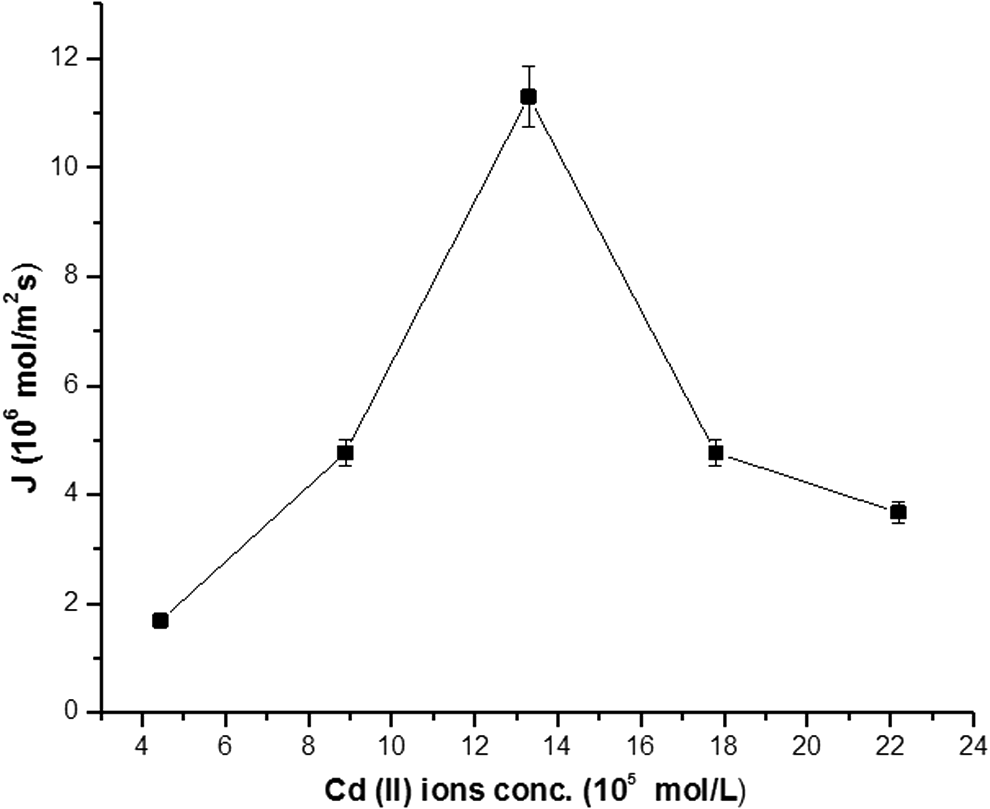
Different concentrations of Cd(II) ions (4.44 × 10⁻⁵ to 22.2 × 10⁻⁵ mol/L) in the feed phase were studied for extraction. Extraction of Cd(II) ion increases with increase in the initial concentration of cadmium and reaches up to a maximum value at 13.3 × 10⁻⁵ mol/L of initial concentration of cadmium. The Cd(II) ion concentration also affects the flux value (Fig. 3). The flux value increases gradually to a maximum value of 22.5 × 10⁻⁸ mol/[m2·s], and then abruptly declines. This decrease may be explained on the basis of following facts: first, with increase in the initial concentration of cadmium salt, the membrane becomes overcrowded with metal–carrier complex, which results in a lower effective membrane area (Alguacil and Alonso, 2004). Second, at low initial concentration of cadmium ions, the transport of metal ions depends on the activity of the metal ions, which is same as the concentration since activity coefficient is unity at low concentration, but at high concentration, the activity coefficient decreases due to long-range columbic force of interaction between anion and cation and due to increasing ionic strength (Debye-Hackel Limiting Law). This results in low activity of the salt and thus extraction decreases (Swain at el., 2006).
Effect of HCl concentration on extraction of cadmium
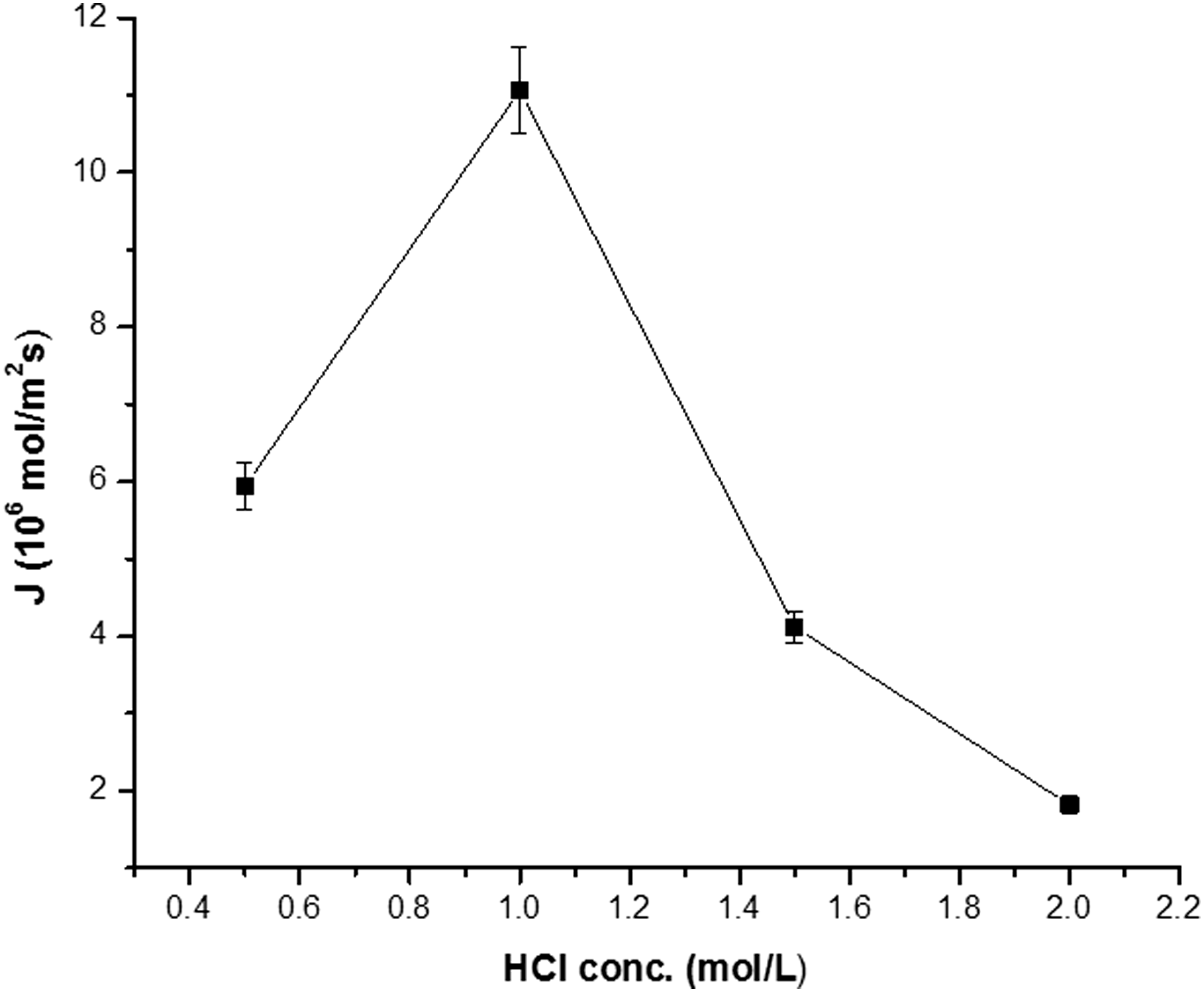
In the extraction of Cd(II), HCl plays a dual role by providing H+ for the protonation of TDDA to produce [{CH3(CH2)11}3NHn]n+ and Cl− ions for the formation of [CdCl2+n]n−, and provides the driving force to transport Cd(II) ions from the feed to the strip phase. The effect of HCl concentration on the extraction of Cd(II) ions was investigated in the range of 0.5–2 mol/L and the maximum extraction of Cd(II) ions was achieved at a concentration of 1 mol/L HCl as explained in the proceeding paragraph. TDDA (20%) in xylene and NH3(aq) at 3 mol/L in the stripping phase were kept constant and the results are presented in Table 6. Figure 4a exhibits a decrease in the concentration of cadmium (II) ions in the feed solution, while for the same concentration, the HCl corresponding curve shows an increase in the concentration of cadmium (II) ions in the strip phase with the passage of time (Fig. 4b). The effect of concentration of HCl on the flux of Cd(II) is depicted in Fig. 5, which shows optimum flux of Cd(II) ions in 1 mol/L HCl. It can be noted that the flux is directly proportional to [H+], which is in agreement with the Equation (28)vide supra. HCl provides Cl− ions to the CdCl2, which is converted to [CdCl2+n]n− species, and TDDA is protonated by H+ ions provided by HCl. The protonated TDDA and [CdCl2+n]n−combine with one another at the feed–membrane interface to form an adduct that releases Cd(II) ions in the strip phase.
Variation in Cd(II) ion concentration with time in feed (a) and strip (b) solutions at various concentrations of HCl. Initial [Cd(II)]: 8.89 × 10⁻⁵ mol/L, [HCl]: 0.5–2 mol/L, [NH3]: 3 mol/L, [TDDA]: 20% v/v.
At 0.5 M HCl, comparatively fewer H+ and Cl− ions are available for the formation of Cd-TDDA complex and hence extraction is low, but as the concentration of HCl increases to 1 M, the extraction also increases because at 1 M HCl, adequate amount of Cl− ions are available for the conversion of CdCl2 to CdCl3− and hence the formation of Cd-TDDA complex.
As discussed earlier, above 1 mol/L of HCl, the extraction of Cd(II) decreases, which could be due to the excess amount of protons, which will shift the reaction
\documentclass{aastex}\usepackage{amsbsy}\usepackage{amsfonts}\usepackage{amssymb}\usepackage{bm}\usepackage{mathrsfs}\usepackage{pifont}\usepackage{stmaryrd}\usepackage{textcomp}\usepackage{portland, xspace}\usepackage{amsmath, amsxtra}\usepackage{upgreek}\pagestyle{empty}\DeclareMathSizes{10}{9}{7}{6}\begin{document}
\begin{align*}
\begin{split}& C{d^{2 +}} + n \left[ {{H^ + }} \right]+ C{l^ -}
\rightleftharpoons \left[ {{H_n}CdC{l_{2 + n}}}\right]^{n -}
\\ & \quad \rightleftharpoons n \left[{{H^+}} \right] +
\left[ CdC{l_{2 + n}} \right]^{n-}\end{split}
\tag{30}
\end{align*}
\end{document}
in the backward direction and the formation of [HnCdCl2+n]n+ instead of [CdCl2+n]n+ will take place, which in turn inhibits the formation of Cd-TDDA complex at the feed–membrane interface, thereby creating difficulties in the separation of [CdCl2+n]n+ from [HnCdCl2+n]n+ (He et al., 2000).
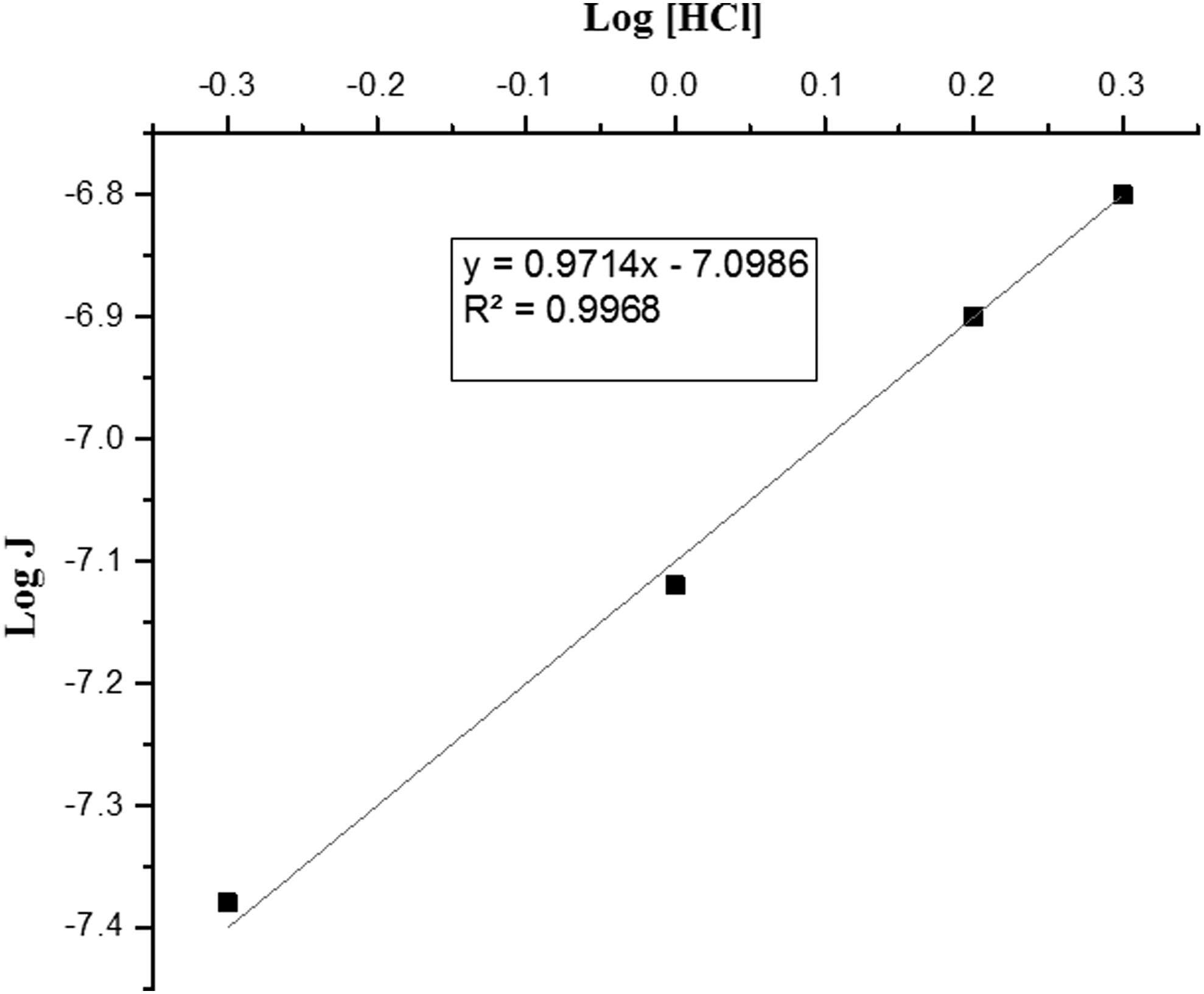
The pH of feed solution at different intervals of time was also investigated (Fig. 6). An increase in the pH was observed at the initial stage of the extraction process due to a decrease in H+ ion concentration owing to the transfer of protons toward the strip side. At about the 120th min, the pH value becomes constant, indicating the completion of the extraction process (Chakrabarty et al., 2010). The plot of log Jη against log[H+] gives a straight line and the slope was calculated to be 0.97, which can be taken as 1 as shown in Fig. 7. As indicated by Equation (28), “n” gives the number of protons associated with Cd-TDDA complex \documentclass{aastex}\usepackage{amsbsy}\usepackage{amsfonts}\usepackage{amssymb}\usepackage{bm}\usepackage{mathrsfs}\usepackage{pifont}\usepackage{stmaryrd}\usepackage{textcomp}\usepackage{portland, xspace}\usepackage{amsmath, amsxtra}\usepackage{upgreek}\pagestyle{empty}\DeclareMathSizes{10}{9}{7}{6}\begin{document}
$${ [ { \{ C{H_3}{ ( C{H_2} ) _{11}} \} _3}N{H_n} \cdot \;CdC{l_{2 + n}} ] _{org}}$$
\end{document} (Rehman et al., 2012). Thus, in the light of this calculation of “n,” the Cd-TDDA complex may be written as \documentclass{aastex}\usepackage{amsbsy}\usepackage{amsfonts}\usepackage{amssymb}\usepackage{bm}\usepackage{mathrsfs}\usepackage{pifont}\usepackage{stmaryrd}\usepackage{textcomp}\usepackage{portland, xspace}\usepackage{amsmath, amsxtra}\usepackage{upgreek}\pagestyle{empty}\DeclareMathSizes{10}{9}{7}{6}\begin{document}
$${ [ { \{ C{H_3}{ ( C{H_2} ) _{11}} \} _3}NH \cdot \,CdC{l_3} ] _{org}}$$
\end{document}.
Variation in pH of feed solution with time. Initial [Cd(II)]: 8.89 × 10⁻⁵ mol/L, [HCl]: 1 mol/L, [NH3]: 3 mol/L, [TDDA]: 20% v/v.
Effect of TDDA concentration on extraction of cadmium
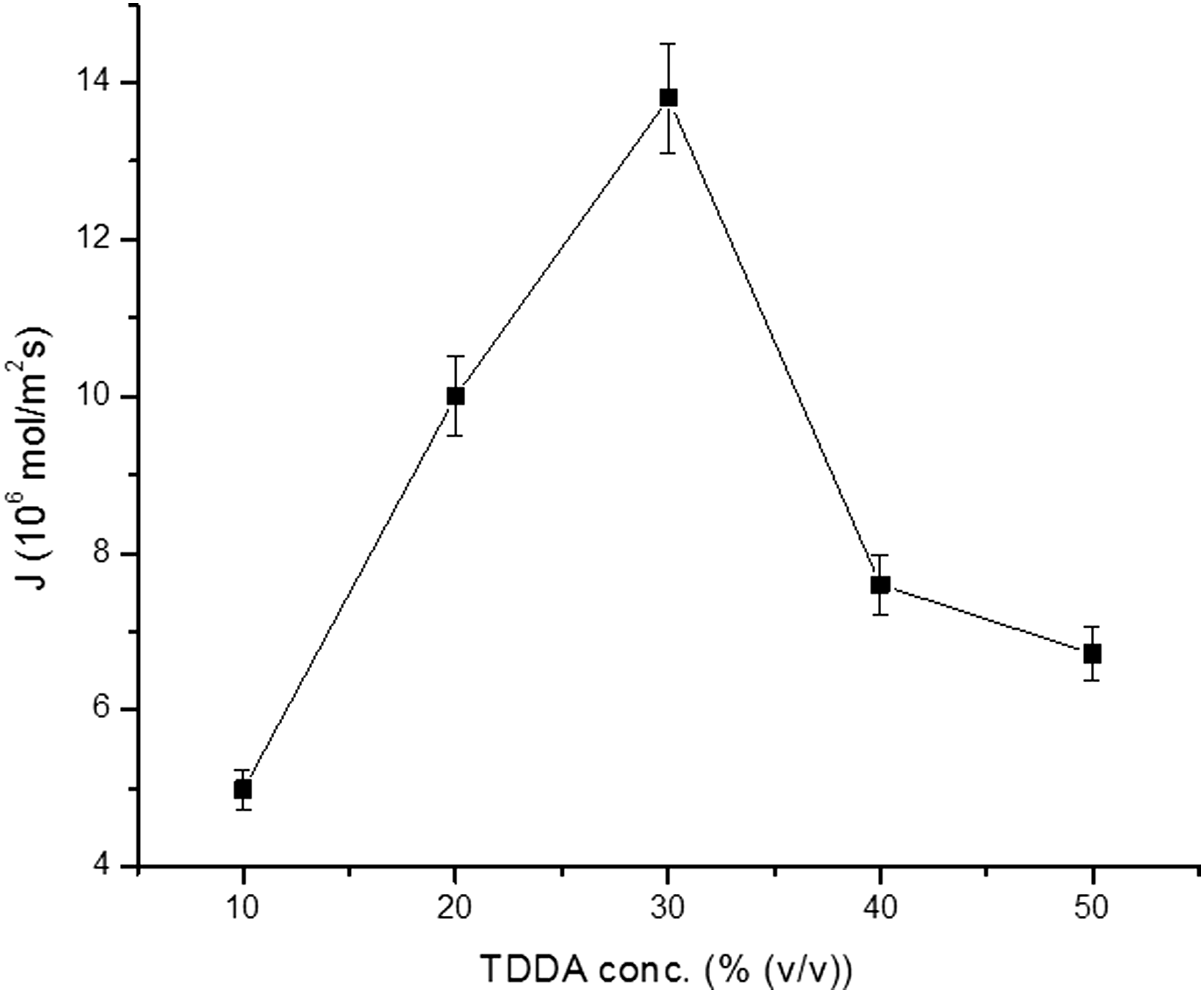
Concentration of carrier has a significant role in the transport of metal ions across the membrane. Various concentrations of TDDA ranging from 10% to 50% were used to investigate the effect of TDDA concentration and the maximum extraction of Cd(II) ions was recorded at 30% TDDA, whereafter a decrease in extraction can be noted. The effect of TDDA concentration on the flux is shown in Fig. 8. An increase in the flux was observed from 10% to 30% TDDA solution giving maximum value at 30%, however, beyond 30%, the value of flux decreases. This decrease in extraction and flux may be attributed to the high viscosity of TDDA solution at 25°C (Fig. 9), which hampers and blocks the movement of Cd-TDDA complex across the membrane (Chaudry et al., 2007).
Viscosity of tridodecylamine–xylene solution at 25°C.
Effect of nature of stripping reagent
The stripping reagent plays a vital role in the transportation of metal ions from the organic membrane phase to the stripping phase. Regarding the extraction of Cd(II) ions, different stripping reagents such as ammonium nitrate, ammonium acetate, and ammonia solution were evaluated for their stripping ability at same condition of temperature, stripping reagent concentration, and extraction time. The results indicate that the % extraction of Cd(II) through NH3 solution as a stripping reagent is better than ammonium nitrate and ammonium acetate. The chemical hardness of NH3 is greater than Cl− ion (SHAB acid–base theory), so at the strip–membrane interface, the CdCl3-carrier complex dissociates and replaces the Cl− ions, and forms a complex with Cd2+ ions in the form of [Cd(NH3)4]2+. Also, the stability constant of [Cd(NH3)4]2+ is 1 × 10⁷ and it forms a stable complex in the aqueous solution (Pearson, 1988). Therefore, NH3 solution was selected as a stripping reagent for further extraction experiments.
Effect of NH3 concentration on extraction of cadmium
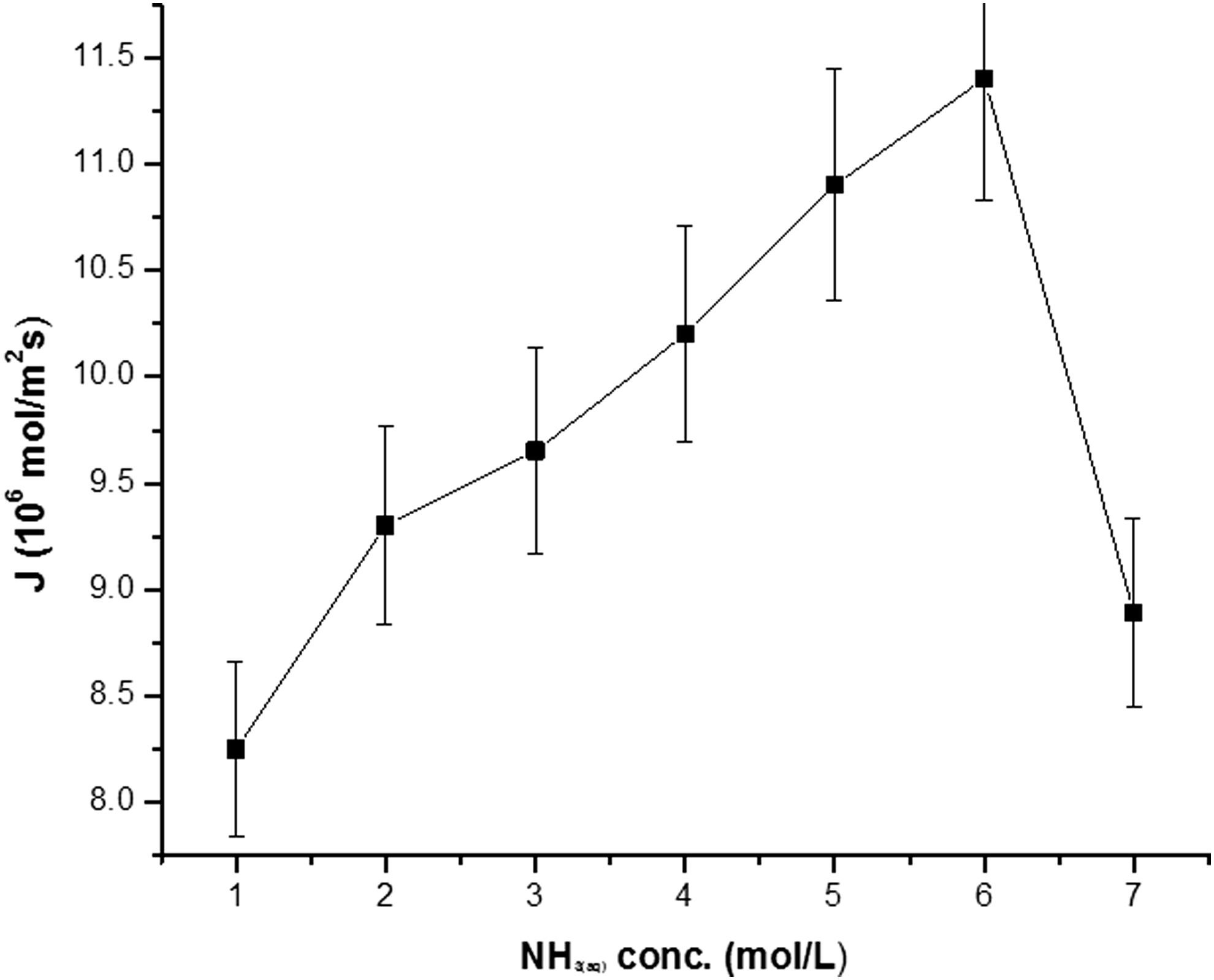
To study the effect of NH3(aq) concentration on the extraction of cadmium, different concentrations (1–7 mol/L) of NH3(aq) were used. HCl (1 mol/L) and 13.3 × 10⁻⁵ mol/L of Cd(II) ion in feed solution and 30% TDDA in membrane were kept constant during the experiment. As the concentration of NH3 solution in the strip phase increases, the extraction of Cd(II) ion also increases, and it was observed that maximum extraction of Cd(II) ion was achieved at 6 mol/L NH3(aq). Beyond 6 mol/L NH3(aq), a decrease in the extraction of the cadmium ions was observed, which could be attributed to the precipitation of cadmium oxides or hydroxides at the strip–membrane interface, which results in the clogging of the membrane pores, which adversely affects the extraction of Cd(II) ion (Bukhari et al., 2006). The reaction is given as follows.
Figure 10 shows the profile of flux at different concentrations of NH3 solution. A slightly gradual increase in the flux can be observed up to 6 mol/L NH3, which decreases at the next higher NH3(aq) concentration.
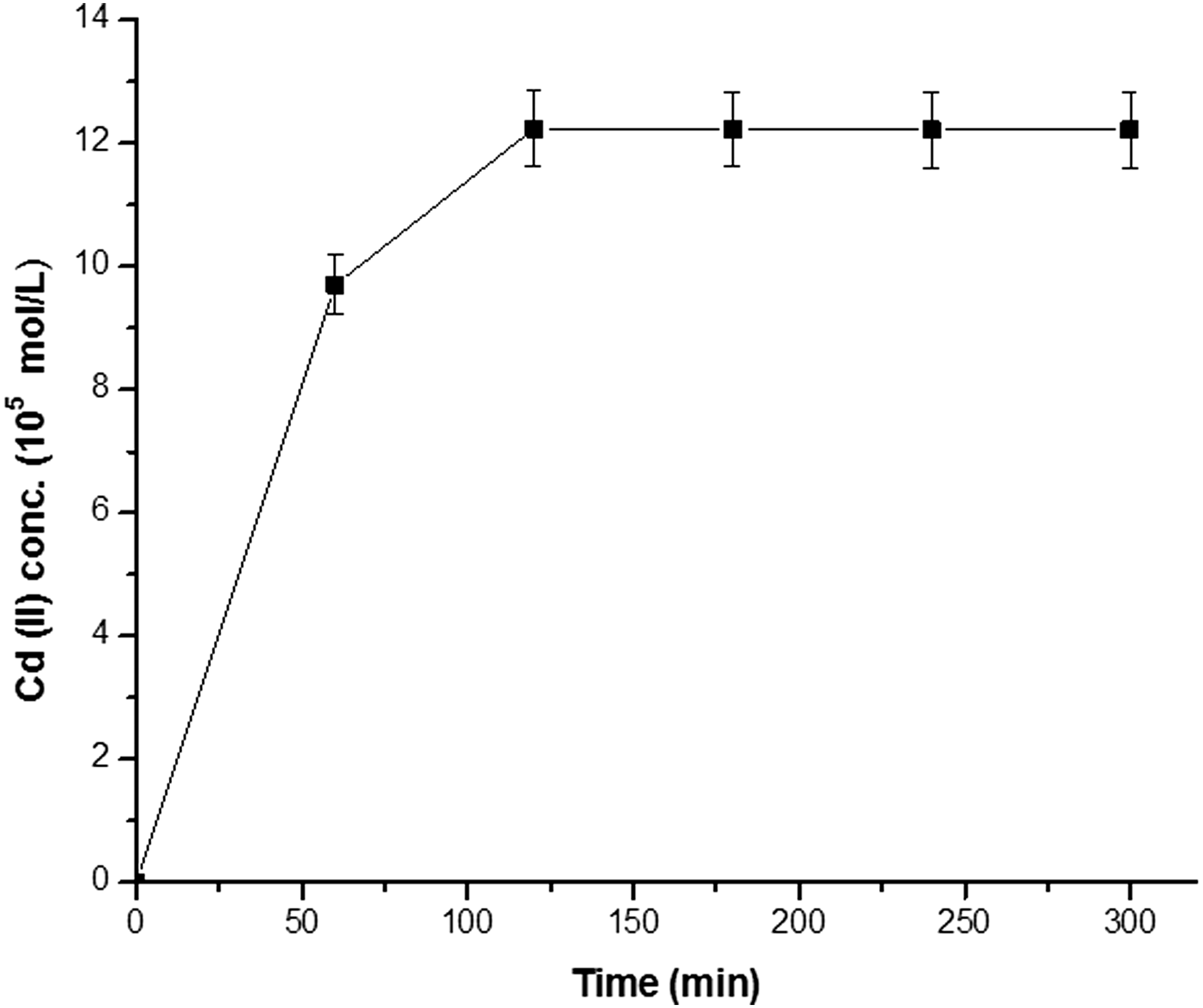
Time dependence of cadmium ion transport through SLM under the optimum experimental conditions was investigated (Fig. 11). Maximum amount of Cd(II) ions that is, 92% was removed in 120 min from the feed solution.
Variation of Cd(II) ion concentration with time. Initial [Cd(II)]: 13.3 × 10⁻⁵ mol/L, [HCl]: 1 mol/L, [NH3]: 6 mol/L, [TDDA]: 30% v/v.
Scanning electron microscopic analysis
Membrane morphology and surface chemistry are very important in the separation processes. Membrane morphology includes pore size and pore distribution, while membrane surface chemistry refers to the chemical nature and its composition. The solid support used in SLM must be hydrophobic in nature so that it can retain the organic solvent in the membrane pores by capillary action. It should also be thermally and chemically stable on contact with the feed, receiving phases, and the impregnating solvents (Fontas et al., 2005). The SEM images of polypropylene membrane (2400 Celgard) before and after extraction of cadmium ions are shown in Fig. 12(a–d), respectively. A smooth surface with uniform pore distribution can be observed from the SEM image of membrane before the extraction, while a granular morphology can be noted for the membrane after the extraction of cadmium ion (Mitiche et al., 2008). The irregular morphology is probably due to the incorporation of Cd-TDDA adduct on the surface of membrane. The membrane pores then become saturated and blocked, thus diminishing the effective membrane area (Kozlowski and Walkowiak, 2005).
SEM image of membrane (a) before extraction, (b) after impregnated with carrier, (c) after extraction, (d) cross section. SEM, scanning electron microscopic.
Membrane stability
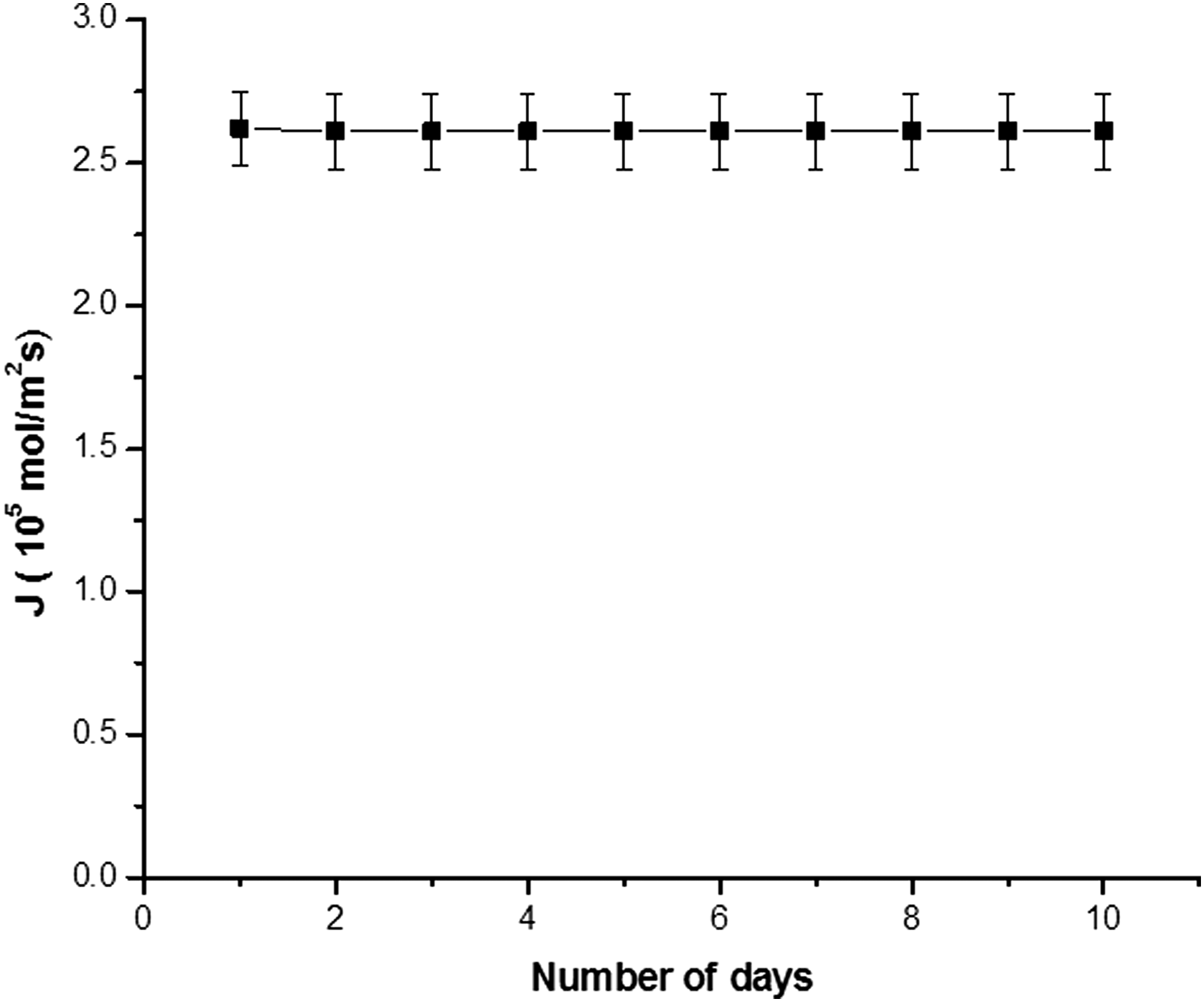
Stability of SLM (Zha et al., 1995) was investigated and for this purpose, 10 independent extraction experiments (one experiment each day) were carried out at optimum experimental conditions, that is, Cd(II) ion concentration at 13.3 × 10⁻⁵ mol/L along with 1 mol/L HCl in the feed solution, 30% TDDA in the membrane phase, while 6 mol/L NH3(aq)was taken in the strip phase, maintaining stirring speed at 1,500 rpm. Each experimental run was of 5-h duration using the same membrane impregnated only once; however, solutions into feed and stripping compartments were replaced with fresh ones for every experiment. Between the successive experiments, the cell compartments were filled with distilled water to avoid the dryness of the membrane. The results reveal (Fig. 13) that in all these experiments, 92% extraction was observed, which is an indication of stability of the membrane. Thus, it can be concluded from this series of experiments that the membrane is stable at least for 50 h of use.
Extraction of Cd(II) ions from paint industry wastewater
One of the major applications of cadmium is its use in the paint industry. The optimized SLM was used for the removal of cadmium from the wastewater of paint industry. The paint wastewater was filtered with Whatman filter paper; 80 mL of filtrate was diluted up to 250 mL with distilled water. The optimum conditions were applied for the extraction as discussed earlier. The transport of cadmium through the SLM was evaluated in the presence of other toxic metal ions, such as Cr(III), Cu(II), and Mn(II). The selectivity of carrier in a solid supported membrane system, using paint industry wastewater as feed solution was investigated.
The stability constants of the metal ion complexes play an important role in the extraction process. In this system, the selectivity of the metal ions for extraction can be explained on the basis of stability constants of the metal ions complexes. The formation constants of [CdCl3]−, [CrCl3], [CuCl3]−, and [MnCl3]− are 2.0, 0.74, 0.04, and 1.9 respectively (Manahan and Iwamoto, 1965; Suzuki and Ishiguro, 1990). Due to higher formation constant, the chances of formation of cadmium-chloro complex are the highest, which result in the higher concentration of cadmium-chloro complex in the feed phase and the higher value of distribution coefficient of Cd(II) ions in aqueous feed and organic membrane phases. Hence, more extraction of Cd(II) ions takes place.
Table 5 shows the composition of wastewater sample of paint industry. The concentrations of metal ions were determined by atomic absorption spectrophotometer (AAS), according to which the concentrations of Cd(II), Cr(II), Cu(II), and Mn(II) were 275, 168, 1.70, and 0.40 ppm respectively. This sample was subjected to extraction process keeping all the experimental conditions at the optimum levels, and after the extraction, the feed and strip solutions were analyzed again by AAS. It was found that 87% Cd(II) was extracted, while a negligible amount of other metal ions were also extracted (Table 7 and Fig. 14). It may be noted that in the original experiments, 92% of cadmium was extracted under the optimized conditions. The decrease in the % extraction in the real sample might be due to the slight interferences of other metal ions present in the wastewater of paint industry.
Variation of metal(II) ion concentration in (a) feed and (b) strip solutions versus time. (Paint industry wastewater in feed). Initial [Cd(II)]: 2.45 × 10⁻³ mol/L, [Cr(III)]: 3.21 × 10⁻³ mol/L, [Cu(II)]: 0.027 × 10⁻³ mol/L, [Mn(II)]: 0.0073 × 10⁻³ mol/L, [HCl]:1 mol/L [NH3]: 6 mol/L, [TDDA]: 30% v/v.
Analysis of Paint Industry Wastewater (Real)
Concentration of metal ions (ppm)
S. No.
Metal ion
B.E (feed)
A.E (strip)
% extraction
1
Cd(II)
275 ± 0.7
240 ± 1.4
87
2
Cr(III)
167 ± 0.7
5.2 ± 0.07
0.03
3
Cu(II)
1.69 ± 0.02
0.02 ± 0.003
1.1
4
Mn(II)
0.40 ± 0.01
0.006 ± 0.0007
0.02
A.E, after extraction; B.E, before extraction.
Conclusion
A number of separation techniques are available for the removal of heavy metal ions, but most of them are complex and costly. This work shows that an SLM is feasible for the extraction of cadmium (II) ions. For the extraction of Cd(II) ions, optimum experimental conditions were 13.3 × 10⁻⁵ mol/L Cd(II) concentration, 1 mol/L HCl in the feed solution, 30% TDDA-xylene in SLM, 6 mol/L NH3 solution in the stripping phase, and 1,500 rpm stripping speed. The extraction time for the maximum transport of cadmium ions through the SLM under the optimum experimental conditions is 120 min. The optimized SLM system was effective for removal of cadmium (II) ions from wastewater up to the permissible level as recommended by WHO. This SLM system is rapid, efficient, and cost-effective compared to other conventional techniques. The results show that (92%) removal of Cd(II) was achieved from the feed solution in original experiments, while 87% cadmium was removed from wastewater of paint industry, which might be due to the little transport of other metal ions along with cadmium (II) ions. Further work is needed to enhance the percent extraction, selectivity for the ions, improved membrane stability, and to minimize the extraction time so as to make this process more suitable for industrial applications.
Footnotes
Acknowledgment
The authors highly acknowledge the Higher Education Commission (HEC) of Pakistan and Institute of Chemical Sciences, University of Peshawar, for the financial support and laboratory facilities for this project.
Author Disclosure Statement
No competing financial interests exist.
References
1.
AguilarJ.C., CastellanosM.S., De San MiguelE.R., and De GyvesJ. (2001). Cd(II) and Pb(II) extraction and transport modeling in SLM and PIM systems using Kelex 100 as carrier. J. Membr. Sci., 190, 107.
2.
AhluwaliaS.S., and GoyalD. (2005). Removal of heavy metals by waste tea leaves from aqueous solution. Eng. Life. Sci., 5, 158.
3.
AlguacilF.J., and AlonsoM. (2004). Transport of cadmium from a mixture of HCl and H3PO4 using phosphine oxides (Cyanex 921 and Cyanex 923) as carriers: The influence of the membrane diluents (Exxsol D100 and Solvesso 100). Hydrometallurgy, 74, 195.
4.
AlguacilF.J., and NavarroP. (2001). Permeation of cadmium through a supported liquid membrane impregnated with CYANEX 923. Hydrometallurgy, 61, 137.
5.
AliK., NawazR., AliN., KhaliqA., and UllahR. (2015). Selective removal of zinc using tri-ethanolamine based supported liquid membrane. Desalin. Water Treat., 57, 8549.
6.
AlonsoM., DelgadoA.L., SastreA.M., and AlguacilF.J. (2006). Kinetic modeling of the facilitated transport of cadmium(II) using cyanex 923 as ionopore. Chem. Eng. J., 18, 213.
7.
AltinS., AlemdarS., AltinA., and YildirimY. (2011). Facilitated transport of Cd(II) through a supported liquid membrane with aliquat 336 as a carrier. Sep. Sci. Technol., 46, 754.
8.
BhatluriK.K., MannaM.S., SahaP.K., and GhoshalA.K. (2014). Supported liquid membrane-based simultaneous separation of cadmium and lead from wastewater. J. Membr. Sci., 459, 256.
9.
BreambroekG.R.M., WitkampG.J., and Van RosmalenG.M. (1998). Extraction of cadmium with trilaurylamine-kerosine through a flat sheet supported liquid membrane. J. Membr. Sci., 147, 195.
10.
BukhariN., ChaudryM.A., and MazharM. (2006). Triethanolamine/cyclohexanone supported liquid membranes study for extraction and removal of nickel ions from nickel plating wastes. J. Membr. Sci., 283, 182.
11.
ChakrabartyK., SahaP., and GhoshalA.K. (2010). Simultaneous separation of mercury and lignosulfonate from aqueous solution using supported liquid membrane. J. Membr. Sci., 346, 37.
12.
ChaudryM.A., BukhariN., MazharM., and AbbasiW. (2007). Coupled transport of chromium (III) ions across tri-ethanolamine/cyclohexanone based supported liquid membranes for tannery waste treatment. Sep. Purif. Technol., 55, 292.
13.
ComesanaA., MonsalveJ.R., CerpaA., and AlguacilF.J. (2011). Non-dispersive solvent extraction with strip dispersion (NDSXSD) pertraction of Cd(II) in HCl medium using ionic liquid CYPHOS IL101. Chem. Eng. J., 175, 228.
14.
DaoudJ.A., El-ReefyS.A., and AlyH.F. (1998). Permeation of Cd(ll) Ions through a supported liquid membrane containing Cyanex-302 in kerosene. Sep. Sci. Technol., 33, 537.
15.
EmsleyJ. (2011). Nature's Building Blocks: An A-Z Guide to the Elements, 2nd ed., New York: Oxford University Press.
16.
FontasC., TayebR., TingryS., HidalgoM., and SetaP. (2005). Transport of platinum(IV) through supported liquid membrane (SLM) and polymeric plasticized membrane (PPM). J. Membr. Sci., 263, 96.
17.
FuaF., XieaL., TangaB., WangQ., and JiangS. (2012). Application of a novel strategy advanced Fenton-chemical precipitation to the treatment of strong stability chelated heavy metal containing wastewater. Chem. Eng. J., 189–190, 283.
18.
GaoF., GuH., WangH., WangX., XiangB., and GuoZ. (2015). Magnetic amine-functionalized polyacrylic acid-nanomagnetite for hexavalent chromium removal from polluted water. RSC Adv. 5, 60208.
19.
Granado-CastroM.D., Galindo-RianM.D., and Garcia-VargasM. (2004). Separation and preconcentration of cadmium ions in natural water using a liquid membrane system with 2-acetylpyridine benzoylhydrazone as carrier by flame atomic absorption spectrometry. Spectrochim. Acta. B., 59, 577.
20.
GuH., RapoleS.B., HuangY., CaoD., LuoZ., WeiS., and GuoZ. (2013). Synergistic interactions between multi-walled carbon nanotubes and toxic hexavalent chromium. J. Mater. Chem. A., 1, 2011.
GuS., YuY., HeD., and MaM. (2006). Comparison of transport and separation of Cd(II) between strip dispersion hybrid liquid membrane (SDHLM) and supported liquid membrane (SLM) using tri-n-octylamine as carrier. Sep. Purif. Technol., 51, 277.
23.
GumT., OleinikovaM., PaletC., ValienteaM., and MunozM. (2000). Facilitated transport of lead(II) and cadmium(II) through novel activated composite membranes containing di-(2-ethylhexyl)phosphoric acid as carrier. Anal. Chim. Acta., 408, 65.
HeD., and MaM. (2000). Kinetics of cadmium(II) transport through a liquid membrane containing tricapryl amine in xylene. Sep. Sci. Technol., 35, 1573.
26.
HeD., MaM., and ZhaoZ. (2000). Transport of cadmium ions through a liquid membrane containing amine extractants as carriers. J. Membr. Sci., 169, 53.
27.
HoW.S.W., and SirkarK.K. (1992). Membrane Handbook. New York, NY: Chapman & Hall.
28.
HongY.K., HongW.H., and HanD.H. (2001). Application of reactive extraction to recovery of carboxylic Acids. Biotechnol. Bioprocess. Eng., 6, 386.
29.
JafariS., YaftianM.R., and ParinejadM. (2009). Facilitated transport of cadmium as anionic iodo-complexes through bulk liquid membrane containing hexa-decyl-tri-methyl-ammonium bromide. Sep. Purif. Technol., 70, 118.
30.
KazemiM., AlamdariE., keshavarz, DarvishiD., EsfandyariG.R., and SalardiniA.A. (2012). Extraction and permeation of Cd2+ ions through supported liquid membrane with mixtures of D2EHPA and M2EHPA. Can. Metall. Quart., 51, 101.
31.
KennedyJ.F., and CabralJ.M.S. (1993). Recovery Processes for Biological Materials. New York, NY: Wiely & Sons.
32.
KertesA.S., and KingC.J. (1986). Extraction chemistry of fermentation product carboxylic acids. Biotechnol. Bioeng., 28, 269.
33.
KittisupakornP., WeerachaipichaskulW., and ThitiyasookP. (2007). Modeling and simulation of copper-ion extraction with hollow fiber supported liquid membrane. J. Ind. Eng. Chem., 13, 903.
34.
KozlowskiC.A., and KozlowskaJ. (2009). PNP-16-crown-6 derivatives as ion carriers for Zn(II), Cd(II) and Pb(II) transport across polymer inclusion membranes. J. Membr. Sci., 326, 215.
35.
KozlowskiC.A., and WalkowiakW. (2005). Applicability of liquid membranes in chromium (VI) transport with amines as ion carriers. J. Membr. Sci., 266, 143.
36.
KurniawanT.A., ChanG.Y.S., LoW.H., and BabelS. (2006). Physico-chemical treatment techniques for wastewater laded with heavy metal. Chem. Eng. J., 118, 83.
37.
LeeK.P., ArnotT.C., and MattiaD. (2011). A review of reverse osmosis membrane materials for desalination development to date and future potential. J. Membr. Sci., 370, 1.
38.
LiangS., GuoX., and TianQ. (2011). Adsorption of Pb2+ and Zn2+ from aqueous solutions by sulfured orange peel. Desalination, 275, 212.
39.
MahmoodiR., MohammadiT., and MoghadamM.K. (2014). Separation of Cd(II) and Ni(II) ions by supported liquid membrane using D2EHPA/M2EHPA as mobile carrier. Chem. Pap., 68, 751.
40.
ManahanS.E., and IwamotoR.T. (1965). Chloro-complexes of copper(II) and copper(I) in acetonitrile. Inorg. Chem., 4, 1409.
41.
MateescuM., PacurariuL., NechiforG., and FierascuI. (2013). Transport of cadmium ions through a bulk liquid membrane with D2EHPA as carrier. U.P.B. Sci. Bull., Series B., 75, 67.
42.
MiticheL., TingryS., SetaP., and SahmouneA. (2008). Facilitated transport of copper (II) across supported liquid membrane and polymeric plasticized membrane containing 3-phenyl-4-benzoylisoxazol-5-one as carrier. J. Membr. Sci., 325, 605.
43.
MondalD.N., SarangiK., PetterssonF., SenP.K., SaxenH., and ChakrabortiN. (2011). Cu-Zn separation by supported liquid membrane analyzed through multi-objective genetic algorithms. Hydrometallurgy, 107, 112.
44.
NawazR., AliK., and ArshadM. (2015). Recovery of mercury using a trioctylphosphine oxide-based supported liquid membrane system. Environ. Eng. Sci., 32, 948.
45.
NawazR., AliK., KhanM. (2016). Extraction of copper from wastewater through supported liquid membrane using tri-ethanolamine as a carrier. Desalin. Water Treat., 57, 21827.
46.
OchromowiczK., and ApostolukW. (2010). Modeling of carrier mediated transport of chromium (III) in the supported liquid membrane system with D2EHPA. Sep. Purif. Technol., 72, 112.
47.
ParhiP.K., DasN.N., and SarangiK. (2009). Extraction of cadmium from dilute solution using supported liquid membrane. J. Hazard. Mater., 172, 773.
48.
ParhiP.K., ParkK.H., KimH.I., and ParkJ.T. (2011). Recovery of molybdenum from the sea nodule leach liquor by solvent extraction using Alamine 304-I. Hydrometallurgy, 105, 195.
49.
ParkK.H., ParhiP.K., and KangN.H. (2012). Studies on removal of low content copper from the sea nodule leach liquor using the cationic resin TP 207. Sep. Sci. Technol., 47, 1531.
50.
PearsonR.G. (1988). Absolute Electronegativity and hardness: Application to inorganic chemistry. Inorg. Chem., 27, 734.
51.
PontN., SalvadoV., and FontasC. (2008). Selective transport and removal of Cd from chloride solutions by polymer inclusion membranes. J. Membr. Sci., 318, 340.
52.
RathoreN.S., LeopoldA., PabbyA.K., FortunyA., CollM.T., and SastreA.M. (2009). Extraction and permeation studies of Cd(II) in acidic and neutral chloride media using Cyanex 923 on supported liquid membrane. Hydrometallurgy, 96, 81.
53.
RehmanS., AkhtarG., ChaudryM.A., AliK., and UllahN. (2012). Transport of Ag+ through tri-n-dodecylamine supported liquid membranes. J. Membr. Sci., 389, 287.
54.
RehmanS., AkhtarG., ChaudryM.A., BukhariN., UllahN., and AliN. (2011). Mn (VII) ions transport by triethanolamine cyclohexanone based supported liquid membrane and recovery of Mn (II) ions from discharged zinc carbon dry battery cell. J. Membr. Sci., 366, 125.
55.
RenZ., ZhangW., MengH., LiuJ., and WangS. (2010). Extraction separation of Cu(II) and Co(II) from sulfuric solutions by hollow fiber renewal liquid membrane. J. Membr. Sci., 365, 260.
56.
RickerN.L. (1978). Recovery of Carboxylic Acids and Related Organic Chemicals from Wastewaters by Solvent Extraction. [PhD Thesis]. Berkeley, USA: University of California.
57.
RubioJ., SouzaM.L., SmithR.W. (2002). Overview of flotation as a wastewater treatment technique. Miner. Eng., 15, 139.
58.
SenhadjiO.K., MansouriL., TingryS., SetaP., and BenamorM. (2008). Facilitated Cd(II) transport across CTA polymer inclusion membrane using anion (Aliquat 336) and cation (D2EHPA) metal carriers. J. Membr. Sci., 310, 438.
59.
ShabanN.Z., AliA.E., and MasoudM.S. (2003). Effects of cadium and zinc ethanol complexes on rat brain monoamine oxidase-B activity in vitro. J. Inorg. Biochem., 95, 141.
60.
ShuxiangG., YuY., HeD., and MaM. (2006). Comparison of transport and separation of Cd(II) between strip dispersion hybrid liquid membrane (SDHLM) and supported liquid membrane (SLM) using tri-n-octylamine as carrier. Sep. Purif. Technol., 51, 277.
61.
SuzukiH., and IshiguroS.I. (1990). Formation of chloro complexes of manganese(II), cobalt(II), nickel(II) and zinc(II) in dimethyl sulphoxide. J. Chem. Soc. Faraday Trans., 86, 2179.
62.
SwainB., SarangiK., and DasR.P. (2004). Separation of cadmium and zinc by supported liquid membrane using TOPS-99 as mobile carrier. Sep. Sci. Technol., 39, 2171.
63.
SwainB., SarangiK., and DasR.P. (2006). Effect of different anions on separation of cadmium and zinc by supported liquid membrane using TOPS-99 as mobile carrier. J. Membr. Sci., 277, 240.
64.
TalebiA., TengT.T., NorliI., and Al-KarkhiA.F.M. (2015). Facilitated liquid-liquid extraction and stripping of nickel and cadmium from aqueous solutions by ionic liquid. Iran J Ener Environ, 6, 188.
65.
TayebR., FontasC., DhahbiM., TingryS., and SetaP. (2005). Cd(II) transport across supported liquid membranes (SLM) and polymeric plasticized membranes (PPM) mediated by Lasalocid A. Sep. Purif. Technol., 42, 189.
66.
TripathyS.S., SarangiK., and DasR.P. (2002). Extraction of cadmium (II) by supported liquid membrane using TOPS-99 as mobile carrier. Sep. Sci. Technol., 37, 2897.
67.
ZhaF.F., FaneA.F., and FellC.J.D. (1995). Instability mechanisms of supported liquid membranes in phenol transport process. J. Membr. Sci., 107, 59.
68.
ZhangW., CuiC., and HaoZ. (2010). Transport study of Cu(II) through hollow fiber supported liquid membrane. Chinese. J. Chem. Eng., 18, 48.
69.
ZhuJ., WeiS., GuH., RapoleS.B., WangQ., LuoZ., HaldolaarachchigeN., P YoungD.P., and GuoZ. (2012). One-pot synthesis of magnetic graphene nanocomposites decorated with core@ double-shell nanoparticles for fast chromium removal. Environ. Sci. Technol., 46, 977.