




Abstract
Abstract
Agricultural soils can be contaminated by industrial activities such as mining and smelting. Contamination with cadmium (Cd) can significantly exceed average background values, which can lead to uptake by rice plant and even harm to humans through food chain. In Hunan province, southern China, rice (Oryza sativa L.) is the main cereal, and human exposure to metallic contaminants through rice pathway is of particular interest. Shortage of land for rice growing means that contaminated agricultural soil is still cultivated for rice in Hunan. In the present work, a field experiment was undertaken to remediate Cd-contaminated paddy soil with three mineral amendments, namely sepiolite, bone char, and a silicon-based product (normally used as fertilizer). Average Cd concentration in the paddy soil was 2.85 mg/kg, significantly exceeding Chinese soil quality standards of China. Cd content was 0.59 mg/kg in sepiolite, 0.28 mg/kg in bone char, and 0.44 mg/kg in silicon fertilizer, respectively. Distribution fractions of Cd in soil followed the order of exchangeable (FI) > organic matter-bound (FIII) > residual (FIV) > oxide-bound (FII) without treatment, while exchangeable (FI) > residual (FIV) > organic matter-bound (FIII) > oxide-bound (FII) after treatment. With addition of three amendments, soil pH values and rice growth such as plant height and ripening rate increased. Concentrations of Cd in the rice plant (straw, husk, and unpolished rice) decreased after treatment. However, among three amendments, only the bone char addition reduced Cd accumulation in the rice plant below the Chinese standard value (0.2 mg/kg) and in the husk to below the Chinese feed hygiene standard for food (0.5 mg/kg).
Introduction
R
Reduction of Cd entering to the food chain is therefore of great importance for China, especially for Hunan, which is China's biggest rice producer and named “hometown of rice and fish.” Although there are some methods such as physical, chemical, and biological methods to remediate contaminated paddy soil, due to the soil being repeatedly reused for the production of rice, few are suitable for remediation of contaminated agricultural soil. Thus, the approach adopted in the present work was to chemically stabilize through an in situ method, using an increase to soil pH (to reduce Cd mobility) but within limits to ensure that paddy soil remained suitable for rice growing. A number of soil amendments, including limestone, zeolite, or other organic and inorganic amendments, have been investigated for Cd stabilization (Chen et al., 2000; Geebelen et al., 2006; Huang et al., 2006; Zhao and Masaihiko, 2007). Most of methods using amendments focus on laboratory-scale incubation or pot trials, while few have been applied in the field, as in the present work.
The aims of the present work were as follows: (1) to investigate the effects of sepiolite, bone char, and silicon fertilizer on speciation of Cd in paddy soil; (2) to examine the effects on Cd accumulation and translocation in rice plants; and (3) to provide a theoretical and practical basis for a field-scale remediation project to immobilize Cd to demonstrating rice safety.
Materials and Methods
Study area
The contaminated paddy field was located in Zu Bugan (27°54.686′N, 112°58.296′E), north of Xiangtan city, Hunan Province. Having been irrigated with contaminated water from Xiangjiang River, the paddy soil was contaminated with Cd, investigated by Tang et al. (2012).
Rice seeds
One genotype of rice seed named Lu Liang you 611 (L611) was obtained from the Hunan Rice Seed Company following germination in a nursery in April 2015 and planting in May 2015.
Amendments
There were three amendments chosen for use in this study as follows: sepiolite, bone char, and silicon fertilizer. The natural sepiolite [Mg4Si6O15(OH)2·6H2O] sample was purchased from Changsha city, Hunan Province, whereas the bone char was obtained from the Guanghan city, Sichuan Province. The silicon fertilizer was obtained from Tangshan city, Hebei Province, China. As there are no control standards for pollutants in amendments used for agricultural use, the relevant standard for sludge (Ministry of Urban-Rural Development and Environmental Protection of China, 1984) was taken as reference.
Field treatment experimental design
The paddy field under investigation was divided into ten plots of 30 m2 and separated by polyethylene plates. Every treatment for plot was random design and irrigated through independent irrigation ditch. In the experiment, the depth of soil used for calculating the amendment dosage was 20 cm, which was applied to three replicate plots by manual plowing according to the Table 1, 25 days before planting. On the day of planting, 200 kg of P, K, N basal fertilizer was added.
The letters in brackets are treatment with each amendment and its concentration.
The experimental plots were planted with rice seedlings (L611) that had been raised for 4 weeks in clean soil on May 4th, 2015.
They were harvested 90 days later during which all water, fertilizer, and pesticide management continued as normal.
Sample collection and preservation
Before sowing, 2.0 kg top-soil sample (0–20 cm) was collected from the paddy field by soil sampler in February 2015 and placed in polyethylene bags for transportation to the laboratory where they were air-dried. The soils were passed through a 2-mm sieve and stored in 500 mL polypropylene plastic bottles for analysis.
Samples of the growing rice plants were collected thrice as follows: at the seedling stage, heading stage, and mature stage. At the harvest in July 2015, whole rice plants were pulled, and rice grains and rice straws (above 4 cm) were separated from the plant by hand picking/cutting above the roots. The rice plant samples (rice root, straw, and grain) from each area were tagged/labeled, kept in polyethylene bags in the field, and transported to the laboratory, where they were washed with distilled water and then oven dried at 65°C for 96 h. The rice root and straw were then cut, milled, and stored for analysis. The rice grain was divided into its husk and unpolished rice, milled, and stored ready for analysis.
Soil, amendments, and rice plant analysis
The soil pH was determined using double distilled water (soil: solution ratio 1:2.5) with a combined pH electrode, and the cation exchange capacity (CEC) was determined using unbuffered 0.1 M BaCl2 (Hendershot and Duquette, 1986). Total concentrations of Cd in paddy soils following acid digestion with HNO3/HCl/HClO4 (U.S. EPA, 1998) were determined by Graphite furnace atomic absorption spectrophotometer (AA240FS; Varian).
The amendments were air-dried and ground to pass through a 0.049 mm mesh sieve. The analysis methods of pH and Cd concentrations of amendments were the same as those of soils.
Between 0.1 and 0.2 g of the rice plant samples (unpolished rice, husk, straw, and root) were weighed into dry clean digestion tubes and moistened overnight with 5 mL concentrated nitric acid. The following day, the digestion tubes were placed on a heating block and heated at 80°C for 3 h and then at 120°C for 48 h until a little solution remained without completely drying out. After the tubes had cooled, the digests were transferred to 25 mL flasks with deionized water and filtered into polythene bottles. Total Cd concentrations in root, straw, husk, and unpolished rice were determined by Graphite furnace atomic absorption spectrophotometer (AA240FS; Varian).
Cd speciation of soil analysis
To assess the effectiveness of amendments for in situ immobilization, the sequential extraction scheme proposed by European Community Bureau of Reference (BCR method), including exchangeable (FI), oxide-bound (FII), organic matter-bound (FIII), and residual (FIV) (Ure et al., 1993), was used to analyze the Cd fractionations in preamended and postamended soil samples. The detail of the BCR method was described in reference (Ure et al., 1993). The determinations of Cd in the extracts were performed by Graphite furnace atomic absorption spectrophotometer (AA240FS; Varian).
Extraction efficiencies of the sequential extraction procedures were expressed as percentage of the total contents, estimated by the following equation:
where E (%) represents the extraction efficiency of Cd with BCR method, CFi (mg/kg) is the average concentration of each fraction of Cd, and Tc is the total content of Cd in soil (mg/kg).
Statistical analysis
All treatments were replicated thrice in the experiments. The means and standard deviation (SD) values were calculated by Microsoft Office Excel 2007. One-way analysis of variance was carried out with SPSS16.0. A significant difference (p < 0.05 or p < 0.01) was observed between treatments.
Results
Properties of soil and amendments
The selected physicochemical properties of the paddy soil and three amendments are presented in Table 2. The paddy soil called the Quaternary Red Clay is highly weathered parent material with slightly acidic pH = 5.13, suggesting that the paddy soil was acidic easily increasing Cd availability and accumulation in rice. The average Cd concentration in paddy soil is 2.85 ± 0.29 mg/kg in dry weight. With reference to the Chinese environmental quality standards for heavy metals in soil, the mean concentration of Cd (2.85 ± 0.29 mg/kg) recorded for paddy soil in this study was ∼10 times higher than 0.3 mg/kg (GB15618-1995), indicating the seriousness of the contamination. Furthermore, the concentrations of Cd in three amendments are low (0.28–0.59 mg/kg) and were lower than the permissible reference standards of Cd for agricultural use (GB4284-1984), indicating that they could be used in practice. The pH values of three amendments were extremely different. The bone char has the highest pH value with 10.79, followed by sepiolite (pH = 8.29), indicating that bone char and sepiolite were alkaline materials. The lowest pH value of silicon fertilizer was 5.63, as same as soil pH value.
EQSHMS means Environmental Quality Standards for Heavy Metals in Soils (GB15618-1995 Grade 2) (Ministry of Environmental Protection of China, 1995).
CSPSAU means Control Standards for Pollutants in Sludges from Agricultural Use (GB4284-1984) (Ministry of Urban-Rural Development and Environmental Protection of China, 1984).
Cd, cadmium; CEC, cation exchange capacity.
Changes in soil pH
The effects of three amendments on soil pH are shown in Fig. 1, and it can be found that the nonamended soil (CK) had a low pH of 5.13 before planting. After application, the pH values of soils significantly (p < 0.05) increased from that of CK with increasing amounts of amendments. Due to it containing calcium carbonate (CaCO3), the addition of bone char led to a marked increase in soil pH (5.50–6.47) compared with the control (p < 0.05). Addition of bone char has caused much bigger increase of soil pH than sepiolite (pH 5.25–5.77) and silicon fertilizer (pH 5.18–5.50) did.
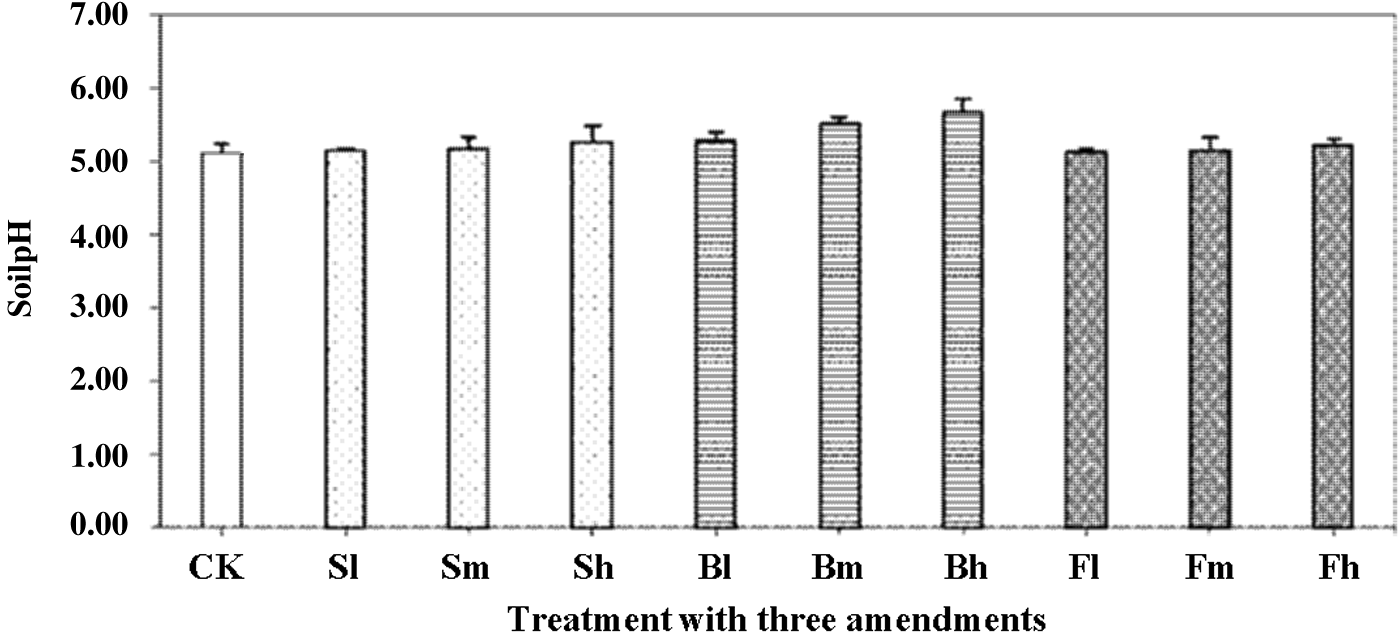
Soil pH in control (CK) and after amendments with sepiolite (Sl, Sm, Sh), bone char (Bl, Bm, Bh), and silicon fertilizer (Fl, Fm, Fh).
Cd fraction distribution
According to the Equation (1), the fraction distributions of Cd in paddy soils before and after amendment are shown in Fig. 2. The distributions of Cd in unamended paddy soil followed: FI > FIII > FIV > FII (51.32%, 22.87%, 19.50%, and 6.30%, respectively), highlighting the bioavailability of Cd. After the amendments were applied, the order of fraction distribution of Cd changed to: FI > FIV > FIII > FII. The average ratios of FI and FIII decreased by: 7.51% and 1.41% with sepiolite, 6.02% and 1.81% with bone char, and 8.04% and 1.57% with silicon fertilizer. The average percentages of FII and FIV increased by: 1.41%, 1.81%, and 1.57% and 7.60%, 8.81%, and 9.38% with application of sepiolite, bone char, and silicon fertilizer, respectively. Moreover, as amendment dosage increased Cd immobilization increased.
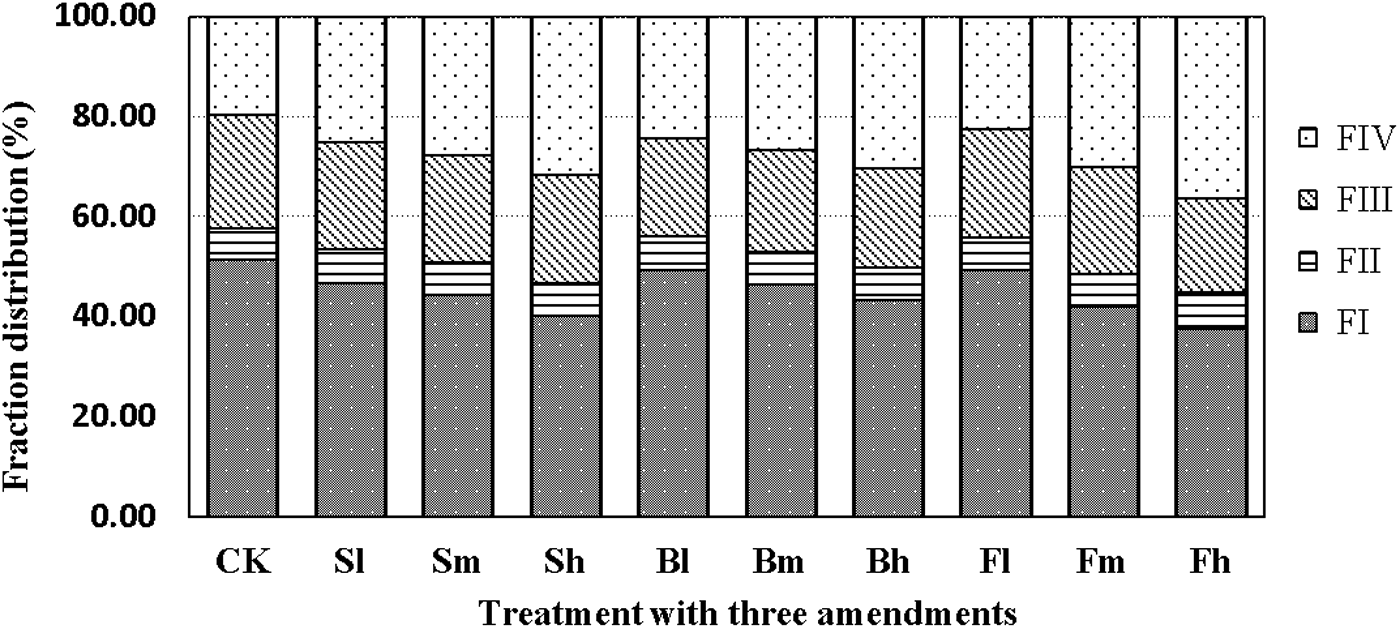
Cd fractions in soil amended with sepiolite, bone char, and silicate fertilizer. Cd, cadmium.
Rice plant growth
Indicators of rice plant growth, including plant height, total of grains per ear, and weight of a thousand grains, are shown in Table 3. There were significant impacts on rice growth, including plant height and ripening rate with the silicon fertilizer. At higher dosage rates, the plant height and ripening rate of rice were 3.7% and 4.2% times higher than those of control (CK), respectively. The ripening rate was the highest, ranging from 83.2% to 86.8% for rice L611 with silicon fertilizer treatment, followed by bone char from 82.9% to 84.1%. There were no obvious effects on the aggregate weight of grains with or without treatment.
Cd concentration in rice roots and straws
Concentrations of Cd in the roots and straws of rice plants, including as seeding at the heading and mature stages are shown in Table 4. In comparison with CK, the Cd contents (in roots and straws) were significantly influenced by the amendments showing both negative and positive relationships at different growth stages. In the mature stage, the ranges of reduction of Cd in rice straws were 23.0–53.1% with sepiolite treatment, 26.7–52.0% with bone char treatment, and 25.2–61.2% with the silicon fertilizer treatment, respectively. The order of effect of amendments on reduction of Cd in rice straw was silicon fertilizer (Sh and Sm) > sepiolite (Sh) > bone char (Bh). However, the concentrations of Cd in the rice roots increased with two treatment levels (Sl and Sm) of sepiolite, three levels (Bl, Bm, and Bh) of bone char, and two levels (Sl and Sm) of silicon fertilizer.
Cd concentration in rice grain
Effects of the three amendments on Cd in rice husk and unpolished rice are shown in Table 5. The Cd found in rice grains, including unpolished rice and husk, reduced with increasing amendment dosage. The Cd contents in unpolished rice and husk without amendments (CK) were 0.50 and 0.57 mg/kg, which exceeded the maximum permissible level for Chinese foods (GB2762-2005) and the permissible level for the Chinese hygiene standard for feed (GB13078-2001), respectively. The negative relationship between Cd in rice grains (unpolished rice and husk) and amendment application rate was for unpolished rice: 22.5% (Sl), 46.8% (Sm), and 52.8% (Sh) for sepiolite; 43.6% (Bl), 47.6% (Bl), and 67.5% (Bh) for bone char; and 53.6% (Fl), 41.9% (Fm), and 54.8% (Fh) for silicon fertilizer, respectively, indicating that the lowest contents of Cd were in unpolished rice treatment with the highest amounts of three amendments, especially bone char, followed by silicon fertilizer.
Discussions
With reference to the Chinese environmental quality standards for heavy metals in soil, the mean concentration of Cd (2.85 ± 0.29 mg/kg) recorded for paddy soil in this study was ∼10 times higher than 0.3 mg/kg (GB15618-1995), indicating the seriousness of the contamination. Furthermore, the paddy soil was acidic causing soil Cd availability and accumulation in rice. Following the BCR method, the (combined exchangeable- and carbonate fractions) first exchangeable fraction of the four followed: FI > FIII > FIV > FII, clearly indicating the bioavailability of this metal.
Although there are mitigation methods for Cd-contaminated soil available, including soil washing, phytoremediation, and chemical immobilization, these can impact negatively on agricultural soils rendering them unusable. However, the in situ treatments used in this work reduced the bioavailability of Cd in the paddy soil without adversely affecting rice yield. The three amendments were within the permissible reference standards for agricultural use (GB4284-1984), indicating that they could be used in practice. Previous studies have shown that the application of alkaline substances containing Ca, Mg, and Si significantly reduced the availability of Cd in paddy soil and its uptake by rice through change in soil pH (Welch and Norvell, 1999; Zhao, Hamon et al., 2002). This is also shown by the present study with increasing amounts of amendments, especially with bone char, followed by sepiolite. An increasing amount of amendment (and consequently rise in soil pH) reduced the bioavailability of Cd (Li et al., 2008; Gu et al., 2011; Liang et al., 2014; Zhen et al., 2015). Of the four exchangeable “fractions,” the percentages of FI and FIII decreased, whereas FII and FIV increased upon amendment. That said, the dominant exchangeable fraction was FI, followed by residual fraction (FIV), as soil parameters such as organic matter, CEC, soil texture and soil microbiota, and redox potential also affect Cd availability under field conditions.
As bioavailability of Cd decreased upon treatment, plant height and rice ripening rate increased. A decrease in Cd in rice roots and straws was seen at each growth stage and in unpolished rice and husk also. The concentrations of Cd in unpolished rice without amendments (0.50 mg/kg) exceeded the maximum permissible level for Chinese foods (GB2762-2005) and in husk exceeded the permissible level of the Chinese hygiene standard for feed (GB13078-2001). Takijima and Katsumi (1973) reported that Cd uptake by plant was reduced remarkably by raising the soil pH. In the present study, the ranges of concentrations of Cd in unpolished rice were 0.24–0.39 mg/kg with sepiolite treatment, 0.16–0.28 mg/kg with bone char treatment, and 0.23–0.29 mg/kg with silicon fertilizer treatment. The Cd content of unpolished rice with the highest bone char addition (22,500 kg/ha) met the food quality standard value of China (0.2 mg/kg), while the doses of amendments used in this study were high. With the existing contents of other amendment treatment, Cd concentrations (0.23–0.39 mg/kg) were slightly above the standard limit value for food. Husk is normally used to feed pigs and cows in southern China, and the values were recorded after the addition if amendments in this study (0.38–0.49 mg/kg) met the limit value for feed hygiene standards (GB13078-2001). This clearly indicated that Cd in unpolished rice was lowest with the highest application rates, showing the order: bone char followed by silicon fertilizer and sepiolite.
Conclusions
Concentrations of Cd in the paddy soil from Zu Bugan, Xiangtan, Hunan Province significantly exceeded the Chinese standard value for soil and this caused Cd to be accumulated in rice plants. The fractionation distributions of Cd analyzed using the BCR method showed that the dominant Cd species was readily exchangeable. The pH of soil and the residual fraction of Cd increased with the increasing addition of sepiolite, bone char, and silicon fertilizer. Rice plant height and ripening rate increased in comparison to plants grown in soil without amendments, and Cd concentrations decreased with increasing amounts of the three amendments; only the highest bone char addition was capable of reducing Cd to meet the food standard of China. This work has demonstrated that it is possible to reduce bioavailable Cd in rice grown in grossly contaminated soil to meet food quality standards. However, more work is required to see how the amendments may be modified or augmented to increase their efficacy at lower dosages.
Footnotes
Acknowledgments
This work was supported by the National Science Foundation of China (21007014/B0702), Ministry of Environment Protection's Special Fund for Scientific Research in the Public Interest (201009047), Key Laboratory of Production Environment and Agro-product Safety of Ministry of Agriculture and Tianjin Key Laboratory of Agro-environment and Food Safety (2010-KJ-KF-03), and by Central Public Research Institutes Basic Funds for Research and Development (Agro-Environmental Protection Institute, Ministry of Agriculture, P.R. China).
Author Disclosure Statement
No competing financial interests exist.