




Abstract
Abstract
An ozone-oyster shell fixed-bed bioreactor (OFBR) and a membrane bioreactor (MBR) were constructed and operated for about half a year for the deep treatment of municipal tail water. Pilot-scale test results showed that the combined OFBR-MBR had high removal efficiencies for carbon, ammonium, and phosphorus, and mean removal efficiencies for chemical oxygen demand, ammonium, total nitrogen, and total phosphorus (TP) were 75%, 99%, 20%, and 40%, respectively. Refractory organics in the municipal tail water were transformed to biodegradable organics in the OFBR, and the MBR effectively intercepted the surplus micro-molecular organics and microbes. Ammonium was mostly converted to nitrate, ∼10% of which was released as nitrogen gas through nitrification and denitrification by commonly known aerobic ammonia-oxidizing bacteria, nitrite-oxidizing bacteria, and denitrifying bacteria in the OFBR-MBR. The sludge was enriched in TP, which could be removed via surplus sludge discharge when sludge loading increased to overload amounts. Total removal depended on the uptake of phosphorus-accumulating organisms in the aerobic phase. Conversion mechanisms of carbon, nitrogen, and phosphorus in the OFBR-MBR system might be further adjusted to optimize process operation parameters, which might result in greater application of this system.
Introduction
M
Ozone has been used to provide microbial disinfection and oxidation of trace contaminants during wastewater and water reuse applications (Zhang et al., 2008; Sigmon et al., 2015). Ozone was reacted with organic contaminants through either direct reactions or the formation of free radicals, including the hydroxyl radical (·OH) (Zhang et al., 2008). Ozone has been applied to treat wastewater as a powerful oxidizing reagent (Mehrjouei et al., 2010; Wu et al., 2012). Therefore, in this study, ozone was selected as the means of preprocessing residual organics that are difficult to degrade. The oxygen generated by ozone oxidation is also advantageous for the subsequent aerobic degradation.
The main constituent of oyster shells is CaO, which features high hardness, large specific surface area, chemical stability, and microbial adhesion in the environment (Beebe et al., 2015; Shih and Chang, 2015). Thus, oyster shells were selected as the supporting material for the ozone-oyster shell fixed-bed bioreactor (OFBR) to adapt to the conditions of low concentration and nutritional imbalance and to promote the subsequent aerobic treatment using ozone. Membrane bioreactors (MBRs) have advantages in the removal of trace pollutants and ammonia nitrogen, as well as intercepting microorganisms (Christensen et al., 2015; Hejnic et al., 2016). Therefore, an MBR was combined with the OFBR, and municipal water passed through both the OFBR and the MBR, constituting an OFBR-MBR municipal water treatment system.
To characterize the optimization control and conversion mechanisms of the OFBR-MBR, it was necessary to explore the technological process by which refractory organics were converted, especially for the toxic substances, and the mechanisms of molecular transformation. It was also important to characterize the conversion of ammonium and TP under conditions, including insufficient carbon sources. Therefore, gas chromatography with mass spectrometry (GC-MS) was used to analyze the conversion of organic substances; nitrogen conversion was studied by examining the changes in the concentrations of ammonium, nitrite nitrogen, nitrate nitrogen, and total nitrogen (TN); phosphorus conversion was studied by changes in the concentration of TP; and high-throughput sequencing of bacterial 16S rRNA was used to analyze the microbial community changes in the OFBR and MBR.
Materials and Methods
Wastewater and characteristics
The raw wastewater was the secondary effluent (municipal tail water) from a WWTP in Zhanjiang City (110°21’E, 21°19’N), Guangdong province, PR China. The characteristics of the raw wastewater and the discharge standards for the secondary effluent are summarized in Table 1.
COD, chemical oxygen demand; TP, total phosphorus.
Experimental procedure
The schematic diagram of the experimental process was described in our previous study and is shown in Supplementary Fig. S1. The whole pilot-scale test lasted for more than 100 days. The first phase was the biofilm formation period and lasted for 30 days; the second phase involved ozone adaption and lasted for 10 days; and the third phase involved a period of increased ozone loading and lasted for 30 days. Activated sludge was taken from the aerobic bio-system in a WWTP in Zhanjiang City. To promote the adaptation of biomass to the OFBR, air was introduced into the OFBR before ozone addition. Glucose was added to the raw wastewater to supplement the carbon source for the growth of microorganisms during the first 15 days. In the following 15 days, the influent flow was increased from 1 to 3 L/h. The MBR was inoculated with activated sludge and injected with air, which maintained the dissolved oxygen (DO) level at 7–8 mg/L. After biofilm formation, ∼10 mg/L of ozone was introduced to the OFBR on the 31st day. The influent flow was maintained at 3 L/h, and the OFBR was operated for ∼10 days. To optimize the efficiency of the OFBR-MBR system, the effects of ozone dosage concentration and HRT on the removal efficiency of the OFBR-MBR system were investigated in our previous study. The ozone concentration was increased from 10 to 120 mg/L in steps, and 10 mg/L was increased at each step for at least 3 days.
Analytical methods
COD concentrations were measured by using the dichromate method (Hong et al., 2009), and BOD5 concentrations were measured by using the inoculation method with BOD5 measurement equipment (Hach-BOD Trak II) (Cui et al., 2014). Ammonium (NH4+-N) concentrations were measured by using the Nessler reagent spectrophotometry method (Zhang et al., 2012). Nitrate nitrogen (NO3−-N) was measured by the ultraviolet spectrophotometric method (Huang et al., 2015). Nitrite nitrogen (NO2−-N) was measured by the N-(1-naphthalene)-diaminoethane spectrophotometry (Huang et al., 2015). TN was measured by the alkaline potassium persulfate digestion-UV spectrophotometric method (Shu a et al., 2015). TP concentration was measured by the ammonium molybdate spectrophotometric method (Shi et al., 2014). Organic substances were analyzed by GC-MS that was performed by using an Agilent GCMS 7890A coupled with an MSD quadrupole detector 5975C. Separation of analytes by gas chromatography was carried out by using a Hewlett-Packard HP-5 MS silica capillary column (30 m × 0.25 mm × 0.25 mm), and the analytical conditions for GC-MS are listed in Supplementary Table S1 (Liu et al., 2015; Selander et al., 2015). High-throughput sequencing of bacterial 16S rRNA and analysis of the data were carried out based on the study of Choi et al. (2014).
Results and Discussion
Conversion of residual refractory organic substances
The OFBR-MBR system was operated under the optimum ozone dosage of 70–80 mg/L determined by our previous study. The COD concentrations of raw wastewater, OFBR effluent, and MBR effluent are shown in Fig. 1. During this period, the average COD concentrations of raw wastewater, OFBR effluent, and MBR effluent were 37, 15, and 9 mg/L, respectively. The average COD removal efficiencies of the OFBR and the combined OFBR-MBR were 59.5% and 75.7%, whereas the individual COD removal efficiency of the MBR was 40%. Under optimum operation of the OFBR-MBR system, the system could successfully remove most of the refractory organics. The OFBR may increase the biodegradability of refractory organics owing to its strong oxidizing of hydroxyl radicals generated by ozone, and it could partially oxidize nonbiodegradable organics, because it nonselectively breaks down their molecular structures (Bijan and Mohseni, 2005; Wildhaber et al., 2015).

COD concentrations of raw wastewater, OFBR effluent, and MBR effluent under optimum ozone dosage. COD, chemical oxygen demand; OFBR, ozone-oyster shell fixed-bed bioreactor; MBR, membrane bioreactor.
To analyze the compositions of organic substances, water samples were collected from the raw wastewater, the effluent from the OFBR, and the effluent from the MBR. The GC-MS chromatograms are shown in Fig. 2.

Chromatograms of raw wastewater
As shown in Fig. 2, there were many more kinds of organics present in the raw wastewater than in the effluents from the OFBR and MBR. This indicates that most of the organics in the OFBR effluent decreased and were converted by ozone in the OFBR, which could destroy refractory organics by converting them into micro-molecular organics. Organic substances could hardly be detected in the MBR effluent, which might be thanks to the strong degradation and intercepting ability of the MBR, and this corresponded with the COD results in Fig. 2. The molecular structure of organic matter present in the raw tail water that was detected by GC-MS is shown in Supplementary Fig. S2. A list of the detected species includes purin-2,6-dione,1,3-diethyl-8-[2-nitrophenethenyl]- (10.8 min, Supplementary Fig. S2A), 4-quinolinecarboxylic acid,2-chloro- (12.5 min, Supplementary Fig. S2B), 2-chloroaniline-5-sulfonic acid (13.8 min, Supplementary Fig. S2C), oleic acid (17.2 min, Supplementary Fig. S2D), hydroxydesmethylimipramin, 2-(20.3 min, Supplementary Fig. S2E), and 5,5′-di(ethoxy(arbonyl)-3,3′-dimethyl-4,4′-dipropyl-2,2′-dipyrrylmethane (25 min, Supplementary Fig. S2F). In the OFBR effluent, the following species were detected: corydine (11 min, Supplementary Fig. S2G), carbamic acid-N-[10,11-dihydro-5-(2-methylamino-1-oxoethy)-3-5-dibenzo [b,f] azepiny]-ethyl ester (12.6 min, Supplementary Fig. S2H), phthalic acid, dodecyl ethyl ester (16.3 min, Supplementary Fig. S2I), 2-ethylacridine (17 min, Supplementary Fig. S2J), N’-[2-cyano-[2-pyrimidinythio] phenyl]-N,N-dimethyformaidine (22 min, Supplementary Fig. S2K), naphthalene, and 6-chloro-1-1nitro- (25 min, Supplementary Fig. S2L). Compared with the raw wastewater, the molecular structures of the organics were relatively simple in the OFBR effluent. Ozone might destroy the structure of refractory organics by converting them into smaller molecular organics; for instance, hydroxydesmethylimipramin (Supplementary Fig. S2E) might transform into phthalic acid, dodecyl ethyl ester- (Supplementary Fig. S2I), and the benzene ring might be destroyed by the strong oxidative effects of ozone. 5,5′-Di(ethoxy(arbonyl)-3,3′-dimethyl-4,4′-dipropyl-2,2′-dipyrrylmethane (Supplementary Fig. S2F) might transform to N’-[2-Cyano-[2-pyrimidinythio] phenyl]-N,N-dimethyformaidine (Supplementary Fig. S2K) under the oxidation of ozone, whose molecular structure was much more simple. The microorganism in the OFBR might utilize these smaller molecular organics easily. In the effluent of the MBR, where Propanamide, 2-methyl- (11 min, Supplementary Fig. S2M), Propanamide (13.8 min, Supplementary Fig. S2N) and dl-Alanyl-dl-asparagine (17.3 min, Supplementary Fig. S2O) were detected, and these organics were much more simple and the variety of organics was much less than the effluent of the OFBR.
High-throughput sequencing of bacterial 16S rRNA showed that the dominant microorganisms in OFBR_1 (before ozone addition) and OFBR_2 (after ozone addition) were Proteobacteria, Chloroflexi, Planctomycetes, Actinobacteria, Firmicutes, Acidobacteria, and Bacteroidetes. In contrast, Acidobacteria, Bacteroidetes, Chlorobi, and Armatimonadetes bacteria were reduced significantly in OFBR_2, and these species decreased by 8.2, 11.5, 42.2, and 2.9 times compared with OFBR_1. Deinococcus-Thermus and Planctomyctes increased significantly in OFBR_2. In particular, Planctomyctes increased from 5% to 18%. The MBR reactor combines the advantages of membrane treatment and aerobic biological treatment. The organic substances are further used by microorganisms and diverted by the membrane. Acidobacteria, Bacteroidetes, Chlorobi, Nitrospira, and Armatimonadetes bacteria were reduced significantly in MBR_2, and they were decreased by 4.9, 3.9, 62.2, 3.4, and 2.9 times compared with MBR_1. Firmicutes, Actinobacteria, and Planctomyctes bacteria increased significantly in MBR_2, and they increased by 3.1, 2.2, and 6.5 times compared with MBR_1. In particular, Planctomyctes increased from 2.5% to 16.4%. Héry et al. (2010) showed that Acidobacteria, Bacteroidetes, Chloroflexi, Actinobacteria, and Planctomycetes could utilize the organic substances detected by GC-MS and are shown in Supplementary Fig. S2. Zul et al. (2007) showed that Firmicutes and Proteobacteria could utilize the organic substances detected as earlier by GC-MS and are shown in Supplementary Fig. S2. The abundances of these microorganisms increased significantly, and they are primary contributors to the removal of organic substances.
Results demonstrated that OFBR played a role in converting refractory organics to small-molecule organic compounds, which increased the biodegradability of municipal tail water (Bijan and Mohseni, 2005). The results also demonstrated that the MBR played a role in removing organics and intercepting microorganisms, which guaranteed the high effluent quality of the OFBR-MBR. Microorganisms in the OFBR and MBR could easily absorb these small-molecule organic compounds, which provided a carbon source for metabolism according to the high-throughput sequencing analysis, and the microbial analysis provided bacterial support for the conversion mechanism of carbon.
Conversion of nitrogen
Under optimal operation conditions, the changes in the nitrogen cycle during processing with the OFBR-MBR are shown in Fig. 3.
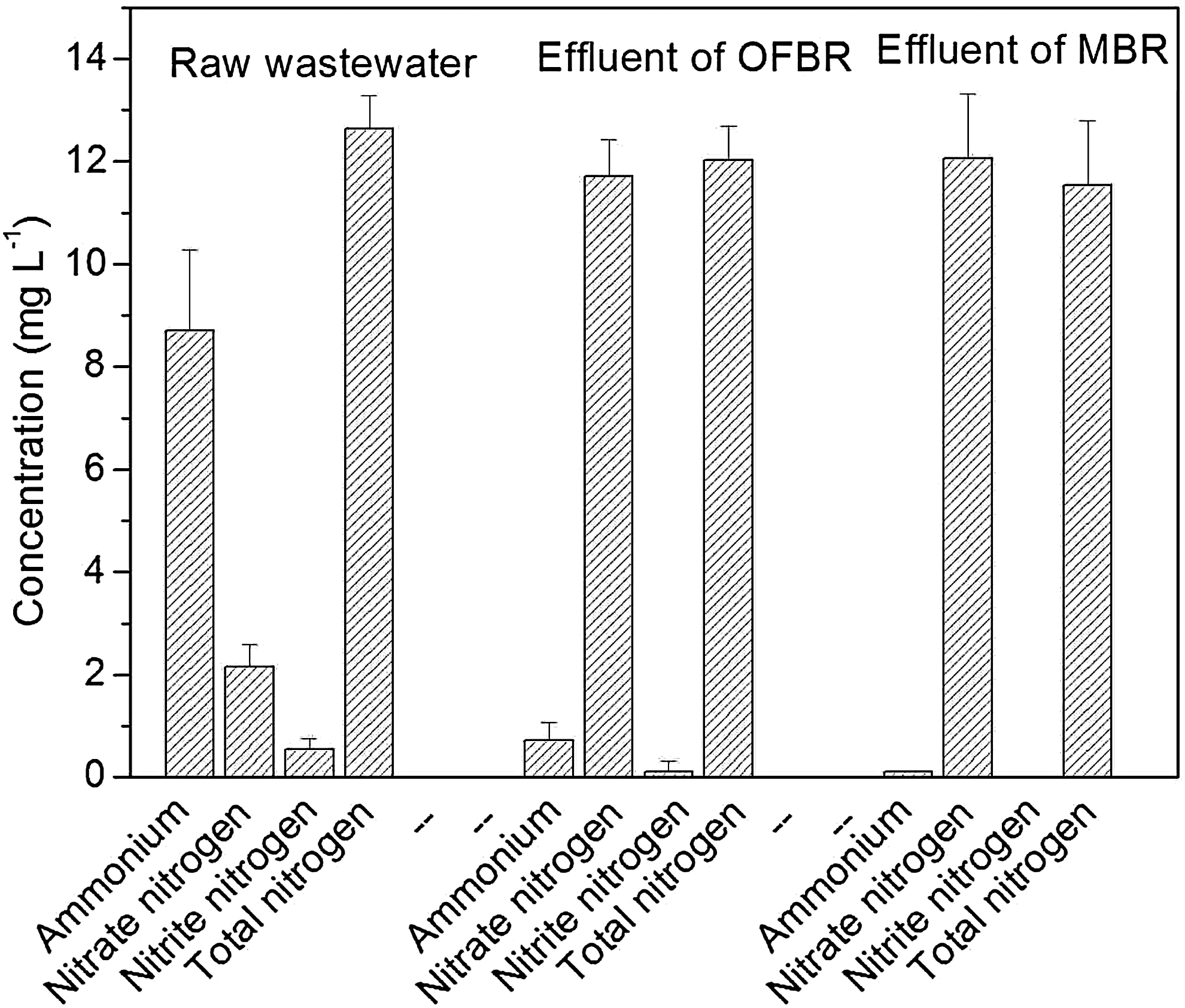
Changes in the nitrogen cycle in raw wastewater, OFBR effluent of the OFBR, and MBR effluent of the MBR.
In Fig. 3, the average NH4+-N concentration was 8.95 mg/L, the average NO3−-N concentration was 2.37 mg/L, the average NO2−-N concentration was 0.32 mg/L, and the average TN concentration was 13.03 mg/L. The TN value was greater than the sum of NH4+-N, NO3−-N, and NO2−-N, because other organic nitrogen species were present, such as proteins, amino acids, and organic amines, as also demonstrated by Supplementary Fig. S2. The NH4+-N concentration was 0.58 mg/L, the mean NO3−-N concentration was 11.12 mg/L, the average NO2−-N concentration was 0.1 mg/L, and the average TN concentration was 12.28 mg/L. In Fig. 3, the average NH4+-N concentration was 0.09 mg/L, the average NO3−-N concentration was 10.10 mg/L, the average NO2−-N concentration was 0, and the mean TN concentration was 10.40 mg/L. In the OFBR, most of the NH4+-N (93.5%) was transformed to NO3−-N, and the NO3−-N increased to 78.7%. NO2−-N decreased to 0.1 mg/L, possibly by the transformation to NO3−-N, and TN decreased to 5.8%, possibly due to denitrification. In the MBR, the NH4+-N was further transformed, which, at only 1%, was a residual component compared with the raw wastewater. NO2−-N was not detected in the MBR effluent, and TN decreased 20% due to denitrification. The nitrogen cycle in the OFBR-MBR resulted in the transformation of NH4+-N to NO2−-N and NO3−-N by aerobic ammonia-oxidizing bacteria, and NO2−-N and NO3−-N were transformed to N2 by denitrifying bacteria. The calculated balance of the nitrogen cycle is shown in Table 2. The inorganic nitrogen was mainly released in the OFBR, whereas organic nitrogen had a relatively high removal rate in the MBR. The nitration rate was higher than the denitrification rate in the OFBR, whereas this result was the opposite in the MBR. The carbon sources used through denitrification were 0.21 in the OFBR and 0.026 in the MBR, respectively (Sun et al., 2010).
Theoretical nitrate production = nitrate be produced through oxidation of converted nitrite.
TN loss (%) = percent changes of TN concentration calculated by the influent and effluent of each reactor.
Ammonium consumption = ammonium concentration in influent—ammonium concentration in effluent.
Inorganic nitrogen loss = nitrogen loss through denitrification of nitrate.
Carbon source used through denitrification = calculated carbon source used through denitrification based on inorganic nitrogen loss.
OFBR, ozone-oyster shell fixed-bed bioreactor; MBR, membrane bioreactor; TN, total nitrogen.
In this study, high-throughput sequencing data were studied for the analysis of the microbial community in the reactors. Both the OFBR and the MBR displayed high efficiencies in the removal of NH4+-N. Changes in the major microbial nitrogen cycle in the activated sludge were analyzed in the OFBR and MBR. As shown in Supplementary Table S2, common aerobic ammonia-oxidizing bacteria, nitrite-oxidizing bacteria, and denitrifying bacteria existed in the OFBR and MBR, whereas anammox bacteria were not detected. The dominant aerobic ammonia-oxidizing bacteria were Nitrosospira, and the major nitrite-oxidizing bacteria were Nitrospira in OFBR_1 and MBR_1. The main denitrifying bacteria were Hyphomicrobium and Paracoccus in OFBR_1, whereas the major denitrifying bacteria were Hyphomicrobium in MBR_1. In OFBR_2, the principal aerobic ammonia-oxidizing bacteria were still Nitrosospira, whereas the principal nitrite-oxidizing bacteria were Nitrospira and Nitrobacter. There were no major denitrifying bacteria; the quantities of Hyphomicrobium, Paracoccus, and Dechloromonas were small. The main denitrifying bacteria were Bradyrhizobium and Hyphomicrobium in MBR_2. The quantities of aerobic ammonia-oxidizing bacteria and nitrite-oxidizing bacteria slightly increased, reaching 9% and 7% from 4% and 5%, whereas the quantity of denitrifying bacteria decreased from 14% to 11% after the addition of ozone, which occurred because the DO content was sufficient to promote the growth of nitrification bacteria and inhibited the growth of denitrifying bacteria (Fitzgerald et al., 2015). However, this was just the opposite of the MBR after the addition of ozone, the quantity of aerobic ammonia-oxidizing bacteria and nitrite-oxidizing bacteria decreased from 9% and 15% to 7% and 10%, and the quantity of denitrifying bacteria increased from 9% to 11%, which was related to the decrease of DO in the MBR (Zhang et al., 2015).
The results demonstrated that nitrification played a leading role in the nitrogen cycle of the OFBR-MBR, and denitrification was accompanied at a relatively low level in the MBR. The OFBR-MBR displayed significant ability in the conversion of nitrogen, which was demonstrated by microbial analysis and the calculated balance of the nitrogen cycle in the OFBR-MBR.
Removal of phosphorus
Changes in the TP concentrations of raw wastewater, OFBR effluent, and MBR effluent under optimum ozone dosage are shown in Fig. 4. The average TP concentration was 0.61 mg/L, the average TP concentration in the OFBR effluent was 0.48 mg/L, and the average TP concentration in the MBR effluent was 0.37 mg/L. The TP removal efficiency of the OFBR was 21.3%, and the removal efficiency of the OFBR-MBR was 39.3%. The individual contributions of the OFBR and MBR to the TP removal were 54.2% and 45.8%, respectively. The removal of TP depended on the presence of polyphosphate-accumulating organisms (PAOs, which can take up phosphorus and accumulate it intracellularly as polyphosphate) when exposed to alternating anaerobic and aerobic conditions (Zhang et al., 2016). TP could be removed with the surplus biomass washed from the OFBR by water flow. All biomass would be accumulated in the MBR, leading to increases in the biomass concentration until sludge discharge would be needed. Although no sludge discharge from the MBR was performed during the experiment because biomass grew very slowly in the MBR at the low organic load levels in the input, TP accumulated in the biomass would be intercepted in the MBR and finally removed through sludge discharge (Wang et al., 2012). The removal of TP mainly depended on the function of PAOs in the OFBR and MBR. PAOs can utilize phosphorus to complete their own metabolism, removing TP from the aqueous phase to the solid phase (activated sludge). In that case, sludge discharge would be needed when it reached a certain concentration.
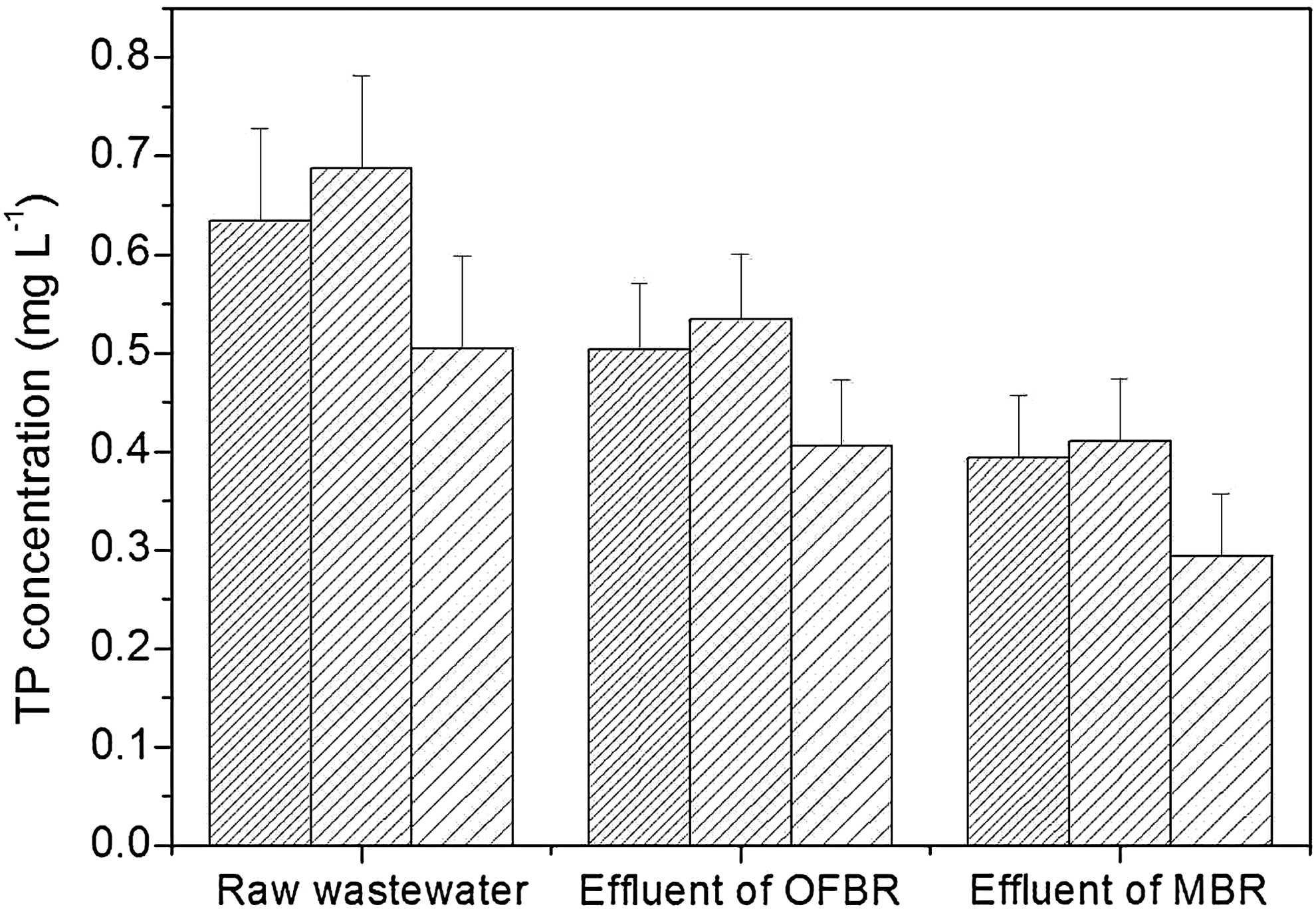
TP concentrations in raw wastewater, OFBR effluent, and MBR effluent under optimum ozone dosage. TP, total phosphorus.
Conversion mechanism of residual refractory organics, ammonium, and phosphorus in the OFBR-MBR
The organics in the effluent from municipal tail water were mainly in the form of refractory organics, which were difficult to degrade by common biological treatments. In this study, ozonation was utilized in the OFBR as a procedure for enhanced oxidation. OFBR had as a major function the transformation of refractory organics into more biodegradable forms, from which large amounts of carbon, ammonium, and part of the phosphorus had been removed. The role of the MBR was to further remove the carbon, ammonium, and phosphorus and support the microbes; denitrification played an important role in the MBR, which linked the carbon and nitrogen cycles. Because of the strong oxidation of hydroxyl radicals produced by ozone, refractory organics might be degraded into biodegradable organics as shown in Fig. 2. The removal of COD suggested that microbiological nitrification and metabolism could make use of these biodegradable organics. As shown in Table 2, the carbon sources used through denitrification were 0.21 mM in the OFBR and 0.026 mM in the MBR, respectively. The removal of ammonium was mainly due to microbiological nitrification, as shown in Fig. 3. Approximately 10% of the ammonium was released as nitrogen gas through nitrification and denitrification by commonly known aerobic ammonia-oxidizing bacteria, nitrite-oxidizing bacteria, and denitrifying bacteria in the OFBR and MBR. Phosphorus had two fates. One was that the growing microbial colonies themselves need part of the phosphorus, whereas the other and larger component of the phosphorus was removed in the aerobic phase. TP was enriched in the activated sludge, and its removal depended on its uptake by PAOs. This study demonstrated that the OFBR-MBR system displayed high removal efficiencies of COD, ammonium, and TP in tail water from a municipal sewage treatment plant. Moreover, thanks to their high efficiency in the conversion of refractory organics, OFBR-MBR systems might have potential applications in the treatment of tail water containing residual refractory organics that are generated during manufacturing processes in many industries such as printing and dyeing, chemical production, and food processing.
Conclusions
The OFBR-MBR possesses enhanced removal efficiency for carbon, ammonium, and phosphorus. This system can convert refractory organics to biodegradable organics, and it then utilizes microorganisms and membranes to intercept and degrade the micro-molecular organics, causing a relatively high removal efficiency of carbon. The presence of common aerobic ammonia-oxidizing bacteria, nitrite-oxidizing bacteria, and denitrifying bacteria in the MBR were all of great significance in the nitrogen cycle. The OFBR converted ammonium to nitrate nitrogen, which could be transferred by denitrification in the MBR. The removal efficiency of TP mainly depended on its uptake by PAOs, and TP was removed with the sludge discharge. The conversion mechanism of carbon, nitrogen, and phosphorus in the OFBR-MBR has been studied and discussed, which demonstrated that the system has great potential in treating municipal tail water and might be further used in other tail wastewater treatment programs.
Footnotes
Acknowledgments
The authors are grateful for financial support provided by the Institute of Guangdong Electricity Science Research (K-GD2013-0501002-001) and the National Natural Science Fund of China (NO. 21477039 and U1401235). J.Y. is supported by the China Postdoctoral Science Foundation (2013 M531852, 2014T70809).
Author Disclosure Statement
No competing financial interests exist.
References
Supplementary Material
Please find the following supplemental material available below.
For Open Access articles published under a Creative Commons License, all supplemental material carries the same license as the article it is associated with.
For non-Open Access articles published, all supplemental material carries a non-exclusive license, and permission requests for re-use of supplemental material or any part of supplemental material shall be sent directly to the copyright owner as specified in the copyright notice associated with the article.
