




Abstract
Abstract
It is important to recycle and remanufacture end-of-life vehicles (ELVs) to protect the environment and sustain a green ecological economy. Recycling ratios of ELV are key factors in the development of the recycling and remanufacturing industry. Although there are many factors affecting the recycling ratio of ELV, in this study, we focused on the degree of consumer participation in recycling. In combination with the theory of planned behavior (TPB), we analyzed different factors affecting consumer behavior, constructed a logical relationship between these factors, built reasoning systems, and established rules of how these factors influence one another. We then transformed a qualitative relationship of the reasoning system by using a cloud model and carried out simulations. The model revealed factors affecting consumer participation in ELV recycling ratios. This study provides a new theoretical reference for further research in this field and provides a framework for relevant government departments to develop policies around recycling.
Introduction
W
Many studies have reported factors that affect the recycling industry. Liu et al. (2015) summarized the main influencing factors of consumer participation in recycling as follows: behavior attitude, economic motivation, service motivation, subjective norm, and public propaganda; these were then further divided into 15 sub-aspects. Using AHP research, the researchers found that economic motivation played a major role in recycling. Lan and Zhu (2009) summarized influencing factors into the following categories: behavioral attitude, subjective norm, behavior control, and environment knowledge.
Through correlation analysis, they found that environment knowledge affects behavioral intention through its effect on behavioral attitude, whereas economic motivation and service motivation affect behavioral intention directly.
Through factor analysis and binary logistic regression models, Ren et al. (2014) found that behavioral control, environmental attitude, and residual effects are the main factors affecting consumers' delivery behavior intention. Yu (2012) applied regression analysis and showed that situation factors, including environmental knowledge, public propaganda, and recycling channels, play a role in regulation. Dai et al. (2010) proposed that factors affecting recycling behavior include motivation, commitment, and demographic characteristics. Lu and Zhao (2009) showed that residual effects and controlling factors were significantly related to the recycling economy and recycling behavior and discussed the effect of recycling on environmental impact consciousness, economic compensation, law cognition, recycling methods, and demographic factors. Boldero (1995) pointed out that awareness of recycling behavior includes convenience and storage space (access to recycling facilities).
Ajzen (1991) argued that past behavior affects present behavior, and Ylä-Mella et al. (2015) proposed that consumer awareness is vital to recycling participation based on the theory of planned behavior (TPB) and value norms through statistical analysis. Xu et al. (2014) analyzed the results of questionnaires by using principal component analysis, multiple step-wise regression analysis, and regulation effect analysis and found relationships between factors affecting recycling behavior and consumer intention. Using a large sample questionnaire survey method, Wang et al. (2011) discussed recycling behavior characteristics and preference for e-waste recycling and proposed a regression model to estimate and explain the willingness of residents to participate in e-waste recycling. Yin et al. (2014) analyzed the factors that affect consumer recycling behavior by applying principal component analysis and multiple logistic regression analysis and found that education level and monthly income were important factors. Darby and Obara (2005) used questionnaires to assess consumer attitudes toward waste electrical appliance and electronic equipment, and their results indicated that increasing recycling awareness is an important factor affecting recycling behavior. Based on the described research, consumer recycling behavior has been well studied to date; however, most of these studies used statistical analysis tools, whereas the logical relationship and numerical evolution process of the influencing factors of recycling behavior have not been explored.
In this study, ELV recycling ratios and the factors affecting consumer participation in recycling behavior were evaluated. The recycling behavior reasoning system was built by establishing the logical relationship between factors, and characteristic numerical values of the system factors were obtained from survey data and cloud model tools to convert qualitative relationships into quantitative values (Fan et al., 2012; Li et al., 2012). Simulations were carried out to analyze the effect of these factors on recycling behavior. The impact of the identified factors that influence consumer participation ELV recycling is discussed, and new theoretical support for increasing ELV recycling is proposed.
Theoretical Basis
Theory of planned behavior
The TPB (Fishbein and Ajzen, 1975; Lu and Zhao, 2009; Yu, 2012) consists of five elements, which include behavior attitude, subjective norm, behavior control, behavior intention, and behavior. Behavior attitude, subjective norm, and behavior control are the three main variables that determine behavior intention. Personal, social culture, and other factors (such as personality, intelligence, experience, age, gender, and cultural background) influence behavior attitude, subjective norm, and behavior control indirectly by affecting belief (Fig. 1).

Schematic of TPB. Arrows indicate transitive and causal relationships. TPB, theory of planned behavior.
There are three key factors that determine behavior intention as follows:
The first is AB (attitude toward the behavior). The formation of attitude is explained from two aspects, which are BB (behavior belief) and OE (outcome evaluations). That is:
The second is SN (subjective norm), which is the perception of social pressure that a person feels when taking a particular action. It is the product sum of NB (normative belief) and MC (motivation to comply) with social pressure. That is:
The third is PBC (perceived behavioral control), which is the degree of control that a person feels when taking a particular action. It is the product sum of CB (control belief), which belongs to behavior expression factors, and PF (perceived facilitation). That is:
Cloud model
The cloud is an uncertain transformation model between a qualitative concept described in terms of linguist values and its numerical representation (Li et al., 1995). By using numerical characteristics of the cloud, which are Ex (expectation), En (entropy), and He (hyper entropy), mathematical properties of linguistic values are represented, which reflect not only the randomness of the sample representing the qualitative concept values but also the uncertainty of the degree of membership (membership degree is a concept of fuzzy evaluation function). Through computer simulation, qualitative evaluation of human beings can be converted into quantitative processing of machine intelligence, thus realizing the mutual transformation between qualitative and quantitative information. In the recycling and remanufacturing system, there are many random uncertain problems. To solve these problems, the cloud model is needed for mutual transformation between qualitative and quantitative information (Li et al., 2004).
Norm cloud and relevant concepts
Fuzzy concepts, such as goodness, medium, and badness, are described by using the normal cloud and the normal cloud model is built to map the indefinite comments as slightly different cloud droplets.
(1) One-dimensional normal cloud
U is a domain
Cloud is represented by three numerical variables, which are Ex, En, and He (expected value, entropy, hyper entropy). The mapping relationship between qualitative concepts of fuzzy random and quantitative values is formed. Then, the formula of mathematical expectation curve (MEC) is determined by Ex and En. It is expressed as Equation (1).
(2) m dimensional normal cloud
U is an m dimensional discourse domain
m dimensional normal clouds are represented by 3m numerical characteristics
Cloud generator
m dimensional normal random number
and cloud droplet

m-dimensional forward cloud generator and m-dimensional reversed cloud generator. This figure explains mechanisms of the cloud generator.
(1) X condition cloud
The m sets of numerical characteristics and specific random arrays
(2) Y condition cloud
The m sets of numerical characteristics and specific membership degree value ui are given, and cloud droplet
(3) Attribute generalization
The system factor set is assumed to be
Assuming that X1, X2, and Xm have effects on Y1/Y2/Y3, the qualitative rule is as follows:
If the language evaluations of X1a, X2a, and Xma are good, then the output of Y1 is good.
If the language evaluations of X1b, X2b, and Xmb are good, then the output of Y2 is good.
If the language evaluations of X1c, X2c, and Xmc are good, then the output of Y3 is good. The multidimensional and multi-rule reasoning model is shown in Fig. 3.
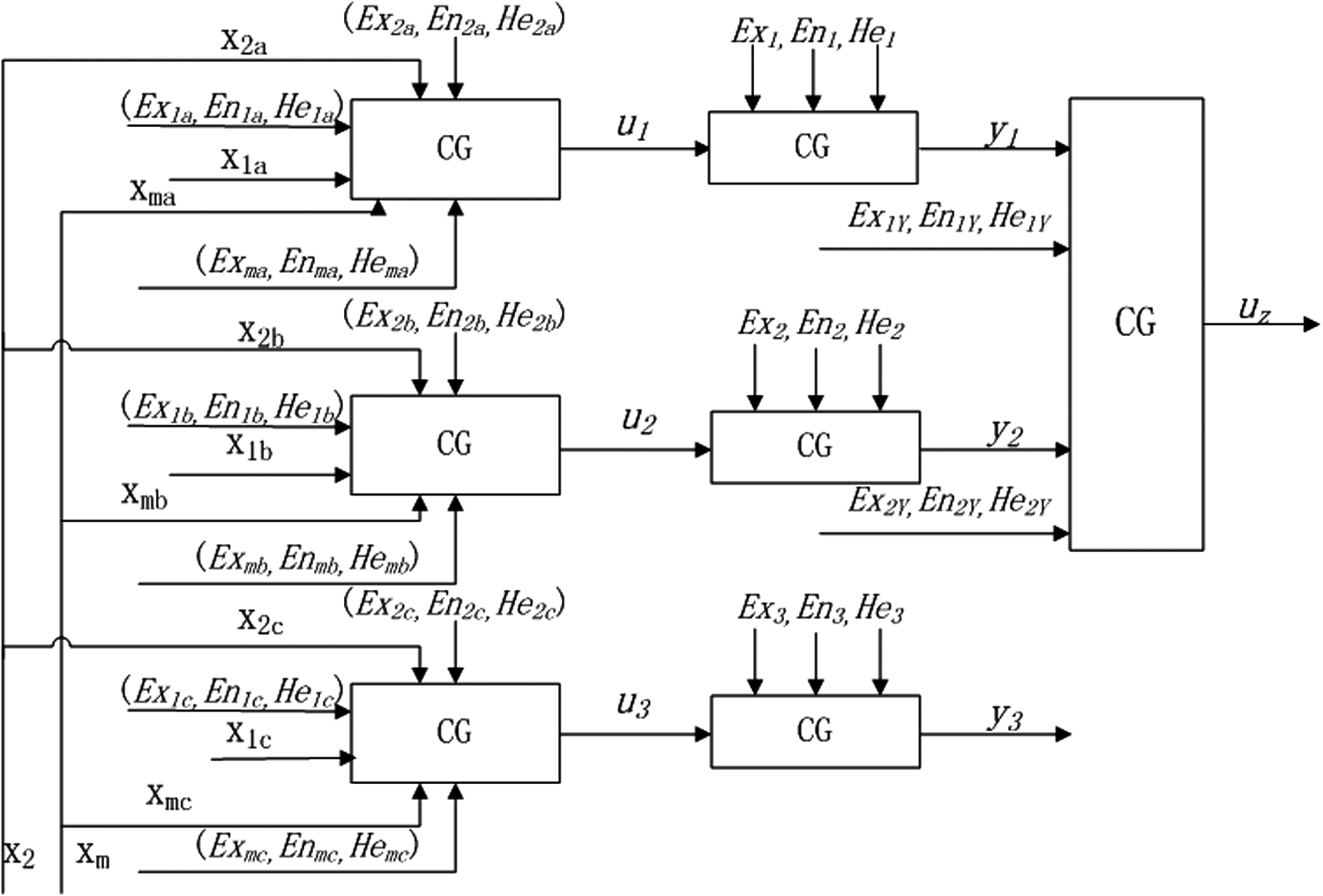
Multidimensional and multi-rule generator. This figure explains mechanisms of the multidimensional and multi-rule generator.
Reasoning System of ELV Recycling Behavior
Analysis of factors on ELV recycling behavior
Based on the Theory of Planned Behavior section, factors that affect consumer participation in ELV recycling are divided into five aspects by TPB. The specific relationship is shown in Fig. 4.
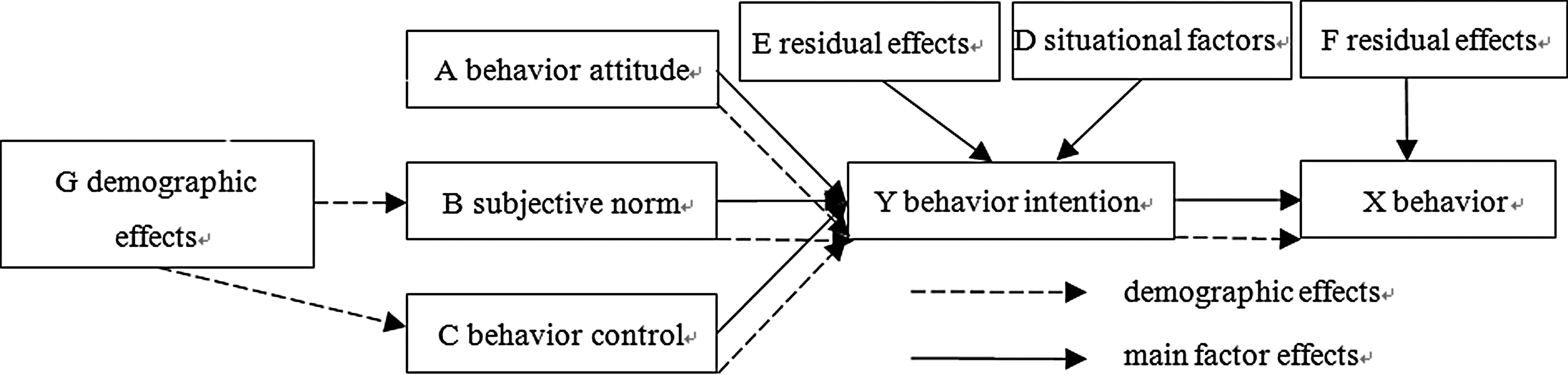
Relationship of influencing factors of ELV recycling behavior. Arrows indicate transitive and causal relationships. Solid arrows represent demographic effects, and dashed arrows represent main factor effects. ELV, end-of-life vehicle.
Related factors also include a number of sub-factors that are specifically described in Table 1.
Cloud of ELV recycling behavior system factors
The questionnaire was set to obtain initial data based on influencing factors and their mutual relationships with recycling behavior. The questionnaire is shown in Table 2. As in the influential factor E3 of recycling motivation, the degree of understanding of the evaluation of formal recycling channel information is divided into different levels (“very understanding,” “understanding,” “general understanding,” “not too understanding,” and “do not understand”) and scored between 0 and 10, assuming that “very understanding” is marked as 10, “understanding” as 7.5, “general understanding” as 5, “not too understanding” as 2.5, and “do not understand” as 0. E3 is set as 7, so the service motivation E3 (understanding regular recycling channel information) is 10, 7.5, 5, 2.5, 0, or 7.
The questionnaire was distributed to the residents of Changsha, Hunan province. To get more accurate results, the questionnaire objects, such as degree of education, monthly income, living area, age, and occupation, were controlled. The statistical characteristics of the questionnaire objects are shown in Table 3.
Results are shown in Table 4.
Aimed at the influencing factors of the ELV recycling system, factor A1 (improvement of environment resources) was used as an example, and the mapping relationship between the qualitative concept A1 and the quantitative numerical value was constructed. Then, according to specific situations, five different ratings were set as “excellent,” “good,” “fair,” “not too good,” and “bad” and were expressed as
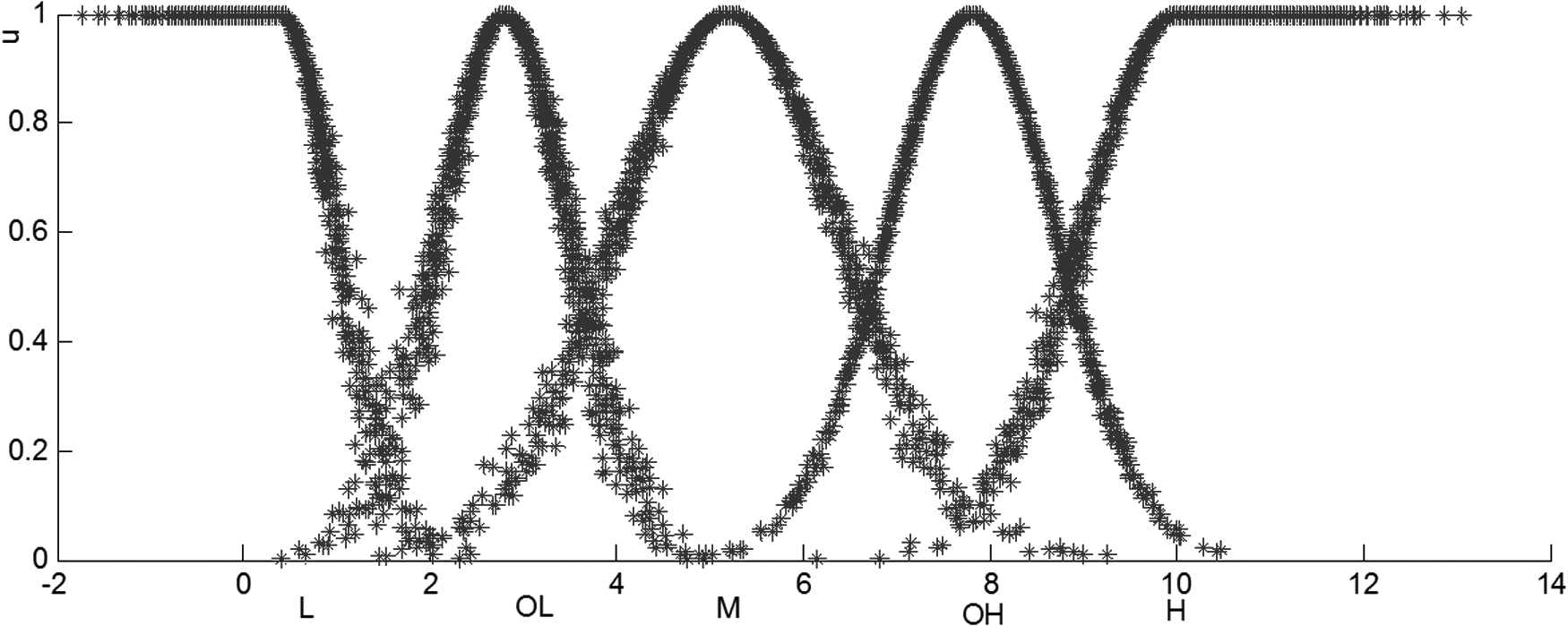
A1 improvement of the cloud model with environmental resources. This figure shows a cloud map generated by the cloud generator; the blue points represent cloud droplets.
Based on the results of the questionnaire, the numerical characteristics of the factors of the cloud model were calculated (Table 5). The relevance between factors, such as behavior attitude, subjective norm, behavior control, situational factors, recycling motivation, residual effects, and behavior intention, was positive; each factor had a significant positive correlation with the behavioral intention.
ELV, end-of-life vehicle.
Qualitative rules for ELV recycling
According to questionnaire results and analysis of recycling influencing factors, the qualitative influence relationship and matching rules between each factor were summarized. Then, qualitative rules to describe the relationship between factors, as well as the rules generator to express logic relationships, were constructed. Among them, H, OH, M, OL, and L (“excellent,” “good,” “fair,” “not too good,” and “bad,” respectively) and other language concepts are shown in Table 6.
Structural model of ELV recycling behavior reasoning system
Based on multidimensional and multi-rule generators and the influencing relationship of recycling behavior from the cloud model described earlier, the reasoning system of ELV recycling behavior was built (Fig. 6).
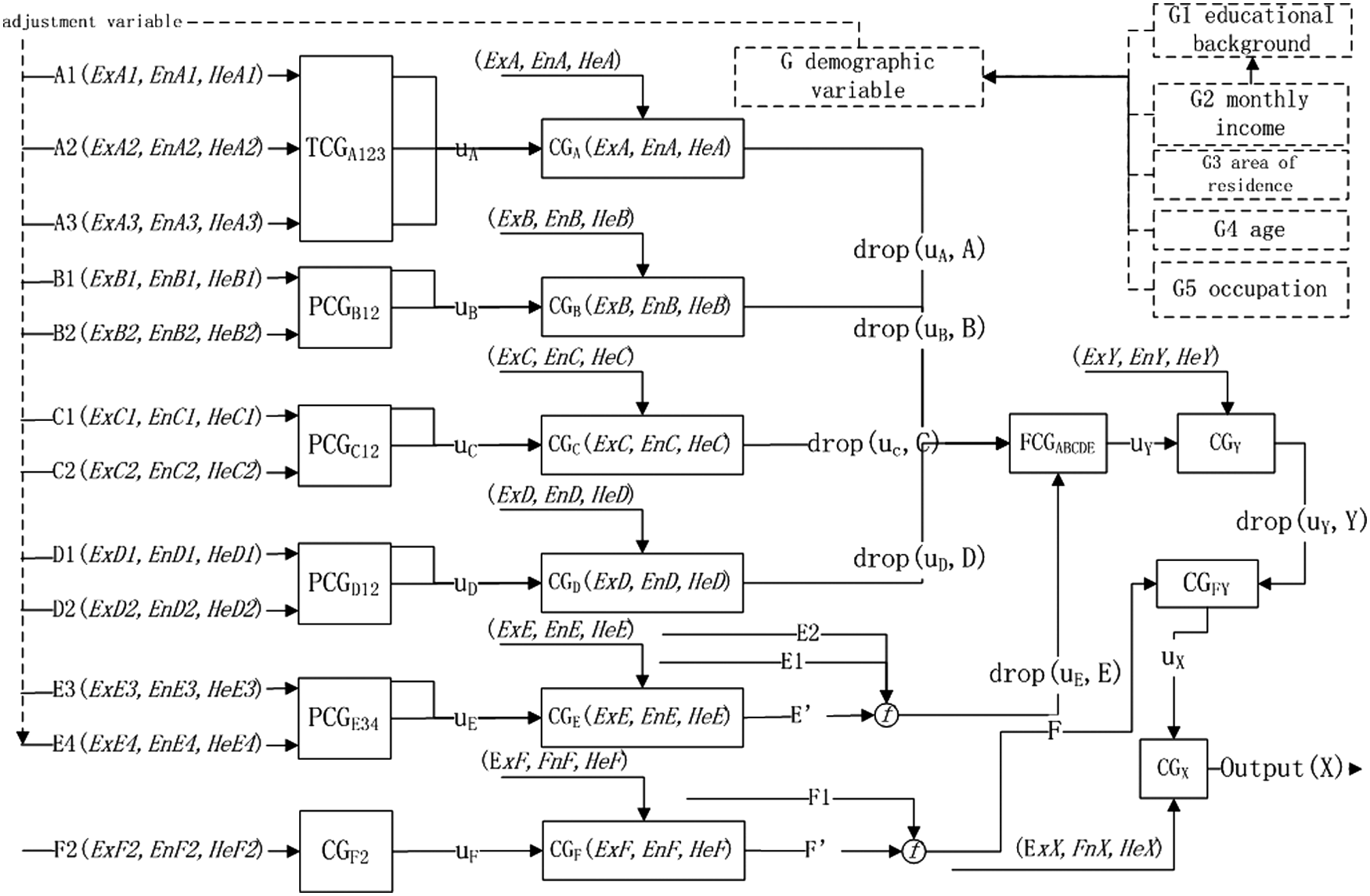
Reasoning evolution system of ELV recycling behavior. Figure shows evolution system of ELV recycling behavior.
Simulation and Calculation of the Cloud Model of ELV Recycling Behavior System
Based on the survey data, the model was simulated and calculated to evaluate effectiveness.
Numerical evolutionary computation was performed based on the qualitative rules in Table 6 and the rules relationship in Fig. 4.
(1) Computation of A behavior: Factors include A1 (improvement of environmental resources), A2 (increase of environmental governance cost), and A3 (willingness to participate in recycling). According to the qualitative Rule A, when evaluation levels of A1, A2, and A3 are relatively high, A is good and evolutionary computation can be carried out.
The former X condition cloud consists of A1/A2/A3. The Y condition cloud is A. The values of the three-dimensional X condition cloud are A1 = 7.24, A2 = 7.87, and A3 = 8.64, so the numerical characteristics related to the qualitative concept are
Step 1: The expectation value and mean square deviation are generated relatively randomly
Step 2: The membership degree can be calculated by Equation (4).
It can be obtained:
Step 3: According to the qualitative rules, it is needed to judge whether the value of A is attached to the front end or the back end of the A cloud.
Step 4: Repeat the operation cited earlier to obtain the value under different cases to achieve the average value, which can be shown as Equation (5).
Thus, after calculation, in the same way, subjective normal, behavior control, situational factor, recycling motivation, behavior intention, and behavior result can be obtained.
(2) To verify the validity of the model, the calculated results were analyzed and compared with those of the cloud model and the error between them was calculated. The validity of the model was verified, and the stability of the results and the correctness of the output are ensured as shown in Table 7. Errors between B, C, E and the initial value were kept less than 3%, and errors between Y, A, and D were around 3%. The error of X was 3.5%, whereas that of Y was 9.6% in the evolution of the recycling behavior based on the TPB. The results show that the errors were within the acceptable limits and ensure the correctness of the results.
In short, based on the questionnaire survey and other statistical data, the qualitative influence rules and the various factors of the cloud model were constructed to obtain the initial value of the calculation. Then, cloud evolutionary computation was carried out. The comparison between the calculated results and the initial values showed that the method can ensure the validity and accuracy of the model.
Discussion on the Effect of Residual Effects, Situation Factors, and Demographic Factors on Behavior
(1) Residual effects on recycling behavior
The average service life of vehicles is t = 10 years, and computation was carried out with the value of participating in recycling behavior at X = 0.59 based on data from questionnaires representing the majority of vehicle users. Thus, 1 out of 10 of respondents will scrap their ELV, whereas the percentage of those scrapping the thorough formal scrap process is 59. Therefore, the proportion of F1 increased by 5.9% in the previous year from the visiting day (F1 = 0.239), implying a change of values of the consumer's recycling behavior during the next 30 years (Fig. 7). The value of X maintained basic stability during the initial 8 years (Fig. 7), but there was a slight decline between the fourth year and fifth year; the F value after 2.7 became larger, and the qualitative evaluation attribution changed from fair to good.
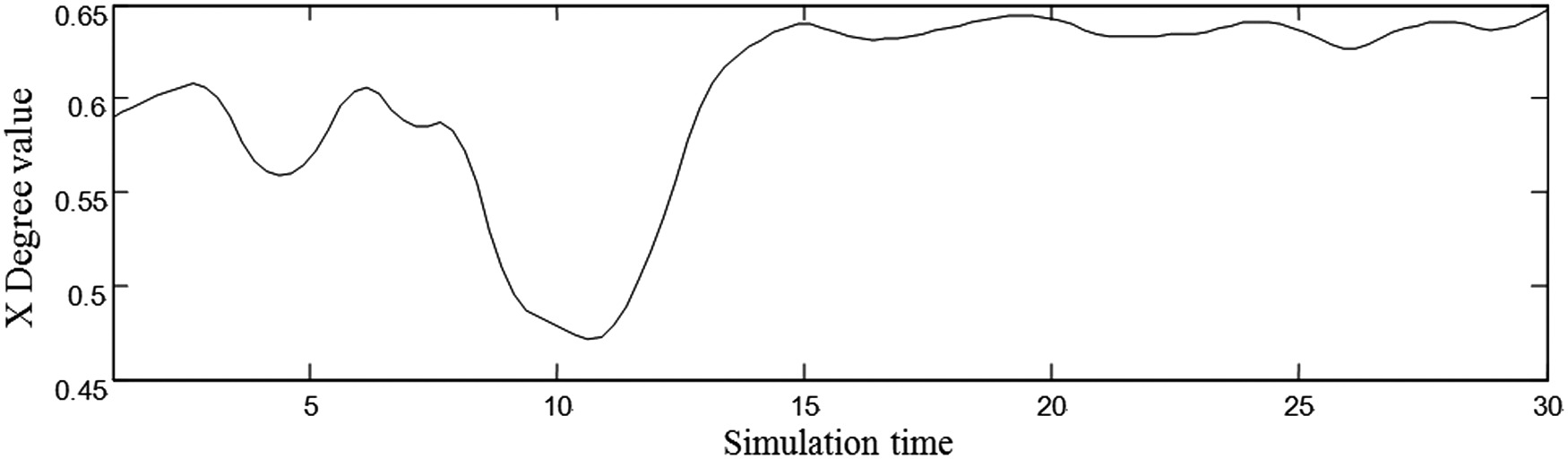
Residual effects on recycling behavior. Figure shows results of the simulation run. The real curve shows the change in consumers who participate in recycling behavior over time.
The membership degree decreases gradually and the evaluation becomes fuzzy, which leads to residual effects playing a smaller role. From the sixth year, the F value continues to grow; however, the effect is offset by a certain degree followed by a clear downward trend between the ninth and tenth year. The F value is 3.30 in the ninth year and 3.37 in the tenth year; these results are between good and fair. The evaluations of the degree of membership in good and fair dimensions are not quite different. The qualitative evaluation attributes are very vague, and the residual effects on consumer participation in recycling behavior become smaller, leading to a sharp decline.
At the beginning of the 11th year, with the proportion of participation in recycling behavior increasing, evaluation is more favorable and the residual effects gradually become larger. At the 15th year, the proportion of participation in the recycling behavior reaches the maximum value and the residual effects reach the extreme. At this point, the value of X fluctuates around 0.64 and tends to be stable. Thus, with other conditions unchanged, the change in consumer participation in recycling behavior caused by the residual effects of recycling behavior should reach the maximum value in the next 15 years.
(2) Situation factor effects on recycling behavior
When the external environment of ELV recycling changes, recycling behavior will change. For example, an enactment of policies and regulations and an increase in the degree of media propaganda help owners understand more about recycling and will affect their recycling behavior.
Therefore, in a situation in which D1 (mandatory laws and regulations) and D2 (media publicity) change, in accord with numerical changes between 0% and 100%, the rule changes and car consumer recycling behavior changes (ideal recycling ratio). In Fig. 8, the effect of D2 (media propaganda) on consumer recycling behavior is shown as solid lines and, at the nodes of 0, 0.5, and 0.95, its effect on recycling behavior reaches maximum and the ideal recycling ratio increases rapidly. However, oscillation effects on recycling behavior are seen at the nodes of 0.25 and 0.75 since values of description attributes are vague and the intuitive effects on human being are in a fuzzy state.
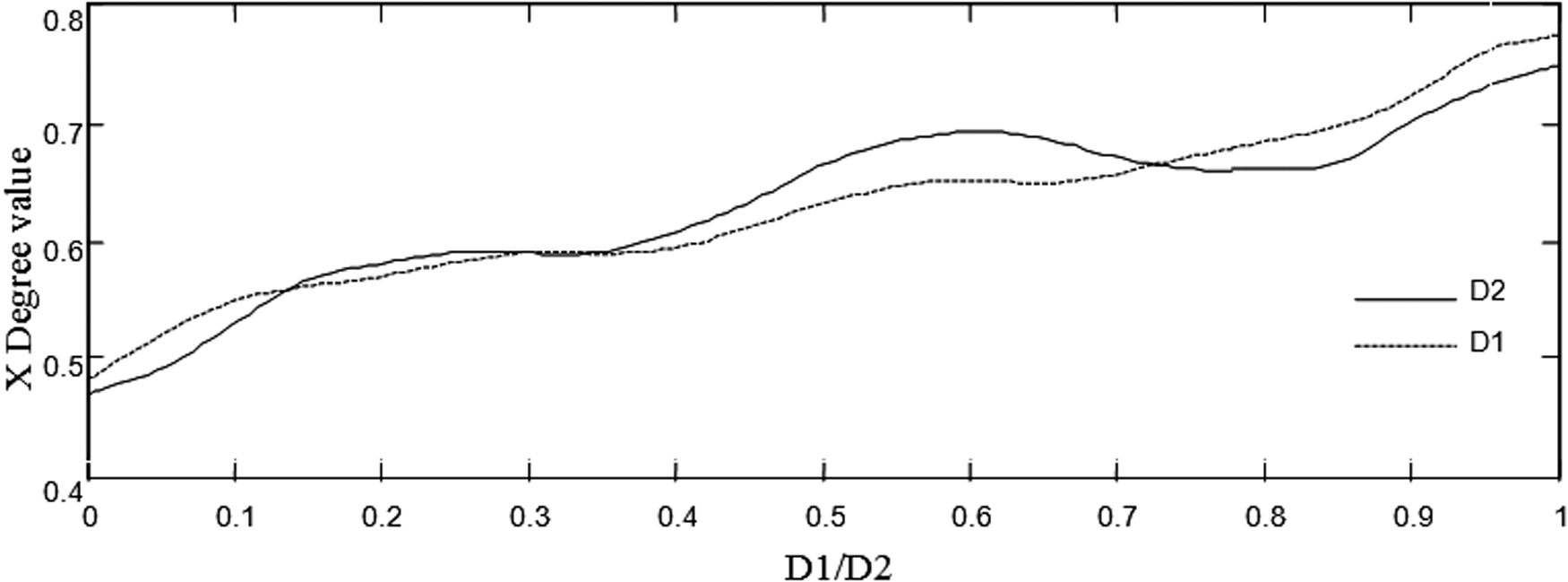
Effect of D1/D2 on recycling behavior. Figure shows results of the simulation run. The real curve shows effect of D1 (mandatory laws and regulations) over time, and the virtual curve shows the effect of D2 (media publicity) over time.
The impact degree of D1 (mandatory laws and regulations) on recycling behavior increases slowly from 0.48 to 0.76. Compared with D2, the impact of D1 on consumer participation in recycling behavior deepens in the second half since, as with gradual improvement of laws and regulations, the binding on consumers' recycling behavior gradually increases until the binding force reaches the maximum value. After 0.85, the binding force increases; it must increase the legal constraints of consumer participation on recycling behavior; only in the case of perfect laws and prominent media propaganda can it ensure that products with environmental hazards such as ELV be recovered in a timely manner, which would improve the environment and increase the rational use of resources.
(3) Statistical analysis of the effect of demographic variables on recycling behavior
Differences in demographic variables affect consumer participation in recycling. Our analysis of demographic variables such as education, monthly income, living area, age, occupation, and recycling behavior intention showed an unstable relationship. We compared and analyzed data by using statistics but did not perform evolution calculations by using the cloud model. Based on the questionnaire results, the higher the degree of education, the more likely a consumer will participate in recycling behavior. For example, at the level of graduate school, 90% of consumers interviewed were willing to participate recycling; however, at the level of junior high school, only slightly >50% of consumers were willing to participate. We also found that those with a higher income were more likely to recycle and those aged 40 years or older had the strongest willingness to recycle. In addition, 85% of those living is an urban population were willing to recycle compared with 77% and 75% of township and rural residents, respectively. Civil servants, public institutions personnel, and foreign personnel were most likely to participate compared with students and farmers (who were least likely to participate). Therefore, those living in a city and who were aged 40 years or older with a high level of education and high income are more likely to support ELV recycling and are more likely to participate.
Conclusion
In this study, recycling behavior rules and reasoning systems were built based on the TPB of consumers. Cloud model tools were applied to transform qualitative descriptions into quantitative numerical values to carry out numerical simulations, and numerical evolution relationships affecting the recycling behavior of consumers were analyzed. We found that the residual effects of consumer participation on recycling behavior fluctuate with time and reach an extreme at the 15th year. In addition, the effects of compulsory laws and regulations and propaganda of situation factors have different effects on recycling behavior and must be properly analyzed. We also found that demographic variables have a significant impact on consumer participation, including education, age, and income, based on specific situations.
This study reported the influence of factors affecting consume participation in recycling behavior that impact ELV recycling, and it verifies the validity of the application of TPB and the cloud model to analyze factors affecting the recovery ratio of ELV. This study also provides a new theoretical reference of how to improve the recycling ratio of ELV, offering both important practical and theoretical findings.
Footnotes
Acknowledgments
This work was supported by the National Natural Science Foundation of China (71473077), the National Key Technology R&D Program of China (2015BAF01B00), and the National High Technology Research and Development Program of China (2013AA040206).
Author Disclosure Statement
No competing financial interests exist.