




Abstract
Abstract
Dissolved organic matter (DOM) has been widely studied in streams, lakes, and oceans due to its role in biogeochemical processes, allowing it to act as a sunscreen, food source, trace metal chelator, and photosensitizer. Few studies have examined DOM in oilfield-produced water. In this study, three major types of solid-phase extraction (SPE) sorbents, a silica-based sorbent (ENVI-18), an active carbon (ENVI-Carb), and polymer-based sorbents (PPL, XAD resins, and HLB), were used to isolate DOM from oilfield-produced brine. Isolated SPE DOM samples were analyzed using dissolved organic carbon (DOC), Fourier transform infrared spectroscopy, and pyrolysis-gas chromatography-mass spectrometry (Py-GC/MS). Results showed that the oilfield-produced brine DOM sample was dominated by aliphatic hydrocarbons and aromatic compounds. Nitrogen-containing compounds and carbohydrates were also observed; however, polycyclic aromatic hydrocarbons, fatty acids, and sulfur-containing compounds were relatively absent. Under acidic conditions, extraction efficiencies of DOM from oilfield-produced brine were enhanced for different SPE sorbents as follows from high to low: XAD-8/4 tandem, HLB, PPL, ENVI-18, and ENVI-Carb. DOM samples isolated by different sorbents exhibited different properties. ENVI-18 and XAD-4 DOM isolates were enriched in aliphatic hydrocarbons but devoid of aromatic compounds, XAD-8, HLB, and PPL samples contained relatively higher levels of aromatics, and HLB and PPL samples showed a high retention capacity for carbohydrates, while ENVI-Carb and HLB DOM isolates contained more nitrogen compounds than those obtained using other sorbents. In addition, XAD-8 and PPL extracts were characterized by higher concentrations of sulfur-containing compounds. This is the first study of its type to study oilfield-produced brine DOM, and the results will help us better understand their structures and properties.
Introduction
O
The dissolved organic matter (DOM) present in oilfield-produced brines has adverse effects on the recovery and quality of the isolated inorganic products (Cui et al., 2009; Li et al., 2012). In addition, the DOM in oilfield-produced brines also includes some potentially toxic organic components that may be harmful when released into the atmosphere or groundwater (Witter and Jones, 1999; Orem et al., 2007; Alley et al., 2011). The complexity and heterogeneity of DOM in oilfield-produced brines (Witter and Jones, 1999; Wang et al., 2012) make acquiring isolated DOM essential for their chemical characterization. This study represents an initial step for assessing and understanding the impacts of DOM on the recovery of inorganic salts and potential harmful effects to organisms and environments.
Liquid-liquid extraction (LLE) and solid-phase extraction (SPE) techniques are the most common methods reported in the literature for isolating DOM from oilfield-produced water (Røe Utvik, 1999; Mccormack et al., 2001; Holowenko et al., 2002; Barrow et al., 2010; Wang et al., 2012). However, the LLE method usually exhibits poor performance in DOC recovery and in isolating representative organic fractions (Mccormack et al., 2001; Holowenko et al., 2002; Yang et al., 2015). Furthermore, the LLE method is labor intensive and consumes relatively large volumes of high-purity solvents with expensive disposal requirements (Hennion, 2000; Poole, 2003; Yang et al., 2015). Due to the ease of handling, special selectivity, and freedom from inorganic ion characteristics, the SPE method is becoming the preferred method for isolating DOM from high salinity water (Fontanals et al., 2005; Wang et al., 2012). Pyrolysis in association with gas chromatography and mass spectrometry (Py-GC/MS) has been introduced as an effective technique for analyzing a large variety of natural macromolecules and presents several advantages in the structural analysis of recalcitrant DOM, such as good reproducibility and use of only a small sample. This method is based on the thermal breakdown of DOM macromolecules into a variety of subunits, which can then be separated by gas chromatography and identified by mass spectrometry (Lehtonen et al., 2000; Fan et al., 2013; Iwai et al., 2013). Therefore, a combination of SPE and Py-GC/MS techniques, together with other complementary analytical techniques, attracted the substantial interest of DOM researchers. However, comparative studies on the molecular compositions and structural features of the DOM isolates acquired using SPE-cartridges are very scarce.
In this work, several commercially available SPE cartridges (ENVI-18, ENVI-Carb, PPL, XAD resins, and HLB), which have been widely used in saline water systems (Aiken et al., 1992; Duarte and Duarte, 2005; Limbeck et al., 2005; Dittmar et al., 2008; Krivacsy et al., 2008; Santos et al., 2009), were selected to isolate DOM from oilfield-produced brines. DOM isolates were analyzed using a combination of techniques, including dissolved organic carbon (DOC) analysis, Fourier transform infrared spectroscopy (FTIR), and pyrolysis-gas chromatography-mass spectrometry (Py-GC/MS), to investigate the similarities and differences of various DOM samples isolated by different SPE cartridges from oilfield-produced brine. These analytical methods provide data on the structures and properties of DOM in oilfield-produced brine (Røe Utvik, 1999; Mccormack et al., 2001; Holowenko et al., 2002; Barrow et al., 2010).
Materials and Methods
Sampling
Oilfield-produced brine samples used in this study were collected from a gas well (depth = 3,600 m), which is in the west of the Qaidam Basin, Qinghai Province in China (Li et al., 2013). Oilfield-produced brines in this area were reported to contain high concentrations of useful inorganic components and concentrations of TDS up to 485.7 g/L (Fan et al., 2007), which is more than 10 times higher than typical sea water. Moreover, the brine is of weak acidity with a pH of ∼5.6.
Oilfield-produced brine samples were collected directly from the gas well by controlling a pressure-reducing valve to make water flow at a reasonable rate. Before collection, each of the precleaned 5 L glass bottles was thoroughly rinsed with the sample and all collected samples were immediately filtered through 0.7 μm pore size glass fiber filters (Whatman GF/F) that had been combusted at 450°C for 5 h. Then, the filtered samples were stored in the dark, cooled with ice packs, and immediately transported to the laboratory. In the process of sampling, we found that a brown-color material precipitated after collection of the sample. After filtration, the sample solution became clarified; however, the brown-color precipitate slowly formed again in the filtered brine. When the filtrate was acidified to pH 2 with HCl, it became a yellowish-green clarified solution. The brown-colored materials were collected and analyzed by energy dispersive spectrometer analysis (data not shown). The results indicated that ∼12% (w/w) of the precipitate was iron. Therefore, we inferred that the initial sample should contain a large number of ferrous ions and that the ferrous irons were slowly oxidized to ferric irons after collection of the sample.
Solid-phase extraction of dissolved organic matter
The five SPE cartridges employed in this study included the ENVI-18 and ENVI-Carb (Sigma Corporation), PPL (Agilent Corporation), XAD resins (Amberlite Corporation), and HLB (Waters Corporation). The chemical and physical properties of these solid-phase sorbents are shown in Table 1. To better understand the chemical composition and structural features of DOM isolated by XAD resins, the XAD-8 and XAD-4 columns were used in tandem (Malcolm, 1992). The extraction efficiencies of DOC by different sorbents were compared under two pH conditions, acidified (pH = 2) and without acid addition (pH = 5.61). Due to the precipitation of dissolved material under alkaline conditions (pH = 12), isolates from high pH treatments were not collected.
The extraction procedure was performed as follows: the cartridges were pretreated with two methanol rinses (each rinse was one cartridge volume, ∼5 mL) before use; the cartridges were then conditioned with three rinses of 0.01 M HCl; a 50 mL aliquot of acidified sample was passed through the cartridges using a peristaltic pump at a flow rate of 3 mL/min; before elution, the cartridges were rinsed three times using 0.01 M HCl to rinse and remove salts; the polymer-based sorbents (PPL and HLB) were dried with air before elution, while the silica-based sorbents (ENVI-18) (Dittmar et al., 2008), as well as XAD resins and ENVI-Carb, were kept wet during the entire procedure; the isolated DOM was eluted using two methanol rinses (∼10 mL) at a rate of 3 mL/min and collected into glass tubes; the eluates were dried using N2 and a freeze dryer; the freeze-dried samples were ground and stored in a desiccator until further analysis. The samples without acid addition were extracted using the same procedure, except that the conditioning and rinse solutions were changed to Milli-Q water.
Blanks were tested with Milli-Q water. Blanks for each sorbent were obtained by extracting Milli-Q water with the same procedures. The results suggested each sorbent contributed negligible DOC to the final methanol elutes.
Dissolved organic carbon analysis
Concentrations of DOC in the brine solutions were measured on a total carbon analyzer (multi N/C 3100; Analytik Jena, Jena, Germany) using high-temperature catalytic oxidation to convert DOC into carbon dioxide. Due to the very high salinity of the oilfield-produced brine, the samples were diluted (1:10) with Milli-Q water before analysis. Samples were acidified to pH 2 and purged with highly pure oxygen (≥99.999%) for 180 s to remove inorganic carbon and purgeable carbon before injection. All values were calculated as the mean values of triplicate injections.
Fourier transform infrared spectroscopy
All FTIR spectra (4,000–400 cm−1; 200 scans were collected, utilizing a 4 cm−1 resolution) of the isolated DOM were acquired on an FTIR (Thermo Nicolet NEXUS). Pellets were prepared by mixing 1 mg of the DOM sample with 100 mg KBr and blank-corrected using a clean KBr pellet (Fan et al., 2013). To remove CO2 peaks, both the blank KBr and sample pellets were quickly placed in the instrument window before scanning. Peak wave numbers were automatically determined using Omnic software (Thermo-Nicolet, Madison, WI) based on absorbance intensities.
Pyrolysis-gas chromatography-mass spectrometry
Py-GC/MS system was a combination of a pyroprobe 2000 pyrolyzer (CDS Analytical, Inc.) and a GCMS-QP2010 (Shimadzu Corporation, Kyoto, Japan). The sample was in a quartz sample tube inserted into a resistively heated Pt-filament of the pyrolysis system, heated from 100°C to 675°C at a rate of 5°C/ms, and maintained at 675°C for 20 s (Sirivedhin and Dallbauman, 2004). Then, the pyrolysis products were directly transported to the GC-injector by helium and separated using an HP-5 MS capillary column (30 m × 0.25 mm × 0.25 μm film thickness). The column temperature was initially kept at 40°C for 2 min, was increased at 8°C/min to 310°C, and maintained for 10 min. Mass spectra were acquired at 70 eV ionization energy, with a mass detection range of m/z 45–650 and a scan speed of 1,250/s. The pyrolysis products were identified by comparison with the NIST library, retention times, manual interpretation, and other publications (Zang and Hatcher, 2002; Buurman et al., 2009; Zhang et al., 2016).
Results and Discussion
Extraction efficiencies of different sorbents
The DOC concentration of the brine sample was 21.85 mg/L, as reported in our previous study (Yang et al., 2015). This value is much lower than the DOC values for oilfield-produced water of oil wells from Wyoming (Wang et al., 2012) but close to the values of that sampled from multiple oil/coalbed methane wells of Oklahoma (Sirivedhin and Dallbauman, 2004). The lower concentration of DOC may be related to the high salinity in the oilfield-produced brine.
To compare the extraction efficiency for the different sorbents, DOC recoveries were calculated as follows:
where R represents DOC recovery, MDOC is the mass of organic carbon in the dried methanol isolate in mg, CDOC is the DOC concentration of the feed water in mg/L, and VFW is the volume of feed water in L.
As shown in Table 2, isolation without acidification led to lower extraction efficiencies compared to isolations performed on acidified samples for all the selected sorbents. Therefore, subsequent discussion will focus on the results for isolates collected from acidified water samples.
The five methods exhibited different DOC recoveries, ranging from 7.90% to 20.03%. As shown in Table 2, XAD-8/4 in tandem exhibited the highest recovery of DOC (20.03%), while HLB, PPL, and ENVI-18 showed similar yields (∼12.50–15.70%); the yields of ENVI-Carb was significantly lower (7.90%). The overall DOC recoveries in this study were relatively low compared to those from other saline waters, such as seawater and salt lake water (Aiken et al., 1992; Leenheer et al., 2004; Dittmar et al., 2008). The lower DOC recoveries may be related to the high salinity of the studied oilfield-produced brine. Leenheer et al. (2004) suggested that high salinity will decrease the recovery of organic solutes isolated from saline water. Moreover, large amounts of iron were detected in the precipitated material, as discussed previously. It has been reported that iron ions, chloride ions, and styrene-divinylbenzene can form coordination complexes and chloro-complexes in HCl solution (Koshima, 1986). The sorbents in this study, such as PPL, XAD-4, and HLB, have a styrene-divinylbenzene or divinylbenzene network that may result in iron-complexes adsorbed on the sorbents that can reduce the adsorption of DOM (Soylak et al., 1996; Poole, 2003; Fontanals et al., 2005; Alpdogan, 2016).
Fourier transform infrared spectroscopy
The FTIR spectra of DOM isolated from oilfield-produced brine by different sorbents is shown in Fig. 1. The differences in individual spectra are apparent in the relative intensity of some peaks. The strong and broad band of ∼3,422 cm−1 is usually attributed to the O–H stretching of hydroxyl groups involved in hydrogen bonds, carboxyl groups, and phenol groups. Moreover, a small contribution from the N–H stretch absorption of amines and amides may also contribute to this band (Polvillo et al., 2009; Zhang et al., 2011). The intensity of the band was higher in the HLB sample than other samples possibly because HLB is a hydrophilic-lipophilic-balanced reverse-phase sorbent that tends to retain relatively polar O–H or N–H groups (Fan et al., 2013).

FTIR spectra of isolated DOM samples. DOM, dissolved organic matter; FTIR, Fourier transform infrared spectroscopy.
There were also a few bands in the 2,960–2,840 cm−1 region in all of the spectra. These bands were assigned to the C–H stretching of methyl (CH3) and methylene (CH2) groups of aliphatic chains (Kalbitz et al., 1999; Esteves et al., 2009; Kanno et al., 2011). By comparison, the spectra of samples isolated by XAD-8, XAD-4, and ENVI-18 had a relatively high abundance in the region, especially the XAD-4 sample. Furthermore, the spectra of XAD-8, XAD-4, and ENVI-18 samples exhibited a band at 1,460 cm−1, which is usually attributed to asymmetric bending vibrations of the C–H bonds of methyl and methylene groups of aliphatic chains (Stevenson and Goh, 1971; Santos et al., 2009). The phenomena indicated that XAD-8, XAD-4, and ENVI-18 samples contain more aliphatic compounds than other samples.
Weak bands near 1,700 cm−1 and the 1,274–1,210 cm−1 region were present in spectra for all samples, except in the case of the ENVI-Carb isolate. This band is generally attributed to nonconjugated C═O stretching vibration, mainly of carboxyl groups, and, to a lesser extent, of carbonyl moieties (Fukushima et al., 1996; Duarte and Duarte, 2005; Abdulla et al., 2010; Iwai et al., 2013; Zhang et al., 2013). In addition, all spectra had absorption bands at ∼1,400 cm−1, which are attributed to the O–H deformation and C–O stretching of phenolic O–H groups, or to COO− stretching (Santos et al., 2009; Fan et al., 2013). The XAD-4 sample presented a relatively strong band in the region, which suggests that the XAD-4 isolate contained more carboxylic-like compounds, while the ENVI-Carb sample possessed the least carboxylic content.
A band at ∼1,640 cm−1 appeared in all spectra and was especially intense in the HLB sample. This peak has been ascribed to the C–C stretching of aromatic rings and the C═O stretching of conjugated carbonyl groups in ketones, quinones, and amides (Stevenson and Goh, 1971; Santos and Duarte, 1998; Duarte et al., 2007). The relatively high absorption in this wavenumber range for the HLB sample may indicate more aromatic compounds in this sample.
The absorption at ∼1,560 cm−1 was assigned to the N–H deformation and C–N stretching of amide groups (Fan et al., 2013), which appeared as a small shoulder in the spectra of ENVI-Carb, XAD-8, and HLB samples. This evidence suggested relatively higher contents of nitrogen-containing (C–N, N–H) compounds in those samples.
A weak band near 1,050 cm−1 was also present in the spectra of XAD-8, ENVI-18, HLB, and PPL samples. This peak is attributed to the C–O stretching of carbohydrate moieties and ethers (Santos et al., 2009; Fan et al., 2013).
Pyrolysis-gas chromatography and mass spectrometry
Total ion current pyrograms of the Py-GC/MS analysis for the SPE samples is shown in Fig. 2, and the major peaks in the chromatograms are assigned (Table 3) based on the NIST library, retention times, manual interpretation, and other publications. The dominant compounds were grouped into the following groups: straight-chain n-alkanes/n-alkenes (A), other alkanes and alkenes (OA), carbohydrates (Car), phenols (Ph), polyaromatic components (Par), other aromatic components (Ar), nitrogen-containing compounds (N), nitriles (Nit), sulfur-containing compounds (S), and fatty acids (FA). The relative abundance of each group is listed in Table 4.
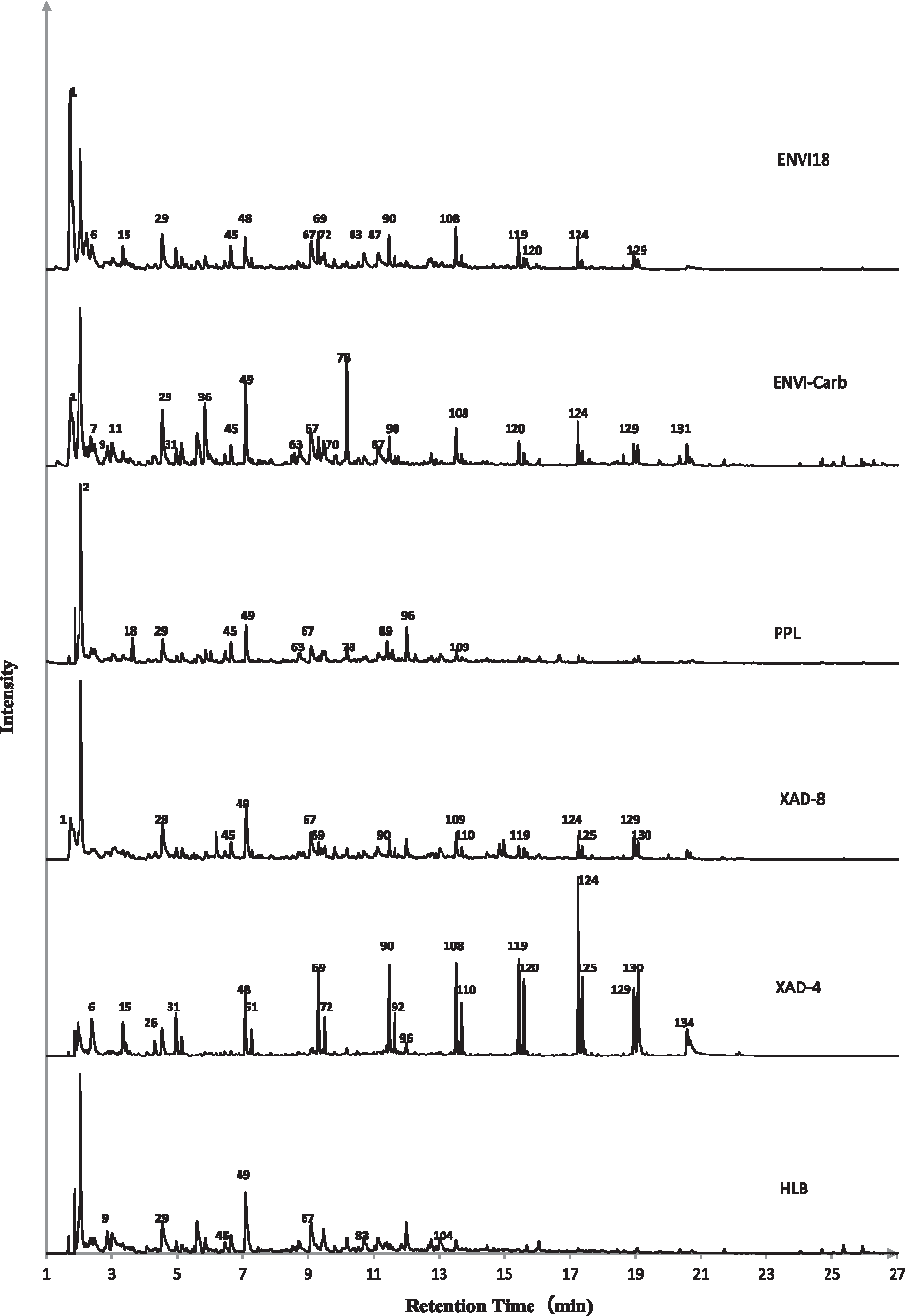
Total ion chromatograms of thermal degradation products obtained following pyrolysis of isolated DOM samples.
A, straight n-alkanes/n-alkenes; Ar, other aromatic components; Car, carbohydrate; Cont, contaminant; FA, fatty acids; N, nitrogen-containing compounds; Nit nitriles; OA, other alkanes and alkenes; Par, polyaromatic components; Ph, phenols; RT, retention times; S, sulfur-containing compounds.
Group as the origin in Table 3.
Among the straight-chain n-alkanes/n-alkenes group, saturated alkyls and unsaturated olefins were detected in all samples. The C10–C17 compounds, to a considerable extent, were the dominant straight-chain n-alkanes and n-alkenes, which were usually presented as doublets. The n-alkenes probably were produced in the pyrolysis step of long-chain n-alkanes because they usually do not exist in crude oils (Mccormack et al., 2001; Barrow et al., 2010; Orem et al., 2014). As shown in Table 4, the XAD-4 sample was strongly dominated by straight-chain n-alkanes/n-alkenes, while the PPL isolate had the lowest relative content compared to the other samples, consistent with the FTIR results. By combining the strong adsorption of carboxyl groups in the XAD-4 samples from FTIR, the exceptionally high relative abundance of aliphatic hydrocarbons may relate to high amounts of organic acids in the XAD-4 sample. After decarboxylation under pyrolysis, organic acids may be detected as aliphatic components (Lehtonen et al., 2000). Moreover, due to the highly hydrophobic structure of alkyl groups covalently bonding to silica, the ENVI-18 isolate also contained high aliphatic content, which is in agreement with the FTIR results. A similar result has also been observed in other studies (Perminova et al., 2014; Li and Minor, 2015).
Other alkanes and alkenes were also identified in our study, including diene, cyclic, and alcohol compounds. The relative abundance of this group ranges from 2.74% to 7.44%. The HLB sample had the highest content of other alkanes and alkenes, while the PPL sample had the lowest.
Carbohydrates identified by Py-GC/MS were principally furan, furan derivatives, aldehydes, and ketones. The highest relative abundance of carbohydrates was found in the PPL and HLB samples, which may suggest that modified porous polymer sorbents can effectively retain oxygen-containing functional groups due to their large specific surface areas and modification with special polar functional groups (Dias and Poole, 2002; Poole, 2003; Fontanals et al., 2005). The ENVI-Carb sample also contained a relatively higher abundance of carbohydrates.
Aromatic compounds were major contributors to the pyrolysis products, accounting for 11.29–47.94% of the total quantified peak area, potentially indicating that aromatic units were the building blocks of the studied DOM structures. The aromatic pyrolysis products can be subdivided into three groups: phenols, polyaromatic components, and other aromatic components. The relative abundance of phenols accounted for 1.93% to 15.76%, with the highest abundance in the ENVI-18 sample and the lowest in the XAD-4 isolate. Polyaromatic components were also detected in all samples; however, only naphthalene and alkyl naphthalene were identified and their contribution was minor (0.3–1.79%). The other aromatic components were mainly benzene, toluene, C1–C4 alkyl benzenes, and indene and its derivatives. The relative abundance of these compounds ranged from 9.07% to 36.74% for the studied samples. Polymer sorbents (HLB, PPL, and XAD-8) were more effective at retaining aromatic compounds than ENVI-18 and ENVI-Carb, which may be related to their polymer skeletons interacting with groups by the π-π sites of the aromatic rings (Fontanals et al., 2005).
Major nitrogen-containing compounds in these samples were N heterocyclic components and minor nitriles. Primarily, the N heterocyclic compounds included pyrrole and imidazole and their derivatives. The nitriles were mainly benzonitrile and benzyl nitrile. The relative abundance of these products was the lowest in the ENVI-18 sample (2.09%) and the highest in the ENVI-Carb sample (9.17%), which conformed to the results of FTIR. This phenomenon may be explained by the fact that ENVI-Carb is a microporous sorbent with polar functional groups bonded in the surface, and this structure can strongly interact with N-containing compounds (Di Corcia and Marchetti, 1991; Hennion, 2000).
Sulfur-containing compounds were also identified in the pyrolysis products, including thiophene and benzothiazole. Sulfur-containing compounds have been widely observed in DOM from oilfield-produced water (Witter and Jones, 1999; Mccormack et al., 2001) and may indicate the existence of heterocyclic polysulfides or sulfate covalently bound to DOM. In this study, sulfur-containing compounds were highest in the XAD-8 isolate but absent from the ENVI-18 sample. Moreover, the PPL sample also contained a large fraction of sulfur-containing compounds. The relatively higher content of sulfur-containing compounds in the XAD-8 and the PPL samples may be due to the reversed-phase mechanism and π-π interactions between the aromatic ring structures in the sorbent and sulfur-containing compounds (Rodriguez et al., 2000).
Organic acids are commonly found in oilfield-produced water, which may arise from the incomplete oxidation of hydrocarbons (Witter and Jones, 1999). For the DOM investigated here, this did not appear to be the case and only 2-butenoic acid was detected in our study. As noted previously, the incompatibility of free organic acids with the polar GC column and thermal reactions, such as decarboxylation, could limit the detection of organic acids (Lehtonen et al., 2000; Buurman et al., 2009; Zhang et al., 2016).
Overall, XAD-8 and XAD-4 in tandem presented the highest recovery of brine DOC, which is ascribed to the extraction of both hydrophobic and hydrophilic organic materials (Aiken et al., 1992). The relative abundance of the major pyrolysis products in the XAD-8 sample were higher than that in the XAD-4 sample, possibly due to the relatively low levels of hydrophilic components in our samples.
Apart from the above-mentioned differences, the ENVI-18 and XAD-4 samples were dominated by aliphatic compounds but were relatively depleted in nitrogen-containing compounds; XAD-8, PPL, and HLB preferentially isolated aromatic components and HLB and PPL also preferentially retained carbohydrate compounds. The ENVI-Carb and HLB samples presented higher yields of nitrogen components, and the XAD-8 and PPL isolates were characterized by a relatively higher content of sulfur-containing components.
Comparison with LLE method
The LLE method has been used to isolate DOM from oilfield-produced brine in our previous study (Yang et al., 2015). Compared with the SPE method, the LLE method had lower extraction efficiencies for DOC (<5%) and isolated less representative organic fractions than the SPE method, possibly because the most common extraction solvents used in the LLE method are low-polar compounds without any pronounced functional groups in their molecules and noncovalent interactions, such as hydrogen bonds or ionic interactions between extraction solvents and extracts, cannot be formed. Therefore, the fractions isolated by the LLE method were less than those isolated by SPE sorbents, since the only available interactions in the extraction solvents and extracts are the hydrophilic-hydrophobic interaction or π-π interaction, which are weaker than the electrostatic forces (Song et al., 2012). Moreover, there are many steric cavities within the SPE sorbents that improve the effective adsorption for the organic fractions (Dittmar et al., 2008; Wang et al., 2012). In addition, polar DOM were the most abundant DOM fractions in aquatic systems (Leentheer et al., 2004) and so the nonpolar or low-polar extraction solvents perform poorly in isolating these polar DOM fractions from aquatic systems (Mccormack et al., 2001; Holowenko et al., 2002).
In general, the chromatograms of the fractions isolated by the SPE method were more complex than those of fractions isolated by the LLE method (Wang et al., 2012; Yang et al., 2015), indicating that the organic fractions isolated by the LLE method were significantly less than those isolated by the SPE method. Mass spectrometry suggested that aliphatic hydrocarbons, carbohydrates, polycyclic aromatic hydrocarbons (PAHs), N-containing, and S-containing compounds were significantly lower in the LLE isolates (Yang et al., 2015). However, the large quantities of volatile organic compounds (e.g., low molecular alcohols, benzene, toluene, ethylbenzene, and volatile fatty acids) were present in LLE isolates, which are like those found in other studies (Mccormack et al., 2001; Holowenko et al., 2002; Orem et al., 2007; Barrow et al., 2010). This phenomenon can be explained, as those compounds can effectively be “washed out” from the DOM in the process of using the SPE method (Dittmar et al., 2008; Wang et al., 2012).
Although the relatively lower DOC recoveries from the SPE method hampered our efforts to comprehensively understand the composition and structural features of DOM in oilfield-produced brine, some new findings were observed for the SPE DOM isolates, including higher content of aliphatic hydrocarbons, carbohydrates, PAHs, N-containing, and S-containing compounds in comparison with the LLE method. Further work will be needed to develop a practical, effective, and comprehensive SPE method for optimal and representative DOC recoveries.
Comparison with other oilfield-produced water DOM
There have been some reports of DOM in oilfield-produced water. However, most water was characterized by higher DOC concentrations, lower salinity, higher fatty acid content, sulfur-containing compounds, and PAHs in the DOM samples in comparison with our studied sample (Strømgren et al., 1995; Lu et al., 2006; Orem et al., 2007, 2014; Wang et al., 2012), which may be attributed to differences in the salinity, type of hydrocarbon products being produced, lifetime of its reservoirs, and different extraction procedures for DOM (Ahmadun et al., 2009).
The salinity of the produced brine in this study is much higher than most produced water in other regions (Dórea et al., 2007; Cakmakci et al., 2008; Wang et al., 2012), which may explain the lower DOC extraction efficiencies and the differences of DOM composition compared to other research. Moreover, different types of kerogen can also influence the chemical composition of DOM; for example, water produced from gas wells usually contain higher contents of low molecular-weight aromatic hydrocarbons, such as BTEX, than those from oil wells (Veil et al., 2004; Ahmadun et al., 2009). The contents of BTEX were lower in our study, which may be related to the extraction method of DOM from the produced brine. Most of the extraction methods reported in the literature involved LLE using dichloromethane as the extractive solvent. This method may have higher extraction efficiency for the volatiles and semi-volatile organics (Røe Utvik, 1999; Mccormack et al., 2001; Holowenko et al., 2002; Sirivedhin and Dallbauman, 2004; Dórea et al., 2007; Orem et al., 2007, 2014), which is in good agreement with our previous study. The processes for sample preparation in our study, such as desalination and freeze-drying, may lead to the partial loss of volatiles and semi-volatile organic components (Strømgren et al., 1995; Dittmar et al., 2008; Wang et al., 2012). Nevertheless, carbohydrates presented higher yields in our study than most of the reported LLE samples (Mccormack et al., 2001; Sirivedhin and Dallbauman, 2004; Dórea et al., 2007). In addition aliphatic hydrocarbons, as well as aromatic components, were the most common compounds; however, for the DOM isolated from some shallow wells, sulfur-containing compounds were commonly reported (Witter and Jones, 1999; Orem et al., 2007, 2014). In some areas, the content of organic sulfur was up to 65% of the total DOM (Wang et al., 2012). In addition, PAHs are also commonly reported in the literature (Røe Utvik, 1999; Dórea et al., 2007; Orem et al., 2007, 2014). The depletion of sulfur-containing compounds and PAHs in our studied sample may be due to subjecting the produced brine to various processes (Li et al., 2012), such as sedimentation, chemical oxidation, and biodegradation, and may have led to changes in the content of those compounds (Røe Utvik et al., 1999). In addition, the particular formation that the well is drilled into and the chemicals used during the extraction of the fuels could also cause those differences, which will be considered in further work.
Conclusions
Five SPE sorbents, ENVI-18, ENVI-Carb, PPL, XAD resins, and HLB, were used to isolate DOM from oilfield-produced brine. Several analytical methods, including DOC analysis, FTIR, and Py-GC/MS, were employed to characterize the DOM isolates. The following conclusions can be drawn:
(1) For the studied oilfield-produced brine DOM, the dominant organic compounds were aliphatic hydrocarbons and aromatic compounds; nitrogen-containing compounds and carbohydrates were also observed. The studied DOM sample was relatively depleted in PAHs, fatty acids, and sulfur-containing compounds when compared to DOM in other reported oilfield-produced water, possibly be due to the differences in salinity, type of hydrocarbon products produced, lifetime of its reservoirs, and extraction procedures for DOM in our sample. (2) The extraction efficiencies of DOM from the oilfield-produced brine were higher under acidic conditions. The DOM recoveries were the highest in XAD-8/4 tandem, followed by HLB, PPL, and ENVI-18, and the lowest recovery in ENVI-Carb. Different properties were observed for the DOM isolated by different sorbents. The ENVI-18 and XAD-4 samples contained relatively higher levels of aliphatic compounds, while the XAD-8, HLB, and PPL samples contained relatively higher abundances of aromatic compound, and HLB and PPL preferentially retained carbohydrate compounds. In addition, the ENVI-Carb and HLB isolates were characterized by higher concentrations of nitrogen-containing compounds than other sorbents, while the XAD-8 and PPL samples contained more sulfur-containing compounds relative to the other SPEs. These extend our knowledge of the composition and structural features of DOM isolated from oilfield-produced brine.
Footnotes
Acknowledgments
This study was supported by the National Natural Science Foundation of China (41403108, U1607103), the West Light Foundation of the Chinese Academy of Sciences (Y412011004), and the Natural Science Foundation of Qinghai Province (2014-ZJ-937Q).
Author Disclosure Statement
No competing financial interests exist.