




Abstract
Abstract
A new class of water treatment processes called advanced reduction processes (ARPs) combine activation methods, such as ultraviolet (UV) irradiation, with reducing reagents to produce highly reactive reductants. This article reports on the application of ARPs to immobilize arsenic and selenium. Batch screening experiments were conducted under anaerobic conditions to evaluate the effectiveness of different ARPs in removing arsenic and selenium and to identify the most promising ARP for this purpose. The combination of sulfite with UV irradiation was not able to effectively remove arsenic and selenium. Although the ferrous iron/UV ARP was able to continuously remove all target compounds, the dithionite/UV ARP was observed to be the most promising method for removal of arsenic and selenium. However, resolubilization of both target compounds was observed with the dithionite/UV ARP. The dithionite/UV ARP rapidly removed soluble arsenic and selenium by reducing them to solid phases (As4S4, elemental Se). This was followed by resolubilization that was probably caused by oxidation of the solids by sulfite radicals or by reaction of sulfite with elemental selenium to form soluble species.
Introduction
C
Common current treatment technologies for arsenic and selenium in water include ion exchange (Nishimura et al., 2007; An et al., 2011; Chiavola et al., 2012), adsorption (Kartinen and Martin, 1995; Su et al., 2008; Wasewar et al., 2009), coagulation-precipitation (Kapoor et al., 1995; Kartinen and Martin, 1995), and membrane processes (Kapoor et al., 1995; Kartinen and Martin, 1995). Among them, ion exchange has been identified as one of the best available technologies for arsenic removal from drinking water (Wang et al., 2000; An et al., 2011). However, the presence of competing anions, such as sulfate and nitrates, which are common in wastewater, is a limitation of applying ion exchange for arsenic and selenium removal (Kartinen and Martin, 1995; Nishimura et al., 2007; Chiavola et al., 2012). The conventional anion exchange resin has a stronger affinity to sulfate than to arsenic (Chiavola et al., 2012). In general, the coagulation-precipitation process appears to be effective only for low concentrations of arsenic in contaminated water (Kartinen and Martin, 1995). Membrane processes are capable of removing more contaminants from water than coagulation-precipitation, but their high operation costs are important disadvantages (Kapoor et al., 1995; Kartinen and Martin, 1995).
In this study, we applied a treatment technology that is part of a group called advanced reduction processes (ARPs), which are similar to advanced oxidation processes (AOPs), in that they combine reagents with activating methods (e.g., ultraviolet [UV] light, ultrasound, and electron beam) to produce highly reactive redox agents. However, ARPs use reducing reagents (e.g., dithionite, sulfite, and ferrous ion) to produce highly reactive reductants, rather than oxidants. Successful and effective removal of inorganics [including perchlorate (Vellanki and Batchelor, 2013; Vellanki et al., 2013; Duan and Batchelor, 2014), nitrate (Vellanki et al., 2013), and bromate (Botlaguduru et al., 2015)] and organics [including vinyl chloride (Liu et al., 2013a, 2013b), and 1,2-dichloroethane (Liu et al., 2014; Yoon et al., 2014)] with different types of ARPs have been reported. Here, UV irradiation at a wavelength of 253.7 nm was used as the activation method, which is already widely used in AOPs (Li et al., 2010; Vilhunen et al., 2010). Three reagents [ferrous iron (Fe2+), dithionite (S2O42−), and sulfite (SO32−)] were used to reduce As(III), As(V), Se(IV), and Se(VI) and remove them from water. UV irradiation of ferrous iron would promote formation of ferric iron and aqueous electron (eaq−), as shown in Equation (1) (Airey and Dainton, 1966; Vellanki et al., 2013; Liu et al., 2014). Dithionite is known to have weak S-S bond that can be broken to form two sulfur dioxide radical anions, as shown in Equation (2) (Makarov, 2001; Liu et al., 2013b; Vellanki et al., 2013; Yoon et al., 2014). Sulfite under UV irradiation could form sulfite radical anion and aqueous electron, as shown in Equation (3) (Neta and Huie, 1985; Liu et al., 2013a, 2013b; Vellanki and Batchelor, 2013; Vellanki et al., 2013; Duan and Batchelor, 2014; Yoon et al., 2014; Botlaguduru et al., 2015). Control experiments with reagents without UV and with UV without reagents were studied to compare with the results with ARPs. Possible reaction mechanisms were also discussed. The purpose of this study was to evaluate the effectiveness of using ARPs for arsenic and selenium removal from water and to identify the most promising ARP for removal of arsenic and selenium.
Materials and Methods
Reagents
All reagents were used as received. Arsenic(III) standard solution [1,000 ± 2 mg/L arsenic trioxide (As2O3) in 2% w/w HNO3], arsenic(V) standard solution [999 ± 3 mg/L arsenic pentoxide (As2O5) in water], sodium sulfite (Na2SO3, ≥98%), and sodium selenite (Na2SeO3, ≥98%) were purchased from Sigma-Aldrich (St. Louis, MO). Ferrous chloride (FeCl2, 4-hydrate, crystal) and sodium dithionite (Na2S2O4, powder, 88%) was purchased from Avantor Performance Materials (Center Valley, PA). Arsenic(III) oxide (As2O3, 99.5%, metal basis), sodium hydrogen arsenate heptahydrate (Na2HAsO4, 98–102%), sodium selenate (Na2SeO4, anhydrous, 99.8%, metal basis), potassium hydrogen phosphate (K2HPO4, anhydrous, 98%), and potassium dihydrogen phosphate (KH2PO4, 99%) were purchased from Alfa Aesar (Ward Hill, MA).
Anaerobic condition
All irradiation experiments and related work were conducted in an anaerobic chamber (Coy Laboratory Products, Inc., Grass Lake, MI) that was filled with a gas mixture (95% nitrogen and 5% hydrogen, PRAXAIR Distribution, Inc., Byran, TX). It was equipped with an analyzer for oxygen and hydrogen, fan box, and a palladium catalyst STAK-PAK (Coy Laboratory Products, Inc., Grass Lake, MI) that scavenges oxygen. The anaerobic chamber was vacuumed and refilled with gas mixture and ultra-high purity nitrogen as required to keep the anaerobic conditions. The deionized water (Milli-Q, Millipore) used in all experiment was deoxygenated by sparging with UHP nitrogen for 2 h outside the chamber and then for 24 h inside the chamber.
Experimental procedure
All UV irradiation experiments were carried out in 17-mL, cylindrical, UV-transparent quartz reactors (Starna Cells, Inc., Atascadero, CA). The UV light source was produced by a Phillips TUV PL-L36 V/4P lamp that emitted shortwave UV radiation with a peak at 253.7 nm. The light intensity at the top of the reactor was measured with a UV digital light meter (General Tools, Model No. UV 512C, New York City, NY), which was calibrated by modified ferrioxalate actinometry (Murov et al., 1993).
Batch screening experiments were conducted with each of three different reductive reagents (sodium sulfite, sodium dithionite, and ferrous chloride) at pH 7 and the extent of removal of target compounds [As(III), As(V), Se(IV), and Se(VI)] was measured. The initial concentrations of target compounds, reactive reagents, and phosphate buffer were 5, 500, and 10 mmol/L, respectively, for all experiments. The UV light intensity incident to the reactors was 6,000 μW/cm2 for all experiments. First, three sets of control experiments were conducted at pH 7. Blank control experiments were conducted without reductive reagents and without UV light. Reagent control experiments were conducted in the dark with one of the reductive reagents, but without UV irradiation. Irradiation control experiments were conducted with UV irradiation in the absence of reductive reagents. Then, in ARP experiments, selected reductive reagents were added into arsenic or selenium solutions and buffered at pH 7 for UV irradiation. In total, four samples were taken at sampling times of 0, 3, 30, 300 min for analysis of soluble arsenic or selenium for each experiment, except blank control experiments, where two samples were taken at sampling times of 0 and 300 min.
Additional batch screening experiments were conducted to determine the mechanism of the precipitation/resolubilization processes found with the dithionite/UV ARP. They were conducted with a higher initial As(III) concentration of 0.1 mmol/L and a higher sodium dithionite concentration of 5 mmol/L, to produce more solids. The initial concentration of phosphate buffer was 10 mmol/L and the intensity of UV light was 6,000 μW/cm2. A total of five samples were taken at a reaction time of 100 min and the samples were all filtered with one 0.2-μm filter inside the anaerobic chamber. The filter paper including the solids was separated from the filter-holder and dried inside the chamber before X-ray Photoelectron Spectroscopy (XPS) analysis.
Analytical methods and spectroscopic characterization
An inductively coupled plasma mass spectrometer was used for analysis of soluble arsenic or selenium (NexION 300D; PerkinElmer, Waltham, MA). Before analysis, the samples were passed through a 0.2-μm cellulose nitrate membrane filter (25 mm-diameter; Whatman, Piscataway, NJ) and then were diluted in 1% v/v HNO3.
An Omicron NanoTechnology XPS (Germany) with Mg-Kα source was used to analyze chemical composition on the surface of particles removed by filtration. The survey scans were recorded with pass energy of 100 eV and the narrow scans used lower pass energy (20 eV or 50 eV) for higher resolution. The spectra peak of C 1 s with a binding energy of 284.5 ± 0.1 eV was used as a reference to correct expected charging effects. The narrow scan spectra of Fe 2p, S 2p, and O 1 s were fitted with XPSPEAK41 fitting program with a Gaussian-Lorentzian peak function through background-subtraction corrections using a Shirley or linear type optimization.
Results and Discussion
Arsenic removal
Control experiments for As(III) and As(V) removal
The results of all three control experiments (blank control, reagent control, and irradiation control) (Supplementary Figs. S1–S6) showed that As(III) and As(V) were not removed in the absence of reagents and an activation method (blank control), were not removed or were only slightly removed in the presence of the reagent when no activation method was applied (reagent control) and were not removed when irradiated without the presence of reagent (irradiation control).
ARP experiments for As(III) and As(V) removal
Different types of reductive reagents have great influences on arsenic (III and V) removal with ARP. Results of ARP screening experiments with As(III) are shown in Fig. 1. At a UV light intensity of 6,000 μW/cm2 and initial As(III) concentration of 5 μmol/L, the combination of sulfite and UV has almost no ability to remove As(III). The ARP that combines ferrous chloride and UV irradiation was able to continuously remove As(III) over the time period of the experiments (300 min) with a maximum removal of about 65%. Hydrated electrons, which were formed by photolysis of ferrous iron [Eq. (1)], were the reactive intermediates that could cause arsenic removal. Dithionite combined with activation by UV was able to remove As(III) very rapidly, with substantial removal (about 80%) occurring in the first 3 min. The As(III) removal capabilities with UV/Fe2+ or UV/dithionite are much higher than conventional precipitation process and reverse osmosis. Kartinen and Martin found that only 10% arsenic was removed from a water containing 4 μmol/L of arsenic using 30 mg/L of alum, while a higher percentage of 50% was found with 30 mg/L Fe2(SO4)3 (Kartinen and Martin, 1995). Arsenic removal was only 58% with reverse osmosis when initial arsenic concentration was 4 μmol/L (Schneiter and Middlebrooks, 1983). However, resolubilization occurred at later sampling times. One hypothesis for this behavior is that the ARP with dithionite is reducing As(III) to a solid form (elemental or arsenic sulfide) rapidly that is solubilized by further reduction to arsine [As(-III)] or by other reactions such as reoxidation.
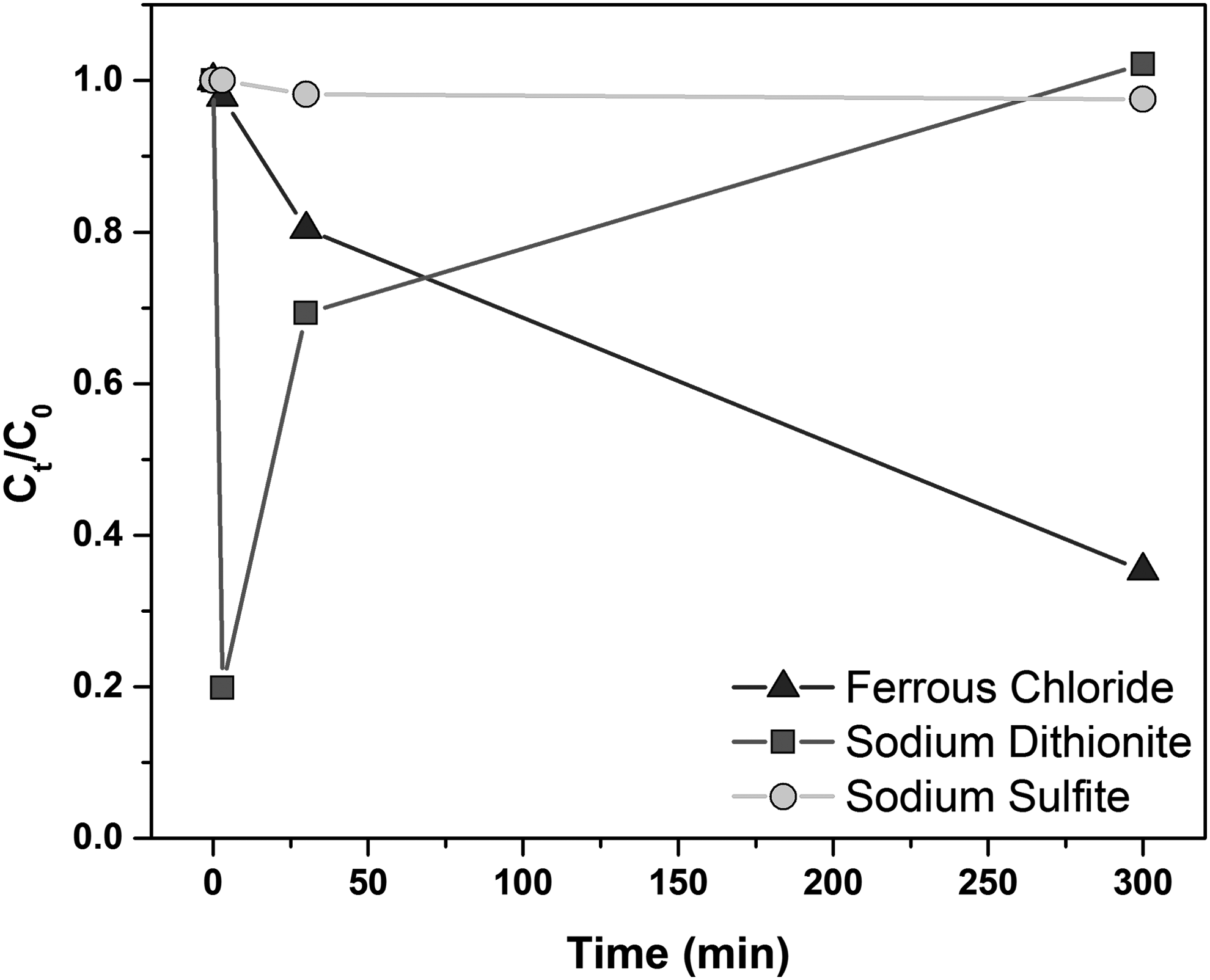
Arsenic(III) degradation under UV irradiation with different reductive reagents at pH 7. Initial arsenic(III) concentration = 5 μmol/L, initial reactive reagent concentration = 500 μmol/L, UV light intensity = 6,000 μW/cm2. UV, ultraviolet.
The results of the screening experiments conducted with As(V) are shown in Fig. 2. Similar results were obtained as found for As(III). Sulfite/UV was not effective for As(V) removal and ferrous chloride/UV was able to continuously remove As(V) over the time period of the experiment with a maximum of 68% As(V) removal. The combination of dithionite and UV irradiation showed the ability to remove as much as 52% of As(V) over the first 30 min, but higher soluble As was measured at the end of the experiment (300 min). The kinetics for As(V) removal was much slower than that observed for As(III) removal, which should be expected because As(V) requires more electrons to be reduced to elemental arsenic or arsenic sulfides. As hypothesized for As(III), the dithionite/UV ARP appears capable of reducing As(V) to elemental arsenic or arsenic sulfide, but may then be reduced further to arsine [As(-III)] or be reoxidized to soluble species.
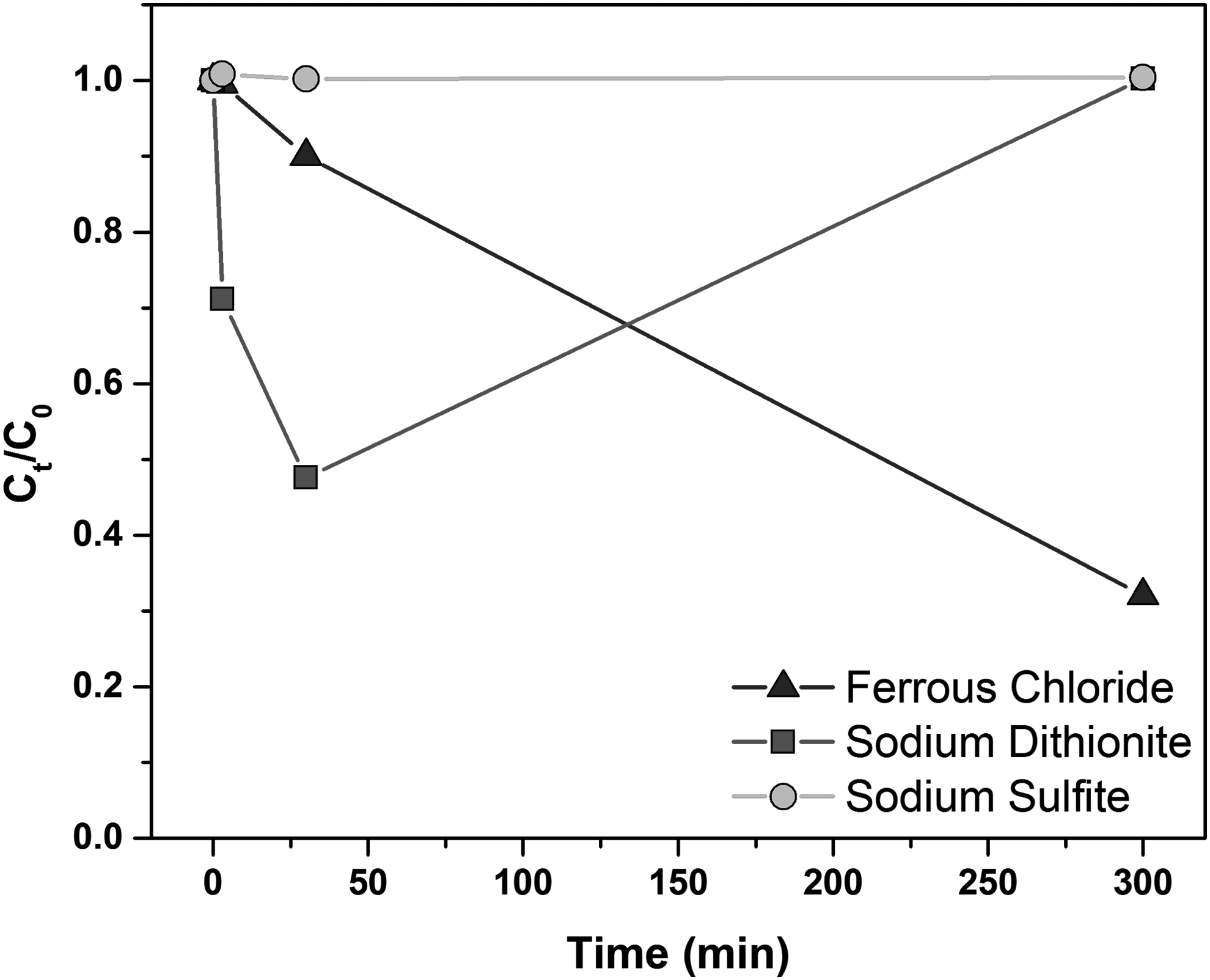
Arsenic(V) degradation under UV irradiation with different reductive reagents at pH 7. Initial arsenic(V) concentration = 5 μmol/L, initial reactive reagent concentration = 500 μmol/L, UV light intensity = 6,000 μW/cm2.
Precipitation/resolubilization mechanism
Yellowish solids were produced in reactors during the additional screening experiments conducted to evaluate precipitation/resolubilization. The XPS broad scan of the solids (Fig. 3) reveals characteristic peaks of oxygen, carbon, sulfur, silica, and arsenic. Carbon peaks were mainly from carbon tape and silica peaks may be due to the filter membrane or due to contamination from mounting or transferring samples.
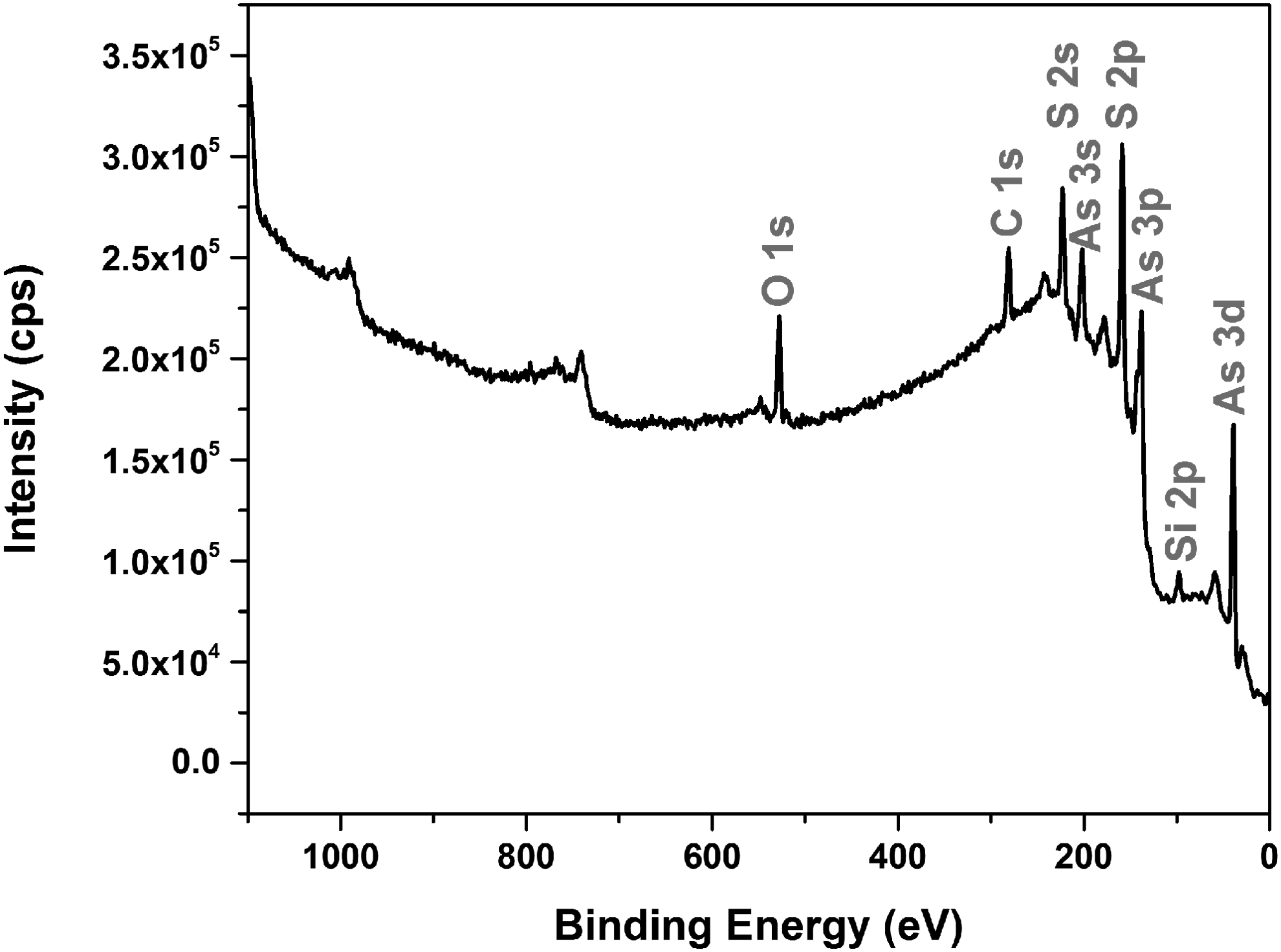
XPS broad scan for the solid phase from As(III)/dithionite/ARP experiments. Initial As(III) concentration = 0.1 mmol/L, initial sodium dithionite concentration = 5 mmol/L, UV light intensity = 6,000 μW/cm2. ARP, advanced reduction processe; XPS, X-ray photoelectron spectroscopy.
XPS high resolution As 3d and S 2p spectra of the sample are shown in Fig. 4a, b, respectively, and the surface compositions are shown in Table 1. The binding energy at 42.5 and 43.1 eV are two of the major peaks of the As 3d5/2 spectra (Fig. 4a), and are the characteristic peaks of As4S4 (Bahl et al., 1976; Soma et al., 1994; Naumkin et al., 2012; Bullen et al., 2003). The As 3d5/2 spectra also contains peaks at 43.6, 44.2, and 44.8 eV, which are interpreted to be arsenic oxides (Nesbitt et al., 1995; Naumkin et al., 2012; Han, 2009). The two major peaks of the S 2p spectra (Fig. 4b) are located at 163.0 and 164.1 eV, which are assigned to disulfide species or polysulfide (Han, 2009; Naumkin et al., 2012; Nesbitt et al., 1995). Furthermore, the atomic ratio of As that was calculated from the As 3d peak in the broad scan spectra was 31.8%, which is very close to the atomic ratio of S (39. 9%) that was calculated from the S 2p peak.
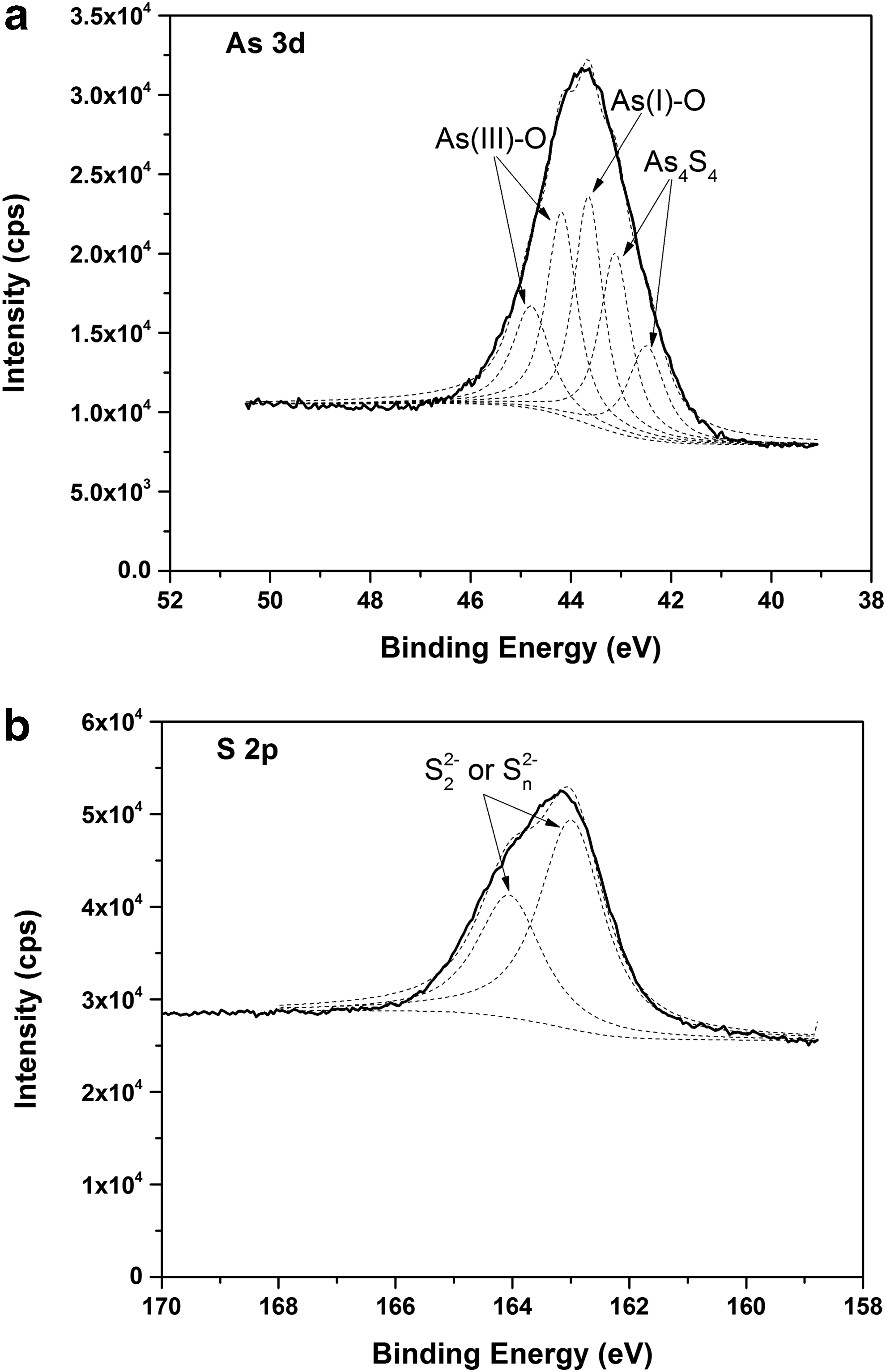
XPS spectra for the solid phase from As(III)/dithionite/ARP experiments.
FWHM is the full width at half maximum.
XPS, X-ray photoelectron spectroscopy.
On the basis of XPS data, it is proposed that removal of As from solution by the dithionite/UV ARP is caused by reduction of As and its precipitation as As4S4. Also, the fact that about 65% of arsenic was found as arsenic oxides (Table 1) could indicate that some As(III) or As(V) was sorbed onto the solid and could be resolubilized. Therefore, the observation of removal/resolubilization pattern from ARP experiments with dithionite could be explained by initial rapid reduction of As(III) and its removal from solution by formation of As4S4. Resolubilization could occur by release of sorbed As(III) or As(V), or by oxidation of reduced As.
Formation of oxidants could occur by interaction of UV irradiation and products of dithionite degradation. First, dithionite can undergo a disproportionation reaction that produces thiosulfate and hydrogen sulfite [Eq. (4)], expecially at low pH (Spencer, 1967; Burlamacchi et al., 1969; Danehy and Zubritsky, 1974). Also, sulfite/hydrogen sulfite can be formed when the sulfur dioxide radical produced by dithionite photolysis acts as a reductant and donates an electron [Eq. (5)]. Sulfite formed by both of these mechanisms could absorb UV light and photolyse to form sulfite radical anions [Eq. (6)] (Yoon et al., 2014), which can act as oxidants or reductants (Liu et al., 2013b). In this case, it is more likely that the sulfite radical anions are working as oxidants, since they did not effectively reduce arsenic in screening experiments (Figs. 1 and 2). Therefore, resolubilization of arsenic observed in Figs. 1 and 2 may be the result of oxidation of reduced arsenic by sulfite radical anions.
Selenium removal
Results of the screening experiments conducted with Se(IV) at pH 7 are shown in Fig. 5. UV irradiation alone was able to remove Se(IV) slowly. Since selenite is analogous to sulfite, it may also photolyze to give a selenite radical and an aqueous electron, in the same way that sulfite photolyzes [Eq. (3)] (Chawla et al., 1973; Liu et al., 2013b). Further reactions could remove selenium from the aqueous phase by converting it to a solid. Sulfite and ferrous iron by themselves were unable to remove Se(IV) (Fig. 5a, c). However, dithionite alone was observed to remove Se(IV) rapidly, with substantial removal observed at the first sampling time (3 min) (Fig. 5b), which is in agreement with previous study (Geoffroy and Demopoulos, 2009). Rapid removal was also observed when dithionite was combined with UV irradiation, but the soluble Se concentration increased at longer times. The combination of ferrous iron and UV-L (Fig. 5a) was able to remove Se(IV) continuously during the first 30 min, but resolubilization was observed at the last sampling time (300 min). Sulfite combined with UV-L (Fig. 5c) showed only 19% Se(IV) removal at 300 min. Removal could be due to reduction of Se(IV) by the aqueous electron produced by irradiation of sulfite [Eq. (3)], but limited by reaction of elemental selenium and sulfite to form selenosulfate, which is the selenium analog of thiosulfate (Velinsky and Cutter, 1990).

Selenium(IV) degradation with different reductive reagents at pH 7.
Results of screening experiments conducted with Se(VI) at pH 7 are shown in Fig. 6. As was observed with Se(IV), UV irradiation without any reagent appeared to be able to remove small amounts (3.1–7.6%) of Se(VI), but the removal rate for Se(VI) was much slower than that for Se(IV). Unlike Se(IV), none of the three reagents were effective in removing Se(VI) without UV irradiation, which may be due to more steps being required to reduce Se(VI) to Se(0) than Se(IV). Figure 6a indicates that the ferrous iron/UV ARP was able to remove Se(VI) over time and about 61% Se(VI) was removed at the end of experimental period. The combination of dithionite and UV light was able to remove Se(VI) rapidly, but resolubilization of selenium was observed as irradiation time increased to 300 min, as shown in Fig. 6b. The sulfite/UV ARP was much less effective in removing Se(IV), as shown in Fig. 6c, and only 17.4% of selenium was removed after 300 min.

Selenium(VI) degradation with different reductive reagents at pH 7.
A previous study of reactions of selenious acid with sodium dithionite at low pH revealed the rapid formation of red amorphous elemental selenium, as shown in Equation (7) (Geoffroy and Demopoulos, 2009). Formation of elemental selenium is the likely mechanism that results in removal of selenium from solution in our experiments (Eqs. (7), (8)]. However, the selenium product is not stable in the presence or absence of UV irradiation, although more resolubilization is observed with UV. This resolubilization could be due reaction of sulfite produced by dithionite decomposition reacting with elemental selenium to form an analog of thiosulfate. This reaction could occur with or without UV. In the presence of UV, the sulfite could photolyze to form sulfite radical, which would oxidize elemental selenium back to soluble forms and account for increased resolubilization in the presence of UV.
Conclusion
Generally, UV irradiation by itself was unable to remove target compounds, although small portions of Se(IV) and Se(VI) were removed with UV irradiation alone. Reductive reagents without activation were generally unable to remove target compounds, except dithionite was able to remove some Se(IV). In all ARP experiments, ferrous iron was able to continuously remove all target compounds, but resolubilization was observed with Se (IV). The dithionite/UV ARP was observed to be the most promising method for removal of arsenic and selenium due to its fast kinetics, but it carries the challenge of resolubilization. However, resolubilization might be solved by adding scavengers for sulfite radicals or by continuously adding dithionite. Precipitation/resolubilization observed with all dithionite ARP experiments is hypothesized to be due to an initial reduction of the target compounds to a solid phase (As4S4, elemental Se), followed by oxidation by sulfite radicals to form soluble species. Selenium resolubilization could also be due to reaction of sulfite with elemental selenium to form selenosulfate, an analog of thiosulfate.
Footnotes
Acknowledgments
This work was supported by the Qatar National Research Fund under its National Priorities Research Program award number NPRP 6-729-2-301. The statements made herein are solely the responsibility of the authors and do not necessarily represent the official views of the Qatar National Research Fund.
Author Disclosure Statement
No competing financial interests exist.
References
Supplementary Material
Please find the following supplemental material available below.
For Open Access articles published under a Creative Commons License, all supplemental material carries the same license as the article it is associated with.
For non-Open Access articles published, all supplemental material carries a non-exclusive license, and permission requests for re-use of supplemental material or any part of supplemental material shall be sent directly to the copyright owner as specified in the copyright notice associated with the article.
