




Abstract
Abstract
Low in stability, difficulty in reuse, and loss in activity are key challenges to the potential use of laccase in industrial applications. To date, enzyme immobilization has become one of the most popular methods to maintain the activity and enhance the stability and reusability of enzymes. Here we described the immobilization of laccase onto poly(diallyldimethylammonium chloride) (PDDA)-modified halloysite nanotubes (HNTs), a natural inorganic porous material, which is biologically safe and chemically stable, to improve the stability and recovery rate of laccase, and immobilized laccase was utilized to destroy priority pollutant 2,4-dichlorophenol (2,4-DCP). Transmission electron microscopy (TEM), thermogravimetrical analysis (TGA), atomic force microscope (AFM), Fourier transform infrared (FTIR), Brunauer-Emmett-Teller (BET), and fluorescence microscopy analysis show that PDDA has been successfully coated onto HNTs surface for improving laccase immobilization. Immobilized laccase exhibits enhanced pH and thermal stability compared with free laccase; and after 10th cycle of continuous reuse, the activity of immobilized laccase remains above 50%. Also, immobilized laccase was able to degrade 2,4-DCP (25 mg/L, 80%) with addition of mediator 2,2-azinobis(3-ethylbenzthiazoline-6-sulfonate) (ABTS). Results of this study demonstrate that, alongside the better stability and reusability, immobilized laccase onto PDDA modified halloysite can be used in removing chlorophenolic pollutants from aqueous sources and also have potential applications in other environmental domains.
Introduction
L
However, the industrial applications of free laccase are restricted by problems of high cost, loss in activity, low stability, sensitivity to environment (pH, temperature), and poor reusability (Sun et al., 2016; Xia et al., 2016). Enzyme immobilization technology has emerged as an effective and straightforward way to solve these problems and implement efficient and continuous application of enzymatic oxidation (Sheldon and van Pelt, 2013). The immobilization of enzymes onto water-insoluble supports can increase the operational stability of enzymes and make them reusable, resulting in a reduction in cost (Zheng et al., 2012).
Inorganic materials, such as clays, zeolites, silica matrix, titania, and alumina, have been extensively investigated to date because they have advantages of high stability, antiswelling ability, good mechanical and thermal stability, excellent biocompatibility, high resistance to microbial corrosion, and better reusability (Chao et al., 2013a; Jiao et al., 2014; Yang et al., 2014). However, previous reports suggested that the binding force between enzymes and supports was usually weak and thus had a disadvantage in that the absorbed enzyme might leach from its support on a change in the reaction environment, such as pH, ionic strength, or temperature. To achieve a high specific activity without compromising any other advantages of immobilization, it is urgent to find appropriate supports or functionalized supports to immobilized laccase through covalent binding, ionic and hydrophobic adsorption, aggregation, or entrapment (Huang et al., 2015).
Halloysite nanotubes [HNTs, Al2Si2O5(OH)4·2H2O], consisting of negatively charged Si-O group on the outer surface and positively charged Al-O group on the inner surface, can serve as excellent support materials for both positive and negative protein immobilization owing to their low cost, negligible toxicity, environmental friendliness, good thermal stability, large surface area, and especially opposite charges on inner and outer surface (Liu et al., 2012a; Chao et al., 2013b; Cavallaro et al., 2014a; Lvov et al., 2016). Generally speaking, positively charged molecule will go inside HNTs inner lumen and negatively charged molecule will tend to attach on their outer surface. However, in case of negatively charged laccase, the small inner diameter (15–20 nm) accompanied by the long tube length of HNTs is unfavorable for laccase transfer and delivery inside the lumen (Lvov et al., 2014, 2016), which greatly reduces laccase immobilization capacity. Besides, the zeta potential of HNTs is found to be 2.75 according to our previous work (Zhao et al., 2013), which means HNTs exhibit negative charge when pH is higher than 2.75, resulting in low adhesion interaction between HNTs and laccase and followed by laccase leaching from support surface.
To improve the chemical and mechanical stability, the modification of halloysite surface by using organic functional modifiers and stabilizers is mostly required (Kotal and Bhowmick, 2015). Poly(diallyldimethylammonium chloride) (PDDA), as an environmentally friendly polymer with positive charge, has been used widely in biocatalysts and chemo/biosensors (Bi et al., 2009). It can be readily coated on the supports, which can bring enough positive charge and sufficient binding sites to anchor enzymes via electrostatic self-assembly (covalent binding). Advantages of PDDA functionalization are that the connection between the enzyme and substrate is firm, giving good stability and reusability. To the best of our knowledge, little attention has been paid to the immobilization of laccase onto PDDA-modified HNTs.
We herein modified HNTs with PDDA to improve the electrostatic interaction between support and enzyme, followed by immobilization of laccase onto PDDA/HNTs and investigation of enzymology properties of the immobilized laccase. The schematic illustration of HNTs functionalization and laccase immobilization is shown in Fig. 1. The negative surface of HNTs provides strong adhesion for positive PDDA loading, while negatively charged laccase can be bonded onto both the inner surface and PDDA-modified outer surface of HNTs. As a consequence, the immobilization capacity of laccase will be improved remarkably. The immobilized laccase shows enhanced pH, thermal and storage stability compared with free laccase, and it is proved to be an effective catalyst with excellent recyclability for degradation of 2,4-dichlorophenol (2,4-DCP) wastewater with inclusion of redox mediator 2,2-azinobis(3-ethylbenzthiazoline-6-sulfonate) (ABTS), which has a function of improving electron transfer between HNTs and the active site of laccase (Johannes et al., 1996), and thus enhancing the removal efficiency of 2,4-DCP.

Schematic illustration of PDDA functionalization of HNTs and laccase immobilization. HNTs, halloysite nanotubes; PDDA, poly(diallyldimethylammonium chloride).
Materials and Methods
Materials
Halloysite was obtained from Xianghu Environmental Technology Co., Ltd. (Henan, China). It was milled and went through 300 mesh sieves to obtain fine powder. PDDA and ABTS were purchased from Sigma. Coomassie brilliant blue G-250 and bovine serum albumin were purchased from Solarbio Company (Beijing, China). Laccase (EC 1.10.3.2, 1.5 U/mg) from Aspergillus species was purchased from H.M.K. Company (Beijing, China). All the chemicals used in this study were of analytical reagent grade and were used without further purification. Deionized water was used throughout the experiments.
Characterization
Microstructures of nanotubes were observed using transmission electron microscopy (TEM, FEITECNAIG2). Thermogravimetrical analysis (TGA) was carried out using Q50 Thermal Analyzer (TA Instruments) at 20–700°C in N2 atmosphere. The Fourier transform infrared (FTIR) spectra of the samples were measured by an FTIR spectrometer (IR300; Nocolet) to determine the surface functional groups. Atomic force microscope (AFM; Dimension FastScan) was used to observe the surface of the samples by using a mica substrate. Brunauer-Emmett-Teller (BET) surface area and BJH pore size distributions of the samples were obtained by using the GEMINI VII2390 surface area and pore size analyzer. A Shimadzu ultraviolet (UV)-Vis spectrophotometer (UV-2450; Shimadzu) was used to analyze the concentration and activity of the enzyme.
Experimental
Preparation of PDDA/HNTs
The procedure for modification of HNTs with PDDA was as follows: HNTs (100 mg) powder was first sonicated in an aqueous of 10 mg/mL PDDA containing 0.5 M NaCl for 3 h. Then, the obtained suspensions were stirred overnight, separated by centrifugation, and washed with distilled water repeatedly until the excess PDDA and NaCl were removed. The final product, denoted as PDDA/HNTs, was dried at 60°C in vacuum for 24 h for further enzyme immobilization.
Enzyme immobilization
In a typical experiment, the immobilization of laccase was carried out by incubating 100 mg of PDDA/HNTs in the citric acid/Na2HPO4 buffer (100 mL, 0.1 M, pH 5) containing 4 mg/mL laccase at 4°C for 4 h, followed by washing three times with the citric acid/Na2HPO4 buffer to remove the free laccase. Then, the wet immobilized enzyme was collected and stored at 4°C for the subsequent enzyme assays.
Protein estimation and enzyme assay
Protein estimation of laccase solution was performed using Bradford (1976) method. The quantity of protein loading on the support was calculated by subtracting the protein recovered in the combined washing of the support—enzyme complex from the protein used for immobilization.
Standard laccase activity was determined by oxidation of ABTS at room temperature. The activity of free and immobilized laccase was determined at 30°C using ABTS as the substrate. The reaction mixture contained 1 mM ABTS, 100 mM citric acid/Na2HPO4 buffer (optimum pH for free and immobilized laccase), and a suitable amount of free and immobilized laccase. The amount of free and immobilized laccase was chosen to make the absorbance of the reaction product within the linear range of the UV-Vis spectrophotometer used in the experiment (UV-2450; Shimadzu). After time has expired, 1 mL of reaction solution (1 mL) was taken out and cooled in an ice bath for 3 min to stop the reaction (Tully et al., 2016), followed by centrifugation at 5,000 rpm for 5 min to remove the solid (Note: the centrifugation step can be ignored for free enzyme). Then, the absorbance changes of the supernatant (oxidation of ABTS) were measured by UV-Vis spectrophotometer at 420 nm (ɛ420 = 36,000/M/cm). One unit of laccase activity was defined as the amount of enzyme required to oxidize 1 μmol of ABTS per minute (Chao et al., 2013b). The relative enzymatic activity was related to a percentage of this highest activity (100% represents the highest enzymatic activity). The activity recovery was calculated from the value of the activity of the initial laccase solution divided by the activity value of immobilized laccase obtained immediately after the immobilization procedure.
Removal of 2,4-DCP
All degradation tests were performed by adding immobilized laccase in 100 mL 2,4-DCP solution with a known initial concentration (C0). Removal efficiency was measured by recording the concentration of 2,4-DCP (C) using spectrophotometer (UV-2450; Shimadzu) since the resulting degradation product quinone-type dye has a characteristic absorption peak at 510 nm and calculated with the following formula (Chao et al., 2013a):
where C0 and C are the initial and final 2,4-DCP concentrations (mg/mL) in the solution, respectively. All the measurements were repeated three times with errors <1%.
Results and Discussion
Characterization
TEM characterization
Figure 2 shows the TEM images of the pristine HNTs and PDDA/HNTs. It can be seen from Fig. 2a that HNTs possess natural open-ended tubular morphology with an average length of 800 nm. The inner diameter of 10–20 nm and outer diameter of 50–70 nm can be clearly observed; however, it becomes blurred in the inner lumen and outer surface after being modified with PDDA (Fig. 2b), indicating a layer of PDDA has been coated on the surface of HNTs. Besides, the outer diameter of PDDA/HNTs increases about 2–4 nm, further confirming the success of PDDA coating onto HNTs and the PDDA thickness is estimated to be 1–2 nm.

TEM micrographs of HNTs
Thermogravimetrical analysis
The mass fraction of the PDDA coated on the HNTs surface was further determined by TGA and the corresponding results are shown in Fig. 3. The decomposition of pristine HNTs agrees well with previous reports (Cavallaro et al., 2014b; Tully et al., 2016), which generally identifies two weight-loss regions below 700°C. The first region (100–400°C) is ascribed to free (absorbed) water residing between halloysite and interlayer water residing between the aluminosilicate layers. In the second region (400–520°C), the continuing fast weight loss is because of the dehydroxylation of the aluminosilicate lattice. As for PDDA/HNTs, their thermal decomposition is also divided into two regions. Briefly, evaporation of absorbed water and gaseous species occurs below 200°C, while the decomposition of PDDA and dehydroxylation of the aluminosilicate are between 200–500°C, which is a typical decomposition temperature range for the pyrolysis of quaternary ammonium (Xie et al., 2001; Joussein et al., 2005). The weight loss of the PDDA/HNTs (15.90%) in the measured temperature range is higher than that for the pristine HNTs (12.82%). The increased weight loss of 3.08% might be because of the decomposition of the functionalized PDDA, which also suggests that the estimated amount of PDDA loaded on HNTs is ca. 3.08%.
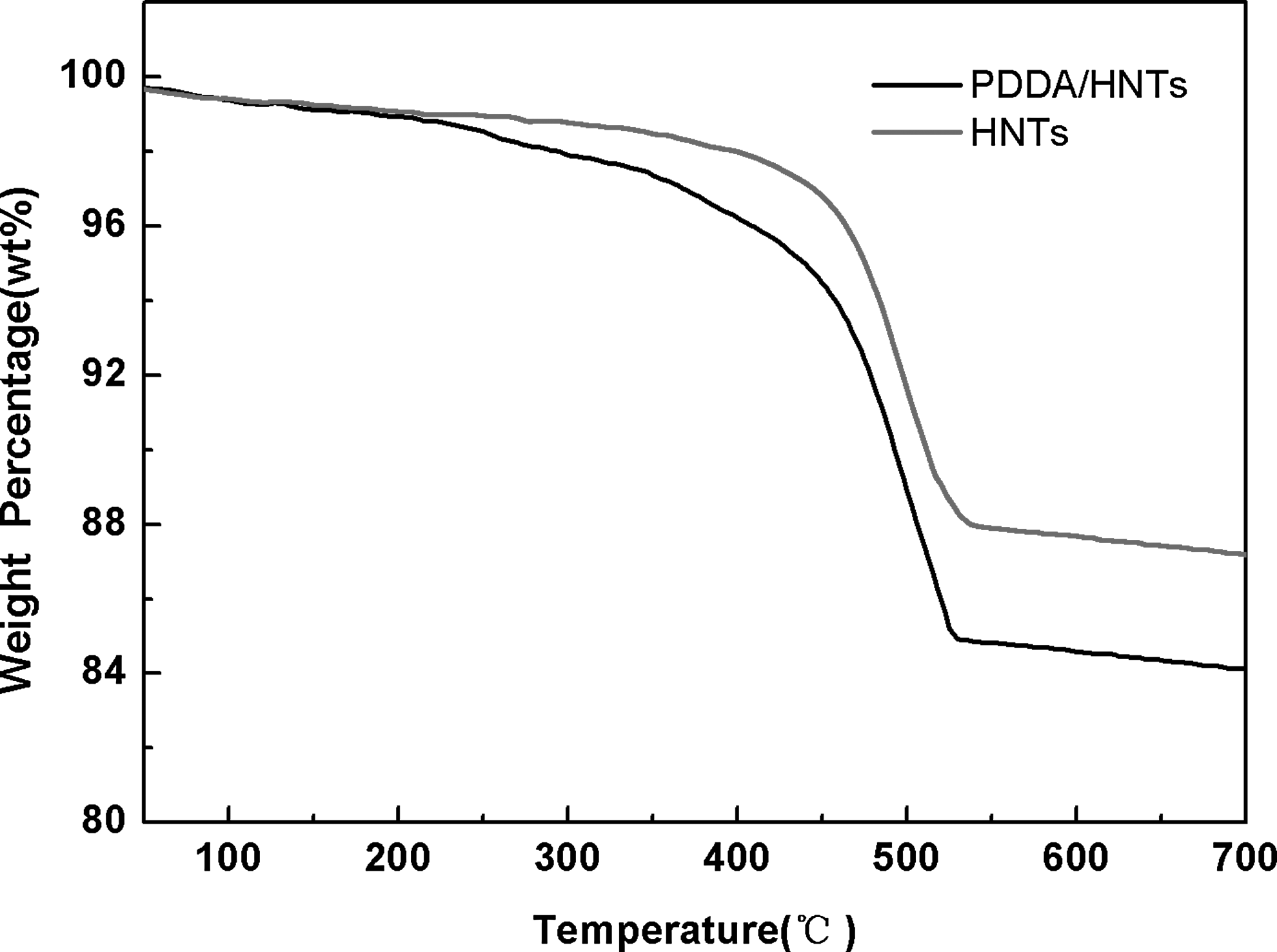
TGA curves of HNTs and PDDA/HNTs (heating rate 10°C/min). TGA, thermogravimetrical analysis.
AFM analysis
Surface topographies of HNTs and PDDA/HNTs were examined by AFM operating in the tapping mode in air, at room temperature. The roughness average (Ra) parameter is calculated for a scanned area of 0.5 × 0.4 μm using Nanoscope v6.11 software. The comparison of the surface morphology of HNTs and PDDA/HNTs is given in Fig. 4. It can be observed that PDDA/HNTs have a coarser texture than HNTs, which is in accordance with the result of TEM analysis. After modified by PDDA, the surface roughness of HNTs significantly increases from 2.62 to 3.99 nm. The highly roughened surface of PDDA/HNTs may provide a more favorable deposition environment for laccase immobilization.
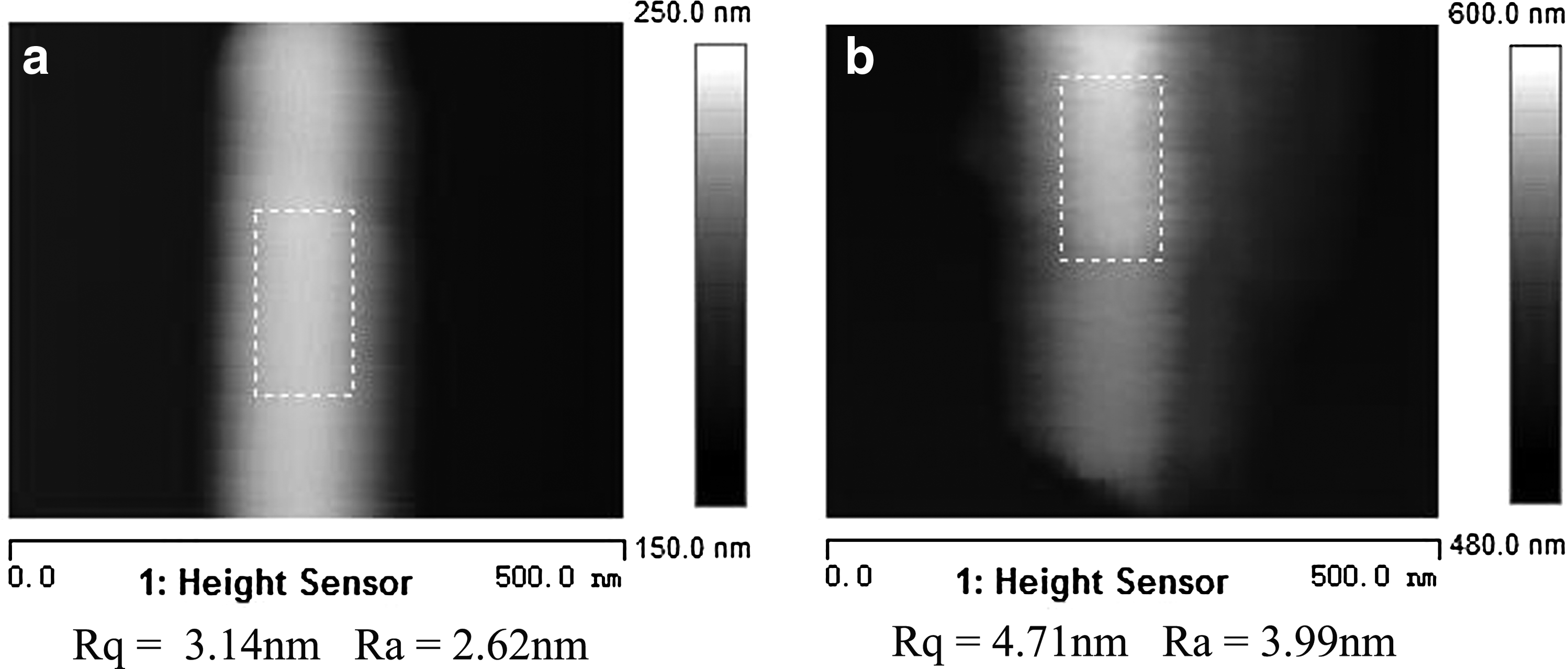
AFM images of HNTs
N2 adsorption/desorption analysis
To study the difference between HNTs and PDDA/HNTs in surface properties, nitrogen adsorption analysis was also conducted. In Fig. 5, the nitrogen adsorption–desorption isotherms of the samples before and after modification curves are both type IV with H3 hysteresis loops, which is in accordance with the category of cylindrical pore, meaning that the prepared PDDA/HNTs do not destroy the tubular morphology of HNTs. Calculating from the isotherms by using BET method, the specific surface area of HNTs and PDDA/HNTs decreases from 37.75 to 24.54 m2/g, further indicating that PDDA is successfully coated on the surface of HNTs. In the pore size distribution curves, PDDA/HNTs and HNTs exhibit similar distributions except for difference intensity, which also accords with the outer surface of thin PDDA layer.

Pore size distributions
FTIR analysis
FTIR spectra of HNTs, PAAD/HNTs, and laccase/PDDA/HNTs are presented in Fig. 6. For HNTs, the peaks at 3,696, 3,621, 3,484 cm−1 are ascribed to the stretching vibrations of hydroxyl groups. The band at 1,629 cm−1 is attributed to the deformation vibration of the interlayer water. The other peaks observed at 1,100–500 cm−1 are caused by the vibrations of Al-O-Si, Si-O, and Al-O. However, after being modified with PDDA, the intensities of all the characteristic peaks of HNTs decrease, and a new peak appears at 1,637 cm−1, which is associated with C═C stretching vibration. Similar phenomena can also be observed in PDDA functionalized carbon nanotubes (Wang et al., 2011). All the results indicate that PDDA has been successfully modified on the HNTs surface. They also need to point out that no obvious band for C-N vibration appears in PDDA/HNTs. The reason may be because the amount of PDDA on HNTs is not high (3.08%), and the peak at 3,696 cm−1 for HNTs is very broad and strong and C-N peak overlaps with it at ca. 3,432 ± 10 cm−1. After immobilization of laccase onto PDDA/HNTs, the mainly characteristic peaks of laccase at 2,931 and 1,421 cm−1 corresponding to COOH- symmetrical deformation vibration can be observed, demonstrating that laccase has been successfully immobilized onto PDDA/HNTs.
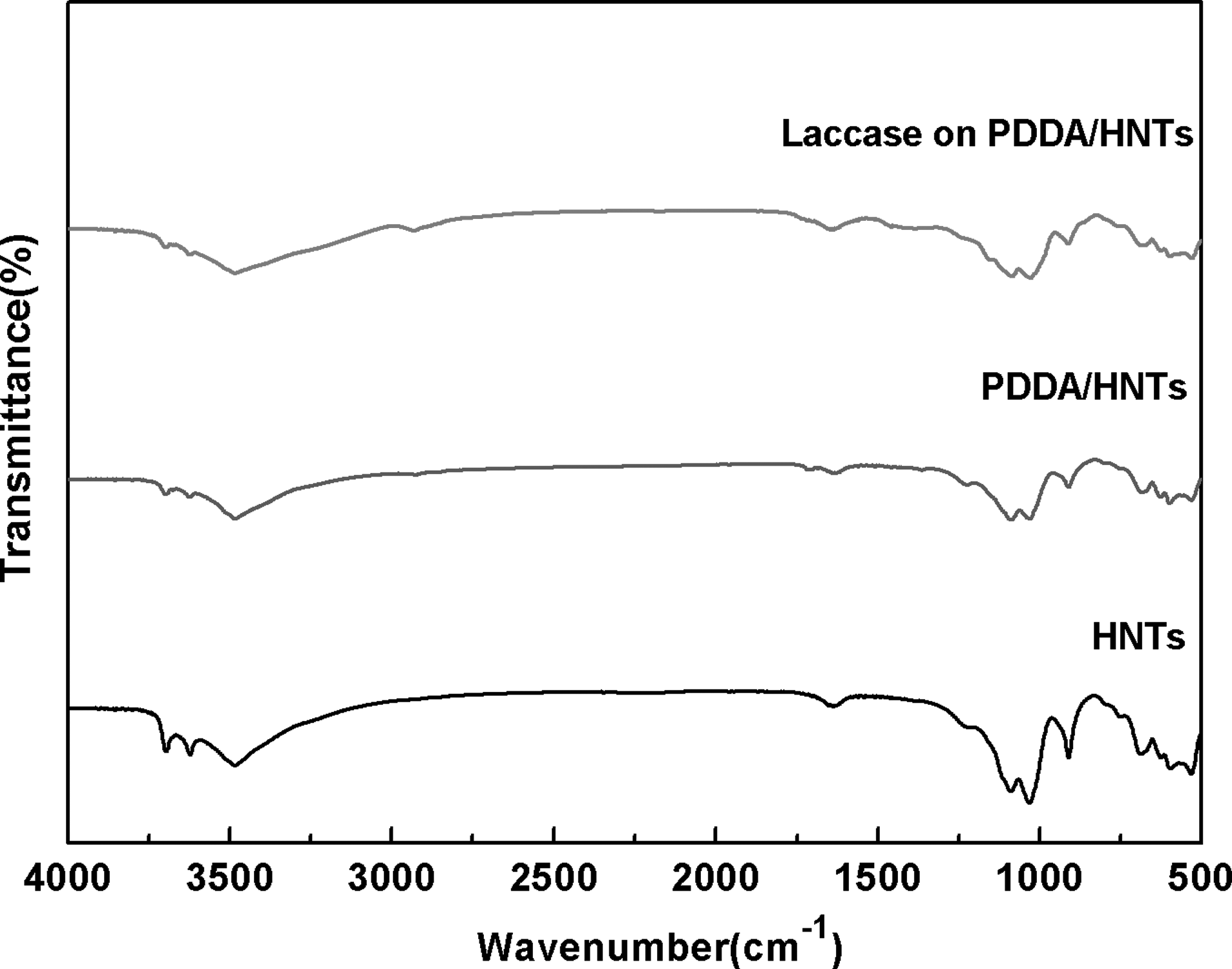
FTIR spectra of HNTs, PDDA/HNTs, and immobilized laccase on PDDA/HNTs. FTIR, Fourier transform infrared.
Fluorescence microscopy analysis
The fluorescent imaging was used to further observe the immobilization and distribution of laccase loading on PDDA/HNTs. As shown in Fig. 7, the prepared immobilized enzyme marked by fluorescein isothiocyanate (FITC) displays a bright green yellow color. Each individual fluorescence shape consists with the appearance of agglomerate carrier. It is suggested that laccase is successfully loaded on PDDA/HNTs, which also corresponds to the result of FTIR characterization.

Fluorescence microscope image of PDDA/HNT immobilized by FITC-labeled laccase. FITC, fluorescein isothiocyanate.
Properties of free and immobilized enzyme
Effect of functionalization of PDDA on HNTs
To compare the effect of PDDA functionalization on enzyme immobilization, 0.2 g of HNTs or PDDA/HNTs were dispersed into 100 mL 4 mg/mL free laccase (specific activity: 1.5 U/g) and incubated for 6 h to guarantee enzyme equilibrium on the support, and the results are shown in Table 1. From Table 1, it can be seen that PDDA/HNTs have much higher laccase immobilization capacity, specific activity, and recovery yield (41.28 mg/g, 1.24 U/g, and 82.67%) than those of pristine HNTs (21.46 mg/g, 0.65 U/g, and 43.33%), respectively. One reason may be because PDDA can absorb enzyme by forming a chemical bond or change the initial charge distribution of HNTs as a cationic polyelectrolyte, which benefits to the loading of negative charges of laccase (Bi et al., 2009). Another reason is that the negatively charged surface of HNTs repulses the attachment of laccase onto their surface, resulting in low immobilization capacity. Compared with free enzyme (1.5 U/g, 100%), PDDA/HNTs-modified laccase has only a modest decrease of specific activity and recovery yield, indicating PDDA/HNTs can be used as potential support for enzyme immobilization.
HNTs, halloysite nanotubes; PDDA, poly(diallyldimethylammonium chloride).
A kinetic study was performed to obtain Michaelis–Menten parameter (Km) of free laccase and immobilized laccase, which provides information on the affinity and catalytic ability of enzymes toward substrate and depends on both partition and diffusion effects. The Km for the immobilized laccase was 3.11 mM, higher than that of free laccase of 2.09 mM and HNTs-immobilized laccase of 2.29 mM (Table 1). The reason may be because the increased diffusion limitation could lower accessibility of the substrate to the active site of PDDA/HNTs-immobilized laccase and the conformation changes of the enzyme (Sarı et al., 2006).
Effect of pH
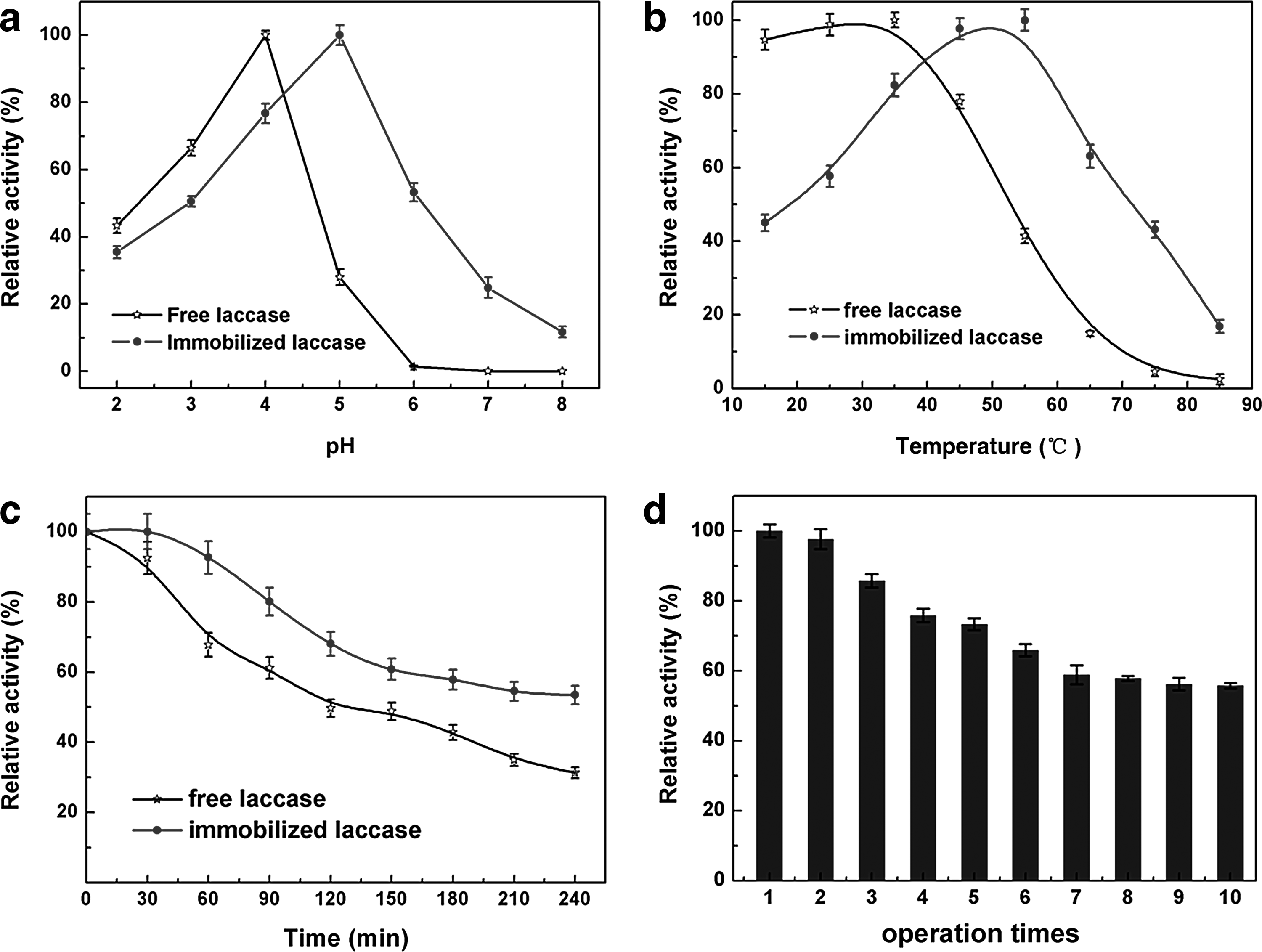
Activity of laccase is known to be dependent on pH, since the solution pH determines the level of electrostatic or molecular interaction between the loading surface and enzyme. To determine the optimum pH, the free and PDDA/HNTs-immobilized enzymes were incubated in 100 mM citric acid/Na2HPO4 buffers with pH ranging from 2.2 to 8 at 4°C for 12 h according to previous work (Wang et al., 2013). Then, the samples were transferred to standard reaction mixtures to determine the residual laccase activity with ABTS (Fig. 8a). Notably, the free laccase has maximum activity at pH 4, whereas the immobilized laccase exhibits the highest activity at a higher pH value of 5. The alkaline shift of optimum pH for immobilized laccase may be attributed to the electrostatic interactions influenced by carrier (Yang et al., 2006). Similar results were also observed in alginate and magnetic bimodal mesoporous carbon-immobilized laccase (Lu et al., 2006; Zheng et al., 2016).
Effect of pH
Besides, immobilized laccase has low activity when pH is below 4, which is due to the leaching of laccase from positively charged PDDA/HNTs. Previous reports suggested that the electrostatic point of laccase varies from 3 to 7 (Hublik and Schinner, 2000; Viswanath et al. 2014), depending on the enzyme source. The laccase electrostatic point used in this work is 3.12, which is determined by the electrofocusing method. It changes to positively charged when the pH is lower than its electrostatic point, which results in electrostatic repulsion between laccase and support. It can also be observed that free laccase loses 100% of its initial activity, whereas the immobilized laccase retains 50% of its initial activity when the pH is >6, indicating that the immobilized laccase shows less degree and speed of decline in reactive activities and the immobilized laccase is more resistant to acidic conditions. This may be due to that the immobilized laccase suffers less interference from the external environment than free laccase (Wang et al., 2013). The higher tolerance of PDDA/HNTs-immobilized laccase to alkali shift conditions promises a broader applicability in catalysis.
Effect of temperature
Thermal stability of laccase in its free form and immobilized over PDDA/HNTs was evaluated in buffers (pH 5) for 5 min at a temperature range between 15°C and 85°C (Fig. 8b). It can be observed that activities of the two enzymes are strongly dependent on temperature, and the free and immobilized laccase exhibits maximum activity at 35°C and 65°C, respectively. In comparison with the free laccase, the immobilized enzyme exhibits a significantly higher temperature tolerance and enhanced activity within the temperature range of 40–85°C, implying that immobilization can increase the thermal tolerance of enzyme. The improvement in resistance against temperature is probably due to the reduction of enzyme mobility and conformational changes caused by immobilization on support (Lu et al., 2006). The support effectively protects the laccase and affords a stable microenvironment.
Besides, the interaction between enzyme and PDDA/HNTs enhances the rigidity of the molecular structure of the enzyme, thereby reinforcing its capability to resist thermal deactivation (Liu et al., 2012b). In addition, the remaining activities of the free laccase and immobilized laccase are very low at 85°C, which may be attributed to the detachment of laccase from the PDDA/HNTs surface and the unfolding of enzymes under thermal stress conditions (Yang et al., 2015).
Thermal stability
To further investigate the time-dependent thermal stability of the immobilized laccase, the free and PDDA/HNTs-immobilized laccases were handled at a constant temperature of 60°C in a buffer solution of pH 5 for varied incubation periods. As shown in Fig. 8c, the activities of the immobilized and free laccase show decreasing trends. Nevertheless, both the rate and degree of decline of the activity of the immobilized laccase are much lower than those of free laccase, with respective residual activity of 92.7% and 67.8% after 1 h of incubation. After 6 h, the immobilized laccase retains 57.8% of its initial activity, whereas free laccase maintains only 42.7% of its activity. The more stable form of the immobilized laccase against heat can be assigned to that the interaction between laccase and the support enhances the structural rigidity and thermal resistance of the enzyme molecules and keeps laccase from injury of direct exposure to environment changes (Liu et al., 2012b; Nair et al., 2013; Zheng et al., 2016).
Besides, it is reported that composites from modified clays have good resistance and flame retardancy properties, which might lead to the displacement of the temperature–activity profile (Wang et al., 2013; Kotal and Bhowmick, 2015). Hence, at the same temperature, relatively better durability of immobilized laccase is detected compared to free enzyme. The increased resistance to thermal deactivation offers a potential advantage in wastewater treatment applications.
Reusability stability
Regeneration of immobilized laccase for repeated use is one of the most important indicators for reducing the overall cost of enzymatic applications. Unlike free enzyme, immobilized enzyme could be easily separated from the reaction solution and reused, which greatly decreases the cost of the enzyme for practical application. The reusability of PDDA/HNTs-immobilized enzyme was evaluated for 10 catalytic cycles by repeatedly incubating the immobilized enzyme in an ABTS solution (0.5 mM), and at the end of each oxidation cycle, the immobilized laccase (50 mg) was washed three times with 0.1 M citric acid/Na2HPO4 buffer (pH 5.0) (Kunamneni et al., 2008). The result is shown in Fig. 8d. It is worthy to note that the relative activity of immobilized laccase is 86% after three cycles, and it can retain over 50% after 10th cycle, indicating a certain reusability of the laccase immobilized on PDDA/HNTs.
Several reasons can be pointed out for rationalizing this loss in the performance of immobilized enzyme for reuse, including detachment from support and/or particle agglomeration (Xia et al., 2016). After the first catalytic reaction, the immobilized laccase was washed with buffer solution, and no active enzyme was detected in the washing solution, which indicates that the enzyme is not detached from the support or it may be released in a denatured form. After oxidation of ABTS, the active site of laccase can be structurally altered or occupied with the reaction products, resulting in a loss of its initial activity. Despite this significant decrease in the catalytic activity, the immobilization of the enzyme over PDDA/HNTs allows its use in repeated cycles, which will not occur when using the free enzyme system, constituting a valuable asset for industrial applications.
Removal of 2,4-DCP
To evaluate the degradation efficiency of chlorophenolic pollutants by the prepared immobilized laccase, removal of two concentrations (25, 50 mg/L) of 2,4-DCP was carried out in a rotary shaker and the result is shown in Fig. 9a. It can be seen that the degradation efficiency can reach equilibrium within 6 h, which is independent of 2,4-DCP concentration. The enzymatic degradation rates of 25 and 50 mg/L 2,4-DCP are 42.58% and 81.66%, respectively, when adding 0.1 mL of 1 mM redox mediator ABTS.
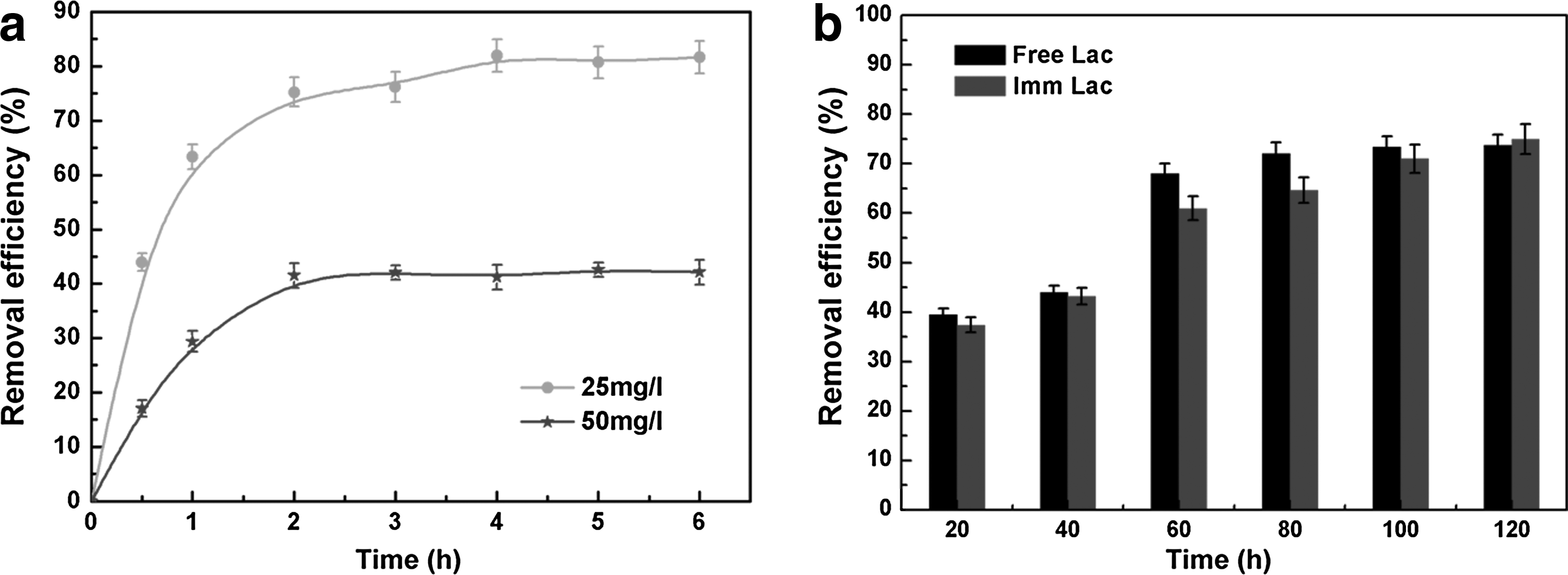
Removal rate of 2,4-DCP at different doses
Researchers found that the presence of small-molecular-weight redox mediator could enhance the oxidization rates of compounds by increasing electron densities at the phenoxy group (Shi et al., 2014). For example, Kazuhito (Itoh et al., 2000) showed that the conversion rate of 2,4,5-trichlorophenol, 2,4,6-trichlorophenol, and 2,4-DCP could be improved by adding a mediator (sinapic acid) to the laccase system. Johannes et al. (1996) compared catalytic oxidation of anthracene by ABTS and laccase/ABTS medium system, and found that the conversion rate could increase from 35% to 75% after adding ABTS. In the catalysis process, ABTS is first oxidized to small-molecule free radicals by laccase. The redox potential of fungal laccases is independent of their species of origin and is in the range of 500–800 mV (Camarero et al., 2005). As the specific substrate of laccase, the redox potential of 2,4-DCP is about 400 mV, lower than that of ABTS (680 mV) (Riva, 2006), which makes 2,4-DCP more easily oxidized than ABTS. The oxidization state of ABTS can get more electrons and transfer them to the substrate, which promises good degradation of 2,4-DCP.
To better understand the removal mechanism of the immobilized and free laccase, we monitored the degradation time course of 2,4-DCP in the first 2 h. From Fig. 9b, it is observed that the removal efficiency of the immobilized laccase is a little smaller than the free laccase initially. This may be partly due to the inactivation of laccase during immobilization process and the spatial limitations for substrate diffusion after enzyme immobilization (Xu et al., 2013). However, the removal efficiency of the immobilized laccase increases significantly after 2 h, which is even higher than that of the free laccase, suggesting that PDDA/HNTs-immobilized laccase does not lose its advantage of high activity. As time goes, the removal yields of both free and immobilized laccase have no significant change. This tendency occurs probably because enzymes are highly efficient and specific catalysts, which means enzyme could react with the substrate completely in a short time (Johannes et al., 1996). Due to the enhanced pH and temperature tolerance, good thermal stability, and excellent reusability, the immobilized laccase can be used in removing chlorophenolic pollutants from aqueous sources and has potential use in other environmental applications.
Another important property in assessing the value of the commercial application of biocatalysts is its reusability along successive cycles. The reusability of immobilized laccase for degradation of 25 mg/L 2,4-DCP in the presence of ABTS is shown in Fig. 10. In the third cycle, immobilized laccase can maintain over 80% of its initial efficiency, and 61.4% of its initial efficiency can remain till the sixth cycle. The result shows that the removal rate of 2,4-DCP on PDDA/HNT-immobilized laccase decreases with repeated use. This decrease in effectiveness can be due to inactivation and loss of enzyme during each cycle (Huang et al., 2011), which is in accordance with the recycling stability of PDDA/HNTs-immobilized laccase.

Reusability of PDDA/HNTs-immobilized laccase in removal of 25 mg/L 2,4-DCP.
Conclusions
Halloysite was successfully functionalized by PDDA for laccase immobilization. Compared with free enzyme, the immobilized laccase exhibited enhanced pH and temperature tolerance. Besides, the thermal stability and reusability of immobilized laccase were also significantly improved compared with the free laccase. It is expected that PDDA/HNTs can be of great potential as a promising support material for biomacromolecule immobilization. The immobilized laccase was used to remove 2,4-DCP, resulting in 80% removal efficiency in 6 h by adding redox mediator ABTS. These results indicate that immobilized laccase has potential application in removing chlorophenols, especially 2,4-DCP, in industrial wastewater.
Footnotes
Acknowledgments
This work was supported by the National Natural Science Foundation of China (Grant Nos. 21271158 and 21576247), Key Scientific Research Project of University in Henan (Grant No. 17A530005), and postdoctoral Research Sponsorship of Henan Province (Grant No. 2015015).
Author Disclosure Statement
No competing financial interests exist.