




Abstract
Abstract
To avoid deficiencies of traditional electrocoagulation process, electrocoagulation process powered by renewable photovoltaic energy has been directly used to remove nickel from wastewater. Results show that under the solar irradiation intensity (SII) of 750 ± 30 W/m2, aluminum electrode has higher nickel removal efficiency (NRE) than graphite and titanium, and its NRE is nearly 100% in 40 min. An optimum distance of 20 mm is determined for the electrode gap. NRE in 40 min nearly decreases from 99.6% to 78.8% when initial Ni2+ concentration increases from 100 to 300 mg/L. Under the SII of 610 ± 40 W/m2, solution containing SO42− of 3.4 mmol/L gets the highest NRE, while wastewater containing Cl− of 6.8 mmol/L has the lowest. Furthermore, effluent, including SO42− of 1.7 and Cl− of 3.4 mmol/L, shows a higher NRE too. NRE in 40 min increases when output power of the photovoltaic panel changes from 30 to 90 W, but doesn't show an obviously increasing tendency when the power improves further to 120 W. NRE for a fine day is the highest and is 100% in 40 min. However, its energy utilization efficiency is the lowest, but the saving cost is the most. In addition, MAl, Ct, and Ca sharply increase with the SII enhancing. Therefore, for some enterprises or regions with serious environmental burden and insufficient economic input, this process will provide an effective alternative approach to remove heavy metals from wastewater in a renewable and low-cost way.
Introduction
A
In recent years, multifarious processes are adopted to treat wastewater containing nickel. The extensively utilized methods include precipitation (Giannopoulou and Panias, 2008), membrane filtration (Landaburu-Aguirre et al., 2012), adsorption (Zamboulis et al., 2011), ion exchange (Revathi et al., 2012), and some electrochemical processes, such as electrocoagulation (Heidmann and Calmano, 2008; Akbal and Camcı, 2011; Vasudevan et al., 2012; Ferreira et al., 2013; Sahu et al., 2014), electrodialysis (Koene and Janssen, 2001; Dermentzis, 2010), electrodeposition (Njau et al., 2000), electroflotation (Belkacem et al., 2008), and electrodeionization (Dzyazko et al., 2014; Lu et al., 2014). Thereinto, electrocoagulation process can continuously in situ produce coagulant in wastewater and reduce significantly the volume of sludge owing to adding excessive chemicals. In addition, its characteristics also include short reaction time, simple equipment, easy operation, and low operating cost. What's more, it greatly eliminates the shortcomings of conventional chemical coagulation (Aoudj et al., 2015; Nawel et al., 2015). As a result, electrocoagulation process is attracting more and more researchers' and engineers' attention in the environmental protection field (Mollah et al., 2004; Heidmann and Calmano, 2008; Vasudevan et al., 2010; Akbal and Camcı, 2011; Coman et al., 2013; Ferreira et al., 2013; Kamaraj and Vasudevan, 2015). During an electrocoagulation process, some electrochemical reactions will appear in wastewater. For instance, when the aluminum electrode is used, the main reactions are as follows:
Afterward the OH− and Al3+ ions in aqueous solution can react and generate all kinds of mononuclear and polynuclear transitional species, such as Al(OH)2+, Al(OH)2+, Al2 (OH)24+, Al(OH)4−, Al6(OH)153+, Al7(OH)174+, Al8(OH)204+, Al13 (OH)345+, and All3O4(OH)247+ (Can et al., 2006; Tchamango et al., 2010). At last, those species gradually turn into Al(OH)3 with large specific area. Thus, contaminants in wastewater are removed due to the adsorption or trapping effect of Al(OH)3. In addition, some ions in wastewater can take part in some reactions too. For instance, Ni2+ in solution and OH− generated from cathode can react to form Ni(OH)2 sediment according to Equation (3).
For another example, when wastewater contains Cl−, the following reactions will be emerged.
Therefore, electrocoagulation process is successfully used to treat all kinds of wastewater, such as drinking water (Vik et al., 1984), underground wastewater (Martinez-Villafane et al., 2009), seawater desalination (Zeboudji et al., 2013), municipal wastewater (Al-Shannag et al., 2013; Elazzouzi et al., 2017), and various industry wastewater (Lafi et al., 2010; Al-Shannag et al., 2012, 2014; Ferreira et al., 2013; Al-Shannag et al., 2015).
However, during the current application of electrocoagulation, traditional alternating current (AC) power generated from fossil energy is extensively adopted. In addition, AC must be changed into direct current (DC) power by transformers, rectifiers, and filters to connect with the electrodes. All these not only make investing and operating cost high but also prevent electrocoagulation process spreading in electricity shortage and remote regions. For that, researchers and engineers are always hunting for better ways to avoid the above deficiencies. The renewable energy emergence brings us a little hope. Currently, the photovoltaic energy, due to clean, abundant, and renewable performances, has achieved absolute dominance in the renewable energy market and is widely used in some fields (Pandey et al., 2016). Photovoltaic panels, which are characterized by long lifetime, easy installation, and very low maintenance cost, can directly output a DC as soon as they enjoy the sunshine. In addition, they can also output a higher voltage and/or current in series and/or parallel connection mode. Moreover, they can supply electric power to a reactor in a direct way or through a DC–DC converter. Consequently, photovoltaic solar panels are being used by electrocoagulation process to treat effluent, which is becoming popular in the environmental protection field (Kargi, 2011; Zhang et al., 2013, 2015, 2016; Mooka et al., 2014; Wright and Winter, 2014; He et al., 2015; Huang et al., 2016). In particular, for some enterprises or regions facing serious environmental pressure and lacking sufficient economic input, it is a very practical and effective process. However, photovoltaic energy, which is utilized directly in removing heavy metal from wastewater, has seldom been reported up to now.
In this study, a synthetic wastewater containing nickel is chosen as an investigation subject. The effects of some conventional factors, such as electrode material, interelectrode distance, initial Ni2+ concentration, and different anions on nickel removal, are explored. In addition, the relevant photovoltaic elements, for example, the photovoltaic panels' output power and weather conditions, are investigated. Moreover, analysis on energy consumption, electrode consumption, and operating cost is carried out too. The aim of present work is to investigate the feasibility of nickel removal from wastewater by electrocoagulation using photovoltaic solar panels as energy. In addition, for some enterprises or regions with serious environmental burden and insufficient economic input, the work will provide an effective alternative approach to remove heavy metal from wastewater in a low-cost way.
Materials and Methods
Experimental system and operation
The experimental system is schematically illustrated in Fig. 1. A photovoltaic solar panel (30 W, Model XLY30M) is directly connected with the electrode plates, and its structure, parameters, and fixed position can be found in the literatures (Zhang et al., 2013, 2015; Zhang et al., 2016). The reactor is made of polyvinyl chloride panel and its inner length, width, and height are 200, 130, and 70 mm, respectively. All electrode plates with the dimensions 110 × 70 × 1.5 mm are installed vertically in the reactor and connected with the photovoltaic panel in monopolar mode. During each test, the electrodes are dipped into the effluent with a depth of 50 mm (The working area of each electrode is 0.011 m2), and their distance is changed according to the experimental requirement. In addition, before each run, all electrodes are burnished by an electrical angle grinder and then washed by distilled water to remove surface powder of oxide layer. During each trial, wastewater containing nickel is prepared by adding NiSO4·6H2O (Analytical grade) into tap water. After that, 3 L of effluent is poured into a beaker and circulated through the reactor by a centrifugal pump at a flow rate of 0.2 L/min. Next, a sample of 30 mL is taken at a proper time and centrifuged at 4000 rpm for 10 min. Finally, the supernatant is sent to analyze physicochemical parameters. During the experiments, all the tests are carried out at room temperature of 25°C–30°C. In addition, original Ni2+ concentration, conductivity, and pH in the synthesized wastewater are 200 mg/L, 750 μs/cm, and 7, respectively.

Schematic diagram of experimental system. 1. Digital multimeter, 2. Photovoltaic solar panel, 3. Digital solar power meter, 4. Electric wires, 5. Flowmeter, 6. Cathodic plates, 7. Anodic plates, 8. Reactor, 9. Water pipes, 10. Beaker, 11. Centrifugal pump.
Analytical methods
Solar irradiation intensity (SII), potential difference, and electronic current between electrodes are monitored according to the literatures (Zhang et al., 2013, 2015, 2016). The pH value in solution is monitored with a Hach 2000 pH meter. The determination of conductivity is carried out by a conductivity meter (Model DDS-11C, Shanghai, China). In addition, nickel concentration is measured using an atomic absorption spectrophotometer (TBS-990; Beijing Purkinje General Instrument Co. Ltd., Beijing, China). Meantime, nickel removal efficiency (NRE), η, is calculated as below:
where Ct is the Ni2+ concentration (mg/L) at the time of t and C0 is the initial Ni2+ concentration (mg/L).
Results and discussion
Effect of electrode materials
Electrode materials play a key role in removing pollutants in wastewater. Due to their lower cost, aluminum, iron, graphite, and titanium are widely used. For that, aluminum, graphite, and titanium (Industrial grade) are selected to investigate their performances on removing nickel.
Figure 2 shows that under the SII of 750 ± 30 W/m2 (Supplementary Fig. S1), aluminum electrode has the highest removal efficiency, and the removal efficiency of graphite is slightly higher compared with titanium. For instance, at the time of 10, 20, and 30 min, the NRE is 45.1%, 70.3%, and 90.3% for aluminum, 7.8%, 15.6%, and 26.8% for graphite, 5.0%, 13.9%, and 18.4% for titanium, respectively. In addition, it can be also seen from Fig. 2 that the nickel removal rate for aluminum is the fastest, and the removal efficiency is nearly 100% in 40 min. However, the removal efficiencies for graphite and titanium are less than 30%.
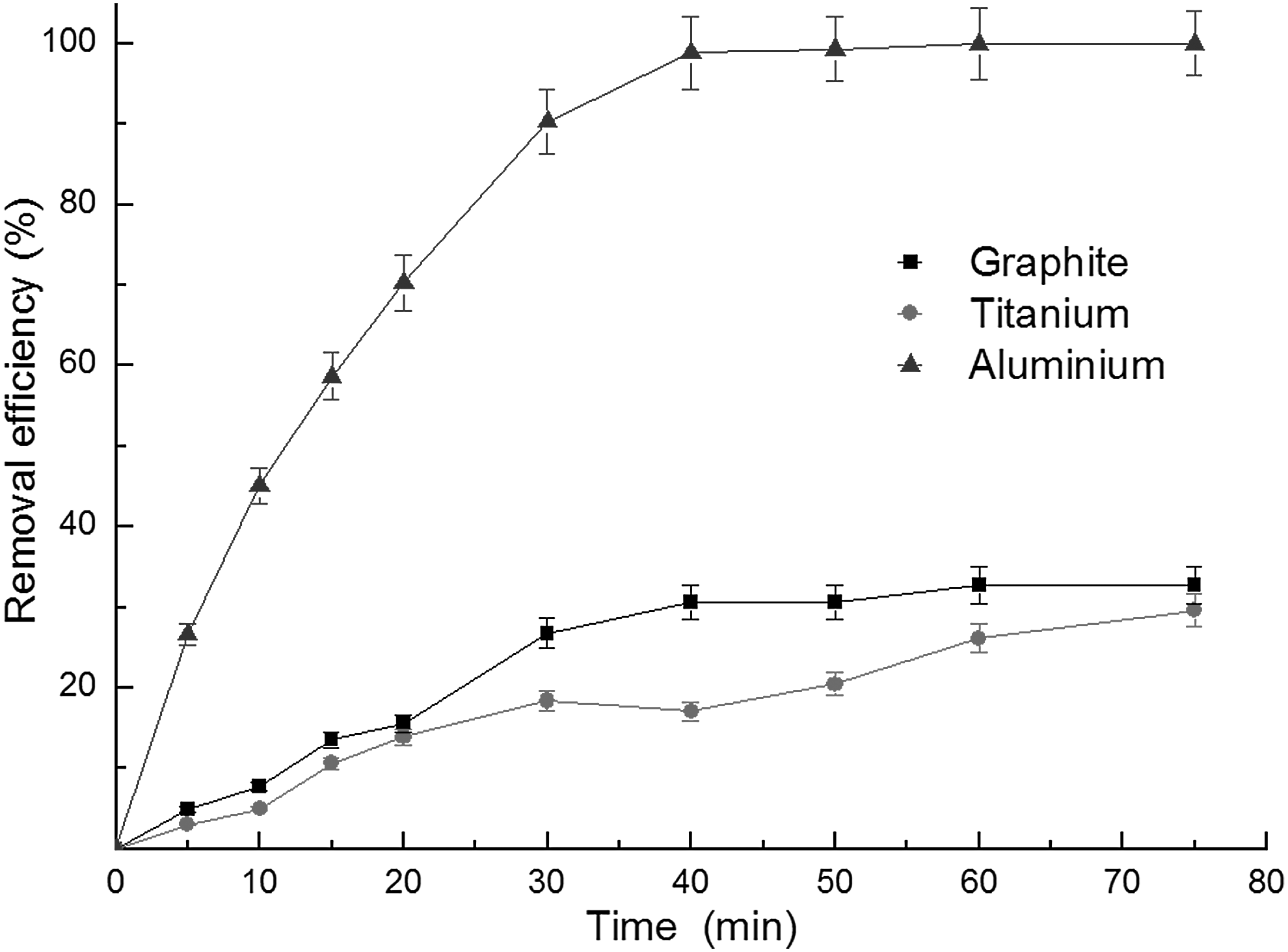
Influence of electrode materials on NRE versus operation time. Interelectrode distance: 20 mm, initial Ni2+ concentration: 200 mg/L. SII, voltage, and current between electrodes were seen from Supplementary Fig. S1. The standard error, including Figs. 3, 4, 6–10, was analyzed at 95% confidence level. NRE, nickel removal efficiency; SII, Solar irradiation intensity.
The reasonable interpretations are as below. As far as graphite and titanium electrodes are concerned, aluminum is a more active electrode material. During electrocoagulation, Al(OH)3, which can adsorb soluble pollutants and trap colloidal particles, is generated easily, and this is a main reason that aluminum electrode has the highest NRE. Moreover, Ni2+ in solution can further be removed according to Equation (3).
However, for graphite and titanium, the Equation (3) may be the only way to remove nickel. Due to a limited number of OH− ion produced from cathode, nickel in solution only has a limited removal, which is a possible reason that graphite and titanium have lower NRE.
Effect of interelectrode distance
For a given SII, interelectrode distance significantly influences output current and voltage of the photovoltaic solar panel and eventually affects the NRE. During experiments, distance between electrodes is changed from 10 to 50 mm to explore removal efficiency.
Figure 3 demonstrates that under the SII of 740 ± 50 W/m2 (Supplementary Fig. S2), the NRE for a given distance increases with time prolonging. Meanwhile, the NRE changes with the distance between electrodes. For example, at 20, 40, and 60 min, the NRE is 52.5%, 90.9%, and 100% for the electrode distance of 10 mm, 70.3%, 98.9%, and 100% for 20 mm, 48.6%, 76.4%, and 92.1% for 30 mm, 34.9%, 55.2%, and 73.9% for 40 mm, and 32.9%, 43.7%, and 57.9% for 50 mm, respectively. It is noteworthy that in the first 40 min, removal efficiency improves evidently when the electrode gap changes from 10 to 20 mm and then it decreases as the interelectrode distance further increases to 50 mm, as implies that the optimum interelectrode distance is 20 mm where a high removal efficiency can be reached.

Influence of interelectrode distance on NRE versus operation time. Initial Ni2+ concentration: 200 mg/L. SII, voltage, and current were seen from Supplementary Fig. S2.
As current between the electrodes decreases with the distance varying from 20 to 50 mm (Supplementary Fig. S2), the amount of aluminum ion produced from the anode also decreases according to Faraday's Law. As a result, the floc production in solution decreases, which is the reason that the NRE decreases when the interelectrode distance increases. Nevertheless, current for 10 mm is nearly equal to that for 20 mm in the first 30 min, but the removal efficiency for 10 mm is obviously less than that for 20 mm. The possible reason is that for the same current, the interelectrode bubble density and upward flux are all greater for 10 mm than those for 20 mm. Hence, the faster removal of metal hydroxide from solution leads to a reduction in the probability of collision between the pollutant and the coagulant (Can et al., 2006; Kobya et al., 2006; Katal and Pahlavanzadeh, 2011).
Effect of initial Ni2+ concentration
In reality, Ni2+ concentration in wastewater constantly changes with rainfall, natural evaporation, or water discharge. To investigate the practicality of the adopted process, initial Ni2+ concentration is changed from 100 to 300 mg/L.
Figure 4 depicts that under the SII of 750 ± 40 W/m2 (Supplementary Fig. S3), the NREs in 40 min all increase with the extension of time. After that, the NREs are all 100% for 100 and 150 mg/L. However, the NRE for 300 mg/L keeps on rising and reaches 100% in 75 min. In addition, the NRE in 40 min nearly decreases from 99.6% to 78.8% as initial Ni2+ concentration increases from 100 to 300 mg/L. Moreover, it can be seen from Supplementary Fig. S3 that except for initial Ni2+ concentration of 200 mg/L, output current of the photovoltaic panel increases as initial Ni2+ concentration increases, while output voltage behaves in the opposite direction. Finally, at the same concentration, output current almost decreases and output voltage increases as time prolongs.
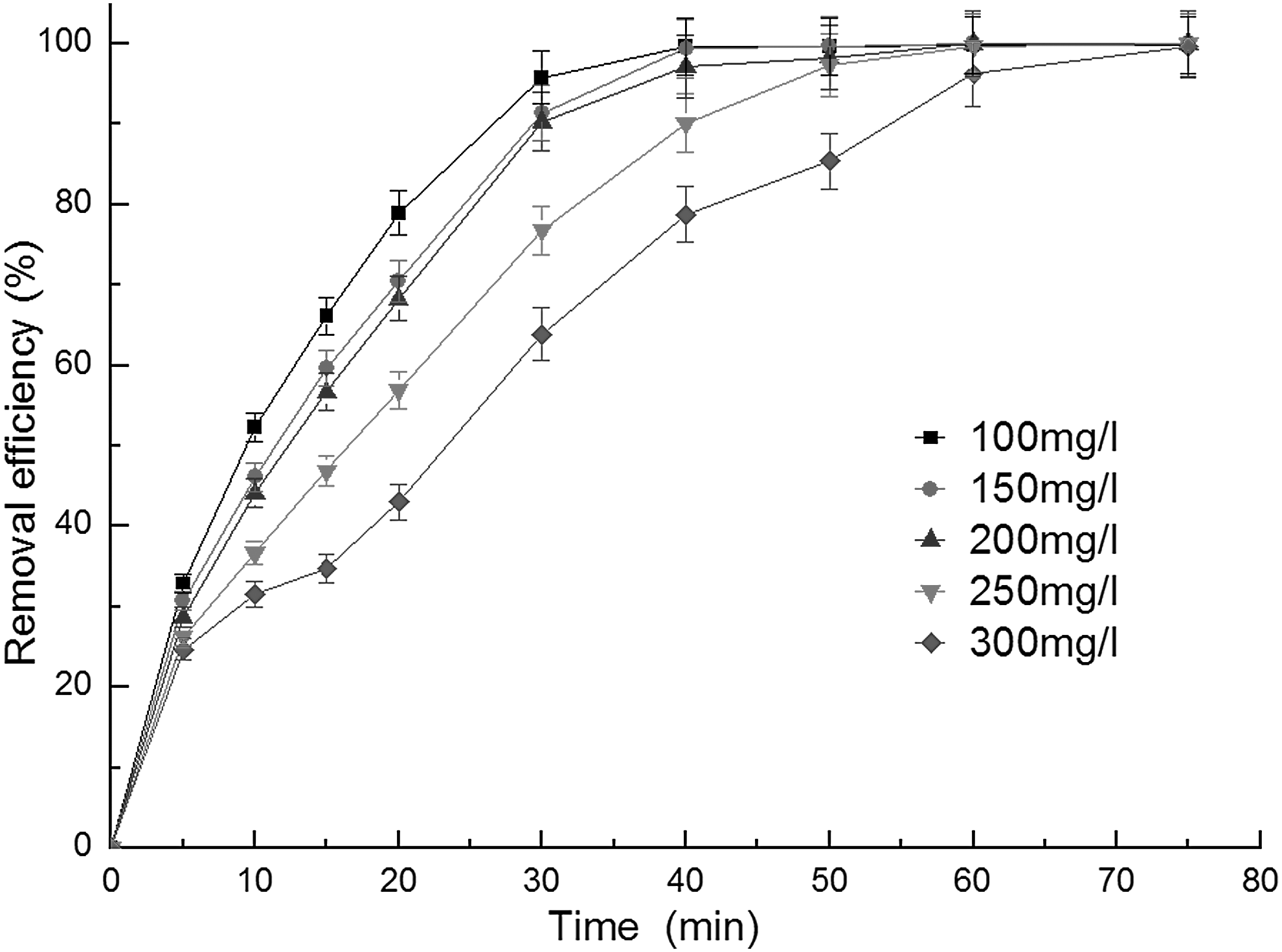
Influence of initial concentration on NRE versus operation time. Interelectrode distance: 20 mm. SII, voltage, and current were seen from Supplementary Fig. S3.
To elucidate the phenomena, the characteristic I–V curve and the working point of the photovoltaic panel are researched. It can be seen from Fig. 5 that for a given SII, ambient temperature, and load, the I–V curve of the photovoltaic module presents two clearly differentiated zones. First, a plateau is observed where current is approximately equal to the short circuit current (Isc) in a wide range of voltage. The second region, where voltage is approximately equal to the open circuit voltage (Voc), is characterized by a sudden decrease of the current (Ortiz et al., 2007; Valero et al., 2008). In addition, the intersection of the I–V curve for the photovoltaic panel with the straight line I = (1/R)V for an ideal electrical resistance load determines the working point (Vw, Iw) of the photovoltaic panel. At the same time, the product of Vw and Iw is regarded as the power provided for a load by the photovoltaic panel (Ortiz et al., 2007; Valero et al., 2008). When initial Ni2+ concentration in solution becomes larger, its electrical resistance load turns lower, and so its working point changes from Working Point 2 to Point 1 (Fig. 5). Seen from Fig. 5, output voltage and current of the photovoltaic panel are different at two Working Points, which is the reason that at the same instance, output voltage and current vary with initial Ni2+ concentration. At the same initial concentration, Ni2+ ion concentration becomes less and less due to the coagulation, and working point changes gradually from Point 1 to Point 2. As a result, output current decreases and output voltage increases as time prolongs according to Fig. 5.
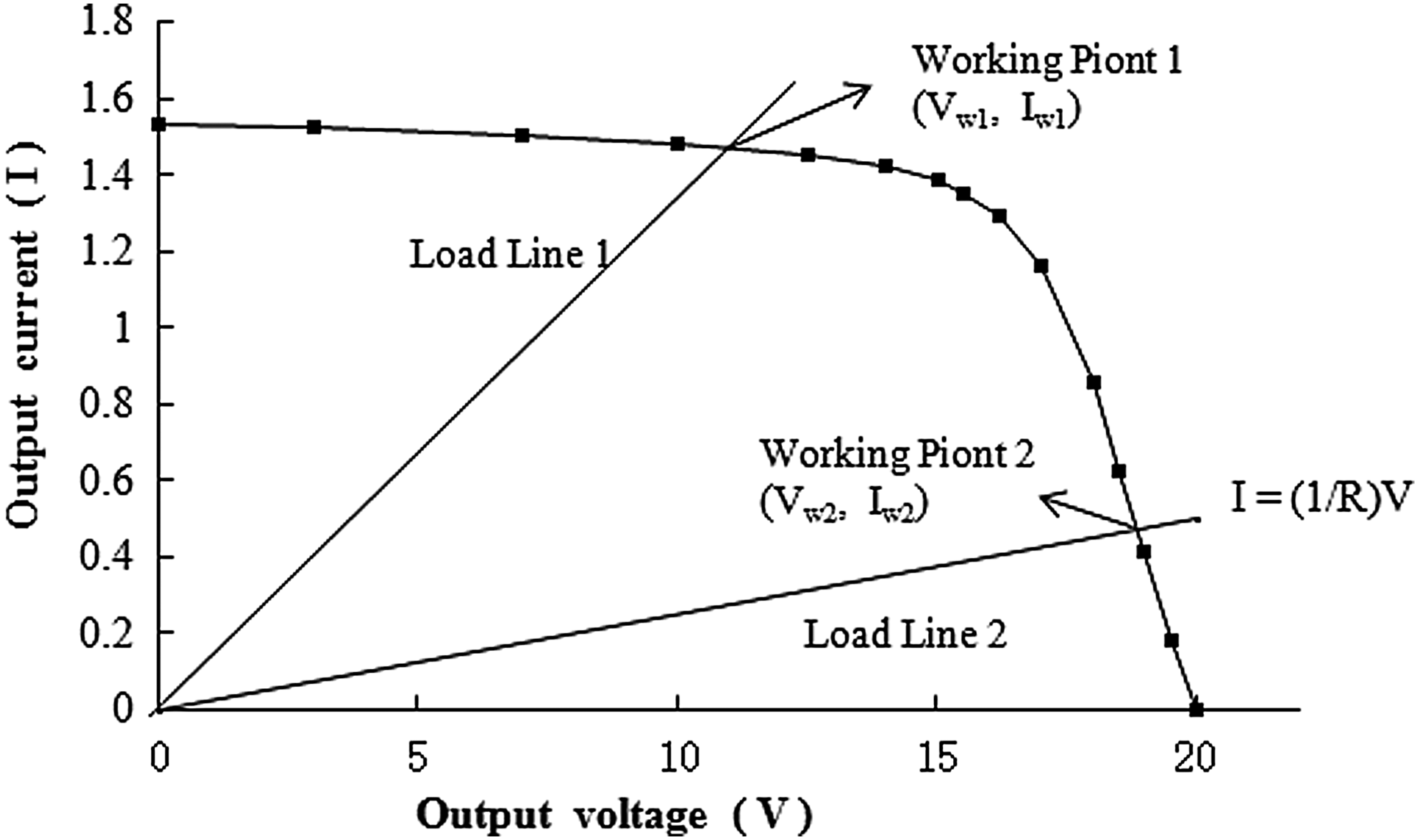
Characteristic I–V curve for SII of 750 ± 40 W/m2 and working points of the electrocoagulator.
As output current increases with initial Ni2+ concentration increasing, the amount of aluminum ion oxidized increases, and subsequently, the floc production in solution increases according to Faraday's Law. However, H2 from cathode and by-product of O2 from anode, which are also produced in larger quantities due to the electrolysis of water, make flocculent aluminum hydroxide rapidly float upwards. As a result, the floc shows a very low adsorption ability, which is a possible reason that the NRE in 40 min nearly decreases as initial Ni2+ concentration increases.
Effect of different anions
Sulfuric acid and hydrochloric acid are widely used in nickel melting and electroplating industries, and so wastewater discharged from these fields contains a large number of SO42− and Cl− ions. The existence of SO42− and Cl− possibly influences the performance of electrocoagulation process (Aoudj et al., 2010; Pulkka et al., 2014). For this purpose, the effect of different anions on nickel removal is conducted.
Figure 6 presents that under the SII of 610 ± 40 W/m2 (Supplementary Fig. S4), solution containing SO42− of 3.4 mmol/L gets the highest NRE, while wastewater containing Cl− of 6.8 mmol/L has the lowest efficiency. Furthermore, effluent, including SO42− of 1.7 and Cl− of 3.4 mmol/L, shows much higher removal efficiency too. For example, at 10, 30, and 50 min, the NRE is 40.7%, 70.4%, and 97.7% for 3.4 mmol/L SO42−, 29.0%, 65.7%, and 87.2% for 1.7 mmol/L SO42− and 3.4 mmol/L Cl−, and 25.9%, 44.0%, and 57.2% for 6.8 mmol/L Cl−, respectively.

Influence of different anions on NRE versus operation time. Interelectrode distance: 20 mm, initial Ni2+ concentration: 200 mg/L. SII, voltage, and current were seen from Supplementary Fig. S4.
Possible interpretations are as below. In wastewater containing Cl−, an indirect electrochemical oxidation reaction easily occurs and Cl− in solution will be oxidized to Cl2 at the anode [Eq. (4)]. Next, Cl2 will be immediately dissolved in water and converted to HClO [Eq. (5)]. Finally, HClO can react with Al(OH)3 in solution to form some intermediate products. In addition, Cl− ion can also react with Al(OH)3 to produce transitory compounds, such as Al(OH)2Cl, Al(OH)Cl2, and AlCl3. Under excessive Cl−, the transitory compounds will be finally dissolved as a form of AlCl4− in the solution. Thus, the amount of Al(OH)3 floc decreases, and the NRE becomes low (Wang et al., 2009), which are the main reasons that wastewater containing Cl− of 6.8 mmol/L has the lowest efficiency. As for effluent, including SO42− of 1.7 and Cl− of 3.4 mmol/L, a possible reason is that the quantity of Cl− in solution is inadequate and the above reactions are not predominant. Consequently, effluent, including SO42− of 1.7 and Cl− of 3.4 mmol/L, shows much higher removal efficiency too.
Effect of photovoltaic panels' output power
When a photovoltaic panel is used in wastewater treatment, its output power is a significant factor. For a given wastewater, when the photovoltaic panel of different power is applied, its output current and voltage are strikingly different. Consequently, the effect of photovoltaic panels' power on the NRE is investigated. In practical applications, photovoltaic panels are often connected in series and/or in parallel to attain a higher output power. Therefore, during experiments, the photovoltaic panels are installed in parallel connection to change the output power.
It can be seen from Fig. 7 that for a given effluent, removal efficiency in the first 40 min increases when output power of the photovoltaic panel improves from 30 to 90 W. After that, removal efficiency does not show an obviously increasing tendency when output power increases further to 120 W, which suggests that for a given effluent there is an optimum power range where a higher removal efficiency can be got. Meantime, it can be seen from Fig. 8 that under the SII of 750 ± 40 W/m2, output voltages for 90 and 120 W slightly fluctuate between 13.0 and 16.5 V. However, their output currents sharply vary from 2.3 to 1.0 A. Nevertheless, output currents for 30 and 60 W change moderately from 1.6 to 1.0 A while output voltages significantly undulate within a range of 8.6–14.9 V, which infers that for a given solution, the working mode of the photovoltaic panel transforms from a similar galvanostatic state to an approximate potentiostatic state when output power increases from 30 to 120 W. In addition, output voltage and current for 90 W in the first 30 min are all bigger than those for 30 and 60 W, as it is a possible reason that the NRE increases with output power improving.
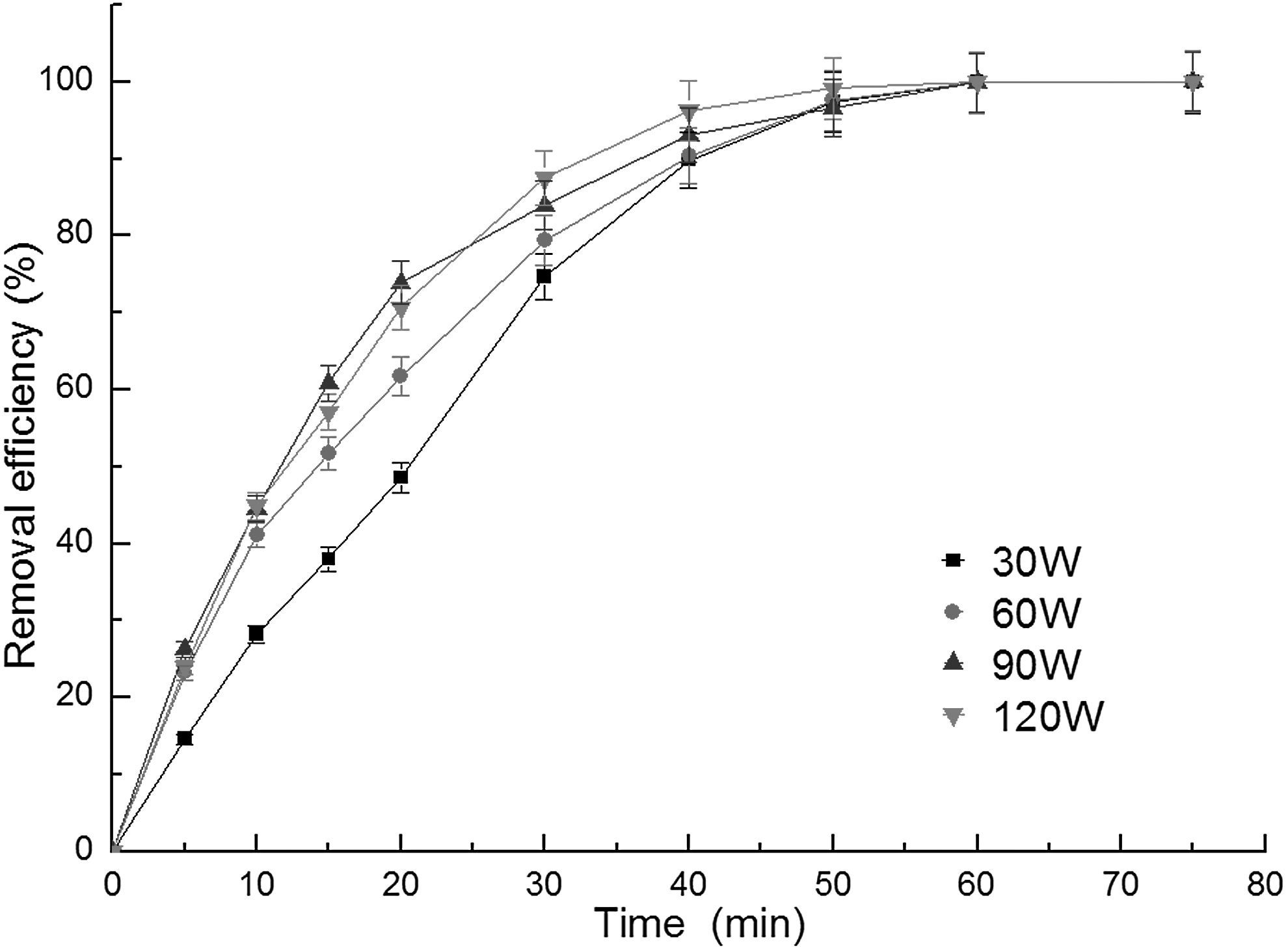
Influence of photovoltaic panel's output power on NRE versus operation time. Interelectrode distance: 20 mm, initial Ni2+ concentration: 200 mg/L. SII, voltage, and current were seen from Fig. 8.
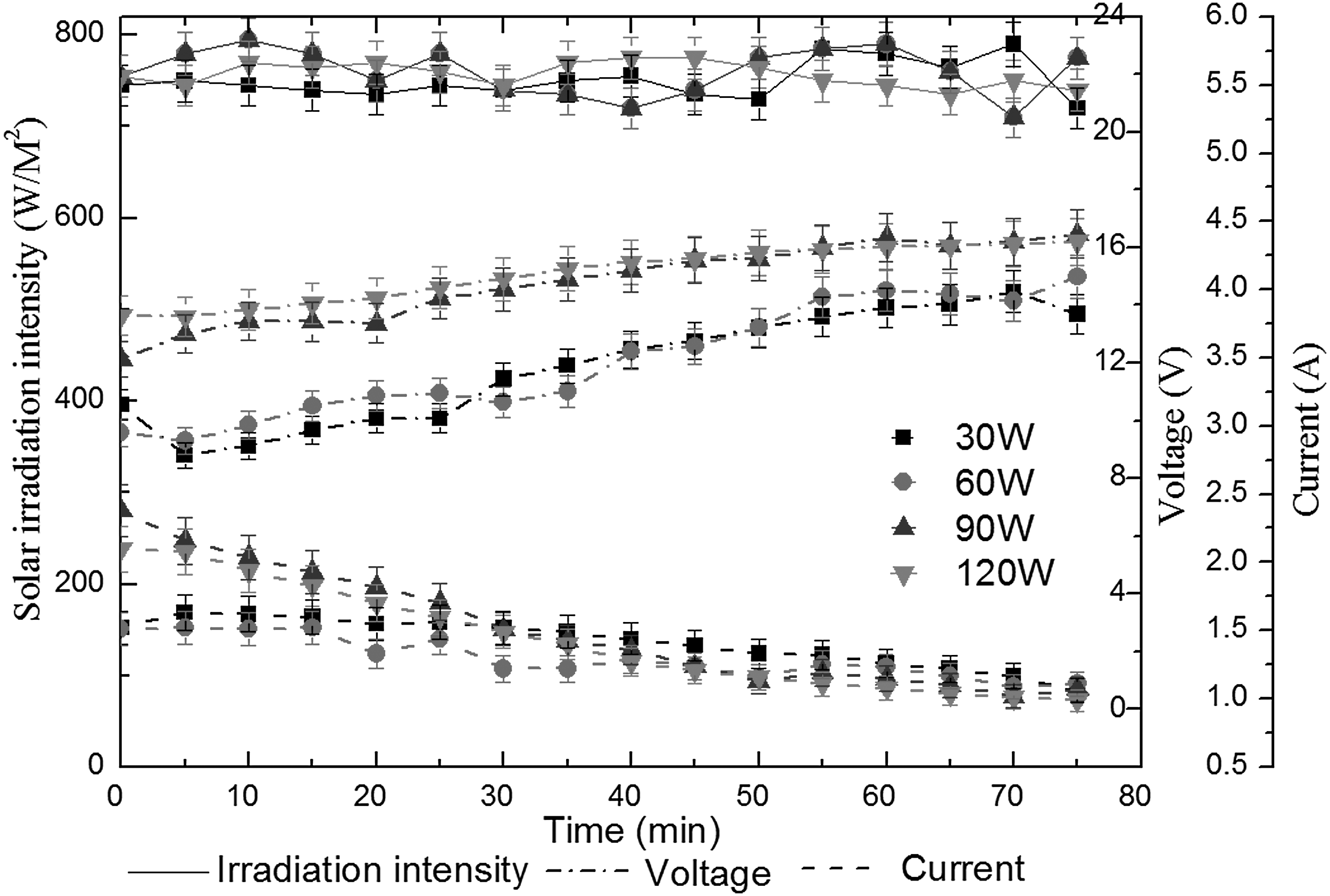
SII, voltage, and current parameters of photovoltaic panel's output power versus operation time.
Effect of weather conditions
Output current and voltage of the photovoltaic panel are predominantly affected by weather conditions, which is an essential prerequisite when the photovoltaic panel is considered for use. For that, the effect of weather conditions on the NRE is studied.
Seen from Fig. 9, the SII for a fine day and an overcast day is all relatively stable, and irradiation intensity is 745 ± 20 and 105 ± 15 W/m2, respectively. However, irradiation intensity for a cloudy day has a broad fluctuation. Furthermore, Fig. 9 also shows that the weather conditions strikingly affect output current and voltage of the photovoltaic panel. Output current and voltage for a fine day, due to the highest SII, are all the highest and those for an overcast day are all the lowest because of the lowest SII. Moreover, Fig. 10 demonstrates that the NRE for a fine day is the highest and is 100% in 40 min. However, removal efficiency of 100% can be got in 75 min in a cloudy day. Nevertheless, removal efficiency for an overcast day is still less than 60% in 75 min.

Voltage and current parameters of SII versus operation time.

Influence of SII on NRE versus operation time. Interelectrode distance: 20 mm, initial Ni2+ concentration: 200 mg/L. SII, voltage, and current were seen from Fig. 9.
Analysis on energy consumption, electrode consumption, and operating cost
Operating cost is a factor to be considered when the electrocoagulation process is used. According to the literature (Elazzouzi et al., 2017), the most important factors on operating cost are the electrode consumption and the energy consumption. For that, the operating cost on aforementioned weather conditions is estimated.
During each analysis, energy consumption (Em), which is used to remove nickel per mass unit, is calculated according to the literatures (Zhang et al., 2013, 2015, 2016). In addition, electrode consumption (MAl), which is used to remove nickel per mass unit, is assessed in accordance to the literatures (Akbal and Camcı, 2011; Al-Shannag et al., 2014). Furthermore, the theoretical operating cost (Ct) required for removing nickel per mass unit is calculated according to the following Equation (7):
where a and b are the price of electrical energy and aluminum plate, respectively. Currently, a and b are 0.53 RMB yuan/kWh and 18.00 RMB yuan/kg in China market, respectively. As the renewable energy is adopted, the actual operating cost (Ca) is assessed as below:
Hence, the saving cost is calculated as follows:
Results from Table 1 show that Em for an overcast day is the lowest and 3.6 kWh/kg, while Em for a fine day is the highest and 36.8 kWh/kg. These results suggest that energy utilization efficiency for a fine day is the lowest, as is consistent with the phenomenon that during experiments the temperature of wastewater has a little increase when the photovoltaic panel is exposed in a fine day. In addition, MAl, Ct, and Ca have a similar trend with Em, which also implies that MAl, Ct, and Ca sharply increase with the SII enhancing. However, Cs demonstrates that the saving cost for a fine day is the most, and this infers that when a bigger current is required to be used, the solar panel can be used to save more operating cost.
Conclusions
In this article, wastewater containing nickel is successfully treated by the electrocoagulation process using photovoltaic solar panels as energy. Some conclusions can be drawn as follows:
Under the SII of 750 ± 30 W/m2, aluminum electrode has the highest removal efficiency, and removal efficiency of graphite is slightly higher compared with titanium. In addition, nickel removal rate for aluminum is the fastest, and removal efficiency is nearly 100% in 40 min. However, removal efficiencies for graphite and titanium are less than 30%.
NRE changes with the distance between electrodes. In 40 min, removal efficiency improves evidently when the electrode gap changes from 10 to 20 mm and then decreases as the interelectrode distance further increases to 50 mm, as it implies that there lies an optimum interelectrode distance of 20 mm.
Under the SII of 750 ± 40 W/m2, the NREs for different initial Ni2+ concentrations in 40 min all increase with the extension of time. Thereafter, the NREs for the initial concentration of 100 and 150 mg/L are all 100%. However, the NRE for 300 mg/L keeps on rising to 100% in 75 min. In addition, the NRE in 40 min nearly decreases from 99.6% to 78.8% when initial Ni2+ concentration increases from 100 to 300 mg/L.
Under the SII of 610 ± 40 W/m2, solution containing SO42− of 3.4 mmol/L gets the highest NRE, while wastewater containing Cl− of 6.8 mmol/L has the lowest efficiency. Furthermore, effluent, including SO42− of 1.7 and Cl− of 3.4 mmol/L, shows much higher removal efficiency too.
For a given effluent containing nickel, removal efficiency in 40 min increases when output power of the photovoltaic panel changes from 30 to 90 W. After that, removal efficiency does not show an obviously increasing tendency when output power improves further to 120 W, which suggests that for a given effluent there is an optimum power range.
Removal efficiency for a fine day is the highest and is 100% in 40 min. However, its energy utilization efficiency is the lowest, but the saving cost is the most. In addition, MAl, Ct, and Ca sharply increase with SII enhancing.
The electrocoagulation process using photovoltaic solar panels as energy for nickel removal from wastewater is feasible.
Footnotes
Acknowledgment
This work was supported by Hubei Provincial Natural Science Foundation of China (No. 2016CFB588).
Author Disclosure Statement
No competing financial interests exist.
References
Supplementary Material
Please find the following supplemental material available below.
For Open Access articles published under a Creative Commons License, all supplemental material carries the same license as the article it is associated with.
For non-Open Access articles published, all supplemental material carries a non-exclusive license, and permission requests for re-use of supplemental material or any part of supplemental material shall be sent directly to the copyright owner as specified in the copyright notice associated with the article.
