




Abstract
Abstract
In this study, we assessed the occurrence, levels, and distribution patterns of hexachlorocyclohexanes (α-, β-, and γ-HCHs), endosulfans (α- and β-endosulfan, and endosufan sulfate), polybrominated diphenyl ethers (PBDEs), and perfluorinated compounds (PFCs) in major water systems across South Korea. We studied water and sediment in four major rivers (Han, Nakdong, Keum, and Yeongsan Rivers), six smaller rivers, and four reservoirs in South Korea. Results showed that these organohalogen compounds were widely distributed throughout the country. Relatively high concentration of γ-HCH was observed at the downstream of the highly populated areas, which indicates the current use of lindane for medical purposes. High concentrations of PFCs and endosulfans in water might reflect the current input of PFCs to the water systems through the release from PFC-containing products and the recent extensive use of endosulfans for pest control. Concentrations of organohalogen compounds in water and sediment were in the range of ND (nondetectable)–1.16 ng/L (average ± standard deviation: 0.342 ± 0.308 ng/L) and ND–0.30 ng/g (0.063 ± 0.093 ng/g) for HCHs (α-, β-, and γ-HCHs), 1.66–15.8 ng/L (6.36 ± 3.23 ng/L) and ND–6.85 ng/g (1.99 ng/g ± 1.04 ng/g) for endosulfans (α- and β-endosulfan, and endosufan sulfate), 0.019 ng/L–0.216 ng/L (0.097 ± 0.060 ng/L) and 0.091–12.13 ng/g (3.11 ± 4.21 ng/g) for 17 PBDEs, and ND–69.02 ng/L (14.06 ± 19.44 ng/L) and ND–3.715 ng/g (0.68 ± 1.16 ng/g) for PFCs (PFOA and PFOS), respectively. Different distribution of these POPs was observed between water and sediment even in the same locations, which might be due to the characteristics of continuously changing river water and stationary sediment as well as the different physicochemical properties of the POPs.
Introduction
E
HCHs have been used as the isomer γ-HCH (lindane) and technical mixtures of isomers (60–70% α, 5–12% β, 10–12% γ, 6–10% δ, 3–4% ɛ) (Willett et al., 1998). The use of technical HCHs was banned between 1970 s and 1990 s in many countries, but lindane is currently used for pest control in some countries such as China and South Korea (Li et al., 2006; KFDA, 2009). Endosulfan was first introduced in 1954, and since then it has been widely used for agricultural purposes in many parts of the world (Weber et al., 2010). PBDEs have been widely used as flame retardants in many types of commercial and household products, such as electrical appliances, plastics, textiles, and foams (Hites, 2004). PFCs have been applied in many industries as protective coatings for metals, papers, and fabrics, and as surfactants due to their stability and unique joint hydro- and lipophobic properties (Zareitalabad et al., 2013). The continuous release of these compounds from various products has resulted in their ubiquitous distribution in the environment (Hites, 2004; Zareitalabad et al., 2013).
POPs are introduced to surface water environments through various pathways such as discharge of wastewater, runoff from nonpoint sources, and wet/dry deposition (Jones and de Voogt, 1999; Boulanger et al., 2004). The presence of contaminants in surface water can negatively influence aquatic ecosystems and ultimately affect human health through food chain transfer from water–aquatic life–human pathways (Boulanger et al., 2004). Since POPs are generally hydrophobic and readily bind to the particle fraction in lake and river waters, sediments act as an important sink for POPs in the environment, and can indicate historical use for a long time period (Fernandez et al., 1999; Boulanger et al., 2004; Hellar-Kihampa et al., 2013). On the other hand, in contrast to the sediments that act as long-term reservoir of POPs, river water continuously changes and reflects the current contamination levels (Hellar-Kihampa et al., 2013). Therefore, assessing the distribution of POPs in water systems is important to understand the fate and transport of POPs in the global and local environments. Currently, the distribution of POPs in water systems has been more extensively studied in marine environments than in freshwater environment and only limited studies have been conducted on POPs in freshwater environments of South Korea.
In this study, we assessed the occurrence, levels, and distribution patterns of HCHs, endosulfans, PBDEs, and PFCs added to the Stockholm Convention's annexes in 2009 and 2011 in the major water systems in South Korea. Even though new POPs, such as hexabromocyclododecane (HBCD), hexachlorobutadiene, pentachlorophenol, and polychlorinated naphthalene, were also added to the Stockholm Convention's annexes in 2013 and 2015, those new POPs were not subject of this study. We studied water and sediment in four major rivers, including Han, Nakdong, Keum, and Yeongsan Rivers, six smaller rivers, and four reservoirs across South Korea in 2011.
The four major rivers cut across 10 provinces with a total drainage area of 63,030 km2, covering approximately 63% of the territory of South Korea (Han River Flood Control Office, 2012). The Han River is the second longest river with 494 km length in South Korea after the Nakdong River covering 35,770 km2 of drainage area. The Han River cuts across Seoul, the capital of South Korea and serves as a water source for over 12 million Koreans. The Nakdong River is the longest river (510 km) in South Korea, and passes through major cities such as Daegu and Busan. The Keum River is the third longest river (401 km) with a drainage area of 9,912 km2. The Yeongsan River passes through major agricultural lands in South Jeolla Province. Major cities in South Korea are located along the rivers, resulting in the release of various types of pollutants into the water system, including OCPs, PBDEs, and PFCs. Since the major river systems are the water sources for living and cultivating of the surrounding areas, it is quite important to monitor water quality.
We studied the distribution of OCPs, PBDEs, and PFCs in the major water system in South Korea by monitoring two to five sites from upstream to downstream of the major rivers. This is the first monitoring study of these POPs in the major surface water bodies distributed across South Korea. Therefore, the findings can provide important information for the future monitoring programs and the government's implementation of the Stockholm Convention.
Materials and Methods
Sampling
Samples were collected at 25 stations selected along the four largest rivers in Korea, including the Han (H1-H5), Nakdong (N1-N5), Keum (K1-K5), and Yeongsan (Y1-Y2) rivers, and eight smaller river estuaries and reservoirs (E1-E8) in 2011 (Fig. 1). The detailed sampling site information is summarized in Table 1.
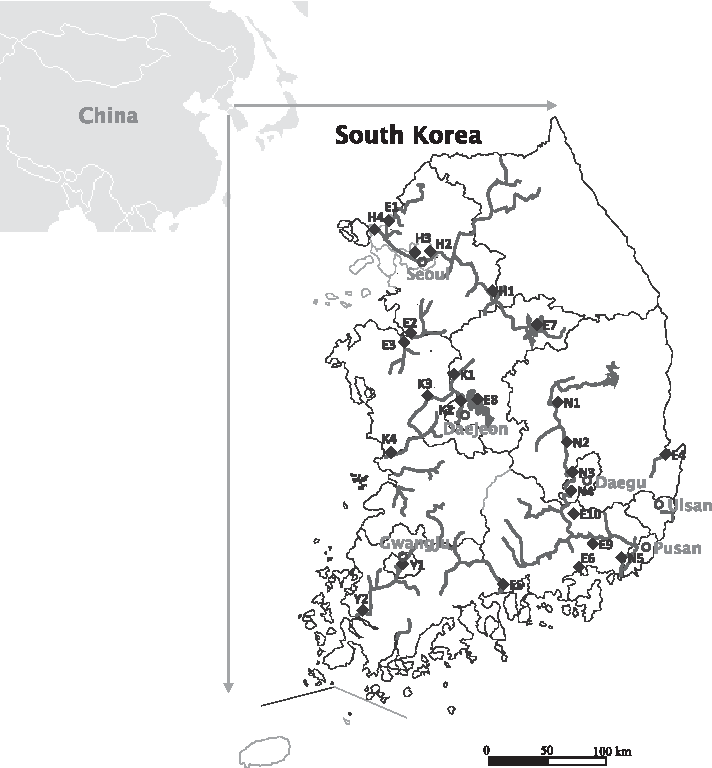
Map of sampling sites.
At each sampling site, surface water was collected by dipping a clean and acetone/hexane-rinsed 4-L stainless steel basket just under the surface of the water. More than 20 L water samples were collected at each sample site and the collected water samples were immediately transferred and stored in 4-L precleaned amber glass bottles capped with Teflon-lined lids. Sediment samples were collected from the upper sediment (∼5 cm) using an Ekman grab sampler to monitor the recent deposition of POPs and current POP levels in the water system. The collected sediment samples were transferred and kept in a precleaned brown glass bottle. The collected water and sediment samples were stored at 4°C, until further treatment. Extraction and analysis of the samples were conducted within 2 weeks and 1 month after the sampling, respectively.
Extraction and cleanup
All reagents used for extraction and cleanup were above the high purity grade. Solvents were obtained from J. T. Baker® and their purities were 95% for hexane, 99.7% for toluene, 99.3% for acetone, 99.3% for methanol, and 99.9% for acetonitrile. The target compounds for analysis were six OCPs, including α-HCH, β-HCH, γ-HCH, α-endosulfan, β-endosulfan, and endosufan sulfate, and seventeen PBDEs congeners (BDE-47, 49, 66, 71, 77, 85, 99, 100, 119, 126, 138, 153, 154, 156, 183, 184, and 191), perfluorooctanoic acid (PFOA), and PFOS.
For OCPs and PBDEs analysis, water and sediment samples were extracted by liquid–liquid extraction and Soxhlet extraction methods, respectively. Extraction of water samples was conducted without further filtration. About 1 L water sample was sequentially extracted with 100, 50, and 50 mL of dichloromethane in a separating funnel. Thirty grams of the dried sediment samples were mixed with 10 g anhydrous sodium sulfate, and were then extracted using a Soxhlet for 24 h with toluene/acetone (8:2, v/v) for OCPs and with toluene for PBDEs. The extracted OCPs were cleaned and fractionated with Florisil solid-phase extraction (SPE) (InerSep Florisil cartridge 5 g/20cc; GL Sciences, Inc.) and activated carbon cartridges (Supelclean ENVI-Carb SPE tubes 0.25 g/2cc; Supelco). The SPE cartridge was conditioned with hexane and the samples were eluted with 150 mL of hexane, followed by 100 mL of hexane:dichloromethane (1:3, v:v) and 50 mL of diethyl ether. The first two eluents were further cleaned with activated carbon cartridges for HCHs and endosulfan analysis. The cleanup of extracted PBDEs was performed in two stages: in a multilayer silica column (25 × 1 cm i.d.) packed with anhydrous sodium sulfate (1 g), silica impregnated with concentrated sulfuric acid (4 g), silica (1 g), silica impregnated with sodium hydroxide (2 g), silica (1 g), and anhydrous sodium sulfate (1 g) from top to bottom, and in an alumina column (25 × 1 cm i.d.) packed with 10 g of activated acidic alumina and 1 g of anhydrous sodium sulfate.
For PFCs analysis, water samples were extracted using OASIS HLB extraction cartridges (Waters Corp). The cartridges were preconditioned by eluting with 5 mL of methanol followed by 5 mL of deionized water. About 500 mL of water samples were loaded onto the cartridges at a rate of 1 mL/min and the eluent was discarded. After washing the cartridge with 3 mL of 40% methanol in water, the extracted fraction was eluted with 6 mL of methanol through the dried cartridge. For sediment analysis, homogenized freeze-dried 1 g sediment samples were sonicated in 5 mL of 1 M NaOH solution for 30 min and neutralized with 1 M HCl. The solution was then separated by centrifugation and mixed with 7.5 mL of acetonitrile:methanol (1:1, v/v) solution. The supernatant was separated by centrifugation and this process was repeated twice. The extracts were purified using a SPE cartridge. The pretreated samples were concentrated with a rotary evaporator and through N2 purging to 0.1 mL for instrumental analysis.
Instrumental analysis
Gas chromatography (HP 6890)/high-resolution mass spectrometry (Thermo Finnigan MAT 95XP) measurements were carried out for OCPs and PBDEs. A DB-5MS column (60 m long, 0.25 mm i.d., 0.32 μm stationary phase; Agilent) was used for the OCPs, and a DB-5HT column (15 m long, 0.25 mm i.d., 0.1 μm stationary phase, Agilent) was used for the PBDEs. The temperature programs of the GC were as follows: (1) for OCPs, initial hold at 100°C for 1 min, increase at 20°C min−1 to 200°C, increase at 2.5°C min−1 to 270°C, hold for 5 min; (2) for PBDEs, initial hold at 100°C for 5 min, 40°C min−1 to 200°C, hold for 5 min, 10°C min−1 to 320°C, hold for 10 min. The sample introduction was achieved by splitless injection. The MS was operated over 10,000 resolutions under positive EI conditions (35 eV electron energy), and data were obtained in the selected ion monitoring (SIM) mode. The compounds were monitored at m/z 218.9116, 220.9086, 222.9346, and 224.9317 79 for HCHs, 262.8569, 264.8540, 269.8804, and 271.8775 for endosulfan, 483.7132, 485.7111, 563.6216, 565.6196, 641.5322, 643.5302, 721.4406, and 723.4386 for PBDE congeners.
PFOA and PFOS were analyzed by high-performance liquid chromatography (Agilent 1200) equipped with a tandem mass spectrometer (Agilent 6430 Triple Quad LC/MS). A Kinetex C8 column (100 × 2.1 mm, 2.6 μm particle size) was used for analysis. Gradient conditions were applied at a flow rate of 0.5 mL/min, starting with 90% A (0.1% formic acid in distilled and deionized water) and 10% B (0.1% formic acid in acetonitrile). The initial conditions were held for 1 min and then decreased to 0% A at 20 min, held for 21 min, increased to 90% A at 25 min, and held constant for 30 min. The MS was operated with an electrospray ionization source under a negative ionization mode.
Quality control
After extraction, 13C-labeled 13C-OCPs (α-HCH, β-HCH, γ-HCH, α-endosulfan, β-endosulfan, chlordecone) (AccuStandard, Inc.), 13C-PBDEs (4, 15, 28, 47, 99, 153, 154, 183, 197, 207, and 209), 13C-PFOA, and 13C-PFOS (Wellington Laboratories, Inc.) were added as internal standards for each analysis, respectively. Before instrumental analysis,13C-TeCBz-70 (AccuStandard, Inc.) and 13C-BDE-138 (Wellington Laboratories, Inc.) were added as injection internal standards for OCPs and PBDEs analysis, respectively. The limit of detection (LOD) was determined as a signal-to-noise ratio of 2.5:1. Field blanks were routinely analyzed with field samples and found to be below the LOD. The average recoveries of OCPs (73–120%), PBDE (71–118%), and PFCs (84–119%) were acceptable. The LOD and the recoveries of POPs observed in water and sediment samples are summarized in Table 2. The relative standard deviations of the relative response factors of each compound in calibration solutions were below ±15%.
LOD, limit of detection; POP, persistent organic pollutant; PFC, perfluorinated compound; PBDE, polybrominated diphenyl ethers; PFOA, perfluorooctanoic acid; PFOS, perfluorooctane sulfonic acid.
Results and Discussion
Hexachlorocyclohexanes
Hexachlorocyclohexane concentrations in water and sediment sampled along the four major rivers and other small rivers are summarized in Fig. 2a. HCHs were detected in 96% of the water samples and the concentrations of total HCHs (ΣHCHs, sum of α-, β-, and γ-HCH) ranged from nondetectable (ND) to 1.16 ng/L with an average concentration of 0.342 ± 0.308 ng/L. The levels of HCHs detected in the water samples were higher than the concentrations of the sum of α- and β-HCH in the Five Great Lakes in USA (0.058–0.417 ng/L) (Venier et al., 2014), but quite low compared with the concentrations found in China (0.50–48.1 ng/L) (Bao et al., 2012), Spain (0.2–28.6 ng/L) (Fernandez et al., 1999), and India (0.16–15.9 ng/L). On the other hand, HCHs were only detected in 36% of the sediment samples. The total HCHs concentrations ranged from ND to 0.30 ng/g (dry weight of sediment) with an average concentration of 0.063 ng/g ± 0.093 ng/g d.w., which is similar to the levels found in Korean soil concentrations observed in our previous study (ND-0.358 ng/g) (Kim et al., 2014) and quite low compared with the levels of sediments found in China (0.00–14.85 ng/g) (Li et al., 2016).

Concentrations of
Since HCHs are widely used pesticides between the 1950 s and 1970 s in South Korea, high concentration was expected to occur near the agricultural land. However, in this study, high HCH concentrations were not observed in the water samples of the Yeongsan River (Y1 and Y2), where large agricultural lands are located nearby. Instead, high HCHs concentrations were observed in the water samples at the downstream of the rivers that flow through large cities such as Seoul (H3 and H4), Daegu (N3), and Daejeon (K2). The water samples having high HCH concentrations showed high contributions of γ‐HCH isomer, indicating the possible input of γ‐HCH to the water body. While the use of technical HCHs has been banned since 1979, lindane is currently used for lice removal mainly at home. According to the Korea Food and Drug Administration (KFDA), the costs for the production or import of lindane were reported as about 1.6 million U.S. dollars in 2005 (KFDA, 2009). Therefore, a high contribution of γ-isomer indicates the continuous input of γ-isomer to the environment due to the current use of lindane for medical purposes. Particularly high concentrations at the downstream of the highly populated areas indicate that HCHs might not be treated by current sewage treatment processes and could be discharged to the river.
The HCHs concentrations decreased further downstream of the Nakdong and Keum Rivers, including N5 and K3, probably due to the dilution, degradation, and/or transfer of γ-isomer in water to the sediment or atmosphere. In addition, the ratio of α- to γ-HCH isomer could provide a useful clue to the origin of HCH; a higher ratio (4–7) indicates a technical HCH source, whereas a lower ratio (<1) indicates a lindane (γ-HCH) source (Willett et al., 1998). The average ratio of α-HCH to γ-HCH isomers of the water samples was 0.37. Particularly low values of α/γ were observed at the sites with high HCHs concentrations, 0.06, 0.11, and 0.08 for H4, N4, and K2, respectively, indicating lindane source. In addition, the low α-isomer in water samples could be partly explained by the higher volatility (vapor pressure for α- and γ-isomers: (1.6 ± 0.9) × 10−2 Pa and (5.3 ± 1.4) × 10−3 Pa) and less solubility in water (log KOW for α- and γ-isomers: 3.9 ± 0.2 and 3.7 ± 0.2) of the α-isomer than the γ-isomer (Willett et al., 1998).
In the sediment, high HCHs concentrations were mainly observed at the downstream of the rivers such as H3, K4, Y2, E1, and E2 (Fig. 2a). Different distribution of HCH was observed between water and sediment along the major river systems. HCHs could be adsorbed on particles present in water due to their high log KOW values (3.7–4.1) (Willett et al., 1998). HCH-adsorbed particles could be transported to the downstream with the flow of water and sink to the bottom of the water body. Some of the mouths of the rivers blocked by man-made banks, such as K4, Y2, E2, and E3 (Table 1), showed relatively high HCH concentrations in the sediments (Fig. 2a). At the bank sites, the accumulation of HCH-adsorbed particles occurs with the flow of water, which probably results in the high HCH concentrations. In contrast to the water samples, β-HCH was the major contributor in the sediments composed of 68% of the total HCH, followed by α-HCH (24%) and γ-HCH (8%). Among the HCH isomers, β-HCH isomer is the least volatile (vapor pressure for α-, β-, and γ-isomers: [1.6 ± 0.9] × 10−2, [4.2 ± 0.3] × 10−5, and [5.3 ± 1.4] × 10−3 Pa) and the most resistant to environmental degradation (Willett et al., 1998). In contrast to flowing water, sediments can accumulate pollutants and can act as a long-term reservoir. Thus, high levels of β-HCH isomer in sediments indicate the local use of technical HCH in the past. The current use of γ-isomer was not reflected in the sediment sample probably due to the relatively high aqueous solubility of γ-isomer and continuous degradation of γ-isomer in sediments. Biodegradation of γ-isomer is reported to occur in the sediments either aerobically or anaerobically (Pesce and Wunderlin, 2004).
Endosulfans
Concentrations of endosulfans in the water and sediment samples of the four major rivers and other rivers and lakes are summarized in Fig. 2b. α-endosulfan, β-endosulfan, and endosufan sulfate were detected in 100%, 96%, and 92% of the water samples, respectively. The concentrations of total endosulfans (sum of α-endosulfan, β-endosulfan, and endosulfan sulfate) ranged from 1.66 ng/L to 15.8 ng/L (average 6.36 ± 3.23 ng/L). These concentrations were approximately one order of magnitude higher than those for HCHs, which might be because endosulfan was the most recently used pesticide investigated in this study. The levels of endosulfans detected in the water samples were quite low compared with the concentrations obtained in Florida, USA (1.74 to 158 ng/L) (Quinete et al., 2013), stream water from Ontario, Canada (10–170 ng/L) (Frank et al., 1982), and the Ganges River in India (ND to 94.7 ng/L) (Malik et al., 2009). On the other hand, α-endosulfan, β-endosulfan, and endosufan sulfate were detected in 84%, 64%, and 84% of the sediment samples, respectively. The total endosulfan concentrations ranged from ND to 6.85 ng/g with an average concentration of 1.99 ± 1.04 ng/g, which is slightly lower than the levels in the Korean soil concentrations observed in our previous study (0.06–8.42 ng/g) (Kim et al., 2014) and quite low compared with the concentrations in sediments observed in South Florida in the USA (1.74 to 158 ng/L) (Quinete et al., 2013).
In the water samples, the highest concentration (15.8 ng/L) was observed in the Yeongsan River, where large agricultural lands are located nearby, whereas relatively low concentrations were observed in the Han River flowing through the largest city (Seoul). This demonstrates that the recent application of endosulfans in the agricultural land for pest control seems to have introduced endosulfans to the water body. However, endosulfan concentrations in the sediment samples showed different trends from those of the water samples. High concentrations were observed in the sediments of the Han River (H2) and the natural swamp (E10). Han River runs through the center of the Seoul riverside parks and residential areas located nearby. The Han River sediment samples were taken near the bridge in deep water; less disturbance of the sediment can thus be expected. The endosulfans used at the upstream or at the riverside park might be transported and accumulated in the less disturbed sediment. In addition, the high endosulfan concentration was observed in the sediment of the natural swamp (E10), which is the largest inland natural swamp in Korea covering about 170 ha area. Endosulfans could be introduced to the swamp by the stream water entering the swamp, which is running through the upper agricultural areas. Thus, endosulfans applied in the upper agricultural land could be introduced to the swamp and accumulated in the sediment. Endosulfan sulfate was dominant in both water and sediment samples, accounting for an average of 62% ± 20% and 52% ± 24% of the total endosulfans in water and sediment, respectively (Fig. 2b). Commercial endosulfan consists of two stereoisomers, α- and β-endosulfan, at a ratio of approximately 7:3. Endosulfan sulfate is a major degradation product of α- and β-endosulfans, and is likely to be more persistent than its parent isomers (Ghadiri, 2001). Therefore, following the application, major degradation of endosulfans to endosulfan sulfate seems to have occurred in water and sediment. When we consider the relative distribution of endosulfans in different water bodies of stream, estuary, and reservoir, a higher ratio of endosulfan sulfate was observed in the reservoir than those in the stream or estuary in both water and sediment samples (Fig. 3). This suggests that more degradation seems to have occurred in the stationary water body than in the flowing water body.
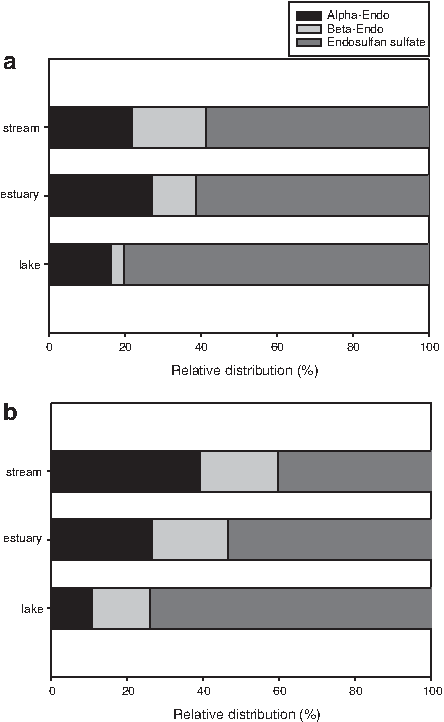
Relative distribution of endosulfan isomers in
Polybrominated diphenyl ether
PBDEs were found to be ubiquitous throughout South Korea (Fig. 2c). Concentrations of the 17 PBDE congeners (Σ17PBDE) identified in water samples ranged from 0.019 ng/L to 0.216 ng/L (average 0.097 ± 0.060 ng/L), which is comparable to the levels in the five Great Lakes of USA (0.034–0.227 ng/L) (Venier et al., 2014) and San Francisco Estuary (0.003–0.513 ng/L) in the USA (Oros et al., 2005) and lower than those reported for Izmir Bay in Turkey (0.49 ± 0.21 ng/L) (Cetin and Odabasi, 2007). The 17 PBDE congener concentrations in sediment samples ranged from 0.091 ng/g to 12.13 ng/g with an average of 3.11 ± 4.21 ng/g, which was comparable to the median levels in the sediments of seven major rivers of China (2.92 ng/g) (Wang et al., 2016) and slightly higher than the levels in sediments of the Great Lakes of USA (0.49–4.0 ng/g) (Song et al., 2004, 2005) and of the Korean soil concentrations observed in our previous study (ND-4.78 ng/g) (Kim et al., 2014). Since PBDEs have low solubilities in water, they eventually sink to the sediment once they are introduced to the water system. This might account for the high PBDE concentration in the sediment samples.
Increased Σ17PBDE concentrations in water samples were observed in the downstream of the rivers, such as H4, N5, Y2, and E6, indicating that PBDEs were transported to the downstream of the rivers. A relatively high concentration above the average concentration was observed in midstream of rivers that flow through heavily populated areas such as Seoul (H2 and H3) and Daejeon (K2 and K3). PBDEs have been widely used as flame retardants in many types of consumer products such as electronics, furniture, and fabrics (Hites, 2004). Thus, intensive use of electrical appliances and home and office furniture at these sites could have affected the PBDE levels in the surrounding water system. In addition, high concentrations were observed in sediment samples of man-made water reservoir upstream of Han River (E7) and natural swamp (E10). The water reservoir in E7 was formed by construction of dam in 1985 for the flood prevention, water management, and electricity generation. A small rural town with approximately 120 households was submerged during the construction. Thus, the high PBDE concentrations in the sediment of E7 could be contributed by the submerged town.
PBDEs are manufactured as three commercial BDE mixtures, that is, penta-BDE, octa-BDE, and deca-BDE. The production and use of deca-BDE was the highest, followed by penta-BDE and octa-BDE (Hites, 2004). However, since we only focused on the newly added Stockholm Convention POPs in this study, deca-BDE was not studied, whereas some of the tetra- to hepta-BDEs, including major congeners used in commercial penta- and octa-BDE mixtures, were studied. The major congeners observed in the water and sediment samples were those associated with the penta-BDE and octa-BDE commercial mixtures. The dominant BDE congeners in the penta-BDE mixtures are BDE-47, -99, -100, -153, and -154. The total of these five congeners in the water and sediment samples were 0.058 ± 0.045 ng/L and 2.02 ± 2.40 ng/g, representing 61.2% and 73.7% of total PBDE concentration, respectively. The dominant BDE congener in the octa-BDE mixture is BDE-183 and its contributions to total PBDE in water and sediment samples were 21.9% and 18.6%, respectively. Figure 4 shows the average distributions of the six main congeners in water and sediment samples. The congener profile indicates that the water and sediment were mainly affected by the penta-BDE mixture, and partly by octa-BDE. However, distribution of the main congeners BDE-47 and BDE-99 showed different ratios between water and sediment samples. The ratios of BDE-47 to BDE-99 could help to understand the sources of PBDEs in the environment. The commercial penta-BDE mixture, DE-71, has a BDE-47/BDE-99 ratio of approximately 0.6 (Stapleton et al., 2005). The BDE-47/BDE-99 ratios of the water samples ranged from 0.66 to 2.92 with an average of 1.48, whereas those of the sediment samples ranged from 0.150 to 1.01 with an average of 0.702. A particularly higher BDE-47/BDE-99 ratio was observed in the water samples than in the commercial BDE mixture. BDE-47 has a higher vapor pressure than BDE-99 and is more prone to long-range transport in the environment (Stapleton et al., 2005). The high proportion of BDE-47 relative to BDE-99 in the water samples might be due to the photolytic degradation of higher brominated congeners to lower congener in the water compared with the deep sediment.
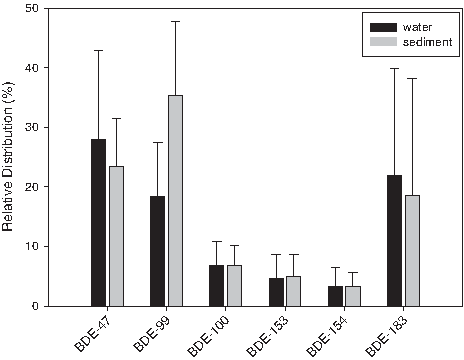
Relative distributions of six main PBDE congeners in water and sediment (dry weight basis) samples.
Perfluorinated compounds
PFCs are ubiquitously present in the environment due to their wide use in industry and their presence in many consumer products (Zareitalabad et al., 2013). Among PFCs, PFOA and PFOS are most frequently detected compounds in the environment due to their environmentally stability (Naile et al., 2013). PFOA was detected in 88% of the water samples, whereas PFOS was detected in 40%. The concentrations of PFOA and PFOS in water ranged from nondetectable (ND) to 69 ng/L (average 11.22 ± 18.12 ng/L) and ND to 24.91 ng/L (average 2.84 ± 5.73 ng/L), respectively, which were one order of magnitude higher than those for HCHs or PBDEs and slightly higher than those of endosulfan (Fig. 2d). These concentrations were comparable to those previously observed on the west coast of Korea (PFOA: 0.54–31 ng/L, PFOS: 0.35–47 ng/L) (So et al., 2004; Naile et al., 2013), whereas lower than those reported for the Great Lakes in the USA (PFOA: 27–50 ng/L, PFOS: 21–79 ng/L) (Boulanger et al., 2004). In sediment, PFOA was only detected in 2 samples of the 25 sediment samples with a concentration of 0.04 ng/g, whereas PFOS was observed in 13 sediment samples with concentrations ranging from ND to 3.72 ng/g (average 0.683 ± 1.16 ng/L). These concentrations were comparable to the median concentrations of PFOA (0.27 ng/g) in 47 sediment samples and PFOS (0.54 ng/g) in 58 sediment samples from previously reported studies (Zareitalabad et al., 2013).
High concentrations were observed at N3, K3, and K4, which were downstream of the highly populated areas of Daegu and Daejeon. PFCs have been widely utilized in many consumer products, such as clothing, papers, cooking utensils, and vehicles. The main source of PFCs in the environment is considered to be the release from PFC-containing products during their manufacture and usage. Thus, the high concentration of PFCs in water might reflect the current input of PFCs to the water systems. In contrast, a relatively low concentration was observed in the water samples of Han River, but the highest concentration was observed in the sediment, H3 (3.72 ng/g), where the discharge of the municipal waste water treatment plant was located nearby. The municipal wastewater treatment plant has been suggested as a main source of PFOA and PFOS in the previous study (Anna et al., 2008). Thus, the high concentration in the sediment of H3 was considered to be affected by the wastewater treatment plant. PFOA was dominant in the PFCs in the water samples, except for H1, K1, and E2. The high PFOS/PFOA ratio in H1, K1, and E2 could indicate an independent source of PFOS in the nearby locations. On the other hand, only PFOS was observed in the sediment similar to the previous study reporting higher PFOS/PFOA ratios in sediments and soils (Zareitalabad et al., 2013). PFOS could be more persistent in the sediment due to the strong adsorption potential in the solid phase and low vapor pressure compared with the PFOA (Anna et al., 2008).
Conclusions
In this study, we assessed the occurrence, levels, and distribution patterns of HCHs, endosulfans, PBDEs, and PFCs in major surface water systems in South Korea. We studied water and sediment in four major rivers (Han, Nakdong, Keum, and Yeongsan Rivers), six smaller rivers, and four reservoirs across South Korea in 2011. These organohalogen compounds were widely distributed throughout South Korea. Relatively different distributions of these POPs were observed in the water and sediment samples, even at the same site. Their average concentrations in water were high in the order of PFCs > endosulfans > HCHs > PBDEs, whereas their levels in sediment were in the order of PBDEs > endosulfans > PFCs > HCHs. The different distributions might be due to both the different characteristics of water and sediment and the physicochemical properties of these POPs. River water continuously changes and mainly reflects the current contamination levels, whereas sediments can act as a long-term reservoir of POPs. Relatively high concentration of γ-HCH was observed at the downstream water of the highly populated areas, which indicates the current use of lindane for medical purposes. High concentrations of PFCs and endosulfans in water might reflect the current input of PFCs to the water systems through the release from PFC-containing products and the recent extensive use of endosulfans for pest control. The relatively high solubility of PFCs in water (3.4 g/L) might result in the high concentrations in water compared with the sediment. On the other hand, the low solubility of PBDEs might cause them to eventually sink to the sediment in the water system, resulting in low concentration in water and high concentration in sediment. This was the first nationwide monitoring study of the newly added Stockholm Convention POPs in 2009 and 2011 in fresh water and sediment across South Korea, and the findings can provide important information for the government's implementation of the Stockholm Convention.
Footnotes
Acknowledgments
This research was supported by research funds of the Chonbuk National University in 2014 and partly by the Basic Science Research Program through the National Research Foundation of Korea (NRF) funded by the Ministry of Education (2016R1D1A3B03934814).
Author Disclosure Statement
No competing financial interests exist.