




Abstract
Abstract
Vitamin B12 wastewater, as a pharmaceutical wastewater, is difficult to treat due to its high concentrations of bioresistant organic matters, salinity, chromaticity, and poor biodegradability. A laboratory-scale microelectrolysis (ME) process with aeration device was designed to treat this wastewater. Our results suggested that, under obtained optimal condition of hydraulic retention time of 80 min, initial pH of 3, and air/water ratio of 100:1, the removal efficiency of chemical oxygen demand, ammonia nitrogen (NH3—N), and chromaticity in the wastewater by ME process was achieved by 43.9%, 7.9%, and 82.6%, respectively. Organic matter with benzene ring was largely removed or degraded and, therefore, C = C and C = O bonds were destroyed, and substituents of aromatic rings contained more aliphatic chains after treatment by ME process. All wastewater samples were divided into three parallel factor analysis components: one protein-like (component 1 [C1]) and two humic-like components (component 2 [C2] and component 3 [C3]). Fluorescence analysis results demonstrated that humic-like and fulvic-like substances with macromolecular weight and complex structure were decomposed or degraded into smaller molecular weight substances by ME process, in addition to those easily degradable protein-like components. We further demonstrated that biodegradability of vitamin B12 wastewater after treatment by ME process was increased using biodegradability index, suggesting that the ME process can greatly improve the removal efficiency of contaminants in wastewater by subsequent treatment process.
Introduction
W
Many pretreatment methods have been reported to increase the biodegradability of this type of wastewater, including ozone (Lester et al., 2013; Cui et al., 2014; Punzi et al., 2015; Xiong et al., 2016a, 2016b), Fenton (Badawy et al., 2009; Ben et al., 2009; Xu et al., 2014; Diya et al., 2015; Pi et al., 2015; Yuan et al., 2016), and photo-Fenton oxidation (Liu et al., 2012a; Anfruns et al., 2013; Silva et al., 2013). However, microelectrolysis (ME) has been proposed as an attractive alternative for the pretreatment of biorefractory organic wastewater, because of its high efficiency, ease of operation, and low cost (Fan et al., 2009; Lai et al., 2012, 2013b; Ying et al., 2012; Zhu et al., 2014). But the optimal conditions for treating wastewater with the ME process can vary greatly, depending on the specific characteristics of the water.
In this study, the effects of three major factors, hydraulic retention time (HRT), pH, and the air/water ratio, on the removal rate of contaminants were investigated, and their variance ranges were 0–300 min, 2–12, and 0:1–1,200:1, respectively, to find the optimal technical conditions for treating vitamin B12 wastewater with the ME process. The principal reactions of the ME process are listed below (Lai et al., 2013a, 2013b; Xiong et al., 2015):
Anodic:
Cathode:
Under acidic conditions:
Under neutral to alkaline conditions:
For anode (oxidation), Equation (1) produced Fe2+, and then the Fe2+ was oxidized into Fe3+, and further transformed into Fe(OH)3 under the aerobic condition. However, for cathode (reduction), the equation varied with different reaction condition. Atomic hydrogen ([H]) can only be produced under acidic condition (Eq. 3). It is reported that organic contaminants can be removed by Fe, [H] and Fe2+ (Guan et al., 2012). Furthermore, the formed ferrous and ferric hydroxides can also reduce organic contaminants by adsorption and coprecipitation (Cheng et al., 2007). Therefore, the ME process has attracted great interests for its operational simplicity, low cost, and efficiency.
Dissolved organic matter (DOM) is ubiquitous in aquatic environments, and it plays a crucial role in the geochemical and photochemical reactions by participating in carbon (C) and nutrient (N, P, S) cycles. DOM dominates microbial-mediated reactions by serving as a potential substrate, where it is the base of the food web, providing energy to heterotrophic organisms and further controlling biological processes, such as microbial degradation (Franco, 2001). Furthermore, DOM can strongly interact with organic and inorganic contaminants, and can heavily influence their transport, transformation, bioavailability, toxicity, and ultimate fate (Li et al., 2014; Zhao et al., 2015).
Few studies, however, has investigated the fluorescent characteristics of vitamin B12 wastewater DOM during the ME process. Insight into variances of fluorescence components and molecular structure of DOM in the wastewater by the ME process can provide better understanding of degradation mechanisms in them. It is therefore necessary to explore these characteristics and their relationship with chemical oxygen demand (COD), ammonia nitrogen (NH3—N), chromaticity, and nutrients for a better treatment outcome.
Hence, the purposes of this study are: (1) to investigate the optimal experimental conditions of vitamin B12 wastewater treatment with aeration techniques and the ME removal performance for COD, NH3—N, and chromaticity, using a single-factor analysis method; and (2) to gain insight into the fluorescence characteristics of vitamin B12 wastewater DOM and their variances in the ME process through advanced fluorescence techniques, including ultraviolet visible (UV-vis), three-dimensional fluorescence excitation–emission matrix (3D-EEM) and parallel factor analysis (PARAFAC). This work will give reference of optimal reaction condition for treatment of pharmaceutical wastewater and help us to better understand the degradation process of contaminants in wastewater by the ME process.
Experimental and Analytical Methods
Materials and experimental system
Raw vitamin B12 wastewater used in this study was the effluent from an upflow blanket filter wastewater treatment plant located in Shijiazhuang city, Hebei Province in China. The main characteristics of the wastewater were: initial pH of about 7.25, with high proportions of COD (280–607.6 mg/L), NH3—N (197–459.3 mg/L), and suspended solids (SS) (238–347 mg/L), characterized by a heavy brownish-black color and a noxious odor. The microelectrolytic reactor used in the experiment was handmade. A simple schematic diagram of the ME experiment is shown in Fig. 1. The major components of the ME experiment device were the reactor (made of PVC), a flowmeter, an air-control valve, and ventilator devices. ME materials of a similar shape and particle size (diameter range: 2–3 cm) were selected and equal quantities were placed into the reactor for all the experiments.
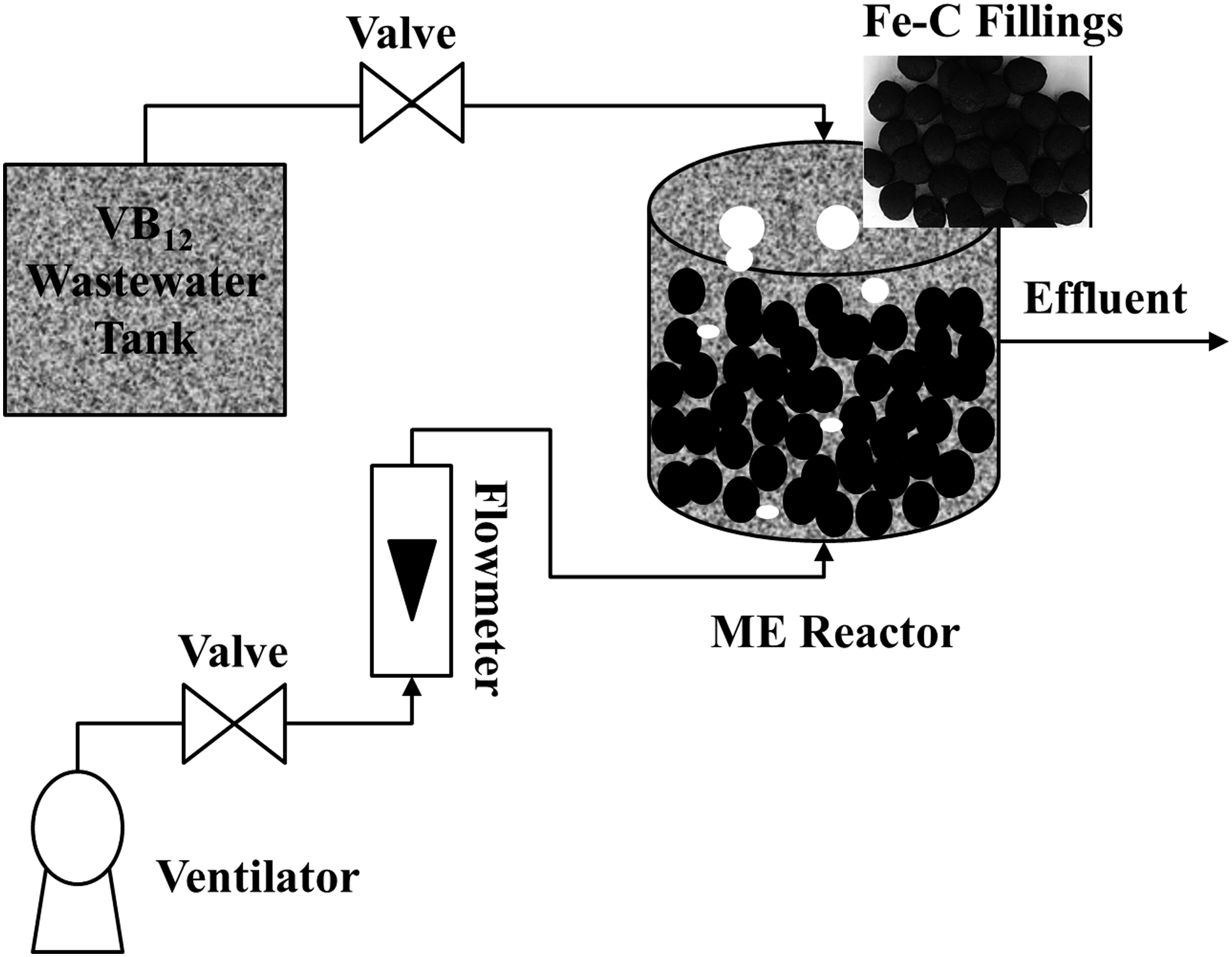
Schematic diagram of microelectrolytic system with aeration device.
To activate the ME material before commencing an experiment, an appropriate amount of acid was added into the reactor to maintain the pH value of the solution at 3 for half an hour, the acid solution was then poured out. The valves were then opened to allow the vitamin B12 wastewater to flow into the reactor, and the flowmeter was used to adjust the flowrate of wastewater and air. The initial pH of the wastewater was modified by adding either sulfuric acid or sodium hydroxide. Then, record parameters what we need (HRT, pH of influent and effluent, and flowrate of air and vitamin B12 wastewater) and sampling to detect all parameters of wastewater at the time. All experiments were carried out at room temperature (∼25°C).
Testing and analysis methods
Basic parameters determination
Concentration of COD in vitamin B12 wastewater was determined using the fast digestion-spectrophotometric method (HJ/T 399-2007). Nessler's reagent spectrophotometry (HJ 535-2009) was applied to measure the content of NH3—N, based on the wastewater's ability to form a yellow–brown compound in response. The value of dissolved iron concentration was measured with atomic absorption spectrometry. The values of pH and chromaticity were measured with a Ray magnetic PHS-3 c pH meter and a Shanghai Xinrui SD9011B portable chromameter, respectively.
Ultraviolet visible
UV-vis absorbance spectra were collected using a double-beam spectrophotometer (PerkinElmer Lambda 650 s) in a 1-cm quartz cuvette at room temperature (about 25°C) over the wavelength range of 200–700 nm with ultrapure water as the reference. Specific UV absorbance at the wavelength of 254 nm (SUVA254), normalized for dissolved organic C concentration, was calculated (Weishaar et al., 2003; Guo et al., 2014).
EEMs and PARAFAC modeling
EEM fluorescence spectroscopy characteristics of the wastewater leachate samples were analyzed using an F-7000 FL spectrophotometer with excitation and emission wavelength ranges of 200–450 and 280–550 nm, respectively. The spectra were recorded by increasing the wavelength by 5 nm for both excitation and emission, at a scan rate of 2,400 nm/min using excitation and emission slit bandwidths of 5 nm. A 290-cm cut-off filter was applied to all leachates to limit second-order Raleigh scattering.
PARAFAC modeling, combined with EEMs, has revealed new insights into DOM in recent years, and is now widely used. A detailed description of PARAFAC can be found in the protocol of Bro (1997). In this study, the EEMs spectra samples were analyzed using PARAFAC and carried out in MATLAB 7.0 with the DOM Fluor toolbox, and split-half analysis was further performed to confirm the reliability of the modeling results.
Before fluorescence analysis, all vitamin B12 wastewater samples were filtered through a 0.45-μm membrane filter for DOM measurement. Obtained DOM leachate samples were collected in precleaned (with nitric and Milli-Q water) brown sampling bottles, stored in the dark at 4°C, and analyzed within 24 h.
Results and Discussion
Effects of various factors on pretreatment of vitamin B12 wastewater during ME process
Influence of HRT
In general, the removal efficiency of contaminants in wastewater was increased with increasing HRT; however, a too-long reaction time cannot achieve high volume of wastewater to be treated. Whereas, short HRT will result in incomplete reaction and low contaminants' removal rate. Therefore, it is necessary to investigate the optimal HRT of wastewater in the ME process. The influence of HRT on the removal efficiencies of COD, NH3—N, and chromaticity in vitamin B12 wastewater are shown in Fig. 2a.

Under experimental condition of pH = 3, air/water ratio = 200:1, and different HRTs, removal rates of COD, NH3—N, and chromaticity
Both the COD and chromaticity-removal rates increased with increasing HRTs. At the beginning of 30 min reaction time, owing to acid condition, numerous macroscopic galvanic cells were formed, therefore, a large number of atomic hydrogen ([H]) with a significant reducing power, electrons, and Fe2+ was produced in the ME process, which greatly reduced organic pollutants in vitamin B12 wastewater (Liu et al., 2012b; Lai et al., 2013b; Xiong et al., 2015). With reaction time increasing from 30 to 80 min, alkaline substances (ferric and ferrous hydroxides) were produced gradually and less macroscopic galvanic cells were formed, the organic pollutants in wastewater were removed mainly through adsorption and coprecipitation by these alkaline matters, and the removal rate of COD and chromaticity were achieved by 53.5% and 83.2%, respectively, during the reaction time of 80 min.
However, the adsorption of ferric and ferrous hydroxides was achieved by saturation when the reaction time further increased, and the removal rate of COD and chromaticity remained nearly constant. As a result, most of the bioresistant contaminants, and the chromophores and auxochromes of refractory substances, were either removed or transformed to easily biodegradable and colorless products (Cheng et al., 2007). However, by further increasing HRT, they slowly increased, owing to the consumption of H+. Compared with the removal rates for COD and chromaticity, the ME process for removing NH3—N was low, it removed only 10.8% of the total NH3—N in the initial wastewater sample during first 3 h of reaction time.
This result was consistent with Liu et al. (2012b), whose results showed that the removal efficiency of NH3—N was 7.1%, using only an ME process. Qi et al. (2015) had demonstrated that most NH3—N in wastewater can be removed by subsequent biological degradation reactors after ME pretreatment. Another possible cause of this phenomenon was that more than 500 mg/L of NH3—N in the HRT experiment influent was too large an amount for a laboratory-scale ME device to treat efficiently.
The dissolved iron yield trend was opposite to that of the pH value effects (Fig. 2b). Under aerated acidic conditions, primary cells had a higher reaction potential, which can promote the oxidation of Fe to Fe2+, and Fe2+ is more likely to be oxidized to Fe3+ under such aerated conditions. The iron leaching, therefore, was shown to be mainly driven by the acidic conditions generated during the initial 0–30 min of the ME process, when the dissolved iron (Fe2+ and Fe3+) yield increased from 221.5 to 6,486.9 mg/L. However, with the consumption of H+ ions and alkaline substances produced in the ME process, it decreased sharply under alkaline conditions and then remained stable with increasing reaction time. Therefore, the appropriate reaction time in this study was determined to be 80 min.
Influence of initial pH
Figure 3a and b illustrates the effect of initial pH on the removal efficiencies of organic contaminants and the generation of dissolved iron in the ME process. The COD removal rate increased from 44.6% to 60.1%—the highest removal efficiency—when the initial pH increased from 2 to 3. The COD removal rate was lower under more acidic conditions (pH = 2); this phenomenon may be explained by the fact that high-concentration H+ ions can compete for electrons produced at the anode of the ME process, which resulted in an electron flow that is faster than the speed of the electron reaction (Xu et al., 2016). Consequently, polarization occurred, which caused a potential difference and the iron corrosion reaction to slow down. With a further increase in the initial pH, from 3 to 7, the removal rate of COD first decreased, and then increased to 59.5% when the initial pH rose to 9, and decreased again as the pH value continued to rise.
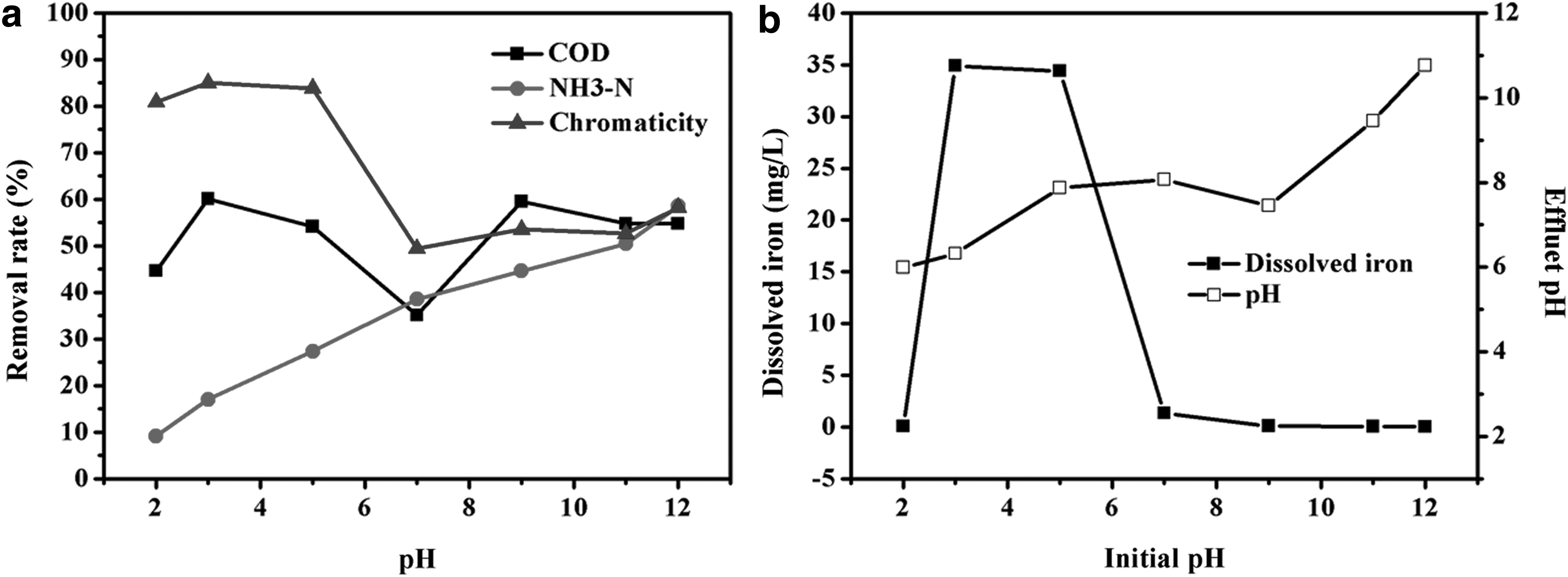
Under experimental condition of HRT = 180 min, air/water ratio = 200:1 and different initial pH values, removal rates of COD, NH3—N, and chromaticity
The same phenomenon was observed in the chromaticity removal efficiency during the ME process. A large amount of coagulated sediments, which can absorb and capture small suspended colloidal particles, macromolecular organic pollutants, and produced precipitate, may have contributed to this result. As shown in Fig. 3a, the NH3—N removal rate increased with increasing initial pH value in this experiment. What is more, its highest removal rate, 58.2%, was achieved at the pH value of 12, much higher than any rates in the HRT-variation experiment. This result may be attributable to differences in the batches of wastewater influent, which caused higher concentrations of NH3—N in the HRT experiment influent (over 500 mg/L) too high for a laboratory-scale device to treat efficiently, whereas its concentration in the pH experiment influent was below 300 mg/L. Other possible reasons for this phenomenon are: first, more ammonium ions were transformed to free ammonia under a stronger alkaline environment; and second, free ammonia ions were removed from the solution under aeration. This result also demonstrated that initial pH value can greatly influence the denitrification effect.
Dissolved iron yield rose sharply to its maximum, 34.9 mg/L, at an initial pH value of 3 and remained stable as the pH value increased to 5. With further increases in the pH, however, to an alkaline condition, the concentration of dissolved iron sharply decreased and then stabilized. A higher H+ concentration, in combination with a lower pH, can promote the production of more dissolved iron, as shown by Equations (1) and (2), and can increase the expenditure of acidic substances. An initial pH of 3 was, therefore, chosen for the subsequent experiments, based on the obtained results and the operating costs of the ME process.
Influence of the air/water ratio
Figure 4a and b show the effect of the air/water ratio on the removal efficiencies of COD, NH3—N, and chromaticity, and the generation of dissolved iron, during the ME process. Apparently, the highest stable removal efficiencies, from 94.1% to 98.2%, of the chromaticity of the vitamin B12 wastewater, were found under different ratios of air/water, suggesting that the influence of the air/water ratio on chromaticity removal is not obvious. However, the NH3—N of the wastewater was not removed under nonaerated conditions, and was only slightly removed after aeration (i.e., different air/water ratios) in the ME process. It was reasonable to deduce that aeration was the major cause of the removal of ammonia nitrate. Free ammonia produced in the ME process were released into the air under aerated conditions, causing the removal of ammonia nitrate.

Under experimental condition of pH = 3, HRT = 180 min and different air/water ratios, removal rates of COD, NH3—N, and chromaticity
The removal rate of COD increased from 44.6% to its highest value of 73.2% under a nonaerated air/water ratio of 100:1. Under nonaerated conditions, the degradation of organic matter mainly depends on the [H] and [Fe2+] ions produced in the ME unit. What is more, not only the functions of flocculation–adsorption by coprecipitation, and enmeshment in Fe(OH)2 and Fe(OH)3 originated from Fe2+ produced during anode oxidation, but also by electrophoresis under electric fields created by electron flow, which also contributed to the removal of organic pollutants. But aerated conditions, the ME process can result in a higher reaction potential and faster redox, according to Equation (4). Moreover, according to previous studies (Lan et al., 2012; Ying et al., 2012; Xu et al., 2016), oxygen can compete as an electron acceptor under aerated conditions, thus generating H2O2 in the ME process, and further produce •OH under the catalysis of Fe2+. Consequently, these produced hydroxyl-free radicals can oxidize organic pollutants into nontoxic matters. Hence, a higher removal rate occurred under the air/water ratio of 100:1, compared with nonaerated conditions. The same result has been obtained in the treatment of landfill leachate and other refractory industrial effluent (Ying et al., 2012; Lai et al., 2013a). With further increases in the air/water ratio, a decreasing trend was observed in the removal rate of COD.
However, the yield of dissolved iron sharply decreased at a 100:1 air/water ratio, and remained stable even with a further increase in the ratio (Fig. 4b). Several possible reasons may contribute to these phenomena: first, the water flowing onto the Fe-C surface can partly eliminate passivation of the Fe-C fillings under a higher air/water ratio (Xu et al., 2016); second, a supersaturated state with further increases in the air/water ratio and too much oxygen may compete for electrons produced at the anode of the ME materials, which could cause a reduction in the potential difference, and a corrosion reaction (Xu et al., 2016). Last, but not the least, a higher air/water ratio results in a smaller effective contact area of reaction, resulting in a lower COD removal efficiency. An air/water ratio value of 100:1 was hence selected for the subsequent experiments, based on the removal efficiency and the costs of the ME process.
Based on the experimental results above, optimal operational conditions of the ME process for the treatment of vitamin B12 wastewater were: HRT = 80 min, pH = 3, air/water = 100:1. The concentrations of COD, NH3—N, and chromaticity in the vitamin B12 wastewater were decreased from 607.7 mg/L, 459.3 mg/L, 340 to 340.9 mg/L, 423 mg/L, and 59.2, respectively, and their removal rates were achieved by 43.9%, 7.9%, and 82.6%, respectively, under the optimal condition.
Degradation process of organic contaminants in vitamin B12 wastewater
To further illustrate the causes of the degradation process of vitamin B12 wastewater, the decoloration of vitamin B12 wastewater, the decay of COD, the removal of NH3—N, and the change of organic compounds in effluent in the ME process–spectrum analysis techniques, including UV-vis, 3D-EEMs, and PARAFAC, were applied in this study.
UV-vis analysis
UV-vis spectra of vitamin B12 wastewater under different effectors, and the optimal conditions, are shown in Fig. 5, which presents the absorbance variance with HRT increases. Apparently, the absorbance between 190 and 400 nm decreased significantly after 60 min of ME treatment, and the characteristic absorption peak between 250 and 290 nm, and the typical benzene ring, almost disappeared with HRT increases (Wang et al., 2013), suggesting that organic contaminants with benzene rings were basically removed. With further increase in the HRTs, the absorbance decreased slightly. Compared with the impact of HRT, the impact of pH and air/water ratios on absorbance showed in Fig. 5b and c, is lower in the ME process. The lowest absorbance of ME effluent was found at pH = 2 and air/water ratio = 100:1, showing the highest removal efficiency of macromolecular organic compounds. However, pH = 3 was selected as the optimal condition, because a stronger acid condition (pH = 2) could aggravate the erosion of ME material and increase the content of Fe2+ in the solution, resulting in increasing the COD and chromaticity (as shown in Eq. [1]) and higher operational costs.
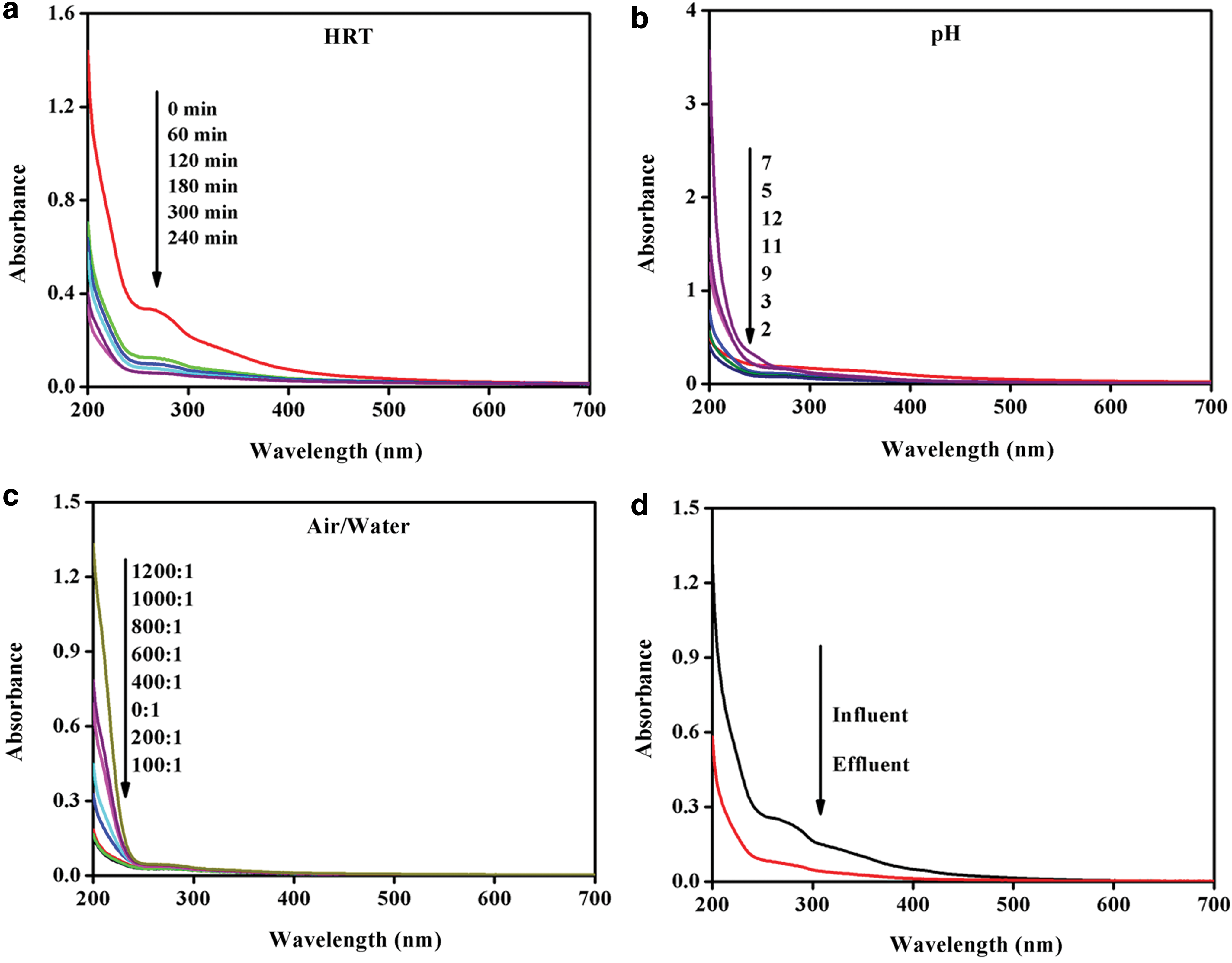
UV-vis spectra of wastewater under
Figure 5d represents the vitamin B12 wastewater absorbance changes before and after treatment by the ME process. Obviously, the ME effluent absorbance declined significantly, showing that complex compounds were degraded into more easily biodegradable substances. SUVA254, an index of the content of humic-like substances with large molecules and aromatic compounds, with C = C and C = O (Nishijima and Speitel, 2004), are listed in Table 1. A lower value of SUVA254 shows a lower humification degree. The SUVA254 variance trends under the impacts of HRT, pH, and air/water ratio were consistent with the absorbance curve variance (Fig. 5). The aromaticity degree of the vitamin B12 wastewater decreased as reaction time increased, and its lowest value was obtained at pH = 2 and air/water ratio = 100:1, suggesting that most of C = C and C = O in wastewater were broken by the reaction process under the condition, and macromolecular compounds degraded into small molecular substances.
The experimental condition of pH = 3 and air/water ratio = 200:1.
The experimental condition of HRT = 180 min and air/water ratio = 200:1.
The experimental condition of pH = 3 and HRT = 180 min.
HRT, hydraulic retention time.
PARAFAC and EEMs analysis
Fluorescence components of wastewater DOM samples in the ME process divided by PARAFAC model were presented in Fig. 6, including one protein-like component (component 1 [C1]) and two humic-like components (components 2 [C2] and 3 [C3]).
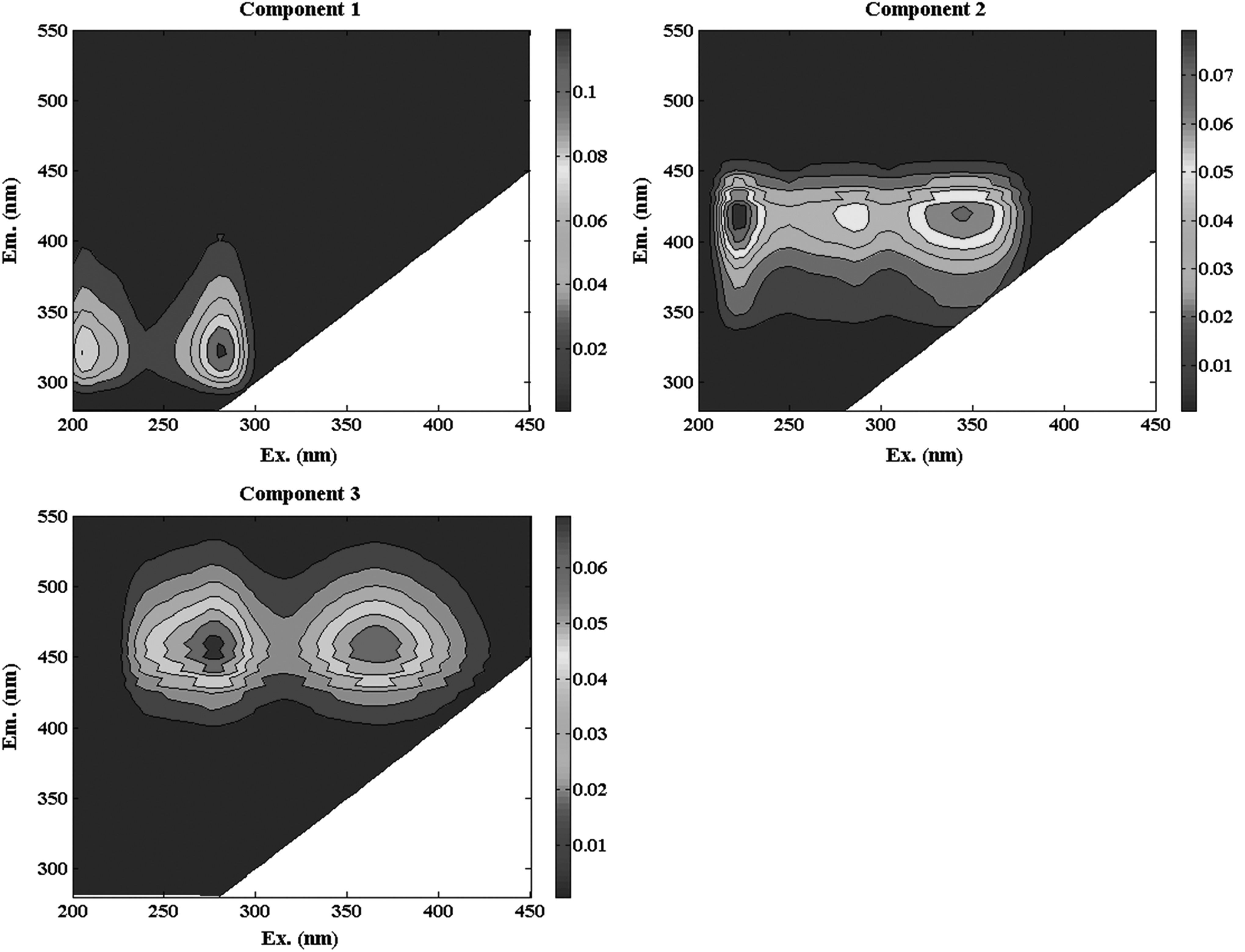
Component 1, component 2, and component 3 of DOM from ME experiment 87 DOM samples identified with PARAFAC model. DOM, dissolved organic matter; PARAFAC, parallel factor analysis.
C1 had a primary (and secondary) fluorescence peak at an Ex/Em wavelength pair of 280 (205) nm/320 nm, which is a typical protein-like peak. This component can often be seen in wetland ecological systems, wastewater plants, fresh landfill leachates, and bacterial extracellular polymeric substances (Baker and Curry et al., 2004; Guo et al., 2014; Henderson et al., 2009; Jun et al., 2011). Yunlin et al. (2011) showed that the cumulative value of this protein-like component was closely related with the biodegradability of the DOM and the activities of microorganisms.
C2 was composed of three excitation maxima at 220, 285, and 345 nm, all of them with an emission maximum of 420 nm, which indicates a humic-like component (Wen et al., 2003; Yang et al., 2015).
The PARAFAC fluorescence C3 exhibited a primary (and secondary) fluorescence peak at an Ex/Em wavelength pair of 275 (365) nm/460 nm, which is also a humic-like component often found in waterbodies, landfills, and compost heaps (Guo et al., 2014; Lv et al., 2014). C3 is often recognized as an aromatic compound with a high molecular weight, and longer excitation and emission wavelengths, indicating a high degree of polymerization (Stedmon et al., 2003; Guo et al., 2014). Compared with C1 and C2, C3 showed an obvious red shift, suggesting that C3 had a more complex structure.
Figure 7 presents the fluorescent intensity changes for the three components obtained by the PARAFAC model under the effects of HRT, pH, and the air/water ratio, respectively. As HRT increased, the fluorescence intensity of the three fluorescence components declined dramatically for the first 60 min, and then decreased slightly as HRT increased further. Under the influence of pH, the change of three components' fluorescence intensity was irregular, and the lowest fluorescence intensities appeared at pH = 2, demonstrating the highest contaminant removal efficiency, which was consistent with the UV-vis absorbance results. With the increases in pH value, the intensity of three fluorescence components were increased from acid condition to neutral condition, and decreased sharply at pH = 9 and increased again further increasing the pH value. There were no obvious changes in the three components' fluorescence intensity under different air/water ratios.
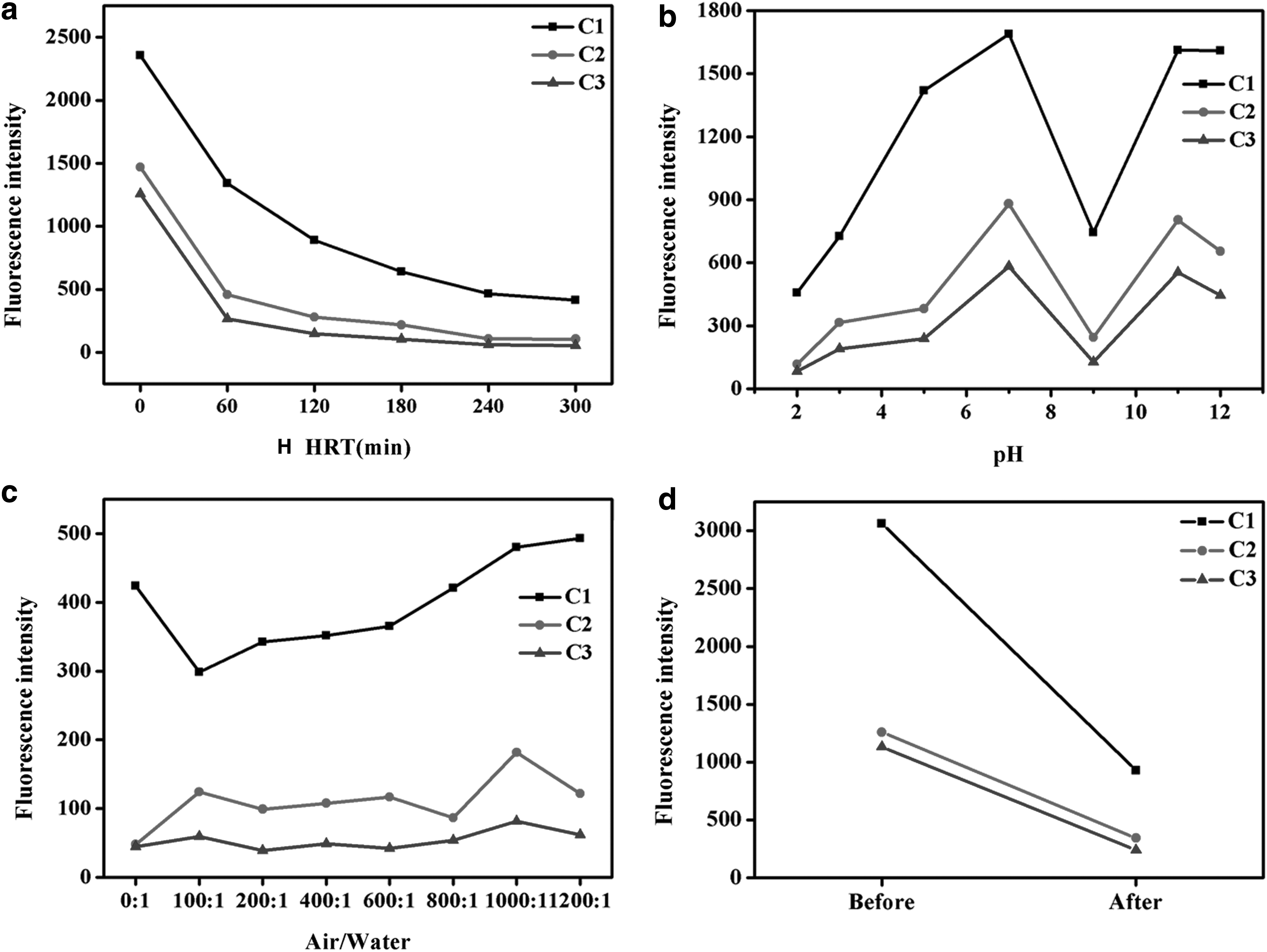
Fluorescent components (C1, C2, and C3) intensity variances of wastewater under
Under the optimal conditions (HRT = 80 min, pH = 3, air/water = 100:1, temperature = 25°C), the fluorescence intensities of three PARAFAC components of vitamin B12 wastewater DOM were significantly decreased after treatment by the ME process (Fig. 7d), suggesting that a great deal of fluorescence substances were degraded or removed.
To investigate the biodegradability of vitamin B12 wastewater after treatment by the ME process, the biodegradability index values of C1/C2, C1/C3, and C2/C3 are calculated in our study and listed in Table 1. High values represent high biodegradability, and low ones indicate low biodegradability. Under the condition of different HRT and pH, the values of C1/C2, C1/C3, and C2/C3 ratios were increased by different levels after treatment by the ME process, indicating that the biodegradability of vitamin B12 wastewater was increased. This phenomenon can be explained by the fact that humic-like C2 and C3 with high molecular weight in wastewater were decreased more than protein-like C1, or degraded into smaller molecular weight substances. However, the values of C1/C2, C1/C3 ratios were decreased and the value of C2/C3 ratios was increased when the air/water ratio increased. This result was contributed by the fact that high air/water ration resulted in less effective reaction area between wastewater and ME materials.
As discussed above, HRT was the key role in removing contaminants in vitamin B12 wastewater. Therefore, to further explore the degradation process of vitamin B12 wastewater, 3D-EEMs fluorescence maps of wastewater under different HRTs were presented in Fig. 8. Previous study (Coble, 1996; Leenheer and Croue, 2003) divided excitation–emission matrix map into four fluorescence peak regions: (1) peak A region correspond to fulvic-like substances centered at Ex/Em = 240–290/370–440 nm; (2) peak B region correspond to tyrosine-like components centered at Ex/Em = 200–250/280–350 nm; (3) peak C region centered at Ex/Em = 350–440/430–510 nm correspond to humic-like components; (4) peak D region correspond to tryptophan-like components with long wavelength centered at Ex/Em = 250–280/300–380 nm.
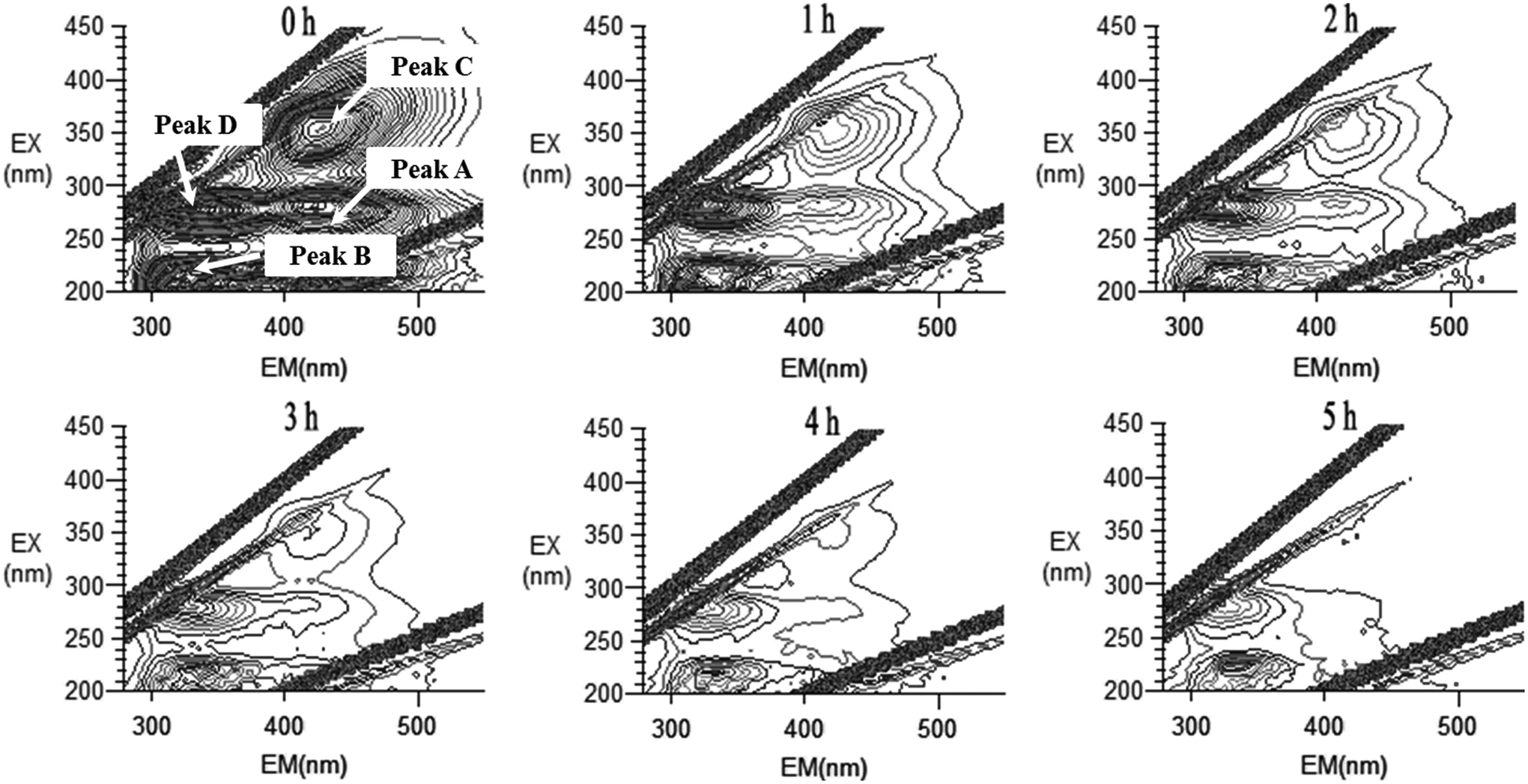
3D-EEM spectra variances under experimental condition of pH = 3 and air/water ratio = 200:1 and different HRTs. 3D-EEM, three-dimensional fluorescence excitation–emission matrix.
As shown in Fig. 8, the fluorescence intensity of four peaks was decreased dramatically after 1 h treatment by ME process. With further increases in HRT, fluorescence peak A and C gradually disappeared, and the fluorescence intensity of peaks B and D was significantly decreased too, suggesting that fulvic-like and humic-like substances with macromolecular weight and complex structure in vitamin B12 wastewater were effectively removed or decomposed into more biodegradability matters after ME process treatment, in addition to easily degraded substances (tyrosine-like and tryptophan-like components). This result also indicated that the humification of the wastewater was decreased, whereas the biodegradability was significantly increased after ME process treatment, which was consistent with the previous result obtained by PARAFAC analysis.
Conclusions
In this study, single-factor analysis method was applied to investigate HRT, pH, and air/water ratio impact on the removal efficiency of COD, NH3—N, and chromaticity in the vitamin B12 wastewater, and an optimal condition was obtained: HRT = 80 min, initial pH = 3, and air/water ratio = 100:1. Under the condition, the concentrations of COD, NH3—N, and chromaticity in vitamin B12 wastewater by ME treatment were decreased from 607.7 mg/L, 459.3 mg/L, 340 to 340.9 mg/L, 423 mg/L, and 59.2, respectively, and their removal efficiencies were achieved by 43.9%, 7.9%, and 82.6%, respectively. The UV-vis spectra demonstrated that organic matters with benzene ring were largely removed, and C = C and C = O bonds were destroyed in the ME process, indicating that the aromaticity of wastewater after the ME process was decreased. One component with protein-like nature (C1) and two components of humic character (C2 and C3) were divided by PARAFAC model to explain the combined raw and treated fluorescence data set. After treatment by the ME process, three fluorescence components of the vitamin B12 wastewater were removed or decomposed into more easily degraded substances, especially for humic-like C2 and C3 with macromolecular weight and complex structure, which resulted in the values of C1/C2, C1/C3, and C2/C3 being increased, suggesting that the biodegradability of ME process effluent was increased. The 3D-EEMs fluorescence maps also showed that humification of wastewater was significantly decreased. Therefore, as a pretreatment, the ME process can greatly improve the removal efficiency of contaminants in wastewater by subsequent treatment units.
Footnotes
Acknowledgments
Supported by the National Natural Science Foundation of China (grants 51578037 & 51669028) and National Key Research and Development Program (2016YFC0501906-1-3).
Author Disclosure Statement
No competing financial interests exist.