




Abstract
Abstract
Membrane fouling remains the most challenging issue in membrane bioreactors (MBRs); however, fouling mechanisms are as yet incompletely understood. In this study, 20 membranes with different characteristics and the mixed liquors derived from MBRs treating sewage wastewater (SAS), restaurant wastewater (RAS), and landfill leachate (LAS) were adopted to study membrane fouling mechanisms. Statistical analyses were conducted to explore the correlations between different membrane properties, and results found that characteristics of membranes were not independent of each other but mutually influential. However, the trend of fouling propensity within each membrane was dependent on the filtering medium. Membranes with smaller pore sizes and strong hydrophobicity showed a slower fouling rate when filtering LAS, whereas an opposite fouling trend was evident for SAS. Furthermore, dissolved organic matter (DOM) derived from MBRs treating SAS (SASDOM) showed the highest permeability followed by DOM derived from MBRs treating RAS (RASDOM), whereas DOM derived from MBRs treating LAS (LASDOM) exhibited the worst permeability due to its strong hydrophobicity. Finally, fouling propensities of hydrophobic and hydrophilic fractions isolated from SASDOM were predicted using extended Derjaguin-Landau-Verwey-Overbeek (XDLVO) theory, and the hydrophobic fraction and charged hydrophilic fraction with the lowest and highest free energy of cohesion, respectively, showed the fastest and slowest fouling propensity, respectively. Results indicate that membrane fouling potential was affected by the interactions between membranes and filtering mediums, rather than the specific properties of individual membranes.
Introduction
M
On the basis of existing studies, the factors effecting membrane fouling are mainly classified into three aspects as follows: (1) the characteristics of the membrane; (2) the properties of the filtering matrix; and; (3) the operational conditions of membrane processes (Le-Clech et al., 2006). Among these factors, the antifouling ability of a membrane is directly dependent on the membrane properties, including pore size, hydrophilicity, zeta potential, and surface roughness. The variations of operational conditions during the membrane separation process (such as aeration rate, flux, sludge retention time, and hydraulic retention time) could change the properties of a mixed liquid and the hydraulic condition in the reactors, thereby subsequently influencing the initiation of membrane fouling. Due to the complexity of membrane fouling in MBRs, none of these factors can be considered as individual indicators to evaluate the propensity of membrane fouling.
For instance, the effects of membrane pore size on membrane fouling propensity depend on the particle size distribution of the filtering medium (Trzaskus et al., 2016). In general, clogging of the membrane pores is likely to occur when the membrane pore size is greater than the particle size of the filtering medium. Therefore, the membranes with larger pore size tend to foul faster than those with small pores (Quang et al., 2016). However, the optimal membrane pore size for different MBR systems varies with the different size distributions of the filtering mediums (Qu et al., 2014).
It is also generally believed that hydrophilic membranes contribute to a lower membrane fouling potential compared to hydrophobic membranes on account of the hydrophobic interaction between a soluble substance and/or free bacteria with the membranes in a mixed liquid (Madaeni et al., 1999; Zydney, 2006). However, inconsistent results have also been reported (Fang and Shi, 2005; Chen et al., 2012). Chen et al. (2012) also found that the flux decline rate of the membranes followed the following order: cellulose acetate (CA)>polyvinylidene difluoride (PVDF)>polyether sulfone (PES) membranes, although CA membranes are the most hydrophilic among the three membranes. The results of Fang and Shi's report (Fang and Shi, 2005) show that the surface of a strong hydrophilic membrane more readily adsorbs a hydrophilic substance in a mixed liquid, and the hydrophilic extracellular polymeric substances have been proved to be the major foulant on the membrane. These previous results imply that not only the membrane properties but also the interactions between the membrane and filtering medium play a major role in determining the membrane fouling potential in an MBR system.
Activated sludge, as the filtering medium in MBRs, is composed of various components, including the influent, metabolites of the biological reaction, and microorganisms. The properties of activated sludge in MBRs change with the influent wastewater type and operation condition, resulting in different membrane fouling propensity and mechanisms. During the process of MBR operation, dissolved organic matter (DOM), colloids, and sludge floc particles in the mixed liquor all have the potential to form the inner or surface foulants. Therefore, the property of a mixed liquor is an additional key factor effecting the membrane fouling propensity.
Effect of the properties of a mixed liquor on membrane filtration performance was studied by Liang et al. (2008), and experimental results showed that the DOM concentration in the supernatant exhibited a positive correlation with membrane fouling propensity. Wisniewski and Grasmick (1998) found that 52% of the filtration resistance was derived from soluble substances. Numerous studies have reported that DOM is the major component of membrane foulants (Wisniewski and Grasmick, 1998; Liang and Song, 2007). In recent years, various analysis methods have been used to identify the factors contributing to fouling in mixed liquors to adjust the physical and chemical properties of mixed liquor, consequently alleviating membrane fouling. However, these studies were performed with different membranes (i.e., nanofiltration, ultrafiltration, and microfiltration [MF] membranes) and different foulants (i.e., soluble microbial products or model foulants such as humic acid, alginate, and bovine serum albumin) in different MBR systems.
In the present study, to interpret the mechanisms of membrane fouling, membranes with different properties were used to conduct the fouling experiments, and the fouling propensities of mixed liquid and DOM derived from MBR systems treating sewage wastewater (SAS), restaurant wastewater (RAS), and landfill leachate (LAS) were examined, respectively. The contribution of different compositions of DOM to membrane fouling was further explored by extended Derjaguin-Landau-Verwey-Overbeek (XDLVO) theory and gel filtration chromatography (GFC) analysis. The results obtained in the present study are expected to provide an improved understanding of membrane fouling mechanisms in MBRs.
Experimental Protocols
Membranes
In the present study, 20 membranes with different properties (Table 1) were used for the correlation analysis. The membranes were prepared in-house according to the procedure reported in our previous study (Wang et al., 2012).
The bold values signify the selected membranes with target properties.
PAN, polyacrylonitrile; PTFE, polytetrafluoroethylene; PVC, polyvinyl chloride; PVDF, polyvinylidene fluoride.
Morphological analyses of all the membrane surfaces were conducted using a scanning electron microscope (Model XL-30; Philips, Netherlands), and the mean pore size was determined by the National Institutes of Health (NIH) software package ImageJ. The reported value was calculated as the average of five measures at different positions on each membrane sample. The porosity was measured by the gravimetric method, that is, measuring the weight of liquid (pure water) contained in the membrane pores. The detailed procedure of measurement and calculation of porosity can be found in our previous report (Wang et al., 2012). The contact angle of membranes was detected using an optical contact angle measurement system (OCA 15 Plus; DataPhysics GmbH, Germany) for the calculation of the free energy parameter of membrane surfaces. A microsyringe with a stainless steel needle was used to drop 2 μL of probe liquid (water, formamide, and diiodomethane) onto the membrane surface. The results reported in the present study are the averages of at least seven measurements conducted at different positions. A streaming potential analyzer (EKA 1.00; Anton Paar, Switzerland) was used to determine the zeta potential of membrane surfaces following the procedure described by Childress and Elimelech (1996). To interpret the correlation between membrane properties in the present study, the statistical software package Statistical Package for Social Sciences (SPSS) (IBM Corp., 2016) was used p < 0.05 was regarded as statistically significant.
Mixed liquor
To investigate the fouling propensities of different filter media, the activated sludges in the MBR treating SAS, RAS, and LAS were regarded as the feed mixed liquor. All the activated sludge used in the present study was obtained from stably-operated MBR systems, for which the detailed information can be found in our previous studies (He et al., 2011; Wang et al., 2011a; Xie et al., 2014). Mixed liquor suspended solid (MLSS) concentrations of all the activated sludges were diluted to 6 g/L.
DOM analysis
To investigate the effects of DOM properties on membrane fouling, SAS, RAS, and LAS were filtered by membranes with 0.45 μm pore size to obtain the respective DOM types, which were labeled as SASDOM, RASDOM, and LASDOM, respectively. Total organic carbon (TOC) concentrations of the three kinds of DOM were diluted to 5.0 mg/L, and their physicochemical properties were analyzed (Table 2). The zeta potentials, hydraulic sizes, and conductivities of the three filtrate samples were determined according to our previous study by dynamic light scattering with a Malvern Zetasizer, NANO ZS (Malvern Instruments Limited, United Kingdom) (Wang et al., 2013). The present study reports the mean value of five measurements of each sample. All the measurements were performed at 25.0 ± 1.0°C. All three kinds of mixed liquid were negatively charged. The hydrophobicities of RASDOM and LASDOM were enhanced compared with that of SASDOM, which was mainly due to the fat substances in RAS and the hydrophobic humic substances in the LAS.
DOM, dissolved organic matter; LAS, landfill leachate; LASDOM, DOM derived from MBRs treating LAS; MBR, membrane bioreactor; RAS, restaurant wastewater; RASDOM, DOM derived from MBRs treating RAS; SAS, sewage wastewater; SASDOM, DOM derived from MBRs treating SAS.
DOM fractionation and GFC analysis
DOM fractionation procedure was conducted according to the reported method (Chon et al., 2013). First, the pH of the DOM sample was adjusted to 2 with 0.1 M HCl and then adsorbed by DAX-8 (Supelco Company, PA) and XAD-4 resins (Amberlite, Rohm & Haas Company, PA). The pH of the effluent of the XAD-4 resin was adjusted to 8 with 0.1 M NaOH and then flowed pass the Amberlite IRA-958 resin (Amberlite; Rohm & Hass Company, PA). The retained component was referred to as the charged hydrophilic (HPI-C) fraction, which was eluted with a NaOH/NaCl mixture, and the remaining substances were considered to be the neutral hydrophilic (HPI-N) fraction. The DAX-8 and XAD-4 resins were then eluted with 0.1 M NaOH solution to obtain the hydrophobic (HPO) and transphilic (TPI) fractions, respectively. The results of fractionation with a recovery rate of 99.2% were used in the present study.
GFC analysis was conducted to obtain the molecular weight (MW) distribution profile of different DOM components. The GFC analyzer consisted of a TSK G4000SW type gel column (TOSOH Corporation, Japan) and a liquid chromatography spectrometer (LC-10ATVP; SHIMADZU, Japan). A detailed description of the procedure used is provided in our previous study (Wang et al., 2011b).
XDLVO theory
Free energy of adhesion
Interaction energy per unit area between membrane surfaces and DOM samples as they move toward each other could be assessed by the free energy of adhesion per unit area, which was evaluated to calculate the surface tensions of all the DOM samples using the acid–base (AB) approach. The Lifshitz-van der Waals (LW) and AB adhesion energies per unit area are determined from Equations (1) and (2), respectively (van Oss, 1993).
where
Surface tension parameters
To calculate the interfacial energy, the surface tension parameters (γLW, γ+, and γ−) of the membrane and DOM were determined using the extended Young's equation and measuring the contact angle using three probe liquids with known surface tension parameters (van Oss, 1993). The extended Young's equation describes the relationship between contact angle of a liquid on a solid surface and the surface tension parameters of both the solid and liquid, which can be given as shown in Equation (3) (van Oss and Good, 1988; Gourley et al., 1994).
where θ is the contact angle and γLW, γ+, and γ− are the LW component, electron acceptor parameter, and electron donor parameter, respectively. The subscripts s and l represent the solid surface and the liquid, respectively. The left-hand and right-hand sides of the equation represent the free energy of cohesion per unit area of the probe liquid (l) and that between the liquid (l) and the solid (s), respectively (van Oss, 1993; And and Abraham, 1998). γTOT is the total surface tension, which is the sum of the LW (apolar) and AB (polar) components, and is calculated by Equation (4) (Gourley et al., 1994).
The LW component gives a single electrodynamic property of a given material, whereas the AB component comprises nonadditive electron acceptor and electron donor parameters, which could be expressed by Equation (5) (Bhattacharjee et al., 1994; Greiveldinger and Shanahan, 1999).
Membrane fouling test
The dead-end filtration experiment was conducted to detect the fouling propensity of DOM and different DOM components using a stirred dead-end cell (MSC300; Mosu Corp., China) at room temperature (25°C). All membranes were conditioned with ultrapure water before the fouling experiment. The filtration pressure was maintained at 0.3 bar by applying compressed nitrogen gas. The stirring speed in the cell was set at 300 rpm throughout the experiments. The filtrate was collected in a conical flask placed on an electronic balance (CP1502; Ohaus), and mass of filtrate was continuously logged to a laptop. The membrane fouling propensity is indicated in terms of the increases in the rate of membrane hydraulic resistance and filtration time, respectively.
Results and Discussion
Correlation analysis of membrane properties
SPSS software was used to interpret the correlations between different membrane properties by statistical analyses of the properties of 20 membranes, and the results are shown in Table 3. The average pore size and water contact angle exhibited a negative correlation (p < 0.05) with a Pearson product-moment correlation coefficient (rp) of −0.553. The average pore size and pure water flux showed a significantly positive correlation (p < 0.01) with a correlation coefficient (rp) of 0.865. There was no significant correlation between the pore size and zeta potential of the membrane surface (rp = 0.07) or between pore size and porosity (rp = −0.23). The water contact angle of the membrane was significantly negatively correlated (p < 0.05) with the pure water flux (rp = 0.62).
Correlation is significant at the 0.05 level (two-tailed).
Correlation is significant at the 0.01 level (two-tailed).
As shown in Table 1, the water contact angles of the M1–M4 membranes decreased with increases in pore size, which was in accordance with the results of statistical analyses. Moreover, the pure water fluxes of the M1–M4 membranes increased from 274.6 to 14,682.1 L/(m2 h bar) as the pore size of each membrane increased from 0.03 to 5.00 μm, indicating the significant improvement of membrane permeability. The zeta potential of each membrane surface and porosity did not consistently vary as functions of pore size, which was consistent with the results of the statistical analyses. The statistical analyses of membrane properties indicated that the properties of the MF membrane are not independent of each other, but are rather mutually influential. Therefore, during the process of membrane preparation, the changing of a specific parameter could also impact the other properties.
The following section provides a description of our investigation of the effect of membrane properties, including zeta potential, water contact angle, and pore size, on the fouling propensities of different mixed liquors. Furthermore, the fouling propensities of DOMs derived from different MBR systems and the different DOM compositions were systematically investigated to obtain a deeper understanding of membrane fouling mechanisms.
Fouling propensities of mixed liquors derived from different MBR systems
The fouling propensities of mixed liquors from MBRs treating SAS and LAS were compared. To simplify the experiments, the membranes of M1–M4 with mean pore sizes ranging from 0.03 to 5.00 μm, M5–M8 with contact angles ranging from 56.8° to 94.2°, and M8–M11 with zeta potentials ranging from −131.9 to −53.3 mV were used to conduct the dead-end filtration experiments. It could be noticed that each of the four membranes had different characteristics other than each target property, which was due to the correlations between different membrane characteristics. Taking the membranes M1–M4 as an example, with the increase of membrane pore size, the water contact angle declined and water permeability improved, which was consistent with the results of correlation analysis of membrane properties (Table 1). In contrast, the zeta potential and porosity of M1–M4 were in the range of −70.3 to −88.0 mV and 31.9% to 48.7%, respectively, which were considered to be similar with no significant effects of the fouling propensity of the selected membrane set. The other two membrane sets were selected on the basis of the same principle.
Effect of zeta potential
In this section the membranes M8–M11 with zeta potentials of −131.9, −97.5, −77.5, and −53.5 mV, respectively, were selected to investigate the fouling propensities of different feed biomasses. The membrane fouling propensities of M8–M11 indicated by the increase of membrane hydraulic resistance are shown in Fig. 1a. Both the fouling rates of SAS and LAS increased with the decreases in membrane zeta potentials. Table 2 shows that the zeta potentials of SAS and LAS were −11.7 and −20.5 mV, respectively. Since both the SAS and LAS were negatively charged, the electrostatic repulsion between membrane surfaces and feed biomass was decreased with the decrease in membrane zeta potential, which facilitated the adsorption of foulants onto the membrane surface. This result indicated the important role of electrostatic interaction in controlling membrane fouling propensity.
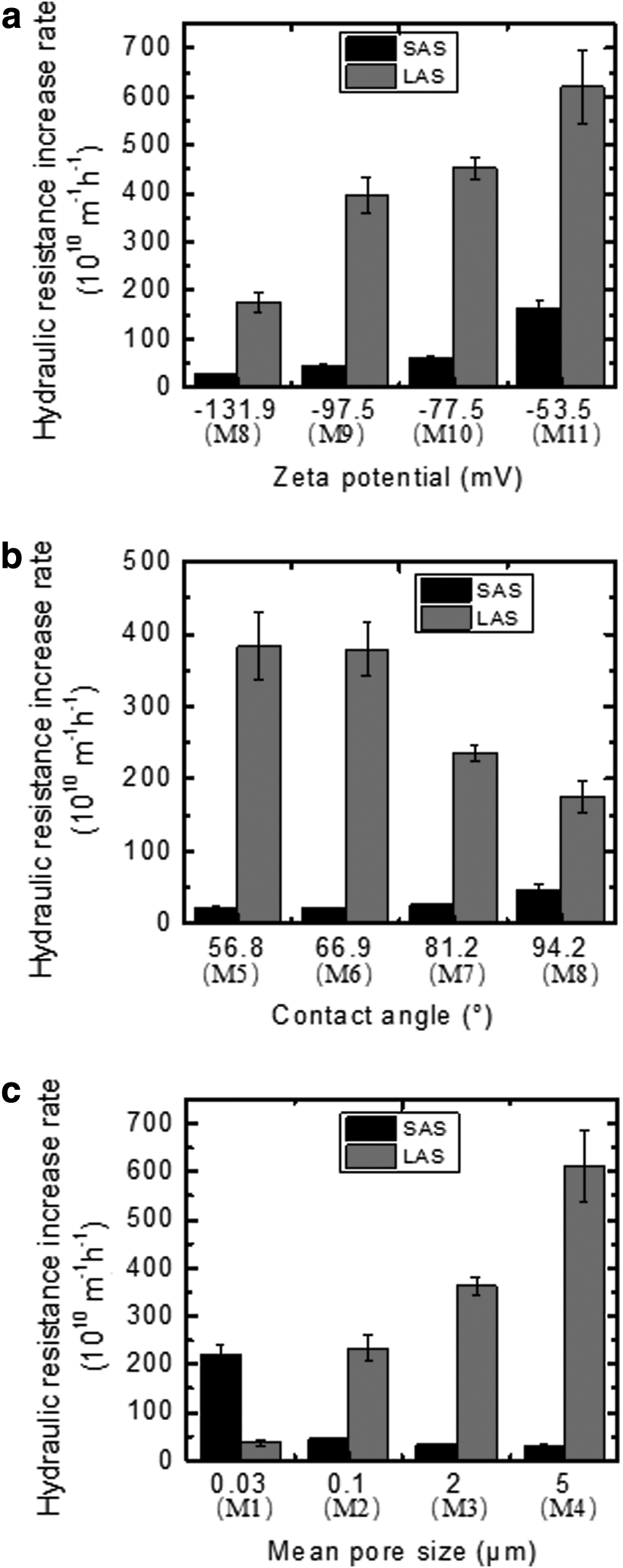
Effects of
Effect of water contact angle
The water contact angle is widely used to evaluate the hydrophilicity of a membrane surface. The membranes M5–M8 with water contact angles in the range of 56.8°–94.2° and similar mean pore sizes (0.08–0.20 μm) were chosen to investigate membrane fouling propensities of different feed biomass.
Fouling propensities of SAS and LAS using different hydrophilic membranes are shown in Fig. 1b. With the increase of membrane hydrophobicity, the membrane fouling rate of SAS increased rapidly, whereas the membrane fouling rate of LAS decreased with the enhancement of membrane hydrophobicity. The result indicated that the hydrophilicities of membranes when SAS was used as feed biomass showed opposite effects on fouling propensity compared to when LAS was used. It has been well documented that hydrophilic membrane surfaces are less susceptible to fouling with organic substances, microorganisms, and charged inorganic particles, on account of a decrease in the interaction between foulants and membrane surface (Choi et al., 2002; Lalia et al., 2013). A thin water boundary between the hydrophilic membrane and bulk solutions is able to build through the hydrogen bonds with surrounding water molecules. Thus, energy is required for hydrophobic matters to remove the water boundary and expose the membrane surface, forming membrane foulants. In contrast, there are almost no hydrogen bonding interactions between the hydrophobic membrane interface and water, and the repulsion of water molecules away from the hydrophobic membrane surface is a spontaneous process with increasing entropy. Thus, foulant molecules such as organic substances, microorganisms, and charged inorganic particles have a tendency to adsorb onto membrane surface and dominate the boundary layer. Therefore, the antifouling abilities of the hydrophilic membranes were believed to be superior to that of the hydrophobic membranes.
However, when LAS was used as a feed biomass, the hydrophobic membrane showed an improved antifouling ability compared with the hydrophilic membrane. The strong hydrophobic substances such as humic acid and fulvic acid contained in the LAS possessed a similar hydrophobic group to that of the hydrophobic membrane surface; thus, it was speculated that these substances did not readily exhibit interactions with the hydrophobic surface, such as adsorption and aggregation. Therefore, the membrane fouling rate of the hydrophobic membrane was lower compared with the hydrophilic membrane when LAS was filtrated. Nevertheless, some researchers have also claimed that the contact of hydrophobic matters and hydrophobic membrane surface can aggravate membrane fouling (Maximous et al., 2009). Therefore, the mechanisms of effects of membrane hydrophilicity on membrane fouling propensity require further study.
Effect of pore size
Figure 1c shows the effects of membrane pore size (from 0.03 to 5.0 μm) on fouling propensities of SAS and LAS. The membrane fouling rate decreased with the increase of mean pore size when SAS was filtered, which was contrary with that when LAS was filtered. It is expected that a smaller membrane pore size would reject a wider range of materials, which renders a higher interception rate and results in a reduced permeability. In contrast, the permeability will be improved at the expense of a higher interception rate when the pore size is larger (Le-Clech et al., 2006). Therefore, the optimum pore size under different experimental systems varies due to the changing of filter media and operating conditions.
The obtained results implied that the feed biomass with same MLSS concentration showed different fouling propensities due to the variation of properties of mixed liquors. Since DOM plays an important role in the fouling propensity of feed biomass, the following section describes the effects of DOM composition on membrane fouling propensity.
Fouling propensity of DOM derived from different MBR systems
This section compares the fouling propensities of DOM derived from MBR treating SAS (SASDOM), RAS (RASDOM), and LAS (LASDOM). Five MF membranes (M5, M13, M14, M15, and M16) with different properties were selected to conduct the dead-end filtration experiments of three DOM solutions. The membranes used for this experiment were selected mainly on the basis of their polymer type. M13, M14, M15, and M16 were composed of polyvinyl chloride (PVC), polytetrafluoroethylene/polyvinylidene fluoride (PTFE/PVDF), PVDF, and polyacrylonitrile (PAN), respectively. M5 was an in-house manufactured PVDF membrane and was compared with the commercial PVDF membrane (M15). The filtration times of all the three DOM solutions with the same TOC concentration are shown in Fig. 2. For all the five membranes, SASDOM showed the highest permeability followed by RASDOM, whereas LASDOM exhibited the worst permeability as indicated by the longest filtration time.

Fouling propensity of DOM derived from different MBR systems. DOM, dissolved organic matter.
Experimental results indicated that DOM properties had a great influence on the membrane fouling rate. The average hydrodynamic size of LASDOM was 226.7 nm (Table 2), which was larger than the average pore sizes of M5, M13, and M16 membranes used in the experiments. During the dead-end filtration, a greater amount of DOM was expected to be retained onto the three membranes, which resulted in the longest filtration time. However, there was no linear relationship between the filtration time of LASDOM and membrane pore size, indicating that the adsorption was induced not only by physical interception but also by interaction between DOM and the membrane surface. It has been emphasized that the interactions between foulants and membrane surfaces play an important role in the formation of membrane fouling (Brant and Childress, 2002; Wang et al., 2013). Therefore, XDLVO theory was used to analyze the surface free energy of DOM from different MBR systems and to interpret the effects of interactions between DOM and membrane surfaces on membrane fouling.
According to XDLVO theory, the initial adsorption of DOM on the membrane surface was controlled by the interaction energy between membrane surfaces and foulants. Table 4 shows the surface tension parameters and free energy of cohesion for each DOM solution calculated from Equations (1) to (5). RASDOM and SASDOM exhibited relatively strong electron donor capabilities, as suggested by higher values of γ−, whereas both the electron acceptor and donor components of LASDOM were low (0.01 mJ/m2), which resulted in a very low AB component. The free energy of cohesion (▵GSWS) of DOM was calculated by the sum of LW and AB components of the surface free energy. ▵GSWS represents the interaction energy when two surfaces of the same material are immersed in a solvent (water in the present study). The contribution of the AB component to ▵GSWS of DOM was significantly greater compared with the LW component. ▵GSWS values of all the DOM were negative, with the magnitude order as follows: SASDOM>RASDOM>LASDOM, indicating that SASDOM was relatively stable with higher hydrophilicity. In contrast, due to the high abundance of humic acid and fulvic acid among LAS, the ▵GSWS of LASDOM was the lowest (−102.13 mJ/m2), showing strong hydrophobicity, which could facilitate the formation of initial membrane fouling.
Fouling propensities of different DOM compositions
To further interpret the effects of DOM compositions on the fouling mechanisms, the hydrophobic and hydrophilic fractions were isolated from SASDOM. The results showed that the HPI-N, HPO, TPI, and HPI-C components accounted for 36.4%, 33.0%, 16.2%, and 13.6% of SASDOM, respectively. Previous studies have found that the HPO component was predominantly humic acid, TPI was mainly the polysaccharide substance, and proteins mostly existed in HPI-N compositions (Yuan and Zydney, 1999; Croué et al., 2003). To predict the membrane fouling propensities of different DOM compositions, the surface tension parameters and surface free energy of different compositions were calculated by XDLVO theory, as shown in Table 5.
All the DOM compositions showed a stronger electron donor monopolarity (γ−) and relatively weaker electron acceptor capability (γ+). The electron donor component of each composition increased with the increase of its hydrophilicity, and the electron donor capability of HPI-C was the strongest. The free energy of cohesion of HPI-C was the largest, indicating its high hydrophilicity, whereas that of HPO fraction was the lowest, which indicated that HPO substances were more easily adsorbed onto the membrane surface to result in membrane fouling during the process of membrane filtration. According to the assessment of XDLVO theory, the order of membrane fouling propensities of the different DOM compositions was expected to be: HPO>TPI>HPI-N>HPI-C.
The fouling propensity of each composition of DOM with the same TOC concentration was determined by dead-end filtration with M5 (Fig. 3). The order of fouling tendency of each composition in terms of the increase of filtration resistance was as follows: HPO>HPI-N>TPI>HPI-C. This result shows that the HPO component, which mainly consists of humic acid in DOM, had the strongest fouling potential in the MBRs (Yuan and Zydney, 1999; Kim et al., 2006). However, the fouling propensity of HPI-N was faster compared with TPI, which was not consistent with the prediction of XDLVO theory. This contradiction was further explored using GFC analysis to detect the MW distribution of each DOM component.
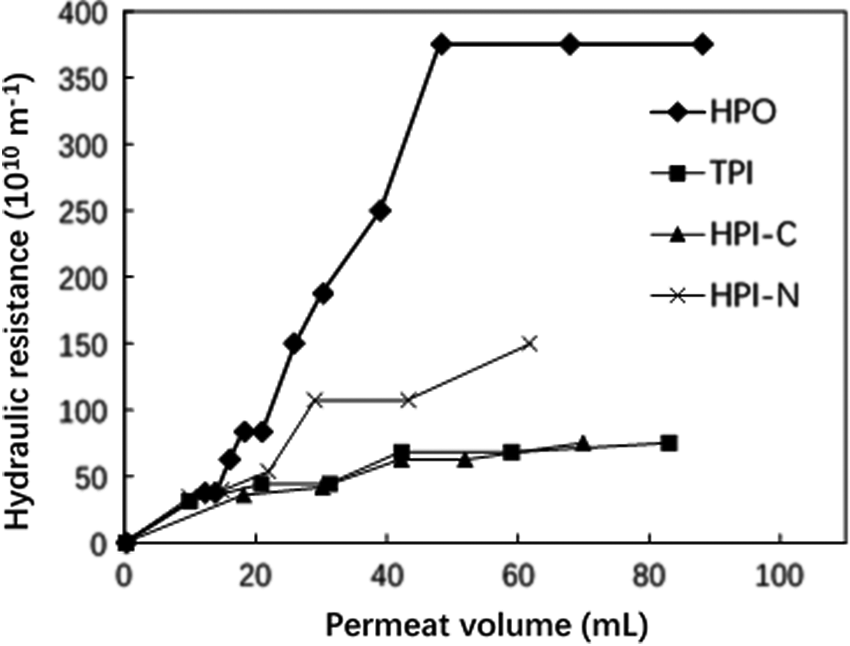
Fouling propensity of different DOM compositions.
Results of GFC analysis of each composition of DOM are shown in Fig. 4. The MW of most HPI-C components was less than 1,000 Da. The peak MWs of the HPO components were slightly larger than those of TPI components, and the MWs of the two components were in the range of 1,000–10,000 Da. The macromolecular substances accounted for a larger proportion in the HPI-N component compared with other components, and the MWs of the vast majority of HPI-N were greater than 10 kDa. According to the results, the high fouling rate of HPI-N may be due to the physical interception of organics with larger MW, and the neutral property could also facilitate the adsorption onto the membrane surface due to the absence of electrostatic repulsion (Fan et al., 2001).
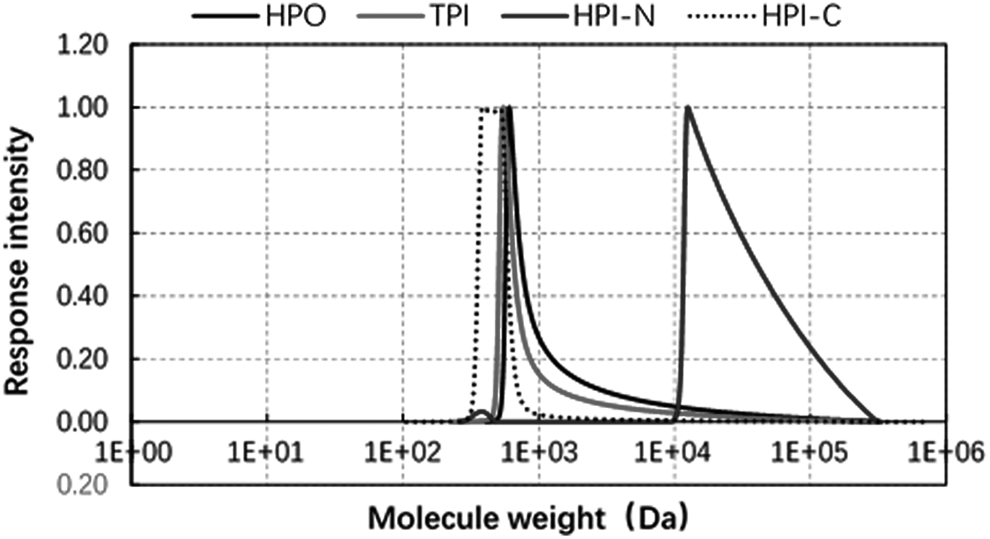
Molecular weight distribution of different DOM compositions.
It is worth mentioning that in the present study, due to the limited amount of extracted mixed liquor, DOM, and DOM compositions, only a batch-scale experiment was conducted to investigate membrane fouling mechanisms. Although a batch-scale MBR setup could not capture all the properties of a practical MBR system, such as aeration and backwashing, this approach has been used in numerous previous reports, the results of which have been reported to be similarly reliable and useful for membrane fouling in practical MBR systems.
Conclusions
In the present study, SPSS software was adopted to analyze the correlations between membrane physicochemical properties. The results showed that the mean pore size has a negative correlation with contact angle and positive correlation with pure water flux. The statistical analyses implied that membrane properties are not independent of each other but are in fact mutually influential, implying that adjustment of a specific parameter could also impact other membrane properties.
Therefore, the membrane properties, including zeta potential, contact angle, and pore size, could affect the fouling propensity of different mixed liquors, that is, the activated sludge in the MBR treating SAS and LAS, respectively. For both mixed liquors, the membrane fouling potential was decreased when the membrane surface became more negative, which implied the important role of electrostatic interaction in controlling membrane fouling propensity. However, membranes with a smaller pore size and strong hydrophobicity showed a slower membrane fouling rate when filtering LAS, whereas the fouling trend was opposite in the case of SAS. The higher concentration of DOM and inorganics in SAS rendered a greater fouling propensity.
Furthermore, the fouling propensities of DOM derived from MBR treating SAS (SASDOM), RAS (RASDOM), and LAS (LASDOM) were compared by filtering with five different membranes at the same TOC concentration. For all the five membranes, SASDOM showed the highest permeability followed by RASDOM, and LASDOM exhibited the worst permeability. The results implied that the interaction between DOM and membrane surfaces rather than physical interception and adsorption was the dominant factor affecting the formation of membrane fouling. XDLVO analysis found that LASDOM with the lowest ▵GSWS (−102.13 mJ/m2) was strongly hydrophobic, which could facilitate the formation of initial membrane fouling.
Finally, the fouling propensity of hydrophobic and hydrophilic fractions isolated from SASDOM was detected to further interpret the fouling mechanisms of DOM. The order of fouling tendency of four DOM compositions was as follows: HPO>HPI-N>TPI>HPI-C. As predicted by XDLVO theory, the HPO and HPI-C possessing the lowest and highest free energy of cohesion, respectively, showed the fastest and slowest fouling rate, respectively. However, due to the high abundance of macromolecular substances in HPI-N and the absence of electrostatic repulsion between HPI-N and the membrane surface, the fouling rate of HPI-N was faster compared with TPI.
Footnotes
Acknowledgments
This work was financially supported by the State Key Laboratory of Pollution Control and Resource Reuse Foundation (PCRRE16003) and the National Natural Science Foundation of China (51308400).
Author Disclosure Statement
No competing financial interests exist.