




Abstract
Abstract
This study investigated impacts of different application rates of soil amendments on cadmium (Cd) and lead (Pb) speciation in calcareous soil and the contents in wheat grain in pot experiments. Results showed that soil amendments could significantly decrease soil pH, which altered Cd and Pb speciation. When applied potassium dihydrogen phosphate (KH2PO4) and chicken manure amendment at a rate of 24–48 g/kg, the Cd exchangeable and carbonate-bound forms decreased by 34–63% and 13–25%, respectively, whereas decreases for the two Pb forms were 17–19% and 42–53%, respectively. In contrast, in the treatment with KH2PO4 and chicken manure amendment, the Cd weak organic, Fe-Mn oxide-bound, strong organic-bound, and residual forms increased by 25–63%, 53–89%, 31–88%, and 4–41%, respectively; these four Pb forms increased by 14–25%, 35–40%, 3–30%, and 38–65%, respectively. In addition, applications of KH2PO4 and chicken manure amendment at 24–48 g/kg also significantly decreased Cd and Pb contents in wheat grain (8–32% for Cd and 19–53% for Pb), suggesting that KH2PO4 and chicken manure amendment facilitated conversion of phytoavailable to less phytoavailable Cd and Pb forms.
Introduction
W
There are many technologies currently available for cleanup or remediation of contaminated soils, among which, application of soil amendments has received widespread attention because of its effectiveness, low costs, and practical operations (Raj et al., 2005; Kumpiene et al., 2008; Begum et al., 2012). Frequently used soil amendments include phosphate-based materials, clay minerals, organic matter (OM), and so on. Previous studies showed that potassium dihydrogen phosphate (KH2PO4) could effectively decrease bioavailability of soil Cd and Pb and decrease their uptake by plants (Cao et al., 2002). Chicken manure was also reported to elevate soil OM and decrease soil metal bioavailability via complexation or chelation reactions between metals and humus or humin (Nwaichi et al., 2010; Wang et al., 2016). Wang et al. (2012) suggested that a combination of phosphate-based materials and OM could further enhance the treatment efficacy, but the treatments integrating KH2PO4 and chicken manure are little studied and the efficacy is largely unknown.
Based on our previous research, KH2PO4 and chicken manure were selected as soil amendments in this pot study (Zhang et al., 2015; Gao et al., 2017). Objectives of this study were to (1) characterize the chemical speciation of soil Cd and Pb as induced by amendment application; (2) measure metal uptake by wheat as affected by the amendments; and (3) explore the mechanisms of the metal transformation and phytoavailability.
Materials and Methods
Soil and amendments
Soil (calcareous fluro-aquic) was collected from the top 20 cm layer of a poplar forest land near a Pb smelter located in Jiyuan City, Henan Province, China. Soil pH, cation exchange capacity, and OM were 7.6, 26 cmol/kg, and 16 g/kg, respectively. For available nitrogen, phosphorus, and potassium, the values (mg/kg) were 82, 14, and 116, respectively. Total Cd and Pb concentrations in test soil reached 21 and 1,453 mg/kg, respectively.
Amendments (KH2PO4 and chicken manure) were selected based on previous studies conducted by Zhang et al. (2015) and Gao et al. (2017). Chicken manure was collected from hennery of the residential areas at Henan Agricultural University; it had pH 6.2, OM 53%, total N 0.8%, total P 3.5%, total K 4.6%, 0.1 mg Cd/kg, and 14 mg Pb/kg.
Experimental design
Greenhouse pot experiments were conducted during the period October 2014–October 2015 on a farm at Henan Agricultural University, Zhengzhou, China. KH2PO4 was mixed with chicken manure at a 1:5 ratio (w/w) and used as soil amendment. Experiments consisted of four treatments with the amendment, including (in g/kg amendment added) T1 (24), T2 (36), T3 (48), and CK (0), with a completely randomized arrangement and 12 replications per treatment. The collected soil was air-dried, ground, passed through a 1 cm sieve, mixed with the amendment at a desired ratio, placed into plastic pots (40 cm diameter × 35 cm high, 18 kg soil per pot), and incubated at 65% of water-holding capacity at 25°C for 2 weeks before planting.
Thirteen healthy seedlings of Aikang-58 wheat cultivar were planted per pot. During the growing season, total 2 g N as urea [CO(NH2)2], 2 g P2O5 as calcium dihydrogen phosphate [Ca(H2PO4)2], and 2 g K2O as potassium chloride (KCl) were applied thoroughly into soil of each pot. All chemicals were analytical grade (Beijing Chemical Reagents Co.).
Sampling and analysis
At the jointing stage, grain-filling stage, and maturity, the soils of each replicated pot were collected, air-dried, and passed through a 1 mm polyethylene sieve for pH and 0.149 mm for metal analysis. Wheat seeds were collected at harvest.
Collected seeds were washed with deionized water, air-dried, and then oven-dried at 70°C for 48 h, and the dry weight was determined. Dried seeds were ground to pass through a 40 mesh sieve and digested with concentrated nitric acid (HNO3) and perchloric acid (HClO4) mixture (4:1 v/v).
Soil sequential extraction was performed on 2.5 g sample passed through 0.149-mm polyethylene sieve and placed in 100 mL polypropylene centrifuge tubes. The extracting solutions were used in the following order (Tessier et al., 1979): (1) shaking with 1 M MgCl2 (pH 7.0) for 2 h, extracting exchangeable Cd and Pb; (2) 1 M sodium acetate (pH 7.0) for 5 h, extracting carbonate-bound Cd and Pb; (3) 0.1 M sodium pyrophosphate (pH 7.0) for 3 h, extracting weak organic-bound Cd and Pb; (4) mixture of 0.25 M hydroxylamine hydrochloride (NH2OH·HCl) and 0.25 M HCl for 6 h, extracting Fe-Mn oxide-bound Cd and Pb; (5) shaking with 3 mL 0.02 M HNO3 and 5 mL 30% H2O2 at 83°C for 1.5 h, followed by addition of 3 mL H2O2 and shaking for another 1 h, cooling, adding 2.5 mL NH4OAC, shaking for 30 min, and finally, resting for 10 h at room temperature to extract strong organic-bound Cd and Pb; and (6) residual Cd and Pb after digestion with aqua regia (HCl:HNO3 = 3:1) and hydrofluoric acid and HClO4. Between each successive extraction, samples were centrifuged at 10,000 rpm (TG16-WS) for 10 min, and then, the supernatants were separated by decantation. Cd and Pb concentrations in soil fractions and grain digests were analyzed by an atomic absorption spectrophotometer (AA, ZEEnit 700 P).
Statistical analysis
Data statistical analysis was performed using the SPSS 13.0 (Apache Software Foundation). Means were compared using the least significant difference test at a significance level of 95%. All figures were plotted with SigmaPlot 10.0 (Systat Software, Inc.).
Results
Grain Cd and Pb content
With increasing the rate of the soil amendment, yield of wheat significantly increased, but grain Cd and Pb content significantly decreased (Fig. 1). Compared with the control, the wheat grain yield increased (T1 and T2) or decreased (T3). Grain Cd decreased in relation to CK by 41%, 51%, and 67% in T1, T2, and T3, respectively. In contrast, in comparison with the control, grain Pb content decreased by 37%, 49%, and 60% in T1, T2, and T3, respectively.
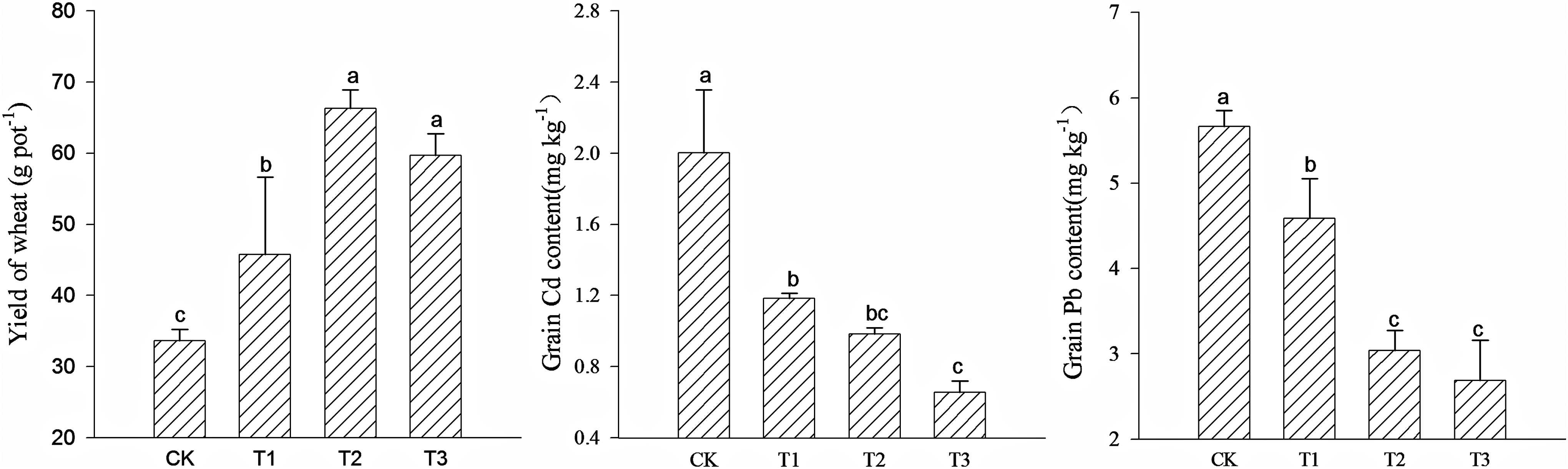
Cd and Pb contents in wheat grain as affected by soil amendments. Data represent mean ± SD (n = 3). Different letters indicate a significance at p < 0.05 level. Cd, cadmium; Pb, lead; SD, standard deviation.
Soil pH
Application of the soil amendment significantly decreased soil pH (Fig. 2). Soil pH decreased by 0.3 (T1) and 0.5 U in (T3), which was significant (p ≤ 0.05) compared with CK.
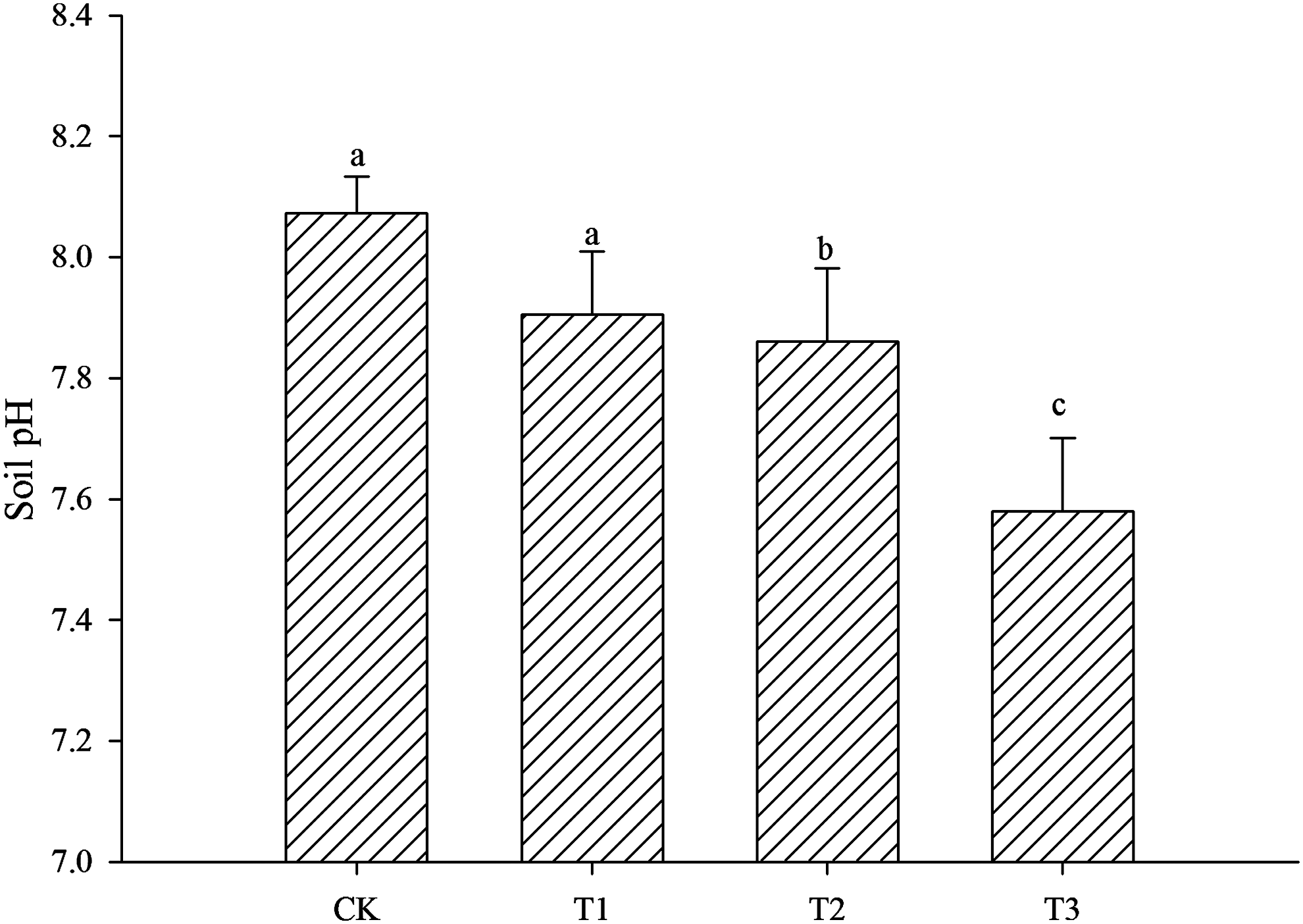
Soil pH at various amendment treatments. Data represent mean ± SD (n = 3). Different letters indicate a significance at p < 0.05 level.
Soil Cd and Pb fractionation
In all treatments, contents of soil Cd in the exchangeable, carbonate-bound, Fe-Mn oxide-bound, and residual forms were relatively high, whereas strong and weak organic-bound Cd was relatively low (Fig. 3). The amendment significantly (p ≤ 0.05) decreased the content of exchangeable (34–63%) and carbonate-bound forms (13–25%) compared with CK. In contrast, the strong and weak organic-bound, Fe-Mn oxide-bound, and residual forms increased by 31–88%, 25–63%, 53–89%, and 4–41%, respectively. The difference with respect to the control was significant when the amendment application was 36 g/kg or more (p ≤ 0.05).

Soil Cd fractions in various treatments. Data represent mean ± SD (n = 3). Different letters on each bar indicate significant difference among different treatments of the same soil Cd forms (p < 0.05). EX, exchangeable; CAR, carbonate; WO, weak organic; FMO, Fe-Mn oxide; SO, strong organic; RES, residual states.
Soil Pb speciation was different from that of Cd. The carbonate-bound, Fe-Mn oxide-bound, and residual forms were dominant, whereas exchangeable and organic-bound forms were minor (Fig. 4). The amendment application significantly (p ≤ 0.05) decreased the exchangeable (by 17–19%) and carbonate-bound forms (by 42–53%). In contrast, the soil treatment resulted in significantly increased Fe-Mn oxide-bound (by 35–40%) and residual forms (by 38–65%) compared with the control. The strong and weak organic-bound Pb fractions increased by 3–30% and 14–25%, respectively, but the differences with respect to the control were significant only when the amendments were applied at 36 g/kg or more.
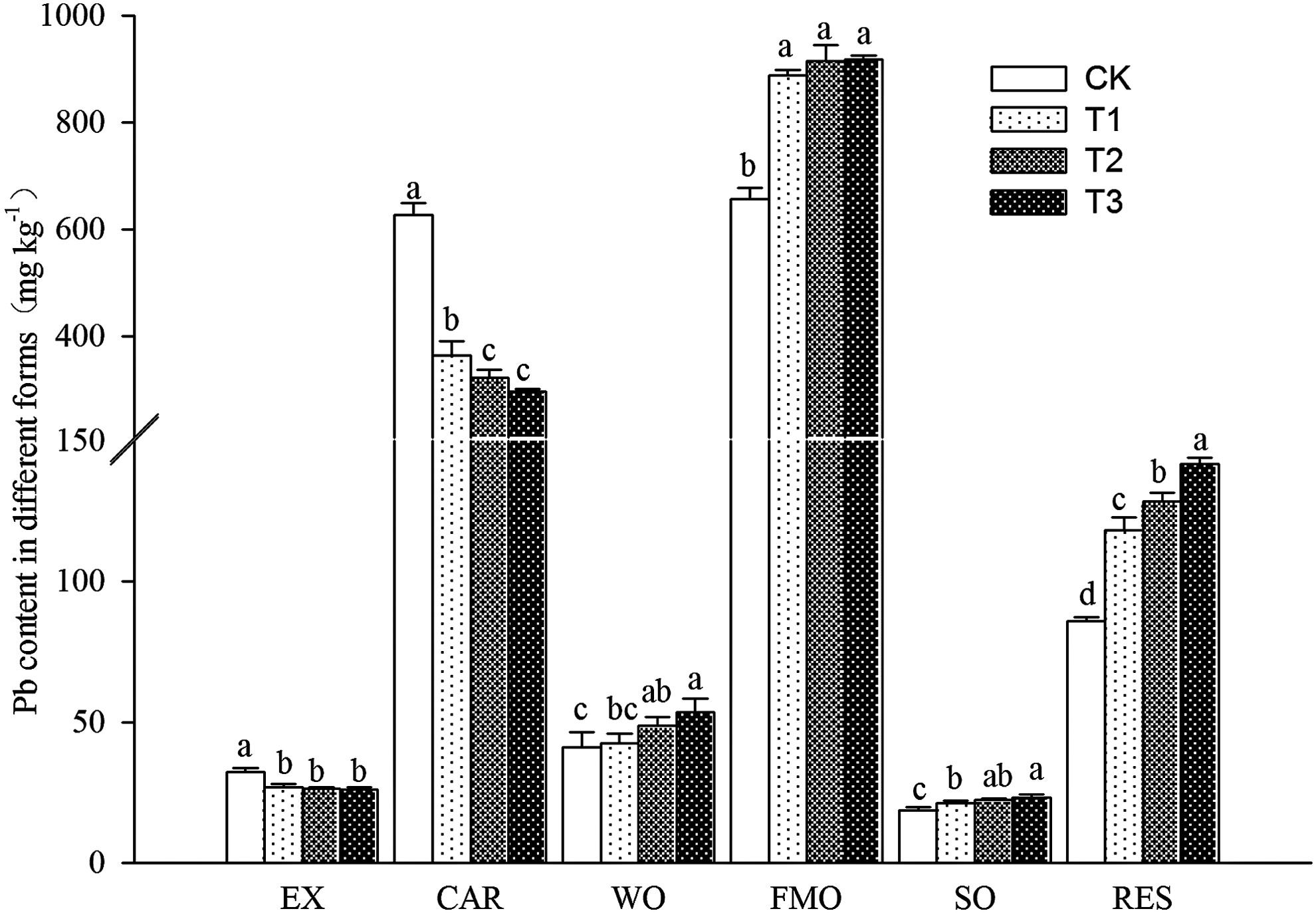
Soil Pb fractions in various treatments. Data represent mean ± SD (n = 3). Different letters on each bar indicate significant difference among different treatments of the same soil Pb forms (p < 0.05). EX, exchangeable; CAR, carbonate; WO, weak organic; FMO, Fe-Mn oxide; SO, strong organic; RES, residual states.
In the T1 treatment, soil exchangeable Cd decreased initially, then increased, and reached relatively steady state at maturity (Fig. 5). When the amendment application was above 48 g/kg, exchangeable Cd decreased during the wheat growing season. In contrast, residual Cd increased toward wheat maturity with an increasing amendment rate. The carbonate-Cd fraction was relatively unchanged (17–24% of the total) during wheat growth regardless of the treatment. The fraction of Fe-Mn oxide-bound Cd ranged from 36% to 43% of the total, decreasing initially and then increasing toward maturity. The fractions of weak and strong organic-bound Cd were low, with no change during the season. The data suggested that treatments induced the conversion of soil Cd from exchangeable and carbonate-bound forms to Fe-Mn oxide-bound and residue forms, which would lower Cd availability for plant uptake.
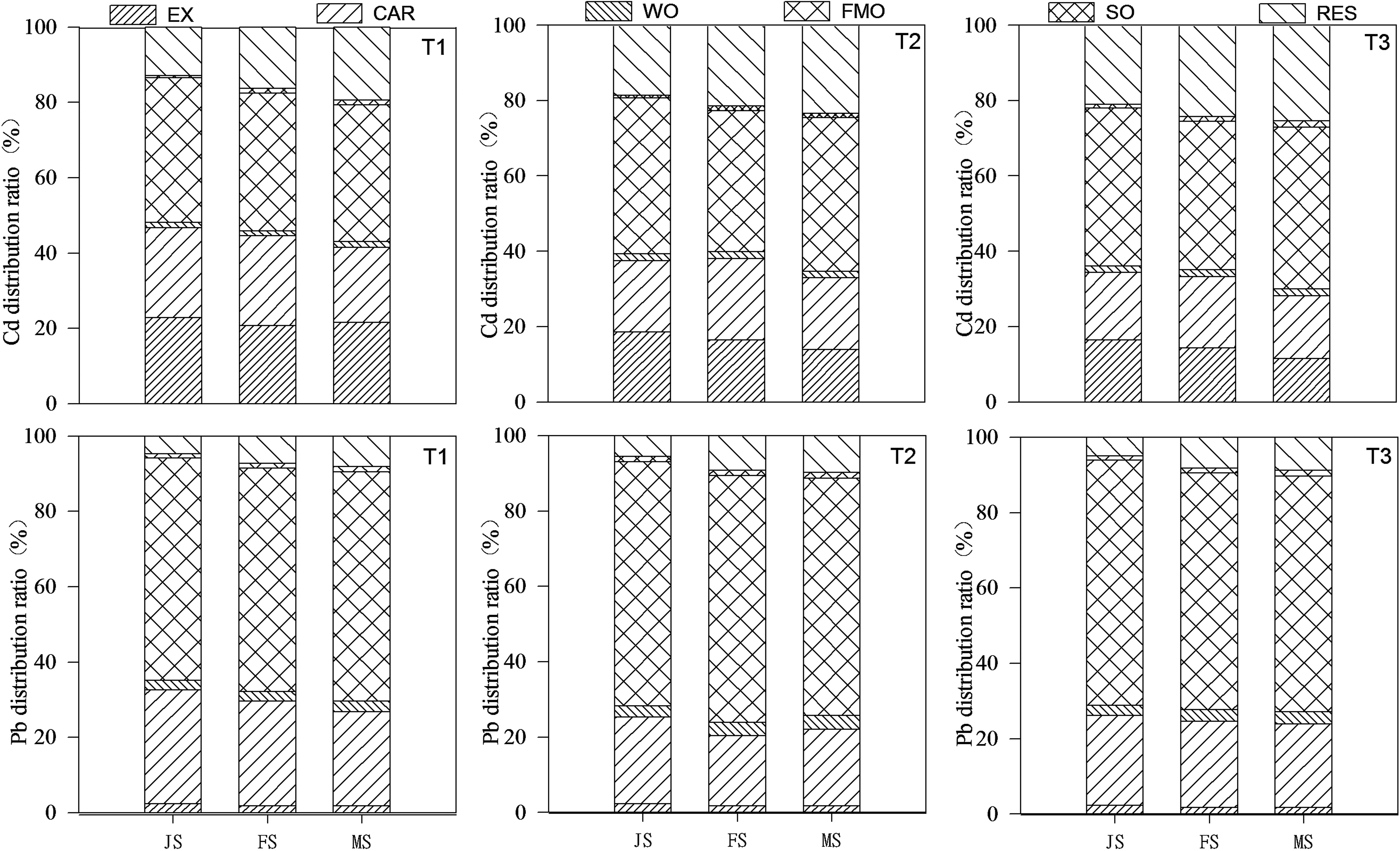
Fractional change of soil Cd and Pb during the growing season as induced by treatments. JS, jointing stage; FS, filling stage; MS, maturing stage; EX, exchangeable; CAR, carbonate; WO, weak organic; FMO, Fe-Mn oxide; SO, strong organic; RES, residual states.
Primary forms of soil Pb were Fe-Mn oxide-bound (59–66% of the total) followed by carbonate-bound (19–30%), with the other fractions being low (Fig. 5). The fractions of exchangeable Pb and carbonate-bound Pb decreased gradually during the growing season. The strong and weak organic-bound Pb showed an increasing trend with the growing season. The Fe-Mn oxide-bound Pb gradually increased and then remained relatively stable with an increase in the amendment application rate. The residual fraction increased gradually with time in response to the treatments.
Correlation among plant and soil Cd and Pb fractions
As illustrated in Table 1, there was a significant positive correlation between Cd content in wheat grain and soil pH, exchangeable and carbonate-bound Cd, whereas Fe-Mn oxide-bound, strong and weak organic-bound, and residual Cd showed a significant negative correlation. Soil pH was positively correlated with exchangeable and carbonate-bound Cd (rEX-Cd = 0.92, rCAR-Cd = 0.94, p ≤ 0.05) and negatively correlated with strong organic-bound and residual Cd (rSO-Cd = −0.97, rRES-Cd = −0.96, p < 0.01). Analysis indicated that a treatment-dependent soil pH decrease would lead to a decrease in exchangeable or carbonate-bound Cd in soil and an increase in strong or weak organic-bound state, Fe-Mn oxide-bound, and residual Cd. Exchangeable and carbonate-bound Cd was considered the labile Cd fractions in soil available for uptake by plants. Organic-bound, Fe-Mn oxide-bound, and residual Cd was relatively poorly available for plant uptake. Thus, as a result of increasing rate of soil amendments, soil Cd gradually changed from the soluble to the more stable forms.
EX-Cd, CAR-Cd, WO-Cd, FMO-Cd, SO-Cd, and RES-Cd represent the exchangeable, carbonate-bound, weak organic-bound state,
Fe-Mn oxide-bound, strong organic-bound, and residual fractions, respectively,
Significance at p < 0.01.
Significance at p < 0.05.
Cd, cadmium.
As shown in Table 2, Pb content in grain was significantly positively correlated with soil pH and carbonate-bound Pb, and the correlation was not significant between grain and exchangeable Cd. Grain Pb was significantly negatively correlated with weak or strong organic-bound and residual Pb in soil, but the correlation of grain Pb with the Fe-Mn oxide-bound fraction was not significant. Exchangeable Pb had a significant negative correlation with Fe-Mn oxide-bound, strong organic-bound, and residual Pb. A similar correlation could be observed for carbonate-bound Pb.
EX-Pb, CAR-Pb, WO-Pb, FMO-Pb, SO-Pb, and RES-Pb represent the exchangeable, carbonate-bound, weak organic-bound state.
Fe-Mn oxide-bound, strong organic-bound, and residual fractions, respectively.
Significance at p < 0.05.
Significance at p < 0.01.
Pb, lead.
Discussion
Toxicological effects of heavy metals on human health are not only related to their total amount but also to their chemical forms (Mohan and Hosetti, 1997; Gleyzes et al., 2002). Soil amendments usually alter chemical forms of metals through precipitation, adsorption, oxidation, and reduction reactions, thereby decreasing metal bioavailability to achieve the restoration or remediation of contaminated soils (Raj et al., 2005; Xu et al., 2009).
Results of this study showed that the application of soil amendments (KH2PO4:chicken manure in 1:5 ratio w/w) significantly decreased the proportions of exchangeable and carbonate-bound Cd and Pb in soil and increased the proportions of Fe-Mn oxide-bound, organic-bound, and residual Cd and Pb. There was a significant positive correlation of soil pH with exchangeable and carbonate-bound Cd or Pb, whereas soil pH was negatively correlated with Fe-Mn oxide-bound and organic-bound fractions. It was obvious that the application of the soil amendments resulted in a decrease of soil pH, which was primarily responsible for the alteration of Cd or Pb fractions in the soil. It was shown that the Cd bioavailability in soil generally decreased with increasing pH (Xu et al., 2004; Naidu et al., 2006). This may be due to calcareous soils containing large amounts of calcium carbonate and magnesium, and decreased pH would be favorable for the release of Ca2+ and Mg2+ and conversion of exchangeable and carbonate-bound Cd or Pb to other forms with lower solubility (Li et al., 2015). In addition, lower soil pH could activate phosphate and Cd ions (Cao et al., 2008) to enhance treatment effectiveness. Studies by Laperche et al. (1996) and Chrysochoou et al. (2007) reported that decreased pH could effectively promote the formation of highly insoluble pyromorphite compounds [Pb10(PO4)6X2, X = Cl, Br, F, OH] in soil, thereby promoting a decrease in Pb availability in soil. For Pb, in addition to the pH effect, adsorption and complexation by chicken manure may also be associated with a decrease in soil Pb availability (Wei et al., 2003).
Cd and Pb contents in wheat grain decreased with increasing the rate of soil amendment, particularly in case of Cd. This finding was consistent with a decrease in the exchangeable and carbonate-bound fractions by treatments and was supported by the correlation data. Therefore, it can be concluded that a decrease in soil exchangeable and carbonate-bound Cd and Pb, as induced by lowered soil pH, was associated with lower bioavailability and consequently lower plant uptake.
Previous studies have found that the chemical forms of soil metals were interconvertible (Li et al., 2015; Zhu et al., 2015). Bacon and Davidson (2008) divided the exchangeable and carbonate-bound state into bioavailable states, weak/strong organic binding state, and Fe-Mn oxide-bound state into potential bioavailability fraction, and the residual states were poorly absorbed by plants. The study presented here demonstrated a significant positive correlation between exchangeable and carbonate-bound Cd or Pb, and the two fractions had a negative correlation with other fractions. In addition, the metal content in grain was positively correlated with metal bioavailability in soil, suggesting that potentially bioavailable stable fractions of soil Cd or Pb could be transformable in dependence on soil chemical conditions.
In the contaminated calcareous soil, the main Cd fractions were exchangeable, carbonate-bound, and Fe-Mn oxide-bound, whereas the predominant Pb forms were carbonate-bound and Fe-Mn oxide-bound. All fractions were in a dynamic equilibrium under certain soil chemical conditions. The fraction of exchangeable Cd gradually decreased with time, and the proportion of residual Cd increased gradually after the amendment was supplied. The variation in the carbonate-bound, organic-bound, and Fe-Mn oxide-bound fractions was not significant during the growing season. Under the same treatment, residual Pb showed a slowly increasing trend with time, whereas the change in other forms was not obvious. This could be due to a relatively small proportion of exchangeable Pb in total soil Pb. It was also possible that higher oxide-bound Pb fraction was liable to be released as a result of the soil conditions (Li et al., 2013).
Conclusions
This study showed that application of soluble phosphate mixed with chicken manure induced a significant conversion of bioavailable Cd or Pb to poorly available forms in a contaminated calcareous soil, which decreased Cd or Pb content in wheat grains. These changes were associated with a decrease in the exchangeable and carbonate-bound Cd or Pb fractions and an increase in the Fe-Mn oxide-bound, organic-bound, and residual Cd or Pb fractions as a result of lowered soil pH by the soil amendment. The treatment effects were stronger for Cd than Pb, and increased with an increase in the amendment application rate. This research demonstrated that soil treatment using a mixture of phosphate and chicken manure may improve soil quality and grain safety, and enhance agricultural sustainability in heavy metal-contaminated soils.
Footnotes
Acknowledgments
This work was sponsored by the key scientific and technological project of Henan Province (152102110064 and 162102110127). We are thankful to Professor Zed Rengel (The University of Western Australia, Perth, Australia) for his critical reading and revision of the article.
Author Disclosure Statement
No competing financial interests exist.