




Abstract
Abstract
To address the issue of global freshwater shortages, wastewater has become an increasingly valuable alternative for crop irrigation. As a result, trace levels of emerging contaminants, including antibiotics, may occur in water used for food production. The objective of this study was to investigate how soil texture affected the availability and uptake of three chemically diverse antibiotics (lincomycin, oxytetracycline, and sulfamethoxazole) by lettuce grown in soils comprised of silt clay and increasing percentages of sand. Lettuce was irrigated routinely with antibiotic-amended water (1 mg/L) from seed germination through the first harvest (40 days), switched to control water, and fate monitored at days 45 and 50. Sulfamethoxazole was the only compound where tissue concentrations increased with increasing sand concentrations to 24.7 ng/g fresh weight (FW). Lincomycin was most readily accumulated with increasing concentrations observed at the second harvest in both the loam (68.3 ng/g FW) and sandy soils (66.6 ng/g FW). Apparent toxicity of the antibiotic mixture resulted in decreasing plant mass (37–72%) with increasing sand content. Results from this study show that soil texture impacts plant growth, contaminant transport, plant uptake, and toxic effects, which all contribute to, observed concentrations in edible plant portions.
Introduction
W
In the case of treated wastewater recycling, treatment technologies are not entirely effective for removal of these chemicals. The efficacy in removal of antibiotics from wastewater in the treatment process is dependent on physicochemical properties, which vary considerably between antibiotic compounds. The result is a range of removal efficiencies from 4% for oxytetracycline to 100% for sulfamethazine (Verlicchi et al., 2012).
One of the primary advantages in wastewater reuse is the recycling of nutrients, otherwise removed, with great expense, in the treatment process (Duran-Alvarez and Jimenez-Cisneros, 2014). Life cycle assessment studies have evaluated the use of wastewater management strategies that include the separation and application of toilet fractions, a source of pharmaceutical contamination in raw municipal wastewater, to agricultural applications with minimal treatment (Spangberg et al., 2014). Furthermore, management practices associated with concentrated animal feeding operations often involve the application of highly contaminated wash and runoff water to agricultural lands.
While some regulation exists regarding treatment requirements necessary for the reuse of wastewater, including recent European Union (EU) regulations on the topic (European Commission, 2017), they have traditionally focused on nutrient management rather than contaminant control, with very limited consideration of emerging contaminants, including antibiotics and resulting antibiotic resistance (Paranychianakis et al., 2015). As a result, agricultural wastewater reuse provides an additional pathway for antibiotics and other pharmaceutical contaminants to move within the agroecosystem (Bradford et al., 2008).
The combination of direct irrigation with untreated wastewater, insufficient management of agricultural wastewater, and the potential for nutrient reuse in municipal sourced wastewater may lead to increased exposure of pharmaceutical contamination, greater than the levels typically observed in wastewater treatment effluent. For example, antibiotics in raw agricultural wastewater have been detected at mg/L levels (Zilles et al., 2005; Bartelt-Hunt et al., 2011), with concentrations as high as 20 mg/L in wastewater lagoons (Peak et al., 2007).
Hydroponic studies, where plants are exposed to antibiotics in a nutrient solution, have been conducted to characterize the mechanisms of root uptake and translocation of compounds in staple vegetables (Herklotz et al., 2010; Liu et al., 2013; Wu et al., 2013; Chuang et al., 2015). Incorporating soil–compound interactions and bioavailability, uptake from spiked soil regimes has also been investigated (Boxall et al., 2006; Hawker et al., 2013; Carter et al., 2014; Chung et al., 2017). Uptake resulting from other known exposure routes, including the land application of manure (Kumar et al., 2005; Dolliver et al., 2007; Kang et al., 2013) and municipal biosolids (Wu et al., 2010; Holling et al., 2012; Sabourin et al., 2012; Wu et al., 2015), as well as irrigation with contaminated water at concentrations representing various degrees of treatment (Jones-Lepp et al., 2010; Tanoue et al., 2012; Wu et al., 2013; Goldstein et al., 2014; Sallach et al., 2015; Azanu et al., 2016), have also been investigated for a number of pharmaceutical contaminants and antibiotic compounds.
The degree of uptake is dependent upon environmental factors, properties of the compounds, and the plants themselves (Briggs et al., 1982; Wu et al., 2013; Carter et al., 2014; Goldstein et al., 2014). Of the studies that have investigated uptake through soil systems, most have investigated only a single soil type, with a few exceptions (Kang et al., 2013; Goldstein et al., 2014; Zhang et al., 2015). Of the few studies that have investigated the impact of soil properties on plant uptake, conclusions have been inconsistent. For example, in two studies investigating the uptake of sulfamethoxazole, increased (Kang et al., 2013) and decreased (Goldstein et al., 2014) uptake was attributed to higher clay contents of the respective soils in each study.
The aim of this study was to investigate the soil sorption behavior and corresponding uptake of chemically diverse antibiotics by leaf lettuce, Lactuca sativa cv. Greenstar, to establish relationships between soil texture and antibiotic uptake at concentrations of 1 mg/L representing the reuse of untreated wastewater. The hypothesis is that an increasing proportion of sand compared with clay in soil would increase the bioavailability and subsequent uptake of antibiotics by lettuce. Batch sorption experiments with three antibiotics (lincomycin, oxytetracycline, and sulfamethoxazole) individually and as a mixture were conducted to determine soil–water partitioning coefficients (Kd).
Unlike a previous study, where contaminants were inoculated in a single irrigation event (Zhang et al., 2015), in the current study, lettuce grown in three soils of varying textures were exposed to the antibiotics through irrigation water routinely throughout the 40-day growth period under greenhouse conditions. Analysis of lettuce shoots, and soil collected from the top and bottom of the soil profile were used to ascertain relationships between sorption and accumulation/translocation to the edible plant portions. In addition, after the first lettuce harvest, irrigation with contaminated water was replaced with clean dechlorinated water and a second and third harvest was conducted 5 and 10 days later to track the fate and mobility of each compound in the soil–plant system.
Materials and Methods
Chemicals and reagents
Lincomycin, roxithromycin, doxycycline hyclate, and demeclocycline hydrochloride were purchased from Sigma-Aldrich (St. Louis, MO). Sulfamethoxazole and oxytetracycline were obtained from MP Biomedicals, LLC (Solon, OH). 13C6-Sulfamethazine was purchased from Cambridge Isotope Laboratories (Andover, MA). Standard stock solutions were prepared with high-performance liquid chromatography-grade methanol and stored in dark at −20°C. Surrogate and internal standard spiking solutions were prepared in methanol at the University of Nebraska–Lincoln (UNL) Water Sciences Laboratory. Calibration standards (0.1–5 ng/μL) were prepared before each analysis in 3:1 (v:v) solution of Nanopure water (Barnstead, Dubuque, IA) and methanol.
Batch sorption study
For each soil, duplicate batch sorption reactors were prepared for each compound individually as well as together as a mixture. For lincomycin and sulfamethoxazole, 5 g of soil was combined with 25 mL of water with antibiotic concentrations of 10, 50, 100, 500, and 1,000 μg/L in 50-mL polypropylene tubes and shaken for 24 h as confirmed by Supplementary Fig. S1. A soil to water ratio of 0.5 g in 40 mL water was used for oxytetracycline at concentrations of 100, 500, 1,000, 1,500, and 5,000 μg/L. Reactors containing a mixture of all three antibiotics were prepared with the same concentrations and soil to water ratio as lincomycin and sulfamethoxazole.
To provide the most accurate comparison of greenhouse experimental conditions, dechlorinated water was taken from the greenhouse and, along with soil, was sterilized at 125°C and 15 psi. Soil and water were then mixed and allowed to equilibrate for 24 h at 20°C before spiking with antibiotics. Concentrations in eluent solution were measured using liquid chromatography–tandem mass spectrometry (LC-MS/MS) analysis. Additional details and validation are provided in Supplementary Data.
Greenhouse study
Three soils were prepared by mixing coarse sand and Sharpsburg silt clay at 75:25, 50:50, and 25:75 ratios by weight. The resulting soil properties were characterized at Midwest Laboratories (Omaha, NE) and reported in Table 1. Soils were classified as sand, sandy loam, and loam. Vegetable production flats, comprising six 17 × 12 × 7 cm pots, were prepared in triplicate for each soil type. Each flat represented a single treatment unit. An additional flat was prepared for each soil type for control samples with no antibiotic exposure. Seeds of a leafy lettuce were planted in each soil type at an initial density of eight seeds per pot. Upon germination, lettuce was thinned to four plants per pot. A final thinning, to two plants per pot, took place upon the emergence of the plumule and first true leaves. Plants were grown in a greenhouse with temperature controlled at 15–18°C and 16 h of daily light.
Flats were subirrigated with 2 L of water to stimulate germination followed by 1 L watering events at the first indication of leaf wilting throughout the growth cycle. Subirrigation was conducted to simulate various types of furrow irrigation (Supplementary Fig. S2). Amended irrigation water was prepared by spiking dechlorinated tap water with the lincomycin, oxytetracycline, and sulfamethoxazole at a final concentration of 1 mg/L. Antibiotic spiking solutions were prepared weekly and stored frozen at −20°C, and amended irrigation water was prepared fresh, immediately before use for all irrigation events. Control flats were irrigated with the same volume of dechlorinated water with no antibiotic amendment. Treatment and control flats were ordered randomly on greenhouse benches and rotated at each watering to reduce biases related to variations in greenhouse microclimates, and samples of soil and plant tissues were taken in triplicate at each harvest.
After 40 days, a single pot from each flat was randomly selected for harvest. Remaining lettuce continued to grow; however, antibiotics were not added to the irrigation water after the first harvest. A second and third harvest of lettuce and soil were collected at 45 and 50 days, respectively. At all harvests, lettuce plants were cut at the cotyledonary node, just above the soil surface. Plant material was weighed, rinsed, and blotted dry before storage in plastic sample bags. Soil was carefully removed from the pot and the top and bottom 1.5 cm of the soil profile was collected separately in a sample storage bag for analysis. A subset of top and bottom soil was used to determine moisture content. Collected samples were immediately taken to the UNL Water Science Laboratory for further processing. A diagram detailing the subirrigation method as well as soil and lettuce harvesting is provided in the Supplementary Data (Supplementary Fig. S2).
Lettuce and soil extraction
Antibiotics were solvent extracted from lettuce and quantified by LC-MS/MS following the method described in previous studies (Zhang et al., 2015; Sallach et al., 2016), and soil extraction followed a two-step organic solvent–aqueous extraction from methods that are also described in the previous work (Sallach et al., 2015). Additional details of the extraction and analytical methods are provided in the Supplementary Data (Supplementary Table S1). Concentrations are reported on a fresh weight (FW) basis, as moisture content in lettuce tissues were not influenced by soil type or harvest date.
Data analysis
Statistical analysis was performed using GraphPad Prism V6 (GraphPad Software, Inc., La Jolla, CA) using two-way analysis of variance and Tukey's multiple comparisons test to determine significance.
Results and Discussion
Uptake as a function of soil texture
Measured concentrations in lettuce and soils were evaluated as a function of soil texture and time. Sulfamethoxazole was the only compound that followed the hypothesis that increased percentage of sand in the soil mixture would result in increased bioavailability and subsequent uptake in the lettuce shoots when exposed to the antibiotic mixture in all irrigation events at the time of the first harvest (Fig. 1). The concentration of sulfamethoxazole in lettuce grown in sand (25 ng/g FW) was greater than that grown in sandy loam (8.1 ng/g FW) or loam (3.3 ng/g FW).

The concentration of lincomycin
Similar to our previous work in a different soil (Sallach et al., 2015), lincomycin was detected at the highest concentration of the three compounds in all three soils. The higher uptake of lincomycin results from its ionic speciation at the soil pH range in the current study (7.1–7.4). Lincomycin, with a pKa of 7.6 existed in its cationic and neutral species. Sulfamethoxazole (1.6, 5.7) and oxytetracycline (3.57, 7.49, and 9.44) were dominated by their anionic and zwitterionic forms. Uptake of positively charged ions has been demonstrated to be higher than other charged organic ions (Goldstein et al., 2014). Unlike sulfamethoxazole, plant concentrations of lincomycin did not increase with increasing sand content in the soil. The highest concentration at the first harvest (40 days) was in the lettuce grown in the sandy loam soil (58 ng/g FW). Oxytetracycline concentrations were also highest in the lettuce grown in the sandy loam soil (18.3 ng/g FW).
As shown in Table 2, leaf bioconcentration factors (BCFs) were determined by dividing the concentration in the lettuce leaves (Fig. 2) by the average concentration measured in the soil (Supplementary Table S2). BCFs represent an uptake efficiency that incorporates translocation from roots to the edible lettuce portion of the plant. BCFs for lincomycin and oxytetracycline are similar in both the loam and sandy soils with values ranging from 0.023 to 0.028. Increased uptake efficiency was observed for both compounds in lettuce grown in the sandy loam soil resulting in greater BCFs of 0.076 for lincomycin and 0.054 for oxytetracycline. Unlike the other two compounds, sulfamethoxazole uptake efficiency increased with increasing sand soil content from a low of 0.010 in loam to a high of 0.111 in the sand soil. Sulfamethoxazole BCFs determined in this study are consistent with BCF values reported in hydroponic systems, where uptake and translocation were also found to be low (Herklotz et al., 2010; Wu et al., 2013).
The concentration of lincomycin
BCF, bioconcentration factor.
To add further insight into the influence of soil texture on the mobility of these antibiotics, batch sorption experiments for each compound in each soil were performed. Batch sorption experiments of the three compounds as a mixture also were conducted to replicate conditions in the greenhouse trial. The resulting isotherms are provided in the Supplementary Data (Supplementary Fig. S4), whereas a summary of soil partitioning coefficients (Kd) and R2 values of the linear regressions are shown in Table 2. As a single solute, oxytetracycline was most influenced by soil texture with Kd values of 1,107, 485, and 260 L/kg in loam, sandy loam, and sand, respectively. Lincomycin sorption was highest in the loam soil with a Kd of 10 L/kg, but was slightly lower in sandy loam compared with the sand at 5.5 and 5.9 L/kg, respectively.
Sulfamethoxazole sorption to soils was not measureable at low concentrations (10–100 ng/mL) in any of the soils (Supplementary Fig. S4), with all of the compound accounted for in solution, which is supported by the findings of Huang and Weber (1998), who found that aqueous phase concentrations within two orders of magnitude in difference could increase the time to reach sorption equilibrium from a few hours for higher concentrations to several months at low residual solution phase concentrations. Surprisingly, sulfamethoxazole at the higher solution concentrations showed no difference in Kd value between the three soils.
When all compounds were present at the same concentrations in the multisolute isotherms, the range of Kd values for lincomycin increased to 3.9–15.3 L/kg, where the least amount of sorption occurred in sandy loam and highest sorption in loam soils. An apparent decrease in sorption to both loam (1.9–0.4 L/kg) and sand (1.9–1.0 L/kg) soils occurred for sulfamethoxazole when all compounds were present in the mixture. However, reductions in R2 values may indicate a deviation from linear sorption for sulfamethoxazole when in a mixture.
For this reason, Freundlich isotherms were also modeled to the data for mixtures of antibiotics (Table 2). Generally, the two parameter models (KF and n) better represented the mixture data and yielded R2 values ≥0.98 in all instances, except for sulfamethoxazole in loam (R2 = 0.49). For lincomycin, n values approaching one in all three soils, confirm linearity. Oxytetracycline was not detected in solution, indicating that all of the compound present adsorbed to the soil. This was not unexpected as the concentration range and soil–water ratio necessary to determine the individual oxytetracycline sorption isotherms were far greater than the other two compounds due to its highly sorptive behavior.
These results show the influence of competitive sorption when compounds are present as a mixture. In practical applications, multiple compounds are likely to occur as mixtures and these results suggest that sorption behavior is likely to be impacted.
Overall, the confluence of data collected in this study shows that sorption is not the driving factor behind the accumulation of antibiotics in lettuce shoots. Even in the case of sulfamethoxazole, where increasing lettuce concentrations corresponded with increasing sand content, this behavior was not supported by the batch sorption isotherms, which showed that changes in soil texture had no measurable effect on sulfamethoxazole sorption. However, the results do show that growth in a soil system, in general, does have a large impact on uptake trends compared with hydroponic systems. For example, Chuang et al. (2015) showed that uptake and translocation of oxytetracycline in lettuce grown hydroponically resulted in leaf concentrations twice that of lincomycin, which were, again, twice as high as sulfamethoxazole.
While similar, sulfamethoxazole in this study was found at low concentrations (3.3–24.7 ng/g FW), oxytetracycline leaf concentrations (11.3–18.4 ng/g FW) were lower than lincomycin concentrations (23.5–29.5 ng/g FW). This difference is partially explained by the high sorption partitioning of oxytetracycline, resulting from the dominant cation exchange mechanism for tetracycline compounds (Sassman and Lee, 2005), in all three soils, which acts to reduce its mobility and corresponding bioavailability to the plant, factors not accounted for in hydroponic studies.
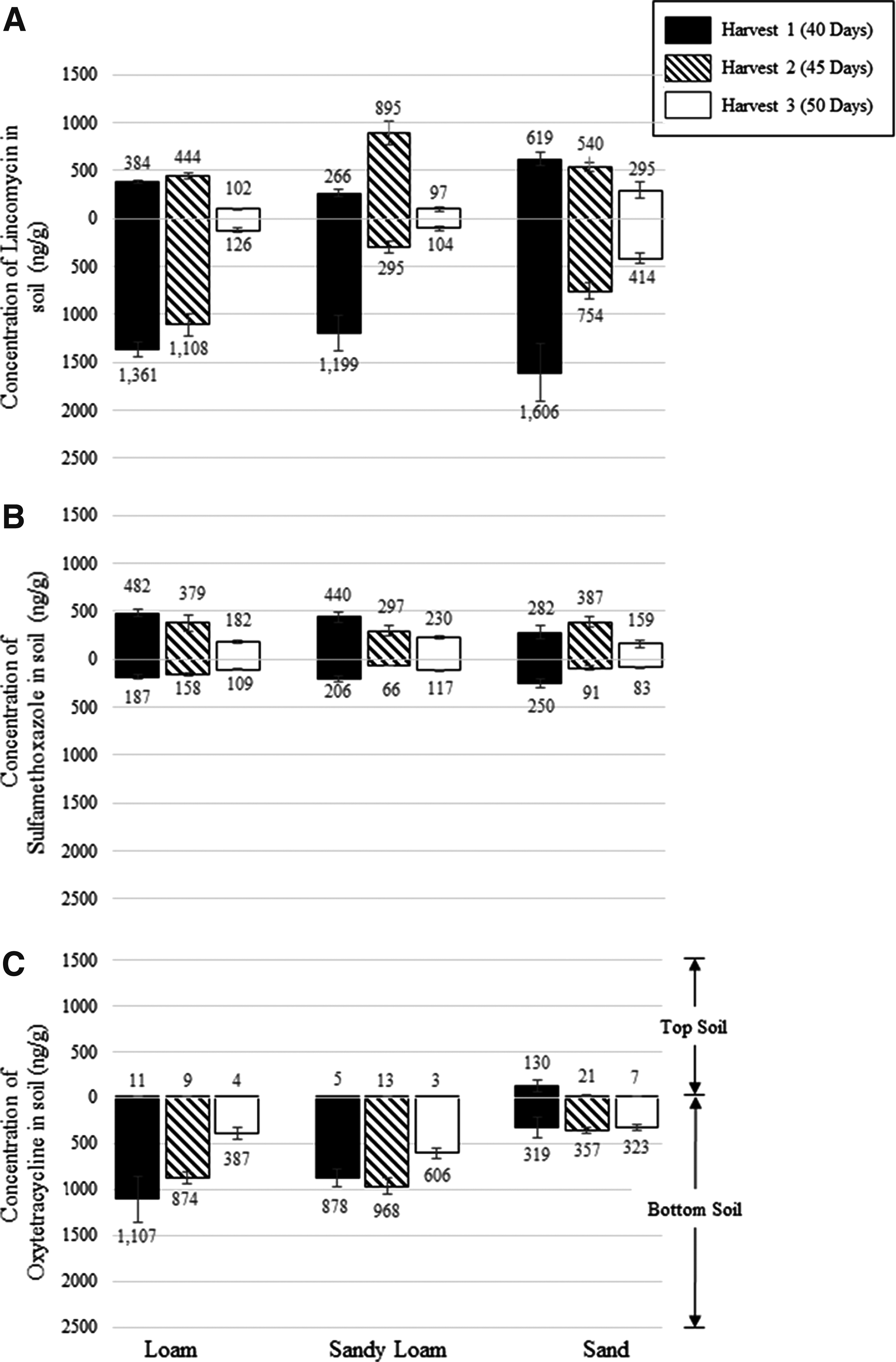
Partitioning coefficients did correlate strongly with the distribution of the antibiotics throughout the soil profile. Comparing the concentrations in the top and bottom of the soil profile (Fig. 2) shows that oxytetracycline, with highest Kd values in all three soils, remained mostly in the bottom layer. In comparison, the compound with the lowest sorption and lowest Kd values for all three soils was sulfamethoxazole, which was detected at higher concentrations in the top soil layer.
Fate in soil and lettuce
After the first harvest, all remaining lettuce pots were irrigated with the control dechlorinated tap water, and samples were collected 5 (harvest 2) and 10 (harvest 3) days later. The leaf concentration of lincomycin grown in the sandy loam soil decreased at both subsequent harvests (Fig. 1). Lettuce grown in the sand and loam soils showed highest concentrations detected at the second harvest. Even without additional amendment, the relatively high solubility of lincomycin (13 g/L) likely allowed for desorption and resuspension into the uncontaminated pore water, making it available for uptake in the irrigation events following the first harvest.
The lettuce concentrations of sulfamethoxazole in the sandy loam soil remained constant at all three harvests at around 8 ng/g FW. In the loam soil, the concentration increased slightly at each harvest, whereas the opposite occurred in the sand soil, where a decreasing concentration trend was observed.
Oxytetracycline concentrations in lettuce were highest at the first harvest for all three soils. However, a sharp decrease in concentration was observed at harvest 2 before a slight increase in concentration at harvest 3. In fact, concentrations in lettuce harvested at 45 days were below the detection limit for a number of the replicates in all three soils (Fig. 2). Oxytetracycline, even as a zwitterion, maintains a positively charged functional group and as a result, cation exchange is more favorable than hydrophobic partitioning, which results in high sorption affinity (Sassman and Lee, 2005). High sorption and low solubility (0.022 g/L) limit its ability to desorb and reincorporate into the uncontaminated irrigation water that was used following the first harvest.
While the concentration of toxicants in edible plant portions is an important measure for the understanding of human exposure of emerging contaminants, it is not enough to reveal all of the behaviors of the dynamic soil–plant system over time. This is because the measure of concentration is dependent upon both the rate of uptake of the contaminant as well as the rate of growth of the plant. Therefore, examining the total mass of accumulation, or net accumulation, provides insight into the movement of the antibiotics with time. Net accumulation was calculated by multiplying the contaminant concentrations in the lettuce plants by the average plant mass at the time of harvest (Fig. 3). For both sulfamethoxazole and lincomycin, even in instances when the concentration decreased, antibiotic uptake continued in the 5 days between harvest 1 and 2. This result highlights how increasing plant mass effectively dilutes contaminant concentrations, an observation noted in a previous study (Sallach et al., 2015).
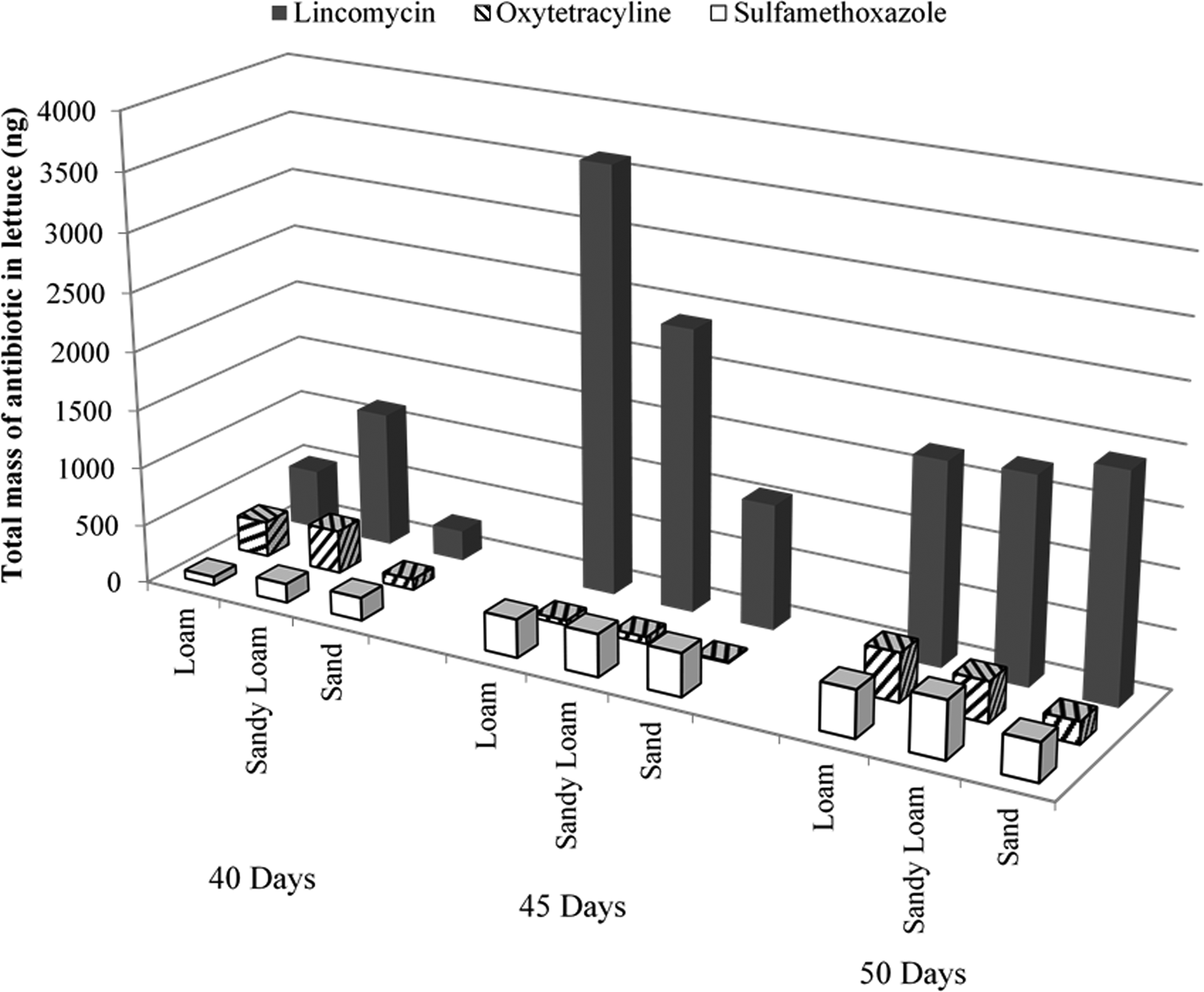
Total mass of antibiotics accumulated in lettuce leaves calculated by multiplying average concentration in lettuce by average total plant mass per pot.
Net lincomycin uptake continued to increase from harvest 2 to 3 in the sand soils. However, in the loam and sandy loam soil, the total accumulated mass of lincomycin decreased from harvest 2 to 3. This indicates that degradation of lincomycin occurred within the lettuce plant at a rate that exceeded uptake. Degradation of sulfamethoxazole is also apparent in lettuce grown in the sand soil, where net accumulation decreased between harvest 2 and 3. While pharmaceutical degradation is known to occur in the environment, few studies have demonstrated its occurrence in vegetable production (Goldstein et al., 2014). Furthermore, this highlights the importance of the significant research gap where the fundamental understanding of the fate and biological impact of antibiotic metabolites is not well known (Williams-Nguyen et al., 2016).
In soil, antibiotic transport and degradation both factor into the soil concentrations over the course of the three harvests. Generally, concentrations of each of the three compounds in both the top and bottom soil profile were reduced over the course of the 10 days during which no additional antibiotics were added to the system. First-order decay functions were generated for the 10-day time period between harvest 1 and 3 and degradation rate constants, k, and compound half-lives, t1/2, were calculated. Values are summarized in Table 2, whereas isotherms and calculations are provided in the Supplementary Data.
Based upon the partition coefficient Kd (Table 2), both sulfamethoxazole and oxytetracycline distributions in the soil profile behaved as expected. Because subirrigation requires irrigation water to flow from the bottom, up through the soil profile, we would expect the more sorptive compounds to be concentrated in the bottom soil layer. Oxytetracycline concentrations in the top profile were far lower than concentrations found in the bottom for all three soils. The least sorptive compound, sulfamethoxazole (Kd = 0.4–1.9) was found at higher concentrations in the top soil as compared with the bottom in all soils and at all harvests. Both of these compound-specific trends are supported by transport studies that show tetracycline mobility to be limited, whereas sulfonamides may pose a risk to surface and groundwater contamination (Blackwell et al., 2007; Watanabe et al., 2010; Kim et al., 2012; Srinivasan and Sarmah, 2014).
With a half-life ranging 3.4–3.7 days, lincomycin demonstrated the most rapid and consistent decay in all three soils. Although soils were exposed to the same concentrations of three antibiotics, higher initial concentrations of lincomycin were detected at the first harvest. This high concentration of the most degradable compound in our system may be a result of an initial lag phase in biodegradation, whereby the compound was able to build up in the soil during the first 40 days where irrigation with contaminated water retarded degradation through alteration in the microbial community. Irrigation with uncontaminated water over the course of days 41–50 may have allowed the native bacteria population to recover leading to the rapid degradation of the compound. This lag phase behavior has been observed in other soil degradation studies and was attributed to the presence of a sulfonamide, also included in our study, which has been shown to temporarily disrupt soil bacteria populations (Monteiro and Boxall, 2009).
Lincomycin and sulfamethoxazole degradation rate decreased with increasing sand content from 8.3 days in loam to 14.6 days in sand. This was expected as biological activity is known to decrease with increasing coarseness of soil texture (Wardle, 1992). Oxytetracycline degradation was most rapid in the loam soil (t1/2 = 6.6 days), but unlike sulfamethoxazole, was most persistent in sandy loam (t1/2 = 20.9 days). Compared with other values reported, half-lives of oxytetracycline and sulfamethoxazole were on the same order of magnitude, but higher, than the biodegradation rates of a sulfonamide (sulfamethazine) and tetracycline (chlortetracycline) antibiotic in a silt loam soil (Topp et al., 2013). In strong agreement with our work, half-lives have been reported for sulfamethoxazole under aerobic and anaerobic conditions ranging from 9.0 to 18.3 days (Lin and Gan, 2011).
Effects of routine irrigation with contaminated water
In a previous study, which evaluated the uptake of these three compounds by lettuce in the same soil mixtures, a single exposure event was conducted with water spiked five times higher than the antibiotic concentrations in the current study (Zhang et al., 2015). Results from the prior study showed that 48 h after exposure, only sulfamethoxazole was detected in lettuce leaves above detection limits (Zhang et al., 2015). Consistent with results from the current study, sulfamethoxazole concentrations in lettuce increased with increasing percentage of sand in the soil mixture. However, when routine irrigation with contaminated water occurred throughout the growth cycle of the lettuce, both lincomycin and oxytetracycline were detected in leaves, and their concentrations in lettuce leaves exceeded sulfamethoxazole concentrations.
The significance of this, which was revealed by differences in exposure regimes between the two studies, suggests that the processes by which oxytetracycline and lincomycin are internalized by lettuce roots and translocated throughout the shoots are more time dependent than the kinetics involved with sulfamethoxazole uptake. As discussed previously, this is supported by results in the fate investigation for lincomycin, where the total mass taken up by lettuce shoots increased significantly in the 5 days following the final irrigation with spiked water (Fig. 3).
Toxicity
The growth of lettuce was affected by the soil texture, where the sand soil mixture resulted in significantly (p < 0.0001) reduced mass of lettuce compared with both the loam and sandy loam soil (Fig. 4). The difference in lettuce plant mass between loam and sandy loam was not statistically significant in the control group (p = 0.146). For all soil types, irrigation with antibiotic-amended water resulted in significantly decreased lettuce growth compared with its respective control (p < 0.0001).

Average mass of lettuce plants at 40-day harvest for control and antibiotic-treated lettuce plants in three soil types
The relative impact of the spiked water on the mass of lettuce increased with increasing sand content in the soil. A decrease of 37%, 55%, and 72% of plant mass between controlled and treated plants was determined for lettuce grown in loam, sandy loam, and sand soil, respectively. High percentage decreases in plant material (up to 60%) have also been associated with the pharmaceutical carbamazepine at similar soil concentrations (Carter et al., 2015). Furthermore, leaf discoloration and reduction in photosynthetic pigments resulted from carbamazepine exposure, consistent with the discoloration, and yellowing of leaves from lettuce grown in the sandy soil from the antibiotic-spiked water. Lettuce was able to recover as soil concentrations declined in the 10 days between harvest 1 and 3, where leaves from all three soils showed no signs of stress.
These significant growth reductions suggest that agricultural productivity may be negatively impacted by the use of recycled wastewater, a significant research gap, recently identified, relating to antibiotics in the agroecosystem (Williams-Nguyen et al., 2016).
Sulfonamide antibiotics, including sulfamethoxazole, have been shown to inhibit the growth of rice at a concentration of 0.1 mg/L and maize grown in soil at 10 mg/kg (Liu et al., 2009; Michelini et al., 2012). However, rice sensitivity to tetracyclines was less acute as concentrations in soil as high as 300 mg/kg, and tetracyclines did not affect plant growth but did effect seed germination (Liu et al., 2009). This likely is attributed to tetracycline's high adsorption to soils (Table 2) and is supported by the findings of Norman (1955), where root growth was inhibited by oxytetracycline in a hydroponic system, but had no effect in soils. Oxytetracycline in hydroponic systems has also been shown to reduce plant growth in alfalfa; however, at concentrations of 1 mg/L, the concentration of oxytetracycline in our irrigation water, no effect was observed (Kong et al., 2007).
Lincomycin has been shown to be toxic to a number of algae strains at the μg/L level (Andreozzi et al., 2006). Attributing toxicity to specific antibiotics in a mixture is not possible, as mixture toxicities can have unpredictable and concentration-dependent synergistic or antagonistic effects (Yang et al., 2008; Liu et al., 2009, 2014; Gonzalez-Pleiter et al., 2013). Consistent with our study, antibiotic toxic effects have also been shown to be dependent upon soil characteristics; where plants were more sensitive in sandy loam than with a high clay soil (Batchelder, 1982). Not only was the sand soil, without antibiotic, the least ideal for optimal plant growth, but it also amplified the toxic effect of the antibiotics to lettuce.
Conclusions
This study confirmed that soil texture plays an important role in the uptake of antibiotics by lettuce. However, correlation between increasing sand content and subsequent uptake and translocation was only observed for sulfamethoxazole. This is because soil composition not only affected the bioavailability of the contaminants but also the health of the plant. When irrigation was switched to noncontaminated water, lettuce recovery was observed resulting in an increase in growth rate. In addition, examination of the net accumulation of antibiotic compounds by lettuce plants over time revealed that degradation of lincomycin and sulfamethoxazole within the lettuce leaves occurred over the 10-day harvesting period.
Results from this study should help in the evaluation of best management practices for the use of recycled wastewater for irrigation. Areas with sandy soil should pay particularly close attention to plant toxicity resulting in decreased yield. Furthermore, due to the persistence and mobility of antibiotic compounds in the soil–plant system, a “finishing” period, utilizing uncontaminated irrigation water, may be suitable to reduce the concentrations of antibiotics in vegetables meant for consumption. The time needed to realize this reduction is dependent upon both contaminant and soil characteristics.
Footnotes
Acknowledgments
The authors recognize the contribution of Emily Hoehn and Lindsey Knight for assistance with sample processing, and separation chemist Dave Cassada for analytical assistance. This work was supported by the United States Department of Agriculture NIFA program (project No. 2011-67019-20052).
Author Disclosure Statement
No competing financial interests exist.
References
Supplementary Material
Please find the following supplemental material available below.
For Open Access articles published under a Creative Commons License, all supplemental material carries the same license as the article it is associated with.
For non-Open Access articles published, all supplemental material carries a non-exclusive license, and permission requests for re-use of supplemental material or any part of supplemental material shall be sent directly to the copyright owner as specified in the copyright notice associated with the article.
