




Abstract
Abstract
Colloidal properties of nanobubbles (NBs) in liquid such as surface charge and surface tension influence stability (coalescence or size distribution), reactivity, and performance of applications (e.g., detergent-free cleaning, water treatment, and remediation) were studied. These colloidal properties are often effected by environmental factors such as pH, ionic strength, and the presence of natural organic matters (NOM). This work performed holistic investigations of colloidal properties of three types of NBs (pure air, oxygen, and nitrogen) in the presence of electrolytes, NOM, and surfactants, which are not reported elsewhere. Three different types of NBs exhibited different bubble size distribution (160–340 nm in water) and zeta potentials (approximately −27 to −45 mV at neutral pHs) presumably due to differences in their surface tension or charges. All tested NBs exhibited high stability against coalescence even under high ionic strength and surfactant concentrations. Soft particle extended Derjaguin-Landau-Verwey-Overbeek theory analysis indicated that the energy barriers between two interacting NBs were extraordinarily high (>5,000 kBT) in pure water, which may explain the high colloidal stability and resistance to coalescence. These results provide new fundamental insight into the physical chemical properties of NBs in water and aim to lay the groundwork toward the green sustainable engineering applications.
Introduction
N
Similar to charged oil–water emulsions (Phenrat and Kumloet, 2016; Srirattana et al., 2017) and colloids (Leunissen et al., 2007), the characteristics of NBs such as zeta potential (ZP) affect coalescence and self-organization processes (Bunkin et al., 2009a), which are critical to many colloidal behavior (Gurung et al., 2016; Sun et al., 2016). In general, NBs like to acquire a surface charge, just as is the case for colloids (Lundqvist et al., 2008; Arvizo et al., 2010; Schaeublin et al., 2011). NBs in pure water are generally negatively charged due to excess OH- groups at the interface (Karraker and Radke, 2002; Beattie et al., 2009). For example, ZP affects interactions of NBs themselves and with other surrounding materials, leading to dispersion, coalescence, and adsorption (Cho et al., 2005).
Previous studies demonstrated that ZPs of air NBs (ANBs) and oxygen NBs (ONBs) are negatively charged with in the ranges of −17 to −20 mV and −34 to −45 mV, respectively, at pH 5.7–6.2 for air and 6.2–6.4 for oxygen (Ushikubo et al., 2010; Uchida et al., 2011). High magnitude of ZPs usually leads to interparticle or interbubble repulsion and stable suspension resistance against coalescence and larger bubble formation. Meantime, colloidal behavior or stability greatly influences the bubble size and size distribution, mobility, reactivity, and other properties of NBs. For example, stability of NBs might be explained by the possibility that they are fully covered and sealed by charge layers that prevent gas diffusion. Nevertheless, the stability and even the existence of NBs in the bulk suspension are still largely debatable in the literature.
One of the important colloidal behaviors is aggregation or coalescence (whether colloids stay stable as suspended or tend to aggregate or adsorb onto interfaces), which is largely mediated by interfacial forces such as van der Waals force and electrostatic force according to the classic Derjaguin-Landau-Verwey-Overbeek (DLVO) theory (Li et al., 2011). Aggregation or coalescence of NBs may be complicated as gaseous NBs may undergo additional concurrent processes such as hydrogen bonding, shape deformation, dissolution, and collapse (Grasso et al., 2002; Firouzi et al., 2015). Moreover, coalescence of NBs may also be affected by solution chemistries such as pH, ionic strength, and organic matters (e.g., surfactants) (Butkus and Grasso, 1998; Jin et al., 2007).
Several research studied the coalescence of bubbles in millimeter or micrometer scales (Prince and Blanch, 1990; Firouzi et al., 2015). Particularly, these studies indicated that the presence of salt and ions changed the structure and texture of the water through hydrophobic interaction and caused retardation of drainage process of coalescence, which consequently inhibits the coalescence of microbubbles (Craig et al., 1993; Craig, 2004; Firouzi et al., 2015).
Despite the knowledge about colloidal behaviors and properties of gases (usually microbubbles) (Postema et al., 2004; Vakarelski et al., 2010; Shams, 2014), there is a lack of fundamental understandings of engineered NBs in colloidal systems. For example, the influences of complex environmental conditions on bubble size (distribution), ZP, and coalescence behavior of different gas bubbles in nanoscale are not largely explored. This information is highly needed to advance the engineering design for any NB-involved application processes and to warrant the desirable properties and performances. For example, in NB applications such as aeration (Navisa et al., 2014), flotation (Jávor et al., 2015; Hassanzadeh et al., 2016; Kouachi et al., 2017), groundwater remediation, and attachment to high density oil (Lim et al., 2016), proper sizes of NBs are needed to achieve optimal mass transfer, reactions, or contaminant interactions. Aggregation or potential to coalescence may hamper these anticipated processes and influence the performance of injected NBs.
This study investigated the effects of the solution pH, ionic strength, and the presence of organics on the bubble size distribution (BSD) and ZPs of three types of NBs made with high purity air, oxygen, and nitrogen. In these three types of gases NBs have different surface tension, surface charge, and chemical properties, which may lead to different colloidal properties and interactions. Ionic strength was simulated by adding sodium chloride (NaCl) and calcium chloride (CaCl2). To examine the effects of organic matters, sodium dodecyl sulfate (SDS) as anionic surfactant, dodecyl trimethyl ammonium chloride (DTAC) as cationic surfactant, and humic acid (HA) were tested. The hydrodynamic diameters of NBs in water suspension over time at different ionic strength and natural organic matters (NOM) were monitored to evaluate the stability and coalescence behavior. The ultimate goal is to provide fundamental insight into the unique colloidal properties and promote potential rationale design in engineering applications.
Materials and Methods
Preparation of NBs
The NB generation system was composed of a pressurized gas tank, gas pressure regulator, gas flow meter, porous ceramic tube (Refractron), 20 nm filter (Whatman Anotop 25 Plus syringe filter; Sigma Aldrich), and the connected pipes as shown in Supplementary Fig. S1. The NB ceramic tube has the nominal pore size of 100 nm, outer and inner diameters of 13 and 8 mm, respectively, and a length of 51 mm. The gas flow was injected under a pressure of 60 psi (∼414 kPa) to pass through a 20 nm filter to eliminate all potential particulate impurities in the gas and then through the ceramic tube into a 500 mL water reservoir. Direct-Q UV Millipore water (DI water) was the solvent of all the experiments. Compressed air (Ultra zero grade air; Airgas, Inc.), oxygen (purity 99.999%; Airgas, Inc.), and nitrogen (purity 99.999%; Airgas, Inc.) gases were used to produce ANBs, ONBs, and nitrogen NBs (NNBs), respectively.
Bubble size distribution and ZP
Dynamic light scattering (DLS) on a Zetasizer Nano ZS instrument (Malvern Instruments) was used to monitor BSD and ZP. The suspension of NBs in tested solutions was taken after 90 min of a continuous gas injection in 500 mL of tested solution to achieve complete saturation and bubble size stabilization (Calgaroto et al., 2014) and transferred into glass cuvettes with 1 cm light transmission path and tested immediately by DLS. The BSD was performed at a scattering angle of 173° and a temperature of 25°C (Ushikubo et al., 2010; Calgaroto et al., 2014). The triplicate measurements for each sample were performed, and each measurement consisted of fifteen runs.
ZPs of ANBs, ONBs, and NNBs at different pHs and ionic strengths were investigated following similar procedures reported previously (Ushikubo et al., 2010; Calgaroto et al., 2014). The pH of the tested solutions was first adjusted with NaOH or HCl. Ionic strength was varied by adding different amounts of NaCl or CaCl2 to evaluate the impacts of different cations on surface charge of NBs. ZPs of ANBs, ONBs, and NNBs in 500 mg/L SDS, 200 mg/L DTAC, and 25 mg/L HA were also detected to analyze the effect of surfactants on surface charge of NBs. U-shape (DTS1070) cuvettes were used to perform ZP experiments with automatic runs (10–100) for each tested sample in triplicate with no delay between them. The average and standard division for each measured sample were calculated.
Surface charge density and surface tension
Surface charge density (SCD) was calculated with Gouy–Chapman equation (Butt et al., 2006) as follows:
where σ is SCD (C/m2), ɛ is the dielectric constant of water, 78.54 (25°C), ɛ0 is the dielectric permittivity of a vacuum, 8.854 × 10⁻¹² (C/[V·m]), ζ is ZP of NBs (V), and λD is Debye length (m), see Supplementary Table S1. The outward pressure (
where D is the relative dielectric constant of the gas bubble (assumed unity). The inward pressure (
where γ is the surface tension of NBs, and a is the radius of NBs.
Therefore, if these pressures are equal (
This equation was used to calculate the surface tension of the different types of NBs. The actual internal pressure, although difficult to measure or estimate accurately, should be between 0 and 414 kPa because of the energy dissipation and conversion into the surface energy of NBs (Brenner and Lohse, 2008; Ducker, 2009; German et al., 2014). For simplification, it was assumed that Pinj was equal to 60 psi (414 kPa) (the initial injection gas pressure).
Aggregation of NBs in the presence of different ionic strength, NOM, and surfactant levels
The aggregation experiments were performed using the time resolved DLS method. The hydrodynamic diameter of the NBs was monitored continuously over the different time intervals. Briefly, NBs were injected into 500 mL of the solution containing different salts, NOM, or surfactants. One milliliter of the suspension was transferred to the cuvette to monitor the aggregation of ANBs, ONBs, and NNBs in water suspension. For example, NaCl or CaCl2 was first filtered with 20 nm filter (Whatman Anotop 25 Plus syringe filter; Sigma Aldrich) and diluted to 500 mL with DI water to obtain NaCl (10–300 mM) or CaCl2 (50 mM) solution as used by others (Saleh et al., 2008; Xu et al., 2009). Then, the NBs were continuously injected in the diluted solutions for 90 min at 414 kPa to create steady NBs. Finally, the cuvettes were filled with 1 mL of NB suspension. Each cuvette was used for one-time measurement and then discarded to avoid the potential artifacts or interferences from cuvette handling.
HA was used to study the effect of NOM concentration on the coalescence of NBs. The HA solutions were also filtered with 20 nm filters and then diluted to 500 mL with DI water. The final HA concentration in the 500 mL tested solutions was 25 mg/L as used by others (Xie et al., 2008; Xu et al., 2009; Jia et al., 2013).
The effects of surfactants on NB stability were investigated using SDS as anionic surfactant and DTAC as cationic surfactant. Again, the SDS and DTAC solutions were filtered with 20 nm filters, and the concentrations were up to 500 mg/L SDS and 200 mg/L DTAC, respectively (Xie et al., 2008; Xu et al., 2009; Jia et al., 2013). The tested concentrations of the surfactants were compared to the critical micellization concentration (CMC), which refers to the concentration of surfactants above which micelles compose and any extra surfactants added to the solution become micelles (Mendrek et al., 2010). Surfactants are aggregated and formed micelles when their concentrations are higher than the CMC. The CMC for SDS and DTAC is 8 and 21.5 mM, respectively (Alargova et al., 1998). The tested concentrations were 500 mg/L (1.73 mM) and 200 mg/L (0.76 mM) for SDS and DTAC, respectively. These concentrations are much lower than CMC. Therefore, the micelles could not be generated or interfere with the measurement of BSD because the surfactants are in the monomeric form (Jusufi et al., 2012).
All the above experimental conditions were repeated thrice to confirm the observations and to obtain the average and the standard deviations represented in the error bars.
Soft-particle extended DLVO analysis for interaction energy
Similar to aqueous thin-liquid films (Wan and Wilson, 1994; Karraker and Radke, 2002; Yaminsky et al., 2010) and due to the softness and deformation potential, the bubble–bubble interaction energy was estimated by the soft-particle extended DLVO (EDLVO) theory (Wan and Wilson, 1994; LaFrance and Grasso, 1995; Karraker and Radke, 2002; Yaminsky et al., 2010; Ge et al., 2014, 2015). Soft-particle EDLVO calculation is used to simplify the quantification of surface interaction energies of two identical NBs (before attachment, coalescence, or deformation occurs). In this study we adopted the sphere–sphere geometry in the application of EDLVO equations. This hypothesis is made because NBs, due to the high internal pressure, are believed to have taut inflexible surfaces (like high pressure balloons) that limit distortion (Cancelos et al., 2016).
Supplementary Table S1 summarizes all the parameters used in the EDLVO equations that are also shown in the supporting information (SI). Effects of different concentrations of NOM, surfactants, and different ionic strength on the aggregation behavior of NBs were assessed on the basis of the changes of interaction energies between NBs in the corresponding solution chemistries.
Results and Discussion
BSD of NBs in DI water
Figure 1a shows the BSD of ANBs, ONBs, and NNBs dispersed in DI water measured after 90 min of continuous injection of air, oxygen, and nitrogen at 414 kPa. The BSD differed for the three kinds of NBs, presumably due to the differences in surface tension as discussed below. They all had a wide size range from about 100 nm to near 1,000 nm. To determine the potential influences of Brownian motion and buoyancy force on the DLS measurement of NBs, the Peclet number (Pe) was calculated and assessed (Ge et al., 2015):
where

ZP for ANBs, ONBs, and NNBs at different pHs, ionic strengths, and surfactants
Figure 2a shows the dependence of ZP of ANBs, ONBs, and NNBs on the solution pH, which agree with previous reports (Oliveira and Rubio, 2011; Jia et al., 2013; Calgaroto et al., 2014). As the pH value decreases the concentration of OH- reduces. Instead, the H+ concentration largely increases, adsorption of which on the gas–water interface significantly decreases the negative charge density (Oliveira and Rubio, 2011; Jia et al., 2013; Calgaroto et al., 2014; Manciu et al., 2016). Similar to other colloids, ZPs are of similar order of magnitude for the three types of NBs. At near neutral pHs, ZPs are around −40 mV, which implies that NBs are highly stable due to the electrostatic repulsion as calculated below.
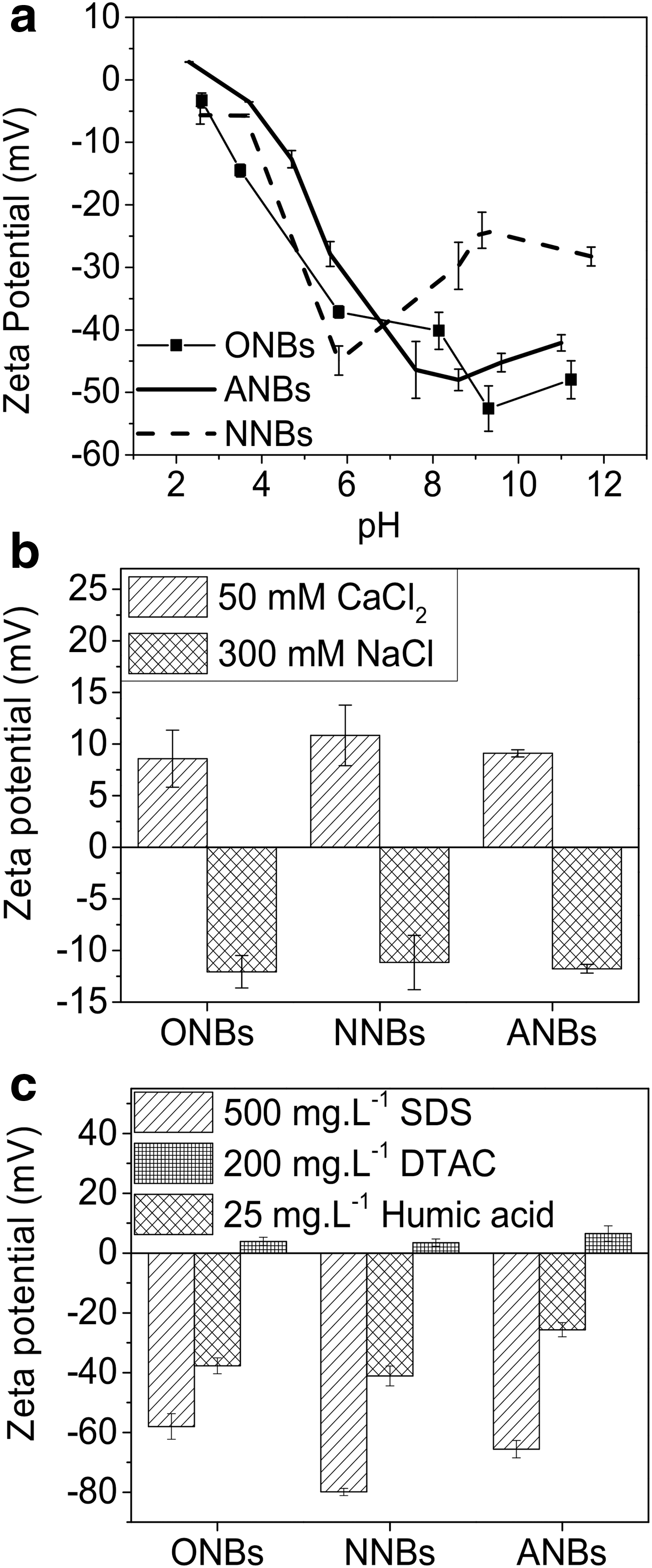
Figure 2b shows ZP for ONBs, NNBs, and ANBs in the presence of 300 mM NaCl and 50 mM CaCl2. CaCl2 led to positive surface charges for all types of NBs as their ZPs shifted to near 10 mV, whereas NaCl only suppressed ZPs to lesser negative values. Since NBs have negative charges in DI water due to the adsorption of OH- (Karraker and Radke, 2002; Beattie et al., 2009), cations (Ca2+ or Na+) may adsorb onto the surface of NBs (Cho et al., 2005; Najafi et al., 2007).
Figure 2c shows the ZPs of ANBs, ONBs, and NNBs in 500 mg/L SDS, 200 mg/L DTAC, and 25 mg/L HA. ZP of the three types of NBs in surfactant solutions is substantially dependent on the type of surfactants. Anionic SDS resulted in more negative ZPs for all three types of NBs, which was also reported previously (Cho et al., 2005; Najafi et al., 2007). ZPs of ANBs, ONBs, and NNBs shifted from −30, −36, and −45 mV to −65, −60, and −80 mV, respectively, probably because of the adsorption of ionized surfactants on NBs. By contrast, cationic DTAC led to positive surface charges for all types of NBs. This might result from the adsorption of cationic surfactant on NB surface (Najafi et al., 2007). The effect of HA on ZP of all types of NBs is almost negligible, indicating that NBs may have weak interactions with hydrophilic HA. In addition, the weakly charge of HA, comparing to the SDS, might not be sufficient to change the ZP of NBs significantly.
SCD and surface tension analysis
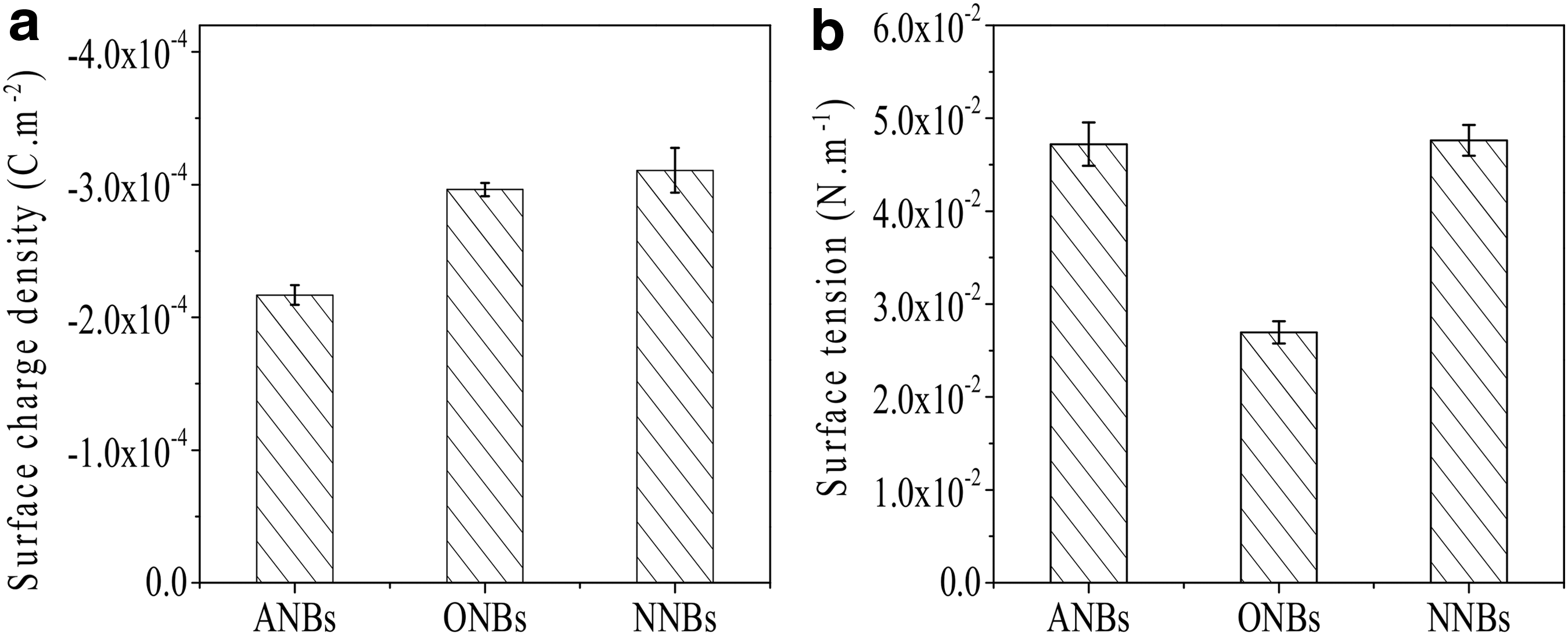
Figure 3a shows the SCD for ANBs, ONBs, and NNBs that was calculated with [Eq. (1)]. SCD of NNBs and ONBs is higher compared with ANBs. This returns to the high ZPs of ONBs and NNBs compared to ZPs of ANBs. The differences in ZP of different gases are attributed to adsorption of ions (Manciu et al., 2016), which might be related to their different ionization energies (Hao et al., 2016). The ionization energy of nitrogen and oxygen is 14.5 and 13.6 eV, respectively, compared to 34 eV in case of air (Roos, 1996; Shimada et al., 2007). Thus, air molecules would require more ionization energy to remove an electron from its outer shell. This may explain the preference of nitrogen and oxygen to adsorb OH- on their surfaces of NBs and increase their negative charges in DI water (Karraker and Radke, 2002; Beattie et al., 2009).
Surface charge density
With Equation (4) the surface tension for ANBs, ONBs, and NNBs was calculated and shown in Fig. 3b. The error bars indicate the variations in the calculated values of surface tension as a result of the variations in the surface charge and measured NB size as stated above. The calculated surface tension is on the comparable order of magnitude with literature reported levels of air/water interface (∼0.073 N/m) (Vargaftik et al., 1983). Surface tension of ONBs is lower than those of NNBs and ANBs. This is probably because ONBs had smaller diameter (170 nm) than both ANBs and NNBs that had 300 and 270 nm in diameter, respectively.
Experimental coalescence kinetics of NBs in pure water, different salts, NOM, and surfactant solutions
The coalescence of three kinds of NBs in pure water is presented in Supplementary Fig. S2. The hydrodynamic diameter shows a symmetrical oscillation between 162 and 260 nm over 140 min. The oscillation confirms that coalescence of NBs was not significant during the experimental period. The three types of NBs had good colloidal stability in DI water, which coincides with the previous studies (Ushikubo et al., 2010; Liu et al., 2013).
The effect of ionic strength on coalescence of NBs was tested in two different concentrations of NaCl (10 or 300 mM) and in 50 mM of CaCl2 (comparable to environmentally relevant levels of ionic strength) (Xu et al., 2009; Li et al., 2011; Zhang et al., 2012), see Supplementary Fig. S3. The figure shows that the hydrodynamic diameters of three kinds of NBs remained almost unchanged, although having sizable fluctuations. This trend supports the ability of ANBs for long lasting even under high ionic strength conditions. Adsorption of charged ions on the surface of NBs may generate electrostatic repulsion forces and tend to increase bubble size. In contrast, adding charged ions may also compress the electric double layer thickness and reduce SCD. Consequently the surface tension force may lead to the decrease of bubble size (Bunkin et al., 2007, 2009b; Chaplin, 2007; Azevedo et al., 2016). This is probably why NBs remained relatively stable and had almost negligible changes in bubble size distribution.
Supplementary Fig. S4 shows the coalescence of ANBs, ONBs, and NNBs in the presence of 25 mg/L, 500 mg/L SDS, and 200 mg/L DTAC. HA was consistently unaffected. Similarly, the bubble sizes of ANBs, ONBs, and NNBs in 500 mg/L SDS and 200 mg/L DTAC appeared to fluctuate significantly without evident coalescence. The stabilization of NBs was attributed to a preferential adsorption of organic molecules at the gas/water interface. The adsorbed organic layer may change surface charge and reduce the surface tension, which could stabilize NBs.
Soft-particle EDLVO analysis for NB coalescence in presence of different salts or surfactants
Analysis of the inter-NB interaction energies was calculated for ANBs, ONBs, and NNBs in pure water and in the presence of different ionic strengths and surfactants. The total interaction energy profiles in Fig. 4 indicate that the energy barriers were substantially high (>5,000 kBT) for the three different NBs in pure water. The energy barrier peaks decreased to 29–287 kBT when DTAC, NaCl, and CaCl2 were added. Adsorption of DTAC (cationic surfactant) molecules on the negatively charged surfaces of NBs may add positive charges on the surface of NBs. This leads to an obvious reduction of the electrostatic interaction energy, which in turn decreases the energy barrier peaks (Zhang et al., 2016). In the presence of NaCl and CaCl2, the energy barrier peaks also decreased because of the increase of ionic strength and the compression of electric double layer (Yoon and Mao, 1996; Li et al., 2011).

Total interaction energy of
For all types of NBs, addition of SDS (anionic surfactant) significantly increased the energy barrier peaks due to the increase of the electrostatic repulsion for all three types of NBs, whereas the addition of HA slightly decreased the energy barrier to a different extent. Nevertheless, the remaining energy barriers were still on the order of 2,000 kBT, which is sufficient to stabilize the suspension of NBs against coalescence. Addition of HA induced minor changes to the interaction energy profiles and barriers of NBs, which are probably because HA is hydrophilic and negatively charged and thus had weak surface binding or adsorption on the negatively charged NBs (Illés and Tombácz, 2006).
Conclusion
The stability of three types of NBs was analyzed through multiple experimental and theoretical approaches. The BSD and ZPs were experimentally monitored and measured under various levels of ionic strength, HA, DTAC, and SDS. Three kinds of NBs had different size distribution because of their different surface charges and surface tensions in water. NBs had similar pH-dependent ZPs that became more negative (−30, −45, and −55 for NNBs, ANBs, and ONBs, respectively) with the increasing of pH. The coalescence of ANBs, ONBs, or NNBs was not significant in the solutions under all tested scenarios in the presence of typical environmental concentrations of salts, NOM, and surfactants. The observed NBs' high colloidal stability was also supported by the results of the soft-particle EDLVO theory analysis that indicated that there was always strong interbubble repulsion. Overall, the results will lay groundwork toward effective and sustainable applications of engineered NBs.
Footnotes
Acknowledgments
The authors thank the Egyptian Ministry of Higher Education (Cultural Affairs and Missions Sector), Taishan Scholar Program, Shandong, China the Department of Civil and Environmental Engineering of New Jersey Institute of Technology (NJIT), and Otto H. York Center for Environmental Engineering and Science for their financial and instrumental supports.
Authors' Contribution
The article was written through contributions of all authors. All authors have given approval to the final version of the article.
Author Disclosure Statement
No competing financial interests exist.
References
Supplementary Material
Please find the following supplemental material available below.
For Open Access articles published under a Creative Commons License, all supplemental material carries the same license as the article it is associated with.
For non-Open Access articles published, all supplemental material carries a non-exclusive license, and permission requests for re-use of supplemental material or any part of supplemental material shall be sent directly to the copyright owner as specified in the copyright notice associated with the article.
