




Abstract
Abstract
The aim of this study was to calibrate and validate activated sludge model No. 3 (ASM3) for an Italian municipal wastewater treatment plant (WWTP) located in Friuli Venezia Giulia region. The model was modified and calibrated using experimental data from aerobic and anoxic respirometric batch tests with activated sludge from the biological treatment line of the studied WWTP. Calibrated set of model's kinetic parameters and stoichiometric coefficients, obtained from these tests, were able to describe the oxygen uptake rate as well as the ammonia and nitrate uptake rate of the activated sludge. The model was validated using full-scale operating data from the biological unit of the WWTP. Validated ASM3 allowed successful simulation and prediction of chemical oxygen demand decay, nitrification and denitrification processes, oxygen consumption, and sludge production. Finally, sensitivity analysis with respect to model outputs was performed and accuracy of the model determined by evaluating the theoretical predictions using the root mean squared error (0.2–72%) and the Nash and Sutcliff efficiency index values (0.806–0.999). The validated ASM3 could be used as a decision tool, predicting the real operating conditions under which best efficiency of the WWTP with low sludge production may be expected.
Introduction
M
Despite the technological improvement of WWTPs, the ability of predicting the operation of a full-scale WWTP is of great importance. Large-scale process design traditionally involves preliminary feasibility modeling studies in small-scale, followed by pilot-scale studies before ultimate full-scale design. However, pilot-scale testing is expensive in view of time, effort, and cost. Therefore, modeling approaches focused on chemical and biological processes involved in WWTPs, are mainly based on the operation of bench-scale systems (Hamed et al., 2004; Liwarska-Bizukojc and Bizukojc, 2012; Pomiès et al., 2013). Moreover, several modeling approaches highlighted the necessity of the calibration and validation of activated sludge models (ASMs) using full-scale WWTP operation (Brdjanovic et al., 2000; Makinia et al., 2006; Burger et al., 2011; Mannina et al., 2011; Liwarska-Bizukolc et al., 2013; Vitanza et al., 2016). These mathematical models are able to identify the key operating-environmental conditions of each WWTP under study, with emphasis in those that lead to the best performance.
The most well-known models in the literature for mathematical simulations of full-scale wastewater treatment processes are the ones elaborated by International Water Association (IWA) (Henze et al., 2000). Therefore, the ASMs ASM1, ASM2, ASM2d, and ASM3, have been widely used for the theoretical prediction of chemical oxygen demand (COD), nitrogen compounds, phosphorous, and sludge dynamics in WWTPs (Gujer, 2008; Zhang et al., 2010; Flores-Alsina et al., 2011; Mannina et al., 2011; Suchetana et al., 2016).
It is noteworthy that failure to account the conditions that exist in real operating schemes, such as nitrification, denitrification, COD degradation, flow rates, etc., may lead to false predictions and wrong selection of operating parameters in WWTPs. Moreover, the proper operation and control of WWTPs has received great attention, since the improper operation of WWTPs may bring about serious environmental and public health problems. A better control and design of a WWTP can be achieved by using a robust mathematical tool for predicting the plant performance based on actual observations of certain key parameters.
In the present work, we present an integrated activated sludge-based mathematical model to simulate the real operation performance of a full-scale WWTP located in Friuli Venezia Giulia (FVG) region in Italy. The model, which was based on ASM3, was calibrated using experimental data from the respirometric characterization of actual activated sludge taken from the biological treatment line of the plant. The validation of the model was based on real quantitative data obtained from the full-scale WWTP's operation. Furthermore, the reliability of the proposed model was evaluated by determining the Nash and Sutcliff index, the root mean squared error, and the sensitivity of model's outputs to the kinetic parameters.
This modeling study provides a validated mathematical model based on real operating conditions, which could be used as a decision tool, predicting the relative success of the biological treatment process and the operating conditions under which desirable effluent characteristics with low sludge production may be expected. The content of this work corresponds to highly challenging issues of modeling and optimization of waste technologies and is expected to have a great impact on the field of WWTPs' management, toward environmental and human health protection.
Materials and Methods
Wastewater treatment plant
The WWTP studied in this work, is located at Terenzano city in the FVG region, Italy. The WWTP serving a population of 8,000 P.E., is characterized by a daily variation of the influent flow rate. The Terenzano WWTP operates by employing a biological nutrient removal (BNR) process. The BNR unit consists of a ring-shaped tank with the settler placed at the center. After the primary treatment (grit screw and horizontal-flow grit chamber), the influent is directed to the first section of the unit, consisting of an anaerobic reactor, from which it goes to the anoxic section and, finally, to the aerobic reactor. The mixed liquor of aerated sludge is recirculated from the aerobic reactor to the anoxic section with a ratio QML/QIN of 3.5.
The recirculation flow rate QR from the clarifier (860 m3/day) goes entirely to the anaerobic reactor. The amount of wasted biomass is about 4.5 m3/day. The oxygen setpoint in the aeration tank is in the range of 1–2.5 mgO2/L (the blowers switch on when dissolved oxygen [DO] concentration is less than 1 mgO2/L and stopped when the value of 2.5 mgO2/L is reached). The diffusers are ceramic fine pore type.
Operating parameters of the WWTP, which were measured during the period April–August 2016, are given in Supplementary Table S1. The characterization of the wastewater in the influent as well as in the biological treatment line of the WWTP was conducted in the laboratory by using analytical procedures for COD, ammonium and nitrate nitrogen, Volatile Suspended Solids (VSS), and Total Suspended Solids (TSS). In addition, Sludge Volume Index (SVI) tests were conducted using activated sludge from the settling tank (clarifier) of the WWTP.
It should be noted that the present modeling study considers only the biological treatment line (BNR).
Respirometric system
The respirometric system used in the present study was a liquid–gas static type (Supplementary Fig. S1), where the concentration of DO was measured in the liquid phase by electrochemical Clark-type probe (Hanna Instruments HI 76407/4). The respirometer vessel consisted of a 1 L cylindrical plexiglass reactor, was continuously stirred by a magnetic mixer to ensure total mixing and was closed to atmosphere. The vessel was submerged in a temperature bath, set at 20°C ± 1°C. The respirometer was provided also with pH (HI 98150), Temperature (T) (Pt 100; RS Components), and Oxidation Reduction Potential (ORP; HI 3230) probes. All probes (DO, pH, T, ORP) were connected to a data logger unit (349701A; Agilent) and interfaced with a computer for automatic recording of data processed by specialized software (34970A; BenchLink data logger). This automatic control system switched on the air blowers (for 1 min) when the DO concentration in the liquid phase reached the set lower limit of 2 mg O2/L. The aeration system consisted of membrane pumps (SCHEGO) with a flow rate of 150 L/h combined with porous microbubble diffusers.
This respirometric apparatus was used for the characterization of the activated sludge, which was taken from the biological section of the WWTP, located in Terenzano city in Italy. All the respirometric runs were inoculated with activated sludge taken from the aerated basin of the studied WWTP, to evaluate the oxygen uptake rate (OUR), the ammonia uptake rate (AUR), and the nitrate uptake rate (NUR).
It should be noted that the WWTP in Terenzano city is located ca. 55 km far from the University of Trieste, where the experiments took place. All the samples (activated sludge, influent wastewater, etc.) were collected in plastic vessels, stored in a portable fridge and immediately transferred to the laboratory for analysis.
OUR, AUR, and NUR experiments
Respirometric experiments were conducted having a total working volume of 800 mL. All experiments were conducted using activated sludge, which was appropriately diluted with tap water (rested for a 0.5 h) to obtain an initial concentration of microorganisms of about 2–3 gCOD XH/L. This concentration corresponded to 1550 ± 350 mgVSS/L and 2100 ± 400 mgTSS/L. The activated sludge samples, which were used for each respirometric experiment, were collected in different sampling days during the experimental period and they had an average concentration of 2200 ± 250 mgVSS/L. In both OUR and AUR tests the diluted activated sludge was left with aeration for 2 ± 0.5 h, to achieve endogenous conditions at the beginning of each experiment.
Consequently, during OUR experiments, wastewater liquid (unfiltered), taken from the influent of the WWTP was added in the system to provide a ratio of initial COD concentration and initial biomass concentration of 0.02–0.04 gCOD Ss_in/gCOD XH_in according to Vitanza et al. (2016). To determine AUR, the diluted activated sludge, having a volume of 750 mL, was put in contact with 50 mL of ammonia solution to obtain an initial concentration of about 19 mgN-NH4/L.
To evaluate NUR, the sample of activated sludge was initially added to the reactor and was left for a few hours before the use, to obtain anoxic conditions before the beginning of the NUR tests. Thereafter, unfiltered influent wastewater from the WWTP was added in the reactor to provide the demanded COD for denitrification process. The values of the soluble (filtrate) COD, which was initially added in the NUR experiments varied from ca. 40 to 130 mgfCOD/L due to the variations of COD values in the raw wastewater during the experimental period (Table S1). At the same time, 50 mL of nitrate solution was added in the reactor to achieve an initial concentration of around 20–25 mgN-NO3/L.
Experiments were performed in triplicate (Run#1, Run#2, Run#3) and each Run had a duration of about 24 h. Samples were taken at different time intervals and analyzed for soluble (filtrate) COD, VSS, ammonium nitrogen (N-NH4) and nitrate nitrogen (N-NO3) content. It should be noted that during OUR and AUR experiments due to the high concentration of substrate that was introduced in the activated sludge, the DO concentration reached the limit of 2 mg O2/L every 1 and 4 min, respectively. This time interval was gradually increased (7 and 16 min) due to substrate consumption and was constant when the biomass reached the endogenous respiration stage (Supplementary Fig. S2). These intervals were used to calculate the experimental OUR and AUR.
Finally, control experiments were conducted, in which only diluted activated sludge was added to the reactor. During these experiments, the air blowers were continuously open until the DO concentration reach the equilibrium.
Analytical methods
Liquid samples were collected, filtrated (0.45 μm cellulose acetate membrane filters/type 11106, Sartorius) and analyzed for ammonia and nitrate nitrogen. COD was determined using a dichromate-reflux colorimetric method (TNT-COD; Hach Lange). The filtered fCOD was defined as the filtrate through Whatman filter papers (pore size 12–25 μm, Grade 589/1, WHA10300010). Ammonia and nitrate nitrogen were determined using TNT-N-NH3 vials and Nitrate Reagent Powder Pillows (Hach Lange), respectively. The Total and VSS, TSS and VSS, as well as SVI were measured according to Standard Methods for the Examination of Water and Wastewater (APHA and AWWA and WPCF, 1989).
Mathematical modeling
Three main processes that take place during the biological stage of treatment in WWTPs were taken under consideration and included in the model. These are (1) Carbon and Ammonia assimilation OUR, (2) Nitrification process (AUR), and (3) Denitrification process (NUR). These processes were described by mathematical expressions and were simulated using a model based on the ASM3 as shown in Table 1 (Henze et al., 2000). To simulate the selected processes, 10 state variables were included in the model: the DO
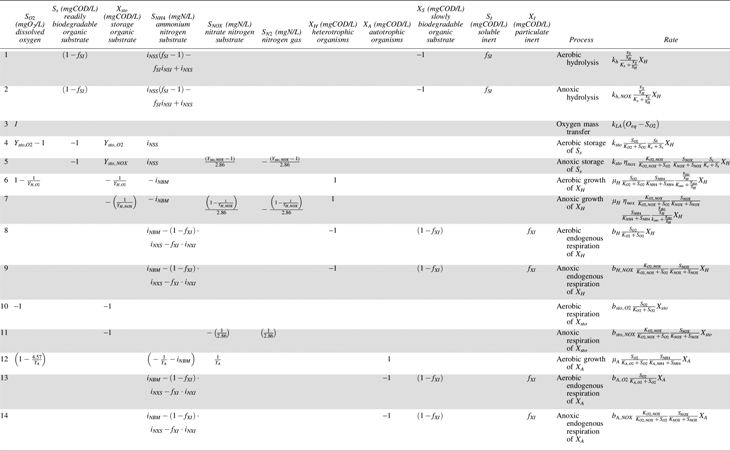
AUR, ammonia uptake rate; COD, chemical oxygen demand; NUR, nitrate uptake rate.
As shown in Table 1 the model considered that the total filtered COD (fCOD, determined with Whatman papers filtration), coming from the wastewater influent, consisted of three substrates: the slowly biodegradable COD (Xs) (soluble or colloidal), the readily biodegradable COD (Ss), and the soluble inert COD (Si) (Henze et al., 2000). It should be noted that in the ASMs the slowly biodegradable substrate Xs is considered as high-molecular-weight soluble, colloidal, or particulate (Henze et al., 2000; Nuhoglu et al., 2005). Also, the total soluble fCOD as determined with paper filtration cannot be considered only as the sum of readily biodegradable (Ss) and the soluble inert (Si) organic carbon, since some amount of Xs can contribute to the analytically determined fCOD (Henze et al., 2000). This is in agreement with other research studies which reported that filtration cannot efficiently separate readily and slowly biodegradable fractions because the colloidal matter of Xs may contribute to both fractions (Pasztor et al., 2009). Moreover, Nuhoglu et al. (2005) reported that the soluble COD (after filtration with Whatman GF/C glass fiber filters) included the readily biodegradable substrate Ss, the soluble inert substrate Si, and the slowly biodegradable substrate Xs. Based on the above, in this work the total fCOD was considered as the sum of soluble Ss, soluble Si, and soluble or colloidal Xs.
Furthermore, COD fractions of wastewater influent were determined by analyzing samples without filtration (total tCOD =
The Ss fraction was directly available to the heterotrophic organisms and was assumed that it first was stored in the form of
Calibration of the model was conducted by using specially designed respirometric experiments that consisted of OUR, AUR, and NUR test runs (calibration dataset). Model kinetic parameters were estimated by fitting the theoretical results to the experimental data and minimizing the sum of the squares of the deviations between measurements and calculated model predictions. Parameter optimization and the numerical solution of model equations were performed using the computer program Aquasim (Reichert, 1998). The system of differential equations implemented in Aquasim was solved with the algorithm DASSL, which is based on the implicit (backward differencing) variable step, variable order Gear integration technique (Petzold, 1983). All the values of the model kinetic parameters are given in Table 2. Aquasim code has been widely used for modeling processes that were considered in water, wastewater, and solid wastes' biological treatment (Vasiliadou et al., 2009, 2014, 2015).
Units based on COD of XH.
Henze et al. (2000).
Following the calibration process, the ASM3-based model together with the determined kinetic parameters were further implemented in BioWin software (EnviroSim Associates Ltd., Canada), to simulate the operating process of the biological treatment line of the full-scale WWTP in Terenzano city (Italy).
Agreement of the model with the measured data was evaluated by determining the root mean squared error (MSE(%)) and the Nash and Sutcliff correlation index (E) (Nash and Sutcliffe, 1970):
where n is the number of samples,
Finally, following the procedure outlined by Vasiliadou et al. (2015), a sensitivity analysis was performed. This analysis was conducted to check which kinetic parameters in the model had the greatest impact on the model outputs. Sensitivity analysis was conducted by modifying each parameter by ±20% around their default values based on the literature (Henze et al., 2000) and initial trials of model's calibration. The influence of these changes on the model outputs (
where Sp is the simulated value of variable S at time tp with the default value of the corresponding parameter and
Results and Discussion
Calibration and evaluation of the model
Calibration of the model was performed by using experimental results of three designed sets of experiments (OUR, AUR, NUR) conducted in the Chemical Plants Laboratory of the Engineering and Architecture Dept. at the Trieste University. The model contained 35 kinetic parameters (Table 2). The parameter estimation was performed using data obtained from the three sets of experiments, which consisted of three kinetic experiments each. Therefore, the calibration dataset, which was used to estimate the parameters of the model, consisted of the following kinetic experiments: first set OUR (Run#1, Run#2, Run#3), second set AUR (Run#1, Run#2, Run#3), and third set NUR (Run#1, Run#2, Run#3).
To reduce the number of kinetic parameters to be fitted, 18 kinetic parameters were chosen as default since they were well established in the literature (Henze et al., 2000) and their values were continuously used by researchers to describe the biological processes involved in WWTPs (Table 2). The unknown parameters bH, kh,
The above mentioned 15 parameters were selected to be determined, since according to the sensitivity analysis they affected more the model outputs than the others. Figure 1 shows the SCs for the model outputs determined by Equation (17). Namely, the readily biodegradable substrate (Ss), the slowly biodegradable substrate (Xs), the ammonium nitrogen substrate (
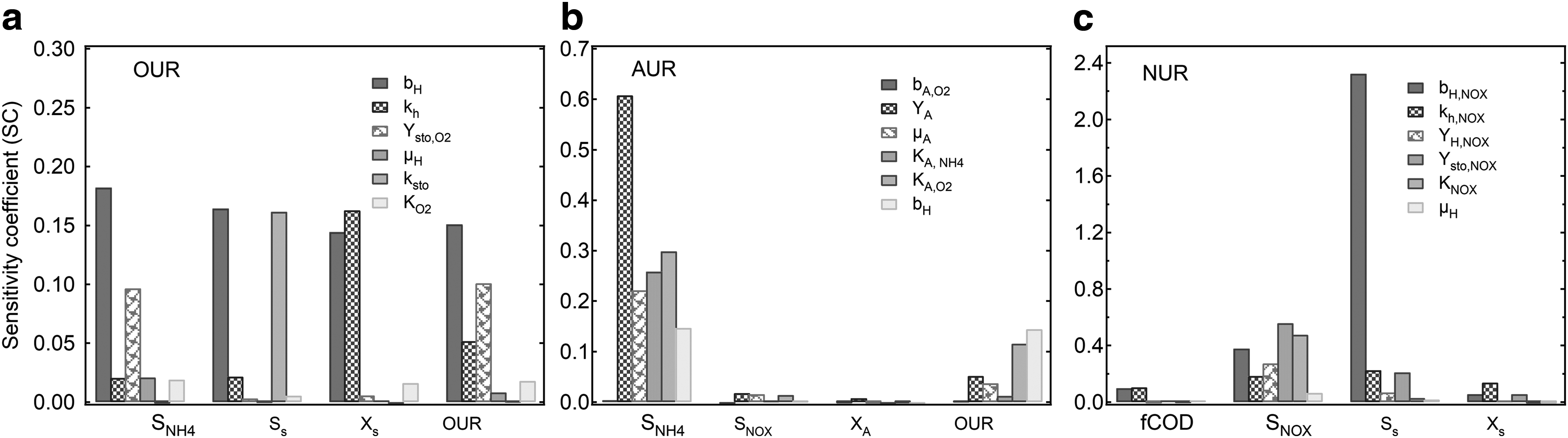
Sensitivity coefficients for
It should be noted that except the 15 parameters that were fitted, two more parameters, the oxygen transfer coefficient (kLA) and the oxygen concentration in the equilibrium (Oeq), were determined by fitting data from the control experiments (data not shown) (Table 2). After the above fitting process and the calibration of the model, the 17 (15 + 2) fitted parameters were kept constant and the parameters, which were previously fixed to default values were left free to be redetermined by fitting the model to all the experimental sets (OUR, AUR, NUR) of the calibration dataset simultaneously. It was observed that from the total 18 kinetic parameters only 3 parameters (
Figure 2a shows one of the three OUR Runs (Run#1) of calibration dataset with the experimental (symbols) and simulated (lines) concentration profiles of total fCOD ammonia nitrogen and nitrate nitrogen. The model was able to theoretically predict the evolution of the two contents of fCOD, the Ss and Xs substrates. It should be noted that during the calibration process of OUR Runs the initial value of Ss was fixed at 40% of fCOD of wastewater, the value of Xs substrate was fixed at 60% of fCOD, whereas the initial value of Si was considered to be negligible (see the Mathematical Modeling section).

Theoretical and experimental profiles of COD (total filtrated, SS, and XS), ammonium and nitrate nitrogen, OUR versus time during Run#1 of
Results indicated that the Ss substrate was degraded rapidly during the first 2 h of the experiments. The Xs substrate was gradually transformed into Ss through hydrolysis with a hydrolysis rate constant kh = 0.33 (mgCOD XS/mgCOD XH·h), whereas new Xs substrate was produced due to the biomass death process (Fig. 2a). The same behavior was observed also during Run#2 and Run#3 (Supplementary Fig. S4a, b). In addition, Fig. 2b presents the measured and predicted data of OUR (
Uptake rate of ammonia, AUR, during one of the three experimental Runs (Run#1) together with the theoretical simulations are given in Fig. 2c. As shown in Fig. 2c the ammonia nitrogen is oxidized to produce nitrate nitrogen, whereas slight growth of autotrophic microorganisms (XA) was theoretically predicted by the model. The two additional Runs (Run#2 and Run#3) of the AUR calibration set are given in Supplementary Fig. S4c, d. Moreover, similarly to OUR dataset, Fig. 2d illustrates the experimental and simulated results for OUR (
Figure 3a–c shows the data (experimental and theoretical) of the total fCOD and nitrate nitrogen as obtained from the NUR Runs of calibration dataset. Alike to OUR results (Fig. 2a and Supplementary Fig. S4a, b), the change with time of Ss and Xs substrates were predicted by the model (Fig. 3a–c). It should be noted that to better calibrate the NUR process the initial value of Ss ranged between 25% and 40% of fCOD of wastewater and the Xs substrate was calculated by subtract of fCOD-Ss. It was observed that all the available Ss substrate was rapidly consumed due to denitrification process. Consequently, more Ss was produced from the hydrolysis of Xs substrate and was consumed also for denitrification purposes. As soon as nitrate nitrogen was negligible, no carbon substrate was needed by denitrifying microorganisms and thus accumulation of Ss substrate was observed in the reactor (Fig. 3a–c). Finally, it is worthy to note that the hydrolysis rate constant that was found under the anoxic conditions of NUR experiments (

Theoretical and experimental profiles of COD and nitrate nitrogen during NUR experiments.
As shown in Figs. 2 and 3 and Supplementary Fig. S4, all theoretical predictions were in good agreement with the experimental data. Moreover, the accuracy of the model was further evaluated using the Relative root mean square error (MSE(%)) and the Nash and Sutcliff index (E) (Supplementary Table S3). Table S3 presents the MSE(%) and E for each state variable participated in the biological process of OUR, AUR, and NUR. Results indicated that all the simulations produced very high-efficiency coefficient (E > 0.806) and low MSE(%), verifying the good predicting ability of the model for all the experimental Runs of the calibration set. Low E value was observed only for fCOD (Ss+Xs) simulation of the second Run included in NUR set, because of the failure to predict the higher Xs production due to biomass death (Fig. 3b).
Validation of the model
Validation procedure of the model was performed by applying the theoretical predictions of the calibrated model to describe real operating data obtained from the biological treatment of the WWTP, located in Terenzano city (Italy). For this process, the mathematical model was implemented into BioWin software and validated using a data set of 2 months. The calibrated ASM3-based model that was proposed in this study (Table 1), was introduced into the software by using the section model builder reactor of the BioWin software, which permits the users to customize existing models or to build their own. The values of the kinetic parameters were put into BioWin software as they were determined during the calibration process (Table 2).
The plant layout is presented in Supplementary Fig. S5. As shown in Supplementary Fig. S5, the biological section of the activated sludge process consisted of one anaerobic and one anoxic reactor followed by an aerobic reactor and one settling tank. As mentioned earlier, the validation of the model was based on the real quantitative data from the influent and from the biological section of the studied WWTP obtained for a 2-month period (April 18, 2016 to June 20, 2017). Moreover, the simulation of the WWTP operation was continued for 1 month and a half more (June 20, 2016 to August 3, 2017) by using real quantitative data from the influent of the WWTP.
Figure 4a shows the comparison between the predicted and real data of COD in the influent and into the aerobic reactor. It was observed that the simulated profiles versus time were in good agreement with the operating performance of the full-scale WWTP which was under study. The comparison between experimental and theoretical data resulted in a Nash and Sutcliff correlation index (E) of 0.6. Furthermore, the evolution versus time of ammonium and nitrate nitrogen is given in Fig. 4b and c. It was observed that the model adequately described the experimental data from the operation of the WWTP.
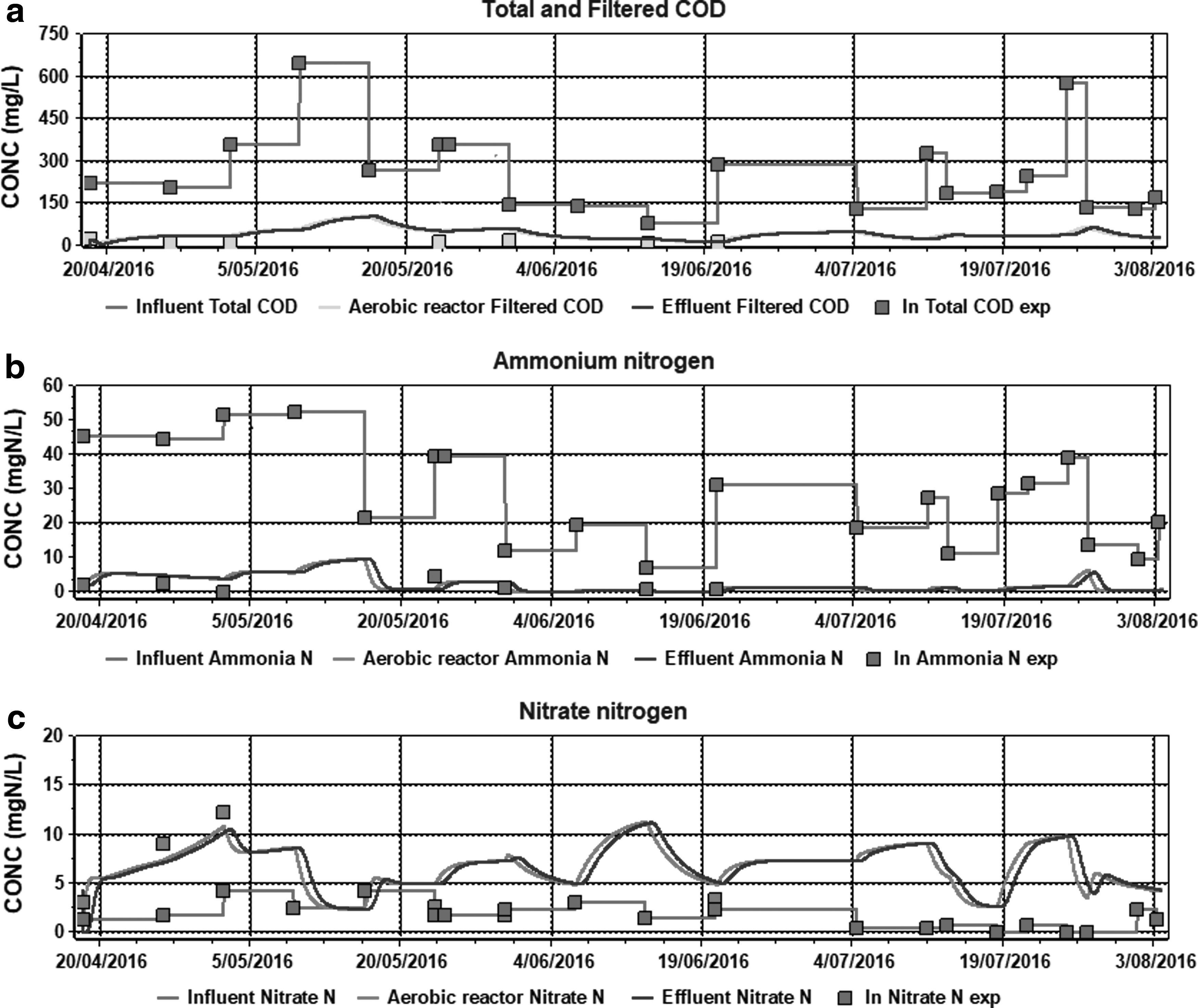
Real quantitative data (symbols) and model predictions (lines) of
Waste of the excess sludge (4.5 m3/day) that was performed in the studied WWTP, resulted in a relatively high sludge retention time of solid retention time (SRT) (predicted) 120 days. It should be noted that the experimentally calculated SRT was 140 days (see Supplementary Table S1 and Supplementary Material). The difference between the predicted and the calculated value is due to the simplification and assumptions made in the experimental calculation. The SRT is the average time of activated sludge in the system, which could be defined as the total mass of sludge in the tanks divided by the mass rate of sludge removed through the effluent and the waste activated sludge. This value is comparable to the SRTs reported for membrane bioreactors used for wastewater treatment, which can be as high as 335 days (Liao et al., 2006). High SRTs are desirable since it corresponds to less sludge production (Fig. 5). The sludge production rate for the WWTP as predicted by the BioWin model was in the range of 15–27 kg/day of TSS, from which (after June 4, 2016) 9 kg/day were VSS.
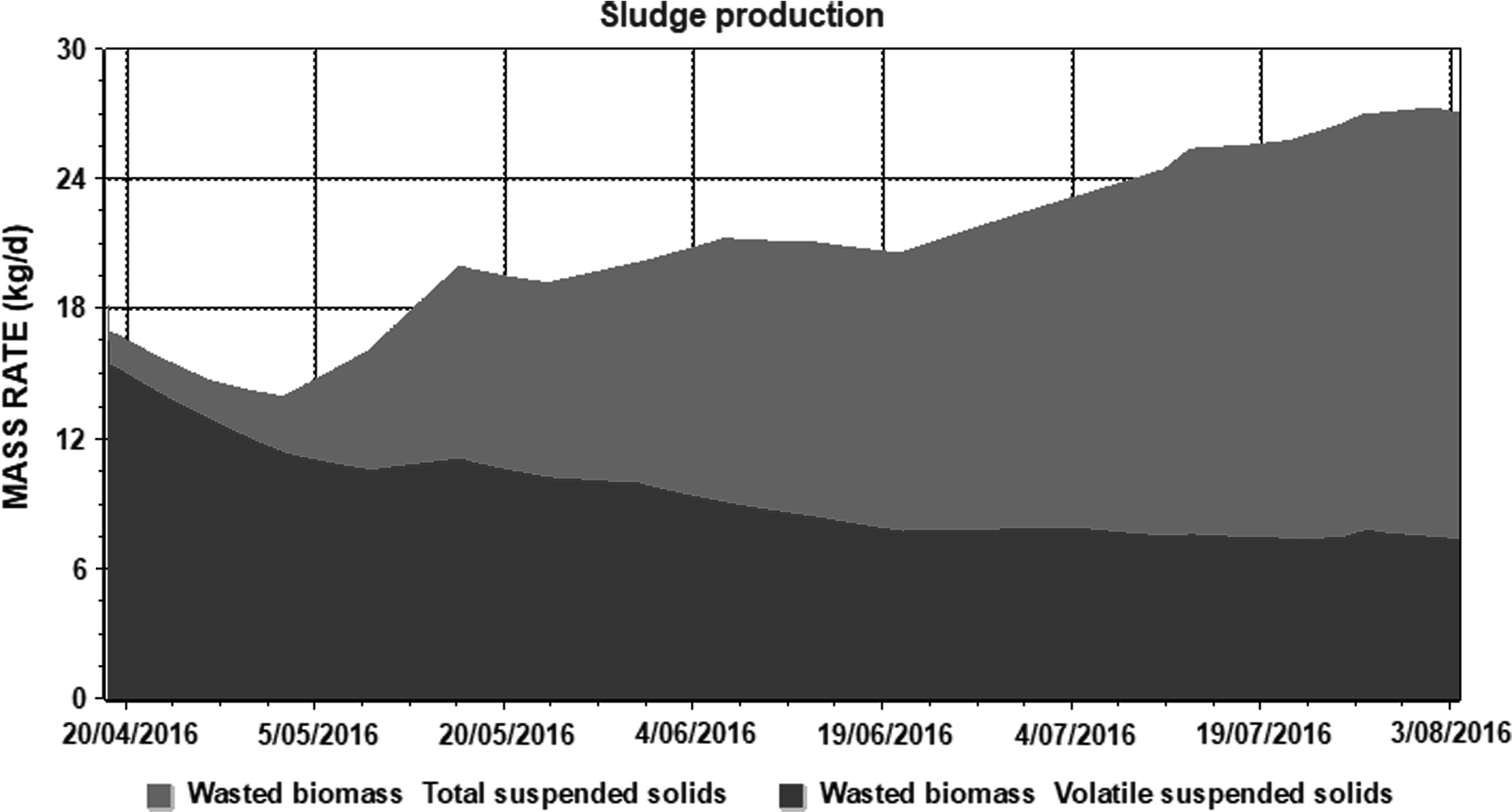
Theoretical prediction of sludge production according to BioWin simulations, considering both TSS and VSS. TSS, Total Suspended Solids; VSS, Volatile Suspended Solids.
It is well known that an increase of SRT can yield marginal decrease of the amount of sludge needed to be disposed (Wei et al., 2003). On the other hand, long SRTs may stimulate cell lysis and increase the release of inert decay products and soluble microbial products leading to an increase of effluent COD concentration (Barker and Stuckey, 1999). It is worth noting that the effluent average concentration of filtered COD for the operating period April 18, 2016 to August 3, 2016, as predicted by the model, was 43 mg/L (Fig. 4a). Considering that the WWTP performed with a relatively low withdrawal of excess sludge and high SRT of 120 days, the outcome of this study is encouraged since the effluent COD concentrations were always less than 60 mg/L in accordance with the discharge limits (European Commission, 1991). Similarly, the effluent average concentrations of ammonium and nitrate nitrogen for the studied period were as low as 2.5 mgNH4-N/L and 6.7 mgNO3-N/L, respectively (Fig. 4b, c).
Settling characteristics of the activated sludge were evaluated by determining the flux function (kg/(m2·day)) of the settling tank. The value of maximum vesilind settling velocity (vo) was set in BioWin at 83 m/day, specifying a TSS concentration of 2 g/L for height calculations, according to Burger et al. (2011). Finally, the vesilind hindered zone settling parameter (K) was set at 0.37 (m3/kg). Supplementary Figure S6 illustrates the results for flux calculations versus solid concentrations.
Experimental values of Flux (kg/(m2·day)) as well as of SVI using activated sludge from the settling tank of the WWTP in Terenzano city were determined as follows (Finch and Ives, 1950; Daigger, 1995):
Note that, the SVI is the volume occupied by sludge after 30 min of settling. The biomass settling ability was measured in a measuring cylinder (2 L) for 30 min.
Results indicated that the experimental flux for biomass concentration in the range of 0.6–1.3 was 49–57 kg/(m2·day), which is in full agreement with the theoretical predictions (Supplementary Fig. S6). Sludge settleability was also determined through SVI values. The calculated SVI maintained stable values around 150 mL/g throughout the study period of three and a half months, SVI = 100 to 200 mL/g. It has been previously reported that activated sludge plants, with an SVI in the range of 100 to 200 mL/g, have good settling characteristics and seem to produce clear, good-quality effluent (Spellman, 2013). Finally, the experimental and predicted values of the TSS (mg/L) in the aerobic reactor revealed the stability of the WWTP operation.
Figure 6 presents the experimental and theoretical values of TSS (mg/L) at four different time periods of the system's operation. It was observed that the model implemented in BioWin was able to accurately predict the amount of TSS in the aerobic bioreactor (see the comparison between TSS of aerobic reactor experimental and predicted). Also, as shown in Fig. 6, the concentration of TSS in the over flow of the settling tank (effluent) was as low as 1.6 mgTSS/L during all the operating periods. This value corresponded to 0.8 mgVSS/L. Similar VSS values were found (0.7 ± 0.6) in the WWTP's effluent during the sampling period. This value is much lower than the permitted limits of wastewater treatment requirements (Environmental Protection Agency, 2008). In addition, it was observed both experimentally and theoretically (Fig. 4) that the effluent characteristics were almost identical with those from aerobic tank in terms of COD, ammonium nitrogen and nitrate nitrogen concentrations. The high-quality treated effluent, evidenced once more the efficient operation of the WWTP located at Terenzano city in the FVG region, Italy.

Experimental and predicted values of TSS (mg/L) for the aerobic reactor, the under flow of the clarifier, and the effluent of WWTP.
Conclusions
In the present study an integrated model was proposed for simulation of the actual operation of a full-scale WWTP located in Italy. Specially designed respirometric experiments were used for model's calibration to find the optimum set of kinetic parameters. The mathematical model was finally validated using actual data from the WWTP's operation. The mathematical model presented herein was able to successfully describe the performance of a treatment plant under real operating conditions. The calculation of the correlation coefficient (E) and relative errors between the simulated and experimental values proved that the mathematical model satisfactorily fitted the evolution of COD, ammonia and nitrate nitrogen, and VSS. Based on the above, the training and the evaluation of the model were conducted using respirometric characterization of actual activated sludge and quantitative measurements of a real full-scale WWTP. Hence, it is concluded that the model can be used for predicting the relative success of the biological treatment process and the operating conditions under which desirable effluent characteristics may be achieved.
Footnotes
Acknowledgment
The authors wish to thank CAFC Company (Udine, Italy) for financial support and helpful discussions.
Author Disclosure Statement
No competing financial interests exist.
References
Supplementary Material
Please find the following supplemental material available below.
For Open Access articles published under a Creative Commons License, all supplemental material carries the same license as the article it is associated with.
For non-Open Access articles published, all supplemental material carries a non-exclusive license, and permission requests for re-use of supplemental material or any part of supplemental material shall be sent directly to the copyright owner as specified in the copyright notice associated with the article.
