




Abstract
Abstract
Pharmaceuticals are characterized as emerging contaminants. Their fate and transport in environmental systems are of substantial importance and should be thoroughly understood. This study investigated the interaction of two pharmaceuticals (acyclovir and fluconazole) with quartz sand. Acyclovir is an antiviral drug, often used for the treatment of herpes infections; whereas fluconazole is an azole fungicide that is widely used as an active ingredient in a variety of pharmaceutical and personal care products (PPCPs) for the treatment of fungal infections. Adsorption behavior of acyclovir and fluconazole onto quartz sand at three different temperatures (4°C, 10°C, and 22°C) under static and dynamic conditions was examined. Kinetic adsorption data were described successfully with a pseudo-second-order model. Furthermore, adsorption equilibrium data were quantified with a linear adsorption isotherm. Results at three different temperatures indicated that PPCPs were weakly adsorbed onto quartz sand. Adsorption of acyclovir and fluconazole is slightly higher under dynamic than static conditions. Although no significant differences were observed between the three different temperatures employed in this study, adsorption of acyclovir and fluconazole increased slightly with increasing temperature.
Introduction
P
After application, the unutilized portion of pharmaceuticals can be removed from the body by washing or through urinary excretion, which are the main entry pathways of pharmaceuticals to municipal wastewater (Hirsch et al., 1999; Gros et al., 2010; Prasse et al., 2010; Kosma et al., 2014). The incomplete removal of pharmaceuticals during wastewater treatment may be the origin of their presence in the effluent and sewage sludge of wastewater treatment plants (WWTPs) (Jelic et al., 2011; Garcia-Valcarcel and Tadeo, 2012; Funke et al., 2016). As a result, pharmaceuticals have been observed repeatedly in the aquatic environment worldwide (Heberer, 2002; Tixier et al., 2003; Gros et al., 2010; Prasse et al., 2010; Bu et al., 2013; Liu and Wong, 2013; Peng et al., 2014; Richardson and Ternes, 2014; Fisher et al., 2016). The sludge of WWTPs is often used as fertilizer in agriculture in many countries (Scheytt et al., 2006; Garcia-Valcarcel and Tadeo, 2012). When the sludge is dispersed on a field, the PPCPs present in the sludge may be leached and threaten the groundwater (Diaz-Cruz et al., 2003).
Knowledge of the fate of pharmaceuticals in soils or sediments is important for estimation of environmental exposure and risk assessment (Pan et al., 2009). Sorption is one of the key factors controlling the input, transport, and transformation of pharmaceuticals in the aquatic environment and in the subsurface (Scheytt et al., 2005). Highly mobile pharmaceuticals have the potential to leach into groundwater, whereas strongly adsorbing pharmaceuticals can accumulate in the topsoil layer, affect the soil microbial community, and may be taken up by plants (Thiele-Bruhn, 2003). The adsorption of pharmaceuticals onto soils is influenced by solution chemistry, type of mineral, and organic sorbents (Tolls, 2001; Boxall et al., 2002; Drillia et al., 2005; Hari et al., 2005; Loffler et al., 2005; Williams et al., 2006; Blackwell et al., 2007; Chefetz et al., 2008).
Acyclovir and fluconazole are two pharmaceuticals with wide production and use around the world (Prasse et al., 2011; Yu et al., 2012; Loos et al., 2013), which may find their way to the environment if they are not effectively eliminated during wastewater treatment. Acyclovir is the most commonly used oral antiviral agent because of its selectivity and low cytotoxicity. It is employed for the treatment and prophylaxis of initial and recurrent episodes of genital and labial herpes, as well as for the acute treatment of herpes zoster and varicella (chickenpox) in immunocompetent individuals. It can be administered in very high doses (from 200 to 1,000 mg three to four times daily). Fluconazole is an azole fungicide that is widely used as an active ingredient in a variety of PPCPs to treat fungal infections by blocking sterol biosynthesis (Zarn et al., 2003; Correa and Salgado, 2011). Fluconazole is administered topically and orally. Due to its low cost and few side effects, fluconazole has become one of the most commonly prescribed drugs (Yang et al., 2012).
Several studies have reported the occurrence of acyclovir in wastewater, landfill leachate, river water, reservoir water, and well water worldwide at tens of ng/L to low μg/L levels (Prasse et al., 2010; Yu et al., 2012; Peng et al., 2014). Prasse et al. (2011) revealed rapid biotransformation of acyclovir in activated sludge, whereas the transformation product, carboxy-acyclovir, was found to be persistent and was detected in drinking water, groundwater, and surface water. The biodegradation half-life of acyclovir was reported as only 5.3 h, indicating rapid degradation during conventional sewage treatment. In addition, an ozonation product of acyclovir was detected in treated drinking water (Prasse et al., 2012).
Fluconazole has been detected in surface waters (Kahle et al., 2008; Kim et al., 2009; Peng et al., 2012). In addition, fluconazole is known to have low removal rates in conventional WWTPs (Wishart et al., 2008). Kahle et al. (2008) reported practically identical fluconazole concentrations in the influent and effluent streams of WWTPs, whereas other azoles (e.g., clotrimazole) were removed by adsorption onto sludge. Garcia-Valcarcel and Tadeo (2012) reported that fluconazole previously adsorbed onto soil, under certain conditions, can be desorbed and may contribute to contamination of surface and ground waters.
The aim of this study was to determine the adsorption behavior of acyclovir and fluconazole onto quartz sand under static and dynamic conditions and to examine if the adsorption process is temperature dependent. To our knowledge, no previous study has explored the adsorption behavior of acyclovir and fluconazole onto quartz sand at different temperatures.
Materials and Methods
Pharmaceuticals
Pharmaceuticals examined in this study are acyclovir and fluconazole and their molecular structures are shown in Fig. 1. Acyclovir [9-((2-hydroxyethoxy)methyl)guanine] has the empirical formula C8H11N5O3, molecular weight 225.2 g/mol, is relatively soluble in water (water solubility 1.62–2.00 g/L), hydrophilic (logKow = −1.56), and nonvolatile (Garcia-Valcarcel and Tadeo, 2012; Bruni et al., 2013). Fluconazole [2-(2,4-difluorophenyl)-1,3-bis(1H-1,2,4-triazol-1-yl)-2-propanol] has the empirical formula C13H12F2N6O, molecular weight 306.27 g/mol (Wishart et al., 2008), is slightly soluble in water (water solubility ∼1 g/L), slightly hydrophobic (logKow in the range 0.25 − 0.4), nonvolatile (Garcia-Valcarcel and Tadeo, 2012), and with good stability in aqueous solutions (stable for more than 15 days) (Dentinger and Swenson, 2009; Correa and Salgado, 2011). The pharmaceuticals were purchased from Sigma and used as received. All stock solutions were prepared with ultrapure water (EASYpureRF; Barnstead/Thermolyne). Subsequently, all desired acyclovir and fluconazole concentrations were made by appropriate dilution of stock solutions with ultrapure water.

Molecular structure of
Although the concentrations of pharmaceuticals in environmental systems are mostly in the ng/L range (Prasse et al., 2010; Yu et al., 2012; Loos et al., 2013; Kosma et al., 2014), in this work, we used relatively high concentrations of acyclovir and fluconazole (3, 7, and 10 mg/L) to elucidate their interactions with quartz sand, which is a common practice in studies examining the fate and transport of pharmaceuticals (Unold et al., 2010; Chen et al., 2011, 2015; Dong et al., 2016).
Quartz sand
Quartz sand was employed in this study as in many other studies, focusing on adsorption and mobility of pharmaceuticals in porous media (Chen et al., 2011, 2015; Dong et al., 2016), because quartz is the most common mineral found on the surface of the earth (Chrysikopoulos and Aravantinou, 2014). The grain diameter of quartz sand used in this study was in the range of 0.425–0.600 mm (sieve no. 30/40), obtained with procedures reported by Chrysikopoulos and Aravantinou (2014). The chemical composition of quartz sand was 96.2% SiO2, 1.75% Al2O3, 0.78% K2O, 0.46% Fe2O3, 0.15% Na2O, 0.11% CaO, 0.06% SO3, 0.03% P2O5, 0.02% BaO, 0.02% MgO, 0.01% Mn3O4, and 0.28% loss on ignition, as reported by the manufacturer (Filcom, The Netherlands). The quartz sand were cleaned with 0.1 M HNO3 (70%) for a period of 3 h, rinsed with distilled deionized water (ddH2O), soaked in 0.1 M NaOH for 3 h, and subsequently rinsed again with ddH2O (Syngouna and Chrysikopoulos, 2010; Chrysikopoulos and Aravantinou, 2012; Chrysikopoulos et al., 2012). Finally, the sand was dried and sterilized at 80°C.
Batch experiments
Static and dynamic batch experiments were performed individually under controlled conditions for three different initial concentrations (C0 = 3, 7, and 10 mg/L) at 22°C and at three different temperatures (4°C, 10°C, and 22°C) with an initial concentration of C0 = 10 mg/L. All batch experiments were performed in 20-mL Pyrex glass screw-cap tubes (Fisher Scientific). The tubes were washed with detergent, rinsed in ddH2O, autoclave sterilized, and dried in an oven at 80°C.
For each experiment, 11 glass tubes were employed. The glass tubes contained 14 mL of fluconazole solution with 14 g of sand. All glass tubes were filled to the top. The experiments at 4 and 10°C were conducted in an incubator. For the dynamic batch experiments, the tubes were attached to a tube rotator (Selecta; Agitador Orbit), which was operated at 12 rpm, to allow the sand to mix within either the fluconazole or the acyclovir solution. One tube was removed from the rotator randomly at preselected time intervals (1 h, 2 h, 3 h, 6 h, 12 h, 24 h, 2 days, 3 days, 5 days, 7 days, and 10 days). This 10-day time period was shown to be adequate for the acyclovir– and fluconazole–sand systems to reach equilibrium.
Collected samples were centrifuged at 13,200 rpm for 15 min in a microcentrifuge to remove soil particles. Modified high-performance liquid chromatography (HPLC; Agilent 1100 series HPLC) with a Supelco C-18 column (5 μm, 280 × 4.6 mm) was used for the determination of pharmaceuticals. A diode array detector was used to detect acyclovir (3.5 min) and fluconazole (5.9 min) at a wavelength of 252 and 210 nm, respectively. A 50/50 water/methanol mixture was used as the mobile phase, with a low flow rate of 0.8 mL/min, at a constant temperature of 40°C. A schematic illustration of the experimental procedure employed in this work is presented in Fig. 2.
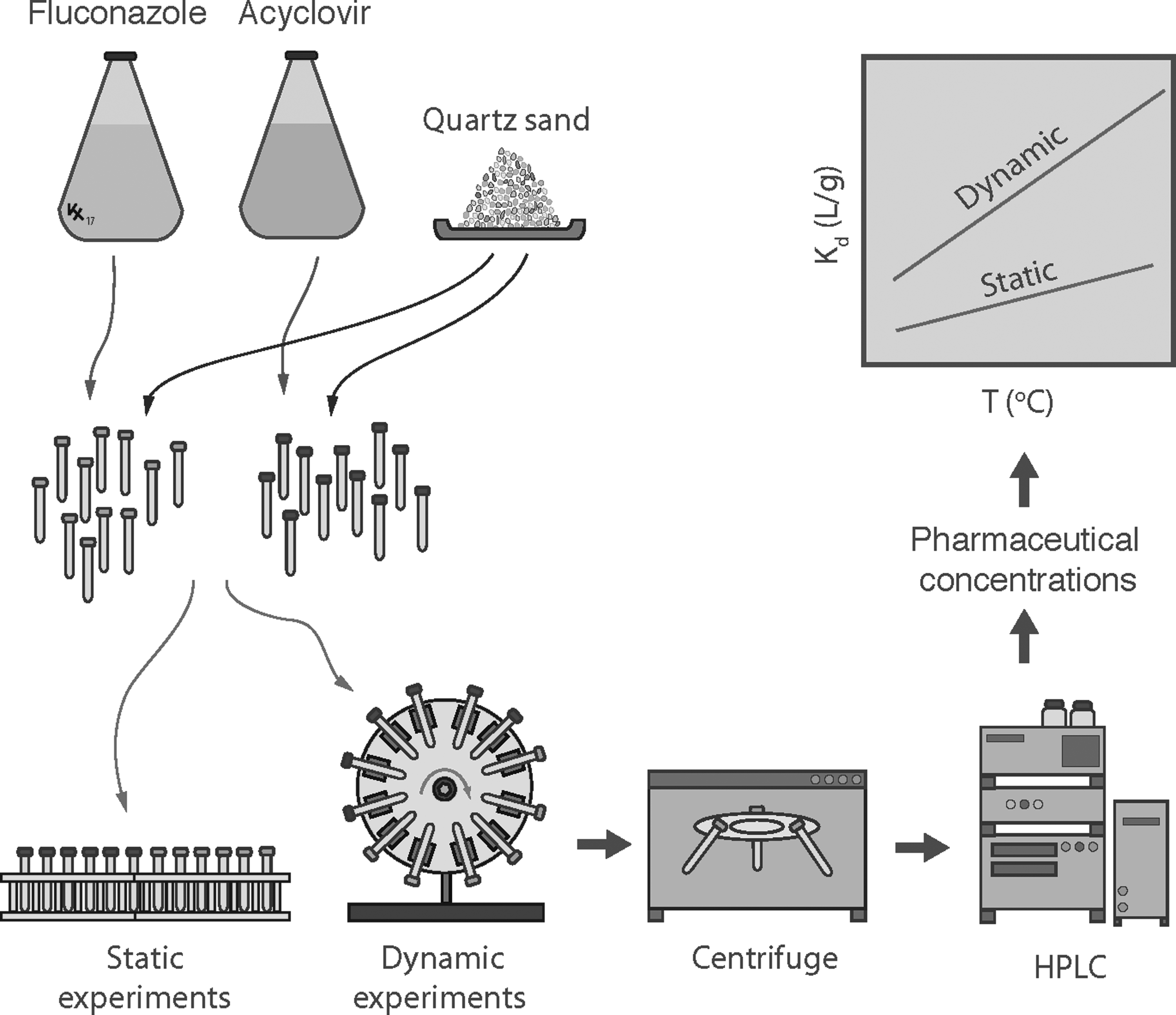
Schematic illustration of experimental procedure.
Theoretical Considerations
Equilibrium and kinetic adsorption
Concentrations of pharmaceuticals adsorbed onto quartz sand (
where C0 [Mp/L3] is the initial liquid-phase concentration (in units of mg pharmaceutical/L), Ct [Mp/L3] is the liquid-phase concentration at time t (in units of mg pharmaceutical/L), V [L3] is the solution volume, and W [Ms] is the dry mass of the adsorbent (in units of g sand). Note that Mp represents the mass of pharmaceuticals and Ms the mass of quartz sand.
Kinetic adsorption experimental data were fit by the following pseudo-second-order expression (Tsai et al., 2003; Ho, 2006):
where t [t] is time,
which can also be rearranged in the following linear form:
It is worthy to note that the pseudo-second-order kinetic adsorption model has been employed in numerous adsorption studies of environmental interest (Upadhyayula et al., 2009; Vasiliadou and Chrysikopoulos, 2011; Sotirelis and Chrysikopoulos, 2015, 2017).
The relationship between the pharmaceutical concentrations in solution and those adsorbed onto quartz sand at equilibrium, which is known as the adsorption isotherm (Scheytt et al., 2005), was determined from the classical adsorption isotherm plots of the amount of the pharmaceutical retained per unit mass of quartz sand versus the equilibrium concentration of the pharmaceutical in the liquid phase at constant temperature. There are several equilibrium adsorption models available in the literature. The most commonly used adsorption isotherm models are linear, Freundlich, and Langmuir. In this study, the equilibrium adsorption of acyclovir and fluconazole onto quartz sand was quantified by a linear adsorption isotherm:
where Ceq [Mp/L3] is the concentration of the pharmaceutical at equilibrium (in units of mg pharmaceutical/L),
Thermodynamic considerations
Thermodynamic behavior of acyclovir and fluconazole adsorption onto quartz sand was investigated by estimating the following thermodynamic quantities: Gibbs free energy change (ΔG° [kJ/mol]), enthalpy change (ΔH° [kJ/mol]), and entropy change (ΔS° [J/mol · K]). These thermodynamic quantities give insights of the adsorption process and were calculated using the following equations:
where Ra = 8.3145 J/(mol/K) is the universal gas constant, T [K] is the absolute temperature, and K0 [L3/M] is the thermodynamic distribution coefficient (ten Hulscher and Cornelissen, 1996; He et al., 2010). Note that ΔG° characterizes the spontaneity of the adsorption process (e.g., for ΔG <0, the adsorption process is spontaneous).
The thermodynamic parameter, Gibb's free energy change, ΔG°, was calculated using Kd obtained from the linear isotherm [Eq. (5)]. In view of Equation (6), the enthalpy change, ΔH°, and the entropy change, ΔS°, were obtained from the intercept and slope of the plot of Gibb's free energy change ΔG° versus temperature T.
Results and Discussion
Experimental data from the kinetic batch experiments of fluconazole and acyclovir adsorption onto quartz sand at 22°C for three different initial concentrations (C0 = 3, 7, and 10 mg/L), under both static and dynamic conditions, are presented in Figs. 3 and 4, respectively. The fitted model simulations are presented together with the experimental data (Figs. 3 and 4). Furthermore, the experimental data from the kinetic batch experiments of fluconazole and acyclovir adsorption onto quartz sand at three different temperatures (4°C, 10°C, and 22°C) with initial concentrations of C0 = 10 mg/L, under both static and dynamic conditions, together with the fitted model simulations are presented in Figs. 5 and 6, respectively.
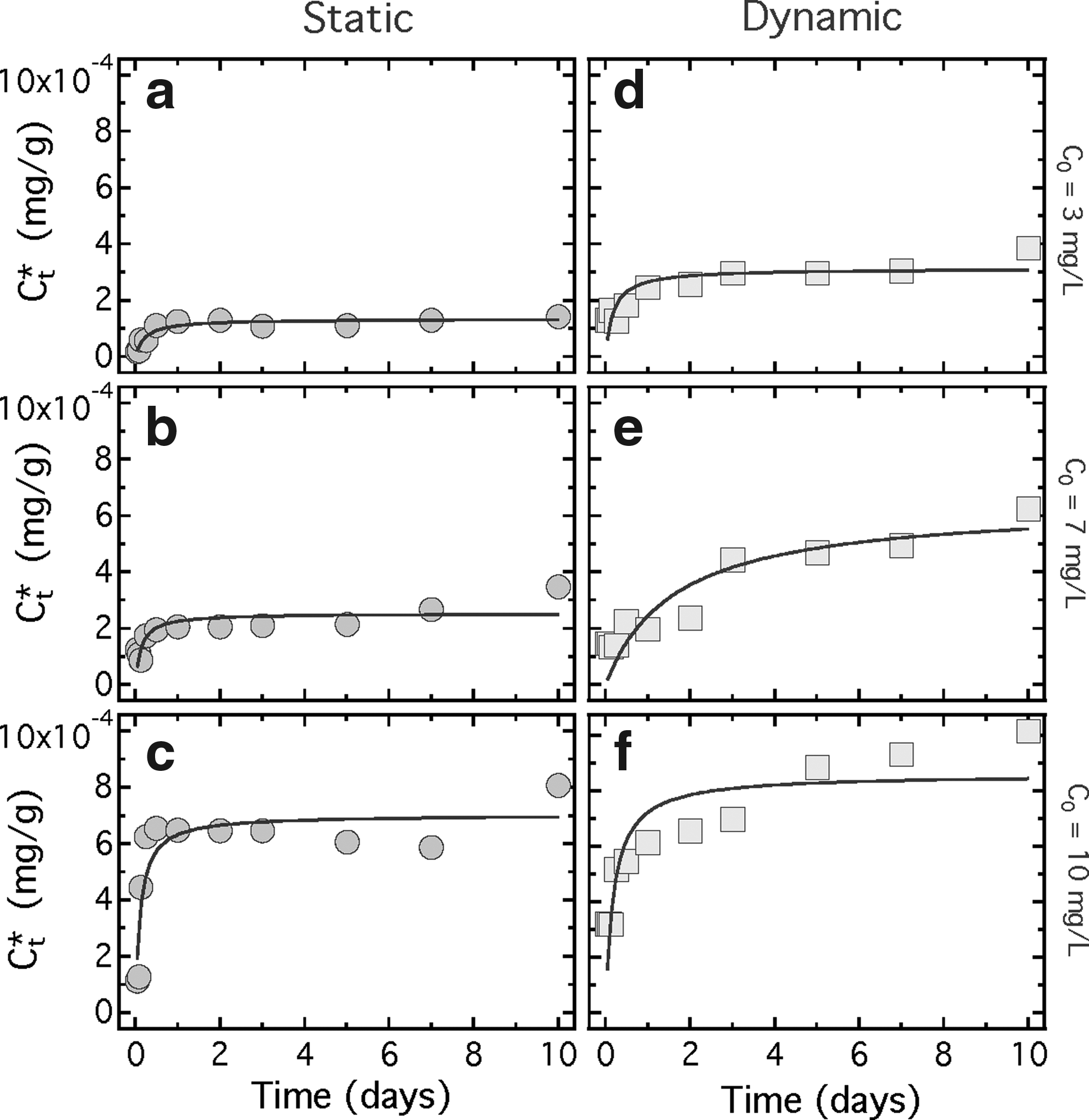
Kinetic data of fluconazole adsorption onto quartz sand under

Kinetic data of acyclovir adsorption onto quartz sand under
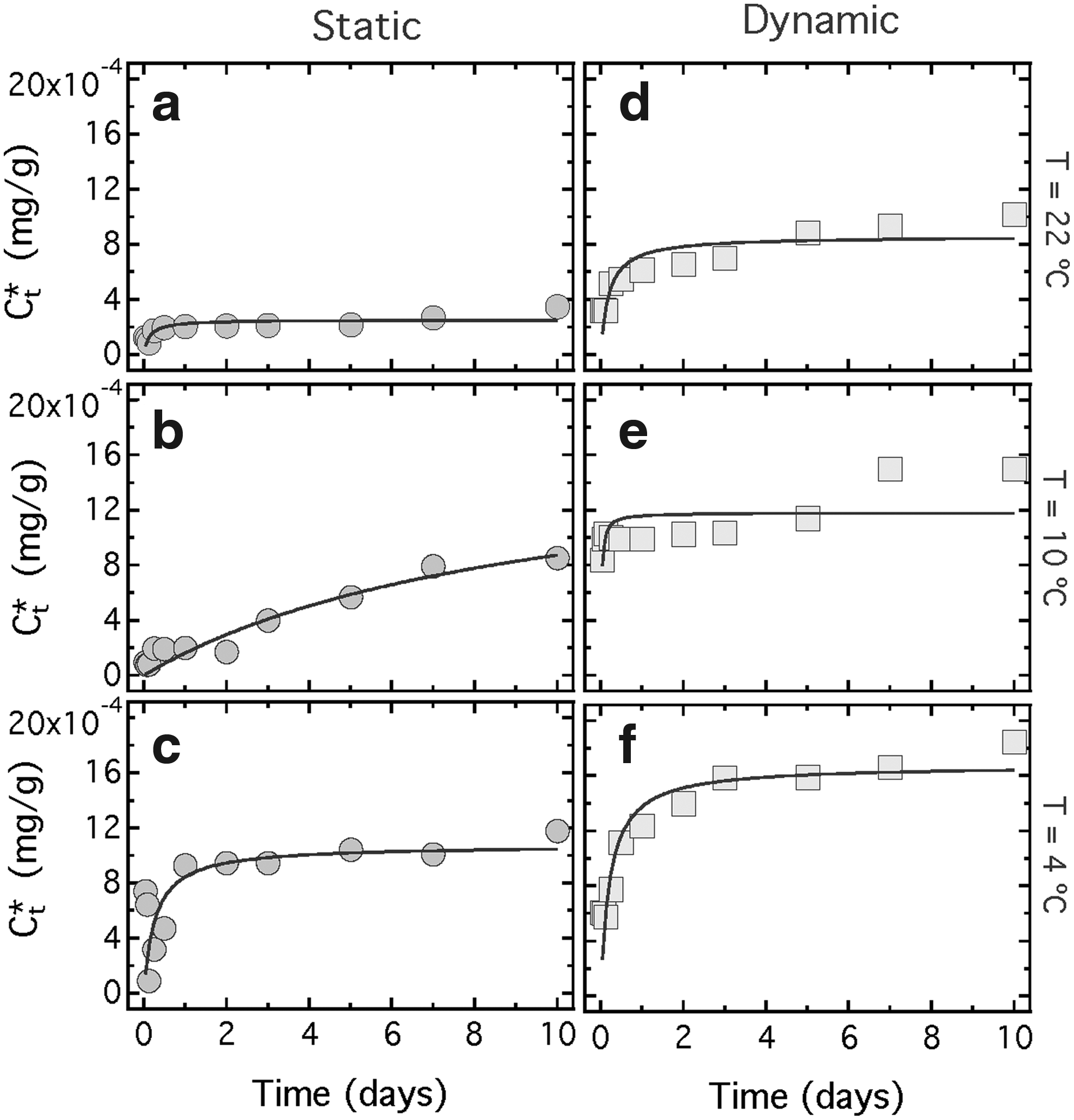
Kinetic data of fluconazole adsorption onto quartz sand under
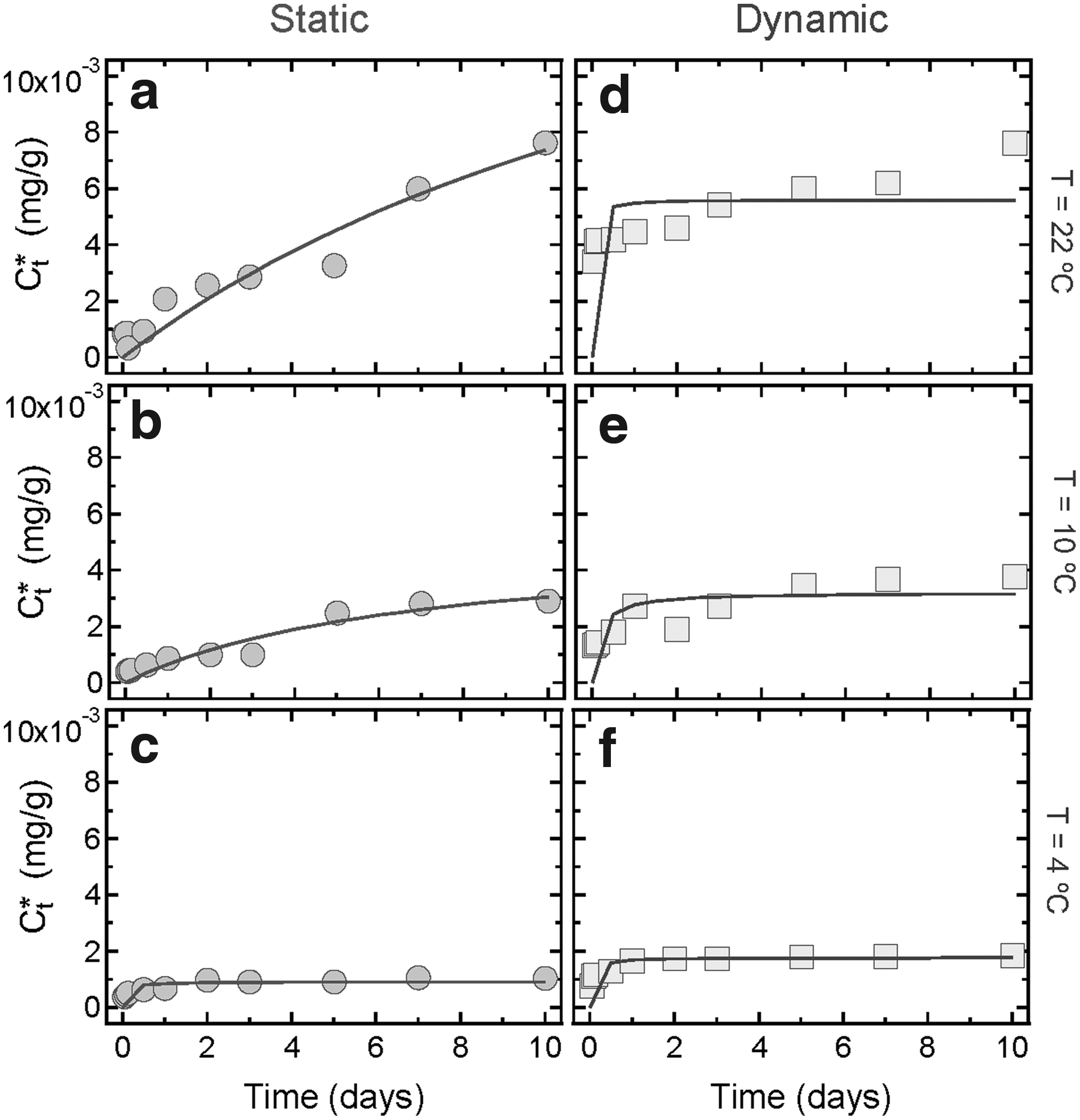
Kinetic data of acyclovir adsorption onto quartz sand under
Kinetic batch experimental data collected in this study (Figs. 3–6) suggested that the adsorption of both fluconazole and acyclovir onto quartz sand increased with increasing temperature for all initial concentrations considered in this study. It is worthy to note that the effect of temperature was slightly more pronounced under dynamic than static conditions. Based on our kinetic experimental data (Figs. 3–6), it was evident that by increasing the initial concentrations, the adsorption rate decreased. In addition, by increasing the temperature, the adsorption rate decreased. Therefore, the adsorption rate was shown to decrease with either increasing the initial concentration of fluconazole and acyclovir or by increasing the temperature.
Experimental data from the equilibrium adsorption experiments of fluconazole and acyclovir onto quartz sand at three different temperatures (4°C, 10°C, and 22°C) under both static and dynamic conditions are shown in Figs. 7 and 8, respectively. The equilibrium adsorption data were fitted with the linear isotherm [Eq. (5)] using ColloidFit (Katzourakis and Chrysikopoulos, 2017). The fitted parameter values together with the corresponding coefficients of determination, R2, which ranged between 0.811 and 0.976, are listed in Table 1. The equilibrium adsorption data suggested that in general, the sorption of acyclovir and fluconazole onto quartz sand, under both static and dynamic conditions, increased slightly with increasing temperature. Note that in agreement with the kinetic batch experiments, the equilibrium adsorption of both acyclovir and fluconazole onto quartz sand was slightly higher under dynamic than static conditions. This was attributed to agitation, which improves the contact of quartz sand particles with the liquid and decreases the resistance to mass transfer (Moore et al., 1981; Chrysikopoulos and Aravantinou, 2012). However, the Kd values determined for fluconazole and acyclovir under static and dynamic conditions, for all three different temperatures examined in this study, are relatively low (Table 1) and suggest that both pharmaceuticals are weakly adsorbed onto quartz sand. This result is consistent with previous studies reported in the literature (Garcia-Valcarcel and Tadeo, 2012). Furthermore, the two PPCPs examined in this study have low vapor pressure (Garcia-Valcarcel and Tadeo, 2012) and negligible dissipation by volatilization. Therefore, fluconazole and acyclovir with relatively low affinity for soils are expected to be mobile in environmental systems and to migrate substantial distances in the subsurface. However, given that the Kd value for both fluconazole and acyclovir increases with temperature, the corresponding retardation factor also increases. Note that for linear instantaneous adsorption, the dimensionless retardation factor, R ≥ 1, is expressed as R = 1 + (ρb/θ)Kd [where ρb (M/L3) is the bulk density of the solid matrix and θ (−) is the porosity] and represents the ratio of the interstitial fluid velocity to the velocity of the pharmaceutical (fluconazole or acyclovir) in the aqueous phase within the porous medium (Chrysikopoulos et al., 1990). Therefore, migration of both fluconazole and acyclovir is expected to become progressively more restrictive with increasing temperature.
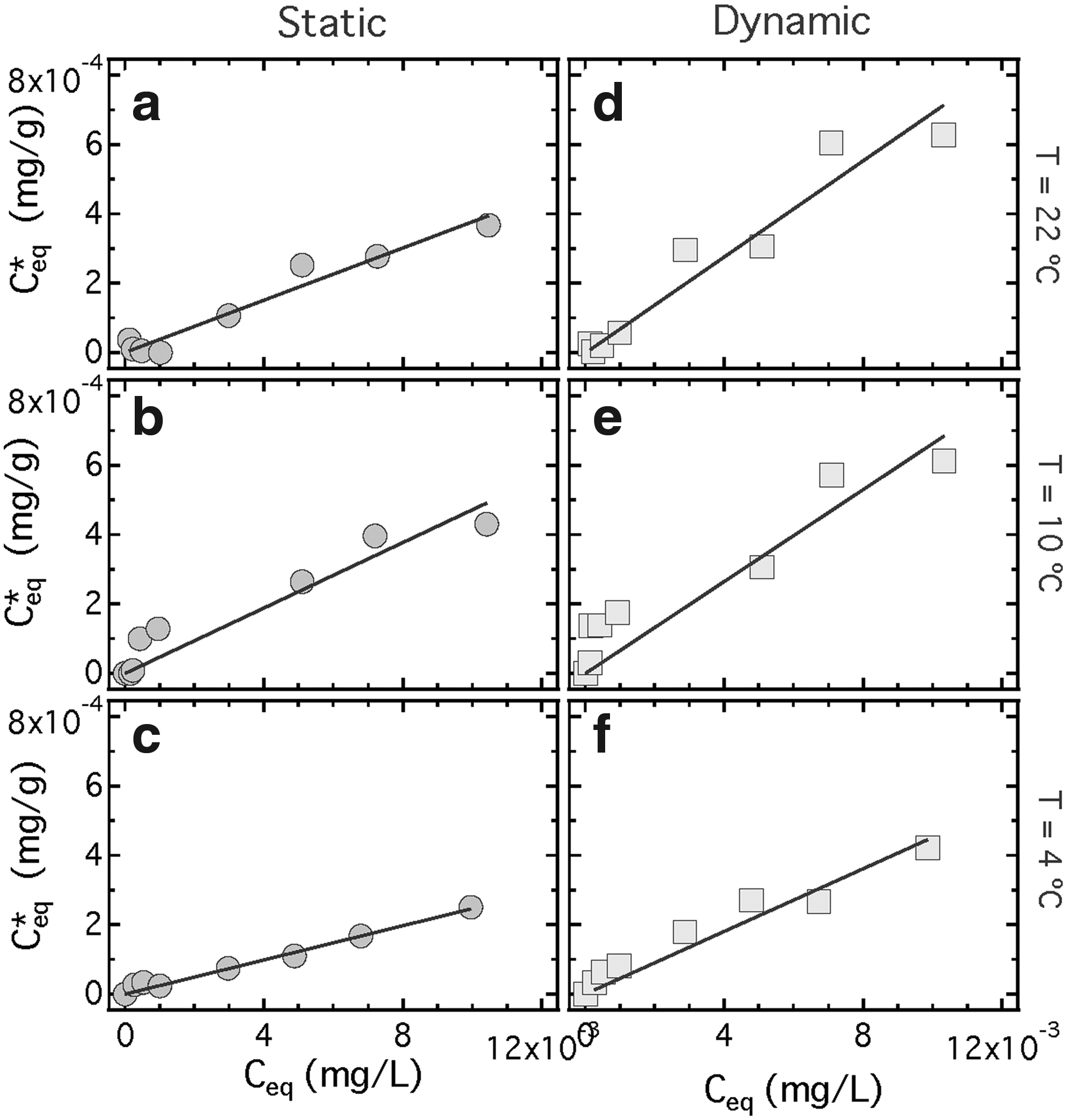
Equilibrium adsorption data (isotherms) of fluconazole onto quartz sand under

Equilibrium adsorption data (isotherms) of acyclovir onto quartz sand under
Thermodynamic parameter values for fluconazole and acyclovir adsorption onto quartz sand under static and dynamic conditions are listed in Table 2, and the Gibbs free energy values are presented in Fig. 9. It should be noted that the value of K0 was shown to increase with temperature, suggesting that the adsorption process was endothermic for both pharmaceuticals examined. The adsorption process was nonspontaneous and endothermic because all ΔG° and ΔH° values were positive, respectively. Nonspontaneous and endothermic adsorption is associated with structural changes of the sand surfaces due to chemisorption (Sotirelis and Chrysikopoulos, 2015). Finally, the value of ΔS° for both static and dynamic experiments was negative, indicating that the adsorption process was enthalpy driven.
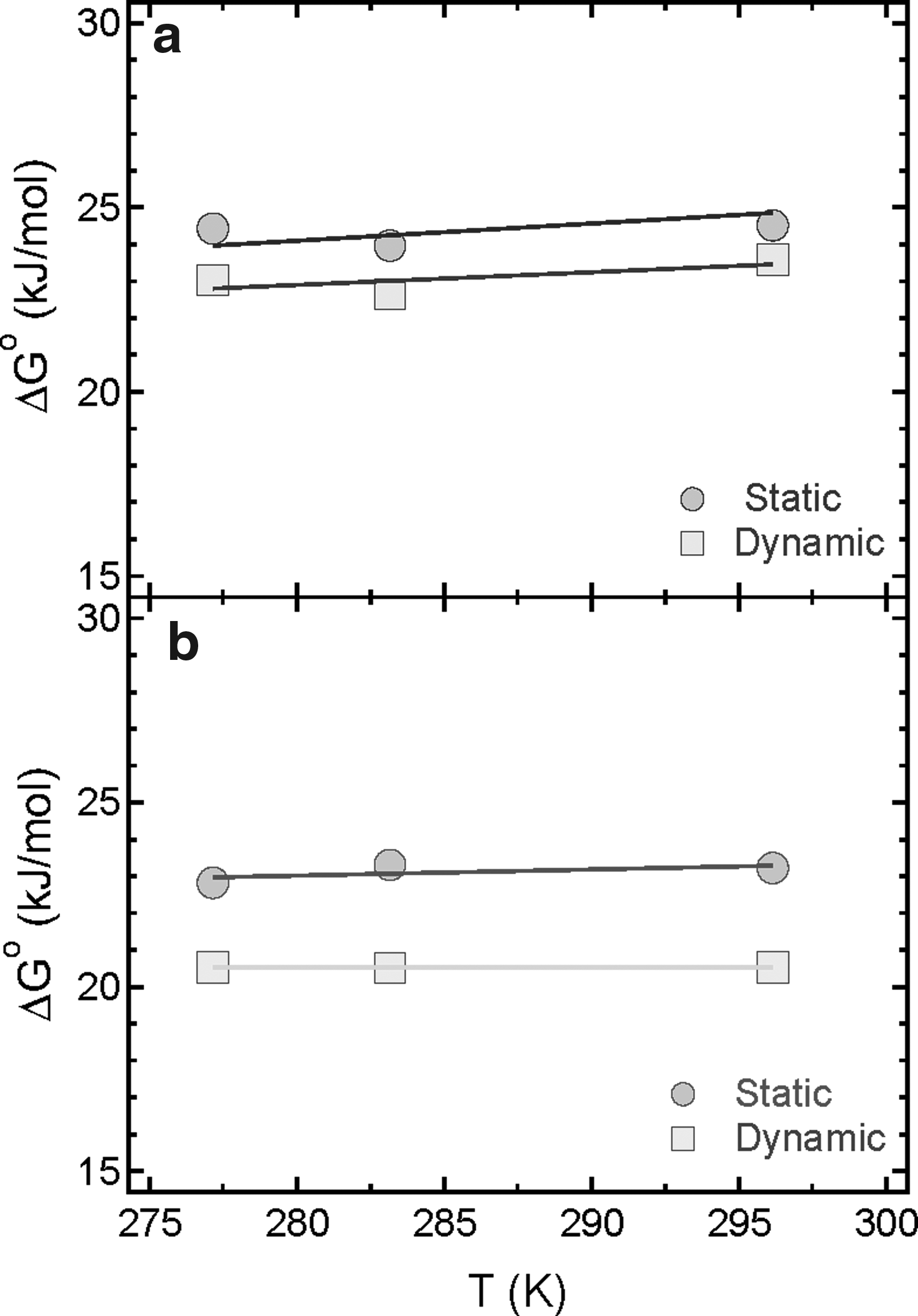
Plot of Gibbs free energy change versus temperature for
Conclusions
Based on the experimental results of this study, it can be presumed that acyclovir and fluconazole are weakly adsorbed onto quartz sand. However, adsorption of the two pharmaceuticals was slightly higher under dynamic than static conditions at the three temperatures examined in this study. The adsorption rate was shown to decrease by either increasing the initial concentration of fluconazole and acyclovir or by increasing the temperature. The adsorption of fluconazole and acyclovir onto quartz sand was characterized as nonspontaneous, endothermic, and enthalpy driven. Consequently, it is anticipated that these pharmaceuticals will be considerably mobile in sandy subsurface formations and can be potentially transported to the aquatic environment with possible negative effects on living organisms and human health. However, migration of both fluconazole and acyclovir in subsurface porous media is expected to become progressively more restrictive with increasing temperature because the Kd values and, in turn, the retardation factor were shown to increase with temperature. Experiments of acyclovir and fluconazole transport through columns packed with quartz sand are highly recommended as an extension to this study.
Footnotes
Acknowledgments
This research did not receive any specific grant from funding agencies in the public, commercial, or not-for-profit sectors. The authors are thankful to R. Sarika and N. Xekoukoulotakis for valuable laboratory assistance.
Author Disclosure Statement
No competing financial interests exist.