




Abstract
Abstract
The goal of this work was to investigate the decomposition of C.I. Reactive Orange 107 (RO107) azo dye by advanced oxidizing method, ultrasound. This method can decolorize azo dyes in a short time period at a high energy input. More than 80% of decolorization was achieved within 4 h. Degradation of the dye RO107 followed pseudo-first-order kinetics. Effects of operating parameters such as frequency, temperature, and initial dye concentrations were investigated. Sonolysis was also carried out in the presence of tert-butyl alcohol to determine the sonication mechanism. Results showed that sonication is controlled by hydroxyl radicals together with pyrolysis, the effect of which is half of free radical reactions. Dye degradation and formation of intermediates and ions were detected directly or indirectly by high-pressure liquid chromatography-diode array detector and liquid chromatography–tandem mass spectrometry analysis. Sulfanilic acid (m/z:172) was identified as the main dye intermediate. Possible pathways for the formation of the degradation products were proposed. Results are presented that allow insight into the reaction mechanism.
Introduction
D
Textile industries waste waters are the most difficult ones to treat among industrial waste waters because they are containing different chemicals and especially synthetic dyestuffs having complex aromatic molecules in their structures. Textile dyes have generally more than one double bond and different functional groups, which make them very stable and difficult to remove from waste water (Peralta-Zamora et al., 1999; Forgacs et al., 2004; Kim et al., 2004; Maas and Chaudhari, 2005).
Reactive dyes are an important class of textile dyestuffs broadly used in the textile industry worldwide. Azo reactive dyes constitute the largest amount of reactive dyes (Djelal et al., 2017). They are extremely water soluble and easily hydrolyzed. Reactive dyes can be used to color wool and polyamide fibers besides cotton due to their wide variety of color shades, ease of application, and brilliant colors. The chromophore (e.g., azo, triarylmethane, phthalocyanine, anthraquinone, and methine) and the reactive groups (e.g., chlorotriazine, chloropyrimidine, and vinyl sulfone) in their structure enable them to bind the fiber by forming covalent bonds with ionized hydroxyl groups on the cellulosic fiber (Al-Degs et al., 2000; Gottlieb et al., 2003; Ergene et al., 2009; Solis et al., 2012). However, dyebath includes hydroxyl ions due to alkaline dyeing conditions and these ions will compete with reactive dye to bind with the fiber (Al-Degs et al., 2000). As a result, dyes are not used up completely during the dyeing processes and therefore discharged to the environment with the effluent coming from dyeing processes with azo dye concentration ranging from 5 to 1,500 mg/L. Reactive dyes released into the environment are stable to light and temperature and they disturb aesthetic view as well as affect absorption and reflection of sunlight and also solubility of gases and, thus, photosynthetic activity of aquatic life (Gottlieb et al., 2003; Forgacs et al., 2004; Supaka et al., 2004; Crini, 2006; Sanghi et al., 2006; Bibak and Aliabadi, 2014; Francisco et al., 2017; Mohammad et al., 2017).
While some of the textile dyes are toxic, others only change the color, taste, and odor of the water. The removal of dyes from textile waste waters is of paramount importance because most of the breakdown products of textile dyes are toxic and carcinogenic (Ge and Qu, 2003; Gottlieb et al., 2003; Van der Zee and Villaverde, 2005). Azo reactive dyes are generally resistant to aerobic biodegradation due to their biological recalcitrance (Ge and Qu, 2003; Gottlieb et al., 2003; Weng and Tao, 2015). It was reported that ∼90% of reactive dyes pass through the activated sludge sewage treatment plants without change or degradation (Abadulla et al., 2000; Kim et al., 2004). They can form toxic and carcinogenic structures such as aromatic amines under anaerobic conditions. Moreover, anaerobic degradation products can cause reverse colorization when exposed to oxygen (Kudlich et al., 1999; Abadulla et al., 2000; Ge and Qu, 2003; Gottlieb et al., 2003; Işık et al., 2004; Van der Zee and Villaverde, 2005; Sanghi et al., 2006; Dukkancı et al., 2014).
Various methods have been developed and studied for the removal of dyes from waters and waste waters for the protection of the environment. The technologies involve advanced oxidation processes (such as ozonization, treatment with hydrogen peroxide [H2O2], irradiation with UV light, ultrasonication), chemical reduction–oxidation, coagulation–flocculation, electrochemical methods, membrane filtration, adsorption/biosorption, bioaccumulation, and biodegradation methods (Forgacs et al., 2004; Jozwiak et al., 2007; Boutamine et al., 2017).
Ultrasound (US) is one of the advanced oxidizing techniques used for the degradation of the pollutants. The process is based on the cavitation phenomenon, which includes the formation of bubbles containing dissolved gases and water vapor, their growth, and collapsing of these bubbles (Gedanken, 2004; Ince and Tezcanli-Guyer, 2004; Rehorek et al., 2007; Boutamine et al., 2017). The parameters affecting cavitation and bubble collapse are reaction medium properties (vapor pressure, viscosity, surface tension), sound wave frequency and intensity, gas properties (solubility, specific heat, thermal conductivity), and other parameters such as external pressure and temperature (Chitra et al., 2004; Vajnhandl and Marechal, 2005). The main advantage of US process is that it only needs electrical energy, while other advanced oxidation processes such as UV/H2O2, ozone or Fenton's reaction requires the addition of some chemicals. US process has also some valuable effects on chemical reactions as it improves homogenization, provides better solubilization, promotes mass transport and mass transfer, reduces reaction steps, and shortens the reaction times (Chitra et al., 2004; Gedanken, 2004; Rehorek et al., 2007).
Reactive textile dyes are found as hydrolyzed form in dye house effluents. The use of the parent form of dye in experimental studies may have different chemical and biological properties in comparison to the hydrolyzed form (Gottlieb et al., 2003). In this study, the degradation of the hydrolyzed reactive azo dye C.I. Reactive Orange 107 (Golden Yellow RNL), which is one of the major components of Marine Blue dye used for dyeing jeans in textile industry, was studied by using ultrasonic method. The detection and identification of parent and hydrolyzed C.I. Reactive Orange 107 (RO107) dye compounds and the degradation products of hydrolyzed dye obtained during ultrasonic treatment were done by using liquid chromatography–tandem mass spectrometry (LC-MS/MS). The degradation mechanism and a sonochemical reaction pathway were proposed on the basis of these results.
Experimental
Azo dye C.I. Reactive Orange 107
Azo dye C.I. Reactive Orange 107 (Golden Yellow RNL–RO107) (empirical formula C16H18N4O10S3; molecular weight = 522 g/mol), one of the major components of Marine Blue dye used for dyeing jeans, has been investigated in this study. It was kindly supplied by Dystar (Leverkusen, Germany). The chemical structure of C.I. RO107 is shown in Fig. 1.
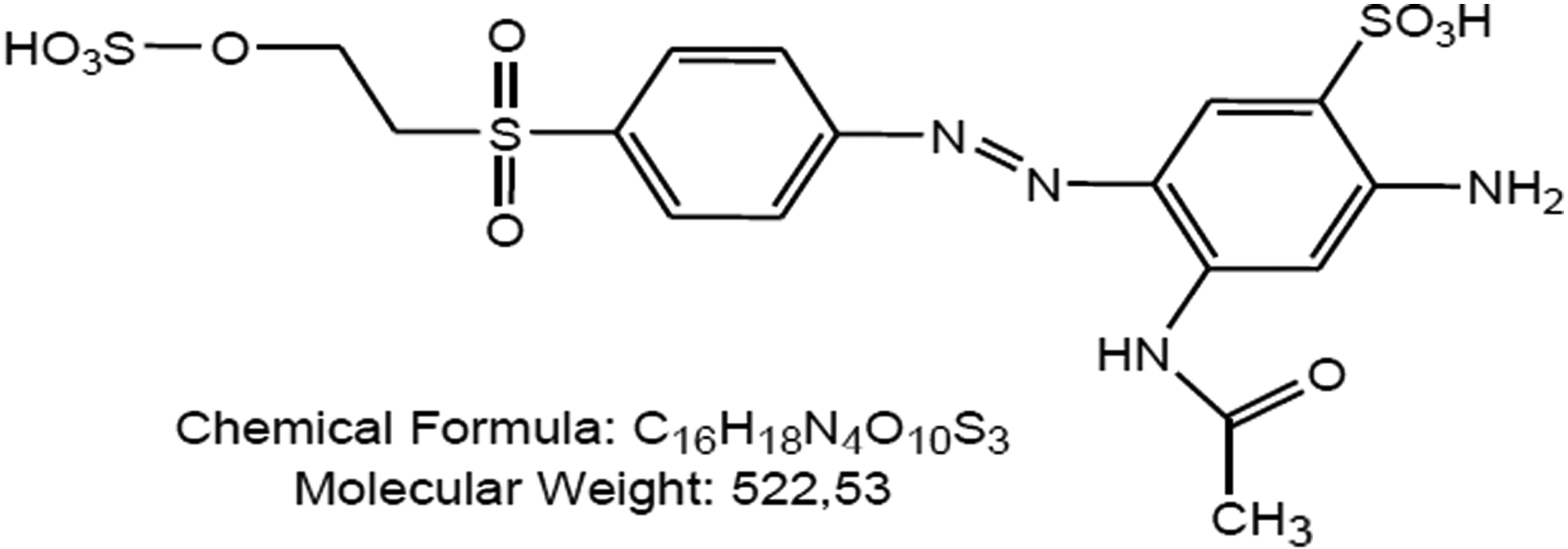
4-Acetylamino-2-amino-5-[4-(2-sulfooxy-ethanesulfonyl)-phenylazo]-benzene sulfonic acid (C.I. RO107).
Preparation of hydrolyzed dye solution
A stock dye solution with an initial concentration of 6 mM was prepared by dissolving RO107 in 2.5 L tap water. The solution was then heated to 80°C, and 100 g/L NaCl (Sigma, Germany) were added. pH of the solution was adjusted to 11 by adding required amount of NaOH (Sigma). The solution was kept under these conditions for 1 day for the complete hydrolyzation of the dye. Simulated dyebath effluents from batch dyeing processes with reactive dyes would thus be obtained. The status of hydrolysis was checked by high-pressure liquid chromatography (HPLC) analysis. HPLC solvents were used in gradient grade quality and obtained from Merck (Darmstadt, Germany). After the hydrolysis process, the solution was cooled down to room temperature and neutralized with concentrated H2SO4 (Sigma). The samples at different initial concentrations were prepared from the stock dye solution (stored in the dark at 4°C) by appropriate dilutions with deionized water.
US experiments
US experiments were performed by using two different ultrasonic power generators: K8 and MFLG (Meinhardt Ultraschalltechnik Leipzig, Germany) working at different frequencies. These systems were studied under conditions given in Table 1. The system parameters were optimized by Rehorek's study group before, and the radical formation rate was determined by means of TPA dosimeters with the fluorescence detector L-7480 (LaChrom® system; Merck Hitachi) (Frömel, 2005).
The subscripts in R*OH60 W and R*OH30 W indicates acoustic power values.
The US system comprised two parts: the device (K8 or MFLG) and a glass reactor mounted to the transducer (Fig. 2). The glass reactor was surrounded by a cooling jacket to maintain the system at a certain temperature. The working volume was 500 mL, and the experiments were performed at batch scale.

Schematic view of ultrasound system.
Analytical measurements
LC/MS-MS is a multidimensional analytical system that can be used for separation and detection of both low and high molecular weight substances which may be polar, nonpolar, colored, and/or colorless. In this study, parent and hydrolyzed forms of RO107 and degradation products were detected by using an Agilent 1100 HPLC gradient system equipped with a diode-array detector (DAD), an ion chromatographic cation suppressor (Metrohm, Switzerland), and a QTRAP hybrid mass spectrometer (Applied Biosystems) having electrospray ionization and atmospheric-pressure chemical ionization. The analytical-reagent grade chemicals were used in the chromatographic method such as ammonium acetate, HPLC-grade LiChrosolv water and gradient grade LiChrosolv acetonitrile, formic acid (Merck). Tetrabutylammonium acetate (TBAAc; purity >99%) purchased from Fluka (Buchs, Switzerland) was used as ion pairing agent. The results were evaluated with Analyst 1.4 Software and the proposed structure analyses were done by using ChemDraw 7.0 Program.
For the determination of the absorption spectra of samples, a single-beam spectrophotometer Lambda 10 (Perkin Elmer, Boston, MA) was used in the wavelength range of 200–800 nm at a scan rate of 240 nm/min.
During the US degradation studies, chemical oxygen demand (COD) values were also measured. COD measurement is based on an oxidative reaction by using a strong oxidizing agent. The most often used oxidant is potassium dichromate, K2Cr2O7 combined with boiling sulfuric acid, H2SO4, under certain conditions of temperature and for a specific time period. The determination of the COD was carried out with standardized cuvette tests of Dr. Lange Company, Dusseldorf according to instructions given by the company for COD kits. Before determining the COD, the samples were diluted to reduce the high salt content. Two milliliter of diluted sample was added into the standardized test solution of COD kit and held at a certain temperature (148°C) for 2 h to complete oxidation. The following COD kits were used: LCK014 measuring range 1,000–10,000 mg/L and LCK114 measuring range 150–1,000 mg/L. COD was determined via a photometer.
Results and Discussion
The structure of RO107 was determined before and after hydrolysis process in advance of the ultrasonic decolorization studies. Ultrasonic decolorization studies were performed by varying the frequency, temperature, and initial dye concentration.
The parent and hydrolyzed forms of RO107 and degradation products were detected by using LC-MS/MS analysis. The dye structures formed during degradation were characterized by Analyst Software and ChemDraw 7.0 program.
Structural analysis of RO107
Parent form of the dye
The structural analysis of RO107 was done both for the parent and hydrolyzed form of dye before using in ultrasonic decolorization process.
If RO107 is directly dissolved in water, the Vinyl form of dye (RO107_V, m/z:423) is one of the main compounds present next to the parent form of the dye (RO107_O). The results of the structural analysis of RO107 by using LC-MS/MS are given in Fig. 3 on a basis of the total wavelength and DAD chromatograms.
From the total wavelength chromatogram (TWC), it was detected that 73.2% of RO107 is the parent (RO107_O) and Vinyl (RO107_V) forms of the dye. These compounds are also the main compounds accountable for the absorption in the visible region (380–720 nm) of DAD chromatogram in Fig. 3. The compounds formed during the dissolution of the dye and their structures are listed in Table 2.
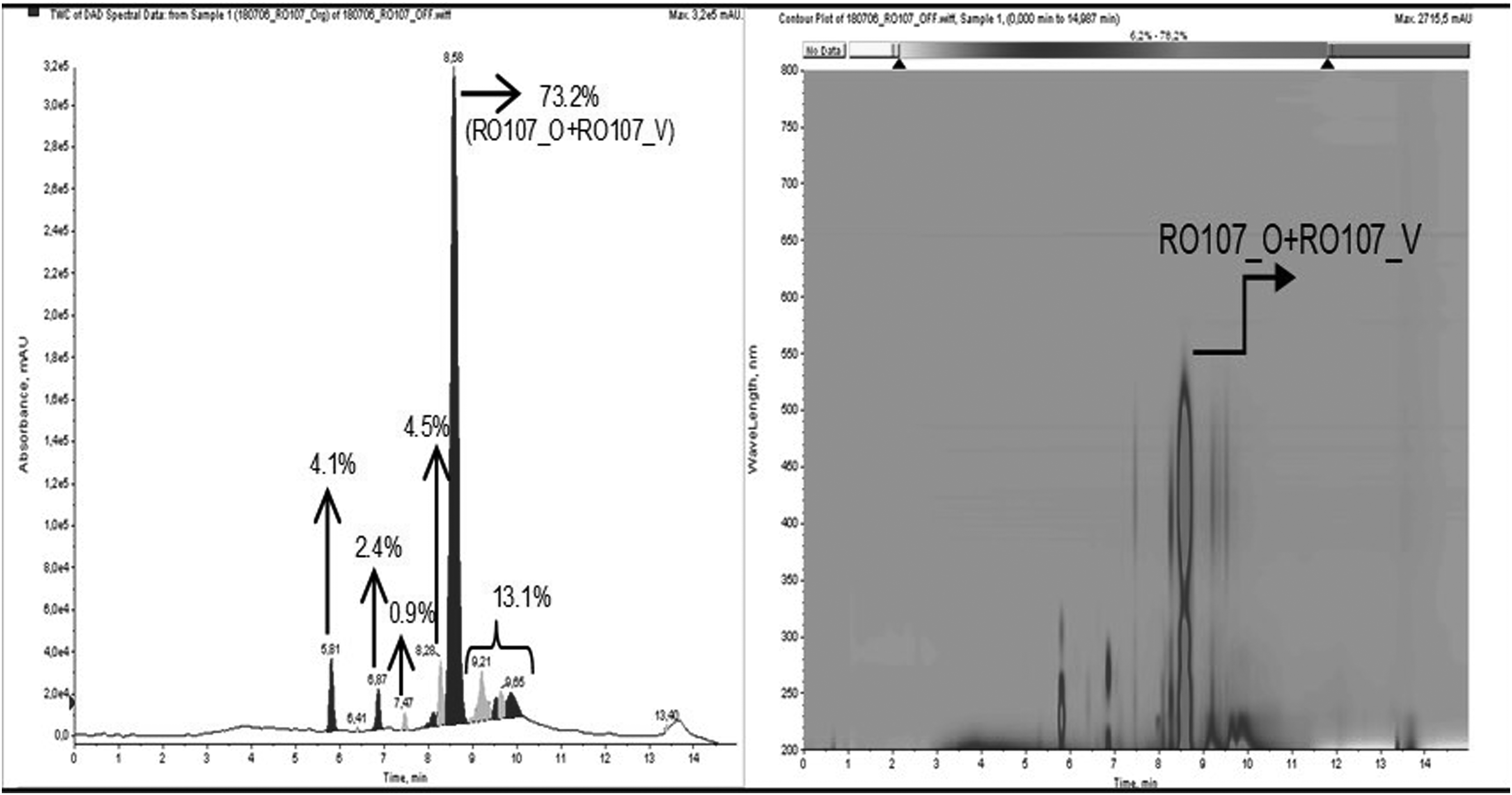
TWC and DAD chromatogram of commercial azo reactive dye, RO107. DAD, diode-array detector; TWC, total wavelength chromatogram.
The negative ionization mode is used as an ionization technique during LC/MS-MS analysis. This method is typically used for the determination of molecular weight and total number of sulfonic and carboxylic acid groups in (poly)-sulfonated dyes. The molecules observed in the fragmentation pattern of azo dyes can be formed by cleavage of the C—N bonds (azo-type fission) and cleavage of the N = N double bond (keto-type fission) (Straub et al., 1992; Holcapek et al., 1999; Smyth et al., 1999; Poiger et al., 2000; Reemtsma, 2001; Epolito et al., 2005; Frömel, 2005; Plum and Rehorek, 2005).
In Fig. 4, the enhanced product ion spectrum and the fragmentation pattern of RO107 parent form are shown. There are two intense signals, one of which belongs to m/z:441 and the other to m/z:213. The signal m/z:441 can be assigned to the hydrolyzed form of RO107 (RO107_H) which is formed by elimination of the SO3− group from RO107 parent form. The other intense peak m/z:213 points at an azo-type fission.

EPI spectrum and fragmentation pattern of RO107 parent form (RO107_O). EPI, enhanced product ion.
Hydrolyzed form of dye
Hydrolyzed form of C.I. RO107 was used in this study because reactive dyes are presented as their hydrolyzed form in waste waters. The hydrolysis mechanism of RO107 parent dye is explained in Fig. 5. Because elimination and addition reactions occurred during the hydrolysis process, Vinyl form (RO107_V), hydrolyzed form (RO107_H), and hydrolyzed form without acetyl group (RO107_H-NA) of RO107 were observed. The hydrolyzed form without acetyl group (RO107_H-NA, m/z: 399) is the main compound in the starting hydrolyzed dye solution used for the experimental studies.
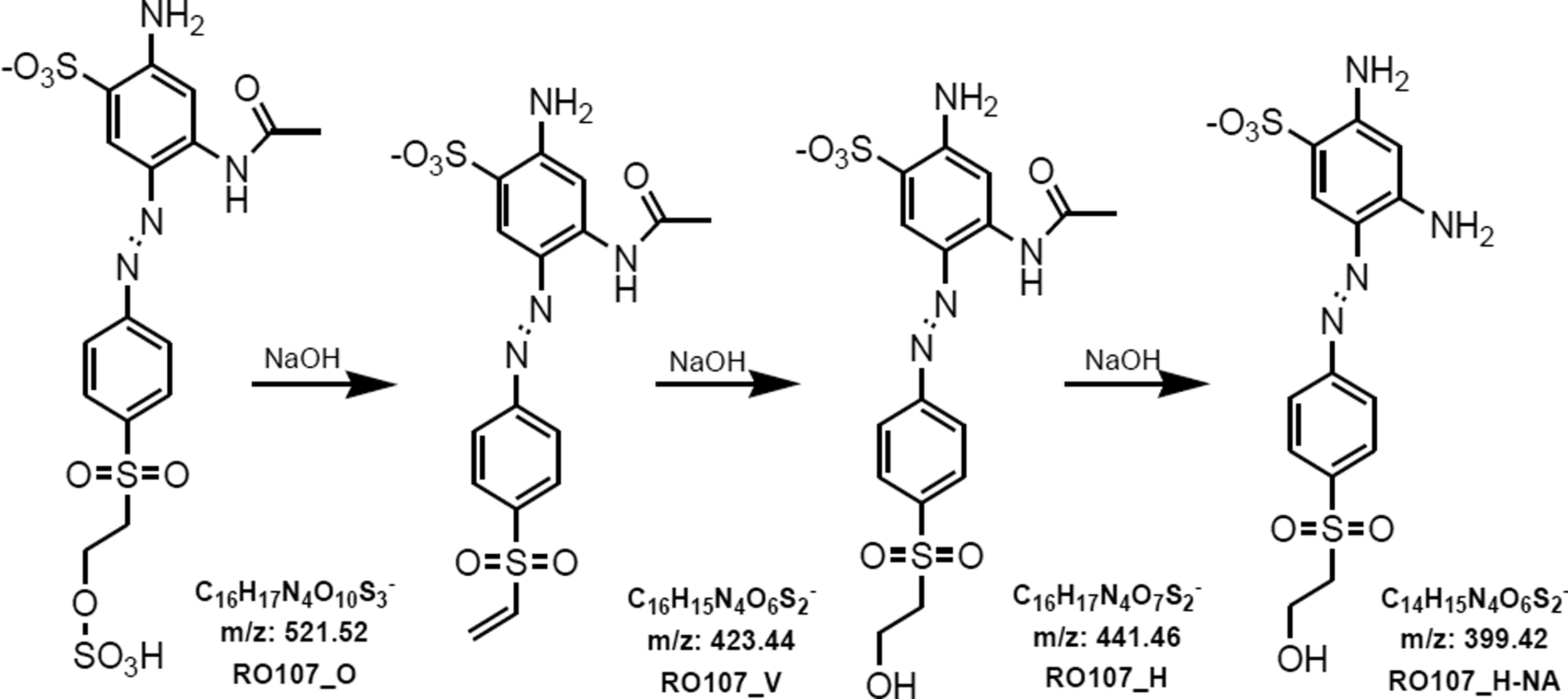
Hydrolysis mechanism of RO107 parent dye.
TWC and DAD chromatogram of hydrolyzed RO107 are given in Fig. 6. It was evaluated that ∼62% of RO107 is in the hydrolyzed form without acetyl group (RO107_H-NA, m/z: 399).

TWC and DAD chromatogram of hydrolyzed RO107.
Enhanced product ion spectrum and fragmentation pattern of hydrolyzed RO107 without acetyl group (RO107_H-NA, m/z:399) are presented in Fig. 7. As seen from the figure, one of the two intense signals which belongs to m/z:290 was formed by elimination of the sulfonylethanol group from main dye structure of RO107_H-NA. The sulfonylethanol group is split off under hydrogen elimination from the phenol ring as neutral particle. The other signal (m/z:186) suggests azo-type cleavage. The signal of m/z:80 belongs to SO3− group, which may split off as neutral particle and also appears as a radical.
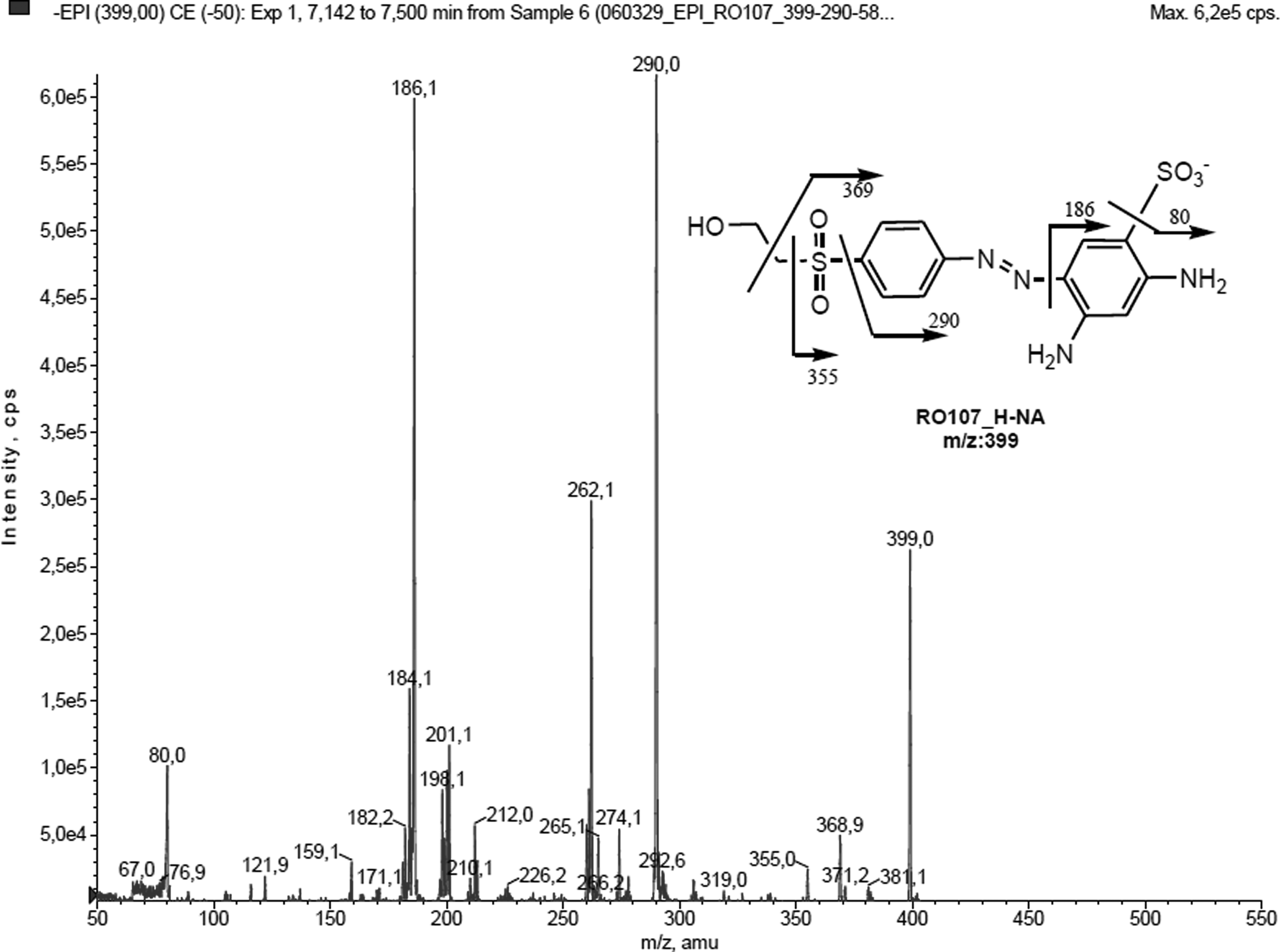
EPI spectrum and fragmentation pattern of RO107 hydrolyzed form without acetyl group (RO107_H-NA).
Ultrasonic decolorization studies
Effect of frequency
Ultrasonic decolorization studies were performed at three different frequencies (378, 850 and 992 kHz) with an initial dye concentration of 50 mg/L at the temperature of 20°C. The working conditions (power value, working volume, radical formation rate, etc.) for US system were given in the previous section (Ultrasound Experiments section and Table 1).
The main compound of hydrolyzed RO107 dye (RO107_H-NA, m/z:399) was considered for all data evaluation. DAD results of LC/MS-MS analysis were used for the determination of decolorization and relative colorization plotted as function of the frequency in Fig. 8. While the maximum rate of production of hydroxyl radical is higher at 378 kHz (Table 1), Fig. 8 indicates that decolorization of hydrolyzed dye solution increased with increasing frequency from 378 to 850 kHz. When the frequency is enhanced to 850 kHz, decolorization percentage raise up to 99%. Upon further increase of the frequency value to 992 kHz, the decolorization percentage (69%) decreased dramatically. Therefore, the optimum frequency of 850 kHz was chosen to perform further studies.

The variation of relative colorization % of RO107_H-NA, m/z: 399 with frequency (C0: 50 mg/L, T: 20°C, Pac: 30 W).
It is difficult to elucidate the effects of US frequency on sonochemical systems because of other parameters of the system. For example, when the frequency is changed, the US intensity inherently affects acoustic cavitation and sonochemistry to different extents. Frequency effects are also dependent on the nature of the dye molecules and their localization in the interior of the cavitation bubbles or on their surface. The frequency of the US effects decolorization efficiency by changing the critical size of the cavitation bubble during the cavitation process. The effect may be due to changes in the amount of dye molecules that can accumulate at the gas/solution surface of cavitation bubbles since this is known to be affected by the frequency of US (Hung and Hoffman 1999; Thompson and Doraiswamy, 1999; Yang et al. 2008).
Effect of temperature
Temperature effect was studied for two different temperatures (20°C and 30°C) at optimum frequency value (850 kHz) for an initial dye concentration of 50 mg/L. The variation of the relative colorization with respect to temperature is shown in Fig. 9.
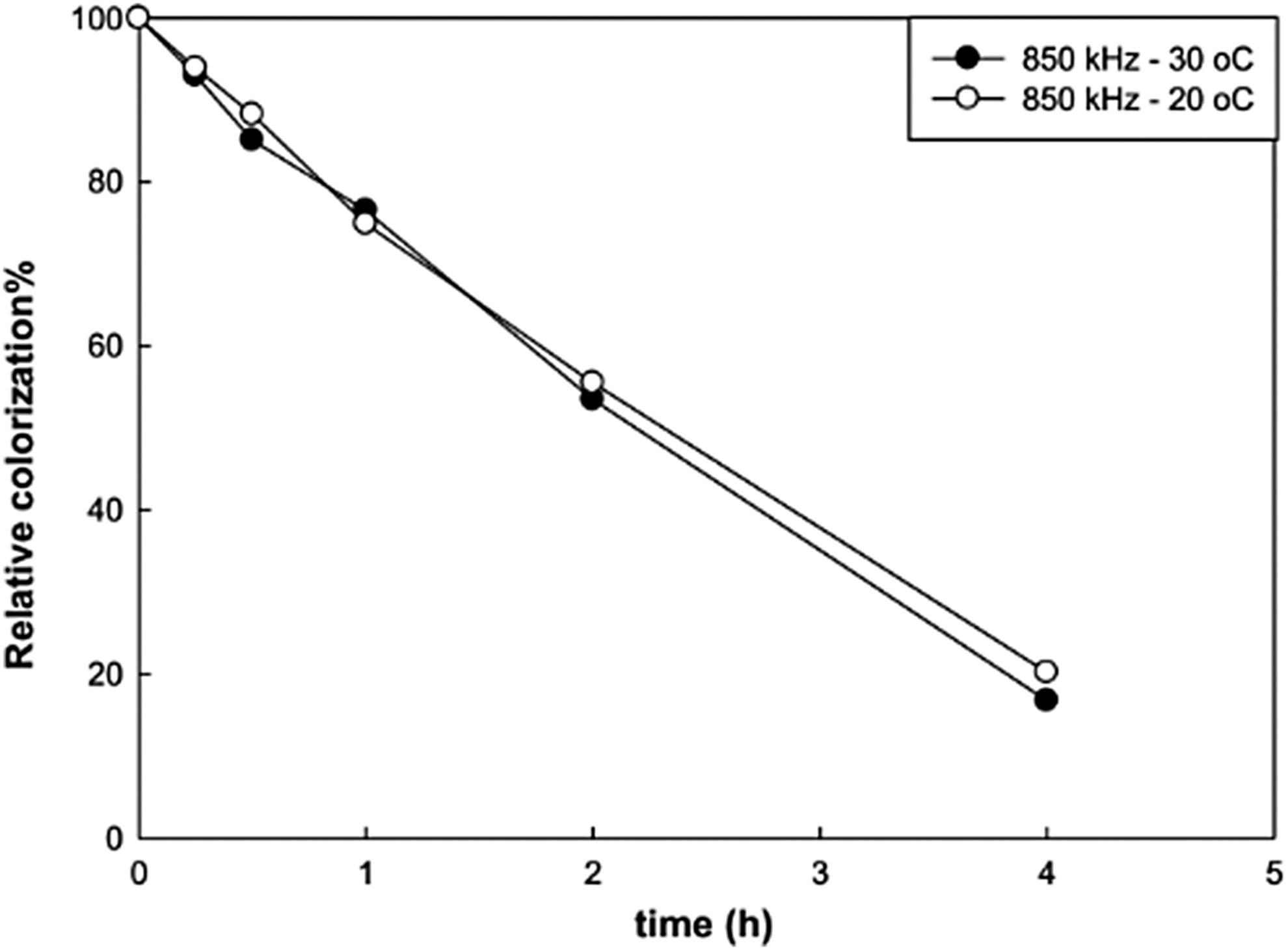
The variation of relative colorization % of RO107_H-NA, m/z: 399 with temperature (C0: 50 mg/L, f: 850 kHz, Pac: 60 W).
As seen from the figure, the decolorization percentage increased from 80% to 83% by increasing the temperature from 20°C to 30°C. Apparently, the temperature affects the decolorization only slightly. It is expected that the rate of a reaction enhances with temperature. However, in sonochemical reactions an increase in the temperature results in an overall decrease in the cavitation violence. At high temperature values, vapor pressure of the liquid increases and this reduces the intensity that needs to produce cavitation. More vapor diffuses into cavity and the cavity collapse is cushioned and less violent (Thompson and Doraiswamy, 1999; Chitra et al., 2004).
Determination of the sonication mechanism
In aqueous solution, degradation of organic pollutants by sonolysis may occur via two mechanisms:
Pyrolysis: This mechanism can occur due to highly localized temperature and pressure in the gas phase of the cavitation bubbles. Free radical: Free radicals can be formed because of the thermolysis of water molecules during the collapse of the cavitation bubble. This reaction occurs in the interfacial region of the bubble or in the bulk solution (Peller et al., 2001; Cai et al., 2011).
To determine whether the sonodegradation of hydrolyzed RO107 occurs via pyrolysis or by reaction with free radicals, sonolysis experiments were conducted in a medium containing tert-Butanol (t-BuOH). t-BuOH acts as a •OH radical scavenger inside the cavitation bubble and prevents the accumulation of •OH radicals at the interfacial region of the bubble [Eq. (1)]. Hence, t-BuOH suppresses degradation of the dye by radicals (Peller et al., 2001).
To investigate the degradation mechanisms of hydrolyzed RO107, experiments were performed with 50 mg/L initial dye concentration at a frequency of 850 kHz at 20°C. Varying amounts of t-BuOH were added to the dye solutions. The change in relative decolorization of RO107_H-NA, m/z:399 in the absence and the presence of varying amounts of t-BuOH from 0 to 0.004 (v/v) is shown in Fig. 10. The results suggest that the sonolysis of the dye was indeed inhibited by the addition of t-BuOH. In the absence of t-BuOH, ∼60% of RO107_H-NA dye was sonodegraded within 4 h. t-BuOH can act as a scavenger for ·OH radicals [Eq. (1)] and the lack of t-BuOH means that ·OH radicals can be effective for dye degradation. Radical inhibitor, t-BuOH, was added at different initial concentrations and ∼30% sonolysis was observed for each case. Further increase of the amount of t-BuOH did not have any significant effect on the dye sonolysis. It can be concluded that the main degradation of hydrolyzed RO107 proceeds via reaction with free radicals together with pyrolysis, the effect of which is half of free radical reactions.

The effect of the addition of t-BuOH on relative colorization % of RO107_H-NA, m/z:399 (C0: 50 mg/L, f: 850 kHz, T: 20°C). t-BuOH, tert-Butanol.
Effect of initial dye concentration
Effect of initial dye concentration on decolorization percentage was examined for three different concentration values of 50, 100, and 200 mg/L at the frequency of 850 kHz and 30°C temperature. Figure 11 shows the time dependence of decolorization percentage for three initial dye concentrations (Fig. 11). As seen from Fig. 11, the complete decolorization of RO107_H-NA, m/z:399 was achieved for all initial dye concentrations. However, the time needed to complete decolorization is extended with increasing initial dye concentration.
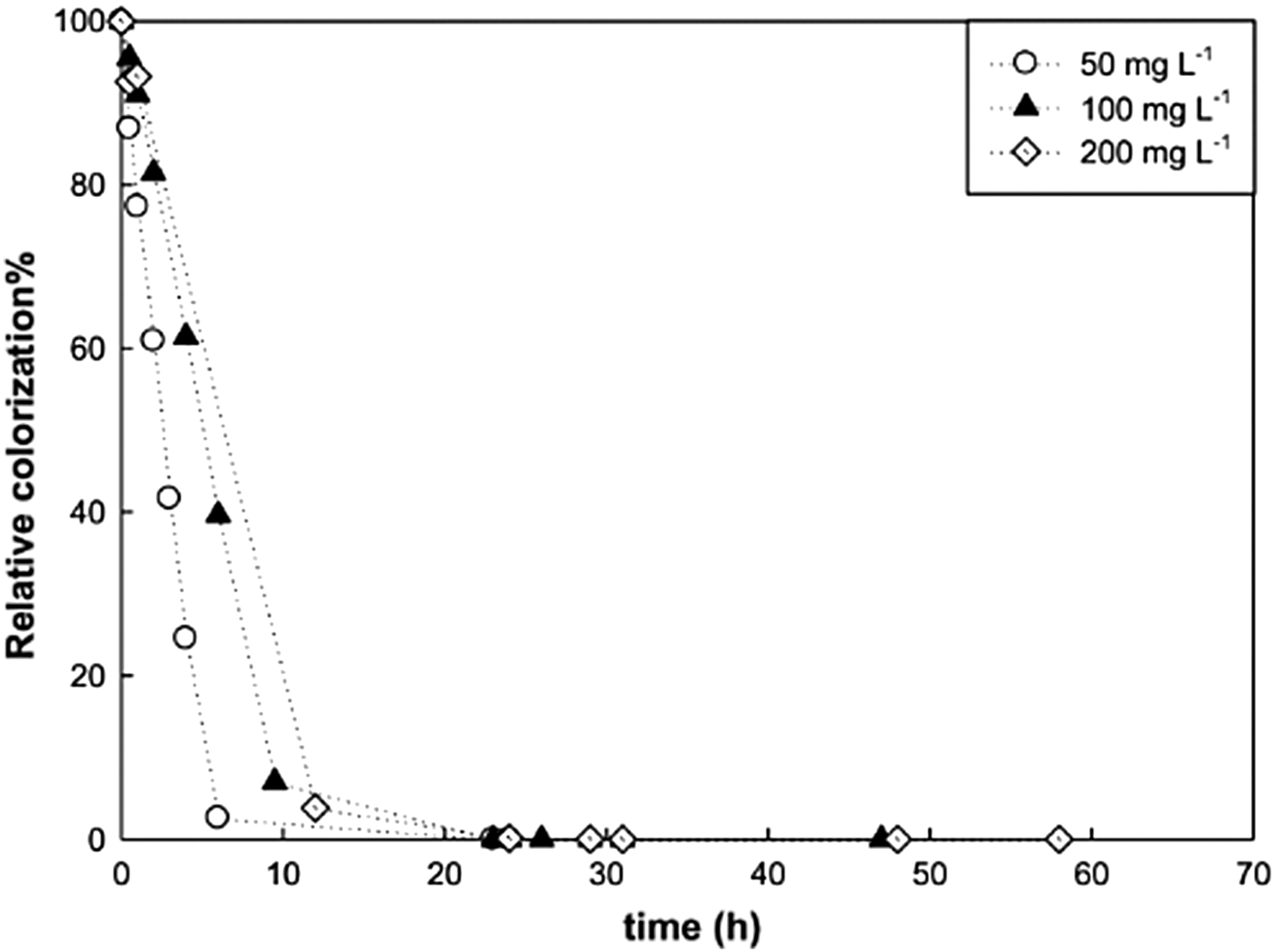
Effect of initial dye concentration on relative colorization % of RO107_H-NA, m/z:399 (f: 850kHz, T: 30°C).
TWC of DAD spectral data for hydrolyzed RO107 before and after 24 h sonication time obtained at 50 mg/L initial dye concentration are shown in Fig. 12.

Comparison of TWC of DAD spectral data for hydrolyzed RO107 before (bottom line-solid) and after (upper line-dashed) 24 h sonication time (C0: 50 mg/L, f: 850 kHz, T: 30°C).
As seen from the figure, the large peak at 6.80 retention time (RT) represents RO107_H-NA, m/z:399, the main compound of hydrolyzed RO107. While the blue line represents TWC of DAD spectral data before sonication, the red one shows TWC of DAD spectral data after 24 h sonication. The TWC of DAD spectral data analyses of hydrolyzed RO107 showed that after 24 h sonication time, almost complete decolorization of RO107_H-NA, m/z:399, main compound, was achieved. It was noticed that an increase of the peak area around 4.6 RT (m/z:172) appeared during 24 h sonication period. This peak was assigned to an intermediate compound of m/z:172 (sulfanilic acid). Increase of this peak area also indicates the increase of the amount of this compound during sonication. A similar peak was observed in DAD chromatograms of hydrolyzed RO107, obtained at 100 and 200 mg/L initial dye concentrations. Some important compounds of hydrolyzed RO107 detected before and after US treatment are listed in Table 3. The proposed mechanism for the degradation of hydrolyzed dye during ultrasonic treatment is shown in Fig. 13 (Donlagic and Levec, 1997; Joseph et al., 2000; Ince and Tezcanli-Guyer, 2004; Shemer and Narkis, 2004; Tauber et al., 2005; and He et al., 2007).
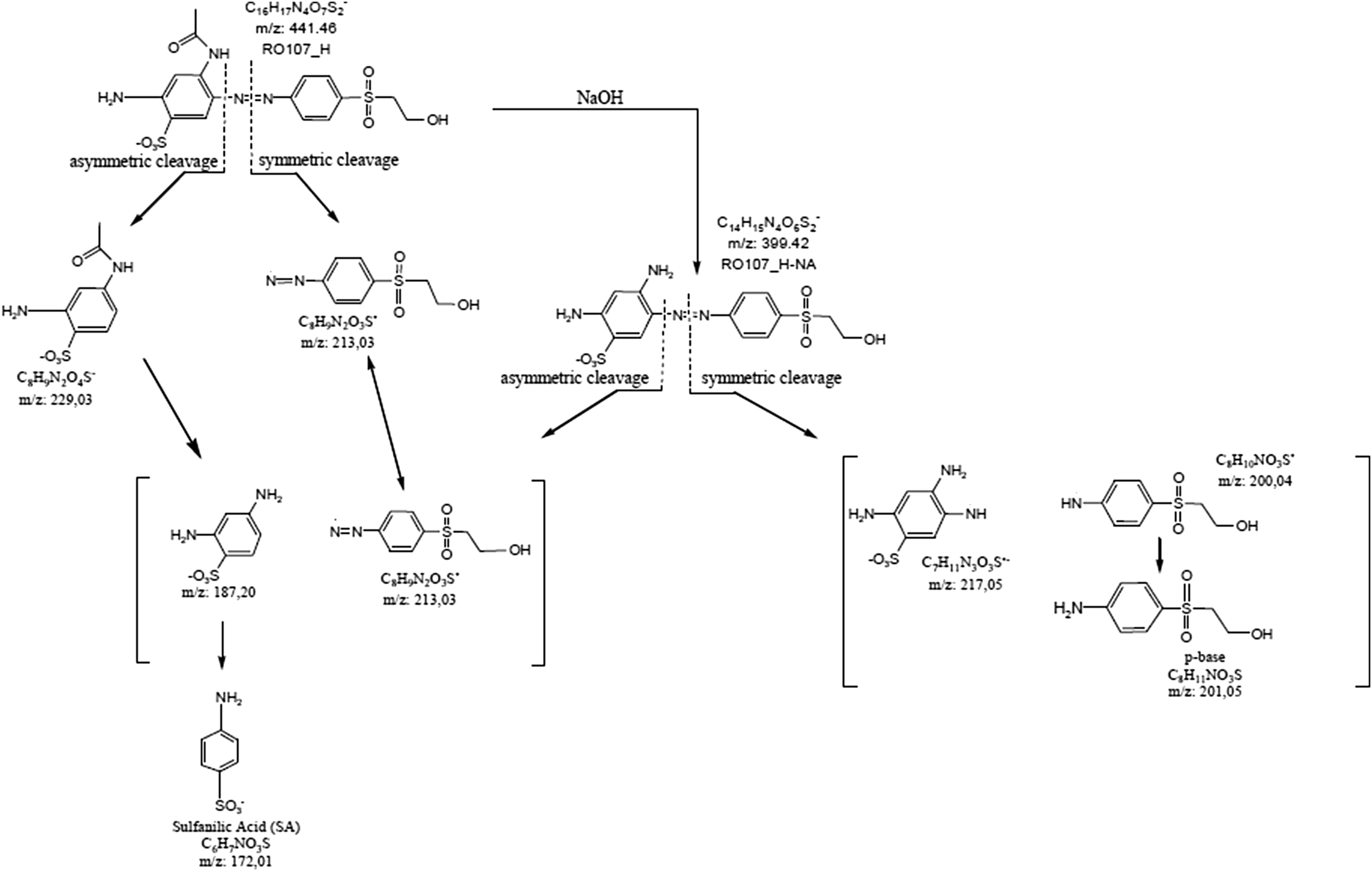
Proposed mechanism for degradation of hydrolyzed dye during ultrasonic treatment.
+, exist; ++, much exist; +−, less exist; −, nonexist; US, ultrasound.
UV-visible spectra of the dye solutions were also recorded during the sonication, and it was observed that magnitude of absorbance increased with increasing dye concentration. Moreover, there is one visible absorption peak in the spectrum at 400 nm for all dye concentrations studied. This peak is due to the azo form of the dye which absorbs typically at 400–440 nm (Jozwiak et al., 2007). The UV-visible spectrum of the dye solutions also indicated the reduction in the color.
COD is a measure of oxygen consumption needed to oxidize the organic compounds during the decomposition of organic matter. The variation of COD with time was studied for each initial hydrolyzed dye concentration (Fig. 14). The COD of dye solution decreased with sonication due to degradation of dye, and it became half of its initial value after 24 h sonication for all initial dye concentrations. It is expected that there should be a constant ratio between the concentration of the compound expressed as COD and the concentration expressed as the mass of the compound itself. However, the initial values of COD are not consistent. This can be due to the presence of chloride ions, which were added to the solution during preparation of hydrolyzed dye in Preparation of the Hydrolyzed Dye Solution section. Chloride is the primary interference in this test method and the interference level is dependent on the chloride and COD concentration.

Variation of COD as a function of time for three different initial dye concentrations. COD, chemical oxygen demand.
Kinetic analysis of dye degradation and electrical energy determination
Decolorization of RO107_H-NA, m/z:399, the main compound of hydrolyzed dye, was shown as a function of time for the three dye concentrations in Fig. 11. As seen from the figure, with increasing the initial RO107_H-NA concentration, the removal rate diminished. Decolorization data could be correlated on the basis of an irreversible, pseudo-first-order reaction written as:
where C0 is the initial dye concentration, C is the dye concentration after time t, and k′ is pseudo-first-order rate constant. The k′ values which were determined from the slope of ln(C/C0) versus t are presented in Table 4. The degradation rate constants decrease with increasing initial RO107_H-NA concentration.
A critical aspect of evaluating the radical-based treatment processes is the EEO (electric energy per order), which gives a measure of the electrical energy required to reduce the concentration of the contaminant by one order of magnitude. In the case of low pollutant concentrations, the electrical energy per order (EEo) is defined as the number of kWh of electrical energy required to reduce the concentration of a pollutant by 1 order of magnitude (90%) in 1 m3 of contaminated water. The EEo (kW h m−3 order−1) can be calculated from the following Equations (3) and (4):
where P is the rated power (kW) of the US system, t is the sonication time (min), V is the volume (L) of the water in the reactor, Ci and Cf are the initial and final pollutant concentrations and is the pseudo-first-order rate constant (min−1) for the decay of the dye concentration (Daneshvar et al. 2005).
From Equations (3) and (4), EEo can be written as follows [Eq. (5)]:
Effect of initial dye concentration on decolorization rate constants and EEO is expressed in Table 4. A decrease in decolorization rate and increase in EEO with increasing initial dye concentration has been observed.
Conclusions
This study introduces the use of ultrasonication method for the degradation of Reactive Orange 107 (RO107). Degradation products were detected and identified by using LC/MS-MS analysis and a degradation mechanism was proposed. The effect of frequency, temperature, and initial dye concentration were investigated. The maximum dye removal was obtained at a frequency of 850 kHz and at 50 mg/L initial dye concentration. It was observed that temperature has no significant effect on dye removal. Increasing initial dye concentration decreased the decolorization percentage for the same sonication duration. This might be caused by decreased cavitational effects at higher dye load and also by insufficient formation of hydroxyl radicals. When sonication time is extended, the generation of hydroxyl radicals will increase at a certain point. This will provide the complete decolorization at higher dye concentration. It is observed that COD was not completely reduced while more than 80% decolorization was achieved under the ultrasonic action. It should be noted that the complete decolorization of dye does not mean complete mineralization (Joseph et al., 2000; Akram et al., 2016). This is because intermediate products of RO107 might be resistant toward oxidative degradation under the ultrasonic action. The kinetic evaluation and energy consumption demonstrate the decrease in rate constant with increasing initial dye concentration besides increase in EEO. However, sonochemical treatment can be used in conjunction with other methods such as anaerobic–aerobic microbiological treatments as a final, safe and cost-efficient step to improve the degradation process on the whole.
Footnotes
Acknowledgment
This work was supported by Hacettepe University Scientific Research Foundation (grant number: 07T09604004).
Author Disclosure Statement
No competing financial interests exist.