




Abstract
Abstract
Anaerobic ammonium oxidation (Anammox) is attracting significant attention for use in mainstream sewage treatment. However, its application is limited by sensitivity of anaerobic ammonia-oxidizing bacteria (AAOB) to environmental conditions. Use of nanoparticles (NPs) for sewage treatment has increased in recent years, but so has the risk of NPs entering into municipal sewage. In this study, three identical sequencing batch reactors were fed with CuO, ZnO, and TiO2 NPs in different concentrations (0, 1, 5, 10, 20, and 50 mg/L) to study the short-term effects of the NPs on Anammox. Results showed that ZnO and CuO NPs had a similar effect on Anammox, that is, both NPs at low concentrations (1 mg/L) significantly suppressed nitrogen removal. Reactors also exhibited self-adaptation to ZnO NPs at concentrations in the range 5–20 mg/L and CuO NPs in the range 10–50 mg/L. ZnO and CuO NPs exerted different levels of inhibition on Anammox within the experimental range of concentrations (1–50 mg/L). TiO2 NPs were beneficial for Anammox and improved nitrogen removal at low concentrations, but significantly suppressed AAOB bioactivity at high concentrations (>1 mg/L). However, they had no impact on Anammox at a concentration of 50 mg/L due to NP aggregation.
Introduction
N
In the process, anaerobic ammonia-oxidizing bacteria (AAOB) utilize nitrite as an oxidant to oxidize ammonia nitrogen directly to nitrogen gas, which results in nitrogen removal under anaerobic conditions. The process entails much lower oxygen consumption (Strous et al. 1999; Francis et al., 2007) and higher nitrogen removal rate compared to traditional denitrification. In addition, the output of carbon dioxide from Anammox is 90% greater than that obtained from nitrification–denitrification, and this is achieved without requiring any additional carbon source (Francis et al., 2007). The production of excess sludge is very low because the AAOB grow slowly and have low cell yield, which ensures low consumption of energy and material in the wastewater treatment system (Chen et al., 2015). Recently, the application of Anammox in municipal wastewater treatment has attracted much attention. However, the AAOB grow slowly and are sensitive to environmental conditions, which are influenced by many factors in sewage such as metal ions (Yang et al., 2014), antibiotics (Ding et al., 2015), salinity (Puthiya Veettil et al., 2015), and substrate concentration (Ma et al., 2017). Therefore, it is important to study the potential effects on Anammox of the materials present in municipal wastewater to develop the process for application in mainstream sewage treatment.
With the rapid development and application of nanotechnology, nanoparticles (NPs) are being increasingly used in consumer and industrial products (Nowack et al., 2015); nanometal oxides such as CuO, ZnO, and TiO2 NPs are especially being employed in a range of products (Jia et al., 2016; Robles-García et al., 2016; Zhang et al., 2018c). It has been suggested that the large-scale use of NPs in commercial products, pharmaceuticals, agricultural products, and chemicals, and so on (Peralta-Videa et al., 2011) has inevitably caused their release into the environment, especially into wastewater treatment systems (Kartal et al., 2010a). Studies have shown that ZnO NPs exert a toxic influence on bacteria, resulting in their abnormal growth (Adams et al., 2006). NPs of ZnO, in concentrations of 10–50 mg/L, inhibited nitrogen removal by a hypoxia aerobic membrane bioreactor (Zhang et al., 2017a). NPs of CuO had an inhibitory effect on the biofilm surface of a sequencing batch biofilm reactor (Hou et al., 2016b). NPs of TiO2 inhibited the growth of algae in water and positively influenced remediation of eutrophic freshwater systems (Li et al., 2015; Bessa da Silva et al., 2016).
Although these studies have established the impact of NPs on microorganisms, especially those functioning in sewage treatment systems, the influence of NPs specifically on Anammox has not been studied. The activity of AAOB is an important factor in autotrophic nitrogen removal in the treatment of mainstream municipal sewage (Jetten, 1998). Total nitrogen and ammonia nitrogen removal from the sewage are impacted because of the influence of the NPs on the AAOB (Morales et al., 2015). Anammox is an advanced and promising process for nitrogen removal, so the effect of NPs on nitrogen removal from municipal sewage must be clarified.
In this study, the short-term effects of CuO, ZnO, and TiO2 NPs in different concentrations on nitrogen removal and variations in extracellular polymeric substances (EPSs) during Anammox were investigated. The main goal was to verify the impact of the NPs upon introduction into the sewage treatment plant, and promote the development of Anammox accordingly.
Materials and Methods
Sludge and wastewater
Three identical sequencing batch reactors (SBRs), named R1, R2 and R3, with an effective volume of 0.5 L were used in this study, as shown in Figure 1. The seeded sludge was procured from a biofilter that had been operating based on Anammox for more than a year, and in which AAOB were the dominant nitrogen-removal bacteria. The mixed liquor-suspended solids (MLSS) of R1, R2, and R3 were 7.46, 7.73, and 7.48 g/L, respectively.

SBR setup schematic (1. electric mixer). SBR, sequencing batch reactor.
The main components of the synthetic wastewater were 189 mg/L of (NH4)2SO4, 197 mg/L of NaNO2, 1678 mg/L of NaHCO3, 68 mg/L of KH2PO4, 150 mg/L of MgSO4·7H2O, 68 mg/L of CaCl2, and 1 mL/L of trace element solutions I and II. The effects of ZnO, CuO, and TiO2 NPs were investigated by adding them directly into the reactors in concentrations of 0, 1, 5, 10, 20, and 50 mg/L.
Experimental setup
Reactors R1, R2, and R3 were operated for two cycles in a day, and each cycle comprised 5 min of inflow, 6 h of stirring, 0.5 h of settling, and 5 min of drainage. Other operational conditions are summarized in Table 1. At the beginning of each cycle, the sludge was washed thrice with synthetic wastewater. NPs of ZnO, CuO, and TiO2 were added to the reactors R1, R2, and R3, respectively, in the first cycle, while the second cycle in each reactor progressed in the absence of NPs. The short-term effects of the NPs on Anammox were investigated using experimental data from the first cycle of each reactor.
Operational Conditions and Wastewater Components
NP, nanoparticle.
In each cycle, the pH and nitrogen components of water were analyzed every hour. The metallic contents of sludge were determined by inductively coupled plasma mass spectroscopy following digestion using a strong acid.
Analytical methods
Concentrations of NH4+-N and NO2−-N were measured daily using different colorimetric methods and that of NO3−-N was analyzed by ultraviolet spectrophotometry. The temperature, DO, and pH were detected using portable instruments with specific probes (WTW, Germany). The ammonia removal rate (ARR), nitrite removal rate (NRR), and total nitrogen removal rate (TNRR) were calculated according to Equations (1)–(3), respectively,
Dehydrogenase activity (DHA) was determined using iodonitrotetrazolium (INT) as the reaction substrate and 37% formaldehyde solution as the reaction-terminating agent, as previously reported (Goel et al., 1998). It was calibrated with the reduced product of INT, and 1 enzyme unit (EU) was defined as equivalent to the production of 1 mM INT-formazan in 1 h. Specific enzyme activities were expressed as enzyme activity per unit biomass and were calculated by dividing the EU by the quantity (mg) of MLSS used in the enzyme assays.
Extraction and determination of EPS
Sludge-mixed liquor was extracted from the three reactors R1, R2, and R3 after the short-term operation to evaluate the effect of the NPs on EPS secretion. The EPS samples were extracted and analyzed for components, including polysaccharides (PS) and proteins (PRO) (Wei et al., 2017). To extract an EPS sample, 5 mL of the sludge sample was first procured for centrifuging (15 min, 8000 rpm). The centrifugal precipitate was then resuspended in PBS for sonication (3 min, 40 KHz). Next, the mixture was heated in a water bath (30 min, 80°C), following which the suspension was quickly centrifuged (15 min, 8000 rpm), and the supernatant was collected for EPS determination. The concentration of PS in the extracts was measured by the anthrone-sulfuric acid method at a wavelength of 625 nm. The concentration of PRO in the sludge extracts was measured by the Flint-phenol method at a wavelength of 500 nm.
Results and Discussion
Effect of ZnO NPs on Anammox
Short-term effects (8 h) of ZnO NPs on Anammox were investigated in the reactor R1. The variation in nitrogen components in each cycle is shown in Figure 2, and the reaction rates in Figure 3. In the absence of ZnO NPs, the TNRR of R1 was 1.38 mg N/(h·g) suspended solids (SS), ARR was 0.79 mg N/(h·g) SS, and NRR was 0.94 mg N/(h·g) SS. At ZnO NP concentration in the range 1–5 mg/L, the TNRR, ARR, and NRR sharply decreased to 0.91, 0.46, and 0.62 mg N/(h·g) SS, respectively. It was speculated that the presence of ZnO NPs in low concentrations had an acute or transient impact on the AAOB, which caused a decline in the rate of Anammox. When the ZnO NP concentration was increased to 10–20 mg/L, the values of TNRR, ARR, and NRR rebounded to 1.36, 0.94, and 0.96 mg N/(h·g) SS, respectively. It is noteworthy that the ARR and NRR were approximately equal. This result suggested that the AAOB demonstrated self-adaptation to the ZnO NPs, enabling a recovery in the NRR. When the ZnO NP concentration was increased to 50 mg/L, the TNRR, ARR, and NRR, all sharply decreased to 0.895, 0.492, and 0.548 mg N/(h·g) SS, respectively. These reaction rates are lower than those observed in the absence of the ZnO NPs, indicating significant suppression by the NPs at this concentration. The data from reactor R1 show that ZnO NPs had an acute inhibitory effect on AAOB at low concentrations, but the NRR could recover to its initial level due to self-adaptation when the ZnO NP concentration was in the range 5–20 mg/L. However, ZnO NPs at very high concentrations (50 mg/L) could again suppress nitrogen removal by Anammox.
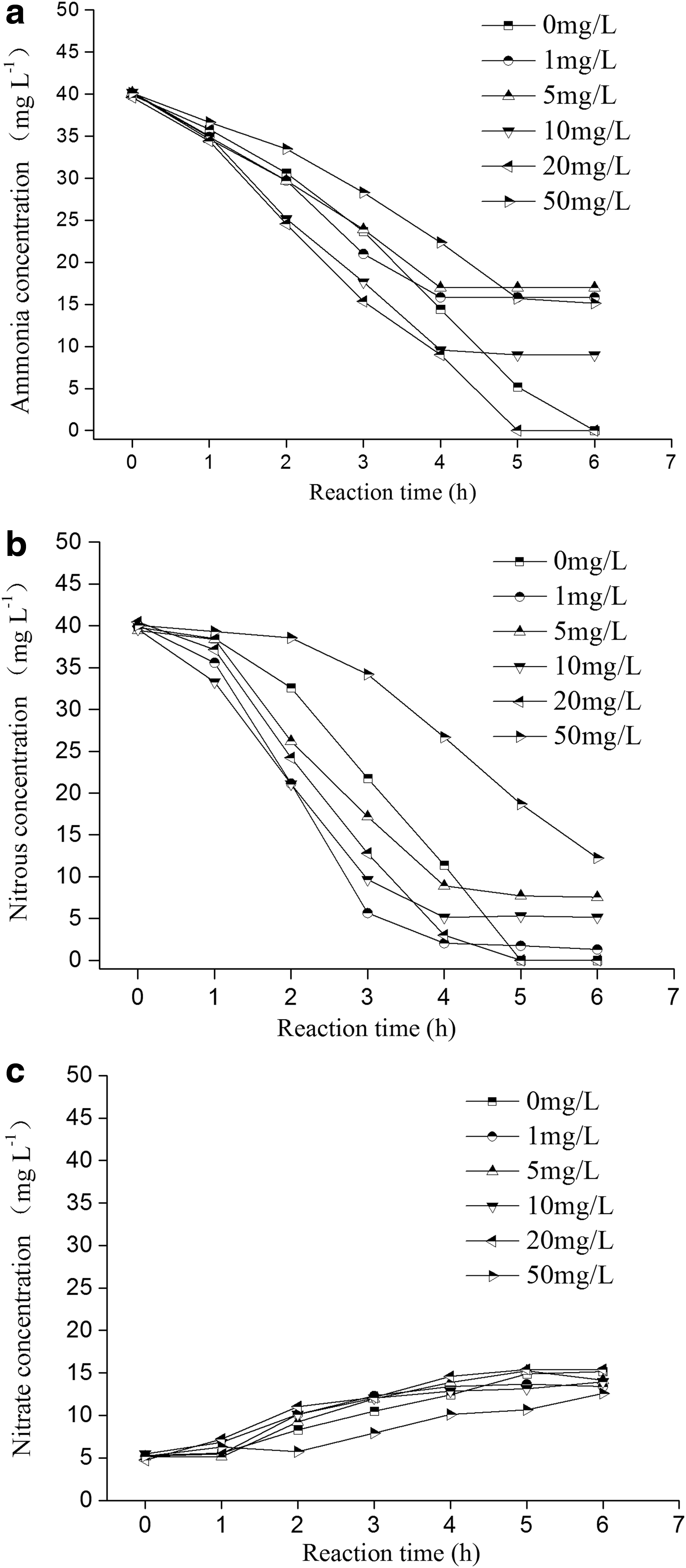
Nitrogen components during one cycle with different concentration of ZnO NPs (

Reaction rates with different ZnO NP concentrations.
Thus, it can be concluded that ZnO NPs at high concentrations have an adverse effect on Anammox and should not be introduced to a water medium. A previous study (Hou et al., 2014) determined that ZnO NPs had no effect on the microbial surface, but inhibited oxygen respiratory activities in wastewater environments at high concentrations (50 mg/L), which is consistent with the findings from this study. However, Zhang et al. (2018b) demonstrated that ZnO NPs did not affect reactor performance when present at concentrations in the range 1–5 mg/L, but reduced the nitrogen removal capacity of the Anammox reactor by nearly 90% within 3 days at a concentration of 10 mg/L, which is inconsistent with the results of this study. The differences can be explained by the fact that the sludge concentration and reaction conditions investigated in the two studies differed, and affected the process of Anammox differently.
Effect of CuO NPs on Anammox
Short-term effects of CuO NPs on Anammox were investigated in the reactor R2. The variation in nitrogen components in each cycle is shown in Figure 4, and the reaction rates in Figure 5. In the absence of CuO NPs, the TNRR, ARR, and NRR in R2 were 0.65, 0.49, and 0.25 mg N/(h·g) SS, respectively. When the CuO NP concentration was increased to 1 mg/L, the TNRR, ARR, and NRR declined rapidly. The removal of ammonia nitrogen and nitrite nitrogen was not very satisfactory. The effluent ammonia and nitrite contents were higher than those in the cycle without CuO NPs. It can be seen from Figure 4 that nitrite nitrogen increased during the cycle and this was perhaps due to oxidation of ammonia by AOB. The AAOB were suppressed and could not consume the nitrite in a timely manner, and hence the TNRR decreased. When the CuO NP concentration was increased to 5 mg/L, the TNRR, ARR, and NRR recovered to some extent, but did not reach their respective initial levels. This result suggests that at low concentrations, CuO NPs had a significant inhibitory effect on the AAOB and led to a decrease in nitrogen removal. The AAOB bioactivity could recover to some extent at CuO NP concentration in the range 5–10 mg/L due to self-adaptation to the NPs. This trend is similar to that seen with ZnO NPs in R1, although the recoverability in R2 was much lower than in R1; the TNRR, ARR, and NRR in R2 recovered only to 0.45, 0.42, and 0.05 mg N/(h·g) SS, respectively. This result indicates the stronger toxicity of CuO NPs on AAOB, that is, the AAOB exhibited higher sensitivity to CuO NPs than to ZnO NPs. However, when the CuO NP concentration was increased to 20 mg/L, the TNRR rose to 0.46 mg N/(h·g) SS, but was still lower than that observed in the cycle without the NPs, whereas the ARR and NRR fell to 0.36 and 0.019 mg N/(h·g) SS, respectively. When the concentration of the CuO NPs was increased to 50 mg/L, the TNRR, ARR, and NRR further recovered to 0.56, 0.46, and 0.1 mg N/(h·g) SS, respectively, but did not return to their initial levels, indicating that the inhibition by CuO NPs was chronic and durable.
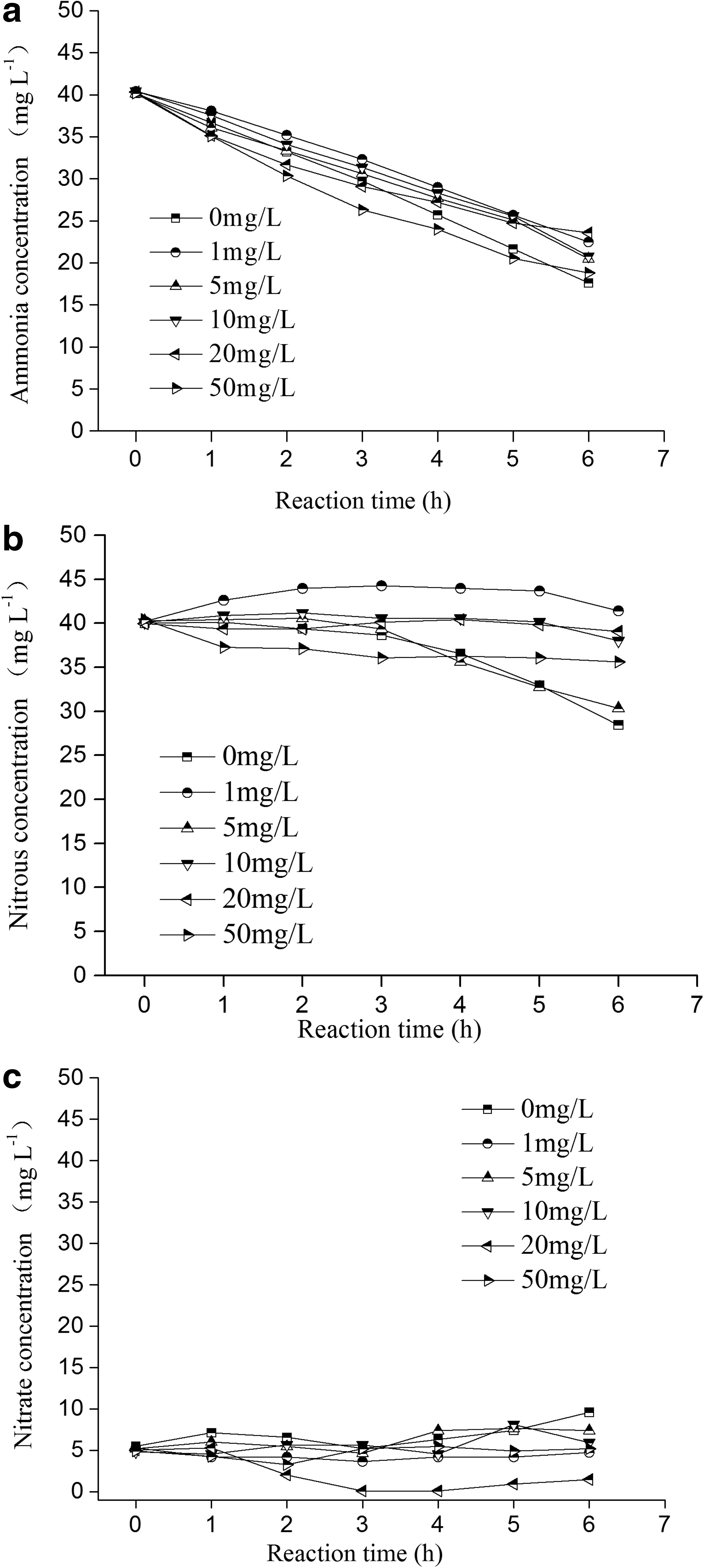
Nitrogen components during one cycle with different concentration of CuO NPs (
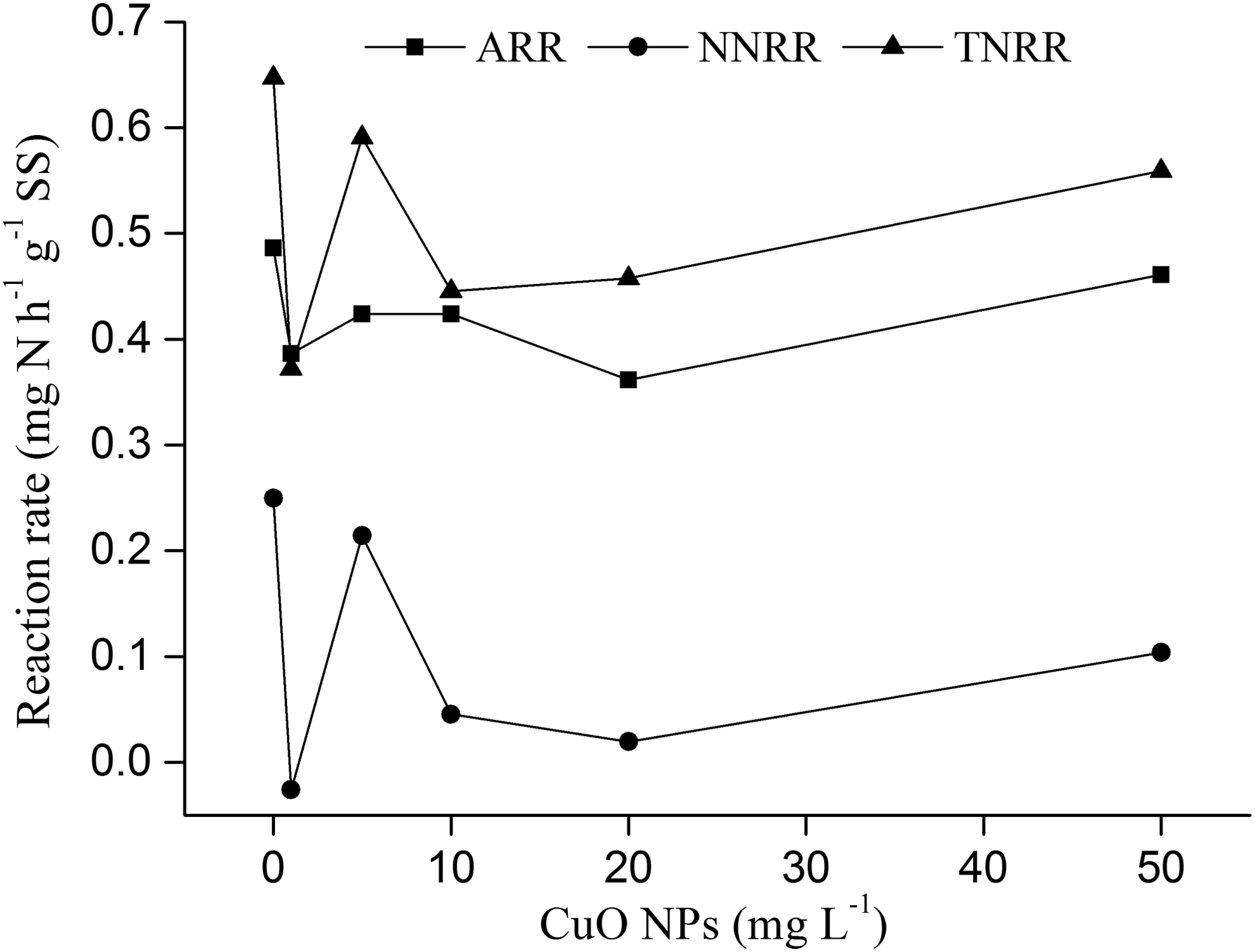
Reaction rates at different CuO NP concentrations.
A study by Zhang et al. (2017b) established that CuO NPs were not acutely toxic to the Anammox sludge and did not affect reactive oxygen species production or cell membrane integrity at concentrations of up to 50 mg/g. However, the authors did not analyze nitrogen removal in Anammox and only discussed changes in microbial performance. A previous study (Hou et al., 2015) has shown that long-term exposure to CuO NPs at concentrations within 50 mg/L could significantly suppress the AAOB; this is similar to the short-term effect of CuO NPs observed in this study. Nitrogen removal was suppressed due to the acute impact of the NPs, and then increased due to self-adaptation, but remained at levels lower than that seen in the absence of CuO NPs. In conclusion, the CuO NPs in the experimental range of concentrations (1–50 mg/L) used in this study exhibited suppression of the AAOB to varying extents.
Effect of TiO2 NPs on Anammox
Short-term effects of TiO2 NPs on Anammox were investigated in the reactor R3. The variation in nitrogen components in each cycle is shown in Figure 6, and reaction rates in Figure 7. In the absence of TiO2 NPs, the TNRR, ARR, and NRR in R3 were 0.52, 0.43, and 0.074 mg N/(h·g) SS, respectively. When the TiO2 NP concentration was 1 mg/L, the TNRR, ARR, and NRR increased to 0.68, 0.55, and 0.34 mg N/(h·g) SS, respectively, suggesting that the addition of 1 mg/L of TiO2 NPs was favorable for the activity of the AAOB. It is evident from Figure 6 that the concentrations of ammonia and nitrite declined during the cycle, while that of nitrate gradually increased. This is perhaps because the NOB in the activated sludge were led to produce large amounts of nitrate nitrogen, which, however, had no impact on the TNRR. When the concentration of the TiO2 NPs was increased to 5–10 mg/L, the TNRR decreased initially and then tended to stabilize. When the TiO2 NP concentration was 20 mg/L, the TNRR decreased to 0.23 mg N/(h·g) SS, indicating that the activity of the AAOB was unstable and represented self-adaptation in the presence of the NPs. When the concentration of the TiO2 NPs was 50 mg/L, the TNRR recovered to 0.55 mg N/(h·g) SS, which was higher than the initial value, whereas the ARR and NRR recovered to 0.41 and 0.07 mg N/(h·g) SS, respectively, both lower than their respective initial values.

Nitrogen components during one cycle with different concentration of TiO2 NPs (
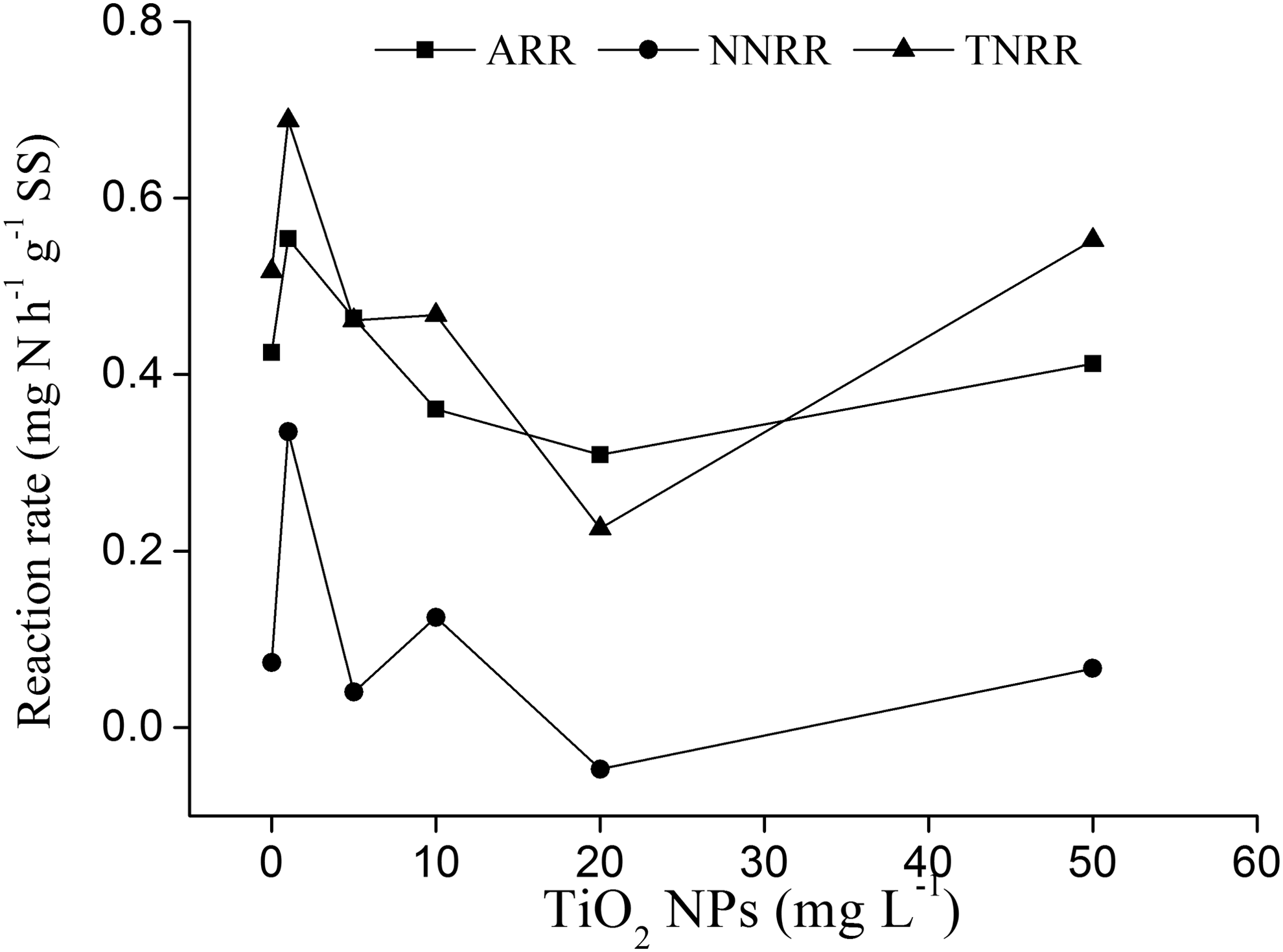
The reaction rate at different TiO2 NP concentrations.
In a similar study (Zhang et al., 2018a), it was concluded that TiO2 NPs demonstrated the strongest inhibitory effect at a concentration of 1 mg/L, contrary to the findings of this study. This is because this study mainly focused on the short-term effects of TiO2 NPs on Anammox, and determined that an acute short-term impact resulted in a promotive effect. The duration of investigation in the previous study was longer, which led to accumulation of TiO2 in the reactor and subsequently an inhibitory effect on Anammox. The inhibitory result was consistent with the phenomenon observed at a TiO2 NP concentration of 20 mg/L in this study. Researchers (Luo et al., 2015) have previously reported that TiO2 NP at concentrations in the range 0–2 mg/L significantly suppressed AAOB activity on ammonia-oxidizing bacterial cultures under ammonia oxidation, which is inconsistent with the results obtained in this study. The difference perhaps is due to the different reaction systems and process control parameters used in the two studies.
In conclusion, TiO2 NPs promoted Anammox at low concentrations and inhibited nitrogen removal at concentrations in the range 5–20 mg/L, but exhibited lower suppression at 50 mg/L due to aggregation that decreased the actual NP concentration in the reactor.
Effect of NPs on sludge properties
Sludge samples were collected before and after the experiments. The metallic contents of the sludge are shown in Table 2. Before the addition of ZnO NPs, the Zn content in the sludge was 4.69 mg/g SS, which increased to 9.83 mg/g SS after short-term exposure to the NPs. At the same time, the Cu, Cd, Mn, and Fe content also increased, indicating increase in adsorption with the addition of ZnO NPs. This partly explains the coprecipitation of Zn and the other metals; another reason is that the trace elements in the influent introduced various metals into the reactor. Before the addition of CuO NPs, the Cu content in the sludge was 1.49 mg/g SS, and this increased to 10.44 mg/g SS after short-term exposure to the NPs. The content of Zn, Ti, Cr, Ni, and Pb also increased, while that of Cd, Mn, Fe, and Co decreased simultaneously. The content of Ti in the sludge of the reactor R3 was 2.48 mg/g SS before TiO2 NP addition, and increased to 4.42 mg/g SS following short-term exposure. The content of Zn, Cu, Cr, Ni, and Pb increased, while the Mn, Fe, and Co content decreased. The metallic contents of the sludge revealed that adsorption by sludge contributed significantly to the removal of NPs; most of the NPs had accumulated in the sludge and thereby affected the AAOB.
Metal Contents in Sludge of Each Reactor with Different Nanoparticle Addition
The seeded sludge and sludge after short-term exposure to 1 mg/L of NPs from each reactor were obtained to detect the DHA. The DHA reduced from 0.841 EU/g SS to 0.652 EU/g SS in R1 and 0.612 EU/g SS in R2, but increased to 1.273 EU/g SS in R3. The DHA has been widely used to assess the overall condition of microorganisms in activated sludge, and is considered to be a great indicator of microbial oxidative activity. The DHA results of this study correspond with the values of TNRR and microbial activity, further validating the inhibitory effect of CuO and ZnO NPs and enhancement by TiO2 NPs in the range of concentrations investigated.
EPSs form an important component of the activated sludge, and play a significant role in microbial resistance to environmental pressure and other aspects. The main components of the EPS, such as PS and PRO, were very similar to those of microbial cells (Zhang et al., 2016). The EPS components before and after the addition of ZnO, CuO, and TiO2 NPs are summarized in Table 3. The three kinds of NPs showed similar impact on EPS secretion. After the addition of NPs, both the PRO and PS content in the three reactors increased, with the PRO content showing an obvious and significant rise. It has been reported that the addition of 50 mg/L of CuO NPs would increase the yield of EPS and the toxicity would inhibit the degree of activated sludge flocculation, resulting in reduced microbial activity (Hou et al., 2016a). Moreover, it has also been stated that the TiO2 NPs were mostly removed following entry into the sewage treatment system and resulted in an increase in EPS content (Qiu et al., 2016). The variation in EPS content in this study is consistent with that observed in previous studies. The increased EPS (mainly PRO in this study) enhanced the neighboring AAOB cells and formed crosslinked networks to prevent NPs from infringing on the cells by self-attraction. This is a self-protection strategy of microorganisms against adverse shocks.
Extracellular Polymeric Substance Contents in Each Reactor with Nanoparticles Addition (mg/g SS)
EPS, extracellular polymeric substance; PS, polysaccharides; PRO, proteins.
Conclusions
This study demonstrated that ZnO and CuO NPs had a similar effect on Anammox, that is, both suppressed nitrogen removal when added in a concentration of 1 mg/L. The process of Anammox also exhibited self-adaptation to ZnO NPs (5–20 mg/L) and CuO NPs (10–50 mg/L); the two NPs presented inhibition at experimental concentrations (1–50 mg/L). NPs of TiO2 were beneficial for Anammox at low concentrations, but significantly suppressed AAOB activity at high concentrations (>1 mg/L) and had no impact at 50 mg/L. The metal contents of the sludge showed that sludge adsorption played a significant role in NP removal, which led to an increase in EPS as a self-protection strategy.
Footnotes
Acknowledgments
This work was supported by the National Natural Science Foundation of China (NSFC: Account No. 41701569), the project of Science and Technology Opening Cooperation in Henan Province (No.182106000010), and Open Project of State Key Laboratory of Urban Water Resource and Environment, Harbin Institute of Technology (No. ESK201703).
Author Disclosure Statement
No competing financial interests exist.