




Abstract
Abstract
Activities and selectivities of iron/palladium (Fe/Pd) bimetallic nanoparticles supported on various resin materials (chelating resins DOW 3N, cation-exchange resin D001, and anion-exchange resin D201) were studied for the reduction of nitrate in water. Scanning electron microscopy–energy dispersive spectrometry and transmission electron microscopy results indicated that the Fe/Pd bimetallic nanoparticles were well dispersed without aggregation on the three resin supports, indicating that the resins were favorable supports for Fe/Pd bimetallic nanoparticles. The surface chemistry of the support plays an important role in the activity and selectivity of Fe/Pd bimetallic nanoparticles. D201-Fe/Pd and DOW 3N-Fe/Pd exhibited high removal efficiency of nitrate (100% and 97.8%, respectively), whereas D001-Fe/Pd exhibited low efficiency (21.0%) of nitrate removal. This is mainly because the fixed negatively charged functional groups on the surface of D001 prevented nitrate permeation owing to the Donnan exclusion effect. Moreover, almost all reduction products with D001-Fe/Pd and D201-Fe/Pd were ammonia, whereas 69.2% N2 selectivity was obtained with DOW 3N-Fe/Pd. The transfer of nitrite from the Fe surface to the Pd surface was regarded as a key step in determining the selectivity for N2. There was no strong electrostatic repulsion or electrostatic attraction between nitrite and DOW 3N-Fe/Pd. The intermediate reduction product nitrite can be transformed from Fe to Pd freely, and can be reduced by Hads on the surface of Pd to N2, resulting in high N2 selectivity. Therefore, the chelating resin, which has no strong electrostatic force between itself and nitrate, was suitable as the support for bimetallic nanoparticles to selectively reduce nitrate.
Introduction
N
Reduction of nitrate using iron (Fe)-based bimetallic nanoparticles has been extensively investigated (Ren et al., 2017; Shubair et al., 2018). Nitrate can be reduced effectively with supported bimetallic nanoparticles. However, the main problem is that undesired ammonium is the primary end product in almost all cases of nitrate reduction. It has been suggested that palladium (Pd) is the most promising second metal because it shows high activity and N2 selectivity (Wang et al., 2017; Guo et al., 2018). It was reported that 30% N2 selectivity was obtained in the alkaline solution (pH 7.5–8.5) using the zero valent iron deposited bimetallic Pd and copper (Liou et al., 2009). Previous studies have been suggested that the formation and further reduction of nitrite on the catalyst surface was the key step in the determination of nitrogen selectivity (Pintar et al., 1996; Prüsse and Vorlop, 2001).
Most of the research has proved that the activity and selectivity of nitrate reduction were strongly influenced by the preparation method (Pintar et al., 2004), metal composition (Prüsse and Vorlop, 2001), size of the metal nanoparticles (Miyazaki et al., 2015), support (Soares et al., 2012; Wada et al., 2012), and so on. Among these factors, support is an important factor in the reduction of nitrate owing to the strong metal–support interaction that is sensitive to catalyst activity (Soares et al., 2012; Miyazaki et al., 2015).
It has been shown that catalyst support can have a direct effect on reactivity through direct participation in catalysis or modification of the electronic properties of the metal particles (Constantinou et al., 2007; Soares et al., 2011). The support can directly affect the activity and selectivity by influencing the density, size, and morphology of the catalytic metal on the support surface (Henry, 1998). The pore structure, surface area, crystalline features, and surface chemical characteristics of the support strongly influence the catalytic behavior of metallic nanoparticles. Even when impregnating different supports with the same bimetallic nanoparticles, the catalytic activity was different (Chinthaginjala and Lefferts, 2010; Li et al., 2015). Therefore, it is very important to select a suitable catalyst support for the catalytic reduction of nitrate.
Some materials, such as carbon (Gu et al., 2018), graphene oxide (Sen et al., 2018), zeolite (Dai et al., 2017), multiwalled carbon nanotube (Azari et al., 2014; Babaei et al., 2015; Ahmadi et al., 2017), and clay mineral (Weng et al., 2018) have been used as supports of the catalyst. Polymeric resins have been proven to be an excellent carrier for metal and metal oxide nanoparticles owing to their chemical stability and robust mechanical strength (Sanchez et al., 2017). We have reported on Fe–Pd bimetallic nanoparticles supported on the polymeric resin DOWEX™ M4195 (DOW 3N) that obtained 97.8% of nitrate removal and 69.2% N2 selectivity without a buffered solution and the addition of the reductant H2 (Shi et al., 2016). Moreover, few studies have reported that the surface chemistry of polymeric resin affected the formation and properties of nano zero valent iron (nZVI) (Jiang et al., 2011). However, only a limited number of reports exist in which the effects of resin supports on the activity and selectivity of Fe–Pd bimetallic nanoparticles under identical conditions have been systematically investigated.
Therefore, to further explore the influence of the surface chemistry of polymeric resin on the activity and selectivity of nZVI for nitrate reduction, in this study, Fe–Pd bimetallic nanoparticles were supported on several types of polymeric resins with different surface functional groups, the chelating resin DOWEX™ M4195 (DOW 3N), cation-exchange resin D001, and anion-exchange resin D201. The size and morphology of nanoparticles supported on these three polymeric resins were characterized. The effect of the surface chemistry of polymeric resins on the reduction behavior of Fe–Pd bimetallic nanoparticles, especially the selectivity for nitrogen, was investigated.
Materials and Methods
Materials
DOW 3N was purchased from Sigma-Aldrich. Cation and anion-exchange resins (D001 and D201, respectively) were supplied by the Zhengguang Industrial Co., Ltd., China. Before use, the resins were extracted with ethanol in a Soxlet apparatus for 8 h, and then washed by 4 wt% hydrochloric acid and 4 wt% sodium hydroxide (NaOH) in turn. The physicochemical properties of the three resins are given in Table 1. All chemicals including ferric sulfate, iron chloride hexahydrate (FeCl3·6H2O), palladium chloride, sodium tetrachloropalladate, ethyl alcohol, sodium borohydride (NaBH4), and sodium nitrate were analytical grade and purchased from the Nanjing Chemical Reagent Co., Ltd., China.
BET, Brunauer-Emmett-Teller.
Preparation of supported Fe–Pd bimetallic nanoparticles
Supported Fe–Pd bimetallic nanoparticles were prepared using a liquid phase reduction method. The Fe–Pd bimetallic nanoparticles supported on the chelating resin DOW 3N were prepared as follows: 1 g resin was added into 500 mL Fe3+ solution containing 2 g/L of Fe3+ and then shaken for 24 h at 30°C. Then, the resin spheres were added into 125 mL of 640 mg/L Pd2+ solution and shaken for 10 h at 30°C. Afterward, the resin spheres were reduced by 100 mL 2% NaBH4 solution with constant stirring for 2 h at 20°C under an N2 atmosphere. The obtained product was designated DOW 3N-Fe/Pd.
Fe–Pd bimetallic nanoparticles supported on the cation-exchange resin D001 were prepared as follows: 1 g D001 resin was added into 1000 mL of 640 mg/L Pd2+ solution and then shaken for 10 h at 30°C. Then, the resin spheres were added into 100 mL Fe3+ solution containing 0.5 g/L of Fe3+ and shaken for 24 h at 30°C. Afterward, the resin spheres were reduced using the same method as described previously. The obtained product was designated D001-Fe/Pd.
The method to prepare the Fe–Pd bimetallic nanoparticles supported on the anion-exchange resin D201 was as follows: 1 g D201 resin was added into 50 mL Fe3+ solution and 70 mL
Amounts of Fe and Pd loaded onto the supports were calculated by determining the initial and final concentrations of the preparation solution using an atomic absorption spectrophotometer (AA-6300C) (Neyertz et al., 2010). The Fe and Pd contents in the resin composites are given in Supplementary Table S1. To investigate the effect of the supports on the reduction properties of the Fe–Pd bimetallic nanoparticles, the contents of Fe and Pd used were almost identical, except for D001 because of its limited metal exchange capacity and the competition between Fe and Pd.
Characterization
Specific surface areas and pore size distribution were measured using an ASAP 2010 (Micromeritics Instrument Co.). High-resolution transmission electron microscopy (HR-TEM) analyses were performed using an electron microscope (JEM-2100, Japan). The Fe and Pd distributions in the resins were observed by scanning electron microscopy–energy dispersive spectrometry (SEM-EDS) (S-3400N II, Japan). The surface chemistries of Fe and Pd were analyzed by X-ray photoelectron spectroscopy (XPS) (Thermo Scientific ESCALAB 250Xi). The zeta potentials of the three composites were measured by Zetasizer Nano zeta potential analyzer at various pH values (Malvern Instruments, United Kingdom).
Batch experiments
All the batch experiments were carried out in three-neck flasks at 25°C. Specific amounts of composites with 2 g support were added to 500 mL of 20 mg N/L nitrate solution stirred with a mechanical stirrer. The nitrate solution was deoxygenated by an N2 stream. The initial solution pH was not adjusted. At specific time intervals, we took a sample with a syringe to analyze the concentrations of nitrate, nitrite, and ammonia in the solution after filtration through a 0.22 μm membrane filter. All solutions were prepared using ultrapure water produced by a Millipore-Q system (Millipore Synergy).
As in previous studies, N2 selectivity was calculated from the balance of nitrogen products analyzed in solution (Al Bahri et al., 2013; Doudrick et al., 2013; Kim et al., 2013; Ren et al., 2015). In this study, the adsorption of nitrate and nitrite on the composites and the possible volatilization of ammonia were also considered. To investigate the mass balance of the experiments, the off-gas from the reactor was absorbed in acidic solution for analyzing gas-phase ammonia, which may volatilize when the solution pH is alkaline. The nitrate and nitrite adsorbed on the composites also were detected after washing with 5 mM NaOH. In this study, the removal of nitrate (Rnitrate), conversion of nitrate (Cnitrate), and selectivity of each product (Snitrite, Sammonia, and Snitrogen) were calculated based on our preliminary study (Shi et al., 2016).
The kinetics of nitrate removal fit the first-order kinetics model well:
where
Analysis
Nitrate and nitrite were analyzed using ion chromatography (Dionex 1000) with an AS11-HC guard column using 15 mmol/L potassium hydroxide as the mobile phase at a flow rate of 1.0 mL/min. Ammonia was determined using a UV-Vis spectrophotometer (UV 2450, Shimadzu, Japan) with the light absorption at 697 nm. The solution pH was determined by a pH meter (FE20, Mettler Toledo, Switzerland).
Results and Discussion
Characterization of supported Fe–Pd bimetallic nanoparticles
Salient properties of the supported Fe–Pd bimetallic composites are given in Table 1 and compared with those of their host polymeric resins. From Table 1, it is evident that the addition of Fe–Pd nanoparticles only had a slight effect on the Brunauer-Emmett-Teller (BET) surface area and average pore diameter of the host polymeric resins. After loading the Fe/Pd bimetallic nanoparticles, the average pore size of the composites remained in the range of 12.92–27.59 nm and thus nitrate could diffuse inside the pores without limitation. The BET surface area was increased after loading the Fe/Pd on DOW 3N, with a decrease in pore size. This was mainly because the loaded nanoparticles made the pores narrower. It can also be seen in Fig. 1 that an increase in the pore volume was observed in the range of 2–30 nm pore diameter after impregnation with Fe/Pd nanoparticles. However, a decrease in BET surface area is noted after loading Fe/Pd onto D201. This may be because some smaller pores were blocked by the loaded Fe/Pd nanoparticles. As given in Fig. 1, a decrease in pore volume in the range of <2 nm pore diameter for D201-Fe/Pd can be further confirmed.
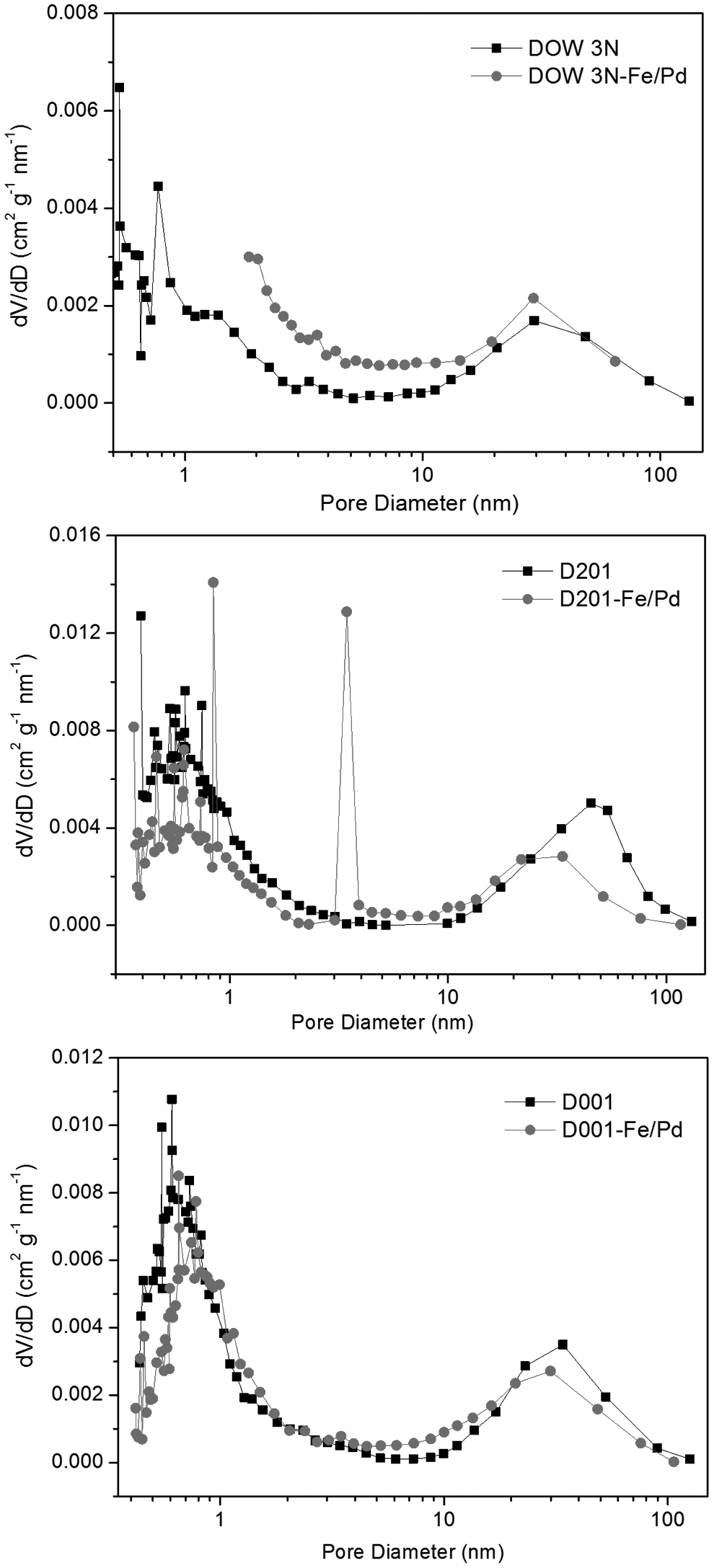
Pore size distribution of composites and their host polymeric resins.
EDS and TEM were carried out to collect more information on the bimetallic particles in terms of particle size and composition. The EDS images of the supported Fe/Pd nanoparticles with different host polymers are given in Fig. 2. The EDS results evidenced a uniform distribution of Fe and Pd on the host polymeric resins. The EDS mappings of composites also showed that Fe and Pd particles are located near each other on the polymer surface, indicating that the host polymeric resins were favorable supports for loading the bimetallic nanoparticles.
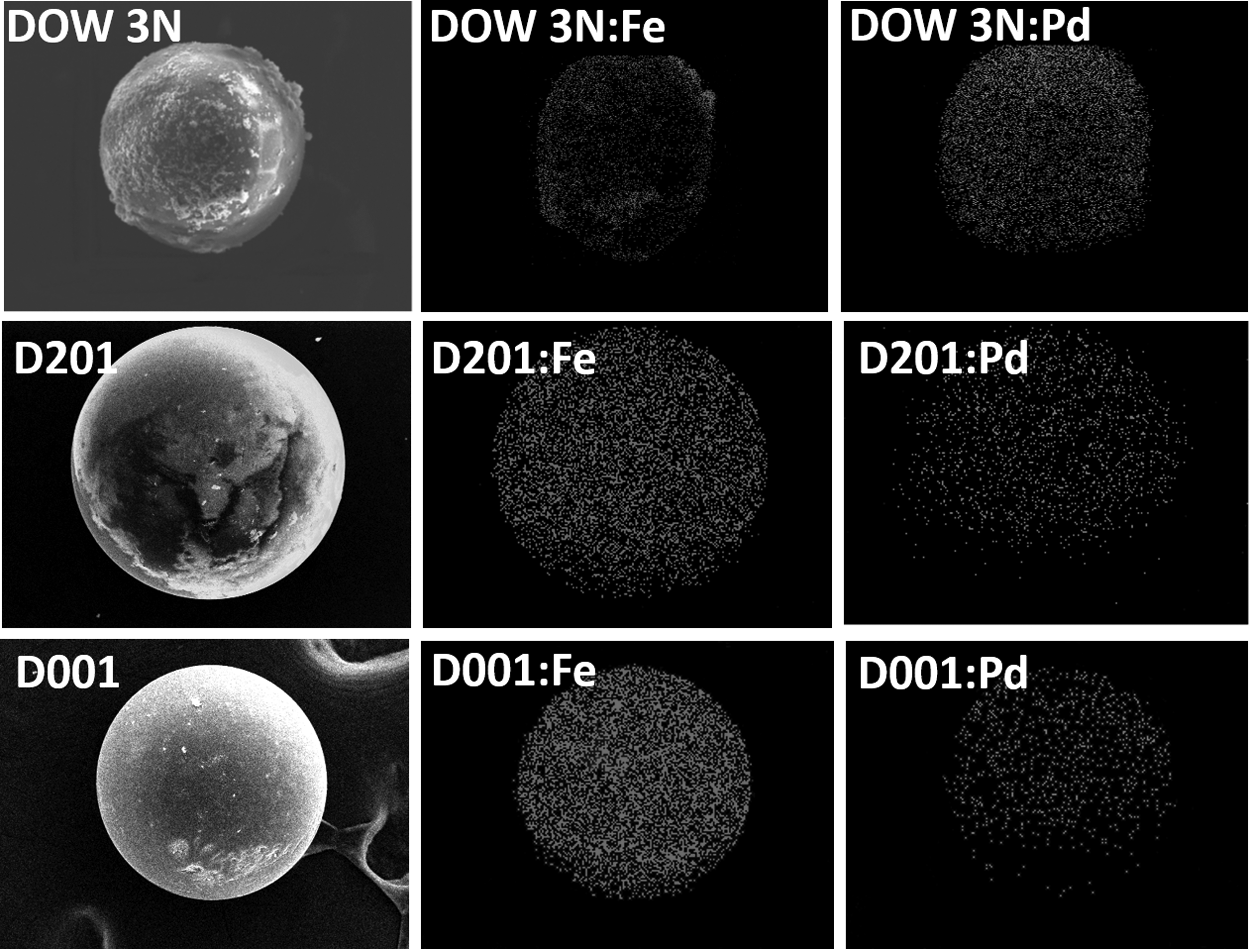
EDS images of supported Fe/Pd nanoparticles with different host polymers. EDS, energy dispersive spectrometry.
TEM pictures of the three bimetallic composites are given in Fig. 3. We can conclude from Fig. 3 that all bimetallic nanoparticles on the three supports were clearly discrete and well dispersed, with a predominant rounded shape and without aggregation. The particle size distributions estimated from the TEM pictures are also given in Fig. 3. The particle sizes of the three bimetallic composites differed slightly. The size of bimetallic particles supported on the chelating resin (DOW 3N) was mainly distributed in the range of 2–5 nm, whereas those on the ion-exchange resins (D001 and D201) were mainly in the range of 1–2 nm. The larger size of the Fe/Pd nanoparticles on DOW 3N than that on D001 and D201 may be because of the larger pore size of DOW 3N than that of D001 and D201 (Table 1).
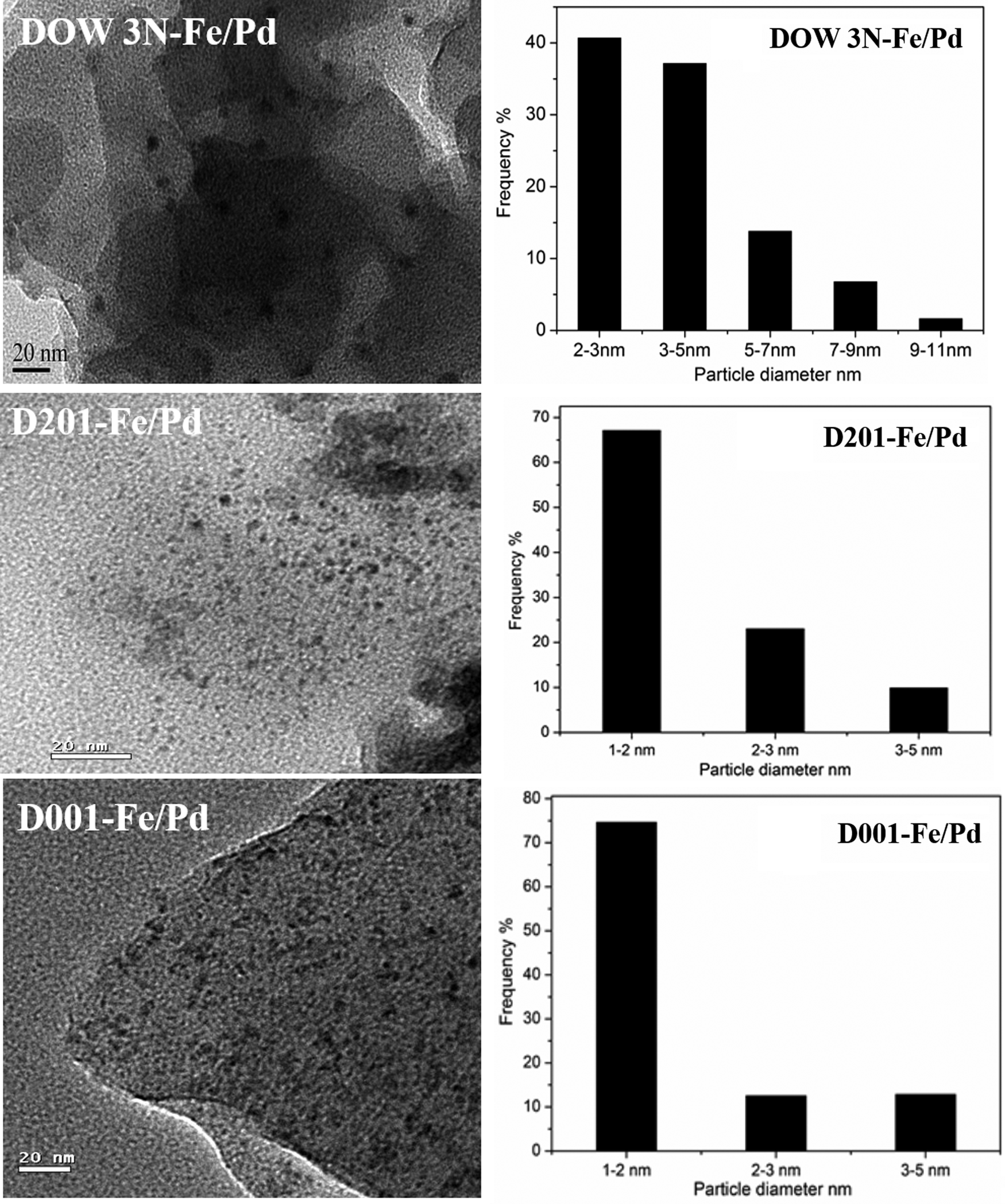
TEM images and size distribution of supported Fe/Pd nanoparticles with different host polymers. TEM, transmission electron microscopy.
Zeta potentials of the three bimetallic composites were measured as a function of pH, and the results are illustrated in Supplementary Fig. S1. The zeta potential values were always positive for D201-Fe/Pd and negative for D001-Fe/Pd. However, the zeta potential values for DOW 3N-Fe/Pd varied between positive and negative values and the isoelectric point was 8.2.
XPS was used to characterize the three Fe/Pd bimetallic composites (Fig. 4). It can be seen that the peaks in Fig. 4 prove the successful loading Fe and Pd. It is well known that the peak positions for binding energies of 706.8 and 720.2 eV are attributed to metallic Fe(0) species. The peaks for Fe(II) and Fe(III) appear at the binding energies of 710 and 723 eV and of 712 and 726 eV, respectively. The peaks at the binding energies of 335 and 340 eV indicate the presence of Pd(0), and the binding energies of 338 and 343 eV are assigned to Pd(II). For all the Fe–Pd nanoparticle composites, the large proportion of Fe(II)/Fe(III) and the existence of Pd(II) may be explained by oxidation of the Fe–Pd nanoparticle composites during the preparation and preservation of the composites.
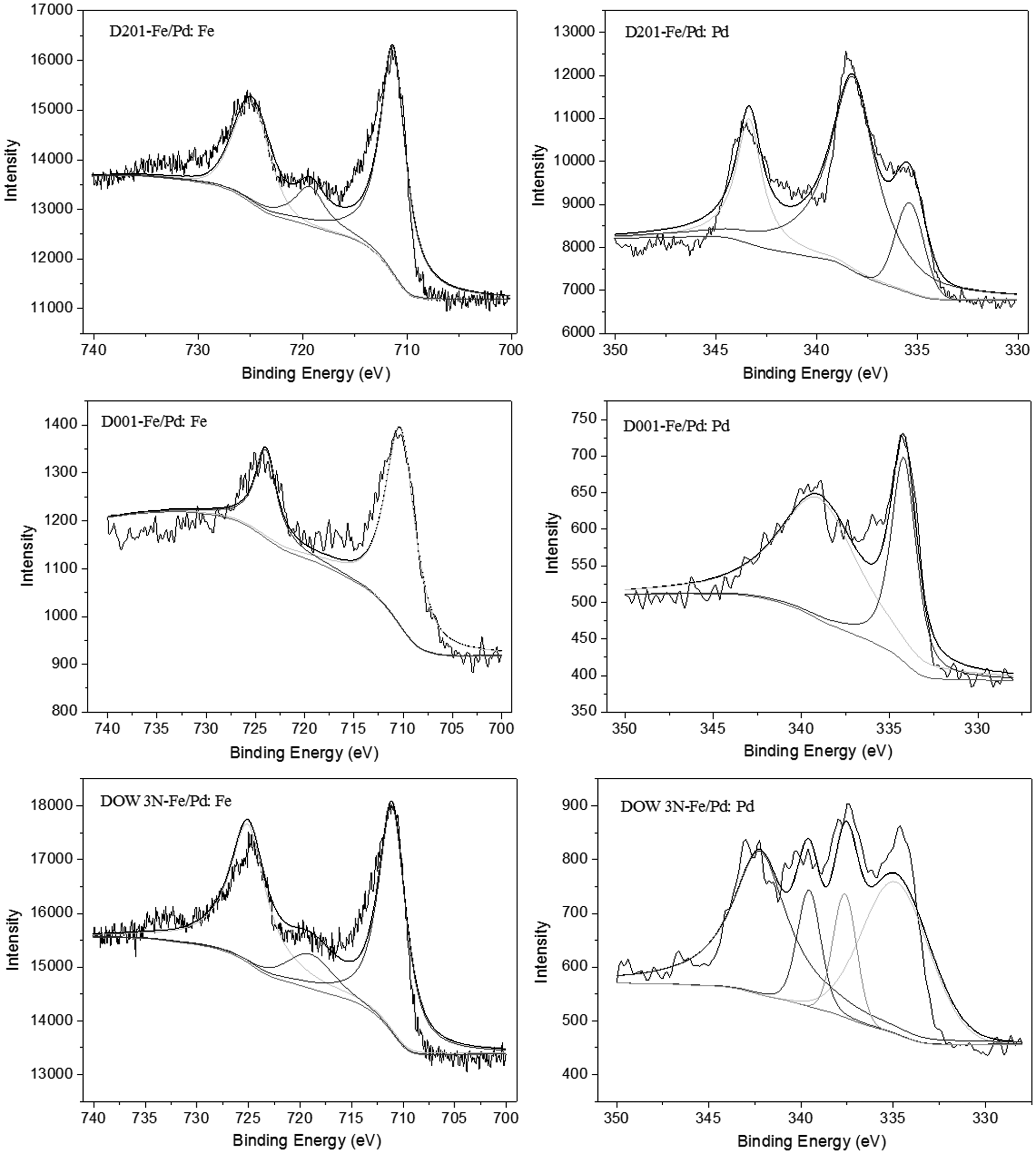
X-ray photoelectron spectroscopy wide scan of D201-Fe/Pd, D001-Fe/Pd, and DOW 3N-Fe/Pd.
Nitrate reduction by supported Fe–Pd nanoparticle composites
Nitrate removal by the three host resins was also tested, the results of which are given in Supplementary Fig. S2. No reduction products (ammonium, nitrite, etc.) were detected during the removal by all polymeric resins, indicating no direct contribution from the host polymeric resins to nitrate reduction by the supported Fe/Pd composites. As can be seen from Supplementary Fig. S2, the D001 resin showed poor adsorption capacity for nitrate. This phenomenon mainly resulted from the negatively charged sulfonic acid groups on the surface of the D001 resin that prevented nitrate from permeating into D001 owing to the Donnan exclusion effect (Sarkar et al., 2010). On the contrary, the D201 resin had almost 100% nitrate removal efficiency. This was mainly because D201 has positively charged quaternary ammonium functional groups that act as an impermeable interface for nitrate. The removal efficiency of nitrate by DOW 3N was 14.7%. This was mainly because the pyridyl groups on DOW 3N were protonated in water and had a positive charge that led to weak electrostatic interaction with nitrate.
Nitrate removal by Fe/Pd nanoparticles supported on the host polymeric resins under the same experimental conditions is given in Fig. 5. The removal efficiencies and the selectivities of the three composites are summarized in Table 2. The lowest nitrate removal efficiency (21.0%) was obtained with D001-Fe/Pd, and the end reduction product of nitrate with this composite was ammonia. This low nitrate removal efficiency may be because of the negative zeta potential values for D001-Fe/Pd (Supplementary Fig. S1). Moreover, we know that almost no nitrate was removed by D001 owing to the electrostatic repulsion between nitrate and the negatively charged sulfonic acid groups on the surface of D001 (Supplementary Fig. S2). Nitrate removal through D001-Fe/Pd may result from chemical reduction of Fe/Pd nanoparticles supported on the external surface of D001. This deduction was further supported by the higher nitrate removal efficiency (50.5%) with Fe–Pd bimetallic nanoparticles supported on powdered D001 (Supplementary Fig. S3). The larger external surface area of powdered D001 increased the potential for contact between nitrate and Fe/Pd nanoparticles, resulting in higher nitrate removal efficiency. These results demonstrate that porous materials with fixed, negatively charged functional groups on the surface are not appropriate as a support to immobilize the Fe/Pd nanoparticles for the reduction of anions, because negatively charged functional groups prevent nitrate from permeating into the support owing to the Donnan exclusion effect (Sarkar et al., 2010). We also concluded that the support grain size can affect the activity of Fe/Pd nanoparticles. A small support grain size can provide a large superficial area that offers more contact potential between nitrate and Fe/Pd nanoparticles, resulting in a high reaction rate.
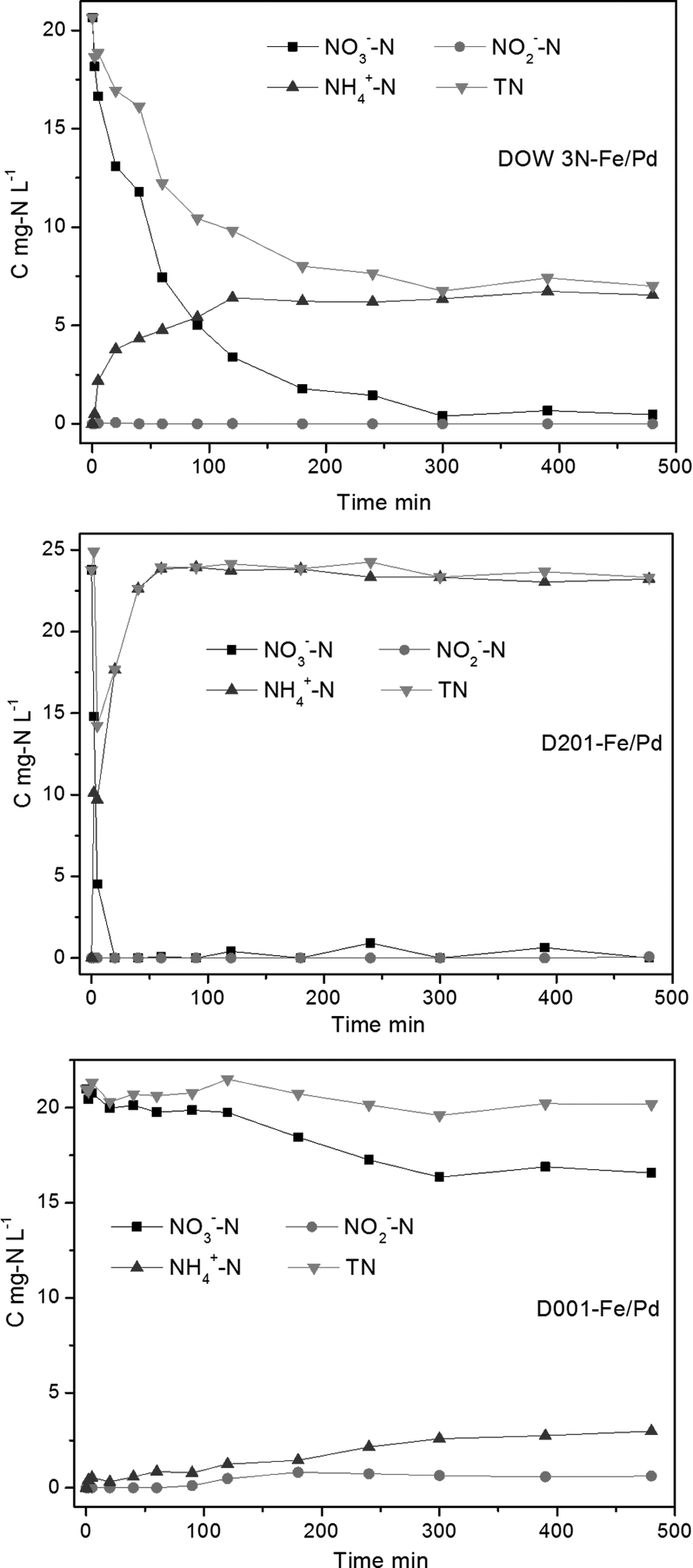
Removal of nitrate by Fe–Pd bimetallic nanoparticle supported on various resins (
Rnitrate, removal efficiency of nitrate; Cnitrate, conversation of nitrate; SN2, selectivity of nitrogen gas; Anitrate and Anitrite, the adsorption of
Compared with D001-Fe/Pd, the other two composites (D201-Fe/Pd and DOW 3N-Fe/Pd) exhibited higher removal efficiencies of nitrate, with 100% and 97.8%, respectively. The reason for this is that polymeric resins containing nondiffusible negatively (DOW 3N) or anion-exchange resin with positively charged groups (D201) permit the anion nitrate to permeate into the interior of the polymer phase. Therefore, without the Donnan exclusion effect,
DOW 3N-Fe/Pd displayed high nitrate removal efficiency and N2 selectivity, with kobs of 0.0156/min. The only detectable stable product was ammonium (
To further study the mechanism of nitrate reduction by bimetallic Fe/Pd composites, supported Fe nanoparticles and supported Pd nanoparticles were also investigated. As shown in Supplementary Fig. S4, D201-Fe and DOW 3N-Fe exhibited much higher removal efficiency of nitrate (100%) than D001-Fe did (only 15.2%), which is in accordance with the results for the bimetallic Fe/Pd composites (the loading of Fe content was identical to that of Fe content for the bimetallic Fe/Pd nanoparticles). For the three supported Fe nanoparticle composites, the main reduction product was ammonia, and the selectivity of N2 was almost zero. The supported Pd nanoparticle composites also were used for nitrate reduction. However, no reduction products were detected, indicating that the monometallic Pd exhibited no activity for nitrate reduction (data not given), which was also confirmed in a previous study (Prüsse and Vorlop, 2001). Compared with the supported monometallic Fe or Pd nanoparticles, bimetallic Fe/Pd nanoparticles showed better nitrate reduction performance. The mechanism of nitrate reduction by bimetallic Fe/Pd nanoparticle composites was possibly through two steps. (1) Nitrate was absorbed on the surface of Fe0 and reduced to nitrite by Fe0, as shown in Equation (3). (2) Nitrite was transformed to ammonium or N2 by Fe0 or adsorbed H (Hads) on the Pd surface (Equations 4–7). In this step, the mechanism was different with the various supports, which is discussed in detail hereunder:
Role of supports on N2 selectivity of nitrate reduction
As given in Table 2 and Supplementary Fig. S5, the N2 selectivity with DOW 3N-Fe/Pd was the highest of the three Fe/Pd composites, with no reliable N2 selectivity obtained using D001-Fe/Pd and D201-Fe/Pd. Almost all nitrate was reduced to ammonia by D201-Fe/Pd, whereas 69.2% N2 selectivity was obtained with DOW 3N-Fe/Pd. The EDS and TEM results in Figs. 2 and 3 show that the distribution and size of Fe/Pd nanoparticles on the surface of the three host polymeric resins were generally the same. Therefore, the surface chemistry of the host resin of supported Fe/Pd composites may play an important role in the selective reduction of nitrate.
The selective reduction pathway of nitrate by bimetallic Fe/Pd nanoparticle composites involves stepwise reductions. First, nitrate was reduced to nitrite by zero-valent Fe on the support surface. Then, nitrite was desorbed from the Fe surface and reabsorbed at the Pd surface for subsequent reduction. H was adsorbed at the reactive sites on the Pd surface and became Pd-Hads. The Hads on the Pd surface helped in the abstraction of oxygen from nitrite and the subsequent N atom may bond with the H atoms adsorbed on the Pd surface, leading to the formation of
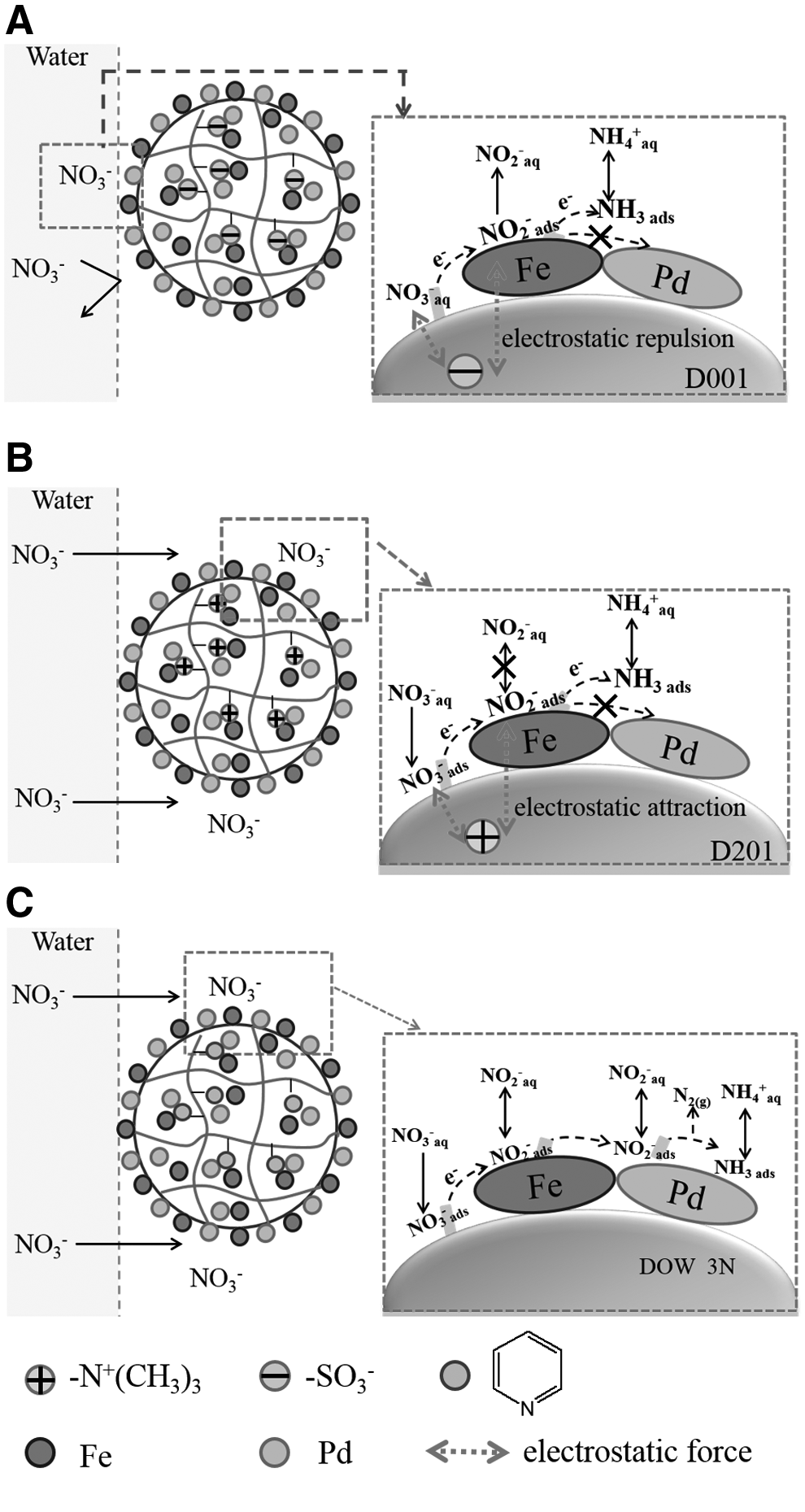
Diagrammatic of nitrate reduction with the Fe/Pd nanoparticle supported on
Reusability and stability of DOW 3N-Fe/Pd in nitrate reduction
To evaluate the potential for commercial application of nitrate reduction by DOW 3N-Fe/Pd, we explored the reusability and stability of DOW 3N-Fe/Pd in nitrate reduction. As given in Fig. 7, five successive reaction cycles were conducted. The nitrate reduction efficiency gradually decreased with the increase in reaction cycle number. The decrease in nitrate reduction efficiency was mainly because of the oxidation of Fe/Pd nanoparticles and saturation of active sites on the composite surface, considering almost no leaching of Fe/Pd nanoparticles into solution. The nitrate reduction efficiency remains unchanged in reaction cycles 4 and 5. We did not detect nitrite, and the concentration of ammonium was ∼1.5 mg/L in solution in reaction cycles 4 and 5. Hence, the removal of nitrate was mainly because of the adsorption by the DOW 3N-Fe/Pd composite. Moreover, no dissolved Fe and Pd ions were present in the solution during the five consecutive cycles owing to the chelation by bis(2-pyridylmethyl)amine functional groups on DOW 3N. Therefore, we concluded that DOW 3N-Fe/Pd showed good stability and has potential for practical application for removing nitrate from contaminated water without the risk of secondary pollution as a result of leakage of metal ions.
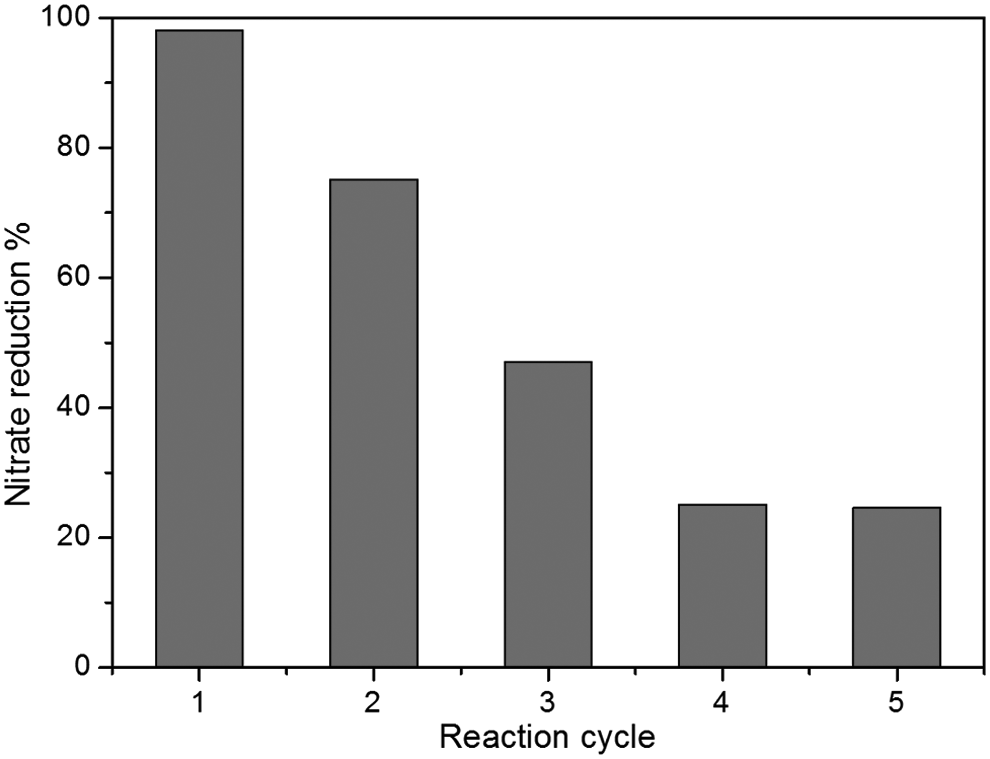
Five cycles of nitrate reduction by DOW 3N-Fe/Pd (
Conclusions
This work compares three resin materials (DOW 3N, D201, and D001) as bimetallic Fe/Pd nanoparticle supports in the reduction of nitrate in water. The results obtained showed that the surface chemistry of the supports had an important role in the activity and selectivity of bimetallic Fe/Pd nanoparticles.
The lowest nitrate removal efficiency (21.0%) was obtained with D001-Fe/Pd. Compared with D001-Fe/Pd, the other two composites, D201-Fe/Pd and DOW 3N-Fe/Pd, exhibited high removal efficiency of nitrate, with 100% and 97.8%, respectively. The low nitrate removal efficiency with D001-Fe/Pd was mainly because of the electrostatic repulsion between nitrate and negatively charged sulfonic acid groups on the surface of D001. Hence, the support with fixed, negatively charged groups was not suitable for the reduction of anion contamination.
Bimetallic Fe/Pd nanoparticles supported on the chelating resin DOW 3N showed high N2 selectivity, that is, 69.2%. However, almost all reduction products with D001-Fe/Pd and D201-Fe/Pd were ammonia. This was mainly because the electrostatic force between nitrate and the D001/D201 supports inhibited the transfer of nitrite from Fe to Pd, resulting in very low N2 selectivity. However, with chelating resin supports, nitrite can transfer from Fe to Pd freely, and then be reduced by Hads on the surface of Pd to N2. Therefore, chelating resins, which have no strong electrostatic force between the resin and nitrate, are suitable as supports for bimetallic nanoparticles to selectively reduce nitrate.
Footnotes
Acknowledgments
This research was financially funded by the Education Department of the Henan Science and Technology Fund Project (No. 16A610009), the State Key Laboratory of Pollution Control and Resource Reuse Foundation (No. PCRRF 17034), the State Key Program of National Natural Science of China (Nos. 51438008 and 51604099).
Author Disclosure Statement
No competing financial interests exist.
References
Supplementary Material
Please find the following supplemental material available below.
For Open Access articles published under a Creative Commons License, all supplemental material carries the same license as the article it is associated with.
For non-Open Access articles published, all supplemental material carries a non-exclusive license, and permission requests for re-use of supplemental material or any part of supplemental material shall be sent directly to the copyright owner as specified in the copyright notice associated with the article.
