




Abstract
Abstract
Gliclazide is a pharmaceutical product used in the treatment of type 2 diabetes. However, this drug is considered to be highly undesirable when present in the environment. We tested in vitro the biodegradation of gliclazide as the sole source of carbon and energy by a microbial consortium. After a 5-month adaptation period in batch culture, two bacterial strains were isolated and identified, namely, Aeromonas hydrophila and Serratia odorifera. With an initial concentration of gliclazide at 0.5 g/L, these two bacteria and their combined culture degraded gliclazide with a specific activity of 22.3, 24.1, and 19.2 ng/(mg·h) and a yield of 88.88%, 82.94%, and 95.88%, respectively. Experimental results reveal a removal efficiency of 98.904% at an inlet concentration of 5 g/L and a flow rate of 14 L/h. The maximum removal efficiency of the biotrickling filter was 99.6%, at a gliclazide inlet concentration of 0.5, 1, and 5 g/L and a flow rate of 6.3 L/h. Interestingly, it was observed that after a period of 12 months, the two dominant strains differed from those present in the initial inocula. Thus, the high elimination efficiencies obtained in this study reveal the interest of the use, for the first time, of a biotrickling filter for the study of the biodegradation of gliclazide. Obtaining a microbial consortium strongly adapted to this substrate may prove to be an interesting alternative for a possible application in the treatment, before discharge, of wastewater containing this molecule or other related molecules, especially in the pharmaceutical industry.
Introduction
For a long time, human and animal pharmaceuticals have been used to prevent and cure diseases. Pharmaceuticals are useful in improving the patient health and well-being (Hughes et al., 2017; Hale et al., 2018). However, significant amounts of used pharmaceuticals are excreted in unchanged or partially metabolized forms reaching the environment through wastewater treatment plants that includes water, soil, and sediments (Archana et al., 2017; Vidal et al., 2018). The most prevalent environmental contamination comes from the use of diabetic medications that include glibenclamide, metformin, alpha-glucosidase, and gliclazide, to name some of them (Mrozik and Stefańska, 2014). Indeed, with the millions of diabetic patients around the world, there are significant quantities of antidiabetic molecules being used to control the disease (Goswami et al., 2014), with certain levels of these molecules being released into the environment. A second major source of pollutant is the disposal of unused medicine from human and animal medical care by pharmaceutical manufacturing plants and hospitals directly into the environment (Heberer, 2002; Esplugas et al., 2007; Trovó et al., 2008).
Presence of pharmaceutical products in the environment has become a growing concern in recent years (Ratola et al., 2012). Pharmaceutical products are known to have potentially harmful effects on both the environment and public health (carcinogenic, mutagenic, and endocrine disruptor) (Heberer, 2002; Kolpin et al., 2002).
Multiple initiatives have been developed to resolve the problem of pharmaceutical pollution. Different removal processes such as biodegradation and physicochemical (activated carbon adsorption, membrane filtration, chemical oxidation, and advanced oxidation processes) trapping were reported (Salgado et al., 2012). Physicochemical methods are costly and also often produce undesirable products that are toxic, thus requiring further treatment actions (Sridevi et al., 2011). Biodegradation has been shown to be the predominant method by which pharmaceuticals are removed from the environment, representing an interesting alternative to rehabilitee the polluted site (Quintana et al., 2005; Salgado et al., 2012). Biodegradation techniques are based on the microorganism's capacities to degrade pollutant compounds (Cheriaa et al., 2012; Panchenko et al., 2017). The presence of microorganisms that may be involved in pollutant degradations was reported on the soil surface and subsurface (Cheriaa et al., 2012; Panchenko et al., 2017). This suggests that subsurface microbial communities can degrade a broad range of naturally occurring and xenobiotic compounds under a broad range of environmental conditions (Liebensteiner et al., 2014; Markiewicz et al., 2017a).
The biodegradation of pharmaceutical compounds requires adequate microorganisms as well as favorable physicochemical conditions such as pH, temperature, and oxygen concentration. The acclimation of the microorganisms is, therefore, an essential step for effective biodegradation to occur. Acclimation is defined as any response that ultimately leads the microbial community to overcome stressful condition and maintain its functionality (Rittmann and McCarty, 2001). A variety of phenomena have been proposed to explain the acclimation phase, two of which are particularly important: the selection and growth of specialized microorganisms and the production of regulatory enzymes (Wiggings et al., 1987; Rittmann and McCarty, 2001).
The pharmaceutical product of interest selected for this study was gliclazide, a second-generation sulfonylurea whose primary mode of action is to stimulate insulin secretion (Smith, 1990; Campbell et al., 1991). This drug was detected at a concentration of up to 130 ng/L in the influent of a sewage treatment plant and up to 15 ng/L in surface water (Al-Qaim et al., 2016).
The goals of this study were to evaluate the biodegradation of gliclazide present in medium as the sole source of carbon and energy. Specifically, we focused on the selection and isolation of specific microorganisms capable of degrading gliclazide in batch cultures. Furthermore, we investigated the removal of gliclazide with a previously isolated mixed culture through biotrickling filtration using lava stones as the packing material. The activity of the mixed culture over time was also studied.
Materials and Methods
Microorganisms and growth conditions
Two different ecosystems were targeted to isolate a diversified microbial biomass intended for gliclazide biodegradation. The first sample was collected from basins for the biological treatment of wastewater, whereas the second sample was collected from agricultural soil.
To select the desired microbial consortia (in batch), 50 mL of sludge and 10 g of soil were inoculated into 250-mL Erlenmeyer flasks containing 100 mL of basal salt mineral medium (BSM) and 0.1 g/L of gliclazide. The flasks were then incubated at 30°C under shaking (200 rpm). After 1 week of incubation, the cultures were centrifuged for 20 min at 2795 g, with the obtained pellets washed with phosphate buffer (pH 7). The collected biomass was used as the inoculum for the next fermentation. The BSM constituents were 10 g of (NH4)2SO4, 1.75 g of KH2PO4, 4 mg of K2HPO4, 0.5 g of MgSO4-7H2O, 1.15 g of CaCl2, 1 g of NaCl, 5 mg of FeCl3, 1 mg of MnCl2-H2O, 1 mg of CuSO4, 1 mg of Na2MoO4, and 1 mg of ZnCl2 (El Aalam et al., 1993).
Gliclazide, kindly provided by the Saidal Pharmaceutical Company (Annaba, Algeria), is an oral hypoglycemic agent used in the treatment of type 2 diabetes (Nirupama et al., 2014). Gliclazide is chemically known as 1-(hexahydrocyclopenta [c] pyrrol-2(1H-yl)-3-[(4-methylphenyl)sulfonyl] urea (Rao and Nikalje, 2011). The brute formula is C15H21N3O3S.
Isolation of microorganisms
Samples of the acclimated culture were spread on BSM agar plates containing 0.1 g/L of gliclazide as the sole carbon source. The predominant colony types were chosen for later taxonomic characterization. Isolates were streaked repeatedly on Mueller–Hinton agar plates to ensure purity. Characterization of the stains was based on conventional API 20E and API 20NE tests (Biomérieux).
Gliclazide biodegradation in batch culture
The gliclazide removal kinetics of the isolated mixed culture was performed by batch culture. Experiments were carried out at 30°C, 250 rpm, in 250-mL Erlenmeyer flasks containing 100 mL of BSM and 0.5 g/L of gliclazide and sealed with rubber stoppers. Fermentation was monitored by determining the dry weight. Specific activities were evaluated after measuring gliclazide concentration and dry weight. The results represented the means of triplicate cultures.
Gliclazide biodegradation in continuous culture
Biotrickling filtration
To study the biodegradation of gliclazide under continuous culture, the experimental setup consisted of a biotrickling filter constructed from a 45 cm high glass column (inner diameter 8.5 cm, inner surface 56.75 cm2) filled to a height of 30 cm, with 1.55 kg of lava stones (mean diameter of 9 mm with a bulk density of 660 g/L) as the packing material (Fig. 1). The recirculation of the aqueous phase, composed of 0.3 L of a biomass in suspension at 0.15 g/L of cells (dry weight basis) and 0.7 L of BSM medium, was controlled by a peristaltic pump (MasterFlex; Cole-Parmer). The liquid recirculation flow was 3.24 L/h. The inlet concentration of gliclazide was 0.5 g/L. Compressed air was distributed through the bed by means of a compressor and controlled by Flowmeter (AALBORG). The air flow rate was 20 L/min. The temperature of the reactor was maintained at 30°C. Samples for analysis were taken in the liquid reservoir below the aerobic biotrickling filter, which was operated continuously for a total of 12 months.
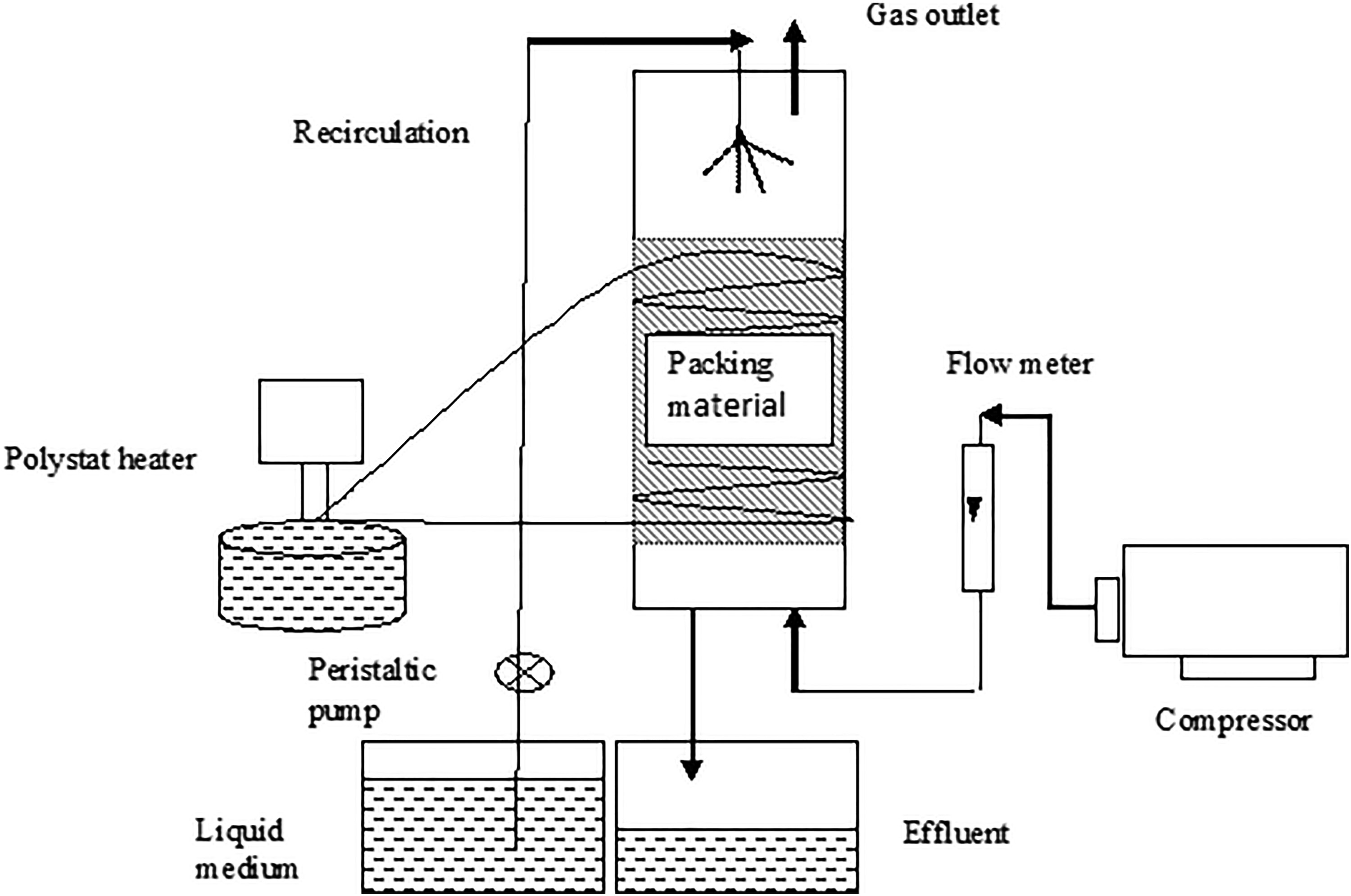
Experimental setup of biotrickling filter.
Activity tests
Gliclazide removal kinetics of the mixed culture was recorded in a continuous culture of 0.7 L of BSM with 0.3 L of a biomass, at 30°C. The flasks were sealed with rubber stoppers. After starting up the reactor, gliclazide was introduced at flow rates ranging from 3.24 to 14 L/h. The inlet concentration of gliclazide ranged from 0.5 to 5 g/L. The air flow rate was fixed at 20 L/min. The gliclazide concentration was measured and the removal yield was calculated during 120 days of operation. The results represented the means of triplicate cultures.
Biofilm isolation and characterization
Some lava stones were removed from the biotrickling filter and placed into 250-mL Erlenmeyer flasks containing 100 mL of sterilized BSM. The Erlenmeyer flasks were subsequently vortexed for 20 min to release the adsorbed cells. The biomass suspension was then streaked on BSM agar plates containing 0.1 g/L of gliclazide as the sole carbon source. Characterization of the stains from the biotrickling filter was based on conventional API 20NE tests (Biomérieux).
Analytical methods
Gliclazide concentration was measured by high-performance liquid chromatography (e 2695; Waters) using an RP-Select B C18 (250 × 4.6 mm; 5 μm) column (Waters), with the ultraviolet detection at 261 nm. The column temperature was maintained at 30°C. The mobile phase was composed of a mixture of phosphate buffer, pH 6.6, and acetonitrile (60:40 v/v), at a flow rate of 1 mL/min. The sample injection volume was 100 μL (Sasi Kiran Goud et al., 2012).
Cell hydrophobicity was determined using the bacterial adherence to hydrocarbons (BATH) technique (Rosenberg, 1984). In brief, the cells were washed and resuspended in phosphate buffer to a final optical density (OD) of 0.2 at λ = 600 nm. A mixture containing 2.5 mL of suspension and 0.2 mL of xylene was then vortexed for 1 min. After phase separation, the OD of the aqueous phase was measured, with the results expressed as the percentage of cells, which partitioned into the organic phase by comparing the initial and final ODs.
To determine the dry weight, 5 mL of the culture was centrifuged for 20 min at 5,000 rpm. The obtained pellet was then washed twice with 5 mL distilled water and placed in weighed cups. After drying at 110°C for 24 h, the cups were weighed again, and the net weight of the dried biomass was calculated.
Results and Discussion
Isolate isolation and characterization
After a 5-month acclimation period, when the microorganisms had reached the maximal level of adaptation, samples were spread on BSM agar plates containing gliclazide for the isolation of strains. Mixed culture growing on gliclazide showed the presence of two bacterial strains: Aeromonas hydrophila and Serratia odorifera. In these tests, a suspension of the isolated strains was deposited in wells containing various carbon compounds. A combination of positive and negative growth or activity provided a good to excellent indication of strain identity.
Cell hydrophobicity
Cell hydrophobicity measurements showed that the bacterial biomass exhibited an adherence of ∼35% to the apolar solvent used. Similar observations were reported in hydrocarbon biodegradation with bacteria and yeasts (Ascon-Cabrera and Lebeault, 1993, 1995; Gauthier et al., 2003).
Gliclazide biodegradation in batch culture
Gliclazide degradation by each isolated strain and their mixed bacterial consortium was assessed with initial gliclazide concentrations of 0.5 g/L. A gradual disappearance of the xenobiotic in the culture medium as well as an increase in the biomass was observed (Figs. 2–4). The maximum growth estimated by dry weight was attained after 120 h. The maximum degradation of gliclazide appears to have occurred during the first 120 h. All of the bacterial strains were able to grow on gliclazide as the sole source of carbon and energy.
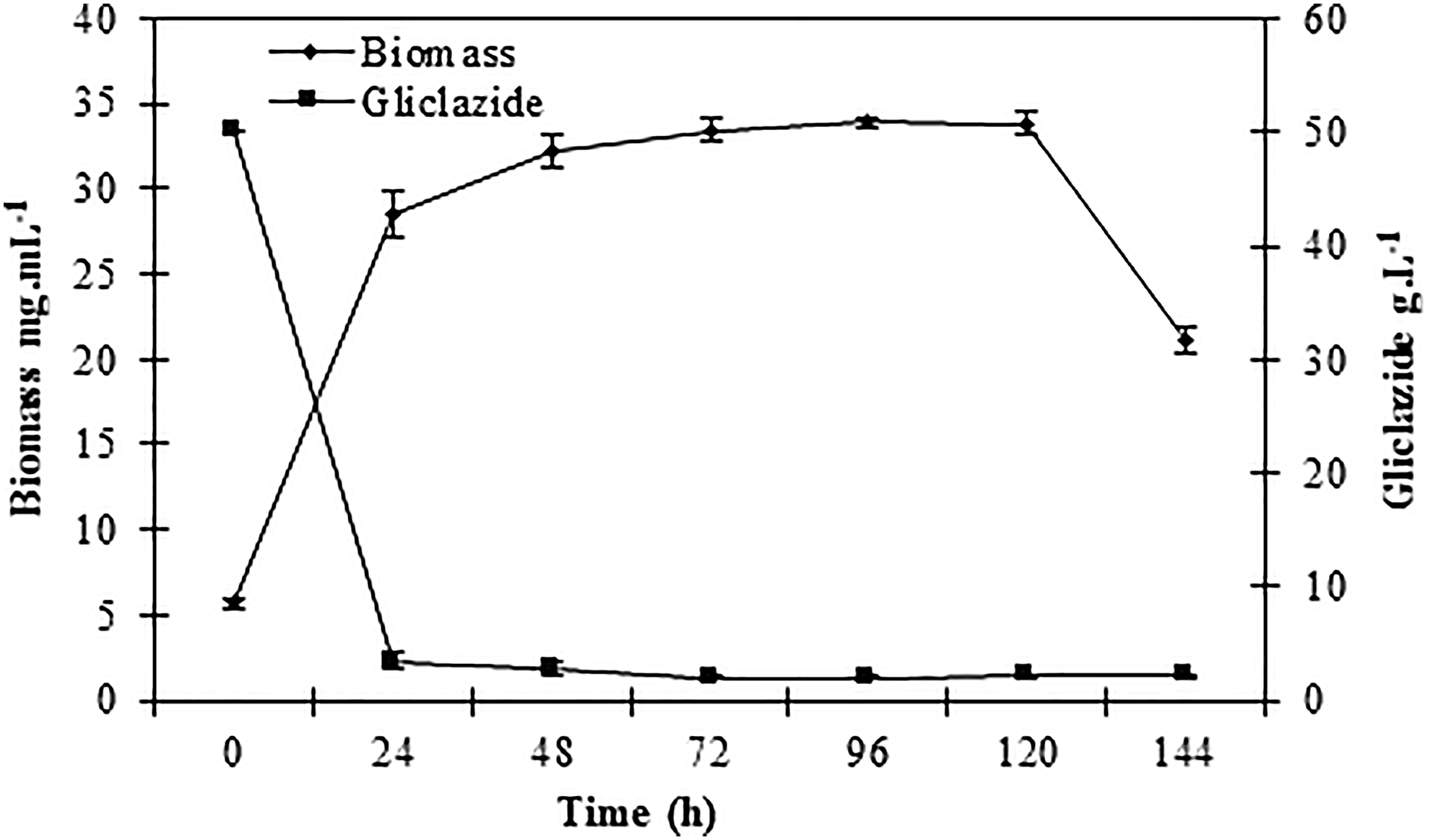
Gliclazide biodegradation by mixed consortium, on 0.5 g/L of gliclazide at 30°C and 250 rpm. The results are averages of triplicate cultures.

Gliclazide biodegradation by Aeromonas hydrophila, on 0.5 g/L of gliclazide at 30°C and 250 rpm. The results are averages of triplicate cultures.

Gliclazide biodegradation by Serratia odorifera, on 0.5 g/L of gliclazide at 30°C and 250 rpm. The results are averages of triplicate cultures.
The specific biodegradation activity of each isolated strain and their mixed consortium was determined during the exponential growth phase. The results are summarized in Table 1. Obvious differences were observed between all of the bacterial strains. In fact, S. odorifera exhibited the highest and most comparable rate of gliclazide degradation, estimated at 24.1 ng/(mg·h).
Specific Activity of Mixed Culture and the Isolates Grown on Gliclazide in Batch Culture Experiments
Determination of the yield indicated that 95.88% of the initial gliclazide was degraded by the mixed culture and ∼85% by the individual strains (Table 2). Our results can be compared with those of Mrozik and Stefańska (2014) who used a bacterial consortium for gliclazide degradation. These authors established that the average degradation of gliclazide was ∼85% under conditions different to those used in our study. However, these results contradict those of Reis et al. (2014), who demonstrated that gliclazide degradation by Achromobacter denitrificans led to a low degradation estimated at 19%, as well as those of Mrozik and Stefańska (2014), who observed that the yield could reach 30% under anaerobic conditions. In their study on gliclazide biodegradation by a mixed culture taken from an activated sludge, Markiewicz et al. (2017b) also obtained a degradation yield that was much lower (estimated at only 3%) than that reported in this study (Table 1).
Characteristics of Biotrickling Filter
Furthermore, the consortium performed much better than each individual strain did on gliclazide degradation. Indeed, as expected, the coculture degraded significantly more gliclazide than did the pure strains. These data suggest that a combination of two microbial strains or more recovered from the same culture was better for gliclazide biodegradation. Mixed cultures are in fact generally considered to be more efficient to biodegrade refractory compounds (Kim et al., 2009; Ha et al., 2016). Zhang et al. (2013) reported that paracetamol degradation was significantly higher with the use of a group of strains rather than individual strains.
Gliclazide biodegradation in continuous culture
Biodegradation of gliclazide by an acclimated consortium in continuous culture was investigated using biotrickling filtration. During the start-up of the experiments, the reactor operated at a low gliclazide concentration of ∼0.5 g/L and a flow rate of 3.24 L/h to allow for the fixation of the biomass onto the lava stones. After 2 months of operation, no cells were detected in the recirculation loop, whereas an abundance of biomass had adhered onto the surface of lava stones. In addition, the dry weight of the immobilized biomass was 45 g. The biofilm was thus successfully developed during the start-up period.
After the development of biofilm, the gliclazide concentration was gradually increased from 0.5 to 5 g/L, along with an increase in flow rate from 3.24 to 14 L/h. Table 2 presents the characteristics and performance of the reactor during 120 days of operation. A stable behavior of the biotrickling filter was observed. In addition, the removal efficiency of the gliclazide was all >96%. A gliclazide inlet concentration was maintained near 0.5 g/L, and flow rates of 3.24, 4.42, 6.3, 9.03, 11.66, and 14 L/h were used. The removal efficiency increased with an increase in flow rate to reach a maximum value of 99.6% at a flow rate of 6.3 L/h after 23 days of biofilter operation. Beyond this flow rate, the efficient removal of gliclazide gradually decreased to 96.66% at a flow rate of 14 L/h. The maximum gliclazide elimination capacity of the biotrickling filter at 4.003 g/(L·h) was observed at a flow rate of 14 L/h. The results indicate that the gliclazide removal efficiency by biotrickling filtration was mainly affected by flow rate variation. Indeed, Chou and Wang (2007) observed that the biotrickling filter performance was affected by flow rate variations during the biodegradation of ammonia.
A gliclazide inlet concentration was maintained at ∼1 g/L, with flow rates of 3.24, 4.42, and 6.3 L/h. The gliclazide removal efficiency of the biotrickling filter reached a maximum of 99.6% equivalent to an elimination capacity of ∼3.71 g/(L·h) at a flow rate of 6.3 L/h. However, at a lower flow rate of 3.24 L/h, a removal efficiency of only 98.55% with an elimination capacity of 1.88 g/(L·h) was obtained.
Finally, during the last 31 days of operation, the inlet concentration of gliclazide was increased to 5 g/L and various flow rates of 6.3, 9.03, 11.66, and 14 L/h were tested. The gliclazide removal efficiency attained a maximum of 99.6%, corresponding to an elimination capacity of 18.56 g/(L·h) at a flow rate of 6.3 L/h and a space velocity of 1.15 m/h. Moreover, only 98.904% of gliclazide was removed when the elimination capacity reached a maximum of 40.96 g/(L·h) at a flow rate of 14 L/h and a residence time of 0.12 h.
The complete elimination of gliclazide immediately after the start-up may be attributed to the presence of an acclimated and active biofilm on a high specific surface area. Furthermore, the variation in gliclazide concentration did not affect the removal efficiency of the biotrickling filter, as high removal efficiency was maintained for each inlet concentration. The gliclazide was thus successfully treated by biotrickling filtration, with a maximum removal efficiency of 99.6%. The observed removal efficiency was much greater than that reported in the literature. Matsuo et al. (2011) reported that >80% of the gliclazide was removed during a full-scale wastewater treatment and that the discharged amounts were low (a few ng/L).
The biodegradation results obtained in this study suggest a potential use of biological processes as a possible alternative in the treatment of effluents loaded with gliclazide from certain pharmaceutical industries. Such biological processes could be optimized for surface and subsurface pollutant decontaminations.
Isolate identification
After running the biotrickling filter for such a long period of time, microorganism components were isolated and identified, showing the presence of two different bacterial strains: A. hydrophila and Pseudomonas aeruginosa. Indeed, the identification results reveal the absence of the S. odorifera bacterium, which was identified during the initial degradation tests performed in batch. It is important to remember that the batch tests were conducted under aseptic conditions, whereas the continuous tests using the biotrickling filter were conducted under nonsterile conditions. This leaves a probable contamination of the device by P. aeruginosa, a bacterium that is both highly contaminating and omnipresent. Thus the disappearance of S. odorifera in favor of P. aeruginosa appears to be a completely normal phenomenon, given the already mentioned culture conditions. Similar observations were reported by Djeribi et al. (2005) regarding the biodegradation of styrene using a biological trickling filter.
Conclusion
After 5 months of selection and acclimation in batch culture, the A. hydrophila and S. odorifera bacteria were isolated and identified from a consortium initially inoculated into the BSM culture medium in the presence of gliclazide as the sole source of carbon and energy. In batch cultures, both A. hydrophila and S. odorifera and their mixed culture degraded gliclazide with a specific activity of 22.3, 24.1, and 19.2 ng/(mg·h) and a yield of 88.88%, 82.94%, and 95.88%, respectively, for an initial gliclazide concentration of 0.5 g/L. A biotrickling filter garnished with lava stones as a packing material contributed to obtaining excellent gliclazide removal efficiency for all of the inlet concentrations tested. With a gliclazide concentration of 5 g/L and a flow rate of 14 L/h, a maximum gliclazide elimination of 40.96 g/(L·h) was achieved, with an average removal efficiency of 98.904%. Furthermore, a maximum removal efficiency of 99.6% was reached under a flow rate of 6.3 L/h and the initial gliclazide concentrations of 0.5, 1, and 5 g/L. This research thus highlights the importance of the involved bacteria in effectively removing gliclazide. However, further investigations are warranted to extend our understanding of the link between the composition of a microbial community, the efficiency of the reactor, and the pollutant removal from the adapted system. Moreover, the dynamics of the bacterial population may provide highly useful information to ensure the success of the biotrickling filtration system. Furthermore, such a biotrickling filtration system could be efficient in decontaminating identified soil surface and subsurface.
Footnotes
Acknowledgment
The authors thank Mohamed Rochdi Sbartai, Director of the Pharmaceutical Unit, Saidal, for his help and collaboration in this research.
Author Disclosure Statement
No competing financial interests exist.