




Abstract
Abstract
An activated sludge aeration tank and a sieve-plate column with six sieve plates were utilized to remove gas-borne volatile organic compounds (VOCs) in air streams. The tank was used for the biodegradation of absorbed VOCs from the column that utilized the activated mixed liquor drawn from the tank as scrubbing liquor. This research proposed a model for VOC absorption to a down-flow activated sludge liquor in a sieve-plate column. Experiments were conducted and the model was verified based on results of tests on removal efficiencies of isopropyl alcohol, toluene, and p-xylene in the system operated at a range of influent VOC concentrations, air application rates, and liquid/gas flow ratios (L/G). Analysis of the model for effects of affecting parameters on VOC removal effectiveness indicates that L/G, plate number N, biodegradation rate constant k, Henry's law constant of VOC H are important.
Introduction
Biological treatment of volatile organic compounds (VOCs) or odors in air streams provides an inexpensive alternative to conventional technologies such as catalytic and thermal oxidation, wet scrubbing, ozonation, and activated carbon adsorption (Don and Feenstra, 1984; Ottengraf, 1986; Neal and Loehr, 2000).
Biological treatment methods include biofiltration, biotrickling, and bioscrubbing. Biofiltration needs solid carrier for immobilization of microorganisms and nutrients, VOCs in the introduced gas to the reactor diffuse to the carrier and are then degraded in biofilms attached to the carriers (Ottengraf, 1986; Devinny and Deshusses, 1999; Yang et al., 2010, 2018; Cheng et al., 2016a, 2016b). Biotrickling also needs solid carrier for immobilization of microbial films and an aqueous solution trickles over the films to provide the necessary nutrients and remove the metabolites (Moussavi and Mohseni, 2008; for example: Tu et al., 2015; Leili et al., 2017).
One of the bioscrubbing systems is the activated sludge aeration (ASA). Waste gas stream to be treated is introduced to an ASA tank for wastewater treatment and water-soluble contaminants in the gas stream are dissolved in the activated sludge mixed liquor and biodegraded therein. Bielefeldt and Stensel (1998, 1999) reported that based on a proposed mass-transfer model, the system with an aeration submerged liquid depth of >2.0 m provides >80% removal for biodegradable VOCs with dimensionless Henry's law coefficients (H) of <0.35. VOCs with the Henry's law coefficients include common solvents such as methanol, ethanol, methyl isobutyl ketone, methyl ethyl ketone, acetone, methylene chloride, and BTEX (benzene, toluene, ethyl benzene, and xylenes).
A related study demonstrated that the treatment efficiency for gas-borne BTEX removal in a laboratory-scale activated sludge tank of 40 cm liquid depth was not significantly impacted by different BTEX mixtures, and ∼99% removal was achieved for volumetric loadings of 11–18 g BTXE/(m3 liquid.h) (Bielefeldt and Stensel, 1998; Burgess et al., 2001). Burgess et al. (2001) extensively reviewed this process and pointed out that by using existing activated sludge plants as bioscrubbers, the foul air generated by other process units of the wastewater treatment system could be treated on site, with no requirement for additional units or interruption of the wastewater treatment (Burgess et al., 2001). The process has been shown to remove hydrogen sulfide in biogas from 2,000 to <20 ppm (Neal and Loehr, 2000).
Although the ASA process has been shown to be effective and economical, the ASA process can only be applied to the treatment of foul air streams of low to medium flow rates such as a few to several tens of cubic meter per minute. One of the main reasons may be the limitation of the permissible aeration intensity of <0.5 cubic meter of gas per cubic meter of aeration tank volume per hour, as specified by ASA system design (Metcalf and Eddy, 1991).
Another similar process is the “tower scrubbing-activated sludge oxidation (SAO)” (Overcamp et al., 1993; Croonenberghs et al., 1994; DeHollande et al., 1998; Hammervold et al., 2000). This SAO process generally consisted of a wet scrubber and a biological oxidation unit. The scrubber absorbs gas-borne pollutants into a biomass slurry such as activated sludge liquor from biological wastewater treatment, and the microorganisms in the oxidation unit oxidize the absorbed pollutants for regeneration of the slurry to retain its absorption ability. The biomass slurry is continuously circulated between the two units.
Overcamp et al. (1993) developed an integrated theory to describe the steady-state operation of a suspended-growth bioscrubber for the control of biodegradable, volatile organic gases. The bioscrubber consists of an N-stage absorber and an oxidation reactor. The biomass slurry is circulated between the absorber and the oxidation reactor, and the pollutant is absorbed and partially oxidized in the absorber. Oxidation is completed in the oxidation reactor. Predictions of the theory show that the removal efficiency is a function of Henry's law constant for the pollutant, the ratio of the liquid flow rate to the gas flow rate, and the number of stages. However, the theory has not been experimentally verified.
Croonenberghs et al. (1994) studied the removal of ethanol in a 12.6 Nm3/min vent gas from a brewery wastewater treatment plant by a single-stage packing tower scrubbed with an activated sludge mixed liquor containing a suspended biomass solid concentration of 500 mg/L. An average VOC removal of 85% was observed with an average influent ethanol concentration of ∼70 mg/Nm3 and a liquid to gas flow ratio (L/G) of 0.0075 m3 liquid/(m3 gas).
Hammervold et al. (2000) used a sorptive slurry biological scrubber to study the control of air-borne acetone. The scrubber had an inner diameter of 15 cm and was equipped with three sieve plates with 5-mm diameter holes of 50% opening area. Using scrubbing liquid with mixed liquor suspended sludge (MLSS) concentrations of 1,440–1,590 mg/L, a gas superficial velocity of U = 0.71 m/s, and an L/G of 0.00267 m3/m3, an average acetone removal efficiency of ∼90% was obtained.
In general, like a wet scrubber, a packed or sieve-plate tower can be served as a biological scrubber and a superficial gas velocity of 1.0–1.5 m3/(m2·s) [equivalent to an air mass loading rate of ∼90–1,300 lb/(ft2·h) for air at 25°C] can be used as a design basis for the cross-sectional area of the biological scrubber (Perry et al., 1994). Hence, a scrubber with a cross-sectional area of 1 m2 can be used to treat a foul gas with a flow rate of 60–90 m3/min. The scrubber can thus be used to clean a medium to high flow rate of waste gas if the attached biological oxidation unit has enough capacity to degrade the absorbed pollutants.
As stated previously, the SAO process has the advantage of treating much more gas flow than the ASA with the same activated sludge tank volume. However, there are limited studies focused on the influencing parameters to the VOC removal efficiency of the SAO process.
This research attempted to propose a model for absorbing gas-borne VOCs into a down-flow activated sludge liquor in a sieve-plate column. Experiments were also conducted to verify the model based on the results of tests on the removal efficiencies of water-soluble isopropyl alcohol (IPA) and relatively water-insoluble toluene and p-xylene in a pilot-scale system operated at a range of influent VOC concentrations, air application rates, and L/G ratios. The three VOCs are frequently used in manufacturing paint, printing ink, and synthetic chemicals. Results of this study allow a confirmation of the model and provide a design basis for treating gases contaminated with a range of VOCs.
Model Development
A model was developed in this study to simulate the steady-state performance of a suspended-growth bioscrubber composed of an absorber and a separate oxidation reactor as given in Fig. 1. The biomass slurry is circulated between the absorber and the activated sludge column for oxidation of the absorbed VOCs. The pollutants are both absorbed and partially oxidized in the absorption unit. The extent of pollutant oxidation in the absorber depends on the concentration of biomass, the pollutant degradation rate, and the total hold-up liquid volume in the plates of the absorber. The oxidation reactor allows sufficient liquid residence for the oxidation of the remaining pollutant and sufficient biomass residence time to allow for their growth.

Nomenclature for material balances and gas absorption in a N-stage sieve-plate column.
The mechanistic model developed by Bielefeldt and Stensel (1998, 1999) describes the removal of VOCs from a contaminated gas stream sparged into a completely mixed activated sludge reactor as a function of the gas–liquid mass-transfer rate and liquid VOC concentrations. By referring to Fig. 1, considering the hold-up aerated liquid in the stage n as a reactor, application of the model gives:
In addition, a material balance over plate n for the VOC removal from the gas phase and the VOC transferred to the liquid and biodegraded therein gives:
In Equations (1) and (2), A is the cross-sectional area of the sieve plate available for gas flow (m2), G is the volumetric gas flow rate (m3/h), H′ is the dimensionless apparent Henry's law coefficient, L is the volumetric recirculating liquid flow rate (m3/h), Vn is the hold-up aerated liquid volume in plate n (m3), Z is the hold-up aerated liquid depth (m), KLaVOC is the overall mass-transfer coefficient of the VOC in clean water (1/h), α is a coefficient for correcting KLaVOC to the case in the activated sludge mixed liquor, rn is the volumetric rate of VOC biodegradation (mg/m3 h), y is the gas-phase VOC concentration (mg/m3), x is the liquid-phase VOC concentration (mg/m3), and y* is the gas-phase VOC concentration in equilibrium with the liquid phase with a VOC concentration of x. Equation (2) states that the gas-phase VOC decrease rate G(yn − 1 − yn) in stage n equals the net VOC L(xn − xn + 1) flowing down to the downstream stage n − 1, and the remaining is biodegraded with a rate of rnVn. α is ∼1 for mixed liquors with suspended solids concentration of ∼2,000–3,000 mg/L generally used in activated sludge systems (Bielefeldt and Stensel, 1999).
A correlation model between H′ and H, the Henry's law constant for partitioning of the VOC between gas and clean water has been derived and verified in this laboratory (Lin and Chou, 2006):
where KOC and KSS are the partition coefficients of VOC between the dissolved organic carbons and the suspended solids (solid activated sludge) in the liquid and the aqueous phase, respectively; and Xd and XS are the dissolved organic carbon and the suspended solid concentration in the liquid phase, respectively. According to the model, in general, H′ is a little smaller than the Henry's law constant H for partitioning of the VOC between gas and clean water at the same condition for relatively water-insoluble VOCs such as toluene and xylene, but somewhat higher for water-soluble VOCs such as IPA in this study. It has been shown that H′ for toluene and p-xylene decreases up to 77% and 93%, respectively, in the mixed liquor with activated sludge concentrations of ∼40,000 mg/L. A higher XS thus helps in the absorption of water-insoluble VOCs and upgrades the performance of the column for VOC removal. In general, H′≈H for XS < 3,000 mg/L in an activated sludge mixed liquor. The rn can approximately be related to xn by a first-order kinetics at a fixed activated sludge or microbial concentration:
where k is the rate constant (1/h).
For highly volatile compounds such that gas film resistance to mass transfer is relatively smaller than the liquid transfer, KLaVOC can generally be related to
where DVOC is the diffusion coefficient of the VOC in water (m2/h),
For semivolatile compounds (SVOCs) such that the gas film resistance to the overall mass transfer is evident, the correlation presented in Equation (6) should be corrected as follows (Hsieh, 2000):
where RL and RT are liquid phase and total resistance for VOC transfer, respectively. By the two-film theory,
where kLaVOC and kGaVOC are the individual liquid- and gas-phase mass-transfer coefficient for VOC transfer, respectively (Perry et al., 1994). As an approximation, from penetration or surface-renewal theory:
where DVOC,G is the diffusion coefficient of VOC in air (m2/h). In general, (DVOC/DVOC,G)≈(10−5 cm2/s/10−1 cm2/s) = 10−4, kLaVOC/HkGaVOC≈1/(100H) and RL/RT≈1/(1 + 0.01/H) from Equation (8) (Perry et al., 1994). For VOCs with H > 0.2, RL/RT > 0.95, Equation (6) can be used instead of Equation (7) for estimating KLaVOC from
For a sieve plate with an available cross-sectional area A, a hold-up aerated liquid depth Z, and operated at volumetric gas flow rate G, Vn≈Z × A and G≈A × U, the superficial gas velocity over the cross-section. By substituting Equations (3) and (5), H′ = H, α = 1, Vn = Z × A, and G = U × A into Equations (1) and (2), it can be shown that:
By referring to Fig. 1, with given KLaVOC/U, Z/U, H, L/G, k, influent liquid VOC concentration xN + 1, and specified effluent gas VOC concentration yN, xN, and yN − 1 could be calculated from Equations (10) and (11). The calculated xN and yN − 1 are then again substituted into the two equations to obtain xN − 1 and yN − 2. By repeated substitution of xN and yN − 1 into Equations (10) and (11), effluent liquid VOC concentration x1 and influent gas VOC concentration y0 could finally be obtained. For a column of fixed specifications and influent gas flow rate, if the calculated y0 is smaller than that of the influent gas to be treated, an increase of L/G could give a higher value of calculated y0, as a higher scrubbing liquid for a gas flow increases the VOC absorption capacity of the plate column. For the same case, if the calculated y0 is higher, a smaller L/G should be used.
By Equations (10) and (11), parameters affecting column performance are KLaVOC (Z/U), H, xN + 1, L/G, Z/U, and k. For activated sludge mixed liquor with a higher MLSS, H in Equation (10) should be replaced by H′ to take the effect of MLSS on the VOC solubility into consideration. In addition, k is also affected by the MLSS concentration of the absorbing liquor. According to the model, an increase of any one of KLaVOC (Z/U), L/G, Z/U, and k, or a decrease of H (or H′) or xN + 1 increases the column absorption capacity for the gaseous VOC.
Materials and Methods
Experimental apparatus
The experimental setup consisted of a pilot-scale activated sludge tank and a sieve-plate tower, as given in Fig. 2. The activated sludge tank was constructed from a 40 × 40 × 300 cm (W × L × H) acrylic column and equipped with an air sparger with 20 orifices of 2 mm diameter. The sieve-plate tower was constructed from a 25 × 25 × 162 cm (W × L × H) acrylic column with six custom-made sieve plates. Each plate has 382 holes, 3 mm in diameter arranged on a square pitch. The holes give an open area of 3.82% of the whole plate area for gas flow. Two 25 mm i.d. down-comer pipes were also equipped to allow for the down-flow of the activated sludge liquor. Ports were provided at the column inlet, outlet, and each plate for gas and liquid sampling.
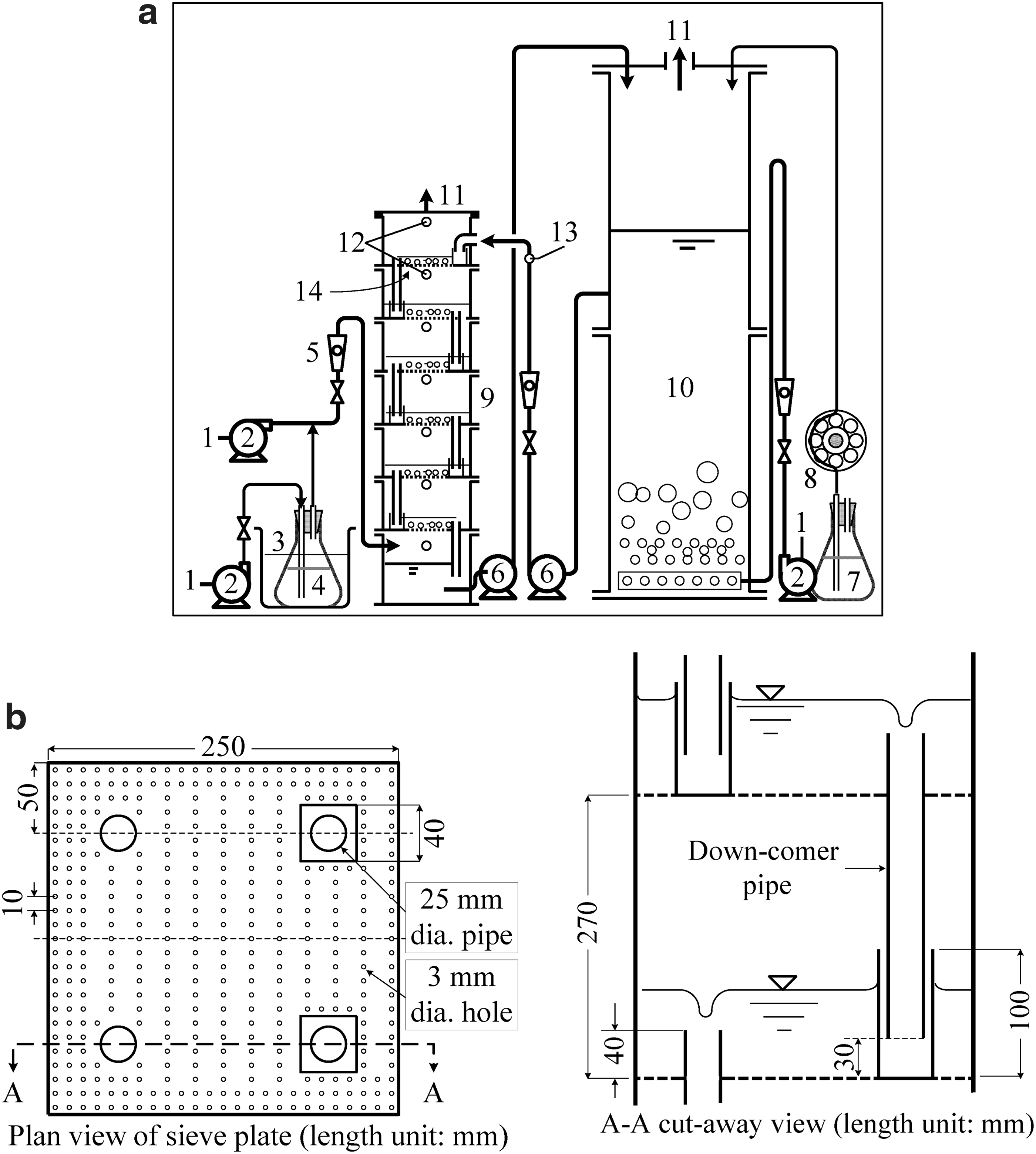
Air drawn by a blower was bubbled through a liquid VOC (of toluene, p-xylene, and IPA) in a water-bathed Erlenmeyer flask to generate a VOC-rich air stream. VOC concentrations in the stream were varied by adjusting the temperature of the water bath or the air flow rate. The VOC-rich air was then mixed with a main air stream, which subsequently flowed into the bottom space of the sieve-plate tower. Air flow rates were measured by the rotameter and regulated by the valve. Constant flow rates of activated sludge liquor for gas scrubbing was provided by the activated sludge tank and pumped into the top plate of the column. An average aerated liquid depth (Z) of 5.0 or 8.5 cm could be kept in each sieve plate by adjusting the weir height of the down-comer pipe. VOC-rich effluent liquor from the column bottom was circulated back to the tank for VOC oxidation.
Materials
Reagent-grade toluene, p-xylene and IPA were used as target VOCs. Activated sludge for seeding and acclimation was taken from the wastewater plant of Ta-Lin Refinery, Chinese Petroleum Co. (Kaohsiung City, Taiwan). The sludge was adopted because it exhibited the potential to oxidize the target VOCs. Table 1 lists the VOC influent rates and the solution composition for the activated sludge nutrition. The nutrient solution was daily prepared and fed continuously into the activated sludge tank. All nutrients and salts were reagent grade.
Nutrition and Volatile Organic Compound Influent Rates to Experimental Activated Sludge Tank
COD equivalents for glucose and the three VOCs are based on the reaction stoichiometries: (1) C6H12O6 (glucose) +6 O2 = 6 CO2 + 6 H2O, (2) C7H8 (toluene) +9 O2 = 7 CO2 + 4 H2O, (3) C8H10 (p-xylene) +10.5 O2 = 8 CO2 + 5 H2O, (4) C3H8O (IPA) +4.5 O2 = 3 CO2 + 4 H2O. The calculated equivalents are 1.07 kg COD/(kg glucose), 3.13 kg COD/(kg toluene), 3.17 kg COD/(kg p-xylene), and 2.4 kg COD/(kg IPA). VOC influent rates are based on the volumetric mass rates (volumetric influent VOC concentration × volumetric gas flow rate × 8 h/day ÷ liquid volume) for 8 h per day and the others (glucose, N, and P) are for 24 h per day during acclimation.
COD, chemical oxygen demand; IPA, isopropyl alcohol; MLSS, mixed liquor suspended sludge; VOC, volatile organic compound.
Operation
Laboratory experiments were performed to measure (1) the clean water
Experimental Conditions
Literature data of Henry's law constants (H) at 25°C in clean water (Eastem Research Group, 1997).
L/G, liquid/gas flow ratio.
The
where DO* is the saturated dissolved oxygen concentration in the liquid at the liquid temperature, and DO0, and DO are, respectively, those values at the beginning of aeration and after an aeration time of t. For simplicity, only
In the acclimation experiment for VOC removal, the activated sludge tank was initially filled with 320 L of the seed sludge with an MLSS concentration of ∼1,940 mg/L and continuously fed with nutrients (Table 1). A constant air flow rate of 10 L/min was maintained for each full acclimation period of 30 days. Glucose was used as a sole carbon source when there was no VOC in the influent air. The carbon nutrition rate was based on an MLSS concentration of 2,000 mg/L and a food-to-microorganism loading of F/M = 0.30 g COD (chemical oxygen demand)/(g MLSS.day). N and P were added according to a mass ratio of COD:N:P = 150:5:1. Daily doses of glucose, N, and P were dissolved in 15 L tap water and fed into the sludge liquor over 24 h. During this phase, for producing more acclimated sludge for VOC degradation, from around 9 a.m. to 5 p.m., the concentrations of influent VOC in the introduced air were in the range of 188–376, 216–433, and 122–245 mg/m3, for toluene, p-xylene, and IPA, respectively. From 5 p.m. to 9 a.m. the next day, there was no VOC in the introduced air. On a daily basis, 50 mL of the mixed liquor was sampled for MLSS determination. Thereafter, the air flow was stopped for 30 min to settle the sludge down and the supernatant was drained to remove half of the total original liquid volume. The removed liquid was replaced with an equal volume of tap water and the flows of air and the nutrient solution were restarted. The rate of liquid replacement gave an equivalent hydraulic retention time of 2 days for the liquid in the activated sludge tank. The operating conditions were pH = 7–8, MLSS = 1,860–2,380 mg/L, and T = 26°C ± 2°C for the activated sludge tank. A period of 30 days has been shown to be enough for acclimation of the sludge to the target VOCs (Chou and Chang, 2005).
After acclimation, experiments were performed to test the performance of the sieve-plate column for adsorption and biodegradation the influent VOC. Experimental conditions are given in Table 2. Influent gas flow rates were controlled in the range of 100–600 L/min (U = 0.0267–0.160 m/s or 96–576 m/h) at an increment of 100 L/min. For each gas flow rate, circulating liquid flow rates were controlled and varied to give L/G values as given in Table 2. For IPA, L/G was in the range of 0.001–0.005 m3/m3; whereas for toluene and p-xylene it was 0.053–0.620 m3/m3. Each condition was kept at least 3 h to let the system getting a quasi-steady state. After that time, a gas sample from each of the influent gas line and the overhead spaces of all the six plates was taken by an 1-mL gas-tight syringe for VOC analysis. In addition, liquid samples were taken from the inlet and outlet of the sieve-plate column and the activated sludge tank to determine the VOC concentration. After liquid sampling, the mixed liquid was immediately filtered through a 4.7-cm diameter glass fiber paper to separate the sludge and the filtrate was put in screw-thread glass vials with Teflon-lined caps and stored at 4°C until analysis.
Analytical methods
VOC concentrations in the gas samples were measured by a gas chromatograph (GC-14B, Serial No. 9663; Shimadzu) with a flame ionization detector. Gas samples with known VOC contents were used for preparation of the calibration curve. The dissolved VOC concentration in the liquid was determined by sealing a 3-mL liquid sample in a 43-mL sample vial, and the vial was then immersed in a water bath at 80°C. As was verified experimentally in another study, a heating time of 10–20 min was required to get a thermal equilibrium between the liquid sample and the water in the bath (Chou and Chang, 2005). A gas sample taken from the tube was then analyzed to determine the VOC concentration. The concentration of the absorbed VOC in the liquid sample could thus be determined. Liquid samples with known VOC contents were used for calibration. Instrument integrity was verified by injecting VOC standards at the beginning and end of each analytical session and comparing the results with the standard calibration curve. The detection limit was 1 mg/m for an injected gas sample of 1 mL. pH of the mixed liquor was measured by a pH meter (Model 761; Knick Co., Italy).
Results and Discussion
Volumetric oxygen- and VOC-transfer coefficients
Figure 3 provides
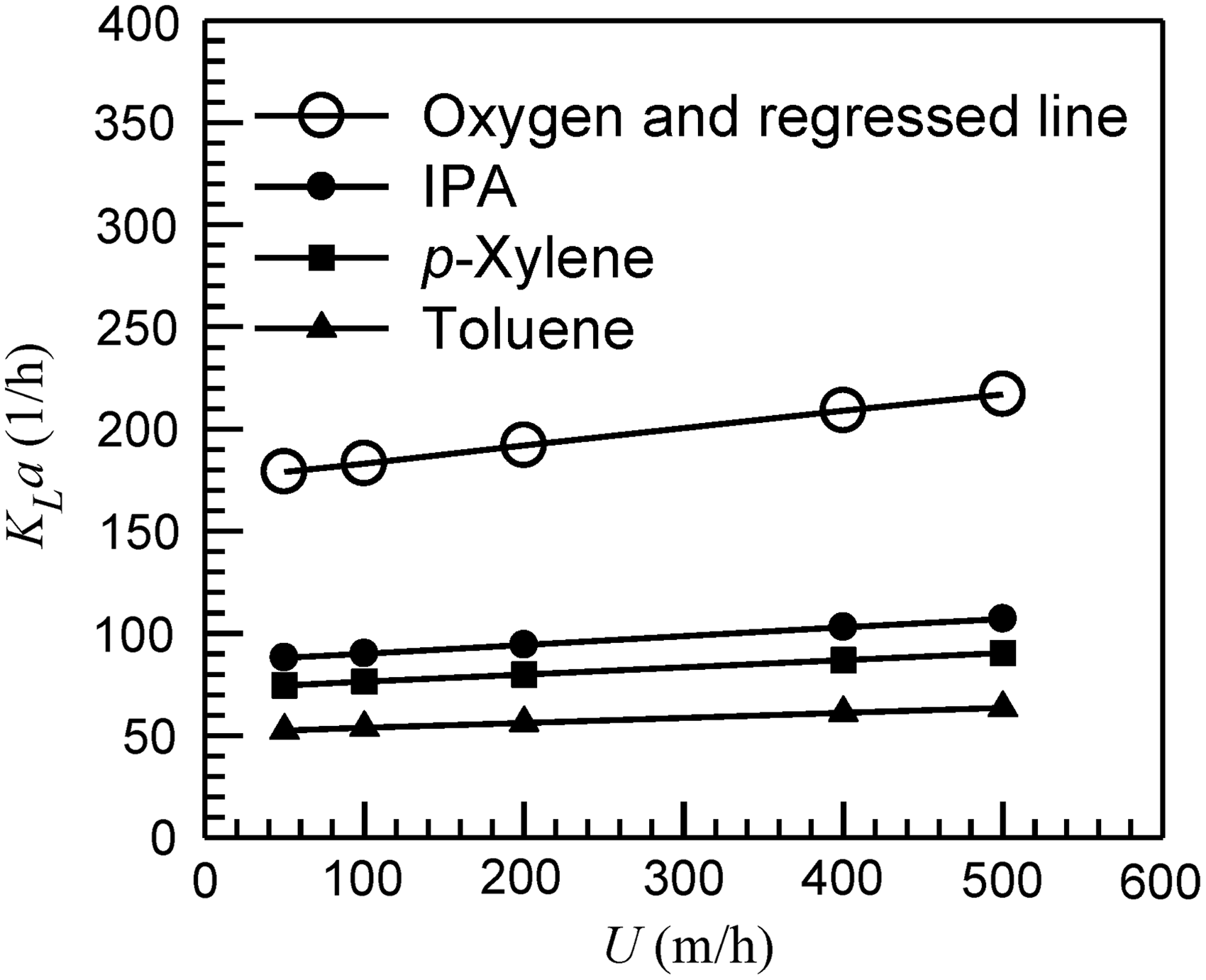
Variation of
H, D and KLaVOC for Test Volatile Organic Compounds
Note 1, D for oxygen obtained from ASCE Standards (1984) and for the VOCs from (Eastem Research Group, 1997); H from (Eastem Research Group, 1997).
KLaVOC calculated from Equation (6)
As given in Fig. 3, KLaVOC increases slightly with increasing U in the range of 50–500 m/h. This phenomenon might arise from the observed fact that many bubbles were formed so quickly and located so closely in the shallow liquid flowing over the plate that they tended to coalesce and the coalescing bubbles did not help in a significant increase of the specific gas–liquid interfacial area for VOC transfer. For design practice, it can reasonably be assumed that the KLaVOC for a specific VOC to be a constant in the operating U of 50–500 m/h. In this study, however, KLaVOC for each operating U was substituted into Equation (10) when verifying the model.
VOC treatment
Data on the variations in the effectiveness of VOC removal at a liquid depth of Z for a fixed U of 48–720 m/h and y0 of 150–450 mg/m3 were obtained for the tested VOCs.
Figure 4 plots variations of toluene removal efficiency with plate number at fixed L/G ratios of 0.053 and 0.107 m3 mixed liquor/(m3·gas) for U = 576 and 288 m/h (influent gas flow rate = 600 and 300 L/min), respectively. Calculated values of the removal efficiency by the model Equations (10) and (11) are also shown in the figure for verification of the model. Table 4 lists the input parameters to the model equations. During the experiments, it was observed that there was only a trace of toluene in the influent to the column and accordingly x7 = 0 was substituted into the model equations to obtain the calculated data. The kinetic constant k value for toluene degradation in the mixed liquor was estimated to be 702 1/h by the method of least squares from the experimental and calculated data.

Variations of toluene removal efficiency with plate number at fixed L/G and Z (symbols: experimental data; lines: calculated from the model). L/G, liquid/gas flow ratio.
Parameters Input to Model Equations (10) and (11)
Figure 4a shows that at ∼25–27°C and an influent gas toluene concentration of y0 = 225 mg/m3, the toluene removal efficiency increased approximately linearly with the increasing plate number n. The higher L/G value of 0.107 (m3 liquid)/(m3 gas) gave a higher toluene removal efficiency than the lower one of 0.053 for the same operating conditions other than L/G. This can easily be understood that more mixed liquor absorbed more toluene from the influent gas although the absorption rate was not linearly proportional to the L/G because the driving force (y − Hx) for mass transfer was not proportional to that. Figure 4b with y0 = 450 mg/m3 shows similar results as Fig. 4a. The limiting removal efficiencies could be attributed to the limited solubility of toluene in the circulating mixed liquor, the low L/G values, and the limited total plate number of the column. Material balance over the whole column if there were no toluene biodegradation in the column liquid gives the following:
The down-flowing circulating mixed liquor is unable to further absorb any VOC if y0 is in equilibrium with x1, that is,
The maximum VOC removal efficiency ηmax of the column in this case with N = 6 and xN + 1 = x7 = 0 is thus:
Figure 4 shows that at an L/G of 0.107, the experimental ηmax was 42% and 48% for y0 = 225 and 450 mg/m3, respectively, and the calculated ηmax according to Equation (15) is 39.2% (L/GH = 0.107/0.273 = 0.392) for both y0. Biodegradation of toluene in the column liquid might result in the slightly higher experimental ηmax than the calculated ones. Similar results were observed at an L/G of 0.053. The phenomenon of higher experimental ηmax than the calculated ones implies that biodegradation in the absorbing column cannot be neglected in the model.
Figure 5 shows variations of p-xylene removal efficiency with plate number at fixed L/G ratios of 0.155 and 0.620 for U = 192 and 48 m/h (influent gas flow rate = 200 and 50 L/min), respectively. Calculated removal efficiencies by the model equations using parameters shown in Table 4 are given in the figure for comparison. The kinetic constant k value for biodegradation of the absorbed VOC transferred to the mixed liquor was estimated to be 490 1/h by the method of least squares. By Equation (15) and the parameters shown in Table 4, ηmax were calculated to be 67% and 100% for L/G of 0.155 and 0.620, respectively. Compared ηmax with the experimental ηN = 6 of 34% (L/G = 0.155) and 58% (L/G = 0.620), it is apparent that additional plates can be used to absorb more p-xylene from the influent gas to improve the removal efficiency.
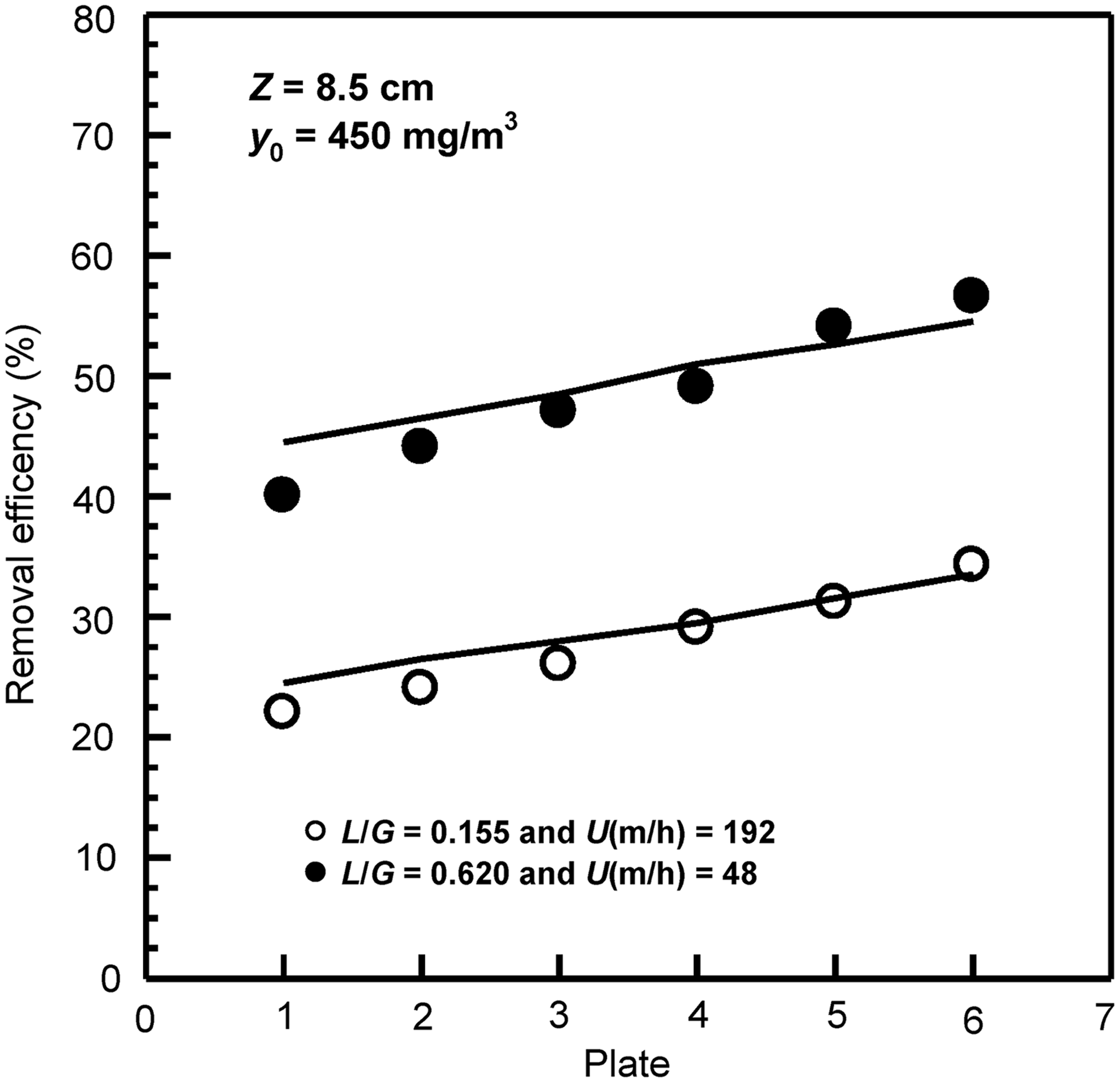
Variations of p-xylene removal efficiency with plate number at fixed L/G and Z (symbols: experimental data; lines: calculated from the model).
Figure 6 shows variations of experimental and calculated IPA removal efficiencies with plate number at fixed L/G ratios of 0.001 and 0.005 for U = 720 and 480 m/h (influent gas flow rate = 750 and 500 L/min), respectively. Parameters for the calculations are given in Table 4. The kinetic constant k value for biodegradation of IPA in the column was estimated to be 1,000 1/h by the method of least squares. By Equation (15) and the parameters given in Table 4, ηmax was calculated to be 15.4% and 77.8% for L/G of 0.001 and 0.005, respectively. Experimental data show that a single plate of aerated liquid depth Z = 0.05 m was required to achieve an IPA removal of >96% for both L/G at the high superficial velocities of 480 and 750 m/h. The Henry's law constant of IPA is 0.00615 at 25°C. Substitution of parameters for IPA listed in Table 4 into Equation (10) gives (y n − Hxn)/(yn − 1 − Hxn) = 0.136 with U = 480 m/h, L/G = KLaVOC = 106 1/h, y n /yn − 1 = 0.168. The removal could achieve 85% with only one sieve plate, and 97.2% with two plates connected in series. The high efficiency could attribute to the far low Henry's law constant of IPA as compared with toluene and p-xylene. Biodegradation of IPA in the column and the relatively lower Henry's law constant of the VOC could be among the major reasons for the high removal efficiency.

Variations of IPA removal efficiency with plate number at fixed L/G and Z (symbols: experimental data; lines: calculated from the model).
The novelty and advantage of the present process is that it could achieve a target removal of a certain VOC with the calculated plate number by a certain operation conditions. The limitations may be it needs a higher construction cost and maintenance labor to clean the plates.
Conclusions
In this study, experiments and theoretical analysis were conducted to determine and predict the removal efficiency of toluene, p-xylene, and IPA from air streams by a perforated-plate column scrubbed with circulating activated sludge mixed liquor. From the results of experiments and model application, the following conclusions can be drawn.
First, a stage-wise perforated-plate column is applicable for absorption of VOCs from waste gas streams by introducing an activated sludge mixed liquor as a scrubbing liquor and partial oxidation of the absorbed VOCs occurs in the column.
Second, a model developed by a material balance for the gaseous and liquid VOC over each plate of the column was developed and experimentally verified in this study. Superficial gas velocity over the column plate (U), plate number (N), volumetric liquid-phase VOC-transfer coefficient (KLaVOC), aerated liquid depth over the plate (Z), volumetric liquid/gas flow rate ratio (L/G), dimensionless Henry's law constant of the VOC to be absorbed (H), VOC content of the influent scrubbing liquor (xN + 1), and the biodegradation rate constant of the VOC in the activated sludge mixed liquor (k) are among the affecting parameters to the effectiveness of the VOC removal.
Nomenclature
α = correction factor
A = cross-sectional area of the sieve plate available for gas flow (m2)
DVOC = diffusion coefficient of VOC in water (m2/h)
DVOC, G = diffusion coefficient of VOC in air (m2/h)
G = volumetric gas flow rate (m3/h)
H′ = dimensionless apparent Henry's Law constant
H = Henry's Law constant
kLaVOC = individual volumetric VOC-transfer coefficient in liquid phase (1/h)
kGaVOC = individual volumetric VOC-transfer coefficient in gas phase (1/h)
KLaVOC = overall volumetric VOC-transfer coefficient in clean water (1/h)
KOC = partition coefficients of VOC between the dissolved organic carbons in the liquid and the aqueous phase
KSS = partition coefficients of VOC between the suspended solids (solid activated sludge) in the liquid and the aqueous phase
k = biodegradation rate constant (1/h)
L = volumetric recirculating liquid flow rate (m3/h)
m = constant (0.5 – 1.0)
MLSS = mixed liquor suspended solids concentration (mg/L)
RL = liquid-phase resistance for VOC transfer
RT = total resistance for VOC transfer
rn = volumetric rate of VOC biodegradation (mg/m3 hr)
Vn = hold-up aerated liquid volume over plate n (m3)
U = superficial gas velocity over plate cross section (m/h)
Xd = dissolved organic carbon concentration in the liquid phase (mg/m3)
Xs = dissolved suspended solid concentration in the liquid phase (mg/m3)
x = liquid-phase VOC concentration (mg/m3)
xn = VOC concentration in effluent liquid from plate n (mg/m3)
y = gas-phase VOC concentration (mg/m3)
yn = VOC concentration in effluent gas from plate n (mg/m3)
yN = VOC concentration in effluent gas form column (mg/m3)
y0 = VOC concentration in influent gas (mg/m3)
y* = gas-phase VOC concentration in equilibrium with the liquid phase with a VOC concentration x (mg/m3)
Z = hold-up aerated liquid depth (m)
Footnotes
Author Disclosure Statement
No competing financial interests exist.