




Abstract
Abstract
Marine macroalga Bifurcaria bifurcata was investigated as sorbent for two environmental emerging pollutants, the pharmaceuticals venlafaxine (VLF) and fluoxetine (FLX), from aqueous solutions, both in mono and bi-component batch systems. The alga was characterized by means of IR spectroscopy, allowing to identify the most important groups for biosorption, carboxylic, sulfonic and hidroxile. The point of zero charge was determined, being 6.4. Adsorption of FLX follows a pseudo first order kinetics and kinetic constants are higher for FLX than for VLF. Its adsorption better represented by the pseudo second order model. For both pharmaceuticals, the equilibrium was reached within ∼100 min. Adsorption studies reveal that the process was more efficient at lower pH range and followed the Langmuir–Freundlich's model for VLF and Langmuir's model for FLX. Maximum adsorption capacities reached a level of 12 ± 3 and 22 ± 4 μmol/g for VLF and FLX, respectively, in the mono-component system. The difference was attributed to the presence of various functional groups of varying polarity within the adsorbates' molecules that affected their interactions with the adsorbent surface. The Langmuir–Freundlich's extended model was applied to the adsorption data of the bi-component system and no changes in the maximum adsorption capacities were found (14 ± 2 and 20 ± 3 μmol/g for VLF and FLX, respectively), there is no evidence of competition between the adsorbates.
Introduction
Presence of emerging environmental contaminants, such as pharmaceuticals (PhCs), in the aquatic environment has been reported all around the world (Meffe and Bustamante, 2014; Lapworth et al., 2015; Thomaidi et al., 2016). Pharmaceuticals have been detected in river water (Santos et al., 2013a; Paíga et al., 2016), seawater (Lolic et al., 2015; Paíga et al., 2015), groundwater (Meffe and Bustamante, 2014; Lapworth et al., 2015), tap water (Mendoza et al., 2016) and wastewaters (Santos et al., 2013b; Vazquez-Roig et al., 2014; Thomaidi et al., 2016).
Stressful life of most of the world's population led to a boom in the consumption of antidepressants such as venlafaxine (VLF) and fluoxetine (FLX), being among the most highly consumed PhCs. For instance, the consumption of antidepressants in Portugal increased by 240% from 2000 to 2012 (Furtado, 2013) and in 2015 this country was identified as the second largest consumer of antidepressants in Europe, closely followed by the United Kingdom (OECD, 2017). It is estimated that ∼30–90% of their administered dose is typically excreted in urine and feces (Halling-Sørensen et al., 1998; Mompelat et al., 2009). Therefore, after consumption antidepressants enter in domestic wastewaters in their original form and/or as metabolites and are directed to the wastewater treatment plants (WWTPs).
In conventional WWTPs, the removal of FLX can range from 3% to 54% (Radjenović et al., 2009; Zorita et al., 2009; Aydin et al., 2016) and VLF around 50% (Rúa-Gómez and Püttmann, 2012). In fact conventional WWTPs are not designed to complete remove emerging contaminants (e.g., pharmaceuticals) and are not efficient in their removal. Therefore they may reach the environment (Reemtsma et al., 2006; Loos et al., 2013; Schlüsener et al., 2015), where they can be found in a wide range of concentrations (ng/L to few μg/L) (Klavarioti et al., 2009).
So far one of the highest values of VLF found in the aquatic environment was 196 ng/L in River St. Lawrence, Canada (Lajeunesse et al., 2008). Also FLX has been detected in surface waters at concentrations of few ng/L, for example, 66.1 ng/L in River Tajo, Spain (Fernández et al., 2010). It is difficult to predict the impact they may have on ecosystems and human health but some ecotoxicological studies have reported adverse effects on flora and fauna (Schlüsener et al., 2015; Trinh et al., 2016).
The presence of FLX in the aquatic environment, even at low concentrations (few ng/L), may adversely affect aquatic organisms, such as fish, algae and crustaceans (Brooks et al., 2003a, 2003b; Foran et al., 2004; Christensen et al., 2007; Stanley et al., 2007). Although there are just a few studies about the ecotoxicity of VLF Painter et al. (2009) described a reduced predator avoidance performance in larval fathead minnows exposed to FLX and VLF.
As an attempt to completely remove PhCs in treated wastewaters, several biological, chemical, and physical techniques have been proposed among which the most studied ones are advanced oxidation processes, namely photocatalytic oxidation (Kaur et al., 2016), ozonation (Ziylan and Ince, 2015), membrane processes (Yoon et al., 2007) and sorption (Akhtar et al., 2016). Sorption is especially promising because it requires low capital investment, it is easy to operate, with low operation costs when compared with other processes (such as advanced oxidation processes and membrane processes which have high energy consumption) and no by-products of degradation of the adsorbates are formed (Acero et al., 2012; Al-Khateeb et al., 2014).
Between the technical solutions available of advanced treatment processes for removal of pharmaceutical residues in urban WWTPs adsorption is considered economic, robust and efficient. Depending on the type of adsorbent, the cost of the treatment is estimated to be in the range from US $10 to US $200 per million liters, while when using other technologies like reverse osmosis, ion exchange, electrodialysis, and electrolysis, the cost can reach US $450 per million liters (Ali, 2014).
Adsorption on activated carbon is a well-established technology for water treatment owning to its versatility and high efficiency, including for PhCs (Putra et al., 2009; Calisto et al., 2015; Mashayekh-Salehi and Moussavi, 2016). Nevertheless, it is an expensive adsorbent, US $20–22/kg (Babel and Kurniawan, 2003), which limits its widespread applicability. Moreover when used to remove polar organic contaminants, high usage rates are demanded due to reduced lifetime and low regeneration capacity, what increases the costs of operation (Quinlivan et al., 2005).
The information gathered in the literature (Swedish Environmental Protection Agency, 2017) shows that the costs vary widely with the sizes of the treatment plant. For facilities using granular activated carbon, for 2,000–10,000 population equivalent (one of the most common sizes of WWTPs), is expected an installation cost of 0.72 million US $, an annual capital expenditure of 0.04 million US $/year, an operating expenditure of 0.1 million US $/year and an operational electricity consumption lower than 0.01 kWh/m3, corresponding to a total cost of 0.09–0.11 US $/m3 of treated. It is verified that annual operating expenditure has a major contribute to the total cost and that the consumption of activated carbon dominates the operating costs, which reinforces the need to find low cost adsorbents.
To reduce the costs of adsorption technology, the scientific community has been looking for alternative low-cost adsorbents (Andrade et al., 2018).
Alternatively to activated carbon, even though in general not so efficient, the use of natural materials, namely biological matrices (e.g., algae, feathers, cork) presents other advantages, such as low cost, availability and sustainability (Putra et al., 2009). They have been already successfully used for the removal of metals (Al-Asheh and Duvnjak, 1998; Lodeiro et al., 2005), dyestuffs (Figueiredo et al., 2005; Freitas et al., 2016), and pesticides (Domingues et al., 2005). Minerals, such as clays, are also natural materials that show interesting properties, they can be recycled and reused (Stawiński et al., 2017a), their adsorption capacity is high and it can be enhanced by simple modifications, such as acid activation (Stawiński et al., 2016, 2017c) or thermal treatment (Stawiński et al., 2017b).
Some studies in the literature describe the adsorptive removal of FLX and VLF from water (Table 1); however, to the best of our knowledge, there are not published results on the biosorption of these PhCs. Therefore, the aim of this study was to investigate the effectiveness of a widespread seaweed, Bifurcaria bifurcata, for such a purpose. B. bifurcata biomass, which can be easily found and collected along the Atlantic coast, is not currently used and neither has cost in the market. Mono and bi-component studies were conducted under batch operation and the removal of the considered PhCs was evaluated at varying pH values and contact times.
Removal of Selected Pharmaceuticals by Means of Adsorption
FLX, fluoxetine; PhC, pharmaceutical; VLF, venlafaxine.
Materials and Methods
Reagents, solvents and materials
VLF hydrochloride (>99% purity, VLF) and FLX hydrochloride (>98%, FLX) were obtained from Sigma-Aldrich (Steinheim, Germany). The molecular structures of these compounds are shown in Fig. 1 and their physicochemical properties are listed in Table 2. Stock standard solutions of the pharmaceuticals (at a concentration of 1,000 mg/L) were prepared in a basis weight in methanol and stored at −20°C to be used for calibration curves. All the working solutions were prepared directly from the solid reagent in ultrapure water (resistivity of 18.2 MΩ/cm) produced using a Simplicity 185 system (Millipore, Molsheim, France).
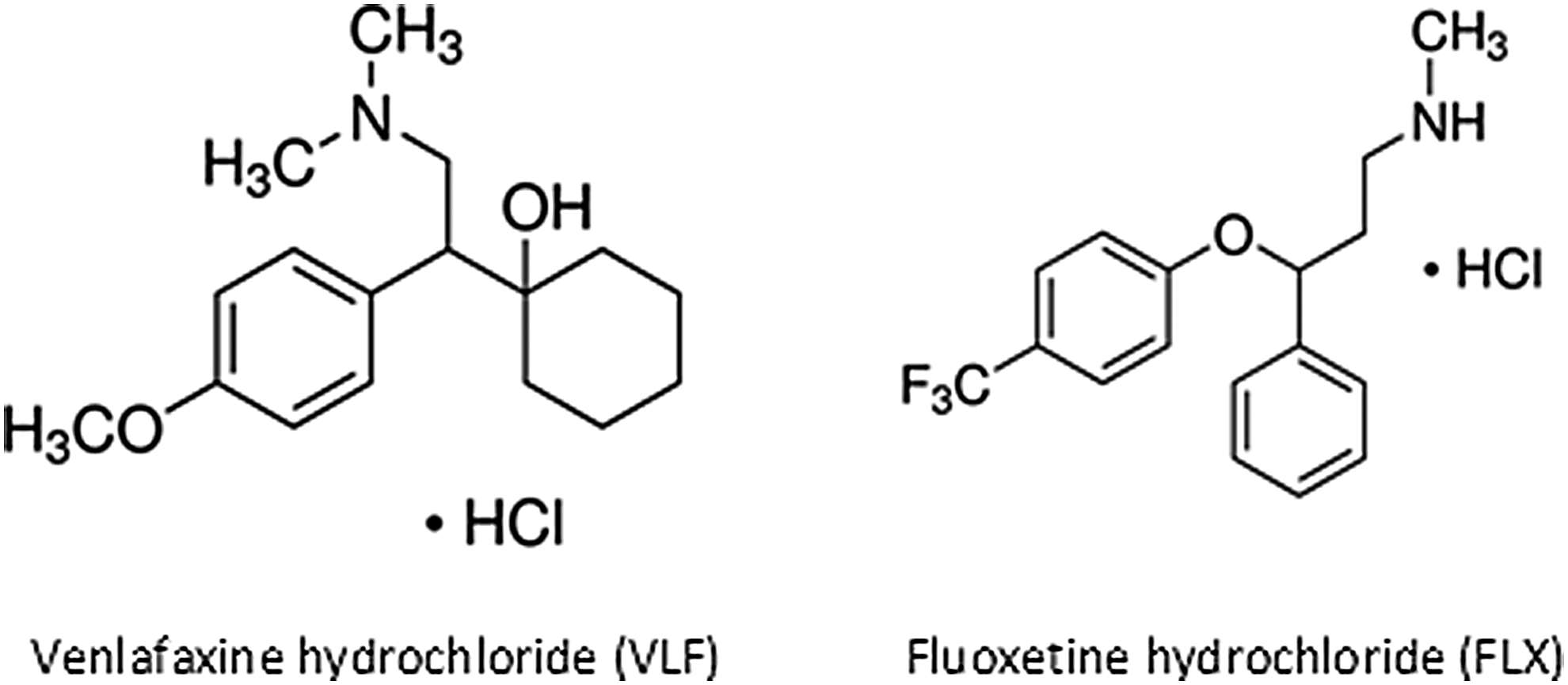
Molecular structures of adsorbates.
Physico-Chemical Properties of Venlafaxine and Fluoxetine
Calculated from Marvin, Calculator Plugin and Chemical Terms Demo (Chemaxon).
Mw, molecular weight; Ka, acid dissociation constant; Kow, octanol-water partition coefficient.
Brown marine macroalga B. bifurcata was collected in the North of Portugal (Póvoa do Varzim, A-ver- o mar beach, GPS coordinates N 41° 24′ 17.40″, W 8° 46′ 49.74″). This brown alga belongs to the class of Phaeophyceae, Fucales order and Sargassaceae family.
It was washed with tap water, dried in the air at room temperature, grinded in a centrifugal mill (Retsch ZM 100, Germany) and sieved (Retsch AS 200, Germany) to obtain a fraction between 0.71 and 1.00 mm. According to author's experience and from literature (Lodeiro et al., 2005), this granulometry allows an easy separation from water and avoids excessive head losses if column operation is chosen.
Methods
Sorbent characterization
Infrared spectra of the alga diluted with KBr (4 mg of sample ground with 96 mg of KBr) were recorded in the range of 500–4,000 cm−1 with resolution of 2 cm−1 (200 scans), using transmittance technique (Nicolet 6700 FT-IR, MCT/A detector; Thermo Scientific).
The point of zero charge (PZC) was determined according to the method proposed by Rivera-Utrilla et al. (2001). Weighted portions of 50 mg of the alga were placed in Erlenmeyer flasks and mixed with 50 mL of solutions of pH varying between 3 and 11 (pHinit). Samples were stirred during 24 h and the final pH recorded (pHfin) using a pH meter (Crison, Barcelona, Spain). The pHfin was plotted against pHinit, the point at which the curve crossed the line pHfin = pHinit was taken as the PZC (pHpzc).
Determination of pharmaceuticals concentration
The quantification of VLF and FLX was performed by high performance liquid chromatography with fluorescence detection using a Shimadzu LC system (Shimadzu Corporation) equipped with a LC-20AB pump, a DGU-20A5 degasser, a SIL-20A autosampler and a RF-10A-XL fluorescence detector.
Chromatographic separation was achieved using a Luna C18 column (150 × 4.6 mm, 5 μm) (Phenomenex) using as mobile phase 0.1% formic acid in ultra-pure water as eluent A and acetonitrile as eluent B. The elution gradient was performed at a flow rate of 1 mL/min, as follows: from 90% A to 20% A in 7 min, returning to the initial conditions in 3 min, and re-equilibration of the column in 4 min. The injection volume was 20 μL and the column temperature was set at 35°C. Fluorescence detection was carried out at the excitation/emission wavelength pair of 274 and 610 nm for VLF and 230 and 290 nm for FLX. All analyses were performed in duplicate.
For the described chromatographic conditions, VLF and FLX retention times were 4.48 and 5.27 min, respectively. Identification of the analytes was based on their retention time comparatively to a standard solution and quantification was performed using external calibration curve method. Calibration curves were settled in the range of 50–3,000 ppb for both compounds, and gave good fits (r2 > 0.999).
Adsorption studies
Batch experiments were carried out to study the adsorption of both PhCs, VLF and FLX, onto B. bifurcata. The experiments were performed at room temperature (20°C). The adsorption capacities qt (μmol/g) at time t were calculated according to Equation (1):
where C0 (μmol/L) is the initial concentration, Ct (μmol/L) the concentration at a given time, V (L) is the volume of the solution, and m (g) is the mass of the adsorbent.
Effect of pH
A set of 12 flasks containing 20 mL of ultrapure water was mixed with 50 mg of the alga for 1 h then the pH was adjusted to a value between 5 and 10 with HCl or NaOH. Then a defined volume of the FLX solution was added and all volumes were adjusted to 25 mL to obtain final concentration of 500 μg/L. The solutions were stirred for 180 min at 400 rpm. After that the pH was measured (Crison 2002) and then the samples were centrifuged at 9,000 rpm for 10 min (Heraeus Fresco 21 Microcentrifuge; Thermo Scientific) and the concentration of the pharmaceuticals was measured in the supernatant as described above. The experiment was performed in duplicate and additionally a blank test without the alga was done for each pH.
To investigate the influence of B. bifurcata in the pH of solutions a test was performed in duplicate. Solutions containing 50 mg of the alga and 25 mL of ultrapure water were stirred for 240 min at 400 rpm and the final pH was measured (Crison 2002).
Kinetics
Kinetic studies were performed in 250 mL Erlenmeyer's flasks with initial concentrations of 0.4 and 0.5 mg/L for VLF and FLX, respectively. Portions of 0.5 g of the seaweed were added to the flasks and stirred at 400 rpm (AREC; VELP Scientifica). An initial sample was taken before adding the alga, and then samples were collected in determined time intervals, centrifuged at 9,000 rpm for 10 min (Heraeus Fresco 21 Microcentrifuge; Thermo Scientific) and the concentration of the pharmaceutical was determined in the supernatant (Ct). The pH measurements were also made at all the determined time intervals.
Equilibrium
Weighted portions of 50 mg of the alga were mixed in Erlenmeyer's flasks with 25 mL of FLX solution of different concentrations varying from 0.5 to 15.0 μmol/L. For VLF the concentration range was from 0.3 to 16.0 μmol/L. In the bi-component system studies solutions containing equimolar concentrations of VLF and FLX in the range of 2 to 9 0 μmol/L were used. The samples were stirred at 400 rpm for 3 h, centrifuged (9,000 rpm, 10 min), then the pH and concentration of the pharmaceuticals in the supernatant were determined. After reaching equilibrium, in Equation (1), Ct and qt are replaced respectively by Ce (equilibrium concentration) and qe (equilibrium adsorption capacity).
Data analysis
Three kinetics models, the pseudo first order (Lagergren, 1898), the pseudo second order model (Ho and McKay, 1999) and the Elovich's model (Low, 1960), were fitted to the experimental results. Four equilibrium models, the Freundlich's (Freundlich, 1906), the Langmuir's (Langmuir, 1918), the Langmuir–Freundlich's (Sips, 1948) and the Tóth's (Tóth, 1971) models, in the case of the mono-component systems, and the extended Langmuir–Freundlich equation (Ruthven, 1984) in the case of the bi-component system, were fitted to the obtained data. Nonlinear regression was used in all fits (software OriginPro 2016). Variances and correlation coefficients were determined. Fits to the models were compared using F-test (F), Akaike's Information Criterion (AIC) and Bayesian Information Criterion (BIC) tests. Models' equations are presented in the Supplementary Data.
Results and Discussion
Sorbent characterization
Several bands of the infrared spectrum corresponding to functional groups were identified in the sorbent (Fig. 2). The broad band with a maximum at around 3,400 cm−1 is characteristic for vibrations of the O—H and N—H groups of carbohydrates and proteins (Deng et al., 2007) and O—H vibration in water (Benning et al., 2004). The two bands at 2,920 and 2,860 cm−1 could be assigned to asymmetric and symmetric stretching vibrations of the C—H groups in aliphatic chains (Sheng et al., 2004; Murphy et al., 2007) that is, methyl and methylene groups in lipids (Benning et al., 2004). The bands at 1,735 and 1,625 cm−1 correspond to C = O of ester functional groups primarily from lipids and fatty acids (Fourest and Volesky, 1996; Giordano et al., 2001), and the band at 1,670 cm−1 to C = O group of amides were associated with proteins (Giordano et al., 2001; Benning et al., 2004).
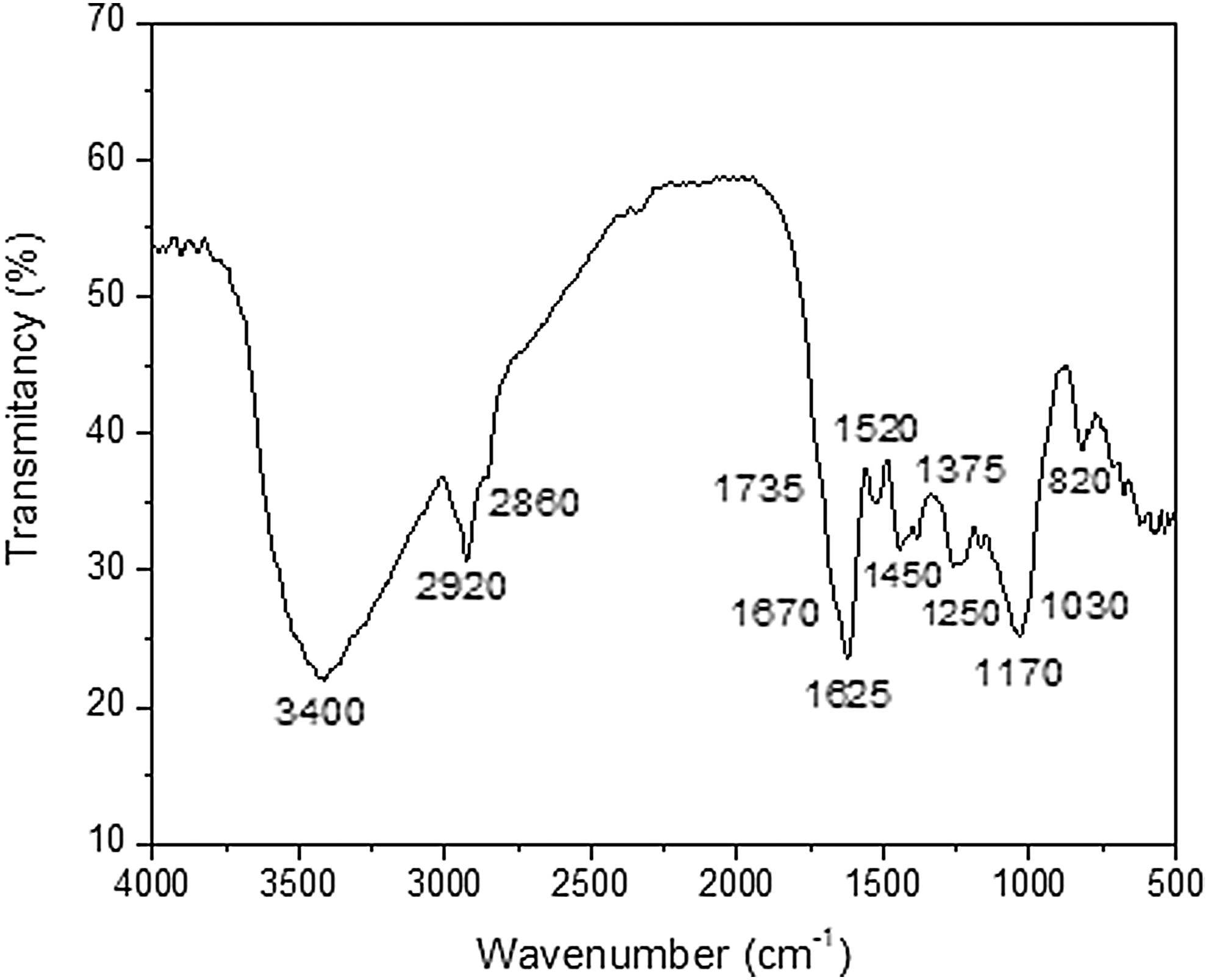
Infrared transmittance spectrum of Bifurcaria bifurcata.
The peak at 1,520 cm−1 may be assigned to bending of N—H and stretching of C—N group of amides II (Giordano et al., 2001; Benning et al., 2004; Park et al., 2005). The band at 1,450 cm−1 may correspond to asymmetric bending of CH3 and CH2 of proteins or lipids and the band at around 1,380 cm−1 to symmetric stretching of C—O in carboxylic acids (Giordano et al., 2001; Benning et al., 2004). The peaks at around 1,250 and 820 cm−1 may be due to vibration of C—S—O and S = O bonds, respectively (Fourest and Volesky, 1996), and the ones at 1,170 and 1,030 cm−1 to P = O and P—OH bonds (Yun et al., 2001).
Brown algae, like B. bifurcate, have abundant polysaccharides in the cell wall matrix and in the extracellular polymers, such as alginate and fucoidan. The most abundant functional groups are the carboxylic (pKa = 3.5–5.0) present in alginate, followed by the sulphonic (pKa = 1.0–2.5) present in fucoidan (Sheng et al., 2004), both play an important role in the biosorption. Although less abundant, hydroxyl groups (pKa = 9.5–13) (Volesky, 2003) present in polysaccharides and amino groups (pKa = 8–11) (Volesky, 2003) from proteins may also contribute to biosorption.
PZC and influence of pH
PZC, was found at pH 6.4 (Fig. 3). In the pH range below the PZC the surface of the sorbent is positively charged. The charge results from several processes such as adsorption of protons from the solution, and partial complexation of background electrolyte (H3O+). Various functional groups that may be protonated and take part in surface complexation during adsorption were identified in the sorbent (Fig. 2).

Point of zero charge determination of alga and influence of pH on adsorption capacity of FLX. FLX, fluoxetine.
Although it is experimentally difficult to identify exactly the nature of all relevant surface complexes present in a solid surface, it is known that charged surface influences the distribution of nearby ions in the aqueous solution in contact with the surface. This leads to formation of an electrical double layer comprising the charge surface and excess of counter ions over co-ions diffused in the solution (Tien, 1994). Thus, the whole surface of the alga is covered with the double electrical layer, with the negative charge on the outer layer. Hence, the adsorption of the positively charged pharmaceuticals by forming outer-sphere complexes, where water molecules are located between the cation and the adsorbent surface, is enhanced (Sposito, 1984).
Another possible mechanism of adsorption is due to direct interaction of the pharmaceuticals with the surface sanction groups via forming the so called inner-sphere complexes (Sposito, 1984). These phenomena are more pronounced when the pH is lower, what is reflected in increased adsorption (Fig. 3), as all the processes act stronger and additionally the functional groups on the adsorbate might be protonated which creates extra driving force for the adsorption. Furthermore, molecules may not only be adsorbed because of the attraction forces with solids, but also because the solution can reject them (Lyklema, 1995). Therefore, when the ionic strength of the solution increases by addition of protons, adsorption of less hydrophilic compounds, like FLX, may be increased.
From the functional groups identified in the Infrared spectra of the alga, sulphonic, carboxylic and amino groups may be involved in the biosorption process in pH range studied (5–10), according the pKa values of these functional groups. When pH increases the surface functional groups become deprotonated (above the PZC the alga becomes negatively charged), thus favoring adsorption of the pharmaceuticals VLF and FLX, which show a predominance of the species with positive charge at pH values below their pKa (9 and 10, respectively) and will reach a maximum positive overall charge at pH values 2 U below their respective pKa, therefore maximizing the attraction adsorbent/adsorbate. However, above these values there is a decrease of the species with positive charge and an increase of the presence of neutral species rendering the removal less efficient.
Considering that adsorption is favored at lower pH values and the limits for discharge are in the range 6–9, kinetic and equilibriums were performed at pH around 6.0 without further adjustment. At this region the sulphonic and carboxylic groups should be the most important for the biosorption process.
Mono-component system adsorption
Kinetics and equilibrium
Fitted kinetic models' parameters are shown in Table 3. Models comparison is presented in Supplementary Table S1 in the Supplementary Data.
Parameters of Kinetic Models for Adsorption of Venlafaxine and Fluoxetine onto Bifurcaria bifurcata in Different Initial Concentrations
According to the pseudo first order model, which was the best fit for adsorption kinetics of VLF in both concentrations, this compound adsorbed with lower rate (k1 parameter) compared to the adsorption of FLX. The rates increased proportionally to the increase of the initial pharmaceutical concentration in the solution. Similar behavior was indicated by the Elovich's model. Here, however the change upon increasing the concentration was more significant for FLX where the rate (α parameter) increased by one order of magnitude. For F-test the difference between models was not significant. According to AIC and BIC tests, the pseudo second order model was the best fit for adsorption of FLX and according to it the compounds in both investigated concentrations adsorbed with a similar rate (Table 3). Nonetheless, the equilibrium in both cases was reached in ∼100 min (Fig. 4).
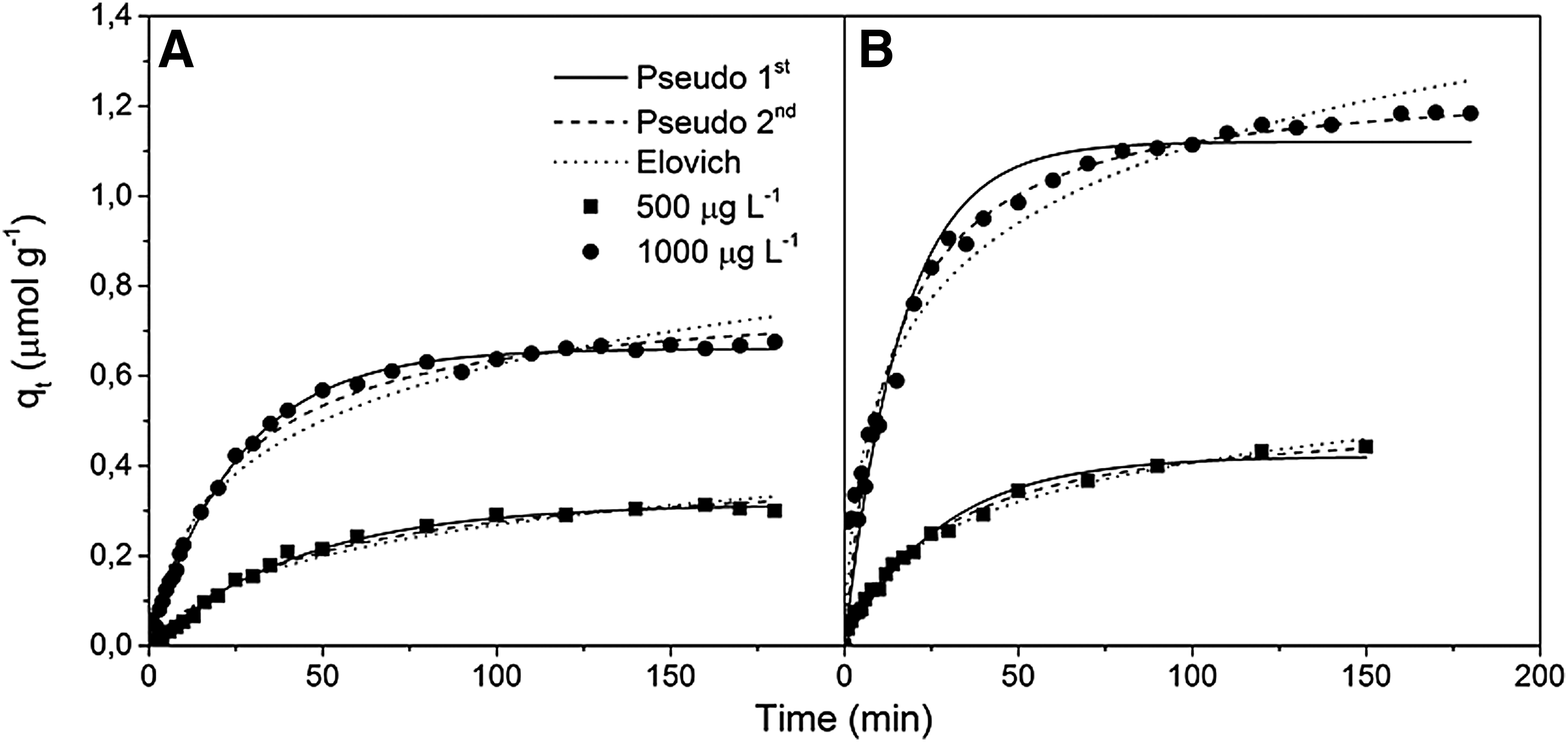
Kinetic experimental data with fitted models for adsorption of VLF
Table 4 contains the fitted parameters for the equilibrium models. The equilibrium studies showed that the adsorption of FLX followed the Langmuir's model and the Langmuir–Freundlich's model was a better fit for the adsorption of VLF (Fig. 5).

Equilibrium experimental data with fitted models for adsorption of VLF
Parameters of Mono and Bi-Component Equilibrium Models for Adsorption of Venlafaxine and Fluoxetine onto Bifurcaria bifurcata
The adsorption capacities obtained for B. bifurcata (without any chemical treatment) are lower than the ones obtained in the studies presented in Table 1 for the same pharmaceuticals using activated carbons, which was expected since the activated carbons are subjected to chemical/physical treatments in their production. The alga exhibited higher adsorption capacity for FLX, which reached a level of 22 ± 4 μmol/g, than for VLF with 12 ± 3 μmol/g. In all cases the models' parameters related to adsorption intensity were lower for VLF (Table 4). In fact, considering that the Kow value of FLX is higher than for VLF it was expected higher affinity of FLX for adsorption and consequently higher adsorption capacity.
Differences of behavior of each pharmaceutical in kinetic and equilibrium studies could be attributed to the structures of the pharmaceuticals.
FLX contains a very polarized trifluoromethyl group on one side, a very hydrophobic benzyl group in its proximity, an ether group between them, and a polarized secondary amine group on the opposite side of the molecule. Owning to that FLX can interact stronger with the adsorbent's surface and because the adsorption sites of the molecule are well defined it may attach to the adsorbent's surface in more organized manner, thus the Langmuir's model fits the data better.
VLF on the other hand contains a tertiary amine group which is more shielded by the methyl groups than the secondary amine group in FLX, a hydroxyl group to which access is partially obstructed by the cyclohexyl group in its proximity. The oxygen in the methoxy group in the molecule may act here as the primary adsorption centre, the same way as the fluorine atoms in the trifluoromethyl group in FLX, due to its peripheral localization, thus no spherical obstructions. However, a polar and nonpolar ends of VLF molecule cannot be defined as clearly as in the case of FLX. Consequently, the latter one interacts with the adsorbent stronger, and hence the maximum adsorption capacity and rate of FLX are higher.
The adsorption mechanism of VLF comprised the premises of both Langmuir's and Freundlich's models as the molecule may attach to the surface of the alga weaker and with various spherical coordinations. However, it cannot be excluded that both kinds of adsorption (homogeneous vs. heterogeneous, monolayer vs. multilayer) play a role in the observed process as most of the times adsorption is controlled by various factors. Thus, the adsorption isotherm equations, as well as rate laws should be considered as helpful means to compare materials and to predict adsorption capacity to design adsorption units, rather than tools to unambiguously determine actual phenomena taking place (Hameed and El-Khaiary, 2008; Sposito, 2008).
Bi-component system adsorption
To describe the equilibrium in the bi-component system the extended Langmuir–Freundlich model was fitted to the experimental data (Fig. 6). This model, although thermodynamically not consistent, has been shown to provide good empirical correlation of binary equilibrium data and is widely used for design purposes (Ruthven, 1984).
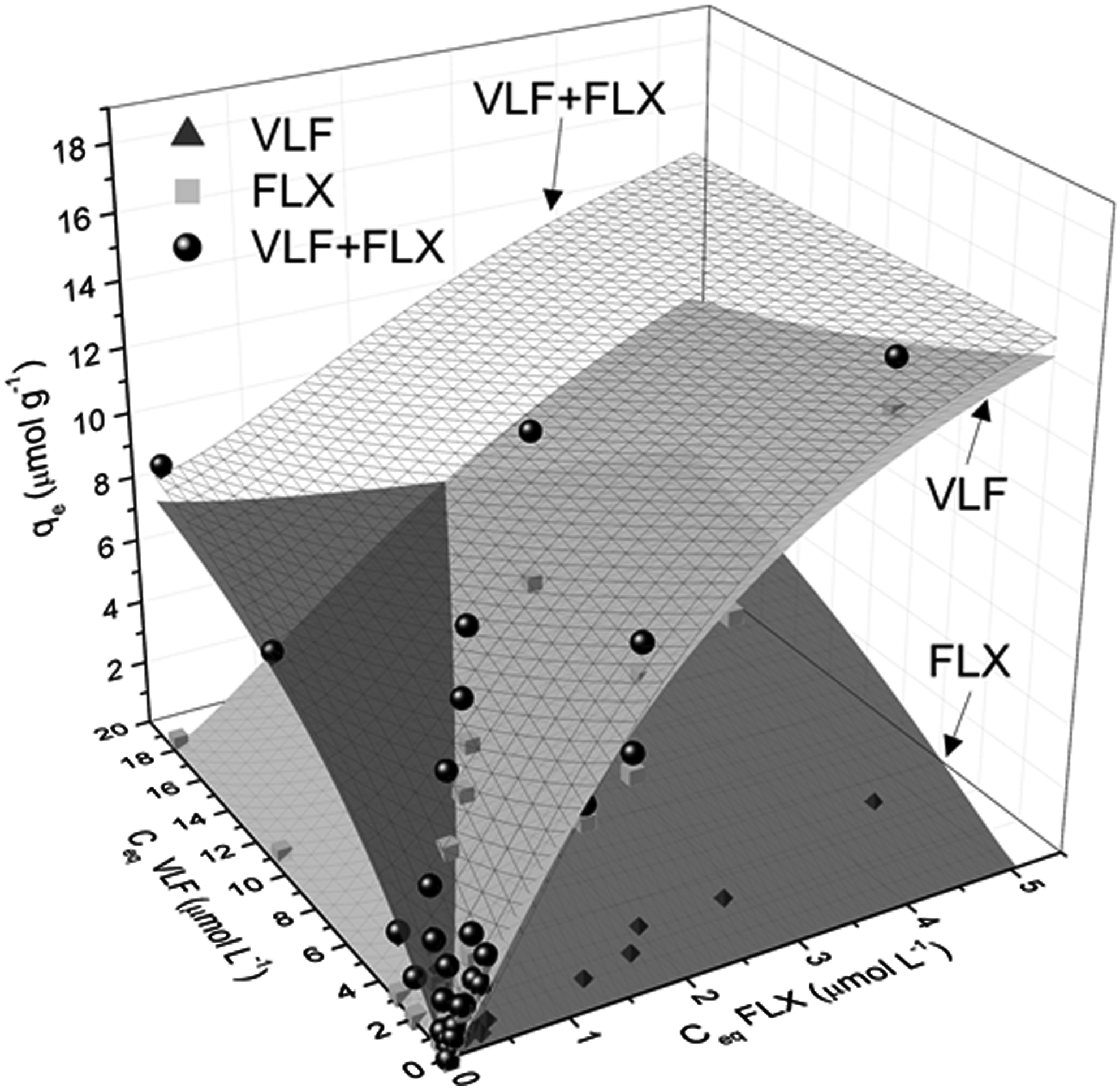
Experimental data of the bi-component adsorption of VLF and FLX with fitted extended Langmuir–Freundlich's model.
The presence of another adsorbate in the solution did not affect the adsorption of the other compound. Although it could be expected that adsorption of FLX would prevail over adsorption of VLF, decreasing the maximum capacity for the latter, as FLX interacts with the surface of the adsorbent stronger (Table 4), there was no statistically significant difference between the maximum adsorption capacities obtained in the mono and bi-component systems. As mentioned in mono-component system analysis of results, the adsorbates might interact with different active sites on the surface of the alga however no synergic effect on adsorption or competition between adsorption of VLF and FLX was noticed, maybe due to the very low concentration of pharmaceuticals used in this experiment, which were selected to be more close to real effluent conditions.
Conclusions
Adsorption of VLF and FLX by the seaweed B. bifurcata is favored at lower pH values. The pH of the solution has great influence both in the charge of the pharmaceuticals and in the functional groups present in the alga's surface. FLX, with its clearly defined polar and nonpolar ends and with higher Kow, interacted stronger with the algae surface, thus its removal level was higher than for VLF, presenting maximum adsorption capacities in mono-component system of 22 ± 4 and 12 ± 3 μmol/g, respectively. No statistically significant difference existed between the adsorption capacities for mono and bi-component systems suggesting no influence of the simultaneous presence of both pharmaceuticals on their adsorption in the investigated conditions.
This study demonstrates that the alga B. bifurcata may be successfully used as low cost biosorbent for FLX and VLF, showing potential to be applied in tertiary treatment of domestic wastewaters contaminated with pharmaceuticals.
Footnotes
Acknowledgments
Acknowledgments are due to Fundação para a Ciência e a Tecnologia (FCT), FEDER under Programme PT2020 (Project UID/QUI/50006/2013—POCI/01/0145/FEDER/007265) and Programme FCT–UT Austin, Emerging Technologies (Project UTAP-ICDT/CTM-NAN/0025/2014) for the financial funding. The authors would like to thank the EU and FCT/UEFISCDI/FORMAS for funding, in the frame of the collaborative international consortium REWATER financed under the ERA-NET Cofund WaterWorks2015 Call. This ERA-NET is an integral part of the 2016 Joint Activities developed by the Water Challenges for a Changing World Joint Programme Initiative (Water JPI). W.S. also thanks FCT/MEC for his grant (Laboratório Associado para Química Verde–Tecnologia e Processos Limpos–UID/QUI/50006, POCI-01-0145-FEDER-007265).
Author Disclosure Statement
No competing financial interests exist.

References
Supplementary Material
Please find the following supplemental material available below.
For Open Access articles published under a Creative Commons License, all supplemental material carries the same license as the article it is associated with.
For non-Open Access articles published, all supplemental material carries a non-exclusive license, and permission requests for re-use of supplemental material or any part of supplemental material shall be sent directly to the copyright owner as specified in the copyright notice associated with the article.
