




Abstract
Abstract
Application of support materials in nanoparticle technology can effectively preserve the reactivity of nanoparticles through preventing nanoparticle aggregation. In this study, the composite of activated carbon fiber-supported bimetallic Fe/Ni nanoparticles (ACF-Fe/Ni) was synthesized and several characterizations for ACF-Fe/Ni were carried out, including scanning electron microscopy, Brunauer–Emmett–Teller surface area, X-ray diffraction, and X-ray photoelectron spectroscopy. Subsequently, dechlorination performance of ACF-Fe/Ni toward chloroform (CF) was evaluated via a series of batch experiments. Results showed that 92.1% of CF was removal by ACF-Fe/Ni within 45 min, higher than that of raw Fe/Ni (63.3%) and ACFs (13.7%) under the identical condition. Analysis of dechlorination products and chloride ion formed during the dechlorination process indicated that the possible pathway of CF removal by ACF-Fe/Ni included hydrogenolysis and complete dechlorination. Moreover, influence of key parameters manifested that rising ACF-Fe/Ni dosage and ambient temperature and lowering initial pH value were conducive to the removal of CF. Common ions and sulfur compounds both showed a detrimental effect on the removal of CF by ACF-Fe/Ni, specifically sulfides almost completely inhibiting the reactivity of ACF-Fe/Ni.
Introduction
Bimetallic Fe/Ni nanoparticles due to their high reactivity have been widely applied in contaminant removal such as halogenated organic compounds (Feng and Lim, 2005; Cheng et al., 2010; Xie et al., 2014), heavy metals (Zhou et al., 2016a), antibiotics (Weng et al., 2014), and mixed contaminants (Weng et al., 2013; Cai et al., 2014). Compared with monometallic nanoscale zero-valent iron (nZVI), Fe/Ni nanoparticles possess stronger reducing capacity and higher efficiency in the utilization of H2 formed as a by-product of nZVI reaction (Feng and Lim, 2005).
However, similar to nZVI, Fe/Ni nanoparticles tend to aggregate with each other under intrinsically strong magnetic interaction and high surface energy, resulting in loss of reactivity (Bokare et al., 2007; Phenrat et al., 2007). Therefore, support modification technology with an expectation of dispersing nanoparticles and improving their reactivity has received growing attention.
A variety of support materials with a large specific surface area and unique structure, such as Al2O3 microparticles (Hsieh and Horng, 2006), montmorillonite (Kadu et al., 2011), graphene oxide (Zhou et al., 2012), chitosan (Weng et al., 2013), attapulgite (Liu et al., 2015), polyvinylpyrrolidone (Kumar et al., 2017), and biochar (Wu et al., 2016), have been evaluated for their effectiveness in the improvement of Fe/Ni reactivity. According to these studies, supported Fe/Ni nanoparticles obviously exhibit a higher reactivity than that of raw Fe/Ni owing to their good dispersion on the surface of support materials.
Besides preventing nanoparticle aggregation, some support materials are also able to provide an additional benefit for contaminant removal. For example, Lin et al. (2015) studied the modification of Fe/Ni by using three surfactants and found that the removal of pentachlorophenol (PCP) was markedly enhanced by using Fe/Ni modified by electropositive cetyltrimethylammonium bromide (CTAB). This enhancement is the result of CTAB preventing Fe/Ni nanoparticle aggregation and accelerating the adsorption of PCP from aqueous solution to the surface of Fe/Ni via electrostatic interaction.
Activated carbon fibers (ACFs) as a kind of highly microporous carbonaceous adsorbent have been extensively used in the removal of various contaminants such as volatile organic compounds (Baur et al., 2015; Son et al., 2016), phenols (Liu et al., 2010), aromatic compounds (Zhang et al., 2010), dyes (Chiang et al., 2009), and SO2 (Gaur et al., 2006). Compared with conventional granular-activated carbon, ACFs have a larger adsorption capacity and a faster adsorption rate due to their huge specific surface area and abundant micropores uniquely exposed on the surface (Brasquet and Cloirec, 1997; Liu et al., 2010).
Recently, composite materials based on ACFs have gained increasing attention and been widely applied in diversified fields such as Fenton catalyst oxidation (Wang et al., 2014; Lan et al., 2015), photocatalytic (Shi et al., 2012; Carraro et al., 2016; Sharma and Lee, 2017), anaerobic biotransformation (Amezquita-Garcia et al., 2016; Thi and Lee, 2017), and catalytic reduction (Beswick et al., 2015) because of their high efficiency and good stability. Nevertheless, to the best of our knowledge, little is known about the combination of ACF with high adsorption ability and Fe/Ni nanoparticles with strong reducing ability, which seems to be beneficial for the removal of hydrophobic contaminants.
This study was the first to synthesize the composite of ACF-supported bimetallic Fe/Ni nanoparticles (ACF-Fe/Ni), and the freshly synthesized ACF-Fe/Ni was characterized by scanning electron microscopy (SEM), the N2 Brunauer–Emmett–Teller (BET) surface area, X-ray diffraction (XRD), and X-ray photoelectron spectroscopy (XPS). Chloroform (CF), a recalcitrant chlorinated organic compound, was chosen as the target contaminant to evaluate the dechlorination reactivity of ACF-Fe/Ni. Based on the identification of products, a possible pathway of CF removal by ACF-Fe/Ni was proposed. Moreover, the effects of several factors, including initial solution pH, ACF-Fe/Ni dosage, ambient temperature, and additional solute on CF removal by ACF-Fe/Ni, were also investigated.
Materials and Methods
Chemicals
ACFs were purchased from commercial sources and immersed in boiling water for half an hour to remove impurities. The ACFs were used after fragmentation by a 30-mesh sieve. In addition to CF (>99.5% Merck), others chemicals, including FeCl2·4H2O, NiCl2·6H2O, NaBH4, NaHCO3, NaNO3, Na2HPO4, Na2S · 9H2O, Na2S2O4, Na2SO3, and ethanol (>99.7%), were obtained from Tianjin Guangfu Fine Chemical Research Institute (Tianjin, China) and were analytically graded without further purification. The water used for all experimental procedures was ultrapure water after purging with nitrogen gas (>99.99%) for half an hour, to deoxygenation as much as possible.
Synthesis of ACF-Fe/Ni
Synthesis of ACF-Fe/Ni was based on the Fe/Ni coreduction method reported by Feng and Lim (2005) and further modification details are as follows. Under nitrogen protection, 0.50 g of ACFs was added into 300 mL deoxygenated ultrapure water and kept in a suspended state with vigorous stirring. Then, 100 mL of mixed solution containing 5.36 g of FeCl2·4H2O and 1.64 g of NiCl2·6H2O was dropwise introduced into the above solution by a peristaltic pump (5.0 mL/min) to form a complex of ACF-Fe2+/Ni2+. Half an hour later, 50.0 mL of NaBH4 aqueous solution (3.50 g) was dropwise added into ACF-Fe2+/Ni2+ by a peristaltic pump (3.0 mL/min) to gradually form ACF-Fe0/Ni0.
After reaction, the black suspension was allowed to settle for separation. The supernatant was discarded, and the solid was washed by deoxygenated ultrapure water and ethanol several times to remove excess dissolved salt ions before vacuum freeze-drying. The obtained ACF-Fe/Ni nanoparticles with ACF to Fe mass ratio of 1:3 were stored in desiccators under a nitrogen atmosphere for further experiments. In addition, the preparations of raw Fe/Ni and other ACF-Fe/Ni materials with ACF to Fe mass ratios of 1:5 and 1:1 were similar with the above procedures.
Batch experiment
A series of batch experiments of CF removal were conducted in 100 mL of serum bottles on a water bath shaker at 160 rpm (SHA-B Changzhou, China). A given amount of ACF-Fe/Ni was added into the serum bottle containing 100 mL deoxygenated ultrapure water and the bottle was sonicated for 10 s to disperse nanoparticles. Subsequently, a certain volume of CF stock solution was rapidly injected into the bottle before tightly sealing with open-top screw caps and polytetrafluoroethylene (PTFE)-lined septa and the removal reaction started. At sampling intervals, 1.0 mL of reaction solution was extracted by a syringe and immediately filtered through a 0.22 μm filter-head into a headspace vial (22 mL, CNW Technologies GmbH, Düsseldorf, Germany) containing 9.0 mL of ultrapure water.
These headspace vials were quickly sealed with open-top screw caps and PTFE-lined septa and preheated in water at 60°C for 30 min before analysis. Blank experiment was carried out to monitor the loss of CF due to volatilization or adsorption. The effects of several factors, including ACF-Fe/Ni dosage (0.1–1.0 g/L), temperature (10–50°C), initial solution pH (3.00–11.00), and external solute (five common anions and three sulfur compounds) on the CF removal by ACF-Fe/Ni, were investigated, respectively. All experiments were conducted in triplicate to ensure reproducibility.
Characterization and analytical methods
Surface morphology of ACF-Fe/Ni was obtained by using a ZEISS JSM-6480LV SEM. The N2 BET surface areas of ACF-Fe/Ni and Fe/Ni were analyzed by ASAP 2020 M + C (Micromeritics Instrument Corporation, Norcross, GA). XRD diffractometer (D8-Advance, Bruker) with Cu Kα radiation at 40 kV and 40 mA was used to measure possible crystallinity of ACF-Fe/Ni at room temperature. XPS analysis with Al Kα radiation was performed on a PHI-5300 system to determinate the valence distribution of vital elements.
CF and its chlorinated products were analyzed using a gas chromatograph (GC; Shimadzu, 2014, Kyoto, Japan) equipped with an Ni electron capture detector. The detector port and the injector temperature were set as 320°C and 220°C, respectively. The temperature rising procedures of the column were as following: kept 40°C for 5 min and increased to 100°C with a rate of 8°C/min, followed by ramping to 200°C at a rate of 6°C/min and holding for 10 min. The carrier gas was high-purity N2 (99.99%) at a flow rate of 1.0 mL/min. The leaching of Fe and Ni was determined by an inductively coupled plasma spectrometer (iCAP 7000; Thermo Fisher), and the chloride ion generated during dechlorination was monitored by using an ion chromatograph (IC) (Dionex ICS-900, Germany).
Results and Discussion
Characterizations
Figure 1 displays the SEM images of ACF-Fe/Ni. Compared with ACFs, the matte surface of ACF-Fe/Ni indicated that some materials were deposited on ACFs (Fig. 1a). Under higher magnification (Fig. 1b), more subtle morphology of ACF-Fe/Ni was observed, showing that spherical nanoparticles with a diameter around 50 nm were deposited on ACFs. Note that nanoparticles without depositing on the surface of ACF were severely aggregated with each other, which demonstrates that ACF plays a key role in nanoparticle dispersion. The BET surface area measurement results revealed that the specific surface areas of ACF-Fe/Ni and Fe/Ni were 92.0763 and 12.4212 m2/g, respectively. The ∼7.5-fold increase in specific surface area from Fe/Ni to ACF-Fe/Ni was attributed to ACF endowed with a huge specific surface area.
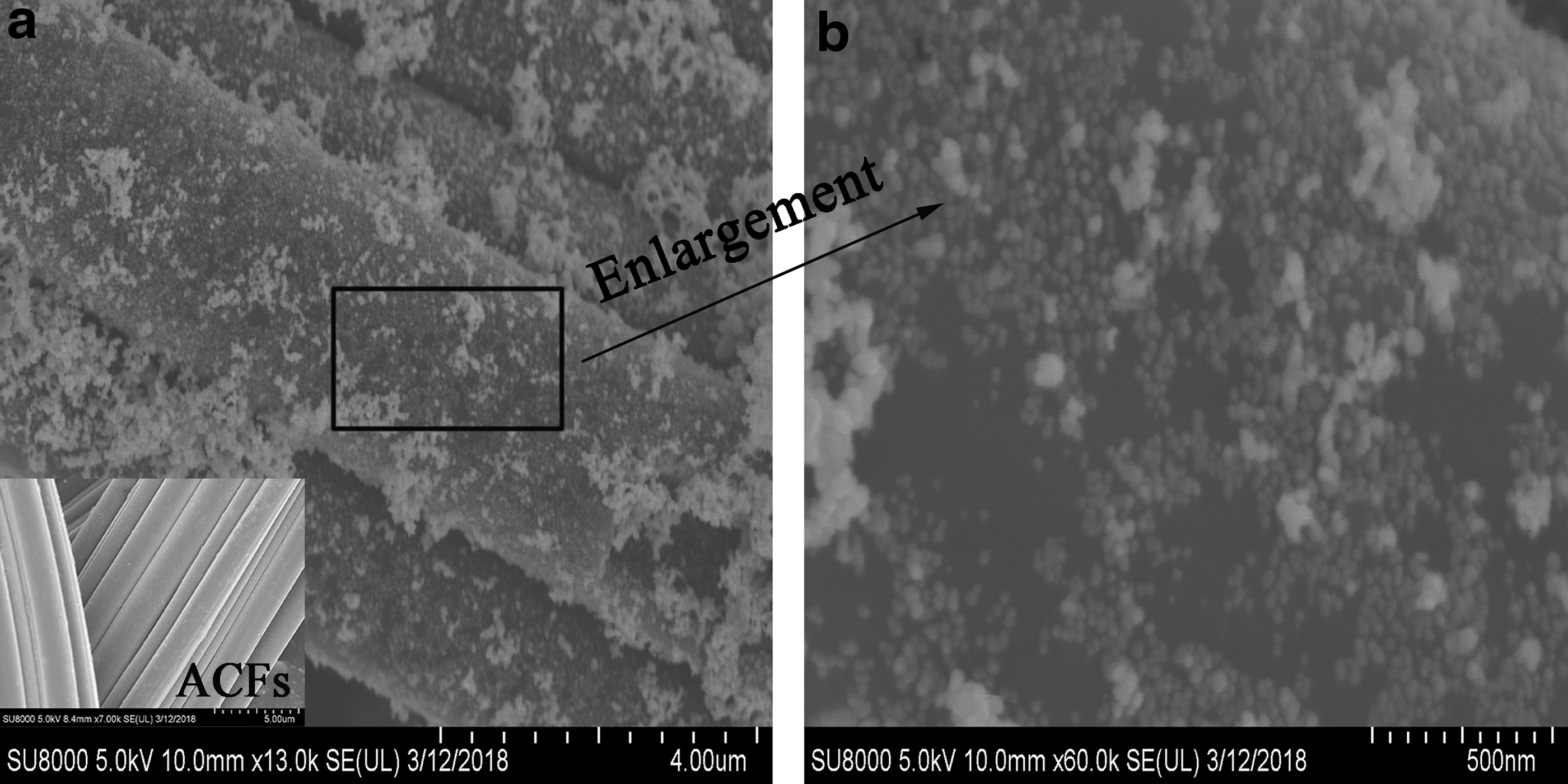
SEM images of ACR-Fe/Ni
Figure 2 illustrates the XRD pattern of ACF-Fe/Ni. A weak characteristic peak at 2θ = 44.9° indicated the presence of Fe0 in the ACF-Fe/Ni. According to previous studies, the characteristic peak of Fe0 of Fe-based composite materials was obviously weaker than that of pure nZVI (Li et al., 2011; Petala et al., 2013; Sun et al., 2014). In addition, the characteristic peak of Ni was not detected, presumably due to its low content or poor crystallinity (Fang et al., 2011). To further determine whether Fe0 and Ni0 existed, XPS measurement for ACF-Fe/Ni was conducted, as presented in Fig. 3. As revealed in Fig. 3a, Fe spectrum was best fitted with two components, Fe0 at 706.55 and 720.16 eV and Fe3+ at 711.206 and 724.720 eV (Wu et al., 2016). Meanwhile, Ni spectrum (Fig. 3b) demonstrated the coexistence of Ni0 (at 852.08 eV) and Ni2+ (at 855.69 eV) (Fang et al., 2011).
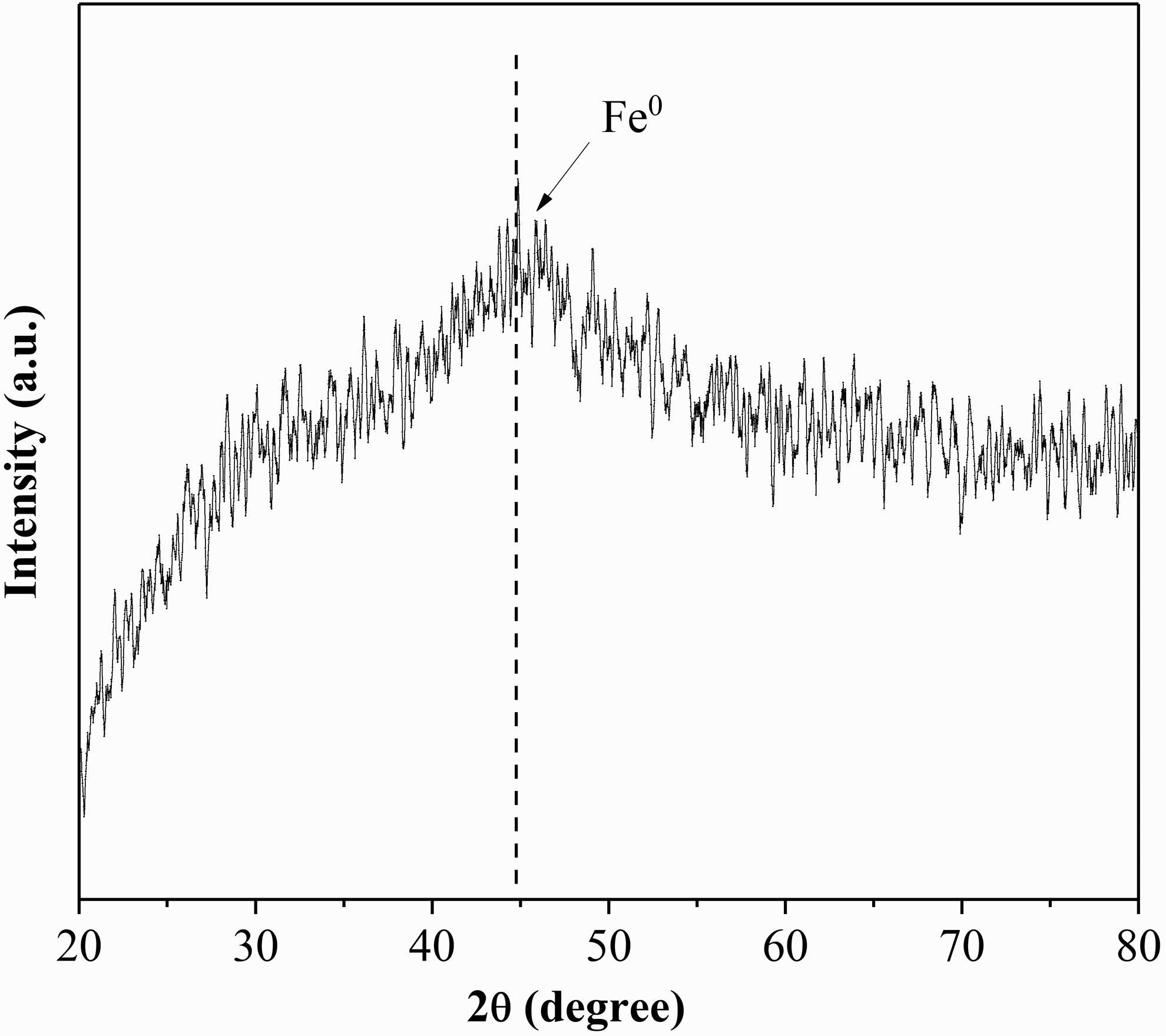
X-ray diffraction pattern of ACF-Fe/Ni.
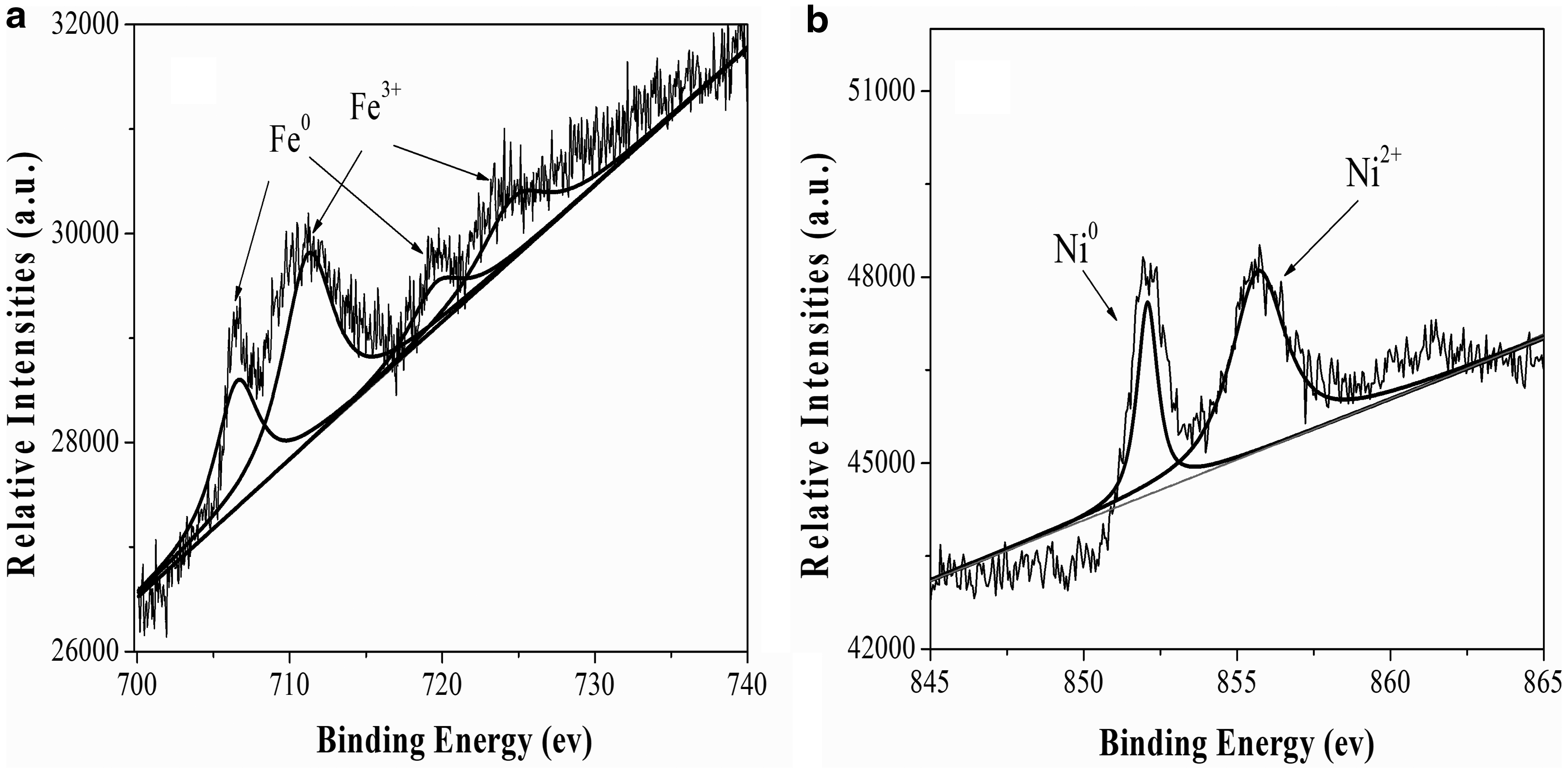
X-ray photoelectron spectroscopy of Fe 2p3/2
Based on the above characterization results, we confirmed that Fe0 and Ni0 nanoparticles were successfully deposited on the surface of ACF. In addition, ACF effectively reduced the aggregation of Fe/Ni nanoparticles and increased the specific surface area.
Ratio and durability of ACF-Fe/Ni
Before extensive research of the dechlorination reactivity of ACF-Fe/Ni for CF, various ACF-Fe/Ni materials with different ACF to Fe mass ratios were used for the experiment of CF removal to determine the optimum mass ratio between ACF and Fe (Fig. 4a). As shown in Fig. 4a, the rate of CF removal increased with the mass ratio increasing from 1:5 to 1:1. Under the same amount of Fe (Table 1), ACF-Fe/Ni with a high mass ratio contained more ACF component resulting in better dispersion of Fe/Ni nanoparticles and faster adsorption of CF from aqueous solution, conducive to the removal of CF (Yan et al., 2015). However, ACF-Fe/Ni with a mass ratio of 1:3 was chosen for further study since the increase in the rate of CF removal was not obvious from the mass ratio of 1:3 to 1:1. Besides, more ACF introduction could result in the attenuation of Fe/Ni magnetic force and the inconvenience of separation.
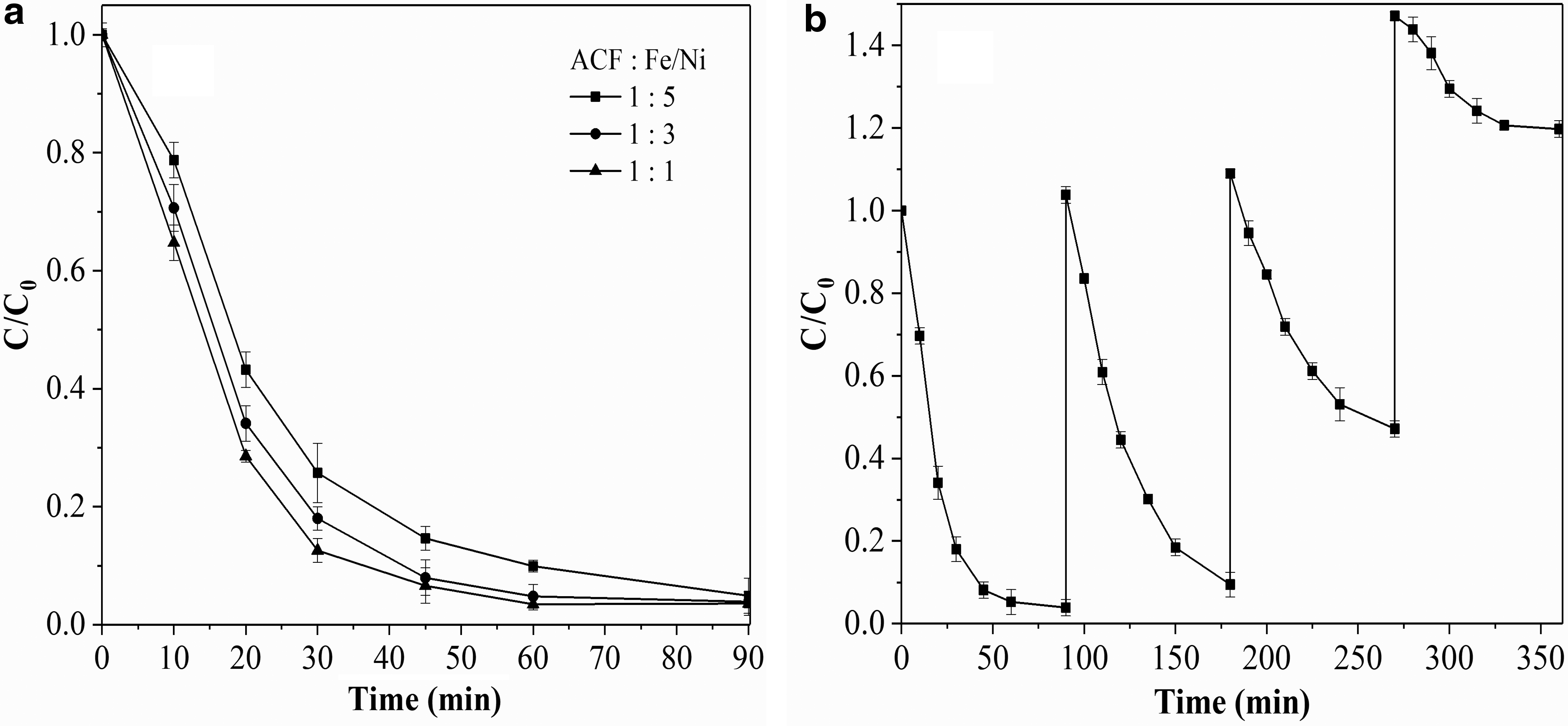
Removal of CF by various ACF-Fe/Ni with ACF to Fe mass ratios of 1:5, 1:3, and 1:1
Concentrations of Fe and Ni in Various Activated Carbon Fiber-Supported Bimetallic Fe/Ni Nanoparticles (ACF-Fe/Ni) with ACF-to-Fe Mass Ratio of 1:5, 1:3, and 1:1
The molar ratio of Fe:Ni as 4:1; the dosage of Fe: 300 mg/L.
To examine the durability of ACF-Fe/Ni, the four sequential experiments of CF removal by ACF-Fe/Ni via reinjecting CF stock solution were conducted as seen in Fig. 4b. It was obvious that the efficiency of CF removal decreased with the number of cycles increasing. The efficiency of CF removal could reach >90% in the first two cycles, whereas the efficiency decreased rapidly to 62% and 27% in the third and fourth succeeding cycles, similar to Zhou et al.'s (2016b) result about the degradation of trichloroethylene (TCE) by Fe/Ni nanoparticles supported on polystyrene resin. Moreover, the reason for the gradually decreased efficiency of CF removal might be attributed to the passivation of ACF-Fe/Ni, resulting in the reduction of active sites for CF removal.
CF removal by ACF-Fe/Ni
Figure 5a presents the removal of CF by using ACFs and raw Fe/Ni and ACF-Fe/Ni with corresponding dosages of 0.1, 0.3, and 0.4 g/L. The blank experiment showed that the volatilization of CF was rarely and controlled within 5%. The slight removal (∼15%) of CF by ACFs indicated that CF tended to be immobilized on ACFs. Although raw Fe/Ni and ACF-Fe/Ni could effectively remove CF during the experimental period, the rate of CF removal by ACF-Fe/Ni was twice faster than that of raw Fe/Ni. A synergistic effect was easily found between ACFs and Fe/Ni, for example, the efficiency of CF removal by ACF-Fe/Ni (92.1%) was higher than the sum of that of Fe/Ni (63.3%) and ACFs (13.7%) at 45 min. After reaction, the concentrations of Fe and Ni in the solution were determined as 0.25 and 0.06 mg/L via using cation exchange resin (H–R), which reaches the EPA standard (0.3 and 0.1 mg/L for maximum acceptable level of Fe and Ni, respectively) (Zhou et al., 2016b).
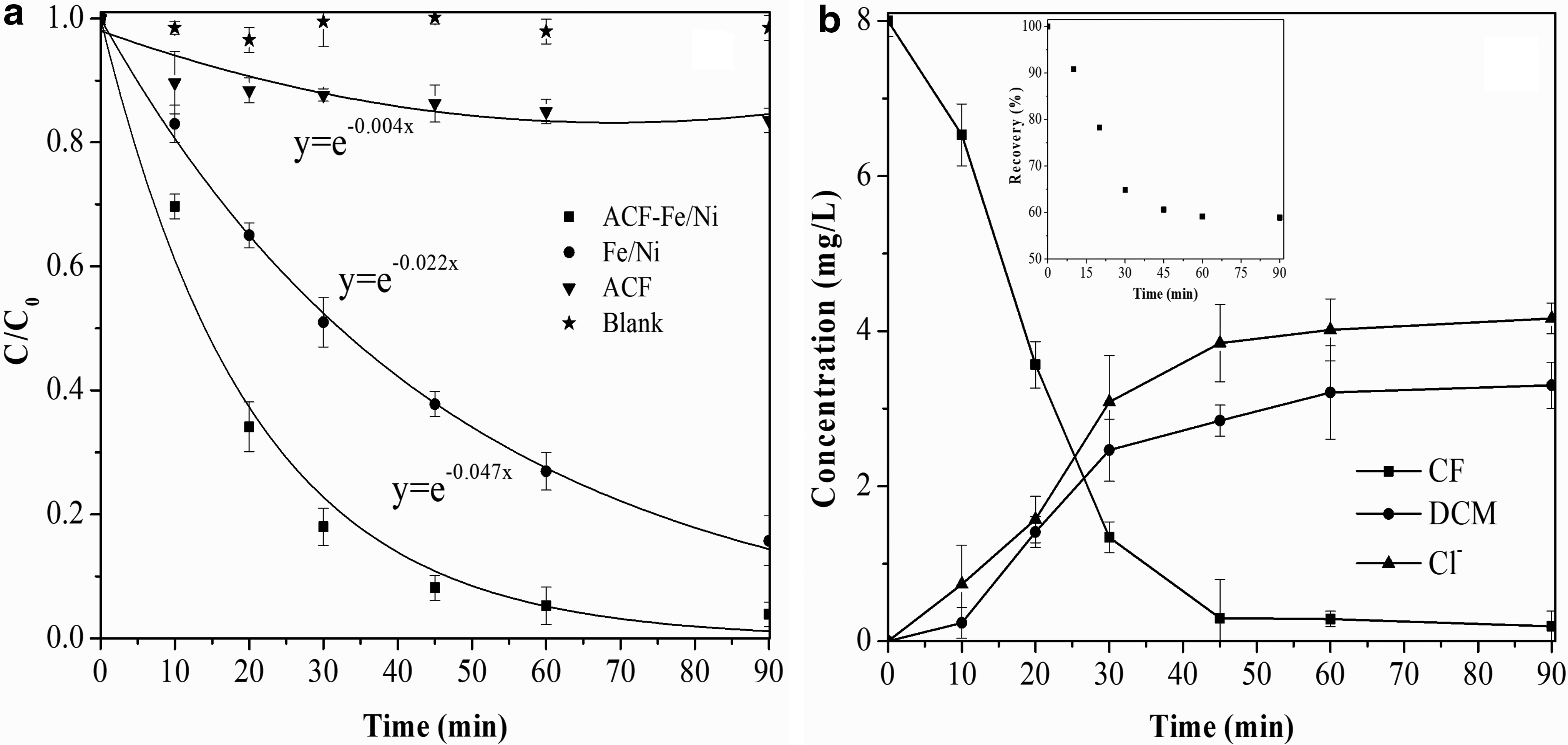
Removal of CF by using ACFs and raw Fe/Ni and ACF-Fe/Ni with dosages of 0.1, 0.3, and 0.4 g/L, respectively
According to previous studies, the poor hydrophobicity of Fe/Ni nanoparticles posed a disadvantage effect on the elimination of hydrophobic organic contaminants (Aless and Li, 2001; Cheng et al., 2010). Fortunately, the introduction of ACF usually used as adsorbent overcame the deficiency of Fe/Ni to some extent. In the process of CF removal by ACF-Fe/Ni, CF in the solution was rapidly adsorbed on the surface of ACF-Fe/Ni with the help of ACFs and then degraded by Fe/Ni nanoparticles with a high reactivity (Fu et al., 2004).
Dichloromethane (DCM) was the only product that could be detected by GC during CF dechlorination. Figure 5b shows the processes of DCM formation and chloride ion (Cl−) release accompanied by CF removal. The amounts of DCM and Cl− were progressively accumulated along with the removal of CF before leveling off at 60 min and the final concentrations were 3.30 and 4.16 mg/L, respectively. In addition, the change of carbon recovery between CF and DCM during the dechlorination reaction is recorded in Fig. 5b. The decreased trend in carbon recovery suggested that CF was likely to be converted to other products except for DCM. The measurement of Cl− generated in the reaction of CF dechlorination further verified the speculation.
Assuming that 8 mg/L of CF was completely converted to DCM by a single-step dechlorination, 5.69 mg/L of DCM and 2.37 mg/L of Cl− should be produced. However, the assumed value of DCM was overestimated and the assumed value of Cl− was underestimated comparing with the corresponding actual values. This indicated that a partial CF was more likely removed via a completely dechlorinated pathway to produce nonchloride products (Feng and Lim, 2005; Wang et al., 2009). Based on the above discussion, Fig. 6 clearly shows the reaction process and mechanism of CF removal by ACF-Fe/Ni.
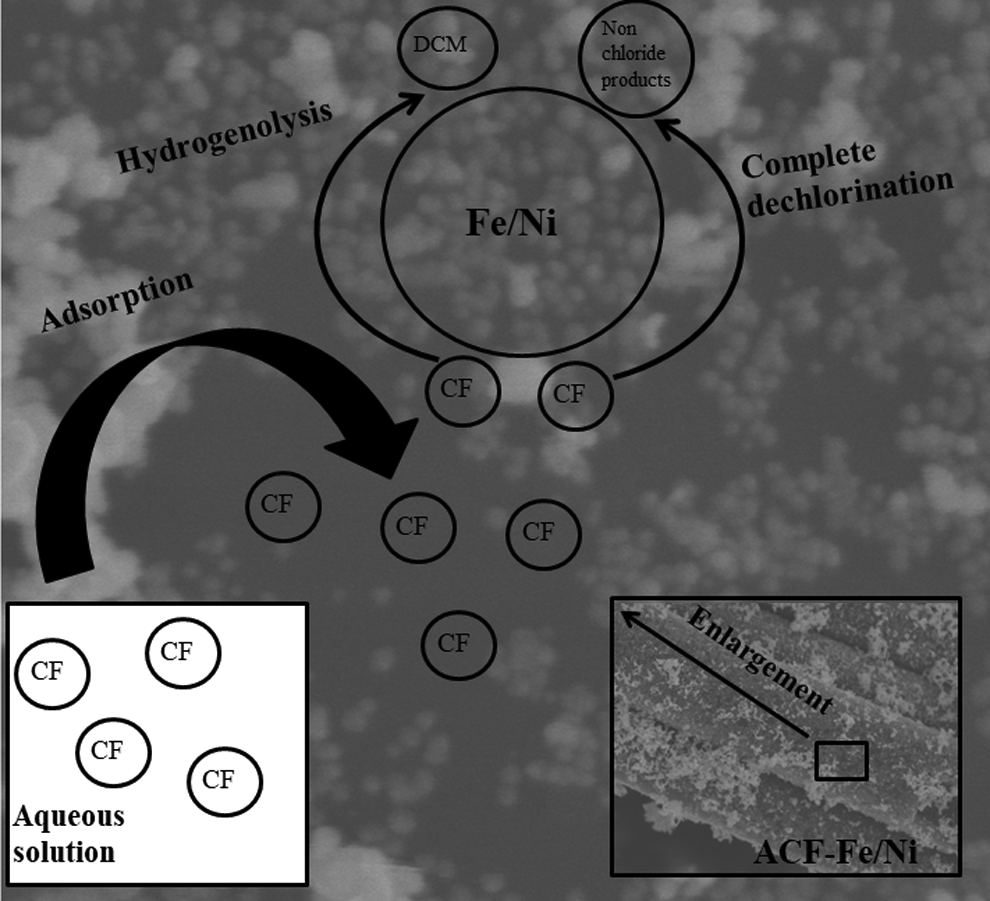
Reaction mechanism of CF removal by ACF-Fe/Ni.
Parameter influence
Solution pH is a key parameter to influence reaction rate, even reaction pathway. The removal of CF by ACF-Fe/Ni at different initial pH values of 3, 5, 7, 9, and 11 is presented in Fig. 7a. The removal of CF obviously increased with the initial pH value decreasing from 11 to 3 and the corresponding efficiencies of CF removal were 34.3%, 81.9%, 96.2%, 97.9%, and 99.4%, respectively.

Influence of essential parameters on the removal of CF, including initial pH value
Generally, acid conditions contributed to the dissolution of the passivated film of Fe/Ni surface, resulting in the exposure of freshly active Fe/Ni (Tee et al., 2009; Weng et al., 2014). The rapid corrosion of Fe via reacting with water or H+ and the abundant formation of active H occurring at fresh Fe/Ni active sites would accelerate CF removal. On the contrary, the passivated film of Fe/Ni surface became thicker due to the formation of Fe/Ni hydroxides under alkaline conditions, which significantly hinders mass transfer and results in the low efficiency of CF removal (Xie et al., 2014).
Figure 7b displays the efficiency of CF removal by using different dosages of ACF-Fe/Ni from 0.1 to 1.0 g/L, indicating that the increment in ACF-Fe/Ni dosage was conducive to the improvement of the efficiency of CF removal. The dechlorination of chlorinated organic by Fe-based nanoparticles is known to be a surface contact reaction, and thus, more dosage of ACF-Fe/Ni would supply more active sites for CF dechlorination (Marcelo et al., 2016; Wu et al., 2016). Obviously, the improvement of the efficiency of CF removal could be divided into two stages, namely, fast stage as ACF-Fe/Ni dosage increasing from 0.1 to 0.4 g/L and slow stage as ACF-Fe/Ni dosage further increasing to 1.0 g/L. Therefore, 0.4 g/L of ACF-Fe/Ni was chosen as the optimum dosage for CF removal in our study.
To determinate the optimum ambient temperature for CF removal, five different temperature values from 10°C to 50°C were applied to the experiment of CF removal. As shown in Fig. 7c, the efficiency of CF removal by ACF-Fe/Ni increased along with temperature increasing and CF could be completely removed at the temperature above 20°C. The increase in the efficiency with temperature rising should be attributed to the frequent collision between CF and ACF-Fe/Ni and the fast generation of active H. Moreover, the activation energy of CF removal by ACF-Fe/Ni was estimated based on the Arrhenius equation as follows:
where k is the measured first-order rate constant, A is a frequency factor, Ea is the activation energy, T is the temperature, and R is the ideal gas constant. Figure 7d presents a good linear correlation (0.98) between ln k and T−1, determining that the activation energy of CF removal by ACF-Fe/Ni is 34.46 kJ/mol. Some related studies have also investigated the activation energy of contaminant removal by Fe-based bimetallic nanoparticles. Lien and Zhang (2007) indicated that the activation energy of tetrachloroethylene (PCE) dechlorination by Pd/Fe nanoparticles was 31.10 kJ/mol, lower than 44.90 kJ/mol of PCE dechlorination by Fe nanoparticles. Marcelo et al. (2016) reported that the activation energy of acetamiprid degradation by Fe/Ni nanoparticles was 107.0 kJ/mol. By comparison, 34.46 kJ/mol was a relatively lower value, indicating that the reaction of CF removal by ACF-Fe/Ni was easy to carry out.
Effect of solute
Five common anions and three sulfur compounds were selected as the concomitant solute to explore the influence of their existence on CF removal as shown in Fig. 8. On the whole, the existence of solute was adverse to the removal of CF by ACF-Fe/Ni.

Effects of common anions
Inhibitory degree of common anions could be arranged as NO3− > HPO42− > HCO3− > SO42− > Cl− (Fig. 8a). The two anions of NO3− and HPO4− severely inhibited the removal of CF and the efficiencies of CF removal were ∼10%. Although they were the same in the inhibition performance on CF removal, the pathway of inhibition was significantly different.
The existence of NO3− caused a fierce competition with CF to contend the limited active sites of ACF-Fe/Ni to be reduced. However, Liu et al. (2007) reported that the rate of NO3− reduction by nZVI was obviously faster than that of TCE reduction. Therefore, ACF-Fe/Ni was preferentially consumed by NO3− reduction, which should be responsible for the insufficiency of CF removal. Note that HPO42− did not like, as NO3−, to compete for electrons and active hydrogen. The pathway of HPO42− inhibition on CF removal was mainly attributed to the formation of ≡FePO4 through a strong complexing reaction between ACF-Fe/Ni and HPO42− (Lim and Zhu, 2008). This ≡FePO4 complex, just like a solid barrier coated on the surface of ACF-Fe/Ni, effectively prevented mass transfer, leading to a low efficiency of CF removal.
The two anions of HCO3− and SO42− performed a moderate inhibition on CF removal and the efficiencies of CF removal were about 50%. By contrast, Cl− presented the weakest inhibition effect on CF removal with the efficiency of CF removal above 85%. The inhibition pathways of the three anions on the removal of CF were similar with HPO42− and the degree of inhibition had a close relationship with the solubility of ≡Fe-anion complexes (Liu et al., 2007). In addition, it was worth noting that there was a big controversy about the influence of SO42− on Fe-based nanoparticles, different experimental phenomena, including inhibition effect (Shih et al., 2011; Han and Yan, 2014), no obvious effect (Lim and Zhu, 2008; Bhowmick et al., 2014), and even stimulation effect (Kim et al., 2014).
The influence of sulfur compounds on the removal of CF by ACF-Fe/Ni is shown in Fig. 8b, indicating that Na2S and Na2S2O4 severely inhibited the removal of CF, whereas CF could be slowly removed in the presence of Na2SO3. Sulfides have been gradually considered severe poisons to catalytic metals (such as Pb and Ni) that a low dosage of sulfides could lead to a huge loss in the reactivity of catalytic nanoparticles (Lim and Zhu, 2008; Hildebrand et al., 2009). The decomposition of Na2S2O4 in solution would produce a variety of sulfur-containing products such as S2O32−, Sn2−, and S2− (Garcia et al., 2016).
Therefore, the almost complete inhibition of CF removal in the presence of Na2S and Na2S2O4 was mainly attributed to the deactivation of ACF-Fe/Ni by sulfide poisoning. According to previous studies, the poisoning pathways of sulfides on Fe/Ni bimetallic nanoparticles might include (1) the transformation of active Fe into less active iron sulfides and (2) the inactivation of Ni sites via complexing with sulfides (Lim and Zhu, 2008). Compared with sulfides, sulfite (Na2SO3) was not a strong poison on catalytic metals. The inhibition of Na2SO3 on the removal of CF by ACF-Fe/Ni could be due to the formation of ≡NiSO3 complex, hindering the direct contact between CF and the Ni sites (Lim and Zhu, 2008).
Conclusion
In this study, ACF-supported Fe/Ni nanoparticles (ACF-Fe/Ni) were synthesized via a simple method and subsequent characterizations demonstrated that Fe/Ni nanoparticles were successfully deposited on the ACF surface. The introduction of ACF not only effectively prevented Fe/Ni nanoparticle aggregation but also increased the specific surface area of Fe/Ni ∼7.5-fold. The experiment of CF removal indicated that the reactivity of ACF-Fe/Ni was obviously higher than raw Fe/Ni. Based on the analysis of dechlorination products and chloride ion, the pathway of CF removal by ACF-Fe/Ni was proposed, including hydrogenolysis (CF→DCM) and complete dechlorination (CF→nonchloride products). Moreover, the efficiency of CF removal increased with rising ACF-Fe/Ni dose and ambient temperature and lowering of the initial pH of solution. The concomitant solutes all were adverse to the removal of CF by ACF-Fe/Ni. The inhibition degree of common anions could be arranged as NO3− > HPO42− > HCO3− > SO42− > Cl−. Na2S and Na2S2O4 nearly completely suppressed CF removal, whereas the removal of CF slowly proceeded in the presence of sulfite.
Footnotes
Acknowledgments
This work was supported by the National Natural Science Foundation of China (Grant No. 50578151) and the National Science and Technology Major Project of China (Grant Nos. 2015ZX07406-005 and 2016YFC0209205).
Author Disclosure Statement
The authors declare that they have no conflict of interest.