




Abstract
Abstract
Mesoporous materials such as manganese dioxide (MnO2) nanoflower present infinite application prospects for dye degradation. To solve the problem of difficult recovery of catalyst, a novel MnO2@cellulose composite film was fabricated through a low temperature route. This film possessed mechanical strength and could buckle flexibly. According to scanning electron microscopy, the microstructure of the composite film was a three-dimensional porous frame structure in which MnO2 particles are uniformly distributed. In addition, X-ray diffraction, X-ray photoelectron spectroscopy, Fourier-transform infrared spectroscopy, and thermogravimetric analyzer were used to investigate the structural information of the film. Finally, the MnO2@cellulose film showed better removal rate than pure cellulose film (the removal rate can reach to 76.1% after 90 min) and a high recycle stability. Most importantly, it is worth mentioning that the composite film has successfully solved the problem of difficult recovery of catalyst and laid a good foundation for the commercial application of MnO2 in the catalysis field.
Introduction
Usage of large amounts of organic dyes has caused water pollution that is becoming increasingly serious. Environment pollution is a public concern (Gupta et al., 2016). Among all kinds of wastewater, the dye wastewater discharged by the dyeing industry has complex composition, high chemical oxygen demand value, and contains a lot of toxic heavy metals and refractory organics, which poses long-term threat to human health (Stolz, 2001) To effectively remove the colored pollutants and organic matter in the dye, researchers have adopted different methods to treat the wastewater according to the requirements. At present, the commonly used wastewater treatment methods include the following: (1) physical method, including membrane separation, adsorption (Moradi et al., 2013; Agarwal et al., 2016; Fakhri et al., 2016; Gupta et al., 2017), and extraction; (2) chemical method, including electricity, Fenton oxidation method (Peng et al., 2016b, 2017), and coagulation method; (3) biodegradation method, including aerobic method, anaerobic method, anaerobic method; and (4) electrochemical advanced oxidation method. After chemical treatment of dye wastewater by these methods, some harmful by-products still exist. We must seek a facile synthesis method that could synthesize catalyst materials with high catalytic activity to be used in polluted water. In particular, some methods will produce precipitation after treatment, resulting in secondary pollution. Among the above methods of wastewater treatment, the adsorption method is highly praised by researchers because of its advantages of low cost, simple operation, strong practicability, and good treatment effect. A large number of relevant literatures reported various types of adsorbents that was used to remove dyestuffs in dye wastewater, such as activated carbon (Valix et al., 2006), mesoporous carbon (He and Hu, 2011), silica (Hernández et al., 2004), clay (Petrolekas and Maggenakis, 2007), natural polymer (Slokar and Marechal, 1998), nanomicrospheres (Chen and He, 2008; Zhu et al., 2012), glass fiber (Wong, 2003), manganese dioxide (MnO2) (Chen et al., 2013), and so on.
Because of the special physical and chemical properties, MnO2 was widely used in many different fields beyond being used as an electrode material for supercapacitors (Peng et al., 2016a). MnO2 is a cheap, mild, low toxic, and selective reagent for the oxidation of a variety of organic dyes. As a catalyst to degrade organic molecules, the catalytic activities of MnO2 were not only dependent on the surface characteristic but also lay on a specific surface area (SSA). However, the synthesis of nano MnO2 with high SSA was difficult. In our previous study (Peng et al., 2018), we proposed three-dimensional (3D) mesoporous MnO2 by a facile hydrothermal method without adding any mesoporous templates. This 3D mesoporous MnO2 can realize an SSA owing to the special mesoporous structure. As a result, the 3D mesoporous MnO2 displayed excellent catalytic activities in wastewater treatment. But nano materials used as a catalyst in wastewater treatment always face the problem of recycling that increases the difficulty of practical application.
Cellulose is the richest natural macromolecule on earth (Wang et al. 2016). It has excellent biocompatibility and degradability advantage and contains a lot of hydroxyl form intermolecular hydrogen bond (Luo et al., 2009; Qi et al., 2009), which can be widely used in water treatment, inorganic nanoparticle field. Zhang and colleagues developed an alkali/urea water system in low temperature to prepare a series of porous cellulose dissolving cellulose base material (Liu and Zhang, 2009; Luo et al., 2009; Luo and Zhang, 2010). By “freezing thawing method of alkali/urea water system” method to dissolve cellulose, the catalyst can be introduced into the film. The building of the new cellulose-based material is a good choice to degrade dye wastewater, which solves the problem of transport and recycling of MnO2 catalyst. This process is an environmental-friendly green process and conducive to resource conservation and environmental protection.
Herein, to solve the difficulty in recovering 3D mesoporous MnO2, MnO2@cellulose composite film was fabricated by simply mixing MnO2 and cellulose in low temperature by “LiOH/urea water system with freeze-thaw method.” This film possessed mechanical strength, and could buckle flexibly. Beside, X-ray diffraction (XRD), X-ray photoelectron spectroscopy (XPS), Fourier-transform infrared (FT-IR) spectroscopy, and thermogravimetric analyzer (TGA) were used to investigate the structural information of the film. Finally, the MnO2/cellulose film showed a better removal rate than pure cellulose film.
Experimental
Synthesis MnO2@cellulose film
Three-dimensional mesoporous MnO2 were prepared by a facile hydrothermal method as given in our previous study (Peng et al., 2018). A 8 wt% LiOH·H2O/15 wt% urea aqueous solution was precooled to −10°C, and then 4 g cotton were added immediately for dissolution. The cellulose was completely dissolved within 5 min with stirring to obtain a transparent solution. The desired amount of MnO2 was dispersed in the cellulose solution. The composite cellulose@MnO2 solution was spread on a glass to a 0.05 mm thick layer, followed by generation through physical sol-gel gelation with ethanol for 12 h, and then thoroughly washing with water to form MnO2@ cellulose film.
Degradation of acid orange
Acid orange (AO; C16H10N2O7S2Na2) was selected as model dye pollutant. MnO2 and cellulose mixed solutions with different mass fraction of the catalysts were prepared into uniform film thickness (length: 85 mm, width: 70 mm). The MnO2@cellulose film was added into 50 mL (initial concentration of 30 mg/L) AO. At given time intervals, 5 mL suspension was sampled and centrifuged to remove the catalyst. The variation of AO concentration was determined with a ultraviolet (UV)-visible spectrophotometer (the wavelength ranged from 300 to 800 nm).
Characterization
Films were frozen directly in liquid nitrogen, immediately snapped, and then freeze-dried under vacuum. The cross-section of the films was sputtered with gold before scanning electron microscopy (SEM; Hitachi X-650) observation. FT-IR of the samples was recorded on a Perkin-Elmer FT-IR spectrometer (model 1600; PerkinElmer Co.). The wide-angle XRD pattern of the dried sheets was recorded on an XRD instrument ( PANalytical) with Cu-Ka radiation (λ = 1.5418 Å). The XRD data were collected within 2θ = 10° – 80° at a scanning rate of 2°/min XPS (AXIS-ULTRA DLD-600W). Absorption spectra were recorded with a UV-visible spectrophotometer (UV2550; Shimadzu) to investigate the concentration of the dye. The total organic carbon (TOC) concentration in reaction solution was determined using a TOC analyzer (TOC-VE; Shimadzu).
Results and Discussion
Cellulose was dissolved by “LiOH/urea water system with freeze-thaw method,” and 3D mesoporous MnO2 was successfully loaded by cellulose base. MnO2@cellulose film was prepared by “green chemistry” method as given in Fig. 1a. The obtained MnO2@cellulose film has certain transparency and can be bent freely without damage. By regulating the content of MnO2 in the catalyst, MnO2@cellulose composite film was prepared with different loads. This kind of film can be used to degrade dye, which can solve the problem of catalyst transportation and recovery. As given in Fig. 1b, the prepared composite film was used to treat AO.

The microstructure of MnO2@cellulose composite films was characterized by SEM. Figure 2a gives the surface morphology of the composite film. It can be seen that the composite film is composed of MnO2 microspheres and the reticular structure of cellulose. The MnO2 microspheres were uniformly attached between these reticular structures. According to the cross-sectional morphology of the composite film, the thickness of the film was ∼200 μm, which can be controlled by the amount of cellulose.
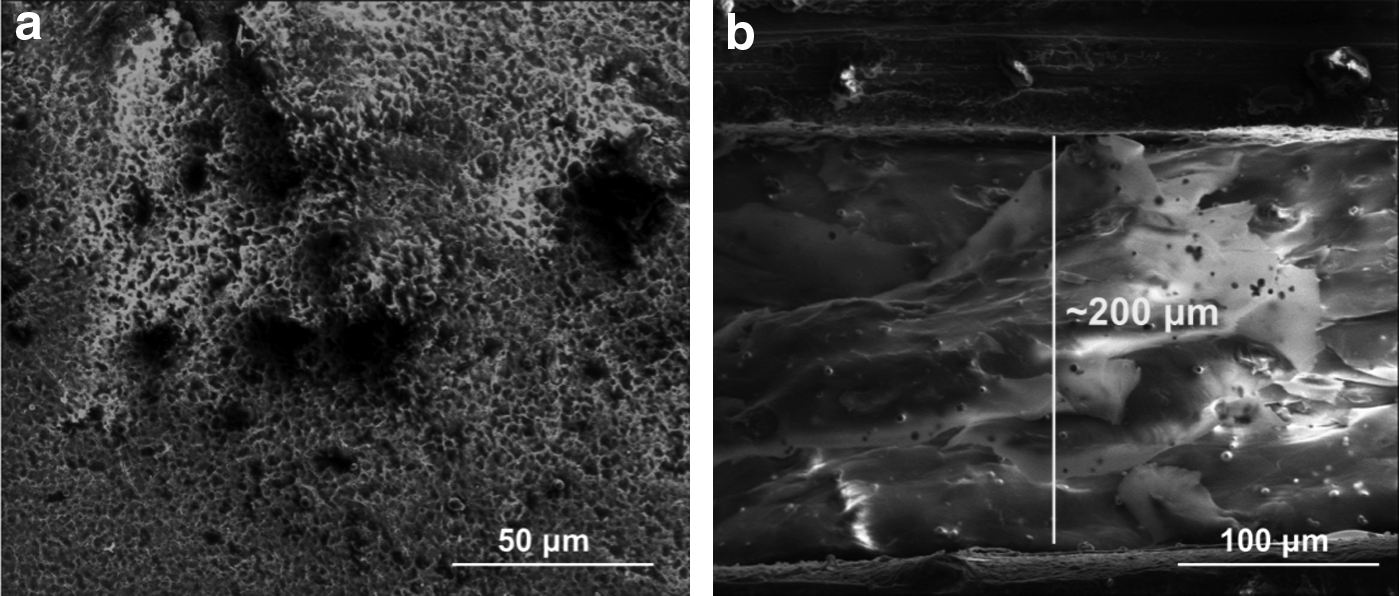
Scanning electron microscopy images of MnO2@cellulose film.
In our previous study, the crystal structure of 3D mesoporous MnO2 microspheres has been discussed (Peng et al., 2018). Through the combination of XRD and XPS, the crystal form of MnO2 nanometer microspheres is α phase. As given in Fig. 3a, the crystal structure of the pure cellulose film and the composite film after adding MnO2 microsphere were characterized by XRD. There are two diffraction peaks at 37° and 42° after adding a certain amount of MnO2 microspheres. These two peaks were the characteristic peaks of MnO2 in α phase. It is indicated that MnO2 microspheres have been successfully introduced into cellulose films. And there was no significant change in the crystal phase of MnO2 during the preparation of composite films.
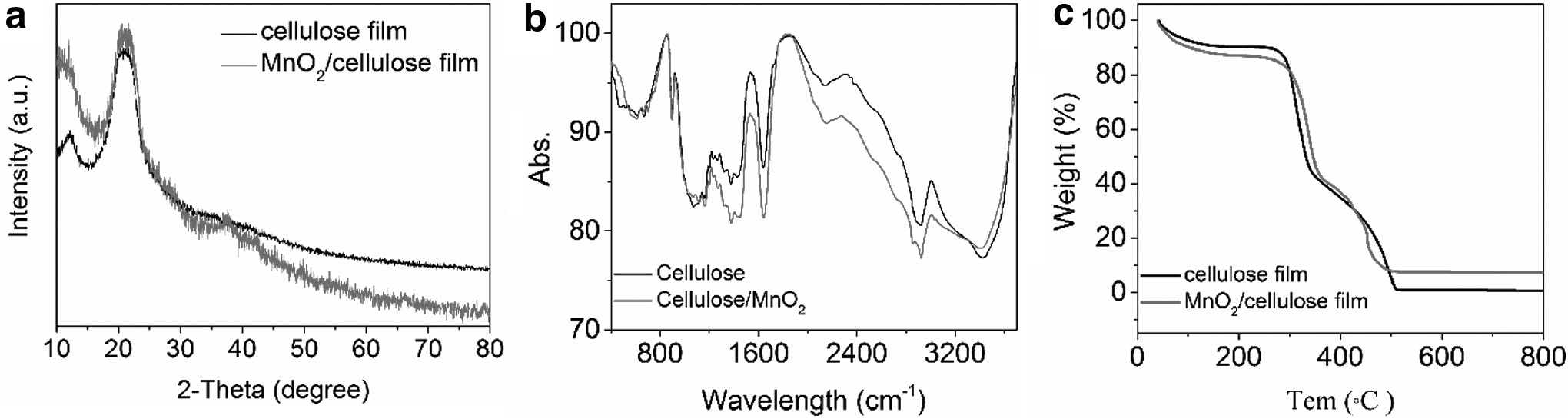
X-ray diffraction
FT-IR analysis can effectively characterize the chemical composition of organic matter according to the infrared response of different groups. We compared the infrared spectra of pure cellulose film and MnO2@cellulose composite film. Figure 3b shows that in 3,800 cm−1, 400 cm−1 wavelength range, the position of infrared characteristic peaks had no obvious change. Among them, 1,280 cm−1 peak is characteristic of C–O peak, 1,430 cm−1 is characteristic of C–C peak, the peak at 1,700 cm−1 is C═O stretching vibration peak, and 2,880 cm−1 peak is C–H stretching vibration peak. All the above characteristic peak types were derived from cellulose and were in accordance with the values reported in literatures (Hao et al., 2016; Xudong et al., 2016).
TGA can be used to analyze the thermal stability and composition of the compound. As given in Fig. 3c, TGA was used to accurately measure the mass of MnO2 in the composite film. Figure 3c shows the pure cellulose film at 500°C after its quality dropped to zero. For the MnO2@cellulose composite film, its quality was no longer down after 500°C. As the final steady at 8%, it indicated that this final 8% of the remaining quality should be the quality of the low manganese oxide breakdown of MnO2.
Surface properties of the film were studied and characterized by XPS and the results are given in Fig. 4. Comparing MnO2@cellulose composite film with the pure cellulose film in Fig. 4a, it can be seen that all the peaks were consistent except the peak at ∼650 eV. The binding energy of Mn element is given in Fig. 4d, the extra peak in the full spectrum composite film of XPS belonged to 2p peak of the Mn element. Thus, it indicated that the presence of MnO2 was in composite film.
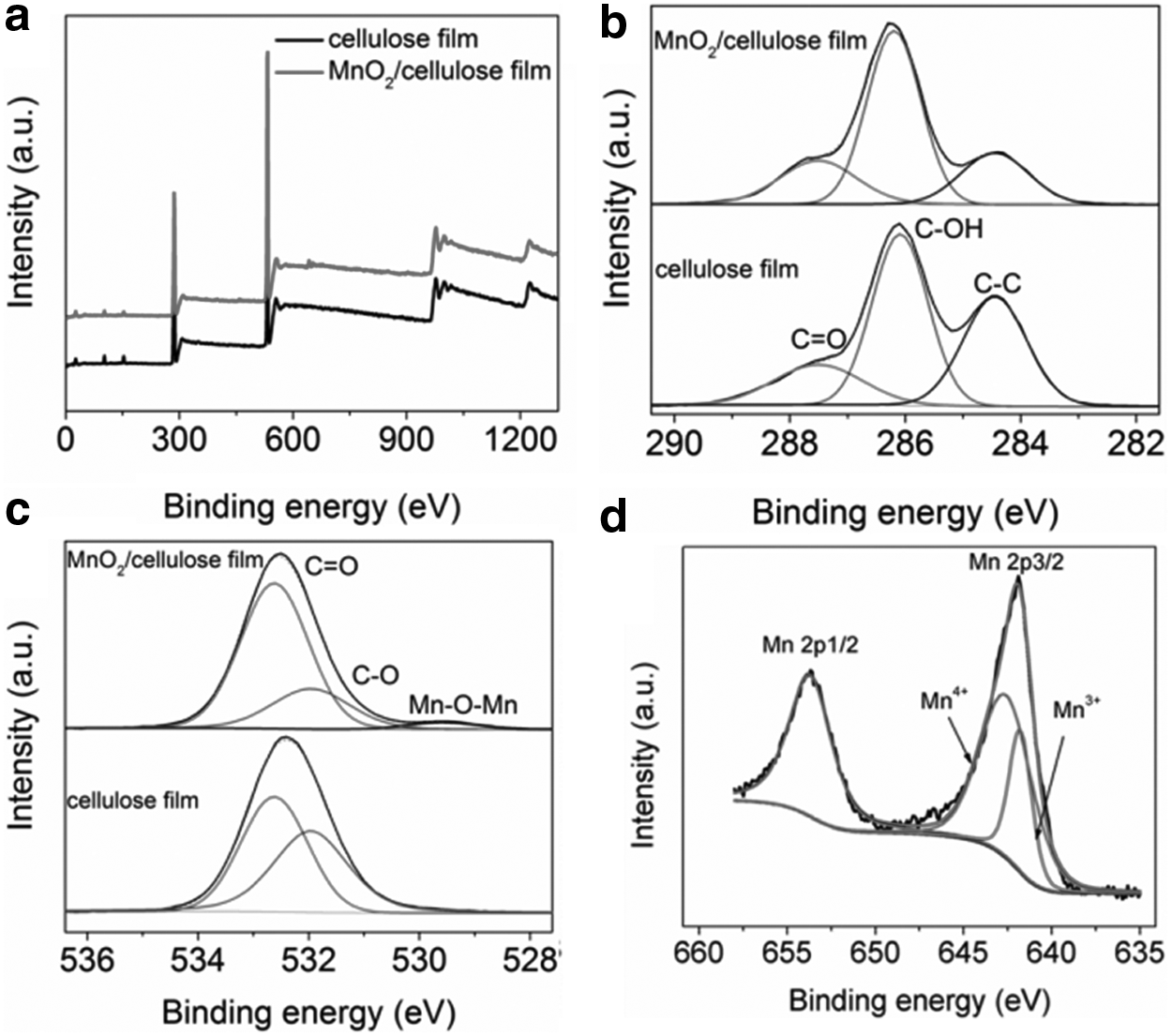
X-ray photoelectron spectroscope patterns of cellulose film and cellulose/MnO2 film,
The change of binding energy of elements C, O, and Mn is analyzed in detail hereunder. First, as cellulose was composed of elements C and O, both composite films contain element C. By the use of XPS peak segmentation software, the peak of C element can be divided into three peaks with different binding energies, which are 284.6, 286.4, and 287.7 eV, respectively. According to the literature (Zhu et al., 2014; Heitmann et al., 2016), these three peaks correspond to the characteristic peaks of C–C, C–OH, and C═O, and the characteristic peaks of the three C1s are consistent with the type of C contained in cellulose. For the analysis of O element, it can be seen that the O1s of pure cellulose film contains two types: one is C–O (531.9 eV) and the other is C═O (532.8 eV). The type of O represented by the binding energy is also consistent with the literature. It is worth noting that there is a significant peak at the binding energy of 529.6 eV in the composite film of MnO2@cellulose, which represents the type of O named Mn–O–Mn bond in MnO2 (Liu et al., 2016a). Finally, manganese element in the composite film analyzed showed that Mn2p characteristic peak can be divided into Mn2p 1/2 and Mn2p 3/2. Because of the defect of the surface of MnO2, the Mn2p 3/2 of peak can be divided into two peaks that represents the +3 valence of manganese at peak of 641.2 eV and +4 valence at the peak of 642.6 eV (Si et al., 2015; Liu et al., 2016b). Researches show that there is different valence of Mn because of the presence of the manganese surface defects. As a result, there are a lot of surface oxygen owing to the existence of +3 valence of Mn surface that can enhance the catalytic oxidation properties (Bai et al., 2015; Najafpour and Allakhverdiev, 2015). It indicated that there is an advantage of the MnO2@cellulose film as a catalyst for catalytic degradation of organic dyes.
To evaluate the removal effect of acidic orange by pure cellulose film, the dye concentration was selected as 30 mg/L and pH = 2.16. As given in Supplementary Fig. S1, the pure cellulose film has a certain adsorption effect on the acidic orange dye. It can be seen that the adsorption speed was fast in the first 50 min, and then gradually slowed down. The adsorption tended to be saturated after 90 min. Cellulose film also changed from colorless transparent to orange as the adsorption amount of 18%.
Under the same test conditions, the dye was degraded by the MnO2@cellulose composite film. The absorption curve of the AO in the solution was tested by the UV-visible spectrophotometer. As given in Fig. 5a, with the increase of reaction time the absorption value of acidic orange in the solution gradually decreased. After 90 min, the removal rate of acidic orange dye can reach 76.1%. Compared with pure cellulose film, the removal effect of dye has been greatly improved. To investigate the removal behavior of AO containing chemical degradation process, we measured the TOC of AO in the removal process. As given in Supplementary Fig. S2, the TOC of AO after 90 min was 49.7%. From the result of UV-visible spectrum, the removal rate of AO was ∼76.1% compared with the initial rate. The concentration change of AO was different from these two measurements. These results illustrated the incomplete mineralization of AO molecules and obtaining some by-products with smaller molecular weight.
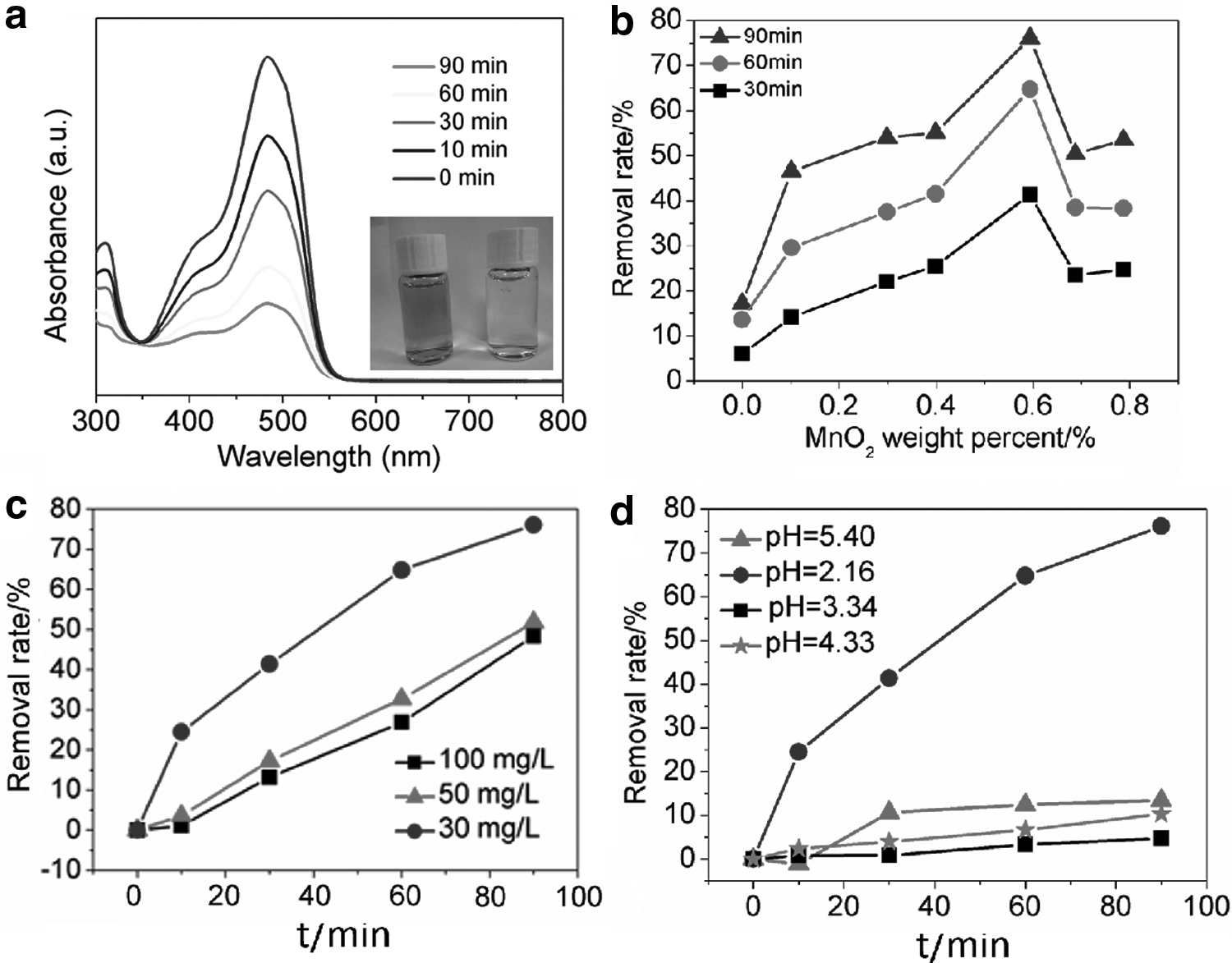
Removal performance of the dye on different MnO2 loads was further tested under the same conditions. It can be seen from Fig. 5b that the concentration of MnO2 is within the range of 0–0.6% (atomic ratio). At the same time, the higher the content of MnO2 reached, the higher the removal rate for the faster reaction rate. There was an obvious drop when the concentration was >0.6%. It found that 0.6% of MnO2 concentration was the optimum concentration. When the concentration was >0.6%, an excess of MnO2 has blocking effects on catalytic degradation. The reason was that the high concentration of catalyst led to the reduced dye effective contact area. At the same time, the removal efficiency became weak for the dye adsorption of film space decreases.
The initial concentration of dye is an important factor affecting degradation. The effect of the initial concentration of three different dyes (30, 50, and 100 mg/L) on the removal effect is given in Fig. 5c. It can be clearly seen that the removal rate of dye concentration at 30 mg/L is the highest under the same MnO2 content and the same reaction conditions. After reaction for 90 min, the removal rate of the initial dye concentration was 76.1%, 51.8%, and 48.3% from low to high, respectively.
The pH value is another important factor affecting the catalytic performance of the catalyst. As can be seen in Fig. 5d, the reaction reached the fastest rate at pH = 2.16. The removal rate decreases significantly when pH increases. It is speculated that the change of pH will change the surface potential and charge density of MnO2, and thus affect the adsorption effect of the dye.
To explore the stability of MnO2@cellulose film in the degradation process, XRD of cellulose film before and after degradation of dye was characterized. As given in Supplementary Fig. S3, the crystal structure of MnO2@cellulose composite film did not change in degradation of dye before and after, the peak strength also had no obvious change. The film was very stable in acidic dyes for its crystal type did not have any effect.
Because the surface property determines the catalytic activity of the catalyst, XPS was used to characterize the surface information of pure cellulose film and MnO2@cellulose composite film before and after dye degradation. As compared with the C1s and O1s peaks in Supplementary Figs. S4 and S5, it was found that the surface of C and O on both pure cellulose film and MnO2@cellulose film has no obvious change before and after the dye degradation. In other words, it is one of the reasons that the film can be reused.
To investigate the recycling performance of MnO2@cellulose film in dye treatment, the prepared composite films were reused to treat AO with a concentration of 30 mg/L six times. The removal rate of acidic orange after reaction for 90 min is given in Supplementary Fig. S6. It can be seen that after repeated use of six times, the composite film always maintained similar catalytic efficiency. This also indicated that the prepared film has strong stability and can be reused many times. High catalytic activity and stability can guarantee the efficiency when the catalyst degrades the dye.
Conclusion
In this study, to solve the recycle problem of catalyst, a facile method “alkali/urea water system freezing and thawing method” was demonstrated to dissolve cellulose and successfully loaded 3D mesoporous MnO2 with cellulose base. The composite film (200 μm) composed of MnO2 microspheres and the reticular structure of cellulose. The MnO2 microspheres are uniformly attached between these reticular structures. The structural composition and surface characteristics of the composite film were investigated in detail. The composite film was used to degrade AO in printing and dyeing wastewater. Compared with pure cellulose film, the composite film of MnO2@cellulose had a better catalytic degradation performance. At the same time, the stability of the catalyst was also characterized. It concluded that they not only have good catalytic degradation of performance, but also the MnO2@cellulose composite film has solved the catalyst recycling problems. Most importantly, this MnO2/cellulose film was easily recycled and the retrievability was the fundamental of the applications.
Footnotes

References
Supplementary Material
Please find the following supplemental material available below.
For Open Access articles published under a Creative Commons License, all supplemental material carries the same license as the article it is associated with.
For non-Open Access articles published, all supplemental material carries a non-exclusive license, and permission requests for re-use of supplemental material or any part of supplemental material shall be sent directly to the copyright owner as specified in the copyright notice associated with the article.
