




Abstract
Abstract
In this study, four reactors named as R1 (control reactor), R2 (fed with 40 nm CuO-NPs), R3 (fed with 200 nm CuO-NPs), and R4 (fed with Cu(II)) were adopted to investigate the influence of CuO-NPs with different particle size on the nitrogen removal and microbial community of the Anaerobic ammonium oxidation (Anammox) process. Compared with the control reactor, the total nitrogen removal rate decreased to 0.2 and 0.43 kg/(m3·d) in R2 and R3, respectively, but it increased from 0.63 kg/(m3·d) to 0.77 kg/(m·d) in R4. Proportions of anaerobic ammonia-oxidizing bacteria R4 (12.88%) >R1 (12.37%) >R3 (8.03%) >R2 (2.52%). Results indicated that Cu(II) promoted Anammox bioactivity, whereas CuO-NPs had a significant inhibitory effect; the NPs with smaller size exhibited more severe effects, whereas the results verified that the suppression of Anammox by CuO-NPs was not due to the released Cu(II), but the nanoscale effect of the NPs, and the smaller particle size exhibited a more severe impact.
Introduction
Anaerobic ammonium oxidation (Anammox) process has been applied in many countries as an efficient and energy-saving nitrogen removal wastewater treatment process (Niu et al., 2016). Its main feature is the direct conversion of nitrite and ammonia to nitrogen gas without organic consumption, under anaerobic condition (Yuan et al., 2015). Compared with the traditional nitrification-denitrification process, the Anammox process has a shorter pathway, less oxygen demand, and lower excess sludge production (Zhang et al., 2018b).
However, the functional bacteria, anaerobic ammonia-oxidizing bacteria (AAOB) are very sensitive to the fluctuation of external conditions, such as dissolved oxygen (DO) (Mukarunyana et al., 2018), temperature (Rush et al., 2014; Li et al., 2017; Sun et al., 2018), pH (Peng et al., 2017), and organic matter content (Guo et al., 2015), all of which would cause the instability of the process. In actual application, it is relatively difficult to achieve the optimum condition for the growth of AAOB.
With the rapid development of nanotechnology, artificial nanomaterials have been widely used in energy, medicine (Bi et al., 2018), military (Chen et al., 2017), environmental protection, and other fields (Peralta-Videa et al., 2011). Nanomaterials have inevitably entered into the wastewater and been proved to be toxic to the Anammox process (Song et al., 2018; Zhang et al., 2018a; 2019). Among the massive utilized nanomaterials, copper oxide nanoparticles (CuO-NPs) have attracted much attention due to their unique physicochemical properties and massive applications (Wang et al., 2017b). During the process of its production and application, the particles could be released into the soil and water, which would then cause potential toxicity to the environment (Troester et al., 2016).
Miao et al. (2016) studied the migration behavior of CuO-NPs in the wastewater matrix and its effects on the microbial activity of wastewater biofilms. It was concluded that CuO-NPs significantly inhibited the respiratory activity of the outermost microbial cells of the biofilm. The biofilm secreted more Extracellular Polymeric Substances (EPS), and the proteins (PRO) were higher than the polysaccharides (PS) because of the significant inhibition by CuO-NPs. The results of Hou et al. (2016a) showed that the activities of nitrite reductase and nitrate reductase were naturally reduced with 50 mg/L CuO-NPs being exposed in a sequencing batch biofilm reactor. Wang et al. (2017a) examined the SBR performance and arrived at the conclusion that the reactor had no evident change at 0–10 mg/L CuO-NPs; however, the COD, nitrogen, and phosphorus removal was significantly decreased in 30–60 mg/L.
In addition, after CuO-NPs entered into the water, copper ions (Cu(II)) may be released, which also has an effect on Anammox. Zhang et al. (2018b) indicated that Cu(II) released from NPs in the influent exhibited good correlations with the variations of community structure and sludge properties on Anammox bacteria in wastewater. It was reported that Cu(II) also had a significant impact on Anammox performance. The kinetic study results of Tang et al. (2018) showed that the presence of Cu(II) imposed a pronounced inhibition nitritation process with half inhibition concentrations of 6.7 mg/L, increased the affinity constant affinity by 2.36 times, indicating that the affinity of the substrate NH4+ for nitrosated microorganisms was significantly reduced, resulting in ineffective removal of NH4+ in the wastewater.
All the previous studies suggested the significant impact of CuO-NPs on the Anammox process. However, the NPs had different size, whether the particle size had a different impact on the Anammox process, and the relationship between the impact of CuO-NPs and the nanoparticle size or the released Cu(II) was still not identified.
In this study, the effect of the particle size of CuO-NPs on the Anammox process was investigated, by adopting 40- and 100-nm-sized CuO-NPs for long-term effect experiments. In addition, a low-concentration Cu(II) comparative experiment was established to make clear the impact mechanism of CuO-NPs on the Anammox process.
Materials and Methods
Experimental setup
The Anammox process was high-rate operated and exhibited steady performance in the parent reactor for more than 1 year. As shown in Fig. 1, the sludge in the parent reactor was equally divided and inoculated to four identical reactors named R1, R2, R3, and R4, respectively, with the effective volume as 1 L. The initial mixed liquor suspended solids of each reactor constituted 7.42 g/L. In these reactors, the operational conditions were totally the same as the parent reactor; the only difference was that 1 mg/L CuO-NPs in 40-nm size were fed for R2, 1 mg/L CuO-NPs in 200 nm size were fed for R3, and 0.1 mg/L Cu(II) was fed for R4. Before the experiment in this study, a Cu(II) release test in the experimental wastewater was carried out. The result showed that 1 mg/L CuO-NPs released about 0.1 mg/L Cu(II). R1 was set as the control reactor, without CuO-NPs or Cu(II) feeding.

Experimental device (1) Power switch; (2) Speed controller; (3). Blender.
The synthetic wastewater contained (in g/L): (NH4)2SO4 0.377, NaNO2 0.493, NaHCO3 2.014, MgSO4·7H2O 0.150, CaCl2 0.068, KH2PO4 0.068, and 1 mL/L trace element solution. Ammonia and nitrite concentrations in influent were set as 80 and 100 mg/L, respectively. Other operational conditions of the four reactors are summarized in Table 1.
Operational Conditions and Wastewater Components
The whole experiment was divided into two stages: (1) Short-term experiment (4 h, triple); (2) long-term experiment (64 cycles, each cycle contained: influent 5 min, reaction 5 h, settlement, 0.5 h, standing, three cycles daily).
EPS determination
Sludge obtained from R1, R2, R3, and R4 before and after the long-term experiment was used to evaluate the effect of CuO-NPs on the EPS secretion. EPS was extracted and then analyzed the PS and PRO, according to the previous study (Hou et al., 2016b). The concentrations of PS in extracts were measured by using the anthrone acid method, and the concentrations of PRO were measured by using the Flint-phenol method (Miao et al., 2017).
Specific Anammox activity detection
Before the long-term experiments, the reaction rates of each reactor in the short-term exposure in CuO-NPs with different particle sizes were examined. The reaction time for each reactor was 4 h, and other operational conditions were the same as those for long-term experiments. Each experiment was triply detected, and the average results were used to calculate the Specific Anammox activity (SAA) as Equation (1):
Analytical methods
Concentrations of NH4+-N were analyzed by using Nessler's reagent method in the spectrophotometer, NO2−-N was measured by using the N-1-Naphthylethylenediamine dihydrochloride colorimetric method, and NO3−-N was measured by using the ultraviolet spectrophotometric method. The temperature and pH were detected by using portable instruments with specific probes (WTW, Germany). Ammonia removal efficiency (ARE), nitrite removal efficiency (NRE), total nitrogen (TN) removal efficiency (TRE), TN removal rate (NRR), and endogenous denitrification ratio (EDR) were calculated as Equations (2), (3), (4), (5), and (6), respectively.
For the copper contents, three different parts, including the copper in effluent, EPS, and copper in sludge, were detected, respectively. After the EPS was extracted, the EPS was used to detect the copper content, whereas the residual sludge was digested with strong acid and then diluted to detect the copper content in sludge. The copper concentration was measured by atomic absorption spectrometry (Jena, ZEEnit700p, Germany).
High-throughput sequencing
Sludge samples obtained from each reactor at the end of the experiment on cycle 64 were used for high-throughput sequencing. The DNA of each sludge sample was extracted and qualified, before being sequenced by Sangon Company in the Miseq sequencing platform. The obtained sequences were blasted in Silva database.
Results and Discussion
Short-term effect on SAA
Before analyzing the long-term effects of CuO-NPs with different particle sizes on the system, ARE, NRE, and SAA were determined in different reactors. The average results of the short-term experiment are shown in Fig. 2. Compared with R1, R2, and R3, the effect of CuO-NPs with different particle sizes on the Anammox process was investigated. It is manifestly shown in the figure that the effluent concentrations of ammonia nitrogen and nitrite nitrogen in R2 and R3 were higher than those of R1. After calculation, ARE of R1, R2, and R3 were 47.52%, 36.46%, and 44.69%, and NRE were 49.77%, 36.92%, and 48.47%, respectively. Both ARE and NRE were lower than those of R1, indicating that CuO-NPs in different size had inhibitory effects on the Anammox process.
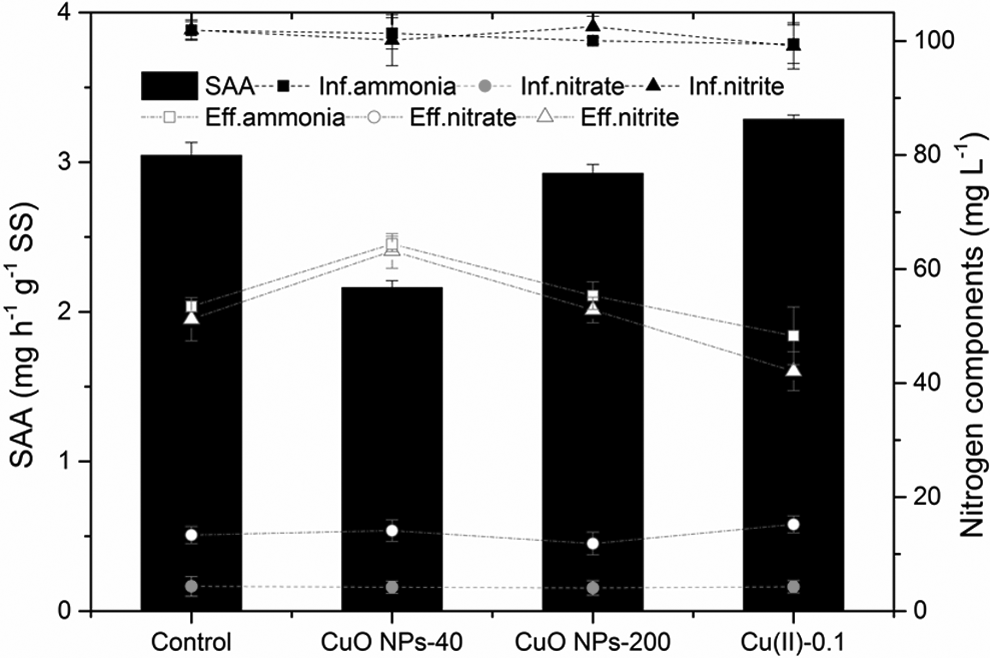
Reaction rates and SAA under different condition. SAA, Specific Anammox activity.
At the same time, Fig. 2 showed that the SAA of R2 was much lower than R1 and that of R3 was slightly lower than R1, indicating that the activity of AAOB was inhibited in R2 and R3, resulting in a slow rate of ammonia oxidation. Comparing R2 with R3, it was observed that the inhibition effect of CuO-NPs in 40 nm was much greater than that of CuO-NPs in 200 nm. In addition, the SAA of R4 was 3.29 mg/(h·g) SS, which was slightly higher than that of R1 (3.05 mg/[h·g] SS). Results by Zhang et al. (2017b) showed that the CuO-NPs were not effected on Anammox; it was because Zhang's test methods and operating conditions were different than this experiment. In R4, ARE and NRE reached 51.45%, and 57.56%, respectively, indicating that the Cu(II) could slightly promote the activity of the AAOB in the system, as well as increased the endogenous denitrification.
Zhang et al. (2019) stated that short-term exposure in 1 mg/L Cu(II) promoted Anammox, whereas long-term exposure in Cu(II) significantly suppressed AAOB and lowered NRR to 0.218 kg/(m3·d). Simultaneously, Tang et al.'s (2018) research also showed that Cu(II) has an inhibitory effect on ammonium oxidizing bacteria (AOB). However, the result in present study showed that Cu(II) slightly promoted the Anammox bioactivity. The possible reason was that the (CuII) concentration was lower than that in previous studies. Copper is an essential trace element for microbial growth. The addition of a small amount of copper can promote microbial activity. Comparing R2, R3, and R4, it was found that the CuO-NPs have an inhibitory effect on the system, whereas the Cu(II) has a promoting effect, so it was speculated that it was not the released Cu(II) but the nano-effect of CuO-NPs that inhibited the Anammox process.
Long-term effect of CuO-NPs with different particle size on the system
Four identical reactors were used for long-term experiments. The nitrogen components variation and NRR during the 64 cycles are depicted in Fig. 3. The ammonia and nitrite concentration in the synthetic wastewater was about 80 and 100 mg/L, respectively, but due to the remaining water in the reactor of each cycle, the initial ammonia and nitrite concentration of each reactor was slightly different. In R1, the control of reaction conditions was the same as that of the parent reactor, and the nitrogen removal performance did not change much during the entire reaction. The influent ammonia nitrogen and nitrite nitrogen was ∼81.2 and 98.1 mg/L, respectively, and the effluent ammonia nitrogen, nitrite nitrogen, and nitrate nitrogen were 40.1, 46.9, and 11.12 mg/L, respectively.

Reactor performance under different condition.
Half of the ammonia nitrogen and nitrite nitrogen were consumed, indicating that a small portion of nitrate nitrogen was obtained. The average results of ARE, NRE, and EDR in R1 were 50.5%, 52.1%, and 3.34%, respectively. The consumption ratio of ammonia nitrogen to nitrite nitrogen was 1:1.25, and the average NRR was 0.53 kg/(m3·d). The results showed that AAOB in the reactor was the principal functional group; its activity was good and stable, and the nitrogen removal effect was noticeable, but the generated amount of nitrate nitrogen was too small, indicating that the produced nitrate nitrogen was used by microorganisms and the endogenous denitrification reaction reduced.
In R2, 1 mL of 40 nm CuO-NPs with a concentration of 1 g/L was added before each cycle, to investigate the long-term effects of CuO-NPs (40 nm) on the system. The effluent ammonia nitrogen and nitrite nitrogen concentration became higher and higher with the operation, ARE decreased from the initial 63.9% to 32.5%, NRE decreased from 60.9% to 0%, and NRR decreased from 0.63 to 0.2 kg/(m3·d) at the end of the experiment. This result showed that CuO-NPs (40 nm) had an inhibitory effect on the Anammox process. The EDR of R2 was 3.23%, which was lower than that of R1, indicating that the endogenous denitrification was inhibited by CuO-NPs (40 nm), which decreased the consumed nitrate by an endogenous denitrification reaction and, in turn, decreased the NRR.
During the entire experiment, the NRR dropped rapidly in 1–35 cycles, and it stabilized at 0.2 kg/(m3·d) in the 36–64 cycles. The results showed that the inhibition on AAOB was more evident with the continuous accumulation of CuO-NPs in the reactor, and the inhibitory effect of CuO-NPs on AAOB no longer increased after accumulating to a specific concentration. The effluent nitrite was equal to the influent nitrite concentration after the 35th cycle, indicating that the production of nitrogen was greater than the consumption since endogenous denitrification existed in the system. The activity of denitrifying bacteria was inhibited, resulting in the reduction of TN removal.
In R3, 1 mL of CuO-NPs (200 nm) with a concentration of 1 g/L was added before each cycle to investigate the long-term effect of CuO-NPs (200 nm) on Anammox systems. In Fig. 3, it could be seen that the effluent ammonia nitrogen and nitrite nitrogen concentration increased with the operation, and the NRR decreased from 0.64 to 0.43 kg/(m3·d). The EDR was 5.39%, which was about two percentage points higher than that of R2. It showed that most of the nitrate nitrogen was utilized by the microorganisms themselves, under the influence of CuO-NPs (200 nm). Although the proportion of nitrate nitrogen was small, the results still showed an inhibitory effect that was much lower than that of CuO-NPs (40 nm) on the Anammox process.
In R4, 0.1 mL of Cu(II) with a concentration of 1 g/L was added before each cycle. In Fig. 3, the effluent ammonia nitrogen and nitrite nitrogen concentrations were slowly reduced; ARE, NRE, and EDR reached 72%, 74%, and 4.98%, respectively; TRE also reached about 68%; and NRR rose from 0.60 to 0.77 kg/(m3·d). This demonstrated that the Cu(II) promoted the activity of AAOB, which was consistent with the SAA results in the short-term effect on the SAA section.
After the data analysis of the four reactors, the conclusions reached were consistent with the conclusions drawn from the short-term experiments. Compared with R1, R2, and R4, CuO-NPs dramatically inhibited Anammox whereas Cu(II) significantly promoted it, which proved that the inhibitory effect of CuO-NPs on AAOB was not caused by the released Cu(II), but by the nano-effect or the role of CuO itself. Compared with R2 and R3, the inhibitory effect in R3 was significantly lower than that of R2, indicating that the CuO-NPs (40 nm) had a stronger inhibitory effect on the reaction, further confirming that the AAOB was severely inhibited due to the nano-effects, and the smaller CuO-NPs had a more severe inhibitory effect on the Anammox process.
EPS and copper content
The leading role of EPS was to help cells not only adsorb nutrients but also resist the hazards of fungicides and toxic substances on cells (Yuan et al., 2017). In this experiment, the variation of EPS before and after the addition of CuO-NPs is shown in Fig. 4 to discuss the effect of CuO-NPs in different particle sizes on AAOB. Comparing Fig. 4a and b, the PS concentration in the four reactors reduced after 64 cycles, whereas the PRO concentration increased. The reason was that the activated sludge secreted more PRO when it entered into the new environment (Menniti et al., 2009). In Control, the EPS in Cycle 0 and 64 was 22.87 and 22.20 mg/g SS, respectively, without significant variation. For R2, R3, and R4, the EPS concentration increased by 28.3%, 41.7%, and 31.6%, respectively, at the end of the experiment.

EPS under different conditions
Combined with the nitrogen removal of R2 and R3 reactors, CuO-NPs accumulated in the reactor with the operation. To counteract the inhibitory effect of CuO-NPs on AAOB, a significant amount of PRO was produced. CuO-NPs (200 nm) inhibition was much less than that of CuO-NPs (40 nm). Therefore, more microbes produced EPS, and this resulted in a higher EPS than R2. The Cu(II) added in R4 stimulated the microorganisms in the activated sludge to secrete EPS that increased from 23.91 to 31.46 mg/g SS; improved the adsorption and treatment of ammonia, nitrogen, and other pollutants by the AAOB. As a result, the nitrogen removal of the reactor was increased.
Sludge samples were taken before and after the experiment to determine the copper ion concentration. In seed sludge, the copper content in effluent and sludge was 0.38 mg/L and 2.53 mg/g, respectively. Those in R1 was 1.43 mg/L and 15.27 mg/g, R2 was 1.49 mg/L and 35.03 mg/g, R3 was 2.68 mg/L and 42.23 mg/g, and R4 was 1.56 and 17.03 mg/g. It could be possible to conclude that the addition of CuO-NPs led to the copper content increasing in sludge, which consists of EPS and sediment. The metal ions in each reactor are presented in Table 2.
Copper in Sludge of Each Reactor with Different CuO-NPs Addition
The concentration of metal ions in the activated sludge increased in the four reactors after being operated for 64 cycles. The concentration of Cu(II) in the extracted EPS slightly increased, and EPS of microorganisms adsorbed Cu(II) to withstand the toxic effect of Cu(II). With the accumulation of Cu(II) in the Anammox system, microorganisms produced more EPS to adsorb Cu(II). EPS no longer increased whereas a large amount of Cu(II) entered into the cell to affect it until saturation. Once the Cu(II) entered into the cell, Cu(II) sequestered the sulfhydryl group, destroyed the heme c and the enzyme, and finally caused intracellular metabolic disorders of the functional microorganism (Zhang et al., 2015). Due to its small particle size, nano-sized CuO is more likely to enter into the cell and accumulate, thereby inhibiting microbial activity.
Mass balance of copper was analyzed in the four reactors (Supplementary Data). In R1, the copper proportion in effluent, EPS, and sludge was 1.55%, 0.39% and 98.06%, respectively. In R2, with the addition of CuO-NPs (40 nm), the ratio of the three parts was 0.53%, 0.3%, and 99.17%, respectively. However, it was 1.06%, 2.17%, and 96.77% in R3, respectively, with the addition of CuO-NPs (200 nm). The higher content in the sludge of R2 with CuO-NPs (40 nm) was due to the CuO-NPs (40 nm) particle being more easily aggregated as precipitates and accumulated into the sludge.
The particle size of CuO-NPs (200 nm) is larger than that of CuO-NPs (40 nm), so more CuO-NPs were discharged from the reactor through the effluent or adsorbed by EPS, and they could not enter inside the cell. Even if the metabolic disorder of intracellular functional microorganisms was caused, the extent was much lower than that of CuO-NPs (40 nm). On the other hand, the experimental results showed that the CuO-NPs (40 nm) had a more severe inhibitory effect on the reactor. The trace amount of Cu(II) added to the R4 reactor resulted in the copper ratio in effluent, EPS, and sludge as 1.37%, 0.62%, and 98.01%, respectively, which further indicated that the inhibitory effect on the reactor was not the Cu(II), but the nanoscale effect of the CuO-NPs.
Microbial community
The sludge samples were obtained from the four experimental reactors at the end of each experiment, for high-throughput pyrosequencing analysis. The detected sequences numbers were 45,689, 57,813, 43,311, and 44,445 and the OTUs were 670, 731, 668, and 617 of the sequences, respectively for the four reactors. It was observed that the CuO-NPs (200 nm) and Cu(II) led to the OTUs increase, whereas the CuO-NPs (40 nm) addition led to a decrease. The Shannon index decreased, which was 3.86, 3.66, 3.78, and 3.69, respectively, indicating that the microbial biodiversity and distribution uniformity reduced due to the presence of CuO-NPs and Cu(II). The effect of CuO-NPs (200 nm) was slighter than CuO-NPs (40 nm) and Cu(II) on the regional diversity of microorganisms. The Chao1 index was increased due to the addition of CuO-NPs (40 nm) and CuO-NPs (200 nm), whereas it decreased due to the Cu(II) addition, which was 855.44, 938.01, 894.23, and 752.20, respectively.
The predominant phylum in the four reactors was Proteobacteria, Planctomycetes, Gemmatimonadetes, Bacteroidetes, and Chloroflexi. Taking Planctomycetes and Proteobacteria as an example, Planctomycetes abundance was lower in R2 and R3, but was significantly higher in R4, when compared with R1. Compared with R2 and R3, the result showed that R3 was higher than R2, which showed that the inhibition of CuO-NPs (40 nm) on Planctomycetes was more sever. The Proteobacteria in R2 and R3 had different degrees of increase under the influence of CuO, and the proportion of R2 was higher than that of R3. The effect of Cu(II) on the Anammox was not visible. Combining Shannon index, Chao1 index, and detected sequences comparison analysis, the inhibitory effect of CuO-NPs resulted in a decrease in the biodiversity of Anammox system, and the increase in their richness was mainly an increase in the same species of microorganisms.
Fig. 5 showed the variation in the proportion of the top 50 microbial bacteria at genus level. The genus of microorganisms such as Denitratisoma, SM1A02, Candidatus kuenenia, Nitrosomonas, Ignavibacterium, Arenimonas, Candidatus brocadia, Truepera, and Blastocatella was more apparent. Combined with the proportion of the main functional bacteria in the Anammox process shown in Table 3, two AAOB genera were detected, including C. kuenenia and C. brocadia, and the ratio was close to 2:1. AOB mainly consisted of two genera Nitrosococcus and Nitrosomonas, of which Nitrosomonas was the principal genus. The proportion of Denitratisoma was higher than that of AAOB and AOB, but endogenous denitrification was not evident in the four reactors.

Taxonomic result in and genus level of each reactor.
Relative Abundances of the Nitrogen Removal Main Microorganisms in Different Reactors
AOB, ammonium oxidizing bacteria; AAOB, anaerobic ammonia-oxidizing bacteria.
Simultaneously, it was possible to detect the DNA sequence of the microbial flora, in spite of the microbial inactivation. So the proportion of Denitratisoma was relatively large, and endogenous denitrification was not the primary reaction of the reaction system.
As shown in Table 3, the proportions of C. kuenenia, C. brocadia, Nitrosomonas, Nitrosococcus, and Denitratisoma in R1 were 8.29%, 4.08%, 4.32%, 0.09%, and 23.46%, respectively. Comparing R2 with R1, the two genera of AAOB decreased considerably; AOB and Denitratisoma increased to varying degrees. The results showed the severe toxicity of CuO-NPs (40 nm), which caused a significant decrease of AAOB, and resulted in the deterioration of nitrogen removal. Nitrification occurred and ammonia was oxidized to nitrite and accumulated because the activity of AOB was promoted by CuO-NPs (40 nm) in the reactor.
CuO-NPs may have an inhibitory effect on the whole microorganism, but the degree of inhibition on AOB was lighter, so the calculated relative abundance was increased. Moreover, nanoparticles can enhance oxygen transfer, and in low concentrations can promote AOB activity (Zhang et al., 2017a). Even some Denitratisoma generated; the endogenous denitrification was not obvious, which was due to the environment not being completely anaerobic because DO in the air entered into the reactor. At the same time, due to the inhibitory effect of CuO-NPs, a large number of bacteria died, which was then provided as organic matter and, in turn, improved the endogenous response. The occurrence of endogenous nitrification consumed a large amount of nitrate, and the amount of nitrite produced in the reactor was higher than the amount of nitrite consumed, making NRR drop sharply in the reactor.
Comparing R3 with R1, the variation trend of each genus was the same as R2, but AAOB was much larger than that of R2, AOB was slightly lower than R2. These results showed that the inhibition of CuO-NPs (200 nm) was lower than that of CuO-NPs (40 nm). The ratio of Denitratisoma was 25.54%, and EDR was 5.39%, indicating that CuO-NPs (200 nm) had a lower inhibitory effect on Denitratisoma than CuO-NPs (40 nm). Comparing R4 with R1, C. brocadia, Nitrosomonas, and Denitamisoma all decreased to some extent, indicating that Cu(II) slightly inhibited these bacterial communities. Overall, the Anammox reaction was promoted, and the endogenous denitrification was enhanced in R4. The results in the microbial community further verified that the inhibition effect on the Anammox process was the nanoscale effect of CuO-NPs.
Conclusion
This study demonstrated that CuO-NPs had toxic effects on the Anammox process, resulting in the decrease of both nitrogen removal and microbial activity, whereas Cu(II) in the corresponding released concentration promoted the Anammox bioactivity. The inhibitory effect by NPs on AAOB was CuO-NPs (40 nm) >CuO-NPs (200 nm). After long-term experiments, the proportion of AAOB in the reactor with 200 nm CuO-NPs was higher than that with 40 nm CuO-NPs, whereas AOB showed the contrary result. The results verified from all aspects that the inhibition on the Anammox process by CuO NPs was due to its nano-effect rather than the released Cu(II).
Footnotes
Acknowledgments
This work was supported by the project of the National Natural Science Foundation of China (NSFC: Account No. 41701569) and the Open Project of Guangdong Province Key Laboratory of Microbial Signals and Disease Control (MSDC2017-14).
Author Disclosure Statement
No competing financial interests exist.

References
Supplementary Material
Please find the following supplemental material available below.
For Open Access articles published under a Creative Commons License, all supplemental material carries the same license as the article it is associated with.
For non-Open Access articles published, all supplemental material carries a non-exclusive license, and permission requests for re-use of supplemental material or any part of supplemental material shall be sent directly to the copyright owner as specified in the copyright notice associated with the article.
