




Abstract
Abstract
Desulfurization (deS) material is usually deactivated because elemental sulfur formed during deS and covers the material surface. In this study, a novel strategy was proposed for a continuous oxidization of hydrogen sulfide (H2S) by a sewage sludge-derived adsorbent without elemental-sulfur deposition. At temperatures <180°C, the sludge-derived adsorbent was deactivated and showed limited deS amount of 0.27 mmol/g at 60 min. Scanning Electron Microscope (SEM) and Fourier Transform infrared spectroscopy showed that carbon sites of the deactivated adsorbent were covered by elemental sulfurs. After the deactivated adsorbent was regenerated at 200°C, it showed a deS amount of 0.25 mmol/g again. On the contrary, at temperatures >180°C, the adsorbent achieved a stable deS without deactivation, resulting in a deS amount of 121.82 mmol/g at 20 h. In this case, yellow particles evolved from the adsorbent. X-ray diffraction and Thermogravimetric Analysis both proved that the particles were sulfur. Sulfur outflow was a key factor determining the regeneration of active carbon sites and continuous oxidization of H2S. This study will help the development of a low-cost adsorbent for H2S purification.
Introduction
During landfill process, anaerobic microorganisms degrade organics in waste and produce a large amount of landfill gas (LG), the main component of which is methane (Ozcan et al., 2009; Liu et al., 2017b). If LG was directly discharged into the atmosphere, it caused greenhouse effect and air pollutions (Wang et al., 2017a, 2017b). On the contrary, if LG was used as energy, the heat value reached 15–23 MJ/Nm3 (Dace et al., 2015). Thus, LG was a potential renewable and efficient resource. However, LG usually contains hydrogen sulfide (H2S), which corrodes equipment and damages human health (Bhatt et al., 2017). LG application had a strict regulation of H2S content. For example, if LG was used to generate electricity, the concentration of H2S was required to be <10 ppm to avoid corroding pipelines (Crespo et al., 2008). Therefore, an efficient method is urgently necessary to remove H2S from LG.
Dry desulfurization (deS) is a traditional method and widely used in industry. The main deS reagent is metal oxide (iron oxide, zinc oxide, etc.), zeolite, and activated carbon (Keller et al., 2001; Jung et al., 2003; Ozekmekci et al., 2015; Shah et al., 2017). Unfortunately, these reagents only had limited deS amounts, because they just reacted with H2S. Hence, they were required to be replaced frequently. To overcome this disadvantage, a catalytic method was proposed to remove H2S by reaction with O2, resulting in elemental sulfur (H2S + 1/2·O2 → 1/x·S x + H2O) (Zhang et al., 2015, 2018). However, this method still showed a big problem. No matter what kind of catalyst was used, the formed elemental sulfur (S0) covered the surface and deactivated the catalyst (Woo Chun et al., 1998; Zhang et al., 2015).
Thus, sulfur-derived deactivation is essentially solved for the development and application of deS catalyst.
On the contrary, sludge is the semisolid material that is a by-product during treatment of municipal wastewater. Sludge contains protein, fat, cellulose, and silica and is usually treated by incineration (Li et al., 2017). However, many works proved that thermal activated sludge was porous carbonaceous material (Zhai et al., 2008; Liu et al., 2017a). Besides, the porous structure was doped with metal oxide, which previously coexisted with organic matter in sludge. In other words, activated sludge was a hybrid of carbon and metal, which was close to the structure of metal-modified carbon (Ansari et al., 2005; Assima et al., 2018; Zhang et al., 2014).
As is well-known, carbon-based materials were effective in dry deS at low temperatures (300–400 K) (Bagreev and Bandosz, 2005). Compared with metal oxides, carbon-based materials were highlighted for their large specific surface areas, microporous structures, and surface-active groups, which were beneficial for deS (Bashkova et al., 2007). A carbon-based catalyst had abundant raw materials and was easily disposed after deactivation (Bagreev et al., 2001b). Moreover, after being doped with metal oxide, a modified carbon displayed better deS (Fang et al., 2013). Considering the components of activated sludge, it was a potential substitute for metal-modified carbon for deS.
Therefore, the main purposes of this study were to (1) obtain effective adsorbent from sewage sludge and apply it in adsorptive and oxidative removal of H2S; (2) improve running conditions to oxidize H2S and remove generated S0 at the same time. In this case, the sludge-derived material was feasible in continuous adsorption and oxidization of H2S; (3) characterize the sludge-derived material and product after deS to attain the mechanism for H2S removal.
Experimental Section
Material preparation
In this study, sewage sludge was supplied by Shanghai Taopu Sewage Treatment Plant in Shanghai, China. The dried sludge (denoted as S0) was detected by X-ray fluorescence (XRF) to obtain elemental contents. As a result, S0 mainly contained 33.30% of carbon, 34.01% of oxygen, and 13.27% of silicon. In addition, S0 also contained Fe, K, Mg, and Na. However, their total content was <7%. In brief, the following procedures were carried out to activate the sludge and produce an adsorbent.
First, S0 was ground through 100 mesh; second, the obtained particles were activated under an insert atmosphere of nitrogen for 2 h at temperature between 400°C and 900°C. According to our previous report, its specific surface area was ∼21.86 m2/g, which was close to that (36–37 m2/g) of a biochar derived from sludge (Feng et al., 2018; Wang et al., 2019). The activated sludge was denoted as S x (x stood for temperature). For example, S500 was the sludge sample activated at 500°C.
H2S removal
Removal of H2S was performed in a quartz reactor (inner diameter = 4 mm; length = 80 mm), which was heated by tubular furnace. Supplementary Figure S1 gives the schematic of this equipment in supporting information. In general, the reactor was set with 250 mg of activated sludge in each running. Before each test, nitrogen was used to flush the reactor to clean residual air. Then, the tubular furnace increased to a designed reaction temperature, including 120°C, 140°C, 160°C, 180°C, and 200°C. When the temperature was stabilized, 3,000 ppm of H2S (balance N2) flowed into the reactor and passed through the activated sludge at 50 mL/min. The residual H2S in outflow was absorbed by Zn(Ac)2 solution. This solution was finally detected by iodometric titration to calculate the removal capacity of H2S (deS amount, mmol/g) by activated sludge.
After reaction at each temperature, the sample was collected and denoted as uS x (x still stood for the activation temperature). Supplementary Figure S2 gives the duplicate tests (five times) of the above system, indicating a steady removal at a given temperature. Hence, most tests were carried out for only one time, except for deS amount lasting 30 min by S x at 200°C, which was carried out three times. In addition, two uS500 samples, which previously removed H2S at 120°C and 200°C, were calcined at 200°C. The evolved concentration of SO2 was detected by OPTIMA7 Handhold multigas analyzer (MRU Instruments). In this study, all gases were controlled by mass flowmeters (Beijing Seven-Star Electronics Co., Ltd.).
To investigate the influence of H2S concentration on deS, different concentration of H2S (500, 1,000, and 3,000 ppm and 3.3%, balance N2) was treated by same processes as in the previous text at 200°C. Furthermore, uS500 was thermal treated under nitrogen at 200°C for 2 h to remove potential covered elemental sulfur and regenerated the activated sludge. The regenerated sample was denoted as rS500, which was then used in deS again at 120°C and 200°C.
Characterizations
XRF-1800 was used to detect main elements and their contents in the sewage sludge. Carbon weight percentages were determined by CHN element analyzer (Jena EA). X-ray diffraction (XRD) was used to obtain structural information of deS product. The diffraction pattern was conducted on a Dmax/RB diffractometer (Rigaku Co.) with Cu Kα radiation (λ = 0.15406 nm) at 40 kV and 100 mA. deS product was also tested on a Thermogravimetric-Differential Thermal Analysis/Differential Scanning Calorimeter (TG-DTA/DSC) mass spectrometer (NETZSCH, STA 449C plus Jupiter-QMS 403C Aeolos). In the process, the sample was heated to 1,000°C under nitrogen atmosphere at a heating rate of 10°C/min. The morphology was characterized by SEM equipped with an electron-probe microanalyzer for element mapping (Nova NanoSEM430).
Results and Discussion
Feasibility of sludge-derived adsorbent in H2S removal
Figure 1 gives the deS amounts for 30 min by S x (x = 400, 500, 600, 700, 800, and 900). When the activation temperature increased to 700°C, deS amount increased from 0.26 mmol/g (S0) to 0.66 mmol/g (S600). However, when the activation further increased to 800°C and 900°C, the deS amount sharply decreased to <0.25 mmol/g (S900). As a result, S700 showed the biggest deS amount, which was more than three times of S0 (0.26 mmol/g).

deS amount for 30 min by S x at 200°C. Carbon contents in S x were also supplied. deS, desulfurization.
In previous reports, sludges were used to produce porous-activated carbons and activation temperature also determined their performances in adsorption and catalysis (Bagreev et al., 2001a; Bandosz and Block, 2006b; Wang et al., 2017a; Zhou et al., 2014). This result indicated that activation temperature played an important role in deS amount of sludge-derived material. In addition, the duplicate tests (five times) indicated a steady removal, which was consistent with Supplementary Fig. S2.
Figure 1 also lists the carbon content (wt%) in S x . Under pyrolysis, organic matters in sludge decomposed and released gaseous species (Nowicki and Markowski, 2015). The formed carbon content was determined by the pyrolysis temperature. With the increase of pyrolysis temperature, the carbon content in a sludge-derived adsorbent decreased. In detail, the carbon content decreased from 26.41% to 13.98%, when the temperature increased to 700°C. The decreased carbon content in sludge resulted in more porous carbons, which was beneficial to H2S oxidization (Bandosz and Block, 2006a).
However, when the activation temperature was further increased, the carbon content was reduced to 10.94% (800°C) and 7.34% (900°C). During this process, the formed porous carbon skeleton collapsed because of too high temperature (800–900°C), thus decreasing the carbon content, specific surface area, and the corresponding deS amount. This was the reason why deS performance of sludge-derived adsorbent first increased then decreased with the increase of activation temperature (x). Other reports also indicated that temperature caused surface sintering and decreased the catalytic activity (Bandosz and Block, 2006b). After all, the sludge-derived adsorbent was feasible in removal of H2S.
Figure 2 gives the deS amount of S500 toward different concentration of H2S at 200°C. In these cases, S500 achieved continuous oxidations of different concentrations of H2S for 60 min, because the linear relation between deS and time indicated a steady removal. Otherwise, deS would attain a platform, which indicated deactivation or S0 accumulation. For example, deS amount for 3.3% of H2S linearly increased from 2.18 to 4.98 mmol/g, when the reaction time increased from 20 to 50 min (Fig. 2A). After all, cumulative deS amounts at 60 min were 5.92 (3.3%), 0.67 (3,000 ppm), 0.16 (1,000 ppm), and 0.07 (500 ppm) mmol/g. On the contrary, different concentration of H2S resulted in different removal.
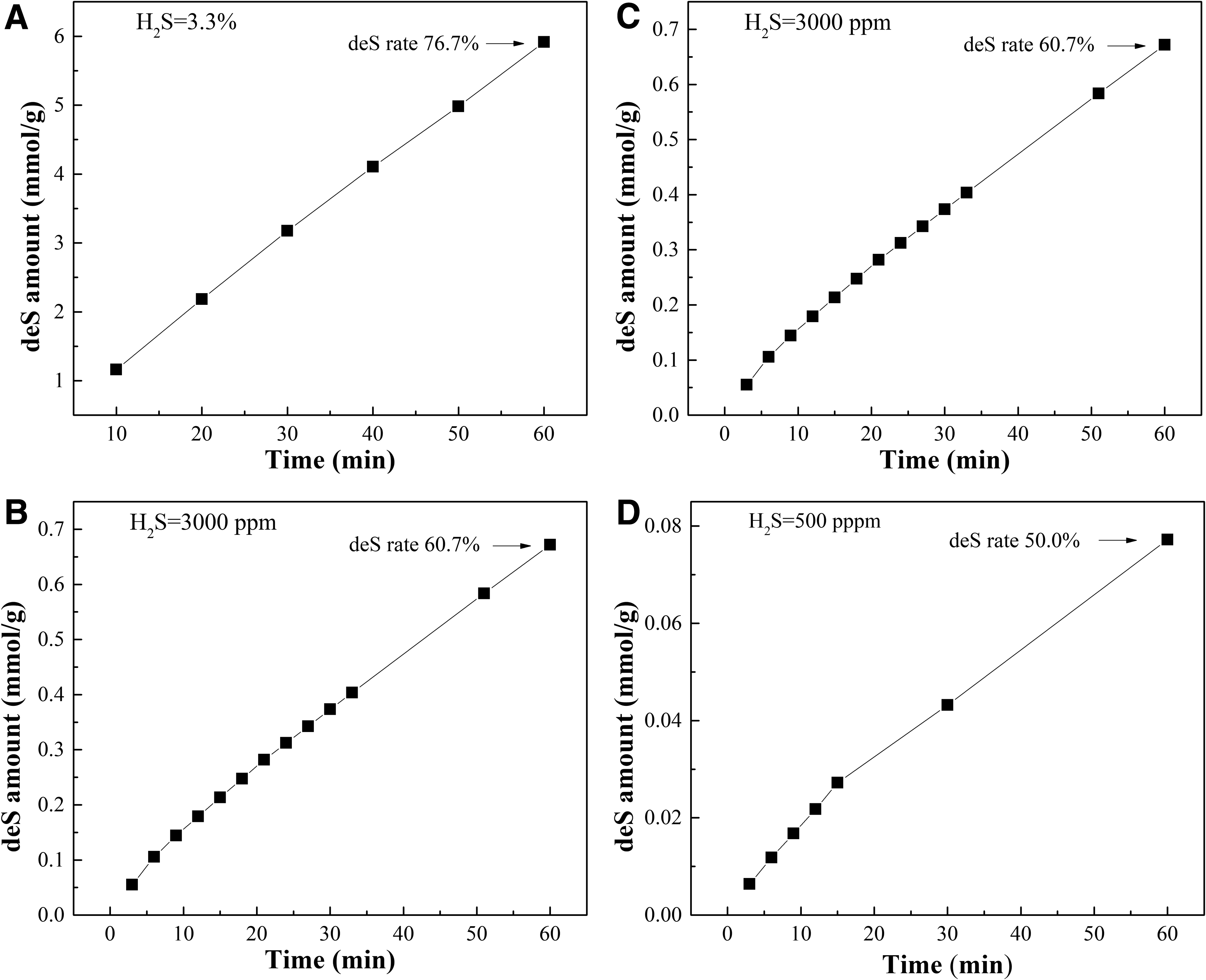
deS amount of S500 toward different concentration of H2S.
With the decrease of H2S concentration, removal also decreased. At a high concentration of H2S (3%), removal was 76.7% (Fig. 2A). After the concentration decreased to 500 ppm, removal decreased to 50.0% (Fig. 2D). This phenomenon was easily understood, because the oxidation process was a heterogeneous reaction and occurred mainly on the surface of the adsorbent. With the decrease of inflow concentration, the concentration decreased in both unit volume and surface of adsorbent. Hence, deS removal declined. Similar results were reported by other works, in which higher initial concentrations resulted in bigger removals than lower ones (Ros et al., 2006; Chen et al., 2011b). In summary, the sludge-derived adsorbent was feasible in steady oxidization of H2S with various concentrations, and it was a potential substitute for activated carbon and other commercial deS materials.
Continuous catalytic oxidation of H2S
Figure 3A gives the deS amounts of S500 at different temperatures. When the temperature ≤160°C, S500 attained deactivation soon after 20 min. As a result, deS amounts reached a platform. Coincidently, at temperature ≤160°C, S500 attained a same platform ∼0.24 mmol/g at 20 min. After this time point, deS amount slightly increased to 0.29 mmol/g at 60 min. In other words, S500 almost showed little activity toward H2S oxidization after 20 min.
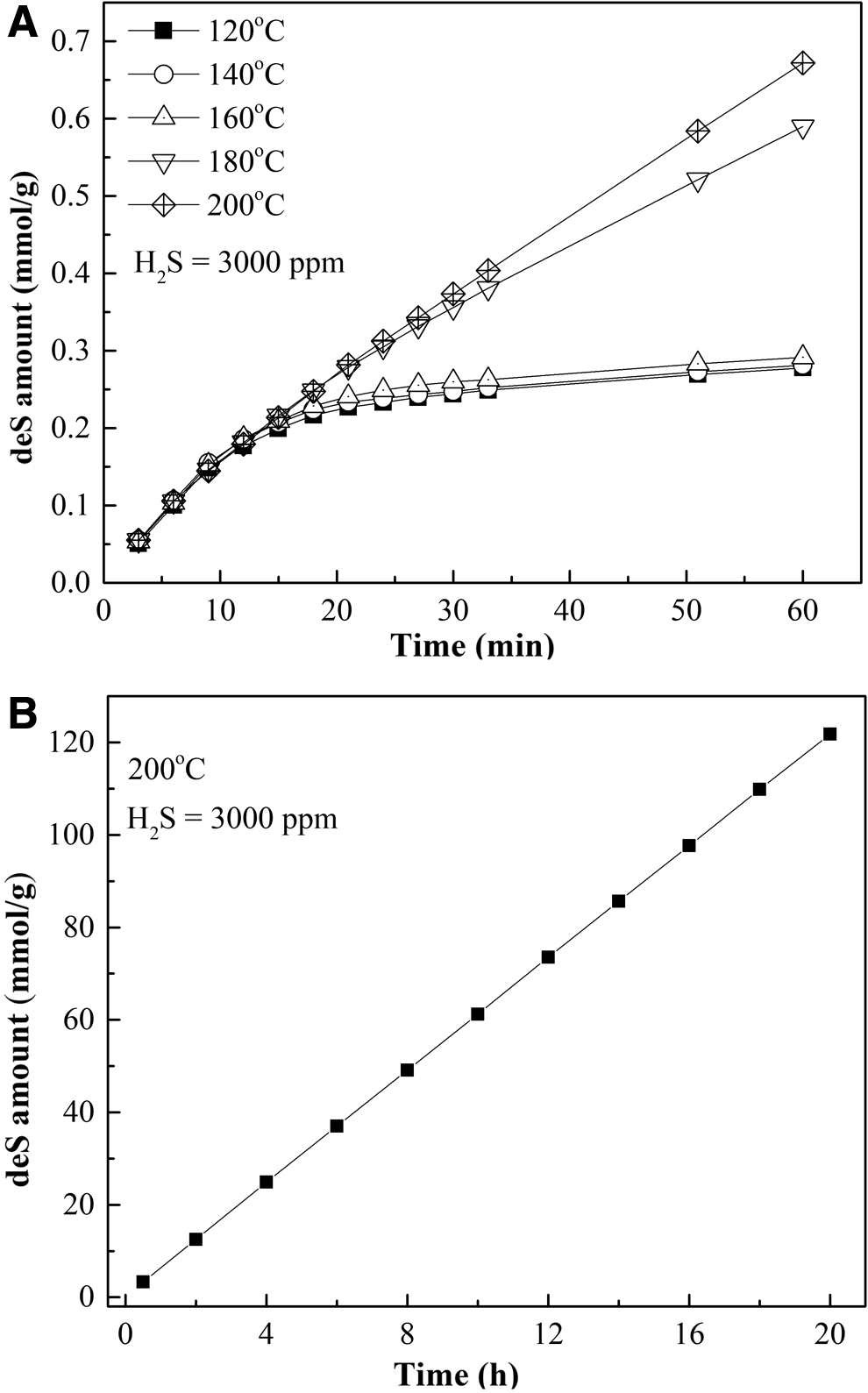
On the contrary, when the temperature was >180°C, S500 exhibited a steady removal of H2S without an obvious deactivation, which was similar to that in Figs. 1 and 2. Especially, when the temperature was 180°C, deS amount increased along with time, and attained 0.59 mmol/g at 60 min. This amount was almost twice as high as 0.29 mmol/g (160°C). When comparing 180°C with 200°C, the latter case showed a bigger deS amount of 0.67 mmol/g. This was attributed to more activated molecules at a higher temperature, that is, 200°C resulted in a larger removal of H2S, corresponding to a higher accumulated deS amount. Therefore, if the temperature was >180°C, the continuous catalytic oxidation of H2S was feasible.
Moreover, Fig. 3B provides the continuous removal of H2S by S500 at 200°C for long-time running. Obviously, cumulative deS amount linearly extended along with time, indicating that S500 maintained good deS for >20 h. Specifically, S500 attained a deS amount as high as 121.82 mmol/g at 20 h. In previous reports, low-temperature deS usually resulted in deactivation because of S0 deposition (Chen et al., 2011b; Ortiz et al., 2014). As a result, these materials generally attained limited deS amounts. For example, commercial-activated carbon removed 14.12 mmol/g of H2S before deactivation at 2 h; alkaline carbon nanotube showed 54.71 mmol/g of H2S before it was deactivated at 11 h (Chen et al., 2011b). Above results and discussions indicated that the sludge-derived adsorbent in this study was effective in continuous catalytic oxidization of H2S.
Regeneration of inactivated adsorbent
Figure 4 compares the deS amounts of S500 and rS500 at 120°C and 200°C. On the one hand, rS500 showed similar deS tendency to that of S500 at 120°C. In detail, deS amount of rS500 first increased to a platform ∼0.20 mmol/g at 20 min, then slowly increased to 0.25 mmol/g at 60 min. This tendency indicated that rS500 also lost activity soon after the reaction. Moreover, deS amount of rS500 at 60 min (0.25 mmol/g) was quite close to that of S500 (0.28 mmol/g). On the other hand, deS amounts of rS500 and S500 were close to each other, both indicating a linear increase along with time at 200°C. Besides, their final deS amounts were also close to each other, that is, 0.65 (rS500) and 0.67 (S500) mmol/g.
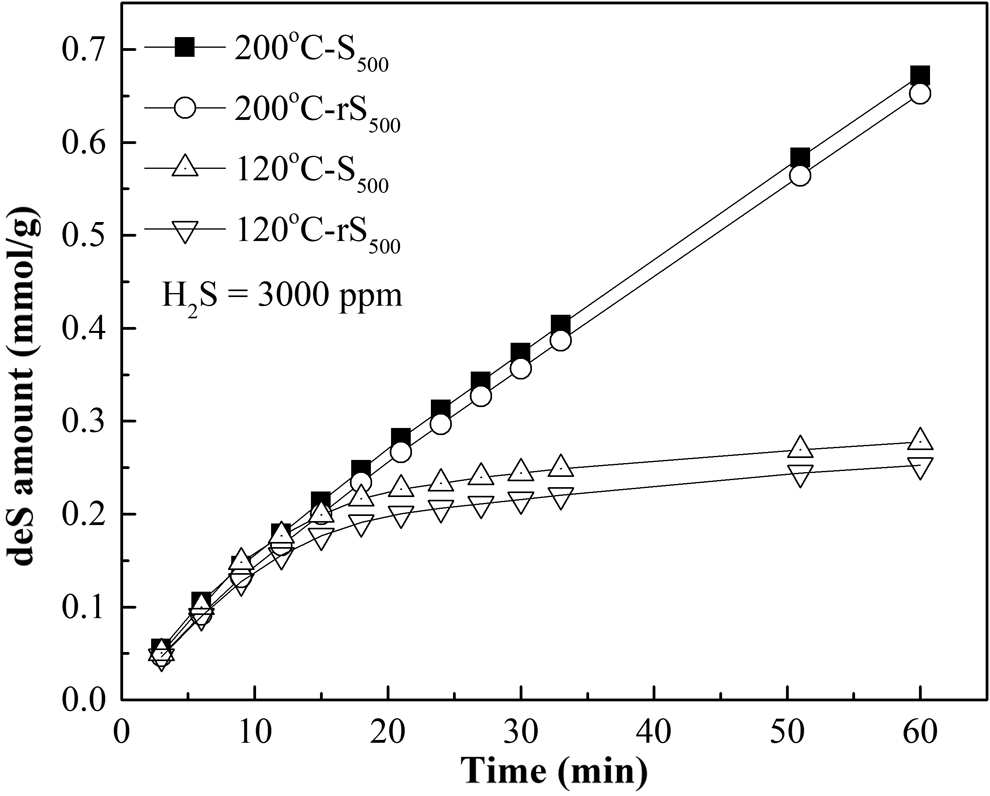
deS amounts of S500 and rS500 at 120°C and 200°C.
Above comparisons indicated the following conclusions: (1) the inactivated sludge-derived adsorbent was easily regenerated by a thermal treatment. What is more, deS amount of regenerated adsorbent was almost the same as that of a newly prepared sample at the same removal temperature; (2) the S0 deposition seemed to result in the deactivation, because the adsorbents (S500 and rS500) showed similar deS amounts at both 120°C and 200°C after the regeneration process at 200°C. As is well-known, the melting point of sulfur was ∼120°C. According to these two results, the continuous catalytic oxidization of H2S by S500 >180°C was attributed to the simultaneous melting of formed S0, thus regenerating the adsorbent for further reaction. After the reaction, yellow particles stuck to the internal surface of reactor tube. These particles appeared to be S0 (Supplementary Fig. S3).
Characterizations of products
Figure 5 gives the SEM and element mappings of uS500 after reaction at 120°C. The microstructure of uS500 seemed to be irregular particles (Fig. 5A, B). In fact, this structure was close to other sludge-derived carbons (Ansari et al., 2005; Ros et al., 2006; Kante and Bandosz, 2007), which were not used in H2S removal. These particles usually contained pores distributed from micro- to macrosizes (Bagreev and Bandosz, 2002, 2004; Ros et al., 2007), thus providing abundant sites for gas absorbances and afterward reactions. Supplementary Figure S4 gives the Energy Dispersive Spectrometer spectra of uS500 after reaction at 120°C. This sample mainly contained 28.2% of C, 44.4% of O and 24.7% of Si (Supplementary Table S1).

Scanning Electron Microscope
According to Fig. 5C–F, elements of O, C, and Si were distributed on uS500 surface. Figure 5G shows that uS500 was covered by S element after reaction at 120°C. Of interest, S mapping pattern was quite similar to C mapping pattern (Fig. 5E, G). Thus, H2S molecules seemed to preferentially adsorb carbon-related sites in S500. Some reports also suggested that H2S was catalyzed at carbon sites (Chen et al., 2011a, 2011b). After all, uS500 was porous particle covered by S0.
Supplementary Figure S3 shows the photo of tube reactor after uS500 was deactivated at 120°C. Yellow particles formed after the adsorbent. These particles were then scraped from the tube and characterized. Figure 6A shows the XRD of these products. All the diffractions indicated a well crystal shape of elemental sulfur (PDF No. 53-1109), including d030, d-212, and d012 (Chen et al., 2011a, 2011b). However, S500 and uS500 only had an obvious diffraction of SiO2 (PDF No. 79-1906). Strong intensity of SiO2 affected the exhibition of sulfur in uS500.
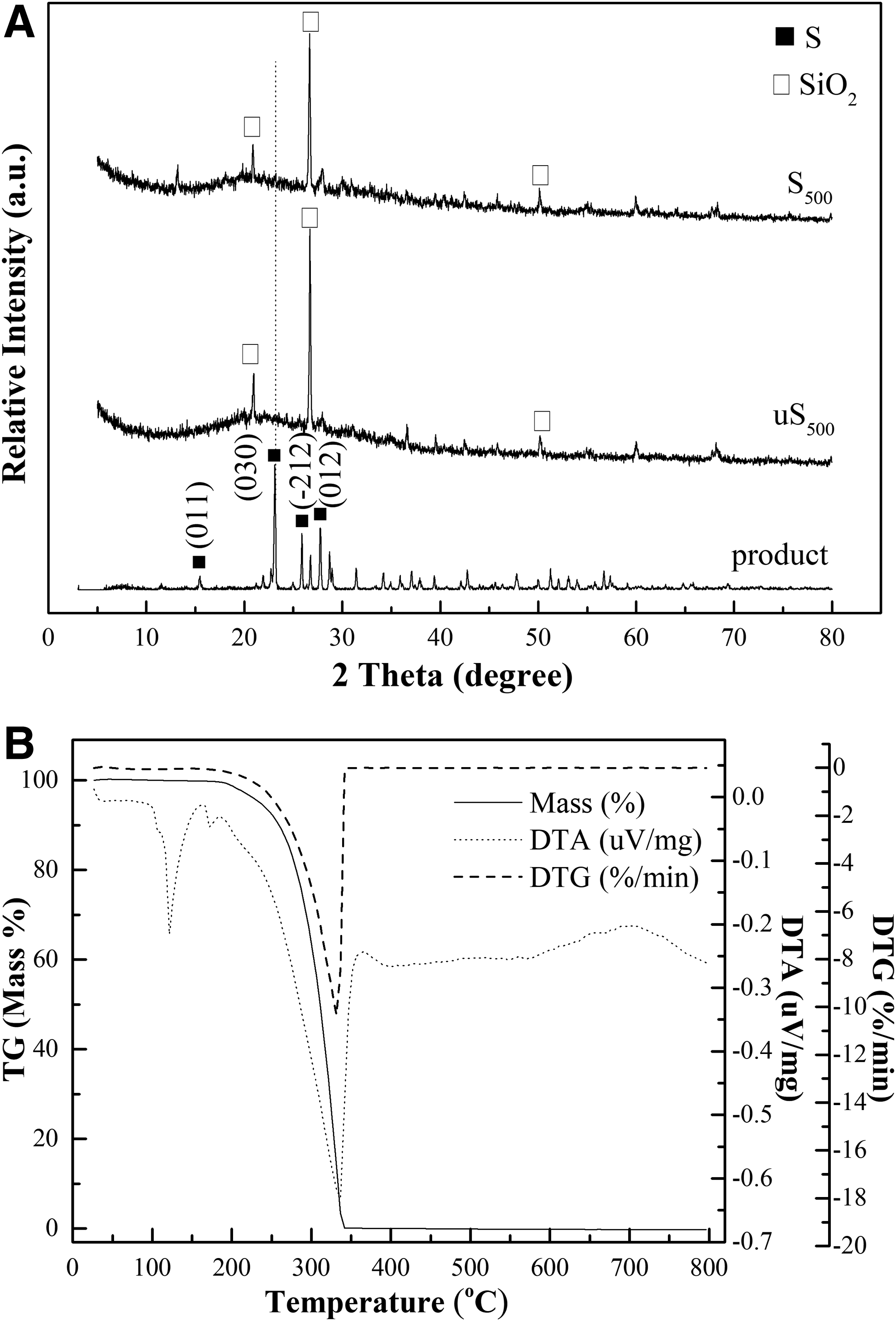
Figure 6B shows the TG analysis of the yellow products. The product was completely decomposed or vaporized before 350°C, that is, the TG signal attained 0%. From changes of DTA, endothermic peaks appeared at ∼110°C, which was potentially attributed to both the boiling point of water and the melting point of elemental sulfur (Dirlam et al., 2015; Griebel et al., 2016). However, no obvious change was observed at this temperature in TG/differential thermal gravity (DTG) curves. Therefore, the endothermic process resulted from the melting of S0. In addition, the DTG curve only showed one peak at 350°C, corresponding to the main weight loss in TG curve. Above discussions suggested that the yellow products were elemental sulfur.
Figure 7 provides the concentrations of SO2 evolved from uS500 under air atmosphere at 200°C. These two samples previously catalyzed H2S oxidization at 120°C and 200°C (Fig. 3A). In general, concentrations of SO2 both decreased along with time until reaching zero. For example, SO2 continuously evolved for 170 min from uS500 (120°C). However, uS500 (120°C) produced more SO2 than uS500 (200°C). In detail, SO2 concentration was ∼210 ppm at the start (0 min) when heating uS500 (200°C); when S500 (120°C) was heated, 250 ppm of SO2 was detected at 0 min.

Concentration of SO2 evolved from uS500, which were used in H2S oxidization at 120°C and 200°C.
Besides, uS500 (120°C) showed higher SO2 concentrations than uS500 (200°C) during the whole processes. It is well-known that the flash point of elemental sulfur is 168°C, at which sulfurs in S500 were released as SO2. Thus, the amount of evolved SO2 indirectly indicated the amount of sulfur content in a sample. Hence, uS500 (120°C) contained more elemental sulfurs than uS500 (200°C) (Fig. 3A).
Supplementary Figure S3 shows the products after catalytic oxidization of H2S at 120°C and 200°C. After the reaction, only little residue was obtained at 120°C. However, its amount obviously increased at 200°C. This phenomenon was consistent with the result in Fig. 3A, because S500 had a better deS amount at 200°C than that at 120°C. Therefore, S500 continuously catalyzed H2S oxidization at 200°C, because the product S0 was continuously removed from the particle surface and pores.
In comparison, S500 had limited deS amount at 120°C, because the surface and pore were soon covered by S0. In other words, S500 achieved continuous catalytic oxidization of H2S because of a “self-outflow” process. This was also the reason why uS500 (120°C) contained more elemental sulfurs than uS500 (200°C), because the formed S0 covered the surface of uS500 (120°C). On the contrary, the formed S0 evolved from the surface of uS500 (200°C), that is, less sulfur was left in adsorbent.
Self-outflow process
Figure 8 presents the schematic of deS. First, H2S was oxidized by oxygen on active surface of S500 during the catalytic reaction, resulting in products of S0. In detail, gaseous H2S was adsorbed on carbonaceous phase, resulting in H2Sads. In addition, a TG-Mass Spectrum analysis showed that some sulfur was left on adsorbent after H2S removal (Wang et al., 2019). At the same time, oxygen was adsorbed on active sites (Cf), resulting in C(O). The formed H2Sads and C(O) reacted with each other to form elemental sulfur (Scov) and H2O, together with the regeneration of Cf. In our previous report, surface functional groups of adsorbents were analyzed before and after H2S removal. The result indicated that benzoquinone group was potentially the most active Cf (Wang et al., 2019).

Schematic of deS by a self-outflow process.
Furthermore, transition metals (such as Zn and Fe) in the sludge also supplied active sites for the oxidation of H2S by molecular oxygen (Bagreev and Bandosz, 2004). This was the reason why the sludge-derived adsorbent was better than an activated carbon for H2S oxidization.
However, the formed elemental sulfur was left, filling the pores and covering the surface, when the reaction temperature was <180°C. As a result, S500 soon lost effect in deS (Fig. 3A).
When the reaction temperature was raised >180°C, the elemental sulfur flowed out in liquid or gaseous forms, left the adsorbent, and released the covered active surface for further reaction. However, after S0 left the adsorbent, the environmental temperature soon decreased, because only the adsorbent region was heated by the tube furnace. For example, if the adsorbent was heated at 200°C, the temperature before and after the adsorbent regions were both <200°C. Thus, the elemental sulfur deposited on the reactor internal surface (Supplementary Fig. S2). This was also the reason why the yellow particle was just below the adsorbent at 120°C, whereas it was far from the adsorbent at 200°C, that is, the elemental migrated for a longer distance at a higher temperature.
After the catalytic reaction at 200°C, we also scraped the yellow particles from tube, obtaining 0.48 g. According to the deS amount at 200°C, 30.455 mmol of H2S was oxidized (Fig. 3B). Thus, >50% of H2S was finally fixed in the form of elemental sulfur, indicating a good recovery. As a result, the sludge-derived adsorbent was successfully used in deS, which was attributed to its porous carbonaceous structure. Moreover, most sewage sludges were feasible in producing effective adsorbents for H2S oxidization, because sewage sludge generally contained enough organic contents.
After pyrolysis, sewage sludge was transformed to porous carbon (Zhai et al., 2008; Liu et al., 2017a). Its pyrolysis temperature was even lower than that (850°C) for producing activated carbon from coconut shell (Daud and Ali, 2004). What is more, sludge was a low-cost resource to produce adsorbent, because it was a by-product with abundant amount, which met requirements of a low-cost sorbent (Bailey et al., 1999). As for the continuous catalytic oxidization of H2S, this was mainly attributed to the self-outflow of element sulfur at a temperature of 180–200°C. This process released the covered surface of sludge-derived absorbent for a further H2S oxidization.
Conclusions
Sludge-derived adsorbent showed enhanced activity of catalytic oxidation toward H2S. However, catalytic effects varied greatly at different reaction temperatures. At 120–160°C, the adsorbent surface was soon covered, and the pores were filled quickly by elemental sulfur, resulting in the deactivation of sludge-derived adsorbent; at higher temperature (180–200°C), the adsorbent attained a continuous catalytic oxidization of H2S for long-time running without deactivation. The long-time running resulted from a self-outflow process of formed elemental sulfur. As a result, the adsorbent achieved continuous deS and S recovery at the same time. This idea will help the high-value-added utilization of LG. On the contrary, the main result of this study also indicated that sludge was a potential biomass resource to produce environmental adsorbent/catalyst.
Footnotes
Acknowledgments
This project was financially supported by National Nature Science Foundation of China, No. 21707087. Research grant from Science and Technology Commission of Shanghai Municipality, No. 16DZX2260601. Program for Innovative Research Team in University No. IRT13078. The authors appreciate Instrumental Analysis and Research Center of Shanghai University for the help of sample characterizations.
Author Disclosure Statement
No competing financial interests exist.

References
Supplementary Material
Please find the following supplemental material available below.
For Open Access articles published under a Creative Commons License, all supplemental material carries the same license as the article it is associated with.
For non-Open Access articles published, all supplemental material carries a non-exclusive license, and permission requests for re-use of supplemental material or any part of supplemental material shall be sent directly to the copyright owner as specified in the copyright notice associated with the article.
