




Abstract
Abstract
The FEWsOnt ontology models major structural and dynamic concepts of the food–energy–water (FEW) systems from the complex system perspective by defining the emergent, nonlinear, and scale-invariant state transitions and behaviors of the network elements that result from natural and planned processes. The model represents the semantics of concepts such as security, footprint, challenge, risk, impact, and uncertainty in relation to governance and assessment of the level of sustainability of the FEW systems in varied domains of usage. The ontology will allow stakeholders working with the FEW systems' data to draw new inferences using semantic facts and discover insights and relationships among the systems' elements to make improved assessment and decisions toward sustainable growth. The knowledge-based model will lead users to optimize the tradeoffs and identify and prevent adverse changes to the FEW systems in relation to the interacting natural and social systems. The annotated terminology and formalized interactions in the ontology will facilitate the integration of the diverse FEW data types, improve communication among researchers, and help to reduce environmental stresses.
Introduction
The food–energy–water (FEW) nexus (e.g., Martin-Nagle et al. 2011; World Economic Forum, 2011; Endo et al., 2015, 2017) is an integrated approach to optimize the use of the closely interlinked FEW resources, manage processes that affect them at different scales, and achieve sustainable growth by reducing risks, tradeoffs, and conflicts, and improve governance across sectors (Bazilian et al., 2011; Hoff, 2011; Hussey and Pittock, 2012; Ringler et al., 2013; Biggs et al., 2015; Mohtar and Lawford, 2016; Scanlon et al., 2017; Wallington and Cai, 2017; Weitz et al., 2017). Sustainable development of the FEW systems requires continuous governance, assessment, and evaluation of the consequences of complex processes that affect FEW systems' intersecting environmental, social, cultural, political, legal, economic, and other dimensions (Wackernagel and Rees, 1996; Kates et al., 2001; Verheem, 2002). The nexus concept emphasizes the fact that a change of the state of a component (element) of any of the FEW systems (e.g., depletion or contamination of water) at any scale has a complex pattern of impacts on, for example, the availability, access, security, and quality of other elements (Labuschagne et al., 2005; Hussey and Pittock, 2012; Ringler et al., 2013; Biggs et al., 2014). The FEW resources are under increasing pressure due to the growing world population, globalization, climate change, rapid economic growth, and unsustainable urbanization (Martin-Nagle et al. 2011; Endo et al., 2017). The risks originated by these threats are stressing the FEW systems and leading to conflicts and crises among the system elements at all levels, from household to global (Howells et al., 2013; Dubois et al., 2014; Leck et al., 2015).
A transition in the state of a complex system's element, through processes such as energy use (e.g., pumping water for irrigation), can trigger a transition at a lower ecosystem level (e.g., decreased availability of energy and increased water supply in a farm) and/or progressively larger landscape mosaics comprising several ecosystems and social systems, and produce complex behavior over multiple scales. A process that changes a system element (e.g., energy becoming less available with heavy use) may change the state of other dynamic variables of the same element (e.g., energy supply becoming depleted), impact other aspects of the element (e.g., increased energy scarcity and risk, and reduced security), or affect other elements (e.g., reduced water and food availability due to scarcity of energy for pumping water and irrigation). The prediction of the type of the effect of a resource-intensive process (e.g., food transport, energy generation, irrigation, and production of biofuel) requires explicit and consistent specification of the complex interrelationships that may occur due to the interactions among the FEW system elements at all organizational levels.
In this article, we formally (i.e., using logics) model the semantics (e.g., Galton, 2009) of the structure (i.e., hierarchy of the system parts and their relations) and dynamics of the interactions (i.e., processes) among the FEW systems' elements by specifying the diverse physical, biological, social–behavioral, and other types of processes that may occur at different levels and scales in the FEWsOnt ontology. The main objectives for building the ontology are to model the knowledge of the characteristics and interactions of the FEW systems' elements from a complex adaptive system and integrated nexus perspective (Jacobson et al., 2011) and making it available to users through query. The model specifies the dynamics of the natural and planned processes that adversely or positively affect sustainability (e.g., Well, 2013; Biggs et al., 2015; Fisher and Rucki, 2017) of the FEW systems and interacting social system.
The ontology specifies many aspects of the FEW systems (e.g., pathway, access, behavior, and stability) including the attributes of their elements (e.g., state, level, location, and status) and resources (affordability, demand, resilience, and security), dynamic changes during phase transitions (e.g., in availability, risk, supply, and demography), events (e.g., disaster, emission, and leakage), phenomena (e.g., drought, fire, famine, and hailstorm), processes (e.g., transport, monitoring, consumption, energy-intensive process, and water-intensive process), and roles (e.g., fuel and organic farmer).
Semantic Modeling of the FEW Systems with Ontology
Villa et al. (2009) present a review of semantic approaches to environmental modeling, and Wijesooriya et al. (2015) argue for the use of ontologies to capture the complex, multidimensional environmental, social, and economic aspects of sustainability. Ontologies have been applied to environmental decision support (Ceccaroni et al., 2004; Wanner et al., 2015), modeling of wastewater treatment and ecosystems, and spatial data (Ceccaroni, 2009; Ceccaroni and Oliva, 2012), management of flow and water quality (Chau, 2007), simulation of soil–plant–nutrient processes (Kwon et al., 2010), and food and diet (Maged et al., 2015). These knowledge models are used for assessing processes at various sustainability levels (e.g., Verheem, 2002; Batra, 2012; Miemczyk and Johnsen, 2012; Singh et al., 2012; Haug et al., 2013; Sala et al., 2015, Yang et al., 2015; Lousteau-Cazalet et al., 2016; Wang et al., 2017; Konys, 2018). Ontologies are also used to define indicators that relate to environmental, social, and economic variables and concepts such as efficiency, production, assessment, regulation, finance, industrial activity, monitoring, and ecology (e.g., Devuyst et al., 2001; Schwartz et al., 2002; Warhurst, 2002; Sikdar, 2003; Bebbington et al., 2007; Teece, 2007; Sala et al., 2015; UNSDG, 2015; Van de Kerk and Manuel, 2016; Geiger et al., 2017). They are built for environmental impact assessment (Garrido and Requena, 2011), sharing of expert knowledge in sustainability science (Kraines and Guo, 2011), environmental justice (Huang, 2015), decision management of urban water resources (Oliva-Felipe et al., 2017), structural properties of forms in an urban system (Silavi et al., 2016), flood risk assessment (Scheuer et al., 2013), built environment (Abanda et al., 2013; Chong and Wang, 2016), and environmental issues related to biological and biomedical sciences (ENVO, 2013; Buttigieg et al., 2013, 2016). Previous semantic models emphasize on specific dimensions of the FEW systems in relation to sustainability (e.g., Kumazawa et al., 2009, 2014, 2017), FEW resources (e.g., Endo et al., 2015; Rao et al., 2016), Earth and environmental science (Raskin and Pan, 2005), hydrogeology (CUAHSI, 2008; Tripathy and Babaie, 2008), or urban environment (e.g., Vilches-Blázquez et al., 2007), and generally do not take an integrated, complex system approach to the nexus issues of the FEW networks in relation to various ecosystems.
Complex and Scale-Invariant FEW Systems Approach
Ecosystems and their interrelated, interacting, and interdependent social system, involving the FEW systems, have a multiscale hierarchical structure that is built from heterogeneously distributed and continuously changing nested networks of diverse elements (nodes) that communicate through their interconnecting links (edges and arcs). The structure (organization) of these networked systems is defined by how different individual and aggregate parts are connected to each other. In such complex systems (Allenby, 1999; Morel and Ramanujam, 1999; Wilensky and Resnick, 1999; Cindea, 2006; Hmelo-Silver and Azevedo, 2006; Goldstone and Wilensky, 2008; Vattam et al., 2011; Porter and Gleeson, 2015; Sayama, 2015), the interactions among different parts are achieved through numerous processes that spatiotemporally affect the state and behavior of the elements along and across various system organizational levels. The autonomous nonlinear interactions among the heterogeneous parts of the system lead to the emergence of new levels of organization (subsystems), which reorganize into a whole through new interactions with other connected parts. The emerged whole, which differs from the sum of the interacting parts after each nonlinear reorganization, is capable of autonomously adapting to its environment without a central authority and can produce variable responses to local changes by exponentially increasing the number of links among the network elements (Bar-Yam, 1997; Marten, 2001; Sayama, 2015).
The complex and adaptive system has scale-invariant emergent properties (e.g., self-organization) that occur self-similarly (i.e., fractally) at the level of individuals (e.g., homeostasis, death, life, thought, and vision), population (e.g., reproduction, genetic evolution, social organization, and population regulation), and ecosystem (e.g., biological production, coevolution, coadaptation, and carrying capacity). The self-organization property allows a complex system to restructure itself into stable more ordered forms through mechanisms such as the assembly process (Marten, 2001). The increased order is realized through energy input, from across the open system boundary, by barriers, challenges, stresses, interventions, and events (e.g., price shocks, natural hazards, regulation, social unrests, and crises) (Sayama, 2015). For example, a riot emerging after a shortage of water due to a reduced water supply (Loftus, 2009) because of a contamination event may lead to an increase in the price of water, decrease in its availability and access (Smith and Hanson, 2003), and possibly rationing, triggering a corrective governance intervention and self-organization of the system components and restructuring of the water distribution pattern. The emergent properties that develop at the higher aggregate (macro and whole) level (e.g., an ecosystem, landscape mosaic, and country) are not immediately discernable from the interactions at fine (micro) hierarchical levels such as a farm or household. This implies that decisions to manage environmental issues at one level, for example, through regulations, should include careful consideration of the sequence of unexpected consequences of any governance policy that affects elements at different levels.
The dynamic FEW systems (Nesheim et al., 2015) can self-organize through the spatiotemporally heterogeneous interactions of their elements, and evolve into stable and robust structures (i.e., attractors) by deliberate actions (i.e., selection), innovations, and new technology and business practice of FEW producers (Room, 2011; Gerrits, 2012; Kuhmonen, 2017). Like gravity that collects (i.e., stabilizes by structuring) all drainage waters into a trunk stream of a watershed, attractors in the adaptive FEW systems dynamically channelize (organize) the system elements' interactions toward a stable location in the “state space” of the systems (Byrne and Callaghan, 2014) by giving new structures to the production, processing, transportation, and consumption of the FEW resources. The trajectory of the stable configuration (i.e., attractor) can change in the next stage of self-organization by “bifurcation” through which the system evolves from one stable “basin of attraction” to another by cutting through the interbasinal “saddle points” that resist change (e.g., by retail and institutionalized corporate food regimes) (Room, 2011).
The notion of sustainability, itself, can be thought of as an emergent property of a desirably functioning complex global economic–environmental–social system that is transpired through refined interactions of the economic activities and components of the environment (Allenby, 1999). This view on sustainability as a property of the aggregate system emphasizes the need for taking a whole complex system perspective on the FEW nexus by modeling the impacts of possible interactions at multiple levels that hinder or promote sustainability. In contrast to simple systems in which the input (cause) and output (effect) are linearly related and the whole is the sum of the properties of the combined parts, the interactions of the elements of a complex system are nonlinear, that is, one process (using energy to pump or transport water) produces many other effects such as pollution and production of greenhouse gases. In such complex interactions, the effect of a process, such as that of the emission of greenhouse gases on global warming, depends on the dynamics of other ongoing interrelated processes that heterogeneously change the state of the system elements in space and time.
In addition to their nested, interconnected, and interdependent hierarchical networks, the complex interacting natural-social systems are further characterized by heterogeneous elements, nonlinearity, autonomy, decentralized structure, emergence, self-organization, self-regulation, pattern formation (e.g., in resource use, consumption, production, distribution), co-evolution and co-adaptation through processes with dynamic learning and abilities (e.g., adaptive management and technology to deal with climate change), and collective behavior (e.g., countries trying to reach sustainability goals through the UNSDGs) (e.g., Sayama, 2015, UNSDG, 2015). Figure 1 depicts some of the characteristics of the complex FEW systems that are modeled under the ComplexSystemQuality class.
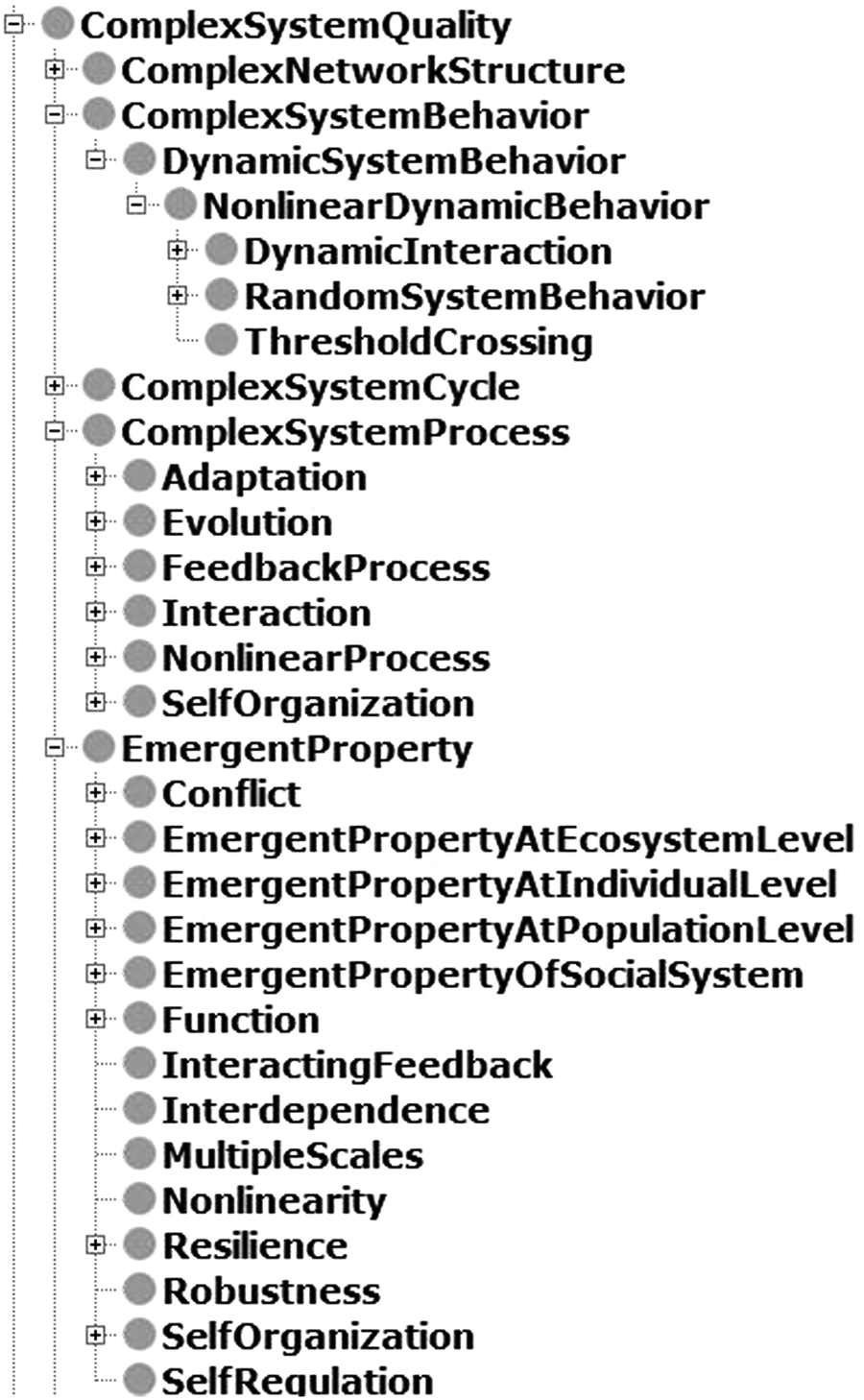
Class hierarchy of some of the characteristics of the complex system under FEWsOnt's ComplexSystemQuality, which reuses the “quality” class of the top-level BFO. Here, the suffix “Quality” in the class names means property or attribute. Classes with a preceding plus sign have additional subclasses that are not expanded. Notice the categorization of the emergent properties based on level (not expanded in this figure). See text for explanation and naming convention. BFO, basic formal ontology; FEW, food–energy–water.
Design of the FEWsOnt Knowledge Model
The complex FEW systems can be perceived as a multilayered three-dimensional network of heterogeneous and variably sized ecosystems and related interacting social systems, each with its own hierarchically nested progressively smaller subsystem components that contain individuals (animals, plants, and people), microorganisms, and physical environments (e.g., lake, soil, aquifer, and factory). Industrial ecology expands the definition of such a system by emphasizing on the interactions of technology and transfer of energy and resource material (Allenby, 1999; Graedel and Allenby, 2003). In such a complex system, the wide range of intersecting processes such as consumption, production, and contamination continuously change the state of the systems' elements (e.g., supply of water, food, or energy, and concentration of a contaminant in water) over time and space. In this scale-invariant (self-similar) structure, the FEW systems at each hierarchical level can be envisioned as a ternary system represented by the Sierpinski triangle (e.g., Conversano and Tedeschini-Lalli, 2011; Davarpanah, 2014) in which diverse elements of the FEW, social, environmental, and technological systems interact (Fig. 2).
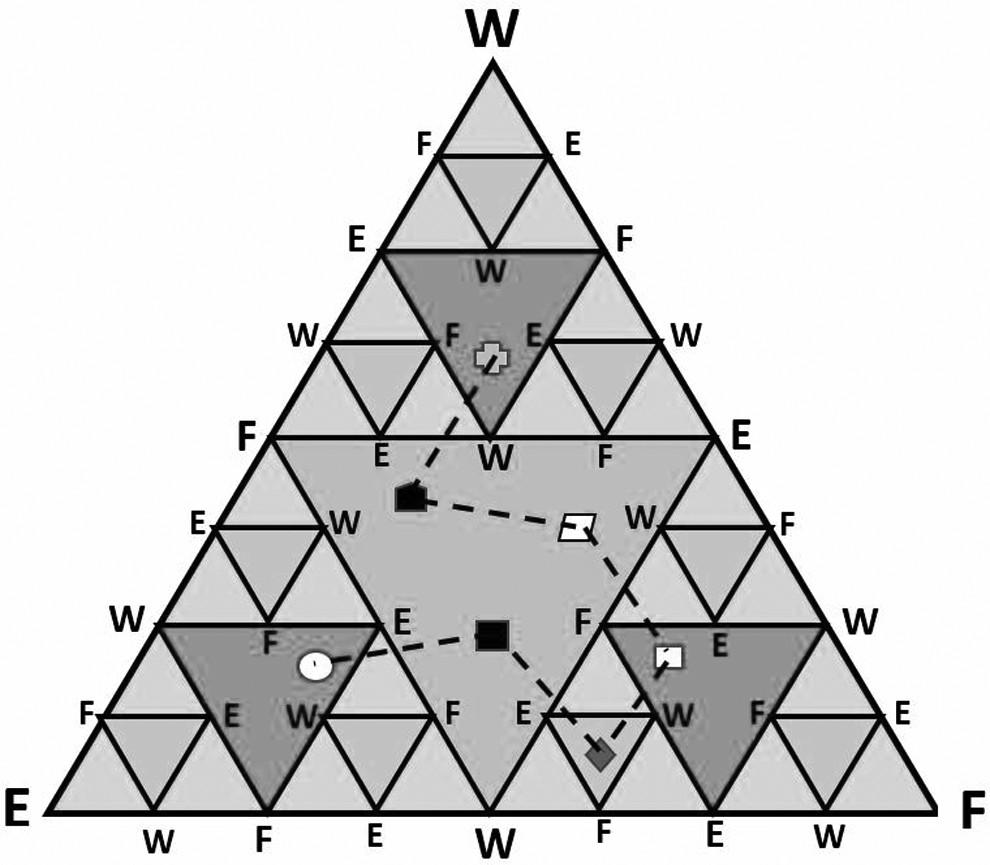
Self-similarity of complex interaction of the FEW systems with other systems in two-dimensional Sierpinski triangle. Elements of natural (ecosystem), social, cultural, technological, political, legal, economic, and other systems interact with the elements of the water (W), energy (E), and food (F) systems at recursively different scales (given by the size of the triangles). Progressively larger triangles represent larger aggregates of several ecosystems, social systems, and other systems (e.g., country, landscape mosaic, and biological community; group of industries). The largest enclosing triangle is at the scale of the Earth system. Objects (i.e., instances of farm, people, or factory classes) within each triangle, depicted by different geometric shapes connected with dashed lines, continuously interact with each of the three FEW systems within and across levels. The states of the objects and the interacting elements of the FEW systems in this dynamic network are continuously changing through energy and material input and output through the open boundaries of the triangles.
The FEW network elements (nodes, i.e., varied objects in the triangles shown in Fig. 2) are connected by both within-level (along-layer) and translevel (cross-layer) links (edges). The processes that fire interactions in one layer can randomly trigger other processes within or across one or more layers. The behavior of the system is determined by complex interactions through causal processes that occur among the interlinked elements (Jacobson et al., 2011). The behavior of one system element (e.g., farm, people, and water), which may arise with a lag, can influence the behavior of other elements and the system as a whole (Sayama, 2015). An example is when energy (E) and water (W) are used to till and irrigate soil, and fertilizer and pesticide are applied to produce food (F) in a small farm (depicted as the smallest FEW triangle in Fig. 2). Transportation of the chemicals by the runoff (represented by the dashed line) leads to the contamination of a stream ecosystem (the next larger triangle), which leads to eutrophication in a larger body of water (a bay or gulf) that, in turn, affects a progressively larger marine ecosystem (the next larger triangle). The interactions of individual farms, factories, and other environmental, economic, and social parts of the system with the FEW components at each level (defined by the size of the triangles) affect the components at progressively larger scales.
The FEWsOnt ontology represents the structure, relations, and dynamics of the FEW networked systems from the complex system and sustainability perspectives. Building of an ontology is a part of the larger process of knowledge management (Jurisica et al., 2004) that involves the representation of a domain knowledge such as that of the FEW nexus. Domain ontologies (e.g., FEWsOnt) are developed to formally organize the semantics (meaning) of the categories of entities (e.g., FEW), their attribute (e.g., availability, supply, and freshness), properties or relations (e.g., energy used for water transportation; wastewater as a source of nutrient for plants), and processes that change the state of the entities (e.g., pollution changing the quality of water; pathogen contamination creating health hazard). The explicit formalization in an ontology is achieved through logics (description logic) that enable inference (drawing new facts from existing facts) applying reasoning that is embedded in the ontology languages such as OWL (Bechhofer et al., 2004; McGuinness et al., 2004). For example, if we explicitly state the fact that access to a FEW resource is determined by its availability, and that water is a FEW resource, then the OWL code infers (through a reasoner in Protégé; https://protege.stanford.edu) that access to water is determined by water availability, without the need to explicitly stating it. If there is a statement in the ontology that declares microorganism (e.g., fungi and bacteria) as a part of the ecosystem, and ecosystem as a part of the landscape mosaic, then the semantic reasoner infers that the landscape mosaic also has fungi and bacteria.
The FEWsOnt ontology, which is being built in OWL DL (Bechhofer et al., 2004; McGuinness et al., 2004) applying the Protégé software (Noy, 2004), explicitly specifies the FEW systems' static structural components (i.e., spatial concepts) and dynamic processes in classes, and links them through object properties (Gruber, 1995; Guarino, 1997, 1998; Munn and Smith, 2008; Smith, 2012a). The ontology is being built with two main objectives in mind: (1) enabling the FEW systems' knowledge fragments to be discovered through queries by users applying OWL's inference rules and (2) facilitating communication among stakeholders and enhancing governance toward sustainable development of the FEW resources. Following good practice, we have structured the classes of our domain ontology under the logically sound and widely used top-level basic formal ontology (BFO) (Smith, 2012b; Arp et al., 2015) to give the FEWsOnt ontology a logical structure and coherent semantic organization.
We have chosen BFO because it models the static and dynamic objects in the real world into two categories that cover most general aspects of the FEW systems' elements and processes. It classifies entities either as “continuant” if they have spatial parts and persist through time as wholes (e.g., Lake, Food) or “occurrent” if they occur and unfold in successive phases (e.g., Cooling, RiskReduction, Pumping, and Flooding). These two imported top-level BFO classes are disjoint (i.e., their intersection is empty), meaning that no object can belong to both classes. FEWsOnt classes that subclass the “occurrent” class include environmental system processes such as Deforestation, Consumption, Degradation, Logging, Solifluction, and Production, and planned processes such as Monitoring, Detection, Measurement, Irrigation, and Farming. The occurrent class also includes events (e.g., ToxicMaterialDischarge, GreenhouseGasEmission, Leakage, and Spill), Phenomenon (e.g., OzoneDepletion, Drought, and Blizzard), and state change (e.g., DemographicChange, Globalization, ClimateChange, DeteriorationOfWetland, and RegulationChange).
The attributes of classes are defined under BFO's “quality” class that is designed for this purpose. Examples of qualities in FEWsOnt include AtmosphereQuality (e.g., Climate), ChemicalQuality (e.g., Toxicity), ComplexSystemQuality (e.g., EmergentProperty), DataQuality (e.g., Bias, Accuracy, and DataUncertainty), EconomicQuality (e.g., Capital, Cost, and Subsidy), EcosystemQuality (e.g., CarryingCapacity and EcosystemService), FEWSystemQuality (e.g., Access and ArableLandAvailability), FEWResourceQuality (Sufficiency and Security), and DatasetQuality (Pattern and Trend).
Class and Property Naming Convention
Simple FEWsOnt ontology class labels are given in this article in italic font, and start with a capital letter (e.g., Groundwater and Conflict). Class names are given in the singular form because they describe the type for the sets of instances (objects and individuals) that are members of the class. Complex class labels are given in the upper CamelCase in italic, for example: DesalinatedWater, GreenhouseGasEmission, and WaterSecurity. Names for the object type properties that connect instances of classes are given as verbs in the lower camelCase form (e.g., adverselyAffectsSustainability, affectsLikelihoodOfConflict, and harvestsBiomassFor). Names of the data type properties that relate an object (e.g., Fuel) and a literal (e.g., string and integer) are also written in the lower camelCase in italic font, for example: biofuelName, dollarCost, and gasComposition. All examples for classes and properties, given in the following sections, are from the FEWsOnt ontology and follow the specified naming convention. The imported classes of the BFO are identified in the FEWsOnt ontology OWL file (and in this article) with lower case labels embedded in double quotation marks (e.g., “occurrent” and “realizable entity”).
The FEWsOnt ontology formalizes FEW nexus interactions by relating instances of classes to each other through predicates (i.e., object type and data type properties). Possible knowledge fragments are given in the subject–predicate–object (SPO) triple statements. The subject (S) is the origin (domain) class and the object (O) is the target (range) class of the predicate or property (P). For example, CornCrop isUsedToProduce Ethanol, AgriculturalLand isRainFedWith RainWater, Government controls Regulation, and NexusApproach isAchievedBy CrossSectorGovernance. Predicates may link a process to the state of a network element (e.g., Process changesValueOf ElementState and ClimateChange hasImpactOnFEWNexus EnergyConsumptionForFood), a planned process to a system property (e.g., ProcessBasedEnvironmentalManagement isEffectiveInAchieving EnvironmentalPerformance), an information content to a process (e.g., InformationAboutSupplyAndDemand isOptimalFor ResourceAllocation), process to process (e.g., NutrientLadenBiomassHarvesting harvestBiomassFor EnergyProduction and EnvironmentalGovernance encompasses PublicAdminstration), and a process to a static class (e.g., HybridCooling usesAirForCooling Air and LandUseInvestment usesCapitalAsAHedgeAgainst SecurityRisk).
FEW Systems' Class Hierarchies and Sustainability
The FEWsOnt ontology is built by classifying processes that lead to a change of state of an element in the FEW systems such as FEWSupplyChange, ChangeInRisk, and ConsumptionChange. Natural processes (e.g., Precipitation and Nitrification) and social activities (e.g., Detection and Lobbying) are modeled in relation to their effect on sustainability of the FEW resources. From this perspective, processes can affect (e.g., Accumulation, Desalination, Distribution, and Generation), positively affect (e.g., Recycling, Conservation, Maintenance, and Protection), adversely affect (e.g., Contamination and Degradation), or prevent (e.g., ExhaustionOfFossilFuel, EcosystemLoss, and MaterialDepletion) sustainability. Planned processes can also affect (e.g., Detection, Financing, and Provision), promote (e.g., Development and Dredging), or adversely affect (e.g., LandGrab, EconomicDistortion, and War) sustainability.
Crosscutting nexus processes affecting FEW include water for food, water for energy, food for water, food for energy, energy for food, and energy for water. These processes are classified in relation to intensity under EnergyForWaterProcess, EnergyForFoodProcess, WaterForEnergyProcess, or WaterForFoodProcess (Fig. 3). The FEW intensity processes that affect sustainability such as BioenergyProduction, FoodProcessing, FossilFuelPowerGeneration, HydraulicFracturing, OilExtraction, Refining, and NuclearEnergyProduction are classified under the WaterIntensiveProcess class. Processes such as Cooling, Desalination, Pumping, FuelProduction, Transportation, and Treatment are categorized under the EnergyIntensiveProcess class. Some classes have multiple parent classes, for example, greenhouse gas intensive processes such as IndustrialEmission, Pumping, and Transportation are classified under both EnvironmentalSystemProcess and ProcessAffectingSustainability classes, and Cooling is classified under WaterIntensiveProcess, EnergyIntensiveProcess, and HeatTransferProcess.
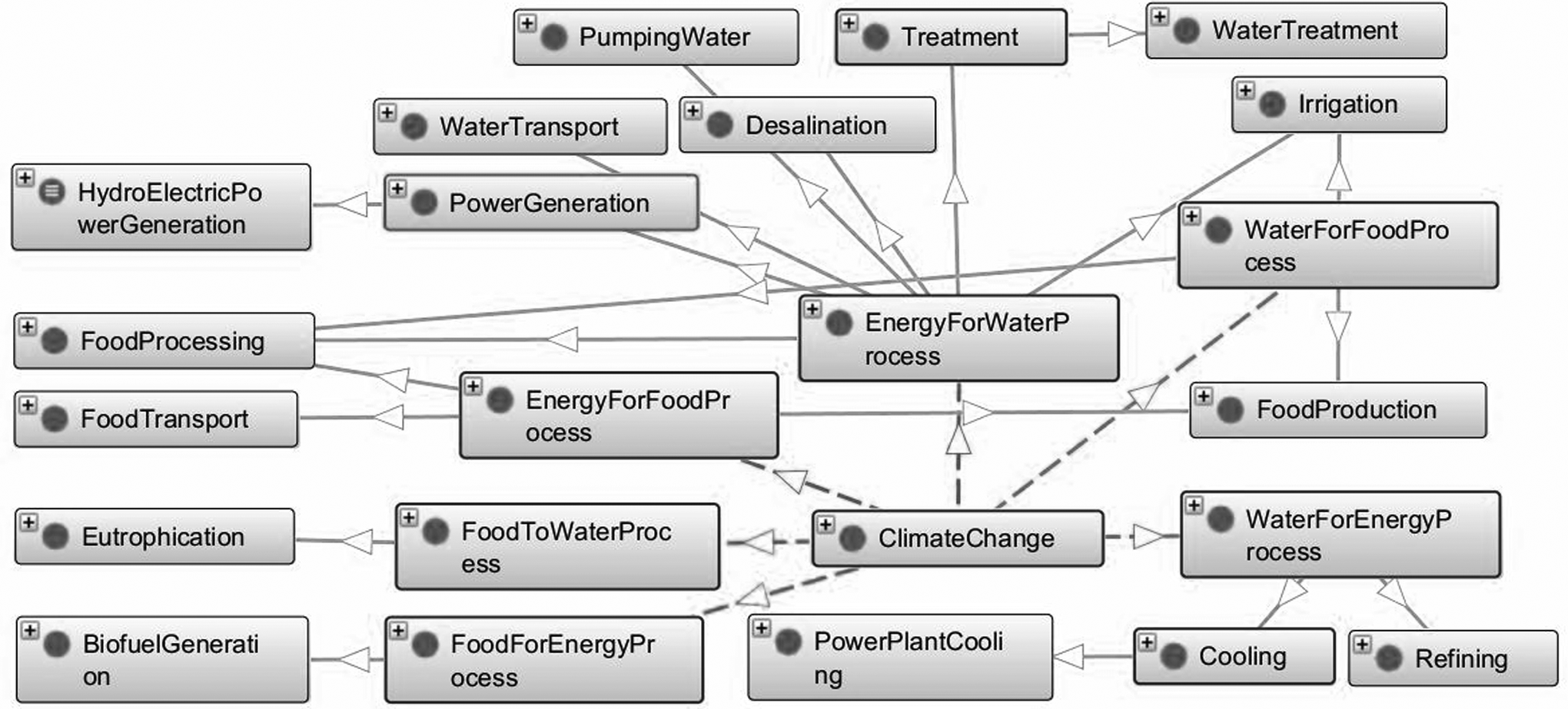
Class hierarchy of resource-intensive nexus processes affecting FEW systems. The WaterForEnergyProcess, WaterForFoodProcess, EnergyForFoodProcess, and EnergyForWaterProcess classes are modeled as kinds of FEWNexusProcess through the isA relations that are shown as solid line arrows. In this diagram, these arrows originate from a class and point to its subclasses. The + signs in the boxes indicate the presence of more subclasses that are not extended in this figure. The relations (through object properties) of the ClimateChange class with members of some of the nexus classes are shown as dashed line arrows. The SPO triples for these relations are ClimateChange adverselyAffectsWater WaterForEnergyProcess and WaterForFoodProcess; ClimateChange adverselyAffectsEnergy EnergyForFoodProcess and EnergyForWaterProcess; ClimateChange adverselyAffectsFood FoodToWaterProcess and FoodForEnergyProcess. SPO, subject–predicate–object.
Object properties (predicate, P) in the FEWsOnt ontology can relate instances of one or more domain (subject, S) classes to instances of one or more range (object, O) classes within and across system organization levels. For example, the affectsAvailability object property relates instances of the DemandForWaterResources subject class to individuals of the WaterAvailability object class. This SPO statement formalizes the fact that demand for water resources affects water availability. Object properties have their own properties, such as being symmetric (e.g., relatesWaterToEnergy and isConnectedTo), transitive (e.g., leadsTo and dependsOn), and reflexive (e.g., changesItself and organizesItself). Similar to classes, object properties are also categorized based on their effect on sustainability. They can affect (e.g., SocialSystem coadaptsWith Ecosystem and People dependOnServiceFrom EcosystemService), positively affect (e.g., Ocean dilutes ToxicChemical and PolicyMechanism enablesImplementationOf AdaptiveAction), adversely affect (e.g., ClimateChange adverselyAffects WaterResource and Contamination affectsResourceQuality WaterQuality), or prevent sustainability (e.g., War [as a Barrier] preventsSustainability SustainableDevelopment). An example, of an object property that relates instances of multiple domain classes to instances of one range class is the diminishesTheNetEmission property that relates instances of the EfficientEnergyProduction, UseOfRenewableEnergySources, DecarbonizationOfEnergySystem, and FightingClimateChange domain classes to instances of the GlobalGreenHouseEmission range class.
In addition to the semantics of classes representing the FEW systems' elements and their connecting properties, the FEWsOnt ontology models other related concepts and their properties such as Data (e.g., Accuracy, Bias, Confidence, DataUncertainty, and DataUsability), Economics (e.g., Asset, Capital, Cost, Grant, and Subsidy), Problem (Cause, Effect, Response, and StateOfProblem), EcosystemProcess (AssemblyProcess, CommunityAssembly, EnergyFlow, HabitatLoss, Homeostasis, and MaterialCycling), EcosystemQuality (CapacityToPurifyWater, CarryingCapacity, EcosystemService, and Redundancy), StateChangeQuality (CurrentState, PeriodOfChange, PreviousState, and RateOfChange), SystemQuality (Efficiency, Pathway, Vulnerability, and Dimension), and SystemElementQuality (Condition, Connectedness, Footprint, Impact, and Level).
Modeling FEW Systems Nexus
The FEWsOnt ontology represents ClimateChange as a GlobalTrend and a Challenge to sustainability and models its adverse effects to the state of several FEW systems' elements through a variety of properties (Fig. 4). Some SPO statements in relation to climate change are ClimateChange hasImpactOn WaterSupply, posesRiskToEnvironment, drivesChangeIn SnowPack, drivesChangeIn Precipitation, and adverselyAffects WaterQuality, StreamFlow, WatershedCondition, and EcologicProcess. As a challenge, ClimateChange adversely affects WaterForFoodProcess, EnergyForFoodProcess, EnergyProduction, WaterForEnergy, and EnergyUse. It leads to the DeteriorationOfWaterQuality, GrowingWaterStress, SeaWaterIntrusion, reducedStreamFlow, ReducedWaterUse, and ReducedWaterSupply. ClimateChange also reducesEcosystemServices, displaces PeopleLivingInAridArea, and impacts WaterResources. Drought is modeled in the ontology as a subclass of the ThreatTo LivestockYield and CropYield. ProlongedDrought and FrequentFlooding are placed under the EffectOfClimateChange and NaturalDisaster classes and are modeled to increaseWaterStress and reduceSupplyOfWaterFor energy and food (Fig. 4).
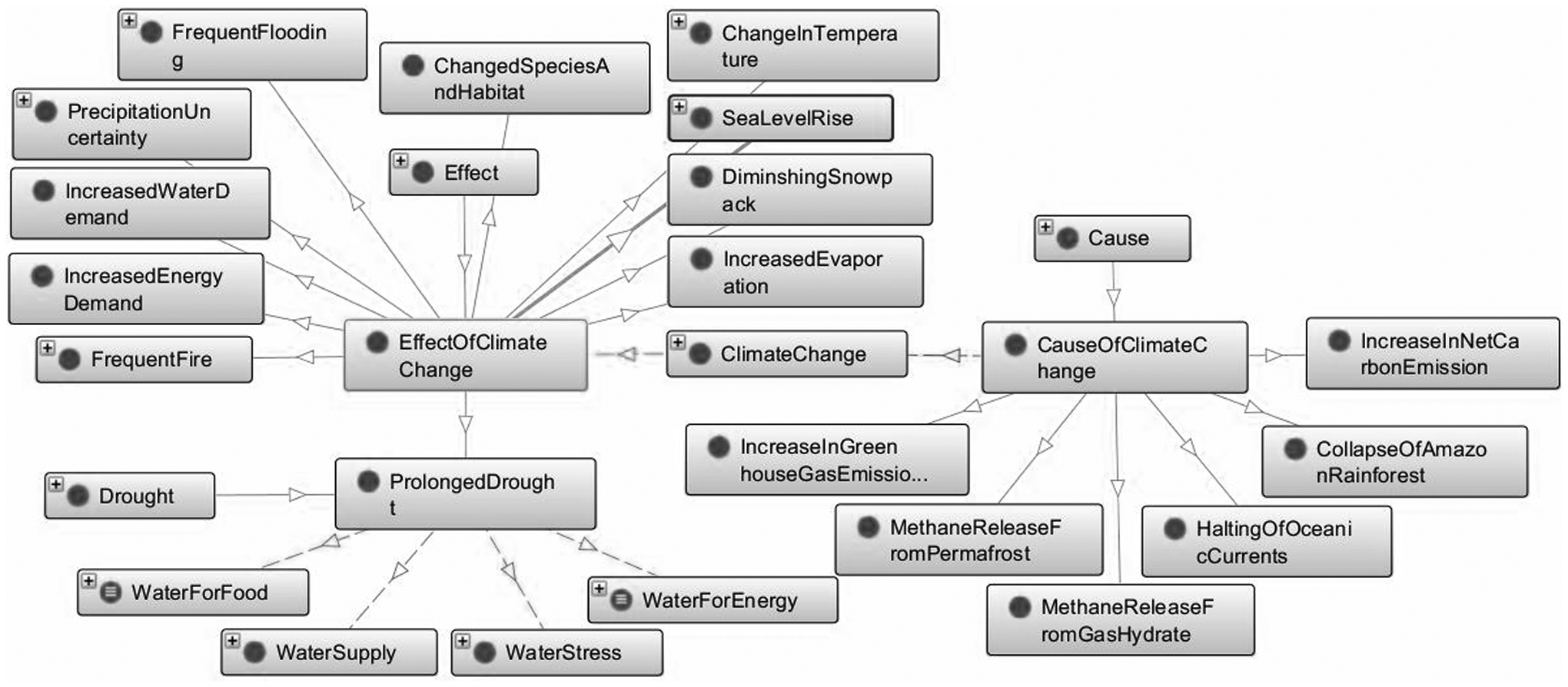
Class hierarchy of the causes and effects of climate change in relation to the FEW systems. The ClimateChange class is modeled in the ontology as a subclass of the ChallengeAdverselyAffectingSustainability, Change, GlobalTrend, MeteorologicalPhenomenon, and Pressure classes (not shown). The ClimateChange is related to its causes and effects through the following SPO triples (dashed line arrows): CauseOfClimateChange causesClimateChange ClimateChange, and ClimateChange hasClimateEffects EffectOfClimateChange. Note: The hasClimateEffects and causesClimateChange properties are the inverse properties of the isTheEffectOfClimateChange and hasCause properties, respectively. Instances of the ProlongedDrought class affect instances of the FEW systems through the following SPO triples: ProlongedDrought reducesSupplyOfWaterFor WaterForEnergy and WaterForFood, ProlongedDrought increasesWaterStress WaterStress, and ProlongedDrought reducesWaterSupply WaterSupply.
In relation to food, the FEWsOnt ontology models the interactions of farming and climate change on the ecosystem. For example, FarmingMethod adverselyImpacts SoilQuality, WaterQuality, and Climate. Monoculture and ExcessiveLogging increaseSoilErosion. SoilErosion and SoilDamage reduceTheCarryingCapacity of soil and reduceFoodProduction as they reduceSoilFertilityDueToTheAbsenceOfLeafLitter. Polyculture, on the other hand, reducesSoilErosion, and PerennialCrop protectsSoilFromErosion by water and wind. Overgrazing leadsToDesertification that leadsToFamine and PastureDegredation, and makesGrassLessAbundant. FoodProduction leadsToLandAndHabitatConflict and BiofuelGeneration resultsIn LandUseChange, FoodPriceIncrease, and Deforestation. These SPO statements are among many in the FEWsOnt ontology that represent the interactions among the FEW network elements (e.g., Figs. 5 and 6) and help users and stakeholders to learn about the effects of processes on the elements and make more informed decisions dealing with the FEW systems and related resources (e.g., soil and air).
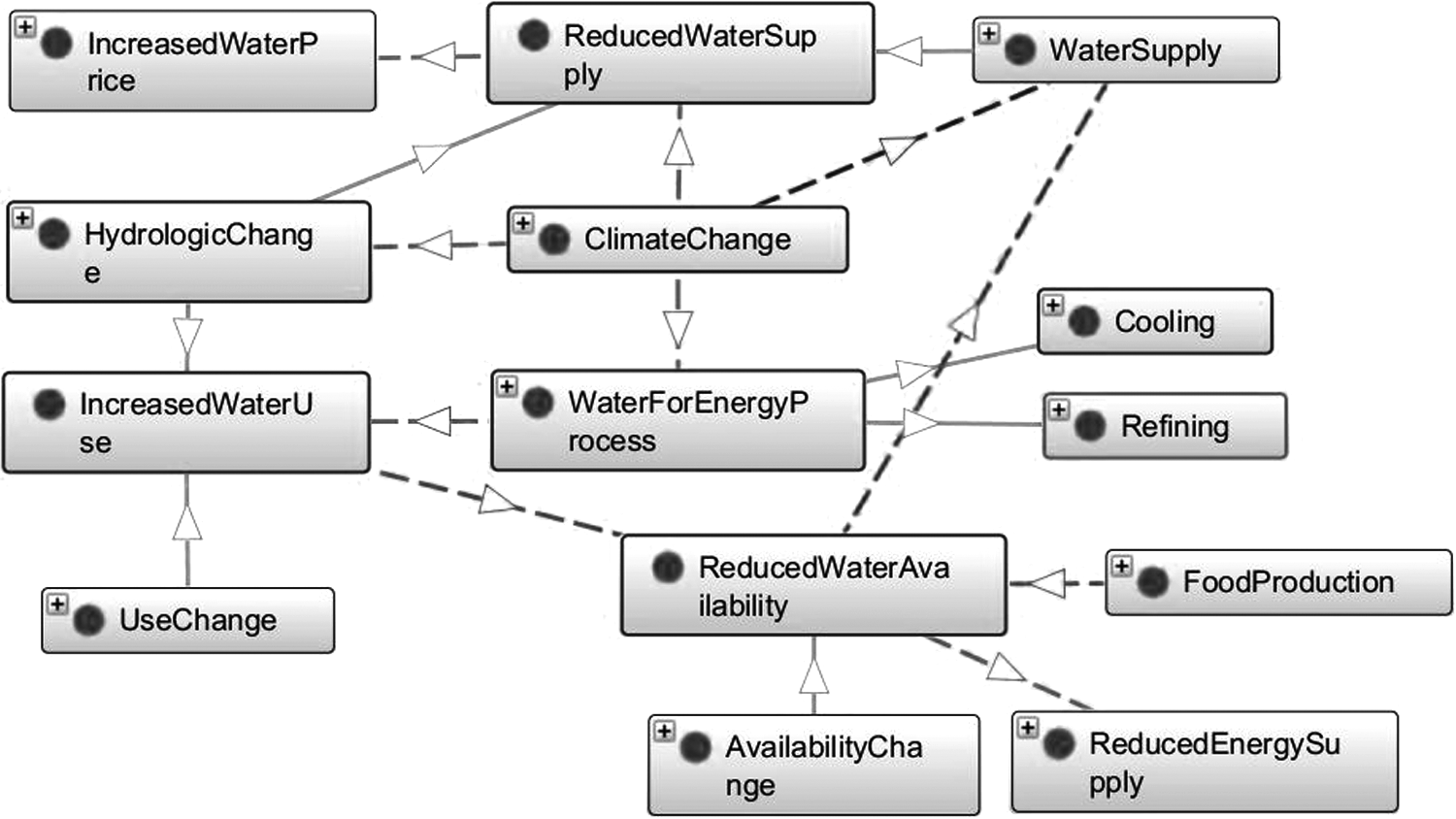
Selected relationships between the WaterForEnergyProcess and FoodProduction and WaterSupply. The solid arrows represent the isAKindOf relations. The dashed lines (properties in SPO statements) between classes (boxes) are as follows: WaterForEnergyProcess usesWaterForEnergy IncreasedWaterUse. IncreasedWaterUse decreasesWaterAvailability ReducedWaterAvailability. ReducedWaterAvailability reducesWaterSupply ReducedWaterSupply. ReducedWaterSupply increasesPriceOfWater IncreasedWaterPrice. ClimateChange adverselyAffectsWater ReducedWaterSupply and WaterSupply. ClimateChange adverselyAffectsWater WaterForEnergyProcess. ClimateChange adverselyAffectsWater HydrologicChange. ReducedWaterAvailability reducesEnergySupply ReducedEnergySupply. FoodProduction decreasesWaterAvailability ReducedWaterAvailability. ReducedWaterAvailability reducesWaterSupply WaterSupply.
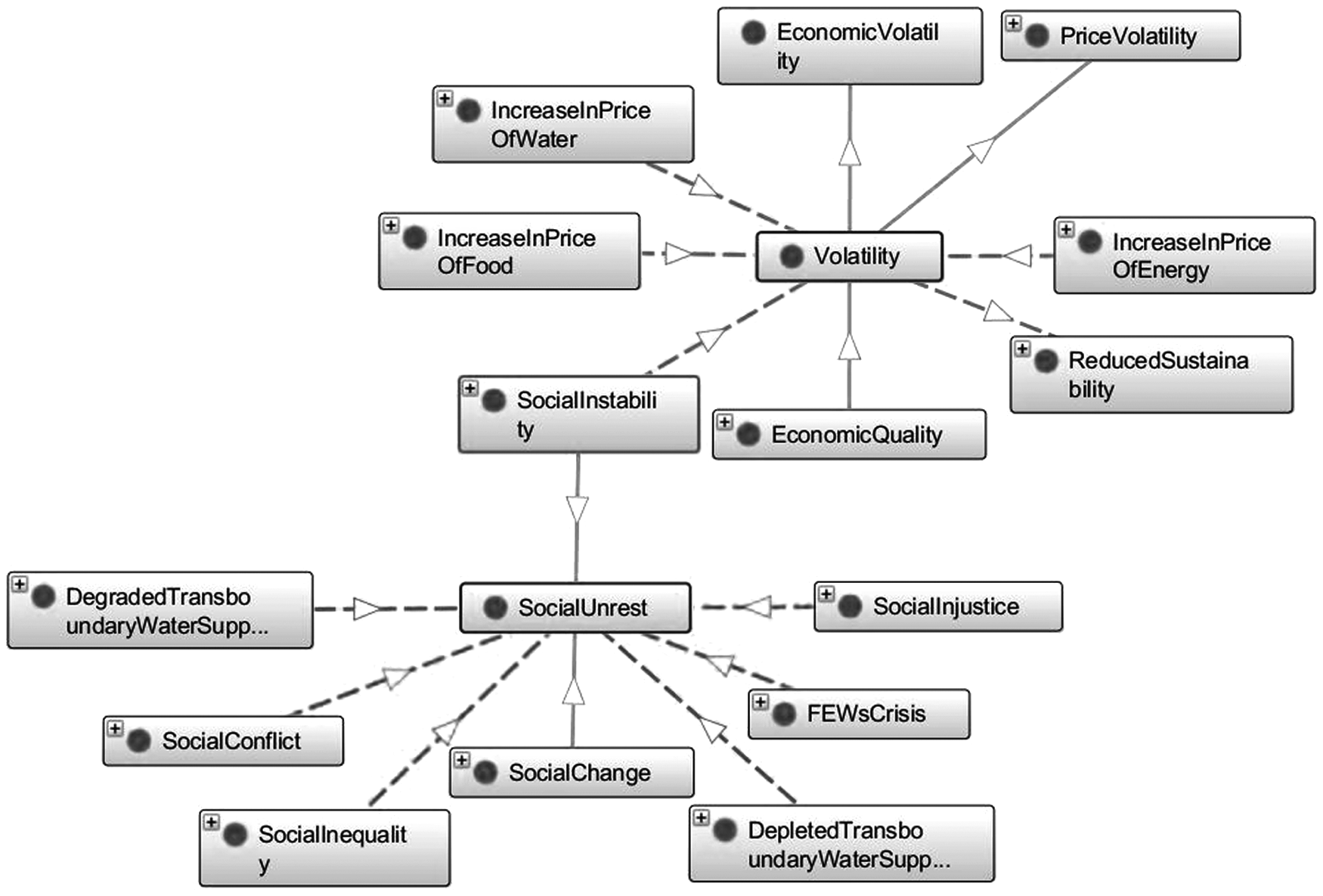
Selected relationships among SocialUnrest and Volatility and other classes. Solid arrows represent the isAKindOf relation. The dashed arrows (properties in SPO statements) are as follows: DegradedTransboundaryWaterSupply hasThePotentialToCause SocialUnrest. SocialConflict leadsToUnrest SocialUnrest. SocialInequality leadsToUnrest SocialUnrest. FEWsCrisis leadsToUnrest SocialUnrest. SocialInjustice leadsToUnrest SocialUnrest. DepletedTransboundaryWaterSupply hasThePotentialToCause Social unrest. SocialUnrest isAKindOf SocialChange SocialUnrest isAKindOf SocialInstability. SocialInstability bringsEconomicVolitility Volatility IncreaseInPriceOfFood bringsEconomicVolitility Volatility. IncreaseInPriceOfWater bringsEconomicVolitility Volatility. IncreaseInPriceOfEnergy bringsEconomicVolitility Volatility Volatility AdverselyAffectsSustainability ReducedSustainability.
Discussion
Simultaneous state changes in various elements of the FEW network and reorganization of their incoming and outgoing links within and across system organizational levels continuously modify the behavior of the whole system. These changes can be discovered and assessed by the users of the FEWsOnt ontology through a reasoner (e.g., Pellet) applying the SPARQL query language (https://www.w3.org/TR/rdf-sparql-query/) in Protégé (Noy, 2004). This would allow a user to recognize pathways that positively or adversely affect sustainability. For example, the following path may increase uncertainty in the system: EnergyGeneration affectsLandAndHabitatConflict by leading to LandConflict that affectsEcosystemProcess that isResponsibleForStructuringOfThe NaturalEcosystem. The tradeoffs at each node of the FEW network can be identified in the ontology and optimized by choosing the positive outgoing and incoming links (object properties) and avoiding those that increase risk in relation to sustainability. This can be done by finding (through queries) whether the links are rdfs:subPropertyOf the top-level positivelyAffectsSustainability or the adverselyAffectsSustainability property.
The following are among the modeled statements with positive effects in FEWsOnt: Ecosystem providesHabitatFor Plant, Animal, and Microorganism. People dependOnServiceFrom EcosystemService. EcosystemService servesPeopleByProviding Energy, Goods, Water, Landscape, HealthyEnvironment, and Food. EcosystemService, like EcosystemGoods, isAnElementOfThe NaturalSystem. Ecosystem providesServicesTo SocialSystem by SupportingService, ReducingGreenhouseGases, RegulatingService, GeneratingRenewableEnergy, ProtectingBiodiversity, ProtectingAgriculturalSoil, StabilizingWaterSupplies, and ProtectingHabitat. HealthyEnvironment providesSecurity. EcosystemService contributesToWastewaterTreatment. A BodyOfWater hasCapacityFor AbsorptionOfWaste such as OrganicWaste. WastewaterOrganicCarbon and WastewaterNutrient rejuvenateEcosystem. TerrestrialEcosystem and AquaticEcosystem purify Water and supply DrinkingWater, WaterForIndustry, WaterForRecreation, and WaterForWildlifeHabitat. GoodWaterQuality isEssentialTo Ecosystem, SocialDevelopment, EconomicDevelopment, and HumanHealth. Positive planned processes include the following: WastewaterManagement helpsToProtect Ecosystem. EfficientUseOfWaterWithinCities and SafeReuseOfWastewaterWithinCities putLessStrainOnSurroundingEcosystem.
Modeled adverse environmental effects on ecosystems include Overpopulation leadsToOverexploitationOf EcosystemService. FossilEnergyUse reducesEcosystemService. DeteriorationOfWetland reducesEcosystem CapacityToPurifyWater. DamageToEcosystem and DisruptionOfCoadaptation reduceTheAbilityOfEcosystemToProvideService. DegredationOfNaturalEnvironment leadsToReducedSupplyOf SafeDrinkingWater. RisingCost hindersAccessToDrinkingWater. AgriculturalRunoffContainingFertilizerHerbicideAndPesticide pollutesEcosystem, SurfaceWater, and Groundwater. FoodProduction leadsToEnvironmentalDeterioration such as the DeteriorationOfWetland, DeteriorationOfNaturalEnvironment, and DeteriorationofWaterQuality. ReducedEcosystemService impacts Biodiversity, FEWResourceSupply, and Habitat. HabitatConflict and LandConflict affectEcosystemProcess and Biodiversity. RapidUrbanGrowth and HumanPopulation increaseDemandForServiceAndMaterial such as FossilEnergyMaterial, FoodMaterial, UrbanService, and EnvironmentalMaterial.
The ontology models network elements with simultaneous positive and negative effects on the environment. For example, the Wastewater class adversely affects sustainability because it containsFaeces and leadsToWaterBorneDiseases. It positively affects sustainability because it containsBiosolid (usedForCooking and usedForHeating), contributesToSecurity (WaterSecurity and FoodSecurity), flowsBackInto Ecosystem, isGoodSourceOf Nutrient and Water, and playsAMajorRoleIn WaterSupply, IndustrialDevelopment, SustainableAgriculture, and EnergyProduction. Farming, a plannedProcessAffectingSustainability producesFood and producesAgriculturalProducts, appliesFarmingMethod that adverselyImpacts Soil, SoilQuality (e.g., SoilComposition, SoilFertility, and ChemicalComposition) and WaterQuality (WaterComposition and Freshness) by using ChemicalInput (e.g., ChemicalFertilizer, Pesticide, and Herbicide). OrganicFarming, on the other hand, doesNotDependOnChemicalInput and minimizesPollutionToSurroundingEcosystem. SyntheticFertilizer (≡ ChemicalFertilizer) and Pesticide, used in Farming as ChemicalInput, also are modeled to have positive and adverse effects. Although Fertilizer boostsCropYield and providesNutrientsToPlants by adding MineralNutrient such as K, N, P, and Silicate, it also adds these MineralNutrients to SurfaceWater through AgriculturalRunoff, which leads to Pollution by Eutrophication (a FoodToWaterProcess). Eutrophication putsPressureOnWater as it stimulatesBloomsOfAlgaeAndOtherAquaticPlants and increasesPhytoplanktonsInWater that reduceTheAmountOfOxygenInWater. The AgriculturalRunoff also degradesQualityOf WaterResources because it containsPathogens (e.g., Bacteria). Pesticide that controlsAgriculturalPests in a Farm is also toxicToAnimalsAndPlants.
Cooling and Refining (subclasses of WaterForEnergyProcess) may lead to IncreasedWaterUse (subclass of the UseChange) through the useWaterForEnergy property (Fig. 5). FoodProduction may decrease WaterAvailability and reduce EnergyAvailability as there would be less water to produce energy or to cool reactors. The ReducedWaterAvailability is a kind of AvailabilityChange that may reduce WaterSupply that, in turn, may reduce EnergySupply as there would be less water available for hydroelectric energy production. ProlongedDrought also may reduce WaterSupply and lead to ReducedWaterSupply. The ReducedWaterSupply may lead to IncreasedWaterPrice through the increasesPriceForWater property, which due to the water intensity for energy and food is a type of IncreasedFEWPrice, and leads to an increase in the price of energy, water, and food. The IncreasedFEWPrice may lead to ReducedStability through the impactsStability property and affect SocialStability through the impactsStability property. The SocialInstability may lead to Volatility through the bringsEconomicVolatility property (Fig. 6). The IncreasedFEWPrice may also lead to IncreasedFEWRisk through the increasesRisk property. The IncreasedFEWRisk, in turn, may lead to ReducedEconomicGrowth through the dragsOnGrowth property, which, in turn, may lead to FEWChallenge through the leadsToFEWChallenge property. The FEWChallenge relates to FEWCrisis through the causesCrisis property, which may lead to SocialInstability and its SocialUnrest subclass. SocialInstability may lead to Volatility through the bringsEconomicVolatility property. Finally, the Volatility class may lead to the ReducedSustainability through the adverselyAffectsSustainability property.
Inferences from such process, among many coded in FEWsOnt, can help stakeholders and users of the ontology to learn about the consequences of the interactions of the system elements, and make informed decisions for the management of the FEW resources. The ontology will increase the interoperability of data across FEW sectors by providing a knowledge-based unified semantically annotated terminology, which can also be used as a concept map for the analytics of the FEW data applying machine learning (Karpatne et al., in press). To test the ontology, we apply it to build a knowledge base of spatial–temporal data related to various interactions of natural ecosystems (river, lake, and groundwater) and social systems (e.g., city, farm, factory, and fishery) along a large watershed (the Apalachicola–Chattahoochee–Flint [ACF] River Basin) in Georgia and Alabama. Stakeholders in urban, agricultural, and energy sectors can apply our ontology to manage their FEW systems requirements.
Summary
The FEWsOnt ontology explicitly specifies major concepts and interactions among the FEW systems and their relations to social and natural systems, applying a network system approach and semantic web technologies. It defines a formal terminology that annotates the FEW concepts from a complex and adaptive system perspective. The processes that change the state of the system elements are modeled with a scale-invariant view across several systems' organizational levels. The processes and links among system elements are constructed based on their positive or adverse effects on sustainability. This approach will allow users to discover the dynamic interactions among the FEW systems' components through queries and optimize the tradeoffs by choosing the pathways toward sustainability. When completed, the logic- and knowledge-based vocabulary and links in the ontology will be tested and extended by building and using a knowledge base that will store diverse FEW nexus data from a large river basin.
Footnotes
Acknowledgments
The authors thank Dr. Richard A. Milligan at Georgia State University, Atlanta, GA, for his constructive review of the article. We also thank three anonymous reviewers for their constructive review of the article.
Author Disclosure Statement
No competing financial interests exist.