




Abstract
Abstract
The dissimilatory iron reducing bacterium Shewanella oneidensis MR-1 (MR-1) exhibited a strong sodium butyl xanthate (SBX) biodegradation capability in the presence of Cr(VI) under aerobic conditions. In addition, 89.27% of SBX at a concentration of 30 mg/L was degraded within 48 h in the presence of 10 mg/L Cr(VI). Temperature and pH significantly affected SBX biodegradation, and MR-1 exhibited an enhanced biodegradation ability at a pH of 6°C and 30°C. Biodegradation kinetics of SBX in the presence of Cr(VI) and anions (NO3−, SO42−, or CO32−) followed the first-order exponential decay kinetics model. The inhibition effect was different for the different types and concentrations of coexisting anions. NO3− exhibited negligible inhibitory effects on SBX removal, whereas SO42− and CO32− had a potential inhibitory effect on SBX removal. When the coexisting anion concentrations were 10 and 30 mg/L, the order of inhibiting factor (IF) of the anions on SBX removal was
Introduction
Xanthates are the most widely used collector in the flotation beneficiation of base metal (such as copper, nickel, zinc, and iron) sulfides and precious metal ores (Khataee et al., 2018). Wastewater containing xanthate, even at low residual concentrations, is toxic to aquatic fauna and harmful to the nervous system and liver of humans and animals (Liu et al., 2015). The wastewater generated by ore flotation processes has become an environmental challenge (Molina et al., 2013; Yan et al., 2016).
Thus, more research is required on the environmental effect and degradation of xanthate. In recent years, a variety of methods have been developed to remove residual xanthate from flotation wastewaters, such as chemical oxidation (Fu et al., 2015) and adsorption (Rezaei et al., 2018). However, these methods are deficient, and it is difficult to meet the water quality criteria for safe discharge into the environment (Fu et al., 2015). Biodegradation is an inexpensive and environmentally acceptable process for the treatment of flotation wastewater and has attracted more attention.
Minimal studies have evaluated the biodegradation of xanthate. Some studies showed that xanthate could be degraded by microorganisms. Bacillus polymyxa was found to be a potential xanthate degradation strain, and >95% of the initial xanthate (100 mg/L) was degraded after 48 h (Chockalingam et al., 2003). Natarajan and Prakasan (2013) found that xanthate could be effectively degraded by Paenibacillus polymyxa and Pseudomonas putida. Our previous study indicated that activated sludge from wastewater treatment plants could be useful in the biodegradation of butyl xanthate (Chen et al., 2011).
However, all previous studies focusing on the feasibility of xanthate biodegradation did not consider that xanthate contamination is usually accompanied by various heavy metals in flotation wastewater. The biodegradation of organics could be suppressed by heavy metals owing to the toxic metals inhibiting the activity of the degrading bacteria (Lu et al., 2013). Cr(VI) is one of most ubiquitous heavy metals in sulfide mine flotation wastewater. Thus, an investigation on the biodegradation of xanthate in the presence of Cr(VI) is required to understand the characteristics of xanthate removal in flotation wastewater.
Shewanella oneidensis MR-1 (hereafter referred to as MR-1), a group of dissimilatory iron reducing bacteria, is widely distributed in the wastewater (Wu et al., 2013a) and with remarkably diverse respiratory capacities (Hau and Gralnick, 2007). It can utilize oxygen as a terminal electron acceptor for aerobic respiration and undertake anaerobic respiration by reducing alternative terminal electron acceptors (Cai et al., 2012), such as Fe(III), U(VI), Mn(IV), Co(III), Cr(VI), Tc(VII), Au(III), nitrite, trimethylamine N-oxide, and dimethyl sulfoxide (Cai et al., 2012; Ji et al., 2012; Xiao et al., 2012). Thus, MR-1 is capable of degrading recalcitrant organics and reducing heavy metal ions, which is environmentally significant. Therefore, MR-1 is a promising candidate for the biodegradation of xanthate flotation wastewater.
However, most of these studies focused on the biodegradation of refractory organic pollutants by MR-1 under anaerobic conditions (Ji et al., 2012; Mao et al., 2018), whereas studies of aerobic degradation of refractory organic pollutants by MR-1 are minimal. Because MR-1 strain has a rapid generation time under aerobic conditions and is adaptable to dynamic environmental conditions, it is an ideal candidate for degrading xanthate under aerobic conditions (Salas et al., 2010).
Minimal studies have been published on the biodegradation of xanthate in the presence of heavy metals. In this study, the biodegradation of sodium butyl xanthate (SBX) by MR-1 in the presence of Cr(VI) under aerobic conditions was studied. The effects of the initial SBX concentration, pH, temperature, coexisting anions, and degradation kinetics were evaluated. Moreover, the inhibitory effects of different coexisting anions on the biodegradation of SBX were compared.
Materials and Methods
Microorganism and culture conditions
Shewanella oneidensis MR-1 (ATCC 700550) was provided by the Marine Culture Collection of China. The strain was cultured aerobically in a Luria-Bertani (LB) broth medium for aerobic cultivation at 30°C until the stationary growth phase. Cells were harvested by centrifugation (8000 × g, 10 min), washed thrice with 4-(2-hydroxy-ethyl)-1-piperazineethanesulfonic acid (HEPES) buffer (30 mM, pH 7.0), and resuspended in the sterilized HEPES buffer. Subsequently, the cells were inoculated into Erlenmeyer flasks and formed at an appropriate optical density using ultraviolet (UV) spectrophotometers at a wavelength of 600 nm (Lee et al., 2018).
SBX biodegradation studies were performed in a basal medium containing 2.5 g/L NaHCO3, 0.1 g/L KCl, 0.25 g/L NH4Cl, 0.1 g/L NaCl, 0.04 g/L KH2PO4, 0.2 g/L MgCl2·6H2O, and 1.0 g/L yeast extract. In addition, the medium was buffered with 30 mM HEPES, and the pH was adjusted to 7.0 before autoclaving.
Biodegradation of SBX by MR-1 in presence of Cr(VI)
All biodegradation experiments were carried out in a batch by shaking a 250 mL Erlenmeyer flask containing 150-mL basal medium with 30 mg/L SBX, (1–15) mg/L Cr(VI), and cells at a concentration of 0D600 of 0.3. The Erlenmeyer flask was incubated in a temperature-controlled cabinet at 130 rpm for the duration of the test. Control experiments with autoclave-killed cells were also evaluated. Subsequently, samples from the individual flasks were collected at given time intervals and centrifuged (10,000 × g, 10 min) to measure the residual concentration of SBX. All treatments and control experiments were performed in triplicate.
Various factors affecting the SBX biodegradation, such as the initial SBX concentration, pH, temperature, and coexisting anions, were examined. First, the biodegradation was investigated at the initial SBX concentrations of 10, 20, 30, and 40 mg/L, and 30 mg/L was used in the following experiments. Various pH values, including 5, 6, 7, 8, and 9, and six temperatures, including 15°C, 20°C, 25°C, 30°C, 35°C, and 40°C, were examined. The effect of coexisting anions was evaluated by adding different concentrations (10, 30, 60, and 100 mg/L) of NO3−, SO42−, and CO32− to the background solutions.
Analytical methods
A pH meter (Leici, Shanghai, China) was used for the pH measurement. The SBX concentration was analyzed at 300 nm using an UV visible spectrophotometer (Shimadzu, Japan).
Kinetic analyses
First-order exponential decay equations were used to compare the biodegradation effect of SBX by MR-1 in the presence of Cr(VI) at 6–48 h (phase II) according to the following equation.
The parameter A is the decay intensity constant, and
To quantitatively compare the inhibitory effect of the anions on the biodegradation of SBX by MR-1 in the presence of Cr(VI), the inhibiting factor (IF) was defined as follows.
When IF > 0, an inhibiting effect is present. When IF = 0, there is no inhibiting effect.
Results and Discussion
Biodegradation of SBX in presence of Cr(VI)
After 48 h of incubation, the SBX concentration decreased by 4.7% in the abiotic control with the autoclave-killed cells, indicating an insignificant loss of SBX originating from the abiotic processes (data not shown). Figure 1 shows that MR-1 was able to use SBX as a carbon and energy source that could degrade SBX in the absence and presence of Cr(VI). There was no inhibitory effect on SBX removal in the presence of 1 mg/L of Cr(VI), whereas SBX removal was slightly inhibited at high concentrations of Cr(VI) (3–15 mg/L). The SBX degradation efficiencies were 80.51%, 78.43%, and 74.54% after 24 h in the presence of 3, 10, and 15 mg/L of Cr(VI), respectively, compared with 90.34% in the absence of Cr(VI). These results indicated that the MR-1 strain exhibited a higher level of resistance against Cr(VI) toxicity. Different bacteria have different sensitivities on Cr(VI) concentrations. Wang et al. (2017) found that Cr(VI) inhibited the degradation activity of LV-1 at all considered concentrations. However, toxic Cr(VI) could also promote biodegradation at specific concentration level. It was observed that the degradation efficiency of BDE-47 was accelerated at low concentrations of Cr(VI) (≤5 mg/L), which is opposite to the effects of the bacteria mentioned above (Tang et al., 2016).

Biodegradation of SBX in presence of different concentrations of Cr(VI). SBX, sodium butyl xanthate.
At the end of this experiment, the cumulative biodegradation efficiencies were 96.64%, 94.91%, 89.84%, 89.27%, and 87.20% at 0, 1, 3, 10, and 15 mg/L of Cr(VI), respectively. The corresponding average removal rates of SBX were 0.604, 0.593, 0.561, 0.558, and 0.545 mg/(L·h), respectively, which were higher compared with a previous report [0.128 mg/(L·h)] (Chen et al., 2011). Thus, the MR-1 exhibited the ability to degrade SBX in the absence and presence of Cr(VI).
The degradation curves contained a short lag phase during the first 6 h (phase I, 0–6 h), descended sharply during 6–24 h, and then stabilized (phase II, 6–48 h). The presence of a short lag phase indicated that MR-1 adjusted to the toxicity of Cr(VI) through metabolic adaptation before the SBX-degrading metabolism started. The MR-1 strain showed an excellent Cr(VI) resistance capability.
Effect of initial SBX concentration on biodegradation in presence of Cr(VI)
The effect of the initial SBX concentration on biodegradation in the presence of Cr(VI) is shown in Fig. 2. The biodegradation efficiency decreased gradually with an increase in the initial SBX concentration. SBX was completely degraded after 30 h with an initial SBX concentration of 10 mg/L, while the biodegradation efficiencies after 30 h were 92.30%, 82.47%, and 74.08% with SBX concentrations of 20, 30, and 40 mg/L, respectively. After 48 h of incubation, the SBX concentrations decreased from 10, 20, 30, and 40 mg/L to 0, 1.04, 3.22, and 7.99 mg/L, respectively, with the corresponding biodegradation efficiencies of 100%, 94.80%, 89.27%, and 80.03%, respectively. However, the average removal rate of SBX increased from 0.208 to 0.667 mg/(L·h) with an increasing initial concentration from 10 to 40 mg/L. These results indicated that MR-1 exhibited a strong SBX degradation capability at different initial concentrations in the presence of 10 mg/L Cr(VI). Considering that the xanthate concentration in the flotation tailings was ∼10 mg/L (Rezaei et al., 2018), MR-1 could be used for actual flotation wastewater treatment.
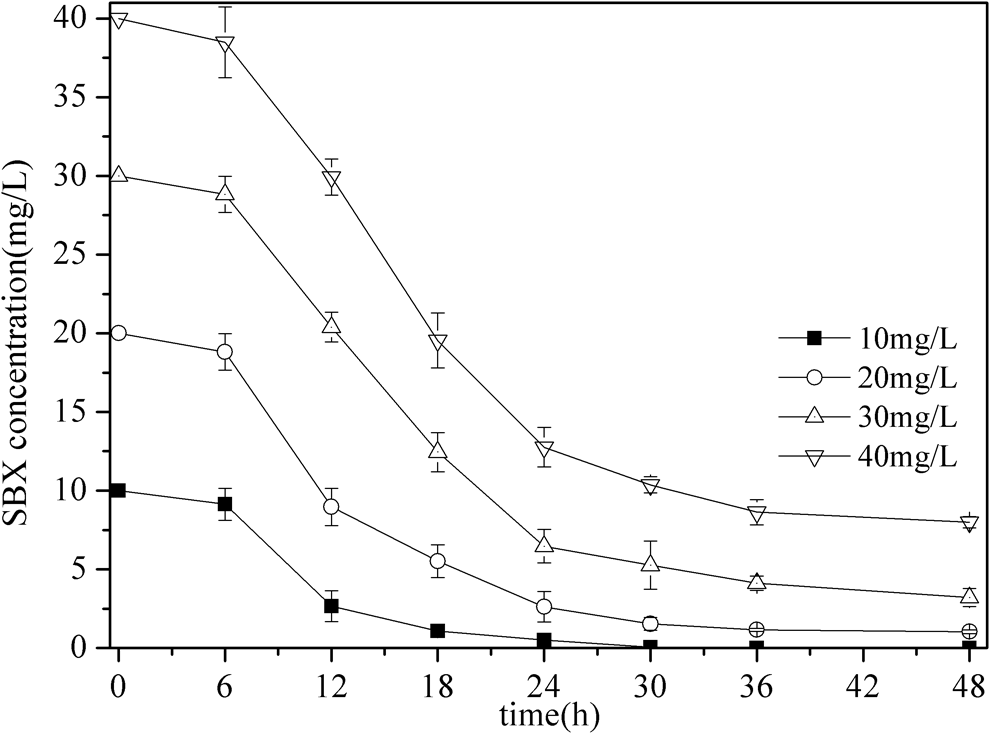
Effect of the initial SBX concentration on biodegradation of SBX in the presence of 10 mg/L Cr(VI).
Effects of pH and temperature on biodegradation of SBX in presence of Cr(VI)
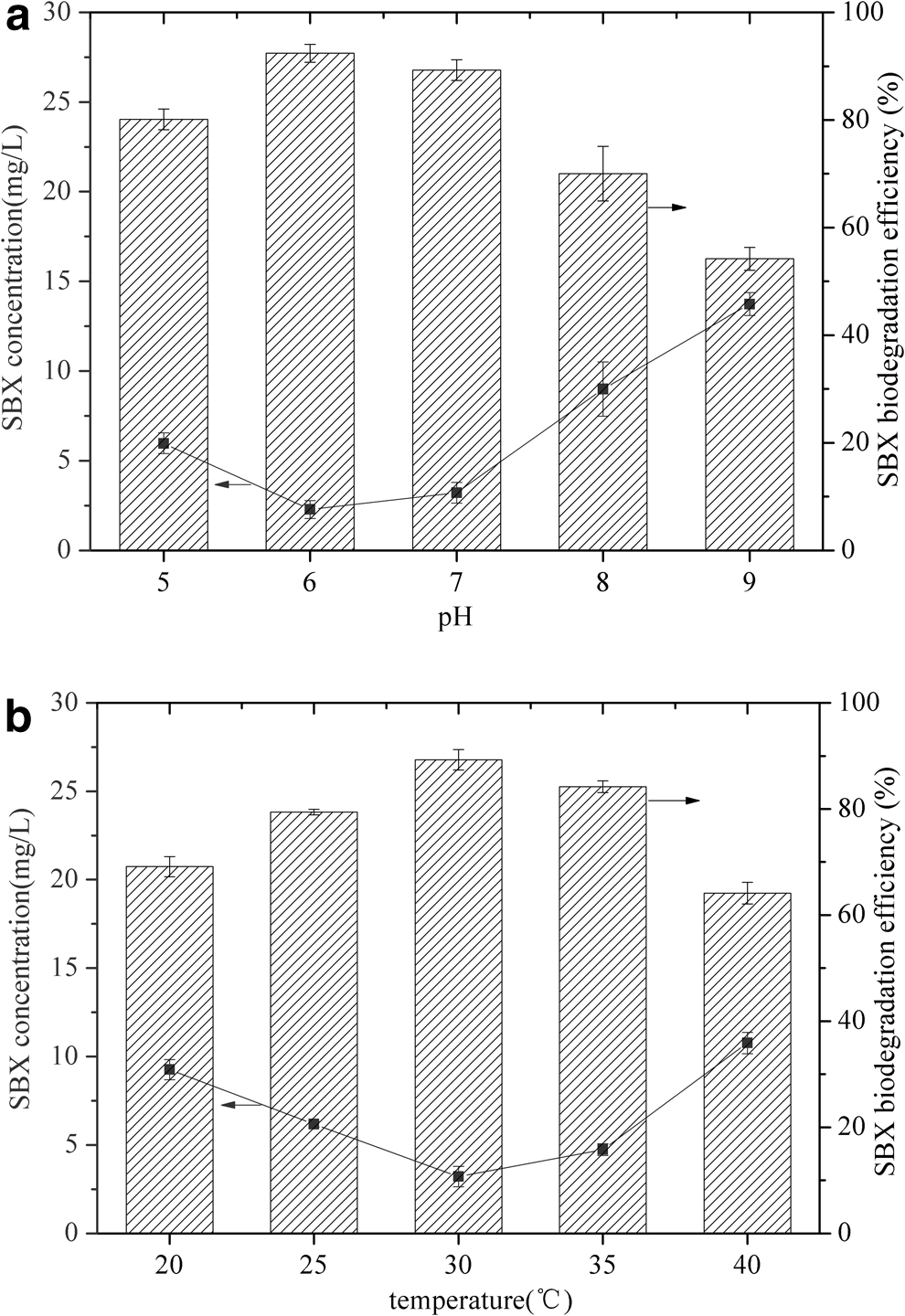
As shown in Fig. 3a, MR-1 exhibited a higher SBX biodegradation efficiency under mildly acidic and neutral conditions. The SBX biodegradation ability by MR-1 contained the following ranking: pH 6 > pH 7 > pH 5 > pH 8 > pH 9, and the biodegradation efficiency increased rapidly from 80.11% to 92.40% when the initial pH increased from 5 to 6. When the pH exceeded 6, the biodegradation efficiency decreased slowly, indicating that the optimal pH for MR-1 to degrade SBX was 6.0. In addition, the biodegradation efficiency could be maintained at 89.27% and 70.01% when the initial pH increased to 7 and 8, respectively. The SBX biodegradation efficiency was >54.20% at all initial pH values, indicating that MR-1 had a broad pH value range for degrading SBX. Figure 3b shows that the SBX removal was significantly influenced by the temperature. The maximum biodegradation efficiency was obtained at 30°C. In this experiment, the biodegradation efficiency was decreased to 69.14% at 20°C and 89.27% at 30°C. This might be because enzyme activity can be affected by temperature; the growth and metabolism activity were inhibited by too high or too low temperature (Xiao et al., 2012). In addition, the biodegradation efficiency decreased when the temperature was >30°C. The SBX biodegradation efficiency was 64.12% at 40°C, 84.21% at 35°C, and 89.27% at 30°C. Similar findings were also obtained by Wu et al. (2013b), where the optimal temperature for MR-1 to degrade sulfonated triphenylmethane dye aniline blue was 30°C.
Effect of coexisting anions on biodegradation of SBX in presence of Cr(VI)
Anions, such as NO3−, SO42−, and CO32−, are ubiquitous in flotation wastewater; therefore, it is necessary to study the effect of NO3−, SO42−, and CO32− on SBX biodegradation. The effects of coexisting anions on the biodegradation of SBX are shown in Fig. 4. The addition of NO3− exhibited negligible inhibitory effects on SBX removal at all considered concentrations. The biodegradation efficiencies after 48 h were 85.75%, 81.20%, 79.28%, and 78.44% in the presence of 10, 30, 60, and 100 mg/L of NO3−, respectively, in contrast to 89.27% in the absence of NO3−. While SO42− and CO32− had a potential inhibitory effect on SBX removal, the effect of the CO32− concentration on SBX removal was different compared with SO42−. The SBX removal efficiency decreased with an increasing SO42− concentration. The SBX removal efficiency decreased to 71.5%, 68.10%, 65.20%, and 62.46% after 48 h when the concentration of SO42− increased to 10, 30, 60, and 100 mg/L, respectively. The experiments with a lower concentration of CO32− (10 and 30 mg/L) revealed a similar inhibitory effect on SBX degradation. The SBX biodegradation efficiencies after 48 h were 75.22% and 73.21%, respectively. For 60 and 100 mg/L CO32−, a similar inhibition effect was also observed, and the SBX biodegradation efficiencies after 48 h were 65.57% and 64.24%, respectively.

To quantify the difference in the biodegradation rates, the degradation curves (phase II, 6–48 h) were fit into a first-order exponential decay kinetics model (Table 1). As listed in Table 1, the first-order exponential decay kinetics accurately described the biodegradation effect of SBX by MR-1 in the presence of Cr(VI) and coexisting anions. The inhibitory effect of NO3− at all concentrations was insignificant, and the IF values were 0.042, 0.059, 0.063, and 0.092 in the presence of 10, 30, 60, and 100 mg/L of NO3−, respectively. However, the IF of SO42− and CO32− increased with the increasing concentrations. When the SO42− and CO32− concentrations were greater than 100 mg/L, the IF values were 0.307 and 0.314 compared to 0.180 and 0.136 at 10 mg/L, respectively. When the coexisting anion concentrations were 10 and 30 mg/L, the order of IF of the anions on SBX removal was
Summary of First-Order Exponential Decay Intensity Constants of Sodium Butyl Xanthate Biodegradation by MR-1
IF, inhibiting factor.
Conclusions
Results of this study indicated that SBX could be effectively degraded by MR-1 in the presence of Cr(VI) under aerobic conditions. This is the first report using MR-1 for SBX degradation. The influences of the initial SBX concentration, pH, temperature, and coexisting anions on the degradation of SBX were investigated. The biodegradation kinetics of SBX in the presence of Cr(VI) and anions (NO3−, SO42−, or CO32−) followed the first-order exponential decay kinetics model. The inhibitory effects of different coexisting anions on the biodegradation of SBX were compared. When the coexisting anion concentrations were 10 and 30 mg/L, the order of IF of the anions on SBX removal was
Footnotes
Acknowledgments
This work was supported by the National Natural Science Foundation of China (Grant No. 51708561), Fundamental Research Funds for the Central Universities, and South-Central University for Nationalities (Grant Nos. CZY19035 and CZP17097).
Author Disclosure Statement
All the authors have no conflict of interest.